This week's guest blogger is another gaming mom from America's heartland. She has been one of the premier female voices on Boardgamegeek for some time now.
Denise Patterson-Monroe's, aka Denise on BGG, comments are always worth the read. She was an easy choice for me to extend an invitation to write an article for Gone Gaming. Denise is perhaps best known for her article on writing a good game review. Those of you who have ever written a game review on Boardgamegeek may have noticed "Click here for help on writing game reviews" on the review page. Clicking will bring up Denise's timeless advice on writing a game review. I consider the fact that I wrote the first comment on that particular article to be one of my brushes-with-greatness. Of course I have no life.
BTW, I still haven't figured out how to roll the dice so they stay on the table, or to otherwise not cause a calamity with the game pieces, so if you don't want your kids to turn out like me take notes while you read this.
Coldfoot
Survey the boardgamers you know and I bet all of them played boardgames as children. Survey all the non-gamers you know and, well, not so much, you'll find a lot more people who never played as kids. (And the people who DID play games as a kid but don't anymore are often good candidates to lure back into the fold with Ticket to Ride, but that's another topic altogether.)
But the kids! If you are interested in keeping boardgaming going for the next generation and not just relegating Settlers to being an obscure fad of the '90s, the kids are where you have to go. Drag 'em away from the X-Box and show them there is A Better Way.
Sounds easy enough - if you are a parent. And I expect most of the non-parents have skipped to the next blog by now anyway. But hang in there, non-parents! Some of you may yet become parents, and others may have nieces or nephews, some of you may be (or know) teachers, Sunday school teachers - even for non-parents, there are lot of ways we can reach out to the Youth of Today. Dare to be the fun grownup at the next inter-generational gathering you attend!!
Now there are lots of articles that list good games to play with kids. That's not where I'm going with this. Kid games come and go, as do regular Euros, so anything I list could be out of print next year. This is a strategy article. I'll list some specific examples, sure, but only for illustration - you can apply these basic principles to a great number of games.
Where to begin? Depends on the age of the child. Once they are seven or eight or so, you really have no problems. Pull out your standard gateway games, get 'em into Carcassonne and you can go from there pretty easily. But honestly, an eight year old who has never played games, or only played roll and move games, may not 'get it'. Hopefully they will, but ideally you want to lay the foundation at an earlier age.
That's right, start 'em young! As soon as they are old enough to not eat the pieces is the right age. For the youngest, look for games that are extremely simple. In fact, don't think of gaming with this age as gaming at all - think of it as introducing basic game mechanics. I've played Snail's Pace Race with kids as young as two (watch them closely to make sure they don't eat the dice!). Keep in mind toddlers have to be taught EVERYTHING, including how to shake and roll the dice, and how to move the pieces one space at a time. This is actually a good opportunity - we've all played with people who can't roll dice without rolling at least one of them off the table, teach them how to roll properly at age two or three and it won't be an issue later.
A couple other things to look for in the very first game you introduce to a very young child. Colorful, high quality bits are good. Not only are they more attractive for the little 'un, (always keeping in mind you don't want the kid to eat the pieces!), but you'll be competing with the video games sooner than you think. Length of game is important too - no more than fifteen minutes for the youngest set when you are first introducing game, and even shorter is better. Candyland is a HORRIBLE game in this regard, goes on WAY too long for what it is.
Non-competitive or less competitive games are good too - yes, we need to teach the budding gamer to be a good sport, but that can come after you show them how FUN games are. Remember, at this age you aren't really teaching them to game, you are teaching them pre-gaming skills. Sportsmanship isn't going to happen at age three. You can (and MUST) demonstrate it yourself, but don't expect it of them yet. If you start demonstrating sportsmanship to a very young child, you are giving them a model that they can draw on later when they are a little more mature. They will need MANY reminders and kindly reinforcements for several years yet - you must be very patient. Don't tolerate outrageous behavior, no tantrums allowed, but you can still be kind about it.
For a slightly older child of four, five, or six, start considering outside factors. Unless you know the child is a precocious reader, all games should have no reading, maybe a few symbols to remember. Although an interested child can rise above this - my daughter at age 4 memorized all the spaces on Monopoly Jr because she loved the game SO much. But when you are first starting, don't assume they will be that interested - if it happens, great, but don't bank on it.
Consider who the child is most likely to get to play with. If you give a game like Coloretto that requires three players to the only child of a single parent, you are setting that child up for a poor experience, as they may never even get to play the game before they forget about it. If the child has multiple siblings that might be enticed to play, look for games that support more players than something from the Kosmos 2-player line. A shy child should get a game that plays well with two so they can be comfortable with the social interaction, and a social butterfly should get a game that allows them to invite all the friends along.
Theme is important to this age group. Unfortunately. There are a lot of crappy games that are marketed to kids this age based on being tied-in with some popular show or movie or character. There are some good themed games too, of course, but mostly they are not so much. At this age, the adult picking the game needs to be responsible for getting past this potential pitfall. Look for good games that are related to things the kid likes without being an actual tie-in. Don't pick that horrible Quidditch game for the Harry Potter fan, get them Frog Juice instead.
If you want to play up the educational value of a game, tell the parents, not the kid. Yes, King's Breakfast uses some multiplication in the scoring, but let's not turn the kid off by making them think they are in school, ok? Tell the parents - they will be impressed, the kid will just be turned off.
Last, and most important, have fun. The BEST way to get a kid excited about a game is have a blast with it. This is the time to pull out your sound effects, tell stories about your meeple, make pyramids with the bits, all that fun stuff. Change the rules if need be - if you insist on getting all hung up on some obscure scoring rule like the farmers in Carcassonne that the kids don't quite get and therefore the kids are just confused at the end, it's not fun. Ditch the farmers and play with the other rules until the kid is ready for it. If the kids are having a good time, then they are much more likely to want to play the next game with you, and then you have them hooked.
Denise
Friday, November 18, 2005


Thursday, November 17, 2005
The Problem with Luck
 I am sick to death of people complaining about luck in their board games.
OK, fine, if you can't stand luck at all, and you spend your life playing Chess in a hermetically sealed bubble, I won't complain. That's your call.
But this article is for the rest of you, who happily draw cards, pick tiles, and maybe even (heaven forbid) roll dice in your favorite games--who do all these things, but then complain about the newest Beowulf, Settlers, or Louis XIV, because it's trendy to do so, and all the cool kids are. I'm sick to death of people complaining about luck in their board games because, simply enough, most people don't understand how randomness actually works and don't understand how moderating luck is an important game skill.
The Truly Lucky Game
Yes, there is such a thing as a truly lucky game. Candyland is one of the most simple and obvious example. You draw a card and you move forward to the appropriately colored space.
What's notable about Candyland, however, isn't the fact that there's a random draw of the cards. Instead it's that there is no option for choice. You can't do a darned thing to make your next draw of the cards more or less useful.
That's a truly lucky game.
Controlling Luck
Let's move on to These Games of Ours, which aren't truly lucky in nearly the same way. I think many people would admit that one of the "luckiest" games around is The Settlers of Catan. Don't roll your numbers and you don't produce goods, period. This is lucky, but probably not as much as most people think.
Part of the feeling of luck in The Settlers of Catan is human psychology. We always remember the unusual, not the usual, so that string of no "8"s for half the game stands out, while the other three games where "8" came up an average amount of time aren't remembered. That's Fortune Telling 101.
However another reason that people feel that Settlers of Catan is luckier than it actually is is that they do a bad job of controlling their luck in the game.
Consider the following situation: you have a wheat production on an "8" and you're given an opportunity to build a second wheat production either on an "8" or a "10". Which do you do? Statistically "8" is a better choice, because you're 5.5% more likely to produce there (13.8% v. 8.3%). However that presumes that an arbitrarily large number of rolls will be made, sufficient that all numbers produce according to their probabilities, and that's just not the case in The Settlers of Catan, particularly not as the game goes on. Instead the "10" can often be a better choice because it insures you against a slightly (but not very) unlikely event where "8" doesn't get rolled enough in a single game.
If you complain about the luck in Settlers, but you greedily grabbed up only the most likely production numbers, even if it meant clustering on the same numbers, then it's your own fault that you did poorly, because you didn't attempt to control the randomness of the game.
Risk v. Reward
Another way to look at how to control luck is by measuring risk vs. reward. This is actually a central basis of many games that people call "lucky". In my Settlers example you took a bigger risk (clustering on fewer production numbers) in the hope of a bigger reward (more production). That's fine. It's a meaningful choice, but step up and admit your own culpability in your loss.
Be a man. (Or woman. Or meeple.)
Beowulf is the game that really got me started on this article, and it has the exact same structure. If you take more risks, you're likely to earn more rewards, but you're also likely to be punished more if you fail at the risk. Figuring out when your level of risk is greater than the potential reward and when your level of reward is greater than the potential risk is the heart of those games, and if you're not able to do that well, 3 games out of 4, that's why you lost, not because Joe or Fred got particularly lucky.
Risk/reward's less probabilistic cousin, which you might be more familiar with, is the cost/benefit analysis.
Consider Age of Steam where you might say, "If I defer a move action to upgrade my locomotive from 4 to 5, instead of doing two 3-value moves, I can instead do one 5-value move. Therefore I have a cost of 1 point, plus the cost of using a better cube, all paying for the benefit of upgrading my locomotive." And then you figure out if the cost or the benefit is greater. If the cost is greater you don't take the considered action, if the benefit is, you do.
You can make a similar analysis in Beowulf where you say "I have a 25% chance of failing this risk, which results in my gaining a second scratch and having to defer a draw of two cards down the line to heal myself, but I have a 50% chance of getting one card from the risk and a 25% chance of getting two." And then you figure out if the risk or reward is greater. In this case I can even thumbnail that caculation: the risk = 25% * 2 cards, or a loss of half a card, while the reward = 25% * 2 cards + 50% * 1 card, of a gain of a full card. I take the risk because it has a sum half-a-card benefit.
If you're doing these types of thumbnail calculations, and when you're familiar enough with a game they'll come naturally, then you're playing a risk/reward game right, and if you're just taking chances as they strike you, that's why you're losing.
Perceiving Luck
The thing that really drives me crazy about complaints about luck in games is that it's all about perception. First off, if someone does well in a "lucky" game, more often than not it's attributed to luck. If someone played brilliantly, but was also a little more lucky than average, we see the luck but not the skill.
More importantly, though, people seem to have major knee-jerk reactions to "luck" in a game if it's easier to see. Take Louis XIV an analytical gamer's game released this year. Everyone and their brother complains and complains about the fact that some points are distributed at the end of the game based upon which shields players (randomly) collected.
The thing is, it's just a few percent swing on the points. A player is very unlikely to get more than 1 or 2 points other than his expected value. And, I've never seen those one or two points actually make a difference in a game. I'm sure if I played enough I would, but I consider that a pretty minor cost to the benefit of the game not breaking down with end-game paralysis and king-making.
What really bugs me is the fact I don't think the shields are even the largest random element in Louis XIV. That would be the mission card draw, where randomly drawing particularly good or bad cards can give you very quick swings of +5 points (or alternatively the loss of the tokens that you need to turn in for those same points).
But because the shield lottery happens at the end of the game, everyone kvetches much more than is warranted, and because the card lottery happens on a turn-by-turn basis, everyone forgets about it.
And before I close out, let me offer an additional note about Louis XIV. As with any good game, there's an opportunity to control your luck, to balance risk versus reward. If you lose a game because you tried to take a medium mission, when you might have been able to complete an easy one, that's your fault, and if you won a game because you against all odds completed a hard mission with a lucky draw, that was a reward for the risk that you took.
Probability as Meta-Game
Perhaps people could deal with luck better if they understood it was a sort of meta-game. Yes, I might win an individual game of Settlers/Louis XIV/Beowulf due to a particularly lucky opportunity, which usually means a long risk that I took. You can similarly sometimes win Poker, Bridge, or almost any classic game due to a risk.
However if you keep taking those long risks, you're going to lose a lot more than you win, and that's the meta-game that you have to keep in mind in any game with any random element in it. Poker makes it easy, because those chips mark how someone is doing, long-term. Similarly Bridge has a clever invention called "points" to mark the same. These Games of Ours are longer, and so we usually can't play multiple rounds of a game to even out the luck, but if it really bugs you, figure out how to do so.
In your secret little game notebook you can keep track of how often you beat Crazy Harvey, and then that one time his long risk comes through will be more obviously the fluke that it actually is.
Understanding Luck
I suspect that a lot of players would be a lot happier with the luck in games if they understood the odds. I mean, you don't hear a lot of whining about how you can win a hand of Poker if you happen to draw a Royal Flush, because the average player understands that a Royal Flush is pretty unlikely, and that the idiot player drawing for the same will lose the other 649,739 times.
So, before you condemn the "luck" in a game, try to at least understand it, and to help with that I offer two simple thumbnails for probability calculation.
First, the odds of an event occurring are the numbers of ways it can occur divided by the total number of possible events. So, take Memoir '44 as an example, where you attack with a die with 6 faces: infantry, infantry, tank, grenade, star, retreat. The odds of hitting an infantry with a die are thus 3/6 (infantry, infantry, grenade), the odds of hitting a tank with a die are thus 2/6 (tank, grenade), and the odds of hitting an artillery with a die are thus 1/6 (grenade)--50%, 33%, and 16%.
Second, the expected value (E.V.) of something occurring is the probability of it occurring, times the number of times you take that chance. So, if you're throwing two dice at infantry in Memoir'44, your expected value of kills = 2 * 50%, or 1. If you hit 0 or 2 times, that was slightly unlikely. I'm amazed how often someone has the expected value for something happen in a game, then curses their luck. ("How could I only get one infantry!?")
Finally, with these two simple statistical ideas, you can even start making some good strategic plans. Take Memoir '44 again. By looking at the expected value of a single die roll and the number of hits required to destroy a unit, we can then quickly calculate how many dice we want to throw to have an average chance of destroying a unit:
| Unit | Size | Hit E.V. per Die | Avg. Dice Needed |
| Infantry | 4 | 50% | 8 |
| Armor | 3 | 33% | 9 |
| Artillery | 2 | 16% | 12 |
Wednesday, November 16, 2005
A Christmas Carol for Gamers

It’s almost Thanksgiving here in America, which marks the beginning of Christmas carol season in my house. From Thanksgiving to New Year’s, I’m allowed to play Christmas music to my heart’s content, then back on the shelf they go. So in keeping with the season, I’ve come up with a gamer’s version of The Christmas Song (Chestnuts Roasting on an Open Fire).
M’nop’ly roasting on an open fire,
Choices nipping at your mind,
Many friends and comfortable attire.
Here’s Christmas of a gamer’s kind.
Everybody knows some meeples and some wooden bits
Help to make the season bright.
Grown up tots with their eyes all aglow
Will find it hard to sleep tonight.
They know that Santa’s on his way,
He’s loaded lots of card- and board games on his sleigh.
And every Euro-geek is gonna smile
Because he has enough games now for awhile.
And so I’m offering you this simple phrase
To gamers from 1 to 92.
Although it’s been said in many languages and ways:
Happy Gaming to you.
- - - - - - -
Since I’m thinking about Christmas music, I’d like to recommend the Trans-Siberian Orchestra to anyone who hasn’t already discovered this amazing group. Each album tells a story through the songs which are a mixture of traditional and original compositions with some wonderful arrangements. My favorite is Christmas Eve and Other Stories which tells the story of an angel who is sent to Earth by God to bring back “the one thing that best represents everything good that has been done in the name of this day.”
~~~~~~~~
Games
I’m in the middle of my second game of Amun-Re online at Spielbyweb. I’ve never played before and I’m completely smitten with this game. (Yes, Kane, I should have listened to you long ago!)
For someone who keeps insisting that she doesn’t like auction/bidding games, I keep running into games that have something unique in them that makes the auction/bidding not only acceptable but fun. Now I have to modify my statement to read “I don’t like once-around bidding games.” Unless I’m the last to bid, I find I’m either being outbid or I bid some ridiculous amount just to finally acquire something. I need to work my way up to the point where I have to decide if $X is too much or does Freddie want this enough to bid even more; I can’t determine how much something is worth with any reliability in just one bid.
Amun-Re’s bidding system is very interesting and also allows for some bluff, if you’re willing to take a chance. Besides that, you’re also faced with some information to help you judge the worth of a province to you and to your opponents, so you’re not just taking a blind stab. Now I can ask myself “how much can you afford to bid and still have enough money to build your province into a money-making point-getter?” “Do you have a card that would make a province worth the extra cost to acquire?” “Are your opponents in the same quandary or are they just being belligerent?”
Yes, this game is tough, interesting and fun and I’m very glad I had the chance to try it out online or I most likely would never buy it. Now it’s very high on my want list and I can’t wait to play it face to face.
~~~~~~~~
Until next time, safe sailing on whichever sea you find yourself.
Mary
Tuesday, November 15, 2005
Rules, Rules, Rules
One thing that continually astounds me is the reverence people give to playing a game "by the rules".
Recalling many of the earliest Dragon magazines, I can recall issue after issue of Gary Gygax imploring, and then threatening, his readers about the dangers of changing the rules of D&D. "You will not be playing real D&D!" he warned. When it wasn't about D&D, it was about going to the "right" convention. "Origins is not Gen-con!" Each month it was something else.
Maybe it's me. I am just not the sort of person who has even been able to comfortably conform to all of society's expectation. I need to hack. I need to know why rules are the way they are and push them to their inconsistent limits. It could be because I grew up Jewish in a non-Jewish world. Or it could be that I like attention. Maybe both.
Despite a strict belief in reasonably acting civilized and trying not to hurt other people, however, I am a very strong individualist. I don't like arbitrary restrictions imposed on my liberties, and I don't like codes of behavior best handled by etiquette and manners being enforced by law. If for no other reason than that law is going to muck it up pretty badly.
When I buy music, I like to play it how I like it, sing it how I like it, harmonize with it, maybe even change the words while I'm singing it. This doesn't mean that I don't want to know what the original is, or that I will wreck the tune if singing with a group. But once I know the tune, it is mine. My thoughts, my singing, mine to do what I want with. Sometimes I can come up with better lyrics or even a slightly better tune than the original singer. That is, of course, my opinion.
The same thing happens when I buy games. A game is mine when I buy it. OK, the copyright holder can enforce a very limited restriction on my ownership: I can't create carbon copies and sell them, or create derivative works and sell those without compensation.
But that's it. Once I know how the game works, I am free to change the rules, make variations for private use, play it how I like it. And I do.
Why does that frighten so many people? I so often read people saying "But if you change X it will change the entire game!" Yeah, so what? Or "That's not how the game designer made it!" Again, yeah, so what?
I can tell you that several mechanics work together in my Menorah game; disrupting them will create some imbalances. Some of these may be negative, and some may be positive. Other mechanics I chose totally arbitrarily. If you change them, it may have little or no impact on the overall game play. Again, so what? Do what you want. Experiment, try it out. Be creative!
The mechanics and rules of our games are a cultural heritage that we must sieze as our own, like the lyrics and music of old folk songs. Take them and change them to your heart's content. Mind copyrights and so forth, but build something new. Don't let games devolve into stagnation just because the designer or publisher made some arbitrary decision.
Rip it. Mix it. Burn it. Just play fair.
Yehuda
Recalling many of the earliest Dragon magazines, I can recall issue after issue of Gary Gygax imploring, and then threatening, his readers about the dangers of changing the rules of D&D. "You will not be playing real D&D!" he warned. When it wasn't about D&D, it was about going to the "right" convention. "Origins is not Gen-con!" Each month it was something else.
Maybe it's me. I am just not the sort of person who has even been able to comfortably conform to all of society's expectation. I need to hack. I need to know why rules are the way they are and push them to their inconsistent limits. It could be because I grew up Jewish in a non-Jewish world. Or it could be that I like attention. Maybe both.
Despite a strict belief in reasonably acting civilized and trying not to hurt other people, however, I am a very strong individualist. I don't like arbitrary restrictions imposed on my liberties, and I don't like codes of behavior best handled by etiquette and manners being enforced by law. If for no other reason than that law is going to muck it up pretty badly.
When I buy music, I like to play it how I like it, sing it how I like it, harmonize with it, maybe even change the words while I'm singing it. This doesn't mean that I don't want to know what the original is, or that I will wreck the tune if singing with a group. But once I know the tune, it is mine. My thoughts, my singing, mine to do what I want with. Sometimes I can come up with better lyrics or even a slightly better tune than the original singer. That is, of course, my opinion.
The same thing happens when I buy games. A game is mine when I buy it. OK, the copyright holder can enforce a very limited restriction on my ownership: I can't create carbon copies and sell them, or create derivative works and sell those without compensation.
But that's it. Once I know how the game works, I am free to change the rules, make variations for private use, play it how I like it. And I do.
Why does that frighten so many people? I so often read people saying "But if you change X it will change the entire game!" Yeah, so what? Or "That's not how the game designer made it!" Again, yeah, so what?
I can tell you that several mechanics work together in my Menorah game; disrupting them will create some imbalances. Some of these may be negative, and some may be positive. Other mechanics I chose totally arbitrarily. If you change them, it may have little or no impact on the overall game play. Again, so what? Do what you want. Experiment, try it out. Be creative!
The mechanics and rules of our games are a cultural heritage that we must sieze as our own, like the lyrics and music of old folk songs. Take them and change them to your heart's content. Mind copyrights and so forth, but build something new. Don't let games devolve into stagnation just because the designer or publisher made some arbitrary decision.
Rip it. Mix it. Burn it. Just play fair.
Yehuda
Sunday, November 13, 2005
MOVIES that could become GAMES!
 After the most recent spate of movies that are or HAVE become 'remade', then this got me to thinking upon certain others that could become GAMEs in and of themselves. Just now, ''the Sand Pebbles'' movie concluded while the very first version of ''Sahara'' is playing out on the AMC channel. Both would be good candidates for some sort of 'RPG' style playings, or maybe even a 'Solitaire' sort of game with enough materials for them. I have to admit that I even liked the 'remake' of ''Sahara'' with 'Jim Belushi' in the main role for it, and I don't wish to spoil this for anyone, but that version has some added 'twists' to distinguish it from the very first film, besides being in FULL 'color'. Another great movie into a GAME theme would be ''Kelly's Heroes'' for many to enjoy and relive or discover, for those who haven't had the pleasure already. Then there's '''the Dirty Dozen'' of which they'd have many more exploits besides just the 'one' that was featured in that. Another along the same lines would be ''the Devil's Brigade'' with a combined Canadian-American force making that one up. I know that ''ole Scrib'' would like to see something done for ''the Wild Ones'' movie and it could become very involved if someone took the time and effort for that. Since it is set in pre-WW I times around the Tex-Mex borders, then there's plenty of 'source' topics that could be covered in a detailed setting for that! Man, watching ''Sahara'' is making ME thirsty, and I can't believe that they're 'spilling' WATER as they take their 'sips' of that! Now these next few movies that I'm going to mention are a bit obscure for many others, so you'll have to bear with me on these. First off, we have ''the Battle of El Alamein'' and this is an 'Italian' production, and with such then it concerns an outfit of 'Italian Paratroops' in that pivotal 'Battle'. I'm not saying that it IS a good or likely 'candidate' for a GAME, since you'd have to see this in order to 'disbelieve' its 'propitousness'. On the flip side of that same DVD is a movie called ''Battle of the Last Panzer'', for which I haven't seen this just yet but from the description of it, then it sounds pretty ''fantastic-farcical'' in its presentation. They mention how an American outfit in FRANCE, having just completed a huge, major 'Battle' are of the mind that the WAR is over! ha! They're NO where near to entering a humbled 'Berlin', so you can see just WHY it sounds so laughable. Anyway, let me delve into some other subjects now.
So, does anyone recall a movie called ''Battle beyond the Stars'' with 'Richard Thomas'?-(of ''the Waltons'' show fame). This also has 'Robert Vaughn', 'George Peppard', 'John Saxon', 'Sybil Danning', and lots of other minor role actors including 'Marta Kristen'-("Judy" from the ''Lost in Space'' TV show!) It is a thinly veiled Space-based version of ''the Seven Samurai'' genre and can get quite 'campy' in its appearances. The 'Space Moose Ship' that ole ''John-boy'' flits about in could even be 'seen' as the very first of its 'kind' that features having its very OWN 'personality' as others have followed suit in the cases of ''LEXX'', or even ''Farscape'' and perhaps a few similiar types as well. Now, it wasn't a 'living ship' as those previously mentioned sorts are ascribed to 'be', so they're NOT exactly the same, but you get the gist. I'm surprised that a GAME wasn't developed upon the basic premise of ''Battle beyond the Stars'' since it'd provide adequate material for conducting such. Maybe even having several 'saviours' being dispatched to off-world places to seek out 'Mercenaries' to bring back and defend their 'system'. I know that many folks, myself included, would really get into a CAMPAIGN 'game' based upon the ''Sid Meier's Alpha-Centauri'' computer GAME, although it would have to be very detailed to cover ALL of the aspects inherent in THAT! I've got some notions of my own upon this matter, but I don't wish to give those away and I'd have to cleverly disguise this to avoid the legal hassles too. For the most part, then I only have enough 'stuff' to create at least ONE version for some games that I have in mind, and obtaining enough additional objects is something that would have to be looked further into for the rest.
Here's some photos of 'Space Ships' that could easily be used in some gaming environments.
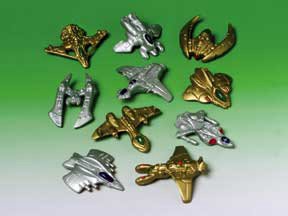

They are currently being made available through a mail-order place called "US Toy Company'', although the 1st set on the LEFT as you see this, are ''out of stock'' for the time being. At the prices that they are going for, then they're an excellent bargain and I've gotten some just like the 1st SET that cost me around $8.50 plus Sales TAX for the same amounts. There's even a couple of 'Ship' designs that I didn't get in my own as that was packaged as ''XXXth Century Starships'' by 'Nexus' products, while I also got 'stands' for mine and they ARE featured in some actual games too. Still, I'd like to get even more of these and at the current prices too, while I'd even 'modify' them further to enhance their 'abilities' in whatever I had planned for those. There are also some flat appearing multi-piece 'Space Ships' but they don't look as good as these do and check them out here if you'd like.

See what I mean? Then again, they could be utilized for other purposes or even 'fleshed out' to avoid being disregarded in some gaming places. There's substances that can be 'glopped' onto these to bulk them out and then look better once every 'thing' had been done for that. I could see some 'Space Stations' or 'Planet Installations' being created from them, although I'd have to have them in hand in order to get the proper 'feel' for such. I already get enough FREE 'stuff' that I intend on utilizing for that anyway, but at least there's these alternatives. Oh yeah, ''ole Scrib'' got some 'Star Troopers' from 'moi', that I found a while back, and maybe he will get some photos of them to display for others to view, or I will if I can get my 'digital camera' to work properly upon this current POS `puter infested with the 'X P'. Those are only in '2' colors for the time being, although I could fairly easily create additional varieties with what I have on hand. I had wanted to create a '3-D' or MINIS version of the ''Marine 2002'' game, or something like that, involving 'Lunar Combat' between the Soviets & the USA forces of which they're BOTH on the Moon-scape surfaces. Also, they could become a VARIANT for the ''Buck Rogers Battle in the 25th Century'' GAME as outside forces to bring into that as well. Well, that'll just have to be something ELSE to look forward to in that ''ConQuest NW Seattle'' event coming up next February, eh?
Saturday, November 12, 2005
How to Eat a Game
Buy one medium-weight game for a family of four, or else figure half an hour per person.
Open box, remove contents. Discard plastic bags.
Soak board in water with a touch of lemon juice.
Put pawns and wooden cubes in a lightly greased pan, sprinkle with coriander, and bake in oven at 400 degrees for one hour.
Heat canola oil in large frying pan. Shuffle cards, cut into 1/2-inch strips. Dip the strips into raw egg and bread crumbs, deep-fry for twenty minutes.
When board is thoroughly soaked, carefully remove paper from board. Scrape all glue into mixing bowl. Discard paper.
Tear up rules. Soak bits in sherry and diced chives and roll into balls.
Assemble cube tower. Tenderize with hammer.
Add the fried cards, rule balls and roast pawns to the mixing bowl and stir. Shave cubes with sharp knife, add to mixture to taste.
Cover mixing bowl with aluminum foil.
Get in car, drive to zoo, strangle kangaroo. Extract juice from pineal gland with a sturdy syringe. Hide evidence of foul play in pouch.
Return home, remove aluminum foil, squirt kangaroo extract liberally onto mixture.
Stuff the mixture into the cube tower with spatula, roll tower in softened board.
Broil for two hours.
When done, garnish with dice and serve with tossed tiles.
Bon appetit!
Open box, remove contents. Discard plastic bags.
Soak board in water with a touch of lemon juice.
Put pawns and wooden cubes in a lightly greased pan, sprinkle with coriander, and bake in oven at 400 degrees for one hour.
Heat canola oil in large frying pan. Shuffle cards, cut into 1/2-inch strips. Dip the strips into raw egg and bread crumbs, deep-fry for twenty minutes.
When board is thoroughly soaked, carefully remove paper from board. Scrape all glue into mixing bowl. Discard paper.
Tear up rules. Soak bits in sherry and diced chives and roll into balls.
Assemble cube tower. Tenderize with hammer.
Add the fried cards, rule balls and roast pawns to the mixing bowl and stir. Shave cubes with sharp knife, add to mixture to taste.
Cover mixing bowl with aluminum foil.
Get in car, drive to zoo, strangle kangaroo. Extract juice from pineal gland with a sturdy syringe. Hide evidence of foul play in pouch.
Return home, remove aluminum foil, squirt kangaroo extract liberally onto mixture.
Stuff the mixture into the cube tower with spatula, roll tower in softened board.
Broil for two hours.
When done, garnish with dice and serve with tossed tiles.
Bon appetit!
Friday, November 11, 2005
Powergrid. View from the rear.
Or How a Humiliating Defeat Can Breathe New Life Into a Stagnant Game
I've played Powergrid several times in the recent past and it never really sparked my imagination. It has been our go-to game when we needed a non-war-like game for 6 players. I think I rated it a 7 on BGG, but I was sorely tempted to rate it as a 6 or even a 5. Choices seemed to be obvious. Power plant auctions seemed to lack tension, because it was difficult to value power plants early in the game and there was a never ending supply late in the game. There were few interesting choices in the commodity market, despite the fact that many fanboys claimed that the commodity market was the heart and soul of the game.
The thing that bothered me most about the game was the tinkering with the turn order from phase to phase within a round. Determining turn order from phase to phase is an important part of Powergrid, if only to keep the leaders in check. I've received grief for this position before, but it is my contention that any game that has fiddley criteria to determine player order from phase to phase within a round for the purpose of keeping the game close is inherently flawed. I'm not going to make that case right now, but let it be known that it is a mechanism that annoys me.
Well, something happened this last weekend that made me re-think my opinion of Powergrid. I got my butt handed to me. The view from last place gave me a new perspective on, and a new appreciation for, the game.
I don't believe I have ever done worse than tie for second place in previous games. Not only did I lose last weekend, I lost by a wide margin. I now appreciate some of the strategy nuances that I had missed in previous games. As a perpetual leader in Powergrid your choices are rather obvious, especially if your opponents aren't playing to screw you.
First, I got blocked out of my easy connections. Then, I miscalculated the cost of connecting a certain city by $10. That mistake didn't so much cost me the game, as it cost me my dignity. May you be so fortunate as to never lose by such a wide margin.
Fiddley turn order did not help me one iota. Although I was trailing by too wide a margin to capitalize, I did see that the commodity market could be more effectively manipulated than I had thought. My opponents in previous games just didn't manipulate the market effectively, nor did my opponents in previous games calculate the value of power plants very well. My opponents in previous games were less interested in blocking access to new cities than they were in protecting their own connections.
Powergrid is now on my must-play-with-cut-throat-players-only list. And off the not-quite-boring-game-to-be-played-only-when-we-need-a-six-player-game list.
I don't know if it will go higher than a 7, I think many of my original concerns are still valid, but losing has renewed my interest in Powergrid. After I get a few games under my belt with aggressive players I'll report back.
As a side note: This is another game I will only be playing with poker chips in the future, instead of the provided play-money.
------------------
Curious story concerning my acquisition of Powergrid:
A year ago my local game store had been unsuccessfully trying to get Powergrid into stock for several months. The owner, who wouldn't pull my leg, told me on a couple occasions that he had talked to his distributor and they assured him the game would be sent. About that time a couple of his shipments were lost by Alaska Airlines, and he never was able to get Powergrid into the store.
One day the owner told me that he appreciated my patience, but I might as well order the game on line. I went on line to order the game and every store but one was sold out. That particular store was in Canada, and would only ship to Alaska via UPS Next Day Air. Forget that. That added another $30 to the price of the game.
I lamented this fact on Boardgamegeek, and who should send me a private message? BGG fixture, and fellow Roads and Boats junkie, Sterling Babcock. He said his local game store had a couple copies in stock and he could help me.
Sterling lives in Longmont, Colorado. That is odd because my only brother also lives in Longmont. Figure the odds. Anyway, I was able to get the address of the store from Sterling and my brother picked up the game for me.
Thanks again to Sterling, and never underestimate the long reach of Boardgamegeek.
Coldfoot
I've played Powergrid several times in the recent past and it never really sparked my imagination. It has been our go-to game when we needed a non-war-like game for 6 players. I think I rated it a 7 on BGG, but I was sorely tempted to rate it as a 6 or even a 5. Choices seemed to be obvious. Power plant auctions seemed to lack tension, because it was difficult to value power plants early in the game and there was a never ending supply late in the game. There were few interesting choices in the commodity market, despite the fact that many fanboys claimed that the commodity market was the heart and soul of the game.
The thing that bothered me most about the game was the tinkering with the turn order from phase to phase within a round. Determining turn order from phase to phase is an important part of Powergrid, if only to keep the leaders in check. I've received grief for this position before, but it is my contention that any game that has fiddley criteria to determine player order from phase to phase within a round for the purpose of keeping the game close is inherently flawed. I'm not going to make that case right now, but let it be known that it is a mechanism that annoys me.
Well, something happened this last weekend that made me re-think my opinion of Powergrid. I got my butt handed to me. The view from last place gave me a new perspective on, and a new appreciation for, the game.
I don't believe I have ever done worse than tie for second place in previous games. Not only did I lose last weekend, I lost by a wide margin. I now appreciate some of the strategy nuances that I had missed in previous games. As a perpetual leader in Powergrid your choices are rather obvious, especially if your opponents aren't playing to screw you.
First, I got blocked out of my easy connections. Then, I miscalculated the cost of connecting a certain city by $10. That mistake didn't so much cost me the game, as it cost me my dignity. May you be so fortunate as to never lose by such a wide margin.
Fiddley turn order did not help me one iota. Although I was trailing by too wide a margin to capitalize, I did see that the commodity market could be more effectively manipulated than I had thought. My opponents in previous games just didn't manipulate the market effectively, nor did my opponents in previous games calculate the value of power plants very well. My opponents in previous games were less interested in blocking access to new cities than they were in protecting their own connections.
Powergrid is now on my must-play-with-cut-throat-players-only list. And off the not-quite-boring-game-to-be-played-only-when-we-need-a-six-player-game list.
I don't know if it will go higher than a 7, I think many of my original concerns are still valid, but losing has renewed my interest in Powergrid. After I get a few games under my belt with aggressive players I'll report back.
As a side note: This is another game I will only be playing with poker chips in the future, instead of the provided play-money.
------------------
Curious story concerning my acquisition of Powergrid:
A year ago my local game store had been unsuccessfully trying to get Powergrid into stock for several months. The owner, who wouldn't pull my leg, told me on a couple occasions that he had talked to his distributor and they assured him the game would be sent. About that time a couple of his shipments were lost by Alaska Airlines, and he never was able to get Powergrid into the store.
One day the owner told me that he appreciated my patience, but I might as well order the game on line. I went on line to order the game and every store but one was sold out. That particular store was in Canada, and would only ship to Alaska via UPS Next Day Air. Forget that. That added another $30 to the price of the game.
I lamented this fact on Boardgamegeek, and who should send me a private message? BGG fixture, and fellow Roads and Boats junkie, Sterling Babcock. He said his local game store had a couple copies in stock and he could help me.
Sterling lives in Longmont, Colorado. That is odd because my only brother also lives in Longmont. Figure the odds. Anyway, I was able to get the address of the store from Sterling and my brother picked up the game for me.
Thanks again to Sterling, and never underestimate the long reach of Boardgamegeek.
Coldfoot
Thursday, November 10, 2005
Memoir '44, The Seafarers of Catan, and Other Scenarios
 One of the most successful games that I've acquired in the last few years has been Memoir '44. It's not necessarily the most strategic game that I've played in that time period. (Despite my occasional grognardery, I'd probably admit that was Puerto Rico.) Nor is it the most clever game I've played in that time period. (For that I'd currently say Dungeon Twister, though ask me again when the new-game smell has worn off.)
However, Memoir '44 is one of the games that has kept me coming back for more the most, and which I expect to keep doing so for years to come. It's long been obvious that Days of Wonder's business plan is to create true evergreen games that can continue to sell long past the initial drop ship, but for their games to be really evergreen not just for their distributors and retailers, but for their players too, that's a truly cool thing.
Scenarios & The Web
The secret behind Memoir '44's success, for me at least, is their use of scenarios. As of this writing I've played scenarios #1-#10 in the original book, once on each side. I've also played #38-40 in the Eastern Front and #34 in the Terrain Pack. That's a total of 28 different games, and it's never once felt repetitive.
As much as anything this is because Memoir '44 isn't really a game. Instead it's a game construction kit. It just so happens that Days of Wonder included the first 16 games made with that kit in the original release as scenarios #1-16. And they've since released a plethora of additional, official "games" on the web and in their new expansions.
However, Days of Wonder also did a few additional clever but simple things.
First, they numbered all the scenarios, giving players a clear method to step through them. Other than playing a D-Day scenario on D-Day, and jumping around between the various expansions for review purposes, I've played through all the scenarios in order, and thus never had to sit around wondering what should be next.
Second, Days of Wonder provided an online spreadsheet that I could use to keep track of which scenarios I've played and how I did. For me this has been amazingly important, because when I had a long break in M44 playing, I could afterward just glance at my online info and see what was next. If I played M44 a lot more, to the point of repeating scenarios, I could go back and look at my battle reports and get clues as to how to replay the scenario in the future.
On the whole the whole idea of scenarios in M44 appeals to me in many ways:
- The originality of the scenarios constantly appeals to my desire for newness, but without requiring me to go play a new game.
- The numbering of the scenarios appeals to my collector bug, so that having played one I want to play the next in line.
- The historical basis of the scenarios appeals to my sense of story, and encourages me to know more about the real battles which are being described.
Scenarios in Other Games
Of course Memoir '44 isn't the first board game to use scenarios. Its immediate predecessor, Battle Cry, contained 15 Civil War scenarios, but with no expansions, no support (and no scenario numbering), Battle Cry just doesn't have the same staying power as M44. In miniature and war games, scenarios are much more common, and that's no doubt how they crossed over into These Games of Ours with Richard Borg's releases.
You could sort of say that Runebound has instituted their own scenarios by releasing small decks of cards that replace the endgame of the core Runebound game, but having to go out and buy even small supplements isn't quite the same thing, nor is there the same variety. And Ticket to Ride offers a good example of why scenarios can't quite work for many games. There are some cool additional maps out for the initial game, but if you've ever spent the hours necessary to construct such a board (and its associated cards), you'd know that it isn't quite the same plug-and-play experience that Memoir '44 offers.
I think that Klaus Teuber really missed the boat by including scenarios only in his Seafarers of Catan release. The main Settlers just begs for that sort of treatment because of its modular board, but instead almost every game of Settlers ever is played on a plain hexagonal island. (Yes, I'm aware of The Book but its general unavailability to the American public keeps it sufficiently below my RADAR, and really, I don't think it has influenced the way that Settlers is played that much.)
I can imagine an alternate reality where the original Settlers had itself included a book of scenarios, and not just scenarios based on different random setups, but instead a history of the settling of the Catan islands. It would be evocative and fun to play, and you could have a clear through-line across the games. Heck, it could even be cleverly marketed so that the first several scenarios only depend on the main game, but to play the next several you need to pick up Seafarers, then Cities & Knights.
Likewise, I can imagine that many other popular games could be made that much more enjoyable with the inclusion of scenarios. Modular boards like those of Settlers and Memoir '44 make it easiest, but there are even possibilities in games like Mexica (where different initial island setups and possibly different victory conditions could make a lot of difference) and Puerto Rico (where scenarios could vary building availability, resource availability, island size, and who knows what else). I'm sure these differences wouldn't be as major as that found in Memoir '44, but a little bit could go a long way.
Conclusion
I think that Days of Wonder has made some really smart moves with Memoir '44, both with their initial release and their web support. The recently released Eastern Front (which brings the war to a new locale) and Terrain Pack (which is largely a make-your-own-game kit, even moreso than the original game) just show how much expansion possibility there is for the system.
Here's hoping that more publishers will consider the possibilities of dynamic scenarios as a different type of game publication than their more staid & set cousins.
Wednesday, November 09, 2005
Deal 'Em

I love playing cards. One of my earliest memories is playing Rummy with men in my grandmother’s tavern—and sharing my Popsicles with her dog. Kids can get away with things that adults wouldn’t dream of.
Later I learned Euchre (I’m originally from Illinois) and Canasta (double deck with a widow hand). I haven’t played either of these games in a very long time and doubt I’d care to play Euchre now but I’d still be willing to play a no-holds-barred, vicious, teeth-baring game of Canasta.
After I married into the Air Force, I learned to play Pinochle (double deck, no passing). I was never really good at it since I am not a card-counter and am lucky to keep track of either trump OR aces; trying for both causes the blue screen of death in my brain. Sad, I know, but I always enjoyed myself.
As my kids got old enough to play cards, we found Wizard, which is a great trick-taking game that we all enjoyed. The luck in it lessens with each hand because each hand is dealt with 1 more card than the last. The addition of the Wizards and Jesters gives you a touch of control that is more fun than simply playing Oh Hell.
When my son, Chris, was in high school, Richard and I taught him and his friend, Eric, how to play Pinochle. Now what I need to know is how is it that 2 kids with no clue can come up with great hands time after time and beat the snot out of 2 veteran adults? They would bid something outrageous, not really understanding what they were doing, and manage to make the bid each time. It was really quite embarrassing. Still, we all had a good time and that’s what counts, and I’d do it again in a heartbeat.
When I found my way to the Internet, I found very nice free downloadable programs of card games from around the world at Thanos card games. Here I discovered Mizerka, King, Preference and Madrasso, among others. Of these, I taught my daughter and husband to play Mizerka since it’s for 3 players and it’s getting almost impossible for me to find 4 card players these days. This has some elements that were new to us so it stands out as a very good trick-taking game. Nastiness, tough decisions, and “oh, shit” moments included.
Then I found the Board Game Geek and lots of card games, some just variations of older games like the Mystery Rummy series or Corsari, which we like very much. Some are totally new ideas for us like Crazy Chicken (Drive), 6 Nimmt (Category 5) and Coloretto, which have all been hits with us. These are all lighter games that you can play with your children or with non-gamer friends and have a good time. I love Crazy Chicken, although I rarely win, and my husband is partial to Corsari, which he wins only occasionally. Why are we attracted to the very games that we don’t seem to have a knack for? That seems dumb to me but I still can’t fight the feeling.
Some are trick-taking games that I may get to play occasionally because they don’t require 4 players--David & Goliath and Sticheln—and require only basic knowledge of trick-taking games to have fun. Others are trick-taking games that I’ll be very lucky to get to play like Mu, and Victory and Honor because they require a higher degree of trick-taking experience but I’m happy to have them in my collection in the hopes that some day…ah, some day…
There’s also climbing card games where the “trick” keeps going around the table, getting stronger with each player, until everyone passes. The last player that played to the trick, wins it. Again, this was a totally new concept for us and Gang of Four became a favorite even with 3 players and a dummy hand. A couple nights ago we gave Frank’s Zoo an inaugural playing with 6 players and I can see this one getting played when we want something light and fun. It’s not as easy to look at your hand and form a plan until you’ve played enough to know what beats what in this strange hierarchy but that isn’t necessary if you’re looking for something fun.
These are just the games I own; there are many others, each a little different with its own twist on the rules. If you like card games, there’s something here for everyone. And give the dog a lick of your Popsicle; it won’t hurt him.
~~~~~~~~
Games
Ta-Yu
I finally got to try Ta-Yu as a partnership game. I and my son, Chris, teamed up against Richard and Chris’ girlfriend, Jessica. Chris had played before but Jessica was playing for the first time.
This is not a rowdy, quick game at any time; it’s a head-to-head competition and the play was appropriately slow and calculating. We were drawing our tiles ahead of our turn in order to have time to plan our move but there was still plenty of down time whenever the board took an unexpected turn.
Amidst all this silent pondering, we managed to get in a few chuckles and a good laugh or two. At one point I declared that a certain tile looks like boobies in a sports bra—well, it does! So during one of the long, indecisive pauses waiting for Chris to make a move, I asked him if he wanted my boobies. It’s a good thing no one was drinking anything at the time.
In the end, it was a very close game, the final score decided by the last tile played by Jessica who was sitting to my left. After much thinking and weighing of choices, she decided to block our access to a 2-point space but also gave us one connection. This turned out to be a very good move because Chris’s next play would have given us the two-pointer and a single connection. The final score was 40 (5 x 8) to 49 (7 x 7). If Jessica hadn’t blocked Chris, the score would have been 50-49. I consider that a very close game.
~~~~~~~~
Christmas Wish Lists
I see the Christmas Lists are starting at the Geek, and none too soon. As for myself, I don’t put games on my Wish List since I buy so many during the year. I usually find one or two to buy before Christmas, though, to have something new to play with friends and family during the holiday season. This year I’m thinking of either Apples to Apples or Squint—something fun for a bunch of people. My Wish List usually includes music CDs, DVDs, books, my favorite perfume and PS2 games. Yeah, I’m a PS2 junkie as well as a board game addict! “I Love Katamari” is my #1 choice this year, followed closely by the third Sly Cooper. Of course, if anyone insists on buying me a board game, I’ll graciously accept!
~~~~~~~~
Until next time, let your actions be controlled by knowledge.
Mary
Tuesday, November 08, 2005
Con-vinced
BGG.con
Well, now I know what a con is. Why do we go to them? Why do we have them?
Let's start with Derk, Aldie, and company. Why did they do this? It can't have been to enhance their reputation, which already hit its peak after being publicly dissed by Reiner Knizia. It can't have made money for them; just consider the amount of time they must have taken off of work to do this. And they really didn't get much time to play.
Answer: it had to be a labor of love. They could do it - so they did it. I imagine that if things hadn't gone as smoothly as they did then we might not be seeing BGG.con 2. But they did, so unless they lost money on this, we will.
How about the local Dallas people? Couldn't they have sat in their houses and played games? They have a large group anyway. OK, they ended up getting door prizes and so forth, probably worth about $40 or $60 anyway. How about the people flying in from God-knows where who spent a lot more on flight and hotel?
Answer: We wanted to meet people who we have come to know only by email and postings. More than that, we wanted to have conversations with people about games for four days and have noone think that we are weird. For some people, it may also have been to keep up with the latest and greatest in gaming. But it was also a perfect vacation: an opportunity to play for days in a row, which most of us wouldn't get to do otherwise, and to learn many games that we would never have access to without buying first. For me, of course, I also had a business agenda - to introduce my game to as many new people as possible.
What about the vendors? Publicity and goodwill to the people who matter most - the hardcore gamers, who will in turn spread word of the games to many other people.
Is it worth it? Yes. It is fun, and if the people are nice and the con is organized, the time is pure enjoyment.
But this was only my first con. What about the others cons? Are they worth it? What about people (unlike me) who are wallflowers? Do they get into a con? If there are worthwhile cons and not-worthwhile cons, how do you know which is which?
Yehuda
Well, now I know what a con is. Why do we go to them? Why do we have them?
Let's start with Derk, Aldie, and company. Why did they do this? It can't have been to enhance their reputation, which already hit its peak after being publicly dissed by Reiner Knizia. It can't have made money for them; just consider the amount of time they must have taken off of work to do this. And they really didn't get much time to play.
Answer: it had to be a labor of love. They could do it - so they did it. I imagine that if things hadn't gone as smoothly as they did then we might not be seeing BGG.con 2. But they did, so unless they lost money on this, we will.
How about the local Dallas people? Couldn't they have sat in their houses and played games? They have a large group anyway. OK, they ended up getting door prizes and so forth, probably worth about $40 or $60 anyway. How about the people flying in from God-knows where who spent a lot more on flight and hotel?
Answer: We wanted to meet people who we have come to know only by email and postings. More than that, we wanted to have conversations with people about games for four days and have noone think that we are weird. For some people, it may also have been to keep up with the latest and greatest in gaming. But it was also a perfect vacation: an opportunity to play for days in a row, which most of us wouldn't get to do otherwise, and to learn many games that we would never have access to without buying first. For me, of course, I also had a business agenda - to introduce my game to as many new people as possible.
What about the vendors? Publicity and goodwill to the people who matter most - the hardcore gamers, who will in turn spread word of the games to many other people.
Is it worth it? Yes. It is fun, and if the people are nice and the con is organized, the time is pure enjoyment.
But this was only my first con. What about the others cons? Are they worth it? What about people (unlike me) who are wallflowers? Do they get into a con? If there are worthwhile cons and not-worthwhile cons, how do you know which is which?
Yehuda
Sunday, November 06, 2005
Stuck & Deserted without a 'CON' I can Game within
 Yep, for those who missed out on attending the ''BGG Con'' this weekend, then it's just wrapping UP as I write 'this'. Maybe I'll have to 'institute' something akin to that for around here, and it can become well known as the ''Deserted 'CLASSICs'!'' in my circumstances. Then it could have the ''latest & greatest'' of the *blog blog* to set it apart from NOTHING other just like it! We could even have discussions upon just 'what' wasn't being played, or excellent 'round-file`r' games and the like. I could trot out my ''almost lost jams'' for GAMEs that I consider as being mostly 'relevant'...mostly. Well, at least good ole ''Yehuda'' here managed to attend and I even heard that he premiered his own 'Game' there at the ''BGG Con'' as well. You'll be finding out more upon this later on then, and from the ''mouth of the source'' no less. While if anyone else of the 'Group' here has been able to attend, then by all means you'll be finding out of their 'experiences' as well. There are numerous 'leads' that many have been providing for the rest of US to 'live' vicariously through their postings, and I Thank You folks for at least doing that. Maybe we ought to have a ''Left Coast'' version of THIS so's many others can join in on the 'comraderie' that would be most inviting. There would STILL be some folks who are definitely of the ''anti-socialite-weights'' who wouldn't 'care' to participate, for who knows WHY! They've developed some sort of 'fear'(?) of such proportions that it may just take them ''over the deep end''-should they 'attend', and maybe the rest are better off for that. Then there's others that only LIVE for ''GAME Con'n''! I don't consider myself as 'one' of them types, as I soon learned to 'live' without just HAVING to 'be' at each & every single Gaming Event. The former are sort of like them ''Dead-Headz'' people and their obsessions with ''the Grateful Dead''. I happen to personally know of a 'wannabe' kind like that, and they just seem to ''jump on the bandwagon'' of whatever the current 'fad' that they take a fancy to, is handy.
Speaking of "Gaming Cons", for which I will be keeping 'updates' on the ONE that I expect to be a major part of, then I've gone ahead and made a proposal to host & run an ''OGRE-Miniatures'' Event! This is in co-operation with the ''ConQuest NW Seattle'' premiere taking place next 'President's Day' weekend in February. I don't have many 'Official' kinds of these 'minis', but I do have 100s of my OWN creation and mainly it will involve a HUGE ongoing 'Battle' with the Troops & Vehicles from that 'genre'. In addition, then I have many others that I've invented to include 'Naval Vessels' with enough to form a couple of 'Battle Groups' for '2' sides for this. Those were improved upon or fabricated entirely from other game's Ships and even some actual model kits with enhancements to many of them. I've got some others that I need to work upon to get them ''up to snuff'' with the rest, while I shall also be including the 'Air Groups' for plenty of the ''Carriers'' that I wish to ''get into the mix'' with. That'll mean some 'Amphib Assaults' shall need to take place and it'll provide an entry for these upon the gaming playing fields. I'd also like to get in some one-on-one or multiplayer GAMEs as well while I'm there and provide some ''Classics'' for any to partake of to enjoy when they otherwise might not be able to. This could involve the likes of ''Red Storm Rising'' & ''the Hunt for Red October'' with even ''A Line in the Sand'' as possibilities for those who'd like to try their hand on these. Here's a listing on some others that I have in mind to bring along:
''Battle for Germany''~S&T-w/the ''Operation: Veritable''-VARIANT
''Across 5 Aprils''~Victory Games-I'd just like to get some playings of this
''World War I''~S&T-w/'Pre-War' buildup VARIANT
''Oldenburg Grenadiers''-American Revolutionary War Battles- to play them
''Fortress America''~w/'Expansion Pack #1' Rules PLUS the actual 'Minis' of this
''Axis and Allies''~Milton Bradley-w/'1941' VARIANT
''A & A''-Europe~w/'Italian Armed Forces' bringing on a 5th Player
''A & A''-Pacific~w/'Alternate Victory' VARIANT w/perhaps some 'alternatives'
''the Russian Campaign''~w/'Expanded OOBs' courtesy of 'moi'
For the kiddies, then I may even bring along the likes of ''Battle Masters'' with a couple of Expansions for it, as well as a GAME of my own making which uses all sorts of smaller scale figures & vehicles with even some aircraft for those too. I've been amassing these over the years and I had intended upon a MODERN 'Battles' type of encounter with them, since they're mostly of those kinds. There's even some 'Missile' and 'Rocket' launching types that really DO that! For the rest, then we'll have to resort to 'rubber bands' for firings since I'd like to keep them mostly intact despite being heavily involved in mock-'Combats'. It should become quite a memorable time and ''tons of FUNZ for everyone's!'' enjoyment. I hope to see some of YOU there if you can make it then.
Friday, November 04, 2005
Sound Familiar?
First the bad news; Did a quick calculation, I figure there are still $300+ worth of games in my friendly, local, game store (FLGS) that I need to buy.
More bad news; That doesn't count HeroScape expansions. My FLGS doesn't carry HeroScape. I have to get them though my FLWM (friendly, local WalMart) and that's gonna be a another chunk of change.
Now more bad news; Caylus, Tempus, Indonesia, Kreta, Railroad Tycoon, Siena, PUNCT, Reef Encounter, Ys, and the Tigris and Euphrates Card Game have yet to be widely released.
The good news; There is no good news.
My conundrum; If I get a part time job to support my game habit, I won't have time to game. As a compromise I'm trying to get my wife to get a part time job.
Can I pawn a cat? And if so, do I have to prove it's my cat?
If I spend everything, can I get Choam Charity?
I've given it some thought and I've reached two conclusions. First, I need to open my own game store. Not to get games at cost, although that thought did cross my mind, rather to give me an excuse to play games and call it work. Maybe I can turn my addiction into a tax write off. At best, it would be a second full-time job for at least a couple years. At best. That would mean less time for gaming with people I want to game with.
Second, this town can't support a second game store. It can't even support one. The existing game store probably does all right with Magic and 40k miniatures and such, but comic books, anime, geeky nicknack, and baseball cards are the important part of the business. Boardgames are barely a blip on the radar screen.
Doesn't sound too promising. Maybe I could set my game store apart if I had an attached espresso bar, aaaaaand sold auto parts, aaaaaand performed discount surgery.
How about if I called it; "Coldfoot's Games, Escorts, and Napoleon Dynamite Videos"? I would have a lock on the geek market, that's a lead pipe cinch. Although I would probably have to change the name when the next Star Trek movie is released, and that would just be a hassle.
How about "Picard Games"? Now that's an idea. "Picard Games and Seven of Nine Comics". Ooooooh. That just might work.
More bad news; That doesn't count HeroScape expansions. My FLGS doesn't carry HeroScape. I have to get them though my FLWM (friendly, local WalMart) and that's gonna be a another chunk of change.
Now more bad news; Caylus, Tempus, Indonesia, Kreta, Railroad Tycoon, Siena, PUNCT, Reef Encounter, Ys, and the Tigris and Euphrates Card Game have yet to be widely released.
The good news; There is no good news.
My conundrum; If I get a part time job to support my game habit, I won't have time to game. As a compromise I'm trying to get my wife to get a part time job.
Can I pawn a cat? And if so, do I have to prove it's my cat?
If I spend everything, can I get Choam Charity?
I've given it some thought and I've reached two conclusions. First, I need to open my own game store. Not to get games at cost, although that thought did cross my mind, rather to give me an excuse to play games and call it work. Maybe I can turn my addiction into a tax write off. At best, it would be a second full-time job for at least a couple years. At best. That would mean less time for gaming with people I want to game with.
Second, this town can't support a second game store. It can't even support one. The existing game store probably does all right with Magic and 40k miniatures and such, but comic books, anime, geeky nicknack, and baseball cards are the important part of the business. Boardgames are barely a blip on the radar screen.
Doesn't sound too promising. Maybe I could set my game store apart if I had an attached espresso bar, aaaaaand sold auto parts, aaaaaand performed discount surgery.
How about if I called it; "Coldfoot's Games, Escorts, and Napoleon Dynamite Videos"? I would have a lock on the geek market, that's a lead pipe cinch. Although I would probably have to change the name when the next Star Trek movie is released, and that would just be a hassle.
How about "Picard Games"? Now that's an idea. "Picard Games and Seven of Nine Comics". Ooooooh. That just might work.
Thursday, November 03, 2005
Redesigning Empire Builder, Part Two
 Last month I began a discussion of Mayfair's Empire Builder game with the thesis that it's a solid game with a lot of appeal, but that its 25-year old design is rough around the edges, and that there's thus a lot of room for improvement. Unlike my regular column, that one was published on a Monday, so if you haven't read it yet, feel free to go browse Redesigning Empire Builder, Part One. I'll wait.
Last time I concentrated entirely on the graphical design of the game, showing how gameplay could be considerably improved with just some work on the demand cards. This time I want to wander through a few of the other design elements. The point? As much as anything to look at how much game design has improved in the last 25 years, and also to highlight some of the factors that a game designer should probably be watching out for.
As I see it, Empire Builder currently has a lot of room for improvement, with these problems being biggest:
- Long Game Time
- Long Downtimes
- High Calculation Requirement
- Low Player Interaction
And with that, let's get underway ...
Reducing Game Time
To a certain extent, game time is a personal preference. However, I think that a game that can play in an evening is usually a better design than a game that can't, and the Empire Builder games tend to straddle that line. By using fast rules, maintaining a smaller number of players, and pushing I can get an Empire Builder game done in just under 4 hours. Given that my game nights usually start at between 6.30 and 7.15, and adding in a bit of time for early evening socialization, that means an Empire Builder game tends to run until at least 11p. That's a pretty hard sell for a lot of people.
On a more analytical level, I think you can measure a game's appropriate length by its amount of game variability. If a game changes a lot as you play, even better if it has some very distinct phases within the game, then it's OK for it to be longer, while if the gameplay remains largely the same, I think it has to be shorter to prevent boredom. Empire Builder does change a fair bit, as early on it's largely about scrabbling for pennies, through the middle game it's mostly about expanding your network, and in the endgame it's usually about hauling freight. That's a fair amount of differentiation as you play. However, I also do feel that at least the endgame of Empire Builder (the freight hauling) gets too repetitive for the length, and so at least that part is too long.
So, by my personal scale Empire Builder needs to be shortened, and by my analytical measure at least the third phase of the game should. The question is, how do you do so?
Time in Empire Builder is spent in two main actions. First, there's the analysis, as you figure out what to take where and as you count out shortest paths on the board. These analytical issues are also the bases of my complaints about "long downtimes" and "high calculation requirements", and so I'll address them more completely there. (They're also corrected to some extent by the graphic design I offered up in my last article.) Second, there's the raw time spent hauling freight around and increasing your monetary supplies, and it's these areas where I suspect that you could really shave off minutes or even hours.
The Empire Builder rules themselves usually contain a variant for faster trains, which speed up all movement by about 25%. The "9" trains move "12" and the "12" trains move "16". I've used these during my last couple of games, and they speed the game with pretty much no down side. I think that even faster might be better, perhaps "18" and "24" move trains, double the initial rate. However, the more you change from the original values, the more opportunity you have to mess up the gestalt of the game.
You could theoretically throw off your game quite a bit if you get your trains moving faster than you can build track (a max of 20 spaces a turn in clear territory), but you're actually doing sustained building right in front of your train pretty rarely, so going just a little bit over (18/24) probably isn't that big of a deal. Likewise you don't want to cram too many decisions into a turn as that goes straight back into downtime issues, but given the distance between things on the board, even with substantially faster trains, you're still unlikely to make more delivery per turn (and I'm going to talk next about how to reduce that particular downtime issue anyway).
The other fix to speed up Empire Builder is equally obvious. As I said, the one point where the game really feels like it starts to drag is in the endgame, where you've connected up all your required cities, and are just trying to accrue the required $250M. There's a pretty obvious answer to that: reduce the amount of money required. I'd need a lot of playtesting to figure out the correct stop point, but I'd go with $150M as a first stab in the dark. That reduces the final phase of the game by a full 40%, but still keeps the bar high enough that you can really see someone heading toward it (not that there's currently any way to stop people).
Reducing Downtime
Closely tied to game length is the problem of downtime. It can take a long time between your turns. This is largely due to two factors: the first is the problem of getting a new demand card, and then needing to lookup all those new supply and destination cities, and figuring out what your new plans should be. The second is the fact that drawing new rails takes quite a bit of time, as you have to count out up to 20 different spaces.
The cause of the lookup problem is the phase placement of when you draw your new demand cards. You do it right in the middle of the turn, and thus you get a bunch of new information that you have to read and assess before you do anything else. This is almost universally a bad design in any board or card game; games shouldn't require a draw at the start or middle of your turn unless the cards drawn are so simple that their use is obvious.
There's two potential ways to change this draw. The first is to say that demand cards aren't drawn until the end of your turn. The second is to say that your turn ends as soon as you make a delivery. Each possibility has some disadvantages. If you don't draw until the end of your turn then you have the possibility to make a very bad move, such as moving one space off of a town, then learning that you had a delivery for it. On the other hand ending your turn whenever you make a delivery can punish particularly efficient play, such as if you'd manage to group together two deliveries for the same location.
Ultimately, I like the first possibility better because it gives players a choice. Inexperienced players might mess themselves up, but experienced players now get to balance options: do they take the other portion or their movement, or do they sit waiting for a very lucky draw? I think that press-your-luck choices like this often make for interesting gameplay (as long as they're obvious enough to the players).
Reducing Calculations
The second downtime issue of adding up to 20 tracks each turn dovetails straight into the issue of high calculations. A lot of time is always spent counting out spaces on the board and drawing crayon rails over them.
I've seen an on-the-net variant for this, where groups explicitly split play into two sections, transport and railbuilding. They then have two turn markers going around the table, one for the current trainmover and one for the current trackbuilder. The one marker is never allowed to lap the other, and thus players always get the two phases of their turn in the correct order, but the slowness of trackbuilding spaces itself out while players consistently push through train movement.
Ultimately I think that this solution is solid, but also very inelegant. It'll probably scare off most less serious players and it doesn't really address the problem.
The problem, ultimately, is that counting up to twenty of anything is going to take a long time. Imagine if your favorite tactical game gave you 20 Action Points to spend a turn. If you already cringe at the downtime of a Tikal or a Dungeon Twister, this idea will probably make you grand mal. The APs of Empire Builder are very constrained, but nonetheless, you still do have to make up to 20 decisions, and that's going to take some time.
Reducing the amount of track that a player can build in a turn doesn't really solve the problem, because you're ultimately going to have to build that same sum of track over a game, and this just spreads it out.
Instead, to reduce the calculation of Empire Builder, I'm fairly convinced that the board should be less granular. If there were half as many mileposts on the board, and thus cities were effectively twice as close, I'm fairly close that this would double the speed of track-building, perhaps more because it's easier for players to keep "10" in their head than "20".
In fact, combining this with my original idea about speeding up the locomotives you'll see that you don't actually need to double their rates: instead you keep their speeds the same on a board that's been halved in size.
Unfortunately, unlike my other suggestions in this article, you can't just adopt this idea. Mayfair would need to do in a second edition variant of their games. Which I suppose leaves us with one main method for reducing calculations: the two-token turn system that I outlined above.
Ah well.
Increasing Interactivity
And that brings us to the final issue with Empire Builder: interactivity. As it stands, Empire Builder is really a race game, with the only interaction being who gets to the victory condition ($150M or $250M or whatever) first. This in turn contributes to issues of downtime, because it feels like longer between your turns when your opponents' actions don't have any real effect on you. Thus figuring out how to increase interactivity can also go back and further improve the issue of downtime.
The top answer I've seen for increasing interactivity on the 'net is "shared demands", which presumably means that some or all demand cards are kept in common on the table, and are completed by whomever manages to do them first. I can see this making the game very frustrating, if you keep losing demands as other people finish the cards, but I'm sure there are some ways to do it right (e.g., letting a player claim a demand card once he has the appropriate load on board). I leave others who have actually tried this game variant to offer more comments on it. Instead I'm going to explore some new possibilities.
There's many types of possible social interaction. Some of the ones that I've identified to date include direct competition, resource competition, economic competition, trading, and auctions. You don't want to try and include all of these, in all likelihood, but a sprinkling could make you care more about the other players' turns.
First, I think the idea of doing something with the demand cards is a good one. Rather than introducing chaos by letting anyone grab them at any time, I'd instead introduce order by auctioning them. Take my previous idea of players not taking demand cards until the end of the turn, and expand it to instead only offer them at the end of a round of play. At this point auction off a number of demand cards equal to at least half the number of players and at most the number of demand cards needed to refill everyone's hand to full.
Do these auctions one at a time, not revealing any future cards to prevent analysis & downtime issues. Do them as simple closed fist auctions, but skew the results. The winner of an auction is the player who bid the most money and doesn't have a full hand of demand cards unless none of the winners are missing any cards, in which case the absolute highest bidder wins. I think this tweak is just enough to keep the auction interesting, and also makes sure that there isn't a simple rich-gets-richer mentality.
If you win a card and already have 3 demand cards, you immediately discard one, which also offers a new way to keep the game fresh and interesting.
Second, I'd introduce a trade phase. Let players exchange money, demand cards, and binding promises of goods (more of that in a second). You may have to put a timer on this--an egg timer might do.
I think the above two changes would do a lot to make you feel like you were playing with other people, but still don't address the problem of other peoples' turns being boring, so one more change is needed.
Third, allow players to exchange goods on the physical board. Allow drop-offs at any juncture point where one players' tracks meet another. The goods can just sit there (possibly with a timer of two of your turns to prevent stagnation: flip the good on the first turn, discard it on the second) Thus as part of a deal arranged in the trade phase, you could have a player bring you a good that you can then use yourself, probably in exchange for a payment of some money.
You'd need one other simple rules change to allow this: let trains turn around at any juncture points, so that you can just build a branch off to an opponents' track, grab a good, then return home with your booty.
Of all the changes I suggest in this article, these are on the ones I'm the least confident of, because they add such a new dimension to the game. They could introduce downtime, collusion, or other problems all their own, and thus would need to be tested, but I think that additional dimension would add a lot to the game.
Conclusion
I really should have called these articles Redeveloping Empire Builder. As I wrote in my first blog entry here, there's a big difference between designing & developing a game; at this point I feel like Empire Builder could use a 21st century redevelopment that could improve the game a lot.
Somes changes are easy to implement:
- Double train speeds
- Drop victory to $150M
- Move demand card draw to the end of a turn
- Redesign the demand cards
- Halve distances on the board (instead of those double speed trains)
- Introduce auction for demand cards (instead of just moving draws to the end of the turn)
- Introduce a trading phase
- Allow storage & exchange of goods on the track
Wednesday, November 02, 2005
Scary Stuff

With Halloween just around the corner (o.k., it was the last corner, not the next one), I thought I’d mention some things that scare board gamers. Please feel free to express your own scary thoughts.
1) The credit card statement.
2) Drinks in close proximity to the game.
3) Cheetos.
4) A burst water pipe.
5) Cats who like to play Puerto Rico with you.
6) Dogs who are faster than you to pick up any dropped pieces.
7) A house full of people who just want to play Monopoly.
8) Playing Duel with an anti-social homicidal maniac.
9) Termites.
10) Dressing your children up as Meeples…when it’s not even Halloween!
~~~~~~~~
Das Ende Des Triumvirats
This is one of the Essen games that has caught my imagination. I haven’t heard a lot about it but the few comments on the Geek and a read through the rules (http://triumvirat.zavandor.de/triumvirate_engl.pdf ) has convinced me this is worth looking into. I’ll try to explain why without going into too much detail regarding the rules.
Firstly, it’s for 2-3 players, which is becoming increasingly important in my game-buying requirements. Granted, it won’t be the same level of competition with only 2 but it sounds like it would still be a good fight.
Secondly, there are three different winning conditions so there’s options on what strategy you want to pursue. The first winning condition is a Political Victory: if a player is selected as Consul for the 2nd time (you become Consul by influencing the Citizens in the Forum). The second condition is a Military Victory: a player who owns 9 Provinces wins. The last winning condition is a Competence Victory: if you reach the 7th level in both Military and Political competence (which is kept track of on the Competence Track).
Thirdly, there’s plenty of interaction between players by either directly attacking an enemy’s province or by indirectly affecting his standing with the citizens in the Forum.
Fourthly, is the management aspect which I enjoy in games. You must manage your money which is needed to carry out actions, manage your Legions and their weapons, balance your military and political influence, and manage your standing with the citizens.
The last thing, and the one that really caught my attention, is the way in which the battles are handled. There’s a random element but also a chance to better your odds.
At the beginning of the game, each player places 2 of his “weapons” (cubes) in the Battle Bag. In an attack, up to 3 cubes are drawn from the bag (the number draw is equal to the lowest number of legions either player has in that province). For each weapon drawn of a combatant’s color, 1 of his Legion is eliminated, a non-combatant’s color has no effect and is returned to the bag. Weapons used to eliminate Legions are not put back in the bag but are returned to the player. This is the only luck in the game and does not always represent the whole battle. If the defender has his Leader in that province, his Legions fight harder and therefore eliminate 2 of the attacking Legions. The “main battle” now proceeds which is simply to remove an equal amount of Legions from each side until one or both sides have none left. Not too impressive yet, is it? Wait, there’s more.
The defender, if he loses the battle, is compensated with either a weapon added to the bag or an increase in either of his competences on the Competence Track. If he has also lost his Civil Servant (who helps you get supplies of gold and legions), he may put another weapon in the bag. Another way to improve your chances with the Battle Bag is through an Action which lets you add 2 weapons to the bag.
A couple other nice points about conflict is that no player may be attacked if he has only 1 province, and there is no huge build-up of legions because if you have more than 6 in a province at the end of your turn, they’re removed. Use ‘em or lose ‘em.
My impression is that this is a game with a lot going on but with relatively simple rules. For now it seems as though it isn’t going to be seen in the U.S. any time soon, which is a shame. Anyone interested in getting together to order from Lookout Games?
~~~~~~~~
Until next time, don’t forget to give an offering to the Gods.
Mary
Tuesday, November 01, 2005
Whose Socks Are These?
For years I have been the source of gaming activities in my little social circles. When I moved to Israel, I found OKBridge and got my brothers hooked. I found out about Magic and arranged some boxes to be bought and brought over. Soon, my brothers and friends were all playing. That was about when I started the game group meetings.
Sometime later I found out about 3e D&D, and I realized that my kids were old enough to play, so I bought the books. I created a campaign for my kids, but I also asked my friends and brothers to test it out, which they did. My brother David then started his own new campaign which is still going, long after I grew disenchanted with 3e and d20.
I brought over Settlers and all the rest of the games, again introducing them to my brothers and friends. Eventually the Jerusalem Strategy Gaming Club got its own name and regular nights.
I have very little experience in NOT being the game teacher. My brothers play bridge better than I do. I think my friend David introduced us to Civilization. Long before, when I was a kid, I was picking up 1e D&D and Cosmic Encounter from them. But that was a long time ago.
The first encounter I've had with someone from outside my circles was when Chris Brooks came to visit me a few months ago. Still, it was in my house. Then, about a few months after that, I took my first trip to a game group in Modiin, Israel, where Gilad (want-to-be leader of a Tel Aviv based group) was having a game night.
It was a very strange feeling. Someone else taught the games. Someone else organized. All I had to do was play. I am so used to being the host that I forgot to bring a snack, something I am always admonishing my game group attendees to bring. I am just so not used to being in that mode.
So here I am, in Dallas. On Sunday I got together with some Dallas people to play Die Macher, which was fun (although long). Again, it wasn't my venue or my game, and I didn't have to teach anyone anything. Wow. Is that what it feels like?
Tonight I am on my way to the regular Dallas game night, and Thursday of course (even Wed evening) is BGG.con . What a lark! I'm not organizing anything (I may help out on Wed evening), or hosting anything. I will be bringing my game prototype and teaching it, of course, but otherwise ... so strange.
As I speak, the game club is continuing in Jerusalem without me for the first time. Last week they met, and it looks like they will this week, too. One more time after that, and the next week I'll be back. They don't need me? Oh no, they don't need me! Actually, great, they don't need me! Or something in between.
Speaking of game groups: I know my game group. I know their personalities, and their play styles. We have a certain liesurely, non-competitive, relaxed idea about the rules and turn-taking. All of us, pretty much. I can already see that meeting new people will mean meeting new personalities: the good, the bad, and the radically different. How strange. How different.
Cool.
Yehuda
Sometime later I found out about 3e D&D, and I realized that my kids were old enough to play, so I bought the books. I created a campaign for my kids, but I also asked my friends and brothers to test it out, which they did. My brother David then started his own new campaign which is still going, long after I grew disenchanted with 3e and d20.
I brought over Settlers and all the rest of the games, again introducing them to my brothers and friends. Eventually the Jerusalem Strategy Gaming Club got its own name and regular nights.
I have very little experience in NOT being the game teacher. My brothers play bridge better than I do. I think my friend David introduced us to Civilization. Long before, when I was a kid, I was picking up 1e D&D and Cosmic Encounter from them. But that was a long time ago.
The first encounter I've had with someone from outside my circles was when Chris Brooks came to visit me a few months ago. Still, it was in my house. Then, about a few months after that, I took my first trip to a game group in Modiin, Israel, where Gilad (want-to-be leader of a Tel Aviv based group) was having a game night.
It was a very strange feeling. Someone else taught the games. Someone else organized. All I had to do was play. I am so used to being the host that I forgot to bring a snack, something I am always admonishing my game group attendees to bring. I am just so not used to being in that mode.
So here I am, in Dallas. On Sunday I got together with some Dallas people to play Die Macher, which was fun (although long). Again, it wasn't my venue or my game, and I didn't have to teach anyone anything. Wow. Is that what it feels like?
Tonight I am on my way to the regular Dallas game night, and Thursday of course (even Wed evening) is BGG.con . What a lark! I'm not organizing anything (I may help out on Wed evening), or hosting anything. I will be bringing my game prototype and teaching it, of course, but otherwise ... so strange.
As I speak, the game club is continuing in Jerusalem without me for the first time. Last week they met, and it looks like they will this week, too. One more time after that, and the next week I'll be back. They don't need me? Oh no, they don't need me! Actually, great, they don't need me! Or something in between.
Speaking of game groups: I know my game group. I know their personalities, and their play styles. We have a certain liesurely, non-competitive, relaxed idea about the rules and turn-taking. All of us, pretty much. I can already see that meeting new people will mean meeting new personalities: the good, the bad, and the radically different. How strange. How different.
Cool.
Yehuda
Subscribe to:
Posts (Atom)