Showing posts with label melissa. Show all posts

Saturday, December 29, 2007

So long, Farewell, Auf wiedersehen, Adieu

Since we're sharing, here's the original approach to me and Fraser back in December 2005 to join what we saw as the pre-eminent boardgaming blog.
Hello Fraser, Melissa, "BIGGIE" & "lil`un" and the 'critters'-if many as I send this for your to read upon and answer quickly please, thanks for reading over it. We would like for the BOTH of YOU to join in at the 'blog' for ONE 'day' out of the WEEK for a "Weekly" upkeep about YOUR 'gaming experiences' with insights, etc. and you could even alternate or however you'd like to approach this:

"FROM: the BGG 'group of geeks"

I'd suggest EACH of us write to them(you folks~edit.) with our very OWN 'notions' as well, in order to foster IDEAS from them or even US. The better MEANS would be for ALL of us to gather in the CHAT here and maybe some of YOU would be able to LISTEN in for 'moi' TALKING through that as well as ANY others capable for this? I've been on for hours with folks ALL over the world at NO Cost 'extra' for it. At the very least then WE can meet and toss 'subjects' off of one another as a 'sounding board' discussion and fleshing OUT Group missions. Should you agree to such, nobody's to FORCE anything upon another AS they can BE in or OUT on whatever matters. I'd surely expect YOU all to join in with "web-cam" meet ups when you're able, while I've got a T V "camera ready" S-VHS kit for actual tapings of 'gamings' in a to be featured "Games Channel" of some sort. Most likely they'll become 'subscriber based' for JUST certain and MANY varied types huh? So of course just about ALL can cover their 'milieu' since I don't EXPECT to myself. Then there's the "local yokels" of which we ALL would comprise for THIS within every country and soon upon the MOON! "Get with the 'program' of GET left behind"~that's a "Xclamato''
" Have 'your people' contact OUR 'people'! "

As I so eloquently put this, then it shall involve HOWEVER we can EACH accomplish this, while WE should all strive towards WHAT they'd like as well. You may become "famously RICH" whilst participating too, but it'll depend upon IF you'd want to AND in what particular 'manner' this results in. Take care-Robert.

My response, if I recall correctly, used the phrase "Mouse in the Company of Giants". I was honoured and surprised to be invited to join the group, and wasn't entirely sure that I had earned the right to be here.

I'm still not sure that I have earned the right, but I have learned that that is one of the beauties of blogging. There's a sort of upside-down logic to it: By blogging, you earn the right to be a blogger. It doesn't get much more egalitarian than that - and I now have a long list of boardgaming blogs on my RSS feed list.

One interesting side effect of writing for Gone Gaming has been that I now write more on my personal blogs than I used to - once you identify yourself as a blogger, you start to write more.

Unlike on Gone Gaming, where I feel the need to at least try to write something a bit longer and relatively cohesive, my personal blog posts may only be a paragraph or even a sentence long - sometimes it is more important to post than to polish. I have seen many excellent blogs lose their way because the author spent so long polishing a post that they missed posting five other things that would have been of interest. This is not (entirely) an argument for quantity over quality, but an understanding that sometimes the balance lies more in one direction than in another.

It has been an honour to be a part of the team here and to get to know so many people, both my fellow bloggers and our loyal (and sometimes occasional) readers. I hope to meet many more of you over the next few years.

My first post on December 17th, 2005 talked about why beating Fraser gives me a thrill. I have to confess, it still does - while I try not to bring anything from outside into a game, I still love to beat him.

When I wrote that, we were packing for a long Summer holiday away, and finding the time and opportunity to blog was tricky. Given that, I'm amused that we decided that December was a good time to pack up and move shop - but this time, it will just be a change of location rather than something new.

There's definitely a pang at leaving the Gone Gaming site behind. It's exciting to be moving somewhere new, though, and I hope to see our many readers on those pages as well.

*smoochies* - and see you next Tuesday!

Melissa


PS - Sadly, although he and we hoped it would happen, DW Tripp was unable to contribute a farewell post to this series. We wish him well - and those of you who are missing his posts might enjoy re-reading his first post on Gone Gaming.

Sunday, December 16, 2007

Boardgames for Christmas

It's fun to play games, but it's fun to give games too. And with Christmas on the way, giving things is definitely on my mind. (Unfortunately, it's also the reason why I skipped posting last week - between family, Agricola and work, the last few weeks have been a bit mad).

We have a friend who loves penguins. Like us, she has a 5' high inflatable penguin; unlike ours, I think hers is still inflated. Last year, we found the perfect Christmas gift - the game Weihnachtspinguine (Christmas Penguins). Not only does it have penguins and even a polar bear, it's also a pretty fun game. Chalk up a gift-giving success.

Some games really scream out to be given to particular people. Here's my list.

Game Name: On the Underground
Designer: Sebastian Bleasdale
I'd like to give it to: My friends Jane and Stuart, who lived in London for 5 years or so.
Why?

Jane and Stuart introduced us to The London Game during the '90s - and we spent many happy times exploring the Tube together from our dining table. On the Underground is a great game for two or more players, so they can play it with one another or with friends, or with their children as they grow up.

They'll love the theme, and it's a great game as well.

Game Name: Thebes
Designer: Peter Prinz
I'd like to give it to: My brother, who studied ancient history and classics at University.
Why?

My brother doesn't play a lot of games any more, but I think this one would be an exception. Players take the role of archaeologists at the start of the twentieth century, travelling around Europe doing research and exhibiting their finds, as well as visiting archaeological sites to excavate for treasure.

The theme of this game is a real attraction - it works so well, you can really believe that you are on a dig (especially when your precious dig turns up only pot shards). There's enough luck that everyone has fun, and enough skill that the game never gets boring.

Game Name: Trötofant
Designer: Roberto Fraga
I'd like to give it to: My 4- and 9-year-old daughters
Why?

Who doesn't need some silliness in their life? This game provides it in elephant-sized doses.

Each player represents an elephant, trying to collect as many logs as possible from the top of a tree. But they can't use their hands to collect the logs - they must pick them up in a party tooter whistle, as it rolls back up.

I've never played this game, and I honestly don't know whether I can recommend it to anyone else. But I think it sounds great fun, and I think the girls will too!

Game Name: Uno Attack
Designer: (Uncredited)
I'd like to give it to: A "giving tree"
Why?

This has become a family tradition. A few years ago, my elder daughter and I decided to buy a gift to put into a charity basket.

"What should we buy?" I asked her.

"Well, we really love games, and other kids do too, so I think we should buy a boardgame"

After much careful selection, Uno Attack was chosen - and it continues to go into the basket each year.


Who would you like to buy a game for? And what is the story?

Melissa

Sunday, November 25, 2007

Multi-player Solitaire? Nuh Uh!

The term "multiplayer solitaire" is often used (mostly by people who don't like them) to describe games where there is no direct player interaction - you can't steal my food cubes or blow up my tanks, because we are each working on our own grand master plan for our own area of the world.

Coincidentally, the games the term is often applied to include most of my favourite games.

What these games typically offer, is ample opportunity for indirect player interaction. Often, this comes through competing with other players - for goods, for resources, for actions, for control of an area.

The games reward planning - often long-term planning - but also the flexibility to respond and react to others' actions. While they are less dynamic than some other types of games, players can still have a significant effect on one another's success or failure.

In my experience, while the first few times with a new game often play out as essentially multiplayer solitaire, with experience and increased skill players will watch what other players are doing and respond/react/block/move appropriately. In other words, a game will become more interactive as you play it more and more. This can take time - and it's easy to write a game off after one or two plays without really exploring the strategies and tactics that underpin it.

Moving a game from multiplayer solitaire to a more interactive experience may have a long learning curve, but it is well worth it to someone who (like me) enjoys these types of games. The interactivity enriches the game experience and deepens the thinking involved in playing the game - or at least, in playing it well.

In bad news for designers, there doesn't seem to be a way to shortcut this process - although some seem to be having success by providing solo rules, or versions of the game with less complexity than the full game, to give players an opportunity to familiarise themselves with the game in stages.

I've looked at a handful of these games and have tried to rank them, starting with the most solitaire. Your experiences will likely vary - I'd bet, according to how often you have played the various games I list.

Crayon rails games
You could call them multiplayer solitaire because: The interaction is really only in where you build (taking the best routes into and out of a city) and in taking the goods that other players want.
Opportunities for interaction with other players: I've only played this 2-player so far, but I imagine with more players there could be more opportunity to block other players out of a particular city or to force other players to use your existing train lines.

Ingenious
You could call it multiplayer solitaire because: The game can be played almost co-operatively, with each player placing pieces without regard to their opponent's scores.
Opportunities for interaction with other players: Blocking!

Thurn und Taxis
You could call it multiplayer solitaire because: Each player plays their own hand, without restrictions on how many pieces may be played on a particular city. The high level of chance in the flow of cards (particularly if you choose the 'replace the 6 cards' option) makes it hard to block, especially in a multiplayer game.
Opportunities for interaction with other players: Card hogs! If I have all the cards for Lodz or Sigmaringen, you don't have much of a chance. Also, the need to keep up with other players' carriage cards means that you are under some pressure to play cards and not just to wait for the next card to come along.

Pillars of the Earth - reduced by the random draw of master builders but still very competitive. Has the feel of an auction game in many ways
You could call it multiplayer solitaire because: Each player is working to make the most of their own set of cards.
Opportunities for interaction with other players: Card selection/choice of actions - it is possible to take the action that another player wants. Watch how many workers they have left and make sure you take the only stone they can afford. Block their access to key resources like metal. Watch whether they have enough money to place their master builders.

Notre Dame
You could call it multiplayer solitaire because: Each player plays their own hand of cards on their own section of the board. There is no restriction on several players choosing the same action.
Opportunities for interaction with other players: Card drafting phase. If the next player is out of money, it might be safe for me to pass her a Notre Dame card if it means I can keep a money card out of her hands. Also, the carriages.

Carcassonne
You could call it multiplayer solitaire because: Each player builds their own structures on the board - there's no trade or opportunity to influence your opponent's tile draw.
Opportunities for interaction with other players: Blocking! Stealing cities, pointing roads at cities - there are ample opportunities for evil play.

Princes of Florence
You could call it multiplayer solitaire because: Each player is building his/her own buildings and playing cards.
Opportunities for interaction with other players: The Auction phase (and the restricted supply of some cards for the Action phase) allows you to take choices away from other players. The Recruiter card also offers an interactive element.

Agricola
You could call it multiplayer solitaire because: Each player is building their own farmyard. Unless you are using the I deck, you have little to no direct interaction with other players.
Opportunities for interaction with other players: Taking resources and actions that other players need. Early complaints about cards being overpowered seem to stem from this problem - if one player has a card that makes clay super-valuable for them then the other players should adapt their strategy to ensure that the first player doesn't get the chance to get a lot of clay. That's hard to do while you're still learning the ropes, which is where the family game should get solid play from gamers who are just starting out with this game.

Tigris & Euphrates
You could call it multiplayer solitaire because: It is possible to play this game without ever entering into any direct conflict with another player.
Opportunities for interaction with other players: War! Two different types, even. It doesn't get much more direct than that - yet the first few times you play you will almost always stick to building up your own civilisation.


What other games attract this label? And does the experience = interactivity rule hold true?


Melissa

Saturday, November 10, 2007

Agricola - or, everything I know about 17th century farming I learned from the Internet

As loyal readers will know, I've spent the last 7 weeks or so immersed in translating Uwe Rosenberg's wonderful new game Agricola.

One of the challenges in translating this game was understanding the richly thematic world that the game encapsulates, and reflecting that in the words and ideas used in the translated text.

Nowhere is this more necessary than in the 360-odd cards, particularly the Improvement and Occupation cards.

I've been asked a few times, "Why did you use this word? No-one will know what it means!" - this is my answer.

First, it's important to understand that the names on the cards enhance the theme of the game. We could play a themeless game which says "Swap a white cube for little markers if you have this card" or we could play a thematic game where we put sheep into an oven and they come out as lamb cutlets to feed the family. It doesn't really matter what the cards are called - they still have effect in the game - but Agricola's heavy theming is so tightly bound to its gameplay that I wanted to make sure I did justice to the cards.

That meant spending way more time obsessing about the names of the cards than might have been expected. Thanks especially to John and Ralph who have shared my obsession in the last week and have made suggestions on what to include or have made me think about why particular words should be used, and also to the many others who have emailed or geekmailed suggestions. And thanks of course to Hanno who dealt patiently with my questions about "what did this guy do?" and William who shared his research as we worked through it.

Here are some of the online resources that I've found helpful:
There are of course other, more detailed references that I used for individual items. Some are old, some are more modern. Many led to squeals or at least shouts of "Aha!" - not least this picture of a shepherd's pipe (not shepherd's horn or shepherd's flute - phew) and John's discovery of the term Gypsy's Crock, which sounds much better than my very mundane "Tripod Pot".

I hope this set of references has been interesting. I've certainly found it a fascinating process. Look for the full set of card translations on the Lookout Games website Real Soon Now.

And enjoy!

Saturday, October 27, 2007

Looking forward, Looking back

So, Essen is over for another year. The pilgrimages have been made, the booty unshrinked, sprues discarded to save luggage space and weight. The first batch of verdicts are in from the Chosen Few - while we, the Unwashed Masses, scoured the Internet with only one mostly industrial medium-sized German town in mind. And occasionally checked airfares and hotel availability.

My loot is still in transit - a couple of consignment numbers my only link to unimaginable greatness. Or, at the least, to hours of gaming fun. (Frustratingly, the consignment numbers only reveal that the package "is in transit to the destination country" - sometimes no information is better than partial)

Meanwhile, there's still time for the older games in our collection. Last night, we had six for games night, including two players who are new to gaming. We kept it light but fun - two games of Diamant, followed by at least ten of Bamboleo. For fun factor, especially with new gamers, it's hard to beat a really good dexterity game.

The game that is getting the most play, though, is Ingenious. This is Otto's favourite game, and she insists on playing it (usually on BSW or on the PC) before bed every night. She's improving, although she does need to be reminded that we are looking to improve our lowest score and not necessarily our highest.

In the past week, we've managed to get two new (to us/me) games to the table. Both are, I think, destined to be family favourites. On the Underground was one Fraser had played before and managed to pick up at 20% off. I enjoyed it a lot - and will put it on a shelf with The London Game. A friend - and regular member of our gaming group - is in hospital at the moment. She and her husband introduced us to The London Game - when she gets out, I look forward to returning the favour.

I have been waiting to find Thebes in Australia for some time, and finally got my chance last week when Fraser's "spies" told him that there were 2 copies available in the city. Ah, the joys of being easily led. We really enjoyed playing this with one another, and hope to get it to the table with more players soon.

We're still trying to work through some more unplayed games before the loot arrives - mostly because I may need some gaming credits to inspire Fraser to try some of my purchases. Australian Rails is on the dining table at the moment, but a combination of factors involving a bicycle, a car battery and a school trip to Hong Kong for older students means that it may not make it to full play today.

Fraser hopes so, though - he knows that once Agricola arrives there will be no chance to get other new games to the table for a while.

Happy gaming! And if you were lucky enough to be in Essen, remember to share the love. Or at least to tell us about the games.

Sunday, October 14, 2007

Game design challenge

Let's be brutally honest here. It's four days till the Essen game fair opens. Three, by the time I post this. And you, gentle Reader, are champing at the bit waiting for reports - or hints - or photos - or ANYTHING really - that give you any information about what is going on with all those New Games.

I know this, because by Tuesday night I too will be compulsively hitting the Refresh key in case anyone has somehow stumbled across a hidden cache of games and managed to play one of them before the Messe actually opened. (Brief pause to gloat: We did manage to play the new Amigo cardgame Ziegen kriegen on Friday night.)

So this week, something different.

I was struck, this week, as I wandered the supermarket listening to Michael Flanders and Donald Swann's classic "Bedstead Men," by how much it sounded like a game.

Oh, when you're walking in the country, Far from villages and towns,
When you're seven miles from nowhere and beyond,
In some dark deserted forest, or a hollow of the downs,
You may come across a lonely pool or pond.

And you'll always find a big, brass broken bedstead by the bank,
There's one in every loch or mere or fen.
Don't think it's there by accident, It's us you have to thank,
The society of British bedstead men.

Oh, the hammer ponds of Sussex, And the dewponds of the west,
Are part of Britain's heritage, The part we love the best.
Every eel and fish and millpond Has a beauty all can share,
But not unless it's got a big brass broken bedstead there.

So, we filch them out of attics, We beg them from our friends,
We buy them up in auction lots with other odds and ends,
Then we drag them 'cross the meadows, When the moon is in the sky,
So watch the wall my darling, While the bedstead men go by.

The league of British bedstead men is marching though the night,
A desperate and dedicated crew,
Under cover of the hedges, Always keeping out of sight,
For the precious load of bedsteads must get through.

The society for putting broken bedsteads into ponds
Has another solemn purpose to fulfil.
For our coastal sands and beaches, All where waving willow wands,
Mark the borders of a river, stream or rill.

You will always find a single laceless, left-hand leather boot.
A bootless British river bank's a shock.
We leave them there at midnight, you can track a member's route,
By the alternating prints of boot and sock.

Oh, the lily ponds of Suffolk, And the millponds of the west,
Are part of Britain's heritage, The part we love the best.
Our riverbanks and seashores Have a beauty all can share,
Provided there's a boot... Provided there's a boot...
Provided there's at least one boot... Three treadless tyres, a half-eaten pork pie, some oildrums, an old felt hat, a lorryload of tar blocks...
And a broken bedstead there.


Can you see it? It's clearly a pick-up and deliver game, possibly with some sort of relative position - each player plays both a British Bedstead Man and an Insomniac Nature-Lover, whose mission is to stop the other players' Bedstead Men from placing their Bedsteads.

Each player starts the game with (or has to collect along the way) a boot, three treadless tyres, a half-eaten pork pie, some oildrums, and old felt hat, a lorryload of tar blocks and of course a broken bedstead. Players must move around the board, leaving them in strategic positions near lily ponds, millponds, rivers, streams and rills.

There could even be an auction component - because you have to collect some of those things (at the least, the tyres, tar blocks and broken bedstead) before you can abandon them in some otherwise picturesque place.

And the board, of course, would show one of those old-fashioned ordnance survey-style maps of part of Britain - with the occasional set of matching sock/boot footprints.

Do you see it?


What obscure and - if we are honest - rather ludicrous - inspiration would you like to one day see as a game?


To those who are lucky enough to be in Germany next weekend, have fun at Spiel. To those with business there, I wish you all the best. If you see an Australian, say hello.

And to any stray people with a company or private jet flying from Melbourne to Germany early next week? Call me!

Melissa.

Saturday, September 29, 2007

Translating boardgames

An out-of-turn post this week - because (for once) I had a post ready early, and Fraser has been busy buying games this weekend. Paradise at our place!

I've spent the last week or two deep in the world of rules translation. Now, I'm an amateur at this, but I thought a glimpse into the process might be interesting.

As an example, I will use Agricola, Uwe Rosenberg's new (Essen) game about agricultural development. This is a medium-to-heavy game (literally - it weighs in at over 2.2 kg or close to 5 pounds), with very detailed rules, as well as lots of theme - and in this context, "theme" means (among other things) 17th century farming terminology. That complicates things because, like most of you, I am not a specialist in historical agricultural practice (although all those trashy historical novels are finally coming in handy). Especially in German.

Agricola boxfront
Agricola boxfront. Image courtesy of Boardgamegeek.com, uploaded by Uwe Rosenberg

In Agricola, players start with two family members, a 2-room hut and an empty farmyard. By selecting Actions (new actions become available in each round - players place a family member disc on an Action space to select that action), they can raise animals, plant crops, produce food, extend or renovate their hut and grow their family - important, because each family member can take only one action in each of the 14 rounds. They can also choose to play cards which allow them to acquire a range of abilities and equipment. The goal is to develop your home and farm as fully as possible while (of course) ensuring that you can feed your family after each Harvest.

The wide variety of cards (360!) ensures variety in the gameplay. It must have been a huge job to illustrate this game but the images and the design are simple, clear and attractive - kudos to Klemens Franz for taking on such a massive project. I see he claims to have had nightmares about the game - I can well believe it - I certainly dreamed about it while I was working on the translation!

I should stress again that this was an amateur translation, which I did for fame and glory fun. A week of fun. Several emails back and forth between me and the publisher to clarify teeny tiny details of fun. In other words, fun :)

I start out by reading the rules. It sounds obvious, but it's important. This isn't a detailed read - I don't take any notes - but it gives a sense of the flavour of the rules and also of their structure - what will I find where?

Next, I assemble my toolkit. My online dictionary of choice is http://dict.cc - mostly because I can put the word straight into the URL, if needed. The paper dictionaries I have are somewhat older - not really a problem for this piece - but still useful, even though they are less comprehensive and more cumbersome to use. Why? Because it's easier to scan the page for any related terms or variant spellings - and because sometimes they have a different range of terms than the online dictionary. I have a German-English/English-German dictionary as well as a German-German dictionary, which can be very helpful. I also have a very very old (early 1900s) English-German/German-English dictionary, which I thought might be helpful for some of the farming terms, but it wasn't quite old enough to be useful. Also, the old font made my eyes bleed.

The first paragraph of the rules is often the hardest to translate - this is the background story for the game. Often I leave it till last, although in this case it was relatively straightforward. I did rework it a couple of times, though.

It's helpful that most rules start with the components - this forces me to make some choices about which term to use for which bit of the game. In Agricola, there were some decisions to be made:
  • Anschaffung - literally, Acquisition. I started with Acquisition, although I felt it was a bit unwieldy - can you really picture yourself playing a game and talking about your acquisitions?
  • Ausbildung - literally, something like Training. The word has the sense of a skill that you have acquired through training or even an apprenticeship.
  • Stall - Stable. I wasn't sure about this translation, because these buildings can hold various types of animals (sheep, wild boar, cattle) and to me stables are only for horses. Fraser pointed out that that was probably the Australian climate talking, rather than my extensive agricultural knowledge.
  • Nährwert - literally, Sustenance value. I kept Sustenance for about a day before switching, with the full agreement of everyone who had looked at the draft rules, to the much easier Food. It just sounded too over-the-top in English - just picture yourself asking an opponent, "How many sustenance will this acquisition provide me with?" Ugh.
  • Anspruch - Demand. On my quick reading of the rules, I had missed what these were for. There'd be time to clarify later.
  • Acker - Field. These are planted with vegetables or wheat.
  • Weide - Pasture. For animals.

Because I knew that this was a complex game and the rules were long and detailed (14 pages in the original German), I started a separate file with a glossary table. This let me quickly see what term I had already chosen (and make sure that I hadn't already used a word for something else - but more on that later). I've uploaded this file as a playeraid, as it should be useful for non-German-speakers who are trying to make sense of a card or space, but originally it was just for ensuring consistency across my translation. I believe that translation software is available (for professionals) that automatically manages these internal glossaries.

As I worked through the rules, I found that some of the terms really didn't work. The first to go was Training - when I found out more about the cards, I felt that some of them were not really training at all. Skills seemed to fit some of them - Wet nurse, Travelling players, Vegetable seller, Rat catcher - but not others. I toyed with Specialist but, in the end, I felt that Occupation was probably the best fit - although it still doesn't quite cover "Chief's daughter" or "Lazy student".

Next to go was the Demand marker - Claim seemed much more apt. Certain cards allow a player to take any raw materials that are left on an Action space at the end of a round. These markers are placed on the space as a visual cue that someone may take some resources. This is a nice addition that enhances the usability of the game.

Now it was time to get creative. The German terms Phase and Spielphase translate directly as 'phase' and 'phase of the game'. Ugh. There are 6 Spielphasen in Agricola, each consisting of a different number of rounds. Each round, in turn, consists of 4 Phasen (with a Harvest at the end of each Spielphase). I needed a better term for an English-speaking player, to avoid the problems we often experience in Power Grid and other games with this many-kind-of-phase problem.

I went with Stage - easily understood and clear. So now we have a game that is played in 6 stages. Each stage consists of a varying (diminishing) number of rounds, and each round consists of 4 phases. There is a harvest at the end of each stage, and a total of 14 rounds in the game. Seems clearer now, I hope.

At this point, a friend pointed out that rounds might not be the best choice of word either. Every time the rules referred to "round cards" he expected to be playing circular cards, not rectangular ones (there are no circular cards in the game). I solved this problem (I hope) by capitalising Round cards. Compare:

  • Play the next round card. (play a card that is circular?)
  • Play the next Round card. (play the next card from the Round cards deck).

Better, I hope. This decision led to lots of capitalisation through the rules, for consistency - hopefully it improves readability rather than hindering it.

It was around now, too, that I search-and-replaced Acquisition, which I couldn't like. I've used Improvement, which I think captures the spirit of what these cards do - they improve your family's home and farm. Examples: Bee hive, Chicken coop, Herb garden, Holiday house, Fish trap, Turnip field, Writing desk, Watermill.

One of the challenges of translating a game like this is that so many of the rules are actually on the cards. With 10 Major and 136 Minor Improvement cards, for instance, it just wouldn't be practical to include the effects of each card in the rulebook. This won't be a problem for someone playing the game (and the icons on the cards should make it OK for non-german-speakers), but for me as a translator it was a bit tricky. There were some emails back and forth to Germany about how exactly a fireplace worked to turn animals into food, and when you could bake bread in the various bread-baking facilities - all answered with a look at the relevant card. Too easy!

Beanfield Minor Improvement cardAnother example is the Beanfield Improvement shown to the right. (Image from Boardgamegeek - uploaded by the very patient Hanno Girke). While it may look a little daunting at first, all the information you need is on the card.

In the top left, we see the pre-requisite for the card: a player must have played 2 Occupation cards (2 Ausbildungen) before s/he can play this card. There is no cost to play the card (top right corner is empty). The number 1 in the gold circle shows that this card is worth 1 VP at the end of the game (scoring is only conducted at the end of the game) and the E indicates that this card belongs to the basic deck, important if players choose to play with only a limited number of cards. The highlighted text gives a brief description of the card: "Plant vegetables on this card" which is explained in more detail below: "When you choose the Seed Action, you can plant vegetables on this card as you would on a field (This card does not count as a field in the scoring). The icon, showing vegetable markers piled on a card, demonstrates this.

Once you understand how these cards work, and how they are laid out, it's easy to follow the rules.

This was where my OCD tendencies came in. As well as my glossary of game terms, I started a list of all the cards that were mentioned in the rules. This was important because I needed to make sure that I always used the same English term for the same German card - and that I didn't use the same English term for more than one German card! With so many cards, there are a few that can overlap - one example is the Fleischer and Metzger cards. Both words mean butcher - the only difference is in which area of Germany they are typically used. I didn't think that "Butcher (northern Germany)" and "Butcher (southern Germany)" would be particularly useful game terms, so eventually compromised on Butcher and Meat-seller.

Now, we were getting there.

Along the way, I had to make some formatting decisions. Although I never actually documented it, I essentially developed a Style guide, deciding how I would present the names of cards and actions and their German equivalents. Because this was an unofficial translation, to be used by English-speakers playing with a German copy of the game, I felt that it was important to include the German terms as well as the English translations. It makes the rules longer and somewhat more unwieldy to read, but I think it also makes them eminently more usable than if I had just produced an English-only document. Players will quickly recognise that Family Growth is Familienzuwachs on the board and on the cards, especially after playing the game several times.

I also had to decide how to deal with the gender issue. I'm just not comfortable using "he" for everything. Where possible, I avoided gender-specific terms or used s/he - and where longer text seemed to require more detail, I tried to alternate between she/her and he/his. I recognise that this will annoy some readers, but it would have annoyed me more not to have done this.

My rules document is not laid out like the German rules - it doesn't include the illustrations - but I have indicated where the page breaks are in the original rules so that anyone reading mine can refer to the illustrations and examples in the original document. A friend tells me that I need to produce prettier rules documents - at least using a serif font - and kindly tinkered with an early original - but in the end I couldn't bring myself to use his layout because it just didn't feel like the document I'd laboured over for the better part of a week. I never claimed to be rational about these things!

The rules didn't end with the original 11-page Word document, though. There was an additional Appendix (which runs to around 15 pages). This very useful document details the scoring and action spaces, and clarifies how the Improvement and Training cards work in combination with one another. Want to know how the 5 special ploughs work? Or what happens if you upgrade a Well to a Village well? Whether you can use a Market woman with your Market stand, or in what order to evaluate the Milking shed, Distaff (for spinning), Butter box mould, Milking stool and Weaving stool? How to use the Lassoo, or the Wood distributor? Whether you can combine a Stable boy and a Fence overseer? It's all here, and all spelled out in detail - based on what's on the cards. Not having the detail of the cards, I did have to fire off a few questions, mostly to do with interaction between the different players. Again, these were quickly and unambiguously answered with a look at the individual cards.

So what would I have done differently if this were an 'official' translation? Not much - I like to make my translations as good as I can, even if they are just (I hope) an interim step and planned to become obsolete - it would be great to see this game picked up by an English-language publisher. In the meantime, though, my goal is to make the game playable and unstressful for non-German-speakers - so it would be silly to cut corners.

I think the main differences are that for an official translation I would have had a full list of all the cards, which would also have needed translating, removing the need for so much to-ing and fro-ing about what the effects of a particular combination of cards might be. I'd also have put more detail into the names used for the cards - I think the terms I have are OK, but a book on 17th century agriculture might have clarified whether there are really such things as a Vehicular plough, Turning plough, Improved plough (OK that one might be a cheat), Furrowing plough and Hook plough. (Fraser is complaining that there's no Stump-Jump Plough -- maybe there needs to be an Australian expansion, with kangaroos, rabbit plagues, droughts and Jackaroos?) Depending on the publisher, I might also have to use US spellings (although that is perhaps better left for the editor to fix). A publisher might also have views on the personal pronoun/gender issues I discussed earlier.

Because my translation was for gamers, I didn't have to worry about some of the terms I used. I did eventually dump "Counter mix limit" (mostly, there isn't one, but there is a limit on the number of fences, stables and family members a player may have) as just toooo much jargon, but I have kept "orthogonally adjacent". I figure that anyone playing a German edition with a home-grown English translation is going to be a gamer, and gamers know what that means.

End result of the translation:

  • Rules (uploaded to BGG - currently in the Files queue)
  • Playeraid - glossary of game terms (uploaded to BGG - currently in the Files queue)
  • Appendix - scoring detail, clarification of interactions between cards, descriptions of cards (still proofreading)

At some stage, I hope to do a translation of the text of the cards as well, for the sake of completeness.

It's been interesting to chat briefly about the game with the lovely William Attia, who is doing the translation into French and who has encountered much the same issues as I have. Sadly, my French is almost non-existent (unlike his excellent English), which limited the opportunities to compare the two translations, but it was great to discuss the different terms that we were considering.

Thoughts on the game itself:

I think this will be fantastic. It is a deep, variable, well thought out and well-playtested game that is definitely worth a good long look. (In the interests of full disclosure, I should perhaps say that it seems on my reading(s) of the rules to be just the kind of game I like - role/action selection, development, limited number of rounds. )

I am unclear over how much interaction there is between players - I suspect this occurs mostly in the selection of actions in each round (any action may only be taken by 1 family member token, so there will be some competition) but some of the cards do seem to allow stealing a little more direct interaction.

The challenge is in building production to acquire other cards - developing a resource engine of sorts, I suppose - with the mix of cards that you have - thematically, making the most of your limited resources. You need to make new family members to help you with the work (Ha! I'm guessing the Rosenbergs don't have children!) but also to make sure that you can feed your family after each Harvest.

Players all have access to build the ten Major improvement cards which include fireplaces and cooking hearths for turning animals, wheat and vegetables into Food. In addition, each player is dealt a hand of 7 Occupation cards and 7 Minor improvements at the start of the game, which may be played as you achieve the required pre-requisites. Players do not draw additional cards during the game - you get what you're given - although a variant rule in the Appendix allows you to discard 3 cards from your hand and draw the (face-down) top card from one of the decks.

For non-German-speakers, the language barrier will be a hurdle initially, but I don't think it is anything like a show-stopper - with the clear layout of the cards, I don't even think that paste-ups will be needed. Obviously, it would be easier if it were in English, and it would be great to see this game picked up for an English language release <self-pimp>and I know a great translator who is very familiar with the game already</self-pimp> :)

The game itself offers incredible variety - I am not even going to try to calculate the number of possible combinations of cards - as well as a simplified "Family" game (no Minor improvements or Occupations) and a Solo game, where you are challenged to improve your score over successive games. Playing time is given as half an hour per player for the full game - shorter for a family game - and player age from 12 years or 10 for the family game. I'd be confident playing this with my 9 year old as well as with my gamer friends - from what I have seen, it has the range and flexibility to appeal to a wide variety of people.

Saturday, September 22, 2007

Itchy feet, evil plans and enlightened self-interest

Ah, Spring is here. This is the time of year when my feet really start to itch.

No, I'm not talking about some personal fungal problem set off by the warmer weather - I'm talking about the urge to travel. With new rules and other game information posted daily, it seems, it's hard for any gamer to ignore the siren song of Essen. Come October, I will be one of many people scouring the internet for those first reports of "What I did today" and thanking the many people who post those wonderful reports.

It's also the time when Certain People begin bugging me for rules translations. A friend and I joked yesterday that there's a whole new P500-style business model there - either taking GG donations to determine which game to (unofficially) translate first, or starting a translation and leaving it at a critical point, with an appropriate ransom note.

Ransom note: We have your rules. Please send 100 GG in unmarked bills or the green pieces will be eliminated.
I am sorely tempted.

The Australian Games Expo next June may not be on the same scale as Essen, but it has its own attractions. Over the past two years, it has established itself as the premier event for boardgames in the country, and possibly the region. I'm excited about the Boardgames Australia awards, especially as game submissions are starting to trickle in. Not only are the awards a great step forward in promoting and raising the profile of games in this country, they also give me the opportunity to try lots of great new games. Enlightened self-interest is a wonderful thing.

I'm also excited about the Boardgame Designer event that we will be running in conjunction with the Expo next year. We already have one publisher who will be hearing pitches from game designers, and we hope to recruit more as publishers sign up to attend the Expo. There will be quite a few people from the Expo at Essen this year, so say hello to them if you recognise the "Australian Games Expo" shirts.

---

Gone Gaming is looking for guest bloggers! Please get in touch or leave a comment if you would be interested in writing for us.

Saturday, September 08, 2007

Pick the Piece!

Time to lighten things up a little with another quiz.

But first, a message from our sponsor!

-----

We are looking for new and guest bloggers for Gone Gaming.

If you are interested, please make contact!

-----

What game are you playing if you use the following pieces/cards/tiles/game constructs...


Count bonus points if you get more than 1 game for an answer.

1. Shoot to Kill
2. Robber
3. Wheelbarrow
4. Cinema
5. Temple Guard
6. Jester
7. Phoenix
8. Garbage (Trash)
9. Giant Spider
10. Mosquito
11. Ra
12. Archon
13. Trade Tower
14. Conveyer Belt
15. Anne of Austria
16. Cube tower
17. Dummy
18. Caballero
19. Seer
20. Geese
21. Polyp
22. Silver Mine
23. Barn
24. Overseer
25. Trollwagon
26. Meat
27. Crocodile/s (you should get at least 3)
28. Sex
29. Vulch
30. Crown of Command

Hopefully they aren't too difficult - a relaxing activity for a lazy Sunday :)

Happy gaming!

Melissa

Saturday, August 11, 2007

When the goal is to participate ...

There's an interesting thread on the Geek this week about playing games with children, questioning whether the "my two year old can beat me at World in Europe" claims are quite what they are cracked up to be.

Earlier this year, I posted about playing Cluedo (Clue) with both the kids. We dealt cards to me, Fraser and Biggie, and played what was really a 3-player game, except that Otto rolled dice and moved her person, occasionally sucked one of us over into whatever room she was in, and was shown cards when she did. As I said at the time, by no stretch of the imagination was she playing Cluedo, but she was engaging in a family gaming activity (and loving it).

Over the past year and a half, I have been asked several times about games that a much younger child (or a disabled child) can join in and play with the family - even if they are playing by different rules.

Here are some that I can think of.

Carcassonne - this one stands out as obvious. The younger child can enjoy the 'co-operative jigsaw' aspects of the game, while the rest of the family plays. Add a random element by giving the smallest player Meeples to play with and making the rest of the family comply with the 'one meeple per area' placement rules, or just ignore their Meeples and keep going.

The Bucket King - we actually tried this yesterday, by request. "I want to play the Buckets game." Build your bucket pyramids, then each play cards in turn. But only the cards you play on your turn count. We played with hands of 7 cards and allowed play of 2 cards together to beat an 8. All stacking (and especially collapsing) rules applied. (This is a little different to the other games on the list, in that we weren't playing by the "real" rules either)

Make 'n' Break - children are surprisingly adept at building things with blocks. Don't worry about the time limit, of give your youngest one a little longer - depending on the child, they may just be happy to build and knock down structures of their own devising until the timer rings.

Ingenious - more pattern matching - don't bother keeping score, just take turns matching the patterns. Again, in a multi-player game, a very young child represents a random element but that can add attraction.

What other games can you think of? Remember, participation is the goal here.

-Melissa

Saturday, July 28, 2007

An abecedary of alliteration

One device that always gets my attention is alliteration. Also making up nouns from adjectives (well abecedarian is a word, so ...)

Here are some alliterative clues - which of these games sound familiar? No prizes, only bragging rights.

Assorted acrobatic animals achieving altitude (on an alligator)
Bulls and their buddies bumping buckets
Crocodiles chewing on clueless characters
Desert-dwelling dromedaries dying in the dunes
Elephants entering empty enclosures
Fragments of France, in formation (with farmers!)
Greedy gentleman gobbles and glugs
Hospitals help health - handicap harbour's habitants
Inuits in igloos? Inconceivable!
Jousters jump in jeopardy
Knight keeps king safe
Lordly landlords leverage lakes and libraries
Monster menaces many - moves, moans, munches
Naughty neighbours nick, never negotiate
Office obviates "only" obligation
Prince's prone paramour pained by pea!
Queens' quiescent quietude
Reckless rabble receive recessed riches.
Start: select, stack, select, stack, select, stack, smash! select, stack, smash! select, stack, select, stack ... score.
Travel to towns! Take tickets - take train.
Unholy undertakers unearth unsavoury undead
Vulch vanquishes vacuum
Which witch is which?
XXXXX
Yellow!
Zoological zealots zig-zag zones


There may, obviously, be multiple answers to some questions.

Enjoy!

Melissa.

Saturday, July 14, 2007

Day tripping - with games

A friend recently told me my posts here (and elsewhere) were very 'suburban'. Here's another one for you, Jon :)

Winter School holidays are here and that meant it was time for me and Biggie to have a Big Outing somewhere. This week, it was Sovereign Hill - a recreation of an 1850s central Victorian goldfields town, and a favourite place for us all to visit.

Unbeknownst to the Bigster, though, the attraction these holidays was not the opportunity to go down t'pit and into the mines, but SNOW! The operators trucked in snow from Mount Buller, some 200 kms away, to create a giant snow slide and to give some snow play opportunities. In addition, snow machines created "snowfalls" every hour or so up and down Main Street. (This wasn't 'real' fake snow though - it looked like teeny tiny bubbles).

The drive up was peaceful - Biggie speculating on how many mine tours we could squeeze in, while I listened to the most recent Metagamers podcast - featuring Gerald and Jim (Linnaeus and ekted) discussing my favourite game ever, The Princes of Florence. Biggie would intervene every so often to ask why they said something, or to complain (sorry guys) that it was boring and she wanted to listen to the Winx Club soundtrack songs instead. Now there's intellectual stimulation for you.

Biggie in the snow
We arrived just in time for Biggie's first snowfall, followed by a visit to the "snowfields". Cold white and fluffy was definitely the order of the day, and we didn't get down the mines at all.

Biggie's favourite moment? The Giant Snowslide.
My favourite moment? Hot chocolate - inside :)

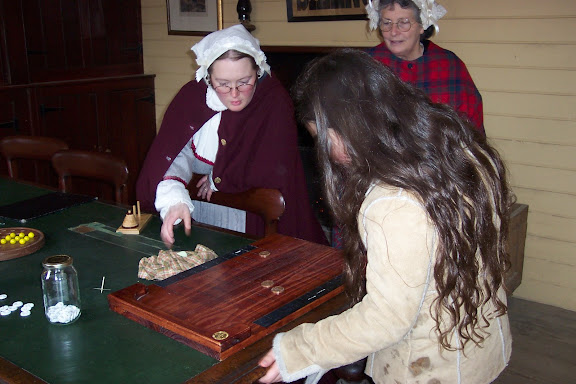
The volunteers were advertising a show of "parlour games" - 19th century boardgames - in the Mechanics' Institute, so we hurried to get there. Now I'm a big fan of Sovereign Hill, and I'm a big supporter of volunteer effort - but I think this little exhibition could have had a bit more thought put into it. The volunteers were able to describe how to play two of the five or so games that were laid out, although their knowledge of knucklebones (which we called jacks when I was a little girl) was a tad shaky. The other games? No idea - and they looked strangely at Biggie when she wanted to fiddle with the pieces and try to work out how to play.

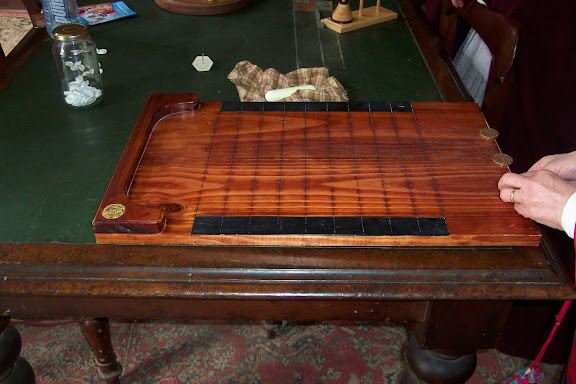
No matter though - one of the games was dynamite. I cannot imagine why no-one is (as far as I know) producing a commercial version of Shove Ha'penny - it's one of the more interesting dexterity games I have played.

Shove Ha'penny board
The wooden board features a barrier/built-up section at one end, and a series of (9?) sections along the board, each just a little wider than the eponymous penny/ha'penny.

To play, players hang three pennies (or ha'pennies) off the end of the board and then give them a shove. The object is to get your penny to stop between two of the lines - that is, completely within one of the sections and not overlapping at all. There is a blackboard/slate section along each side, and the goal appears to be to get a mark in each of the 9 delineated sections along the blackboard.

Biggie and I played this until we felt we were expected to stop, and we had a great time. I was trying to bounce my pennies off the backboard and back onto the rows, while she was trying to score some of the earlier rows.
Biggie - and volunteers - at Shove ha'penny
I would love to get my own copy of this game - and I think my mum still has a tin of old pennies at home, if we get tired of playing with 20 cent pieces.


Back home at the end of the day, we headed out to the local malaysian restaurant for dinner. Otto coloured in, while Biggie entertained me and Fraser with a description of what she knew about Princes of Florence.

Here's what she had to say today when I asked her to recap:

There are three main strategies. I can only remember two.
  • Cheap – he or she always buys cheap things. The cheap player may also get Jesters, but cheaply.

  • Mad Jester – loves to get Jesters, to get works and from that he gets points that you can transform into money. The Mad Jester player would willingly give up at least 1000 Fluoros, so that they can get a Jester. The player that is using the strategy of “Mad Jester” has an advantage in the game.


Three types of landscapes:
  • Forest is the cheapest but more people tend to use forests. The two smallest buildings in the game have forests.

  • Park has the most value though not many people tend to use that landscape
  • And lake is in the middle.


Buildings may not touch each other.

In your hand, you have types of personalities. When you choose artists, you try to get an artist with those kinds of personalities.

There are seven rounds in the game. In the first round, there is the number 7 involved. In number 5, it’s 15 and in round 7 it’s 17.

The least you can get anything for is 200 Fluoros.

Usually it would take at least one round to get money out of the works.

Mum was mentioned because she plays Princes of Florence a lot on BSW.

Each player has one courtyard to build in.

You try and get as many people into your hand as possible.

Mum, do you get GeekGold for blogs? Because if you did, that wouldn’t be fair, it should come to me if I wrote it.


In fairness, she did call them Florins on Thursday night. I just used Fluoros cos she said it today and it was cute. And her BGG ID is - apparently - DaughterTheElder (Fraser set it up, and Biggie was already taken).

Do you think I should tip her?

---


Happy gaming!

- Melissa

Saturday, June 30, 2007

Games in the classroom

As a reward for good behaviour, Biggie's teachers decided that the class would have a games day to celebrate the end of the term. Initially it was going to be all boardgames, all the time, but lots of the children wanted to bring their own games to school, so 'our' part of the day was cut back to two hours.

After much consideration, I cut the list of games to take back to around 17. Gregor had kindly offered to help out, and he brought a couple as well, although we found there was less time to talk than we had expected.

We started the day by talking about games - what makes a game a game? First response: "It's about having fun with your friends and spending time with them" - how can I top that?!

Next, we talked about rules for games. There was a lot of discussion about cheating and why that's not acceptable. I used as a basis the rules that Giles Pritchard has suggested - although I condensed them to a few major points:

  • Board games are games; the idea of playing them is to have fun in good company.
  • You must listen to the rules explainer.
  • Cheating is admitting defeat and is completely unacceptable. If a person in a game you are playing is caught cheating the game should be ended immediately and a new game begun – with the promise that cheating will not occur.
  • Always treat the game and the game pieces better than you would treat your own game. – After you have finished playing the game there should be no sign that you played it except for a pleasant memory.
  • Setting up and cleaning up are a part of the game, you need to do your share.
  • Be a good loser and an even better winner.
We summed them all up with the Knizia quote, which we put up on the board as a motto for the day:

“When playing a game the goal is to win,
but it is the goal that is important, not the winning”

I had planned for this to lead into a discussion of how games have designers just like books have authors, but the natives were getting a little restless so we jumped straight into theme, as a way to introduce the first batch of games.

I'd prepared a quick table of the games that I'd taken with a quick overview of each for me, Gregor and the teacher.

Here's what I had about the themed games:

Game

Number of Players

Notes

Incan Gold

(Alan R Moon and Bruno Faidutti)

3-8

EXPLORERS! Explore a ruined temple and collect treasures – but if you go too far you might lose it all!

5 explorations = 1 game. Disasters only count the second time.

For Sale

(Stefan Dorra)

3-6

GET RICH! Buy and sell property – the winner is the person with the most money at the end.

Part 1: Auction properties (buy with money)

Part 2: Sell properties (for cheques).

Hey that’s my fish

(Günter Cornett & Alvydas Jakeliunas)

2-4

PENGUINS! The players are penguins, trying to catch as many fish as possible.

Strategy is to isolate an area from the other players.

Fearsome Floors

(Friedemann Friese)

2-7

MONSTER! Race game – players have 14 turns to escape from the monster.

Part 1: Eliminated pieces are returned to the player. Ends when all but 2 tiles have been turned over

Part 2: Eliminated pieces are eliminated forever.

Cartagena

(Leo Colovini)

2-5

PIRATES! Play cards to move forward to the next empty square with a matching symbol

Move backwards to an occupied square to collect 1 or 2 more cards.

Pick Picknic

(Stefan Dorra)

2-6

CHICKENS! Players compete to get the most food – but are they a corn-eating chicken or a chicken-eating fox?

Pickomino

(Reiner Knizia)

2-7

CHICKENS! But this time it’s worms that they want. Yahtzee-style dice game.

Remember: You MUST have rolled a worm before you can pick up a tile.

Fast rules: Turn over highest tile AND the tile that is returned.


and some others that I took out at that stage:

Game

Number of Players

Notes

Sherlock

2-6+

Memory game testing out-of-sequence memory

Apples to Apples Junior

4-10

All players have 5 red cards; take turns to be the judge (flip a green card). Best red card match gets the green card – winner is first to 4.

Ingenious

(Reiner Knizia)

1-4

Match the pattern to place tiles & score in 6 different colours

Only your LOWEST score counts!

Use paper scoresheets instead of wooden cubes


The children separated into four groups.
  • Gregor took a group of girls who were desperate to play For Sale. This was a huge hit with the kids - at the end of the session, they begged me to leave it so they could play it again.
  • I took a group of girls and boys who were interested in Fearsome Floors. It was very popular but the kids found it a bit too complicated, especially when I had to move away for a little while
  • The teacher sat down with a group of boys who were very interested in Apples to Apples. This was amazing - they played it for over an hour!
  • Biggie sat on the floor to teach Pickomino - it seemed to go over very well, too, although I didn't hear any chicken noises from the group.
Meanwhile, one boy was roaming the classroom with Incan Gold in hand, not wanting to play anything else, and another girl was wandering around watching but not wanting to join in.

My Fearsome Floors group moved on to Sherlock and Otto, who had been playing Catch the Match quietly by herself, came to join in. She was pretty pleased to finish in second place in the group of five eight to ten year olds. Meanwhile Gregor had enticed the For Sale girls to play Incan Gold (by promising another game of For Sale later on in the day). Surprisingly, this wasn't much of a hit - they were too interested in getting back to For Sale to enjoy Incan Gold.

I'd prepared some journal pages for the students to reflect on the games they played in between new games. These were filled in with differing levels of detail and success, but with some great answers:

Game

Rating

What I Liked

Something I Learned

Next time I will

Apples to Apples

8

That it had a lot of risk

That you can do opposites

Have a lot of fun!

Make ‘n’ Break

10

It was VERY fun.

It was constructive

Have a lot of fun!

For Sale


It is really fun and I bought a lot of houses

Money!

Do better

Incan Gold


It was really fun

Take your chances

Get more jewels

Pickomino

7

The temptation!

It’s hard!

Play better (hopefully)

Incan Gold


The temptation

That it’s easy to lose

Play with more people and have more fun

Pickomino

10

The temptation and the worms

How lucky you can be!!

Not so much of risk taker

Apples to apples

4

It was funny

That you don’t need to be honest


Apples to Apples

10

It was funny

You don’t need to be honest

Be better

Polarity

6

It was a challenge


Be better

Dancing eggs

9.5

I liked how it was really hard and a challenge to do the actions. I WON!

Never think that anything’s easy

Do the exact same thing!

Finstere Flure

9 Excellent

It was so scary how the monster walked to try and eat you up!

X

Try to go first so I don’t get locked in! (by the other players’ pieces)

Sherlock

5 OK

How you had to use your memory

X

Try to remember much, much more

Fearsome Floors


There was a monster

You don’t always need a dice

Try to win

Sherlock


I WON!!!

You need a REALLY good memory

I’ll win AGAIN.

For Sale


It’s fun and I got to buy good houses

How to sell houses

Not spend too much money

Incan Gold


It was fun

Take your chance

Do something


We came back together as a group to discuss the games we'd played, and what skills we had been using.
  • Memory (heh - I pointed out that Otto had come second)
  • Deciding when to take a risk
  • Spending your money
  • Opposites (this from the Apples to Apples group, who had played some rounds looking for something that was unlike the faced card)
  • Dividing up the treasures
To finish up, I took out some games that used a skill that we hadn't used yet: dexterity. We had two groups playing Tier auf Tier, one playing Make 'n' Break and one playing Dancing Eggs - and a copy of Polarity for everyone to try out.

Game

Rating

What I Liked

Something I Learned

Next time I will

Dancing Eggs

5

Dancing eggs was a really fun game


Animal on animal


Stacking animal

How to stacking animals

Try harder

Tier auf Tier


It’s easy

The rules

Try harder

Polarity

9

It was a huge challenge because if the slightest thing was out of place it would fall

I learnt about magnets and balance!

Try and get three!


Overall, the day was a huge success. The teacher liked games, the journal pages, and the way the kids were engaged. Best of all - they're all (teacher and students) keen to do it again :)

To sum up the session:

What I liked
  • Having someone (Gregor) to help demo the games was invaluable.
  • The game journal pages worked well and made a great record of the day (where they were used)
  • Finishing with dexterity games was fantastic, although Dancing Eggs got a bit rowdy
Something I learned
  • Games work best with supervision - especially if they have a mechanic the kids haven't seen before (eg Finstere Flure)
  • It's difficult to involve some kids in the classroom activity, even if they are interested in the material
  • Having games that use a range of different skills works well for the larger groups
Next time I will
  • Try to take fewer games (I say this every time)
  • Introduce the game journal pages at the start of the session rather than as games finish.