Biggie's teacher: So, Melissa, what is it that you actually DO?
Me: I'm a consultant in online services. I help companies improve their websites & web presence, and to manage them better.
Teacher: (Looks confused). So, where do the games fit in?
We've had this before, too, with comments like, "I didn't know you ran a book shop" (I don't, we just like to read).
I wonder whether it would be different if I coached a children's netball or hockey team three times a week. There doesn't seem to be an expectation that people are paid for their volunteer sporting activities - so it intrigues me that other recreational activities are automatically assumed to be money-making. I only wish they were! Who wouldn't prefer to play & talk about games all day?
This weekend, I'm playing and re-learning all the games that I want to take to Biggie's school on Friday, for her class's last-day-of-term games day. I'm trying to design some curriculum-related material around it, not so much for the kids (who will have fun anyway) but to demonstrate to the teacher how good a fit games can be in the classroom.
The other thing on the gaming agenda is restacking the game shelves. They are a bit like wardrobes: they're fine, they're fine, everything fits ... and then you buy ONE MORE ITEM and suddenly nothing fits anymore and you have piles of games lying around everywhere and nowhere to put them. (Or piles of clothes, in the case of the wardrobe). I think our games may have been spawning while we weren't looking - anyway, I think it's time to retire some stuff to the attic or maybe even to eBay. You know storage space is tight when you catch yourself eyeing the bedroom, thinking, "well if I turned the bed around, then I would have a WHOLE WALL that I could fill with bookshelves!"
And rearranging the bookshelves would let me set up my system for sorting the games properly, too.
Showing posts with label gaming_promotion. Show all posts
Showing posts with label gaming_promotion. Show all posts
Saturday, June 23, 2007


Tuesday, June 12, 2007
A simile of games or "Die Polyps"
As gamers determined to proselytize the unwashed masses of non-gaming folk we need to take it upon ourselves to provide a welcoming atmosphere. In any hobby, a vernacular arises around important people, actions, and other subjects. Walk into a bowling alley on league bowling night and try to hang out with the crowd present. You will quickly see the need to know the difference between a spare, a split, and a turkey. We have some of our own in the boardgaming world: grognard, eurogame, and meeples. While it is great to have some terms that describe useful ideas and concepts within our hobby, we have to try to remember to remain as friendly as possible to newcomers if the hobby is going to continue to grow (at least I would like to see that).
In general, I find boardgamers to be some of the friendliest people I know. We’re generally not cliquish (well, aside from invitation-only conventions, but even there the folks are friendly to new faces) and are typically glad to see newcomers arrive at our gaming evenings. However, there are a few habits that sometimes arise in the online boardgame community that can be frustrating to new boardgamers. One of the common ones, and the subject of this brief post, is the boardgame simile.
In many of the reviews posted online on the Boardgamegeek and other sites, the reviewer will use one or more games to explain aspects of another. This game is like Goa’s auctions with a bit of Caylus-like worker placement and Puerto Rico’s role selection. A single game is like Goa, like Caylus, and like Puerto Rico. (Yes, its not a true modern simile, but work with me here… ) If a new gamer wanders over to a recent review, they may get very little out of it. Using some games to describe others is a great shorthand for those who have played and are familiar with a wide range of games, but it isn’t so useful for the newcomer. Like the poor soul who finds two words in the dictionary that are used to define each other, a new gamer can be awash in game comparisons before they even get a chance to become familiar with a few of them. So, lets remember out there to keep the comparisons to a minimum whenever possible, or at least be sure to follow up comparisons with a bit of further explanation.
This whole mini-rant came about during a facetious comment while I was explaining Reef Encounter to folks in my local gaming group. Known for somewhat difficult instructions, I consider the polyp tile scoring mechanism to be partially at fault. It is a difficult concept to grasp without actually playing through the game. Having to play through a game to understand the intricacies of the scoring is typically not a good sign. Regardless, I enjoy the game due to its theme (yes, it is pasted on but I like the cool pieces and the thought to trying to be the best coral reef I can be is just too enticing to a science teacher like myself.) As I tried to explain the manipulation and control of the coral ranking/scoring tiles, one player piped up: “It’s like the leader board in Die Macher!” We proceeded to tear up the game making as many Die Macher comparisons as possible. There is conflict on four different boards at a time. Your opponents are always trying to reduce your prime scoring areas. Eating your polyps could be like taking a little “vote” to score points, and so on… Since I had already mentioned the scoring is a bit strange until experienced, we decided to describe the game to anyone who asked us playing using words one might rarely expect to hear: “Reef Encounter? Oh, it’s like an advanced game of Die Macher”.
In general, I find boardgamers to be some of the friendliest people I know. We’re generally not cliquish (well, aside from invitation-only conventions, but even there the folks are friendly to new faces) and are typically glad to see newcomers arrive at our gaming evenings. However, there are a few habits that sometimes arise in the online boardgame community that can be frustrating to new boardgamers. One of the common ones, and the subject of this brief post, is the boardgame simile.
In many of the reviews posted online on the Boardgamegeek and other sites, the reviewer will use one or more games to explain aspects of another. This game is like Goa’s auctions with a bit of Caylus-like worker placement and Puerto Rico’s role selection. A single game is like Goa, like Caylus, and like Puerto Rico. (Yes, its not a true modern simile, but work with me here… ) If a new gamer wanders over to a recent review, they may get very little out of it. Using some games to describe others is a great shorthand for those who have played and are familiar with a wide range of games, but it isn’t so useful for the newcomer. Like the poor soul who finds two words in the dictionary that are used to define each other, a new gamer can be awash in game comparisons before they even get a chance to become familiar with a few of them. So, lets remember out there to keep the comparisons to a minimum whenever possible, or at least be sure to follow up comparisons with a bit of further explanation.
This whole mini-rant came about during a facetious comment while I was explaining Reef Encounter to folks in my local gaming group. Known for somewhat difficult instructions, I consider the polyp tile scoring mechanism to be partially at fault. It is a difficult concept to grasp without actually playing through the game. Having to play through a game to understand the intricacies of the scoring is typically not a good sign. Regardless, I enjoy the game due to its theme (yes, it is pasted on but I like the cool pieces and the thought to trying to be the best coral reef I can be is just too enticing to a science teacher like myself.) As I tried to explain the manipulation and control of the coral ranking/scoring tiles, one player piped up: “It’s like the leader board in Die Macher!” We proceeded to tear up the game making as many Die Macher comparisons as possible. There is conflict on four different boards at a time. Your opponents are always trying to reduce your prime scoring areas. Eating your polyps could be like taking a little “vote” to score points, and so on… Since I had already mentioned the scoring is a bit strange until experienced, we decided to describe the game to anyone who asked us playing using words one might rarely expect to hear: “Reef Encounter? Oh, it’s like an advanced game of Die Macher”.
Saturday, June 09, 2007
Games Australia Announcement
We are away at the Australian Games Expo in Albury this weekend. (I did an interview on ABC radio about it earlier in the week as well as some (unrecorded) regional breakfast radio). I will login with photos if I can find any internet access (unlikely, as I will probably leave even my new pink notebook pc at home).
One of the highlights of the Expo this year will be the announcement of GamesAustralia, offering a new, independent, credible award for boardgames in Australia. We're delighted to be part of this new organisation and look forward to announcing our first winners in 2008.
Here's the text:
---
GamesAustralia today announced the establishment of a new award for quality board games. The inaugural winners of the awards will be announced in June, 2008.
The Game of the Year award will be awarded to the best new game available on the australian market that is suitable for families. Local/Australian Game of the Year will be awarded to the best new game with australian creative content. Children's Game of the Year will be awarded to the best new game for under 8 year old children.
Research shows that families that work well and produce happy, resilient children spend time doing things together. More and more families are looking for an interactive alternative to solitary computer games. The many wonderful new board games appearing in the specialist market in the "new golden age" of the boardgame offer social interaction as well as intellectual stimulation. Every year brings more exciting board games that challenge children's higher order and strategic thinking skills, expose them to new themes and ideas, and offer countless opportunities for negotiation and discussion. And the best thing is, they're fun!
GamesAustralia aims to stimulate the growth and raise the profile of boardgaming in Australia by establishing and promoting awards that recognise and reward excellent new local and international boardgames.
The GamesAustralia awards fill an important niche. Although there are recognised independent international awards such as the Spiel des Jahres (Game of the Year) award from Germany, these awards do not reflect the games' availability and suitability for the Australian market. The Australian Game of the Year award will help to raise the profile of creative Australians internationally as well as at home, while the set of awards will offer a relevant, independent and highly credible overview of the best games available to Australians today.
The members of GamesAustralia have come together to create a credible award that is independent of game publishers or retailers. The Committee includes teachers, journalists, parents, academics and business people united by a passion to foster positive engagement of families and friends around the games table.
Like most things, board games have developed a lot over the last century. While we may be familiar with music and films made after the 1950s, this is generally not true for board games: did you know Monopoly is more than 70 years old? The "Hollywood" for modern board games is Germany where family gaming is very popular, and a wide range of these games are now available in English. They are easy to learn and play, and typically last less than an hour.
---
Expect to hear more from and about GamesAustralia over the coming months.
One of the highlights of the Expo this year will be the announcement of GamesAustralia, offering a new, independent, credible award for boardgames in Australia. We're delighted to be part of this new organisation and look forward to announcing our first winners in 2008.
Here's the text:
---
GamesAustralia today announced the establishment of a new award for quality board games. The inaugural winners of the awards will be announced in June, 2008.
The Game of the Year award will be awarded to the best new game available on the australian market that is suitable for families. Local/Australian Game of the Year will be awarded to the best new game with australian creative content. Children's Game of the Year will be awarded to the best new game for under 8 year old children.
Research shows that families that work well and produce happy, resilient children spend time doing things together. More and more families are looking for an interactive alternative to solitary computer games. The many wonderful new board games appearing in the specialist market in the "new golden age" of the boardgame offer social interaction as well as intellectual stimulation. Every year brings more exciting board games that challenge children's higher order and strategic thinking skills, expose them to new themes and ideas, and offer countless opportunities for negotiation and discussion. And the best thing is, they're fun!
GamesAustralia aims to stimulate the growth and raise the profile of boardgaming in Australia by establishing and promoting awards that recognise and reward excellent new local and international boardgames.
The GamesAustralia awards fill an important niche. Although there are recognised independent international awards such as the Spiel des Jahres (Game of the Year) award from Germany, these awards do not reflect the games' availability and suitability for the Australian market. The Australian Game of the Year award will help to raise the profile of creative Australians internationally as well as at home, while the set of awards will offer a relevant, independent and highly credible overview of the best games available to Australians today.
The members of GamesAustralia have come together to create a credible award that is independent of game publishers or retailers. The Committee includes teachers, journalists, parents, academics and business people united by a passion to foster positive engagement of families and friends around the games table.
Like most things, board games have developed a lot over the last century. While we may be familiar with music and films made after the 1950s, this is generally not true for board games: did you know Monopoly is more than 70 years old? The "Hollywood" for modern board games is Germany where family gaming is very popular, and a wide range of these games are now available in English. They are easy to learn and play, and typically last less than an hour.
---
Expect to hear more from and about GamesAustralia over the coming months.
Saturday, June 02, 2007
School Games Night the second
As forewarned by Melissa last week, we held another Family Games Night at Daughter the Elder’s School on Friday. We had twenty-five adults and thirty-five children. This year in terms of adults explaining games there was just Melissa and myself as well as contributions from Daughter the Elder. You can read about last year’s session here.
This year we were scheduled from 4:30 pm until 7:30 pm, which was actually ended up being 8:30 pm. It was also designed to be a fund raiser via our friendly internet games shop in that the school will get 10% of any orders.
We took most of the games that we intended to take, although one or two have been eaten by our house. There were two specific requests, Settlers of Catan and Fish Eat Fish.
The parents and children who came brought some of their own games, which were all played.
Ticket to Ride - Märklin Edition
Chess
Fish East Fish
Monopoly
Trivial Pursuit - Junior
Popomatic Sorry or Ludo
These are the games we ended up bringing, including a couple of demo copies from our FIGS.
Ticket to Ride Always popular with the parents.
Von 0 auf 100
Perpetual Commotion
Make ‘n Break
Spooky Stairs sans expansion.
Cartagena
Marrakesh
M is for Mouse
Carcassonne
Apples to Apples Junior!
Halli Galli
Catch the Match
TransAmerica
Dancing Eggs
Incan Gold played as Diamant, i.e. without the artifacts
Gulo Gulo
Piggy Back
Sherlock
Pick Picknic
Fish Eat Fish
The Same Game
All the above were played, these were the lonely ones
Settlers of Catan
Finstere Flure
Gopher It!
There were some stand out popular games for the night.
I started a session of Von 0 auf 100 very early on and it was played most of the night, quite often with children teaching other children how to play. It’s a lovely little racing and bluffing game. Another Haba gem.
Make ‘n Break is always popular and rightly so, it is fun and easy to learn and play.
Spooky Stairs got a lot of table time too. The cute little ghost and magnet head meeples probably help, but it an excellent variation on a roll and move game.
Piggy Back is another excellent variation on a role and move game. With hitching ride on the back of other players and a balancing mechanism to reduce the chance of runaway lucky leaders.
Apples to Apples Junior! a good one for parents and children together. The Junior edition is good for primary school children and for people outside the US it also has the advantage of being more global.
Catch the Match is realistically just a pattern matching game, but it has been designed very well and captivates both adults and children without fail.
TransAmerica Ticket to Ride may not catch the attention of the children and these games nights, but TransAmerica does.
Dancing Eggs was played a lot at night, including occasionally in a very non-standard manner with eggs flying across the room!
Fish Eat Fish is too abstract for Melissa, that or her reaction to fish may be subconsciously put her off. I like this, but she doesn’t. It was being played most of the night. It required explanation, and got a few glazed looks during the explanation but after a few turns it would invariably click with the players and they became quite enthused (both parents and children).
I still think that the more helpers the merrier is the case for this sort of event. It is billed as a Family Games Night to get the children along. I suspect an alternate way of getting games into the homes might be to run a Parent’s Family Games night, where you can teach the parents various games without the distraction of marauding children. This has its logistical difficulties, including babysitting and just how many parents would come to such an event, but it is an idea bubbling around in the back of my mind to possibly try out one day.
This post is dedicated to the memory of the red Ticket to Ride train that was sucked up by a vacuum cleaner and the card from another game that was grabbed by the baby, it was bent back into shape, but I don’t think it will ever be quite the same. They gave their best in service to games.
Mmm meeples taste like …
This year we were scheduled from 4:30 pm until 7:30 pm, which was actually ended up being 8:30 pm. It was also designed to be a fund raiser via our friendly internet games shop in that the school will get 10% of any orders.
We took most of the games that we intended to take, although one or two have been eaten by our house. There were two specific requests, Settlers of Catan and Fish Eat Fish.
The parents and children who came brought some of their own games, which were all played.
Ticket to Ride - Märklin Edition
Chess
Fish East Fish
Monopoly
Trivial Pursuit - Junior
Popomatic Sorry or Ludo
These are the games we ended up bringing, including a couple of demo copies from our FIGS.
Ticket to Ride Always popular with the parents.
Von 0 auf 100
Perpetual Commotion
Make ‘n Break
Spooky Stairs sans expansion.
Cartagena
Marrakesh
M is for Mouse
Carcassonne
Apples to Apples Junior!
Halli Galli
Catch the Match
TransAmerica
Dancing Eggs
Incan Gold played as Diamant, i.e. without the artifacts
Gulo Gulo
Piggy Back
Sherlock
Pick Picknic
Fish Eat Fish
The Same Game
All the above were played, these were the lonely ones
Settlers of Catan
Finstere Flure
Gopher It!
There were some stand out popular games for the night.
I started a session of Von 0 auf 100 very early on and it was played most of the night, quite often with children teaching other children how to play. It’s a lovely little racing and bluffing game. Another Haba gem.
Make ‘n Break is always popular and rightly so, it is fun and easy to learn and play.
Spooky Stairs got a lot of table time too. The cute little ghost and magnet head meeples probably help, but it an excellent variation on a roll and move game.
Piggy Back is another excellent variation on a role and move game. With hitching ride on the back of other players and a balancing mechanism to reduce the chance of runaway lucky leaders.
Apples to Apples Junior! a good one for parents and children together. The Junior edition is good for primary school children and for people outside the US it also has the advantage of being more global.
Catch the Match is realistically just a pattern matching game, but it has been designed very well and captivates both adults and children without fail.
TransAmerica Ticket to Ride may not catch the attention of the children and these games nights, but TransAmerica does.
Dancing Eggs was played a lot at night, including occasionally in a very non-standard manner with eggs flying across the room!
Fish Eat Fish is too abstract for Melissa, that or her reaction to fish may be subconsciously put her off. I like this, but she doesn’t. It was being played most of the night. It required explanation, and got a few glazed looks during the explanation but after a few turns it would invariably click with the players and they became quite enthused (both parents and children).
I still think that the more helpers the merrier is the case for this sort of event. It is billed as a Family Games Night to get the children along. I suspect an alternate way of getting games into the homes might be to run a Parent’s Family Games night, where you can teach the parents various games without the distraction of marauding children. This has its logistical difficulties, including babysitting and just how many parents would come to such an event, but it is an idea bubbling around in the back of my mind to possibly try out one day.
This post is dedicated to the memory of the red Ticket to Ride train that was sucked up by a vacuum cleaner and the card from another game that was grabbed by the baby, it was bent back into shape, but I don’t think it will ever be quite the same. They gave their best in service to games.
Mmm meeples taste like …
Saturday, May 26, 2007
Family Game Night preparation
This Friday, we're holding our second "annual" Family Game Night at Biggie's school.
We're aiming to take fewer games this year, to try to reduce the game explaining and to get people playing the same games a few times, so they can talk about them later. We've also co-ordinated a game drive with a friendly internet game shop with a specialisation in children's and family games, with a percentage of all sales to be credited to the school to buy some games (probably to use in the out-of-school-hours-care room).
We have a few changes from the session we ran last year.
Based on advice from a friend, we're trying an earlier start. Last year, we ran 6-8pm or so; this year, we are running 4.30-7.30. That way, we hope to get the after-school crowd as well as parents collecting their children after work, and people who prefer to go home first. I'm a little dubious about how this will work, but we'll give it a go. We may get more teachers coming along to check the games out, which would be great.
This year, too, we have no "grown-up helpers" - just me, Fraser and the kids. This will definitely make things difficult, but Fraser and I have had long discussions about the ethics of taking adults who we only know through playing games every so often into the school. He thinks I'm paranoid, I agree but think school will be too. And there's not time to get working-with-children police checks processed, although that might not be a bad idea if we are going to do any other events. It's not that I mistrust people, just that I think it's wise to be seen to follow protocols.
This year, too, we will be taking Otto. That's probably the biggest risk as far as time and availability, but with my mother's health that's really our only option. She'll be happy to play Blink or Make 'n' Break, though she may be less happy to share those games with others.
Games we're definitely taking (these are also on the fundraiser list, so people can try them out and then fill in an order form if they want them) are listed below. I chose them based on availability, price (to a small extent) and age range - we want to make sure we have all primary school age groups covered, as well as adults.
I'm also tempted to take a couple of others - Formula De was a big hit last year, but it really requires an adult volunteer. Pirates' Cove is another great one to demonstrate as it is so easy to pick up. Otto always enjoys playing Catch the Match, even by herself, so that should come along. And a family actually asked me, "Will you be able to bring the Settlers of Catan?" (of course!)
So what is left to be done this week?
When we set up, this time, the priority will be to set up some self-sustaining games on the tables. Once we get those started, our job becomes a whole lot simpler.
Have a great week!
Melissa
We're aiming to take fewer games this year, to try to reduce the game explaining and to get people playing the same games a few times, so they can talk about them later. We've also co-ordinated a game drive with a friendly internet game shop with a specialisation in children's and family games, with a percentage of all sales to be credited to the school to buy some games (probably to use in the out-of-school-hours-care room).
We have a few changes from the session we ran last year.
Based on advice from a friend, we're trying an earlier start. Last year, we ran 6-8pm or so; this year, we are running 4.30-7.30. That way, we hope to get the after-school crowd as well as parents collecting their children after work, and people who prefer to go home first. I'm a little dubious about how this will work, but we'll give it a go. We may get more teachers coming along to check the games out, which would be great.
This year, too, we have no "grown-up helpers" - just me, Fraser and the kids. This will definitely make things difficult, but Fraser and I have had long discussions about the ethics of taking adults who we only know through playing games every so often into the school. He thinks I'm paranoid, I agree but think school will be too. And there's not time to get working-with-children police checks processed, although that might not be a bad idea if we are going to do any other events. It's not that I mistrust people, just that I think it's wise to be seen to follow protocols.
This year, too, we will be taking Otto. That's probably the biggest risk as far as time and availability, but with my mother's health that's really our only option. She'll be happy to play Blink or Make 'n' Break, though she may be less happy to share those games with others.
Games we're definitely taking (these are also on the fundraiser list, so people can try them out and then fill in an order form if they want them) are listed below. I chose them based on availability, price (to a small extent) and age range - we want to make sure we have all primary school age groups covered, as well as adults.
- Animal upon Animal
- Apples to Apples Jr
- Blink
- Bohnanza
- Carcassonne
- Cartagena
- Dancing Eggs
- Halli Galli
- Hey! That's My Fish!
- Incan Gold
- M is for Mouse
- Make 'n' Break
- Marrakesh
- O Zoo le Mio
- Pick Picknic
- Sherlock
- Spooky Stairs
- Ticket to Ride
I'm also tempted to take a couple of others - Formula De was a big hit last year, but it really requires an adult volunteer. Pirates' Cove is another great one to demonstrate as it is so easy to pick up. Otto always enjoys playing Catch the Match, even by herself, so that should come along. And a family actually asked me, "Will you be able to bring the Settlers of Catan?" (of course!)
So what is left to be done this week?
- Work with Biggie to write a 'speech' for morning assembly on Tuesday. I won't be able to go, so she will have to advertise the event herself.
- Confirm the fundraiser order form with the game vendor
- Pack all games securely and make sure they are all there
- Re-play a couple that I've not played recently
- Work out which games Biggie can teach by herself, and practise her 'patter'
- Resist the urge to add more & more games to the pile!!!
When we set up, this time, the priority will be to set up some self-sustaining games on the tables. Once we get those started, our job becomes a whole lot simpler.
Have a great week!
Melissa
Saturday, September 23, 2006
Musings from the museum
A short but rambling post tonight - mostly because we are now at the museum 4 days a week and I'm short on time.
What we are really noticing is the variety in the people who come through.
Variety in their attitudes to games:
* "Oh, look at all these toys!"
* "No, we don't have time for that stuff."
* "We love games"
Variety in their knowledge of games
* (Fraser swears he heard this) "That must be the new Monopoly" (looking at Power Grid)
* "We have a game called Junior Stratego, from about the 1960s. Was there ever a game called Stratego?"
* "Carcassonne ... we have that at home"
* "Settlers of Catan ... our friends love that game"
Variety in their ability to play games
This is the one I can't distill down to point form. We are seeing at first hand the incredible range of abilities that still constitutes "normal".
Whether it's the 3 year olds who find the matches in Catch the Match before their parents and siblings, or the 7 year olds who stare and stare and find nothing. Or the kids that take one look and decide it's too much like work, and run away.
We've had kids who thought Make 'n' Break and Tier auf Tier were too hard, and others that took to Blink like they'd been playing it for years. Today, we watched a group of six year olds whose maths wasn't up to Halli Galli - and a 10 year old who was in the same boat.
But we've also met the most lovely people and their fantastic kids, and really enjoyed gaming with them.
One family from Biggie's school came in on Thursday - they came to the family game night we ran, and played and enjoyed Ticket to Ride, so they came in specially to see the exhibit. The mother told me yesterday that they have since bought it for themselves and for another family, and some friends of theirs recently told them that they have bought it as well.
Another family came by today and played games - dad, 12 year old daughter and 10 year old autistic & intellectually disabled son. We found that the son enjoyed Make 'n' Break, as well as placing tiles in Carcassonne, while dad and daughter played a whole raft of games with us, including Blink, Apples to Apples and Tier auf Tier, and had a good look at Settlers too. They came back later for a game of Marrakesh, after meeting up with the family's mother as well.
We had a family last week, too, who reminded me of why we were doing the demos - they played games with us for over an hour, and by the end of it the kids were tugging at their parents' sleeves saying "you've played enough". They left the museum and went straight for a games shop to buy some of the games they had played with us.
And then we get home.
"I want to play a game," says Otto. "Actually, I want to play FIVE games."
And five games are played.
-Melissa
What we are really noticing is the variety in the people who come through.
Variety in their attitudes to games:
* "Oh, look at all these toys!"
* "No, we don't have time for that stuff."
* "We love games"
Variety in their knowledge of games
* (Fraser swears he heard this) "That must be the new Monopoly" (looking at Power Grid)
* "We have a game called Junior Stratego, from about the 1960s. Was there ever a game called Stratego?"
* "Carcassonne ... we have that at home"
* "Settlers of Catan ... our friends love that game"
Variety in their ability to play games
This is the one I can't distill down to point form. We are seeing at first hand the incredible range of abilities that still constitutes "normal".
Whether it's the 3 year olds who find the matches in Catch the Match before their parents and siblings, or the 7 year olds who stare and stare and find nothing. Or the kids that take one look and decide it's too much like work, and run away.
We've had kids who thought Make 'n' Break and Tier auf Tier were too hard, and others that took to Blink like they'd been playing it for years. Today, we watched a group of six year olds whose maths wasn't up to Halli Galli - and a 10 year old who was in the same boat.
But we've also met the most lovely people and their fantastic kids, and really enjoyed gaming with them.
One family from Biggie's school came in on Thursday - they came to the family game night we ran, and played and enjoyed Ticket to Ride, so they came in specially to see the exhibit. The mother told me yesterday that they have since bought it for themselves and for another family, and some friends of theirs recently told them that they have bought it as well.
Another family came by today and played games - dad, 12 year old daughter and 10 year old autistic & intellectually disabled son. We found that the son enjoyed Make 'n' Break, as well as placing tiles in Carcassonne, while dad and daughter played a whole raft of games with us, including Blink, Apples to Apples and Tier auf Tier, and had a good look at Settlers too. They came back later for a game of Marrakesh, after meeting up with the family's mother as well.
We had a family last week, too, who reminded me of why we were doing the demos - they played games with us for over an hour, and by the end of it the kids were tugging at their parents' sleeves saying "you've played enough". They left the museum and went straight for a games shop to buy some of the games they had played with us.
And then we get home.
"I want to play a game," says Otto. "Actually, I want to play FIVE games."
And five games are played.
-Melissa
Saturday, September 09, 2006
Demonstrating games
Demonstrating games is very much on our minds this month, with 12 days of September's 30 committed to the museum. Rather than telling you even more about our fantastic display (come and see it!), I wanted to talk a bit more generally about demonstrating games to the public.
The first, and absolutely crucial, element of your game demo is not the games, but the people who are demonstrating. It's essential that your demo is well-staffed by people who are knowledgeable about games in general, and the games you are demonstrating in particular.
Specifically, they should know what skills are used in a game, what ages it is suitable for, and ideally roughly how much it is and where it can be bought (we have had a lot of queries about these last 2).
For us, in a non-profit environment, it was also important that our demonstrators not have a commercial interest in selling games. We didn't want to confuse the goals we had set for the event (interest more people in games, educate them about the range & types of games that were available) with commercial pressures. This also seems to have been a good policy decision as the people we chat to often ask whether we are selling the games.
Also, when people say "wow, cool, game demos, I will help" -- get them to write their names on a calendar then & there. It doesn't matter if it is 8 months before the event, just do it. We are having some difficulty finding people to staff the display, especially during school holidays. Today we had 3 people and we were stretched to the limit.
The second crucial element is the games themselves. As Fraser (in particular) is very fussy about the condition of our games, there was no question that our own copies of some games could be used. There are plenty that we are taking, but there were others where we approached the supplier to see if they could loan us a demo copy or donate one to the cause. Three local suppliers came on board, although we're going to need to speak to the one who invoiced us for them - maybe I'm being cheap, but we're already giving up 12 days (including 4 days when I would have been paid for work) to these demos, we don't want to spend money on duplicates of games we already own.
It was important to us that we have a good range of games to demonstrate. We wanted to really highlight games for families and adults, as well as having plenty for kids to do.
The third element is the rules to the games. I'm always wary of playing games with home rules, but when you're demonstrating there often isn't time to go through every single rule. Make sure that your demonstrators are not so married to the game's mechanics that they can't simplify it when needed. (Remember, I'm talking about demos to the general public, not to gamers). We need to remember that these people have come to visit the museum, not specifically to play games.
Some examples of rules modifications we have made:
The fourth element (probably more important than the rules, if truth be known) is the setup, or the layout of your demonstration area. We have two trestle tables, with an option of adding another although I'm really not sure where it would go.
A suggestion that came from Jon Power of York's Beyond Monopoly group, and that grew from our own experiences too, was that it's a good idea to actually have people playing a game - especially if they are willing to talk about what they are doing. We experimented today with Ticket to Ride with train cards face up, but quickly were sidetracked by other queries.
So one table contains a game in play, hopefully with gamers sitting around it. The other has a big pile of games, hopefully arranged in some way. You need one or two people who are *not* playing the demo game who can talk about and demonstrate the games as people stop to look.
One last point - try to have a tagline or something to say about every game. It doesn't need to be profound, but it seems to personalise the encounter for people:
"I like this because my kids can play it together and I don't really need to supervise."
"We went to Albury to play in the national championships for this game - the winner won a trip to Germany."
"I bought this the day after I first played it, I liked it so much."
"I think this should be in every primary school in the country."
"It plays in about 45 minutes, so it's great for after dinner."
"Our daughter used to trade her bedtime stories to play this game."
"Last time we played this, Fraser sneakily took my green route and then all the other players conspired to shut me out of Seattle, so I took a -22 on my longest route card and lost the game 123 to 156. Of course, that was using the first edition board that only scored up to 80 around the outside, and didn't have symbols on the route spaces."
Or maybe not :)
Don't eat the Meeples.
xx
Melissa
The first, and absolutely crucial, element of your game demo is not the games, but the people who are demonstrating. It's essential that your demo is well-staffed by people who are knowledgeable about games in general, and the games you are demonstrating in particular.
Specifically, they should know what skills are used in a game, what ages it is suitable for, and ideally roughly how much it is and where it can be bought (we have had a lot of queries about these last 2).
For us, in a non-profit environment, it was also important that our demonstrators not have a commercial interest in selling games. We didn't want to confuse the goals we had set for the event (interest more people in games, educate them about the range & types of games that were available) with commercial pressures. This also seems to have been a good policy decision as the people we chat to often ask whether we are selling the games.
Also, when people say "wow, cool, game demos, I will help" -- get them to write their names on a calendar then & there. It doesn't matter if it is 8 months before the event, just do it. We are having some difficulty finding people to staff the display, especially during school holidays. Today we had 3 people and we were stretched to the limit.
The second crucial element is the games themselves. As Fraser (in particular) is very fussy about the condition of our games, there was no question that our own copies of some games could be used. There are plenty that we are taking, but there were others where we approached the supplier to see if they could loan us a demo copy or donate one to the cause. Three local suppliers came on board, although we're going to need to speak to the one who invoiced us for them - maybe I'm being cheap, but we're already giving up 12 days (including 4 days when I would have been paid for work) to these demos, we don't want to spend money on duplicates of games we already own.
It was important to us that we have a good range of games to demonstrate. We wanted to really highlight games for families and adults, as well as having plenty for kids to do.
The third element is the rules to the games. I'm always wary of playing games with home rules, but when you're demonstrating there often isn't time to go through every single rule. Make sure that your demonstrators are not so married to the game's mechanics that they can't simplify it when needed. (Remember, I'm talking about demos to the general public, not to gamers). We need to remember that these people have come to visit the museum, not specifically to play games.
Some examples of rules modifications we have made:
- Transamerica - depending on how much time people have, we might eliminate all the blue cities from the board, or even all the blue and green cities. Apologies to readers who live in places that abruptly cease to exist. We also only play one round, then we explain that you can play as a series of rounds.
- Carcassonne - no farmers (again, you can explain them after they have played, if you want to). As we have it left out, we can explain the map building aspect first before we add meeples.
- Snorta - and other games - only play with the basic ruleset, not anything more complicated.
- Apples to Apples - and especially Apples to Apples junior - always have an adult be the judge.
- Ingenious - get them started placing pieces before you even try to explain the scoring.
The fourth element (probably more important than the rules, if truth be known) is the setup, or the layout of your demonstration area. We have two trestle tables, with an option of adding another although I'm really not sure where it would go.
A suggestion that came from Jon Power of York's Beyond Monopoly group, and that grew from our own experiences too, was that it's a good idea to actually have people playing a game - especially if they are willing to talk about what they are doing. We experimented today with Ticket to Ride with train cards face up, but quickly were sidetracked by other queries.
So one table contains a game in play, hopefully with gamers sitting around it. The other has a big pile of games, hopefully arranged in some way. You need one or two people who are *not* playing the demo game who can talk about and demonstrate the games as people stop to look.
One last point - try to have a tagline or something to say about every game. It doesn't need to be profound, but it seems to personalise the encounter for people:
"I like this because my kids can play it together and I don't really need to supervise."
"We went to Albury to play in the national championships for this game - the winner won a trip to Germany."
"I bought this the day after I first played it, I liked it so much."
"I think this should be in every primary school in the country."
"It plays in about 45 minutes, so it's great for after dinner."
"Our daughter used to trade her bedtime stories to play this game."
"Last time we played this, Fraser sneakily took my green route and then all the other players conspired to shut me out of Seattle, so I took a -22 on my longest route card and lost the game 123 to 156. Of course, that was using the first edition board that only scored up to 80 around the outside, and didn't have symbols on the route spaces."
Or maybe not :)
Don't eat the Meeples.
xx
Melissa
Saturday, August 26, 2006
Museum prep
Our exhibit at the Melbourne Museum starts next Friday, so I've had a really busy week trying to get everything ready. Expect me to talk of nothing else for the next month or so.
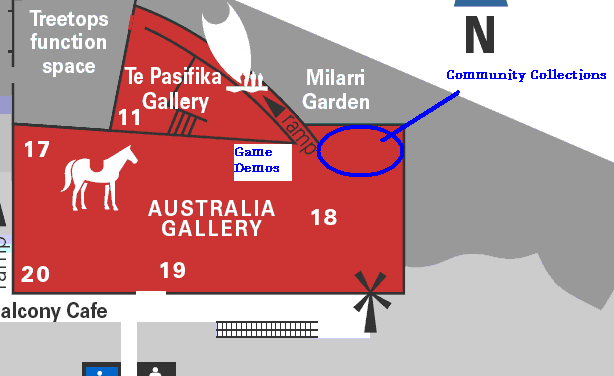
We have had some fantastic offers of help, although we are still finding staffing the demo games every weekend a bit heavy going.
Here's where we'll be - it's a little out of the way, but the demo games really move us into the main part of the gallery.

I've built a rudimentary website to provide extra information for people who are interested. This will also include a list of all games exhibited (ideally, of all games demoed each week, but I am not sure my energy will stretch that far after a full day at the museum...)
Trying to select 11 or so games that are "representative" of what we like about games is really really tough. Here's the list we have so far, and the text I've written to accompany the displays. I think we have room for one more game ... maybe
On the wall:
Shadows over Camelot
Serge Laget & Bruno Cathalla
(Days of Wonder, 2005)
Winner of a special “Fantastic game” prize from the German Spiel des Jahres (Game of the Year) council in 2006, Shadows over Camelot is a co-operative game for up to 7 players.
Players take the roles of Knights of the Round Table, working together to stop the siege of Camelot and complete various quests including retrieving Excalibur and the Holy Grail. Each Knight has a different special ability which allows him to change or bend a rule (for example, to draw 3 cards instead of 2).
The tension in this game comes from the feeling of impending doom as players struggle to balance all the conflicting threats. If that’s not enough, players can use the optional rules to add a traitor to the mix – one (unknown) Knight who is working against the rest of the group.
The very strong and engaging theme of Shadows over Camelot pulls players in to the game, and the high production values and beautiful game boards enhance the gaming experience.
Sunda to Sahul
Don Bone
(Sagacity games, 2002)
This game by an Australian designer is played by 2-4 players, or can be played as a solo puzzle. The theme of the game is the migration of people down the Indonesian archipelago into New Guinea and Australia.
In this simple but engaging game, players place jigsaw tiles to build the archipelago of islands, while also claiming land rights over particular ‘nodes’ (points where several tiles meet). All pieces on a completed island score double points, so players have to balance the need to complete islands with the benefits to them if they extend the island (and possibly place more pieces on it).
A variety of optional game rules which can be combined in different ways extend the game for experienced players.
Don’s second game Freya’s Folly was launched at the international games fair in Essen, Germany, in 2005.
Out for people to play with
(The local distributor has kindly offered us some spare sets of pieces forif when they go missing.
Blokus
Bernard Tavitian
(Educational Insights, 2000)
Blokus is a very popular “abstract” game – that is, a game that does not have a theme attached to it. Traditional abstract games include Go, Othello, Backgammon and Ludo (and even Chess).
The rules are simple – 3 or 4 players take it in turns to place a piece. The only rules are that a piece MUST touch another piece diagonally (it may not touch along any sides).
A single player can also play Blokus as a puzzle – see if you can get all the pieces of one colour onto the board at once, following the rule that they cannot touch directly but must be connected on the diagonal.
You are welcome to play with this Blokus set, but please make sure that you leave all the pieces beside the board when you’re done.
“Travel Blokus” (2005) is a slightly smaller version for 2 players – and “Blokus Trigon” is a new (2006) version where the pieces are made up of connected triangles rather than squares, and are place on a hexagonal board.
In the display cases:
Nacht der Magier - “Magicians’ Night”
Jens-Peter Schliemann & Kirsten Becker
(Drei Magier Spiele, 2005)
This unusual dexterity game was nominated for the 2006 German “Kinderspiel des Jahres” (Children’s game of the year) award.
Each player takes a piece with a different symbol – crescent moon, lightning, ring or star. Your aim is to be the first player to push a cauldron (red piece) with your symbol into the recessed area in the centre of the game stand. As soon as a piece falls off the game area, a player’s turn ends and the next person can start pushing.
The trick? The game is played in pitch dark – fortunately the symbols on the pieces glow in the dark.
Shear Panic
Fraser & Gordon Lamont
(Fragor Games, 2005)
This is one of the more collectible games in our collection. Released for the Essen games fair in November 2005, the print run of 550 copies was completely sold out before the fair opened. Although originally priced at 25 Euros, there were reports of this game selling for up to 80 Euros during the event.
This was a self-published and home-produced game, but it has since been picked up by a major game company and a re-release is imminent.
The combination of a rule book full of bad puns, some great little sheep pieces and fiercely competitive game play made this a huge hit.
Plus and Minus
(unknown designer, c. 1940s?)
We found a copy of “The most intriguing game ever invented” in a beach house we hired during January 2005. When we finally got around to playing it, we found it to be a great little maths game.
The rules are simple – add the number on your card to the number on the card played by the previous player, then move one of your pawns that many spaces forward, or backward if the total is negative. The goal is to get all of your pieces to land exactly on 25 – if you go over 25, you have to go back to the start.
It took us a couple of months to track a copy down on eBay, but we found it eventually. Maybe it’s not “The game everyone has been waiting for for years!” but we’d agree that it’s “Absorbing for the Adult, Interesting & Instructive for the Children.”
The Settlers of Catan
Klaus Teuber
(Kosmos / Mayfair Games, 1999)
“Settlers of Catan” (1995) won the German Spiel des Jahres (Game of the Year) award for that year, and is widely credited as being the game that kick-started the popularity of Eurogames (European-style boardgames). Players earn raw materials and trade them with the other players, then use them to build cities and settlements, expand their armies and build special buildings.
Settlers of Catan was followed by expansions The Seafarers of Catan (1999) and Cities and Knights of Catan (2000), by a cardgame version (1996), by 5-6 player expansion sets for all expansions, by a travel edition and by the Starfarers of Catan (1999). Starship Catan, a card version of Starfarers of Catan, was released in 2001, and The Kids of Catan, a simple building game for young children, in 2003. More recently, Candamir: the first Settlers (2004) and Elasund (2005) have built on the Settlers success story. There has even been a novelisation of the story of Candamir.
A Mormon adaptation, The Settlers of Zarahemla, was released in 2003, and die Siedler von Nürnberg (The Settlers of Nuremberg) was released in 1999 to commemorate the 950th anniversary of the city’s charter. There are several special editions of the Settlers games, including the very rare “das Wasser des Lebens” or “Whisky Settlers” (1997), a re-theming of Settlers based on the production of scotch whisky and issued in conjunction with the Glen Grant Distillery company. The most notable, though, is the tenth anniversary 3-D “Treasure Chest” edition (2005) which retailed for nearly $800 Australian. Sadly, and for obvious reasons, this edition is not in our collection.
The first Australian Settlers of Catan championships were held in June 2006 at the Australian Games Expo in Albury. The winner, Dennis Bodman, will represent Australia at the world championships in Essen, Germany, in October.
Power Grid
Friedemann Friese
(2F-Spiele / Rio Grande Games, 2004)
In Power Grid, players compete to power cities – by building connections to the cities, buying power plants, and fuelling them with the appropriate raw materials (coal, oil, garbage or plutonium).
Power Grid is probably the “heaviest” (most complicated) game that we have on display here, as there are so many different factors for players to balance – can I afford to buy a new power plant? If I buy it, can I afford to power it? Will I be able to connect to a new city? Would it be better to buy a more expensive but environmentally friendlier wind plant?
Power Grid is probably Fraser’s favourite game at the moment.
Ra
Reiner Knizia
(Alea / Rio Grande Games, 1999)
Reiner Knizia is considered one of the world’s great game designers. His prolific output is matched only by his enthusiasm for innovation – one recent game uses a special ink that can hold an electrical charge.
The game Ra features an innovative auction mechanic (players bid for tiles, aiming to collect groups of particular tiles in each of the three Epochs of the game). The player must balance the conflicting needs by collecting a variety of different types of tile but at the same time collecting sets of the same tile. This theme of balancing different requirements is often a feature of Knizia’s games.
Ra is widely considered one of Knizia’s best games, with the main criticism being that the ancient Egyptian theme is incidental to the game.
Amun-Re
Reiner Knizia
(Hams im Glück / Rio Grande Games, 2003)
Reiner Knizia is considered one of the world’s great game designers. His prolific output is matched only by his enthusiasm for innovation – one recent game uses a special ink that can hold an electrical charge.
In Amun-Re, each player takes the role of a pharaoh, aiming to build more pyramids than any other. To accomplish this, players first acquire a province, which they can trade and farm. The profits from trading can buy new provinces and building stones to erect pyramids. Players can use power cards and can offer sacrifice to Amun Re to help them achieve their goals.
Tier auf Tier
Klaus Miltenberger
(Haba, 2005)
Tier auf Tier (“Animal upon Animal”) is a delightful and beautifully produced children's dexterity game in which players take turns piling wooden animals on top of one another.
Although this is billed as a children's game, we have found that it is enjoyable for adults and children alike. It's also a game where children have some advantage when playing with adults, due to their smaller and sometimes steadier hands.
Big City
Franz-Benno Delonge
(Goldsieber / Rio Grande Games, 1999)
In Big City, players compete to build a city, adding residential and commercial buildings and factories, as well as tram lines, parks, a town hall and a range of special buildings including shopping malls and cinemas. Before they can build, though, each player must acquire the rights to the pieces of land that they need for building.
Big City is a light-to-medium-weight game and typically takes around 45 minutes to play, of which the first 5-10 are usually spent oohing and aahing at the pretty plastic pieces.
Big City has been out of print for a couple of years now, but copies occasionally appear on eBay and on game trading sites. There are no verifiable rumours of a reprint at this stage.
Puerto Rico
Andreas Seyfarth
(Alea / Rio Grande Games, 2002)
Puerto Rico is generally considered to be one of the three best “Eurogames” ever, and is one of Melissa’s favourites.
The 3-5 players are plantation owners in Puerto Rico, growing a variety of crops, which they sell at the trading post or ship back to the old world. Strategically building commercial buildings to gain an advantage, in each round players must choose a role that will give them a slight advantage - but each other player can also take that action.
Other stuff:
It's been suggested that we should exhibit 2 versions of a game, to show the difference a reissue could make. We're considering
Britannia
Lewis Pulsipher
(Avalon Hill, 1986 / Fantasy Flight Games, 2006)
Two different versions of this popular medium-weight historical wargame, which re-enacts the struggle for control of the British Isles from the Roman invasion of 43AD to the Norman conquest in 1066.
The new edition from Fantasy Flight games looks much prettier than Melissa’s 20-year-old copy. While the rules have been updated for the new edition, the basic game remains the same – but is now accessible to a new generation of gamers.
We will also have a PC running a selection of Scott Nicholson's video reviews of boardgames:
Video Reviews
Many thanks to Scott Nicholson of http://www.boardgameswithscott.com for his permission to show these boardgame reviews.
You can see Scott’s reviews at his website, or subscribe to automatically receive new reviews through iTunes.
We also have a folder of game reviews, I've spoken to the museum shop and promised the guy there that I'll give him a list of games we're displaying (with distributors ...), I'm not sure what else is left. I have that nagging feeling that I've forgotten something, though.
We have had some fantastic offers of help, although we are still finding staffing the demo games every weekend a bit heavy going.
Here's where we'll be - it's a little out of the way, but the demo games really move us into the main part of the gallery.
I've built a rudimentary website to provide extra information for people who are interested. This will also include a list of all games exhibited (ideally, of all games demoed each week, but I am not sure my energy will stretch that far after a full day at the museum...)
Trying to select 11 or so games that are "representative" of what we like about games is really really tough. Here's the list we have so far, and the text I've written to accompany the displays. I think we have room for one more game ... maybe
On the wall:
Shadows over Camelot
Serge Laget & Bruno Cathalla
(Days of Wonder, 2005)
Winner of a special “Fantastic game” prize from the German Spiel des Jahres (Game of the Year) council in 2006, Shadows over Camelot is a co-operative game for up to 7 players.
Players take the roles of Knights of the Round Table, working together to stop the siege of Camelot and complete various quests including retrieving Excalibur and the Holy Grail. Each Knight has a different special ability which allows him to change or bend a rule (for example, to draw 3 cards instead of 2).
The tension in this game comes from the feeling of impending doom as players struggle to balance all the conflicting threats. If that’s not enough, players can use the optional rules to add a traitor to the mix – one (unknown) Knight who is working against the rest of the group.
The very strong and engaging theme of Shadows over Camelot pulls players in to the game, and the high production values and beautiful game boards enhance the gaming experience.
Sunda to Sahul
Don Bone
(Sagacity games, 2002)
This game by an Australian designer is played by 2-4 players, or can be played as a solo puzzle. The theme of the game is the migration of people down the Indonesian archipelago into New Guinea and Australia.
In this simple but engaging game, players place jigsaw tiles to build the archipelago of islands, while also claiming land rights over particular ‘nodes’ (points where several tiles meet). All pieces on a completed island score double points, so players have to balance the need to complete islands with the benefits to them if they extend the island (and possibly place more pieces on it).
A variety of optional game rules which can be combined in different ways extend the game for experienced players.
Don’s second game Freya’s Folly was launched at the international games fair in Essen, Germany, in 2005.
Out for people to play with
(The local distributor has kindly offered us some spare sets of pieces for
Blokus
Bernard Tavitian
(Educational Insights, 2000)
Blokus is a very popular “abstract” game – that is, a game that does not have a theme attached to it. Traditional abstract games include Go, Othello, Backgammon and Ludo (and even Chess).
The rules are simple – 3 or 4 players take it in turns to place a piece. The only rules are that a piece MUST touch another piece diagonally (it may not touch along any sides).
A single player can also play Blokus as a puzzle – see if you can get all the pieces of one colour onto the board at once, following the rule that they cannot touch directly but must be connected on the diagonal.
You are welcome to play with this Blokus set, but please make sure that you leave all the pieces beside the board when you’re done.
“Travel Blokus” (2005) is a slightly smaller version for 2 players – and “Blokus Trigon” is a new (2006) version where the pieces are made up of connected triangles rather than squares, and are place on a hexagonal board.
In the display cases:
Nacht der Magier - “Magicians’ Night”
Jens-Peter Schliemann & Kirsten Becker
(Drei Magier Spiele, 2005)
This unusual dexterity game was nominated for the 2006 German “Kinderspiel des Jahres” (Children’s game of the year) award.
Each player takes a piece with a different symbol – crescent moon, lightning, ring or star. Your aim is to be the first player to push a cauldron (red piece) with your symbol into the recessed area in the centre of the game stand. As soon as a piece falls off the game area, a player’s turn ends and the next person can start pushing.
The trick? The game is played in pitch dark – fortunately the symbols on the pieces glow in the dark.
Shear Panic
Fraser & Gordon Lamont
(Fragor Games, 2005)
This is one of the more collectible games in our collection. Released for the Essen games fair in November 2005, the print run of 550 copies was completely sold out before the fair opened. Although originally priced at 25 Euros, there were reports of this game selling for up to 80 Euros during the event.
This was a self-published and home-produced game, but it has since been picked up by a major game company and a re-release is imminent.
The combination of a rule book full of bad puns, some great little sheep pieces and fiercely competitive game play made this a huge hit.
Plus and Minus
(unknown designer, c. 1940s?)
We found a copy of “The most intriguing game ever invented” in a beach house we hired during January 2005. When we finally got around to playing it, we found it to be a great little maths game.
The rules are simple – add the number on your card to the number on the card played by the previous player, then move one of your pawns that many spaces forward, or backward if the total is negative. The goal is to get all of your pieces to land exactly on 25 – if you go over 25, you have to go back to the start.
It took us a couple of months to track a copy down on eBay, but we found it eventually. Maybe it’s not “The game everyone has been waiting for for years!” but we’d agree that it’s “Absorbing for the Adult, Interesting & Instructive for the Children.”
The Settlers of Catan
Klaus Teuber
(Kosmos / Mayfair Games, 1999)
“Settlers of Catan” (1995) won the German Spiel des Jahres (Game of the Year) award for that year, and is widely credited as being the game that kick-started the popularity of Eurogames (European-style boardgames). Players earn raw materials and trade them with the other players, then use them to build cities and settlements, expand their armies and build special buildings.
Settlers of Catan was followed by expansions The Seafarers of Catan (1999) and Cities and Knights of Catan (2000), by a cardgame version (1996), by 5-6 player expansion sets for all expansions, by a travel edition and by the Starfarers of Catan (1999). Starship Catan, a card version of Starfarers of Catan, was released in 2001, and The Kids of Catan, a simple building game for young children, in 2003. More recently, Candamir: the first Settlers (2004) and Elasund (2005) have built on the Settlers success story. There has even been a novelisation of the story of Candamir.
A Mormon adaptation, The Settlers of Zarahemla, was released in 2003, and die Siedler von Nürnberg (The Settlers of Nuremberg) was released in 1999 to commemorate the 950th anniversary of the city’s charter. There are several special editions of the Settlers games, including the very rare “das Wasser des Lebens” or “Whisky Settlers” (1997), a re-theming of Settlers based on the production of scotch whisky and issued in conjunction with the Glen Grant Distillery company. The most notable, though, is the tenth anniversary 3-D “Treasure Chest” edition (2005) which retailed for nearly $800 Australian. Sadly, and for obvious reasons, this edition is not in our collection.
The first Australian Settlers of Catan championships were held in June 2006 at the Australian Games Expo in Albury. The winner, Dennis Bodman, will represent Australia at the world championships in Essen, Germany, in October.
Power Grid
Friedemann Friese
(2F-Spiele / Rio Grande Games, 2004)
In Power Grid, players compete to power cities – by building connections to the cities, buying power plants, and fuelling them with the appropriate raw materials (coal, oil, garbage or plutonium).
Power Grid is probably the “heaviest” (most complicated) game that we have on display here, as there are so many different factors for players to balance – can I afford to buy a new power plant? If I buy it, can I afford to power it? Will I be able to connect to a new city? Would it be better to buy a more expensive but environmentally friendlier wind plant?
Power Grid is probably Fraser’s favourite game at the moment.
Ra
Reiner Knizia
(Alea / Rio Grande Games, 1999)
Reiner Knizia is considered one of the world’s great game designers. His prolific output is matched only by his enthusiasm for innovation – one recent game uses a special ink that can hold an electrical charge.
The game Ra features an innovative auction mechanic (players bid for tiles, aiming to collect groups of particular tiles in each of the three Epochs of the game). The player must balance the conflicting needs by collecting a variety of different types of tile but at the same time collecting sets of the same tile. This theme of balancing different requirements is often a feature of Knizia’s games.
Ra is widely considered one of Knizia’s best games, with the main criticism being that the ancient Egyptian theme is incidental to the game.
Amun-Re
Reiner Knizia
(Hams im Glück / Rio Grande Games, 2003)
Reiner Knizia is considered one of the world’s great game designers. His prolific output is matched only by his enthusiasm for innovation – one recent game uses a special ink that can hold an electrical charge.
In Amun-Re, each player takes the role of a pharaoh, aiming to build more pyramids than any other. To accomplish this, players first acquire a province, which they can trade and farm. The profits from trading can buy new provinces and building stones to erect pyramids. Players can use power cards and can offer sacrifice to Amun Re to help them achieve their goals.
Tier auf Tier
Klaus Miltenberger
(Haba, 2005)
Tier auf Tier (“Animal upon Animal”) is a delightful and beautifully produced children's dexterity game in which players take turns piling wooden animals on top of one another.
Although this is billed as a children's game, we have found that it is enjoyable for adults and children alike. It's also a game where children have some advantage when playing with adults, due to their smaller and sometimes steadier hands.
Big City
Franz-Benno Delonge
(Goldsieber / Rio Grande Games, 1999)
In Big City, players compete to build a city, adding residential and commercial buildings and factories, as well as tram lines, parks, a town hall and a range of special buildings including shopping malls and cinemas. Before they can build, though, each player must acquire the rights to the pieces of land that they need for building.
Big City is a light-to-medium-weight game and typically takes around 45 minutes to play, of which the first 5-10 are usually spent oohing and aahing at the pretty plastic pieces.
Big City has been out of print for a couple of years now, but copies occasionally appear on eBay and on game trading sites. There are no verifiable rumours of a reprint at this stage.
Puerto Rico
Andreas Seyfarth
(Alea / Rio Grande Games, 2002)
Puerto Rico is generally considered to be one of the three best “Eurogames” ever, and is one of Melissa’s favourites.
The 3-5 players are plantation owners in Puerto Rico, growing a variety of crops, which they sell at the trading post or ship back to the old world. Strategically building commercial buildings to gain an advantage, in each round players must choose a role that will give them a slight advantage - but each other player can also take that action.
Other stuff:
It's been suggested that we should exhibit 2 versions of a game, to show the difference a reissue could make. We're considering
Britannia
Lewis Pulsipher
(Avalon Hill, 1986 / Fantasy Flight Games, 2006)
Two different versions of this popular medium-weight historical wargame, which re-enacts the struggle for control of the British Isles from the Roman invasion of 43AD to the Norman conquest in 1066.
The new edition from Fantasy Flight games looks much prettier than Melissa’s 20-year-old copy. While the rules have been updated for the new edition, the basic game remains the same – but is now accessible to a new generation of gamers.
We will also have a PC running a selection of Scott Nicholson's video reviews of boardgames:
Video Reviews
Many thanks to Scott Nicholson of http://www.boardgameswithscott.com for his permission to show these boardgame reviews.
You can see Scott’s reviews at his website, or subscribe to automatically receive new reviews through iTunes.
We also have a folder of game reviews, I've spoken to the museum shop and promised the guy there that I'll give him a list of games we're displaying (with distributors ...), I'm not sure what else is left. I have that nagging feeling that I've forgotten something, though.
Saturday, June 03, 2006
Inaugural Australian Games Expo
The inaugural Australian Games Expo will be held next weekend, in Albury.
The work, planning and thought that the organiser, Phil Davies, has put into this event is truly incredible. Whether his vision of "An Australian Essen" will be realised remains to be seen, but in the meantime it looks like the 3 hour drive North will take us to a very solid weekend of gaming.
For starters, the event will feature sanctioned "national championships" for Settlers of Catan and Carcassonne. I'm not sure how much prestige will actually attach to either title, but the prizes are well worth the $25 entry fee -- the first place getter in each tournament will be flown to Essen to play in the world championships (and, presumable, attend the Messe as well). Second prize in each tournament will be a Settlers of Catan anniversary chest, and third prize is a copy of Settlers, signed by Klaus Teuber. They're pretty incredible prizes, and definitely enough to make me wish that my skill at those games matched my desire to win the trip. (Sadly, not the case).
There will also be a large (20 or so tables) open gaming area, with a game library and tame game explainers on site, courtesy of the local Border Games club.
The event has been widely promoted to schools as well as through game shops and gaming groups, with the hope that members of the public as well as die-hard gamers will attend. Our Biggie, at seven, is annoyed that she won't be attending - we're taking my parents with us as tame babysitters - but I hope to be able to bring her in for part of the event, at least. I had to tell her that the minimum age for the tournaments was sixteen or we would have never heard the end of it!
One big advantage of the venue and location is the support that Phil has received from the local council. I'm impressed that the event makes the front page of their site, and I believe that there may be more support from them over the weekend.
There will, of course, be traders and demonstration games, and an alliance with the ChiTaG game fair will see them attending this event, which Phil will then promote at their fair later in the year. Hasbro's VP for Research and Development will also be attending as a special guest.
In the evenings, gaming will be available at the Border Games clubrooms. We're staying at the same hotel as at least 3 other gamers, too, which gives us a nice local group if we don't feel like going out, or if mum and dad need a break for a while. Discussions about what to take started about a month ago, and I expect them to continue all week.
I'm feeling pretty excited about the event, and am pleased we decided to make the trip, logistics of managing children and aging parents aside. It's easy to find flaws in a grand plan like this - there's been some muttering about the location, as Albury is a 3-hour drive from Melbourne and a 6-hour drive from Sydney - but in general people seem pretty happy to be going away to play games. Let's face it, who WOULDN'T be happy to be doing that!
Most of all, though, I'm excited to be catching up again with friends met through BGG and to be meeting others for the first time. That alone has to be worth the trip.
And if anyone wants to teach me an unbeatable Settlers and Carcassonne strategy that doesn't involve giving everyone else at the event severe food poisoning or some communicable illness (hmmm, Otto has had vaccine-beating chickenpox this week... sadly the incubation period for that is longer than a couple of hours though), then I'll buy you a drink in Essen.
Or maybe not.
See you in LupusLanding (or Albury - take your pick)
Melissa.
The work, planning and thought that the organiser, Phil Davies, has put into this event is truly incredible. Whether his vision of "An Australian Essen" will be realised remains to be seen, but in the meantime it looks like the 3 hour drive North will take us to a very solid weekend of gaming.
For starters, the event will feature sanctioned "national championships" for Settlers of Catan and Carcassonne. I'm not sure how much prestige will actually attach to either title, but the prizes are well worth the $25 entry fee -- the first place getter in each tournament will be flown to Essen to play in the world championships (and, presumable, attend the Messe as well). Second prize in each tournament will be a Settlers of Catan anniversary chest, and third prize is a copy of Settlers, signed by Klaus Teuber. They're pretty incredible prizes, and definitely enough to make me wish that my skill at those games matched my desire to win the trip. (Sadly, not the case).
There will also be a large (20 or so tables) open gaming area, with a game library and tame game explainers on site, courtesy of the local Border Games club.
The event has been widely promoted to schools as well as through game shops and gaming groups, with the hope that members of the public as well as die-hard gamers will attend. Our Biggie, at seven, is annoyed that she won't be attending - we're taking my parents with us as tame babysitters - but I hope to be able to bring her in for part of the event, at least. I had to tell her that the minimum age for the tournaments was sixteen or we would have never heard the end of it!
One big advantage of the venue and location is the support that Phil has received from the local council. I'm impressed that the event makes the front page of their site, and I believe that there may be more support from them over the weekend.
There will, of course, be traders and demonstration games, and an alliance with the ChiTaG game fair will see them attending this event, which Phil will then promote at their fair later in the year. Hasbro's VP for Research and Development will also be attending as a special guest.
In the evenings, gaming will be available at the Border Games clubrooms. We're staying at the same hotel as at least 3 other gamers, too, which gives us a nice local group if we don't feel like going out, or if mum and dad need a break for a while. Discussions about what to take started about a month ago, and I expect them to continue all week.
I'm feeling pretty excited about the event, and am pleased we decided to make the trip, logistics of managing children and aging parents aside. It's easy to find flaws in a grand plan like this - there's been some muttering about the location, as Albury is a 3-hour drive from Melbourne and a 6-hour drive from Sydney - but in general people seem pretty happy to be going away to play games. Let's face it, who WOULDN'T be happy to be doing that!
Most of all, though, I'm excited to be catching up again with friends met through BGG and to be meeting others for the first time. That alone has to be worth the trip.
And if anyone wants to teach me an unbeatable Settlers and Carcassonne strategy that doesn't involve giving everyone else at the event severe food poisoning or some communicable illness (hmmm, Otto has had vaccine-beating chickenpox this week... sadly the incubation period for that is longer than a couple of hours though), then I'll buy you a drink in Essen.
Or maybe not.
See you in LupusLanding (or Albury - take your pick)
Melissa.
Saturday, May 06, 2006
School Game Evening
The school game evening was on Friday night. We thought it went very well. We didn't take a roll call, but we think we had about 40 people, roughly half children and half parents. We had one grown-up helper (thanks Stefanie) and also Daughter the Elder as a helper too.
Melissa made a GeekList of games we were thinking about taking before the event, you can find it here. Melissa will be updating it in the near future.
The games we brought that were played on the night were Formula Dé, Ticket to Ride, TransAmerica, Make 'n' Break , Apples to Apples Junior!, Carcassonne - Hunters and Gatherers, Dicke Luft in der Gruft (Dawn Under), Fish Eat Fish, Flix Mix, Hexentanz, Guillotine, Lost Cities, Piggy-back, Zendo, Catch The Match , Pick Picknic, Right Turn, Left Turn , Igloo Pop, and Carcassonne.
Games that families brought that were played were Connect Four, Blokus and Cluedo. Games that familes brought that were not played were Mouse Trap and Monopoly.
The most popular games for the evening were Formula Dé, Make 'n' Break and Flix Mix. All three were played pretty much all night from when they were set up. Formula Dé had one of us with it all night, but the other two games had the advantage that they could be taught to an initial group of people who could then teach new people to play when they joined for the next game, thus didn't need constant supervision.
This difference exemplifies the difference between a games night for predominantly non-gamers and a games night of gamers. Generally at a gamers night there will be at least one person who is well acquainted with every game that is present. It is very rare that you would pull out a game and find that nobody present had played it, with the possible exception of brand-new-hot-off-the-plane-from-Essen type games.
A school games night is pretty much the opposite, I believe of all the games that we had brought that Carcassonne was the only one that any of the people had played before and of course they were there to play new games, thus were not available to teach others. This meant an extra workload for us, especially Melissa who spent the whole night flitting from table to table.
A lesson we have learnt from this is to make sure we have some of the games that non-gamers can teach other non-gamers after a single game ready to go at the outset, so that they can be played all night without the requirement of constant supervision. Apples to Apples Junior, Make 'n' Break and Flix Mix all fall into this category.
Others lessons:
When I was teaching Carcassonne - Hunters & Gatherers I had three different families mention that they had or had played Carcassonne but hadn't seen the Hunters & Gatherers edition, interestingly nobody mentioned Settlers of Catan. Has Carcassonne usurped Settlers of Catan as the new gateway game to the general public?
From our point of view Formula Dé was labour intensive with a helper all night, but it was very popular with four to six players the whole time. I think it is worth taking again if we have a spare helper, I am less sure about something like Carcassonne for a future night though, as it is complicated enough that it probably needs someone who has played before to supervise it and it is less likely to be played all night. Ticket to Ride is simple enough that it does not need a helper to play the game with the new players. It can be explained to them in a few minutes, supervised for a few turns and then they can be left to themselves to play. They may need to occasionally query a rule or ask for a clarification, but generally it should just run itself.
This leads me to the realisation that there are two different groups of Gateway Games. One group where there is a dedicated teacher available which would include Carcassonne and Settlers of Catan and the second where there is no dedicated teacher available, just someone who can explain the rules and come back to answer queries if required. Ticket to Ride falls into this second category as it really only has about three rules.
Based on the queries we had along the lines of "Where can I buy this game?" the most popular games of the night were Formula Dé, Ticket to Ride, TransAmerica, Dawn Under and Make 'n' Break.
All in all it was a tiring night, but popular with all the attendees and I am sure we will be doing it again next term.
Mmm meeple taste like...
Melissa made a GeekList of games we were thinking about taking before the event, you can find it here. Melissa will be updating it in the near future.
The games we brought that were played on the night were Formula Dé, Ticket to Ride, TransAmerica, Make 'n' Break , Apples to Apples Junior!, Carcassonne - Hunters and Gatherers, Dicke Luft in der Gruft (Dawn Under), Fish Eat Fish, Flix Mix, Hexentanz, Guillotine, Lost Cities, Piggy-back, Zendo, Catch The Match , Pick Picknic, Right Turn, Left Turn , Igloo Pop, and Carcassonne.
Games that families brought that were played were Connect Four, Blokus and Cluedo. Games that familes brought that were not played were Mouse Trap and Monopoly.
The most popular games for the evening were Formula Dé, Make 'n' Break and Flix Mix. All three were played pretty much all night from when they were set up. Formula Dé had one of us with it all night, but the other two games had the advantage that they could be taught to an initial group of people who could then teach new people to play when they joined for the next game, thus didn't need constant supervision.
This difference exemplifies the difference between a games night for predominantly non-gamers and a games night of gamers. Generally at a gamers night there will be at least one person who is well acquainted with every game that is present. It is very rare that you would pull out a game and find that nobody present had played it, with the possible exception of brand-new-hot-off-the-plane-from-Essen type games.
A school games night is pretty much the opposite, I believe of all the games that we had brought that Carcassonne was the only one that any of the people had played before and of course they were there to play new games, thus were not available to teach others. This meant an extra workload for us, especially Melissa who spent the whole night flitting from table to table.
A lesson we have learnt from this is to make sure we have some of the games that non-gamers can teach other non-gamers after a single game ready to go at the outset, so that they can be played all night without the requirement of constant supervision. Apples to Apples Junior, Make 'n' Break and Flix Mix all fall into this category.
Others lessons:
- Melissa should wear more comfortable shoes.
- Cap the numbers. We could not have coped with many more people at all, both due to the number of helpers we had and the number of tables available to play on.
- Try to ensure that there is a 1:1 parent child ratio. The children stay a bit more focused if they are playing with a parent. I had to give up trying to teach one game to five seven year olds, because three of them were more interested in playing with the tiles and had no parent to steer them back to playing the game. When those three left, the two remaining seven year olds and a parent were taught and played.
- Extra helpers.
- Nothing was damaged by food or drink spillages, but we would enforce a no food or drink at the table policy in future.
- Concentrate on simpler games unless there are extra helpers who can be spared to babysit a game.
- Give Daughter the Elder a list of games that she is allowed to teach people.
When I was teaching Carcassonne - Hunters & Gatherers I had three different families mention that they had or had played Carcassonne but hadn't seen the Hunters & Gatherers edition, interestingly nobody mentioned Settlers of Catan. Has Carcassonne usurped Settlers of Catan as the new gateway game to the general public?
From our point of view Formula Dé was labour intensive with a helper all night, but it was very popular with four to six players the whole time. I think it is worth taking again if we have a spare helper, I am less sure about something like Carcassonne for a future night though, as it is complicated enough that it probably needs someone who has played before to supervise it and it is less likely to be played all night. Ticket to Ride is simple enough that it does not need a helper to play the game with the new players. It can be explained to them in a few minutes, supervised for a few turns and then they can be left to themselves to play. They may need to occasionally query a rule or ask for a clarification, but generally it should just run itself.
This leads me to the realisation that there are two different groups of Gateway Games. One group where there is a dedicated teacher available which would include Carcassonne and Settlers of Catan and the second where there is no dedicated teacher available, just someone who can explain the rules and come back to answer queries if required. Ticket to Ride falls into this second category as it really only has about three rules.
Based on the queries we had along the lines of "Where can I buy this game?" the most popular games of the night were Formula Dé, Ticket to Ride, TransAmerica, Dawn Under and Make 'n' Break.
All in all it was a tiring night, but popular with all the attendees and I am sure we will be doing it again next term.
Mmm meeple taste like...
Subscribe to:
Posts (Atom)