- If a meeple falls in the forest, does it still score 2 points?
- A penny saved is a penny put aside for your next game order.
- Let a smile be your strategy.
- Don’t put off until tomorrow the game you can play today.
- Idle hands means it’s not your turn.
- Look before you leap or you’ll soon fall behind in VPs.
- Fish and visitors stink in three days but some games stink right away.
- He who lives in a glass house has a house-sized display case for his games.
- A fool and his money are soon out of the game.
- Don’t look a gift meeple in the mouth.
- A rolling stone will be chased by the cat and batted under the refrigerator before you can grab it and put it back on the table.
~~~~~~~
O.k., that’s enough of that silly stuff. What’s been on my mind lately?
Quite unexpectedly I find myself curious about other types of war games besides the C&C system. I read the rules for Combat Commander: Europe and followed some threads on BGG. This left me interested but still hesitant. A lot of people are enjoying it very much but when I asked myself what I was really looking for, here’s what I came up with:
1. Freedom. I want the freedom to move whatever units I feel the need to move and attack wherever I feel the urge to attack.
2. Short. I think 2-2 ½ hours is a good length for me and my husband.
3. Rules. I need rules that make sense so that I can remember them instead of constantly looking things up. And preferably without dozens of steps/phases in each turn.
Everything else is up for grabs: minis or counters, hexes or point-to-point, card-driven or not.
Someone pointed out the video of Tide of Iron, which I watched and found interesting enough to follow up on the Geek. A day later, the rules were posted (thank you very much, Fantasy Flight) and I’m totally intrigued by this one. It sounds like it has everything I want and more. Tanks, troop transport, specialized units, three levels of elevation, squad building and transferring men between units. And rules that, for the most part, make sense. Yep, I’m very interested!
So what happens next? The release date gets postponed, of course! Oh, well; that gives me more time to devour the rules and make sure it’s what I really want. You know the old saying: Purchase in haste; repent at leisure.
Mary
Wednesday, January 31, 2007


Tuesday, January 30, 2007
Index for Gone Gaming 08/06 - 01/07
Index for 08/05 - 01/06 can be found here.
Index for 02/06 - 07/06 can be found here.
BGIAs: announcement / nominations / results
A six month index, Aug '06 - Jan '07 (tags are arbitrary and inconsistent):
--
Gone Gaming has been, and remains the foremost board gaming blog. It started with immensely talented people, and though the contributors cycle, there remains equally immensely talented people to carry it on. Any and all of you are also welcome to join the roll, as full time, part time, or occasional contributors.
Thank you Coldfoot for the initial invitation, and to all of my co-bloggers during the last year and a half. Thank you for all the comments.
And with this, I too must take a break from Gone Gaming. I invite all of you to continue to follow my madcap gaming exploits, poems, thoughts, and random humor on my personal blog Yehuda.
Yehuda
Index for 02/06 - 07/06 can be found here.
BGIAs: announcement / nominations / results
A six month index, Aug '06 - Jan '07 (tags are arbitrary and inconsistent):
--
Gone Gaming has been, and remains the foremost board gaming blog. It started with immensely talented people, and though the contributors cycle, there remains equally immensely talented people to carry it on. Any and all of you are also welcome to join the roll, as full time, part time, or occasional contributors.
Thank you Coldfoot for the initial invitation, and to all of my co-bloggers during the last year and a half. Thank you for all the comments.
And with this, I too must take a break from Gone Gaming. I invite all of you to continue to follow my madcap gaming exploits, poems, thoughts, and random humor on my personal blog Yehuda.
Yehuda
Saturday, January 27, 2007
14 days at the beach, 2 children, no television, 10 kid’s books, 53 plays of 16 games, 2 rainy days, 13 books read and a working washing machine.
We just got back from a fortnight (fourteen days or two weeks) at Lorne. The weather was OK, we visited the beach most days, but there were no, what we would call, hot days (35 C or more).
In retrospect we took way too many games (now there’s three words in a row that you will rarely see me use), we only played about half of those that we took with us. Daughter the Elder, eight and half, and Daughter the Younger, almost four, are both avid game players. Both of them wanted to play games and they would demand games often, when they were not demanding trips to the beach or trampolines that is.
Games
In order of appearance the games we played were:
Gulo Gulo
Daughter the Younger is a big fan of this and is very blasé about the way she just grabs eggs from bowl. Her main strategy, which seems to be common amongst three year olds that I know who play this game, is to flip the next tile. Due to her small fingers she can and does win this game against competitive adults. Six plays.
Marrakesh
This is one that Daughter the Younger learnt by osmosis, she is now fully conversant about how to play and will actually choose the red market tiles because they are generally worth more instead of the colour that she likes at the moment. She also understands the how all the tiles work. It’s a game that she and Daughter the Elder can play with one or two adults and no handicapping is required. Four plays.
Blink
Daughter the Elder plays this very fast, if Daughter the Younger is playing we need to play slower or give her less cards. She knows what she is doing, but just doesn’t have the speed of the other family members. Four plays.
Cluedo
We introduced Daughter the Elder to this a few days before we went down to Lorne. She liked it a lot. Initially we introduced a handicap where Melissa and I would wait two turns after we had deduced the answer before making our accusation. After giving her a few tips on what sort of information she would probably want to make detective notes on we have reduced that handicap to one turn and it will probably get dropped entirely in the near future. Daughter the Younger also likes “playing” this. She has her own piece, take her turn and rolls the dice and moves it around the rooms and puts weapons in the room just like the rest of us. It is good, she is pleasantly occupied and involved and the rest of us can play the game. Six plays.
Jambo
Part of Melissa’s Christmas loot, this is the only game that we actually played without children. I quite like it, although my results seem to be progressively deteriorating. Three plays.
Gopher It!
A game that Daughter the Younger will request. She seems to have better luck in the push your luck aspect than adults do, but I am sure this claim would not stand up to scientific investigation. Two plays.
San Juan
Quite often played with Daughter the Elder as a two player before bed game. She is currently favouring the Chapel and does quite well with it too. Four plays.
Connect 4
We had a little travel edition with us this year as Daughter the Younger managed to break Daughter the Elder’s set early last year. The travel set is only five by six instead of seven by six and this seems to have thrown a spanner into Daughter the Elder’s set plays as I managed to beat her three games in a row which is something I have never done with the proper set! Three plays.
Puerto Rico
Daughter the Elder has been bugging us for a long time to let her play this, especially every time she looks at the back of the San Juan box. We relented at Lorne. She has watched us play before and her background in San Juan made her familiar with role selection and the idea of the buildings giving benefits for particular roles. I wouldn’t recommend San Juan as a pre-requisite for Puerto Rico for an adult gamer, but I must admit it was worthwhile for Daughter the Elder. In the first game Melissa and I gave her a lot of tips and general advice and picked on each other instead of her, but the requirement to do this quickly dropped off. She is favouring a colonist strategy with the Hospice and University, which paid off for her in the second game, which she won. We are trying to educate her to the idea that different strategies are sometimes required depending on the situation and also what works one game may not work the next as the other players try something different. For example in our most recent game Melissa and I both went for a shipping strategy. We noticed that three player Puerto Rico is much less cutthroat than four or five players. Neither of us had actually played three player before, we usually play two or five player. In fact two player Puerto Rico is usually our standard two player game down at Lorne, but we didn’t manage a single two player play this year. Four plays.
Frank’s Zoo
For some reason we only seem to play this down at Lorne, we all like it, so should try and get it out at home more often. A full three player game does take over an hour, so possibly that is what is keeping it off the table. Daughter the Elder’s card play strategy is not quite up to that of ours, so we allow her to go out when she has one card left. One play.
Settlers of Catan
We hadn’t played this for about six months, early in the first game Melissa and I were both of the opinion that Daughter the Elder had the game sewn up, she had two cities on good numbers and was rolling in resources. However as the game progressed she concentrated on getting development cards and didn’t build any more settlements for a long time and thus didn’t manage the expected win. So as an educational and intellectual exercise we played twice more using exactly the same board layout and starting positions as the first game. The first game lasted for 89 rolls, the second abnormally short at 45 rolls and the third a more usual 77 rolls. In game three where she did not concentrate on development cards so much, she did achieve a higher score. She still favours ports and cities though. Three plays.
Flix Mix
Daughter the Elder likes this and we sometimes get Melissa to play too. This game seems to be very hard to obtain outside Germany which is a pity, it’s a good family game and more families should be able to easily be exposed to it. Five plays.
Duell
Daughter the Elder is good at this. We usually have to play the full eight rounds to determine the winner. She had the better of me again. One play.
Balloon Cup
Daughter the Elder is an old hand at this, given that she has been playing it since she was five. Another one that I lost :-) One play.
Go Fish
What’s a holiday house without a deck of cards? I don’t think Daughter the Elder and I have played Go Fish since we were down at Lorne last year. Five plays.
Catch the Match
Daughter the Younger still likes this a lot. Simple pattern matching. Two plays.
Books
Read aloud, many, many times, to Daughter the Younger (with BGG style ratings):
Albert Le Blanc – Mark Butterworth (6)
Billy Tibbles Moves Out – Jean Fearnley (7)
Fix It Duck – Jez Alborough (3) [Good cadence, but I dislike the main character immensely]
Oww! – Michael Rosen & Jonathan Langley (7)
Badness for Beginners – Ian Whybrow & Tony Ross (7)
I Want to Be – Tony Ross (8)
If you going walking in Tiger Wood – Alan Durant & Debbie Boon (7)
Zigby Dives In – Brian Peterson (6)
Wilfred to the Rescue – Alan MacDonald (8)
The Hedgehog’s Balloon – Nick Butterworth (7)
Read, not aloud - mostly science fiction or things found at the beach house:
Stiff– Shane Maloney (9)
Trouble with Lichen – John Wyndham (6)
Our Children’s Children – Clifford D Simak (5)
The Autumn Land and other Stories – Clifford D Simak (6)
The Seeds of Time – John Wyndham (7)
The Gray Ghosts of Taylor Ridge – Mary Francis Shura (7)
King Solomon’s Mines (1907 edition)– H Rider Haggard (6)
Nebula Award Stories 9 – Kate Wilhelm ed (8)
Science Fiction: The Great Years – Carol and Frederik Pohl eds (7)
Legacy of Heorot – Niven, Pournelle & Barnes (6)
Radio City the first 30 years of 3RRR– Mark Philips (9)
The Salzburg Connection – Helen MacInnes (6)
Consider Her Ways and Others – John Wyndham (6)
In retrospect we took way too many games (now there’s three words in a row that you will rarely see me use), we only played about half of those that we took with us. Daughter the Elder, eight and half, and Daughter the Younger, almost four, are both avid game players. Both of them wanted to play games and they would demand games often, when they were not demanding trips to the beach or trampolines that is.
Games
In order of appearance the games we played were:
Gulo Gulo
Daughter the Younger is a big fan of this and is very blasé about the way she just grabs eggs from bowl. Her main strategy, which seems to be common amongst three year olds that I know who play this game, is to flip the next tile. Due to her small fingers she can and does win this game against competitive adults. Six plays.
Marrakesh
This is one that Daughter the Younger learnt by osmosis, she is now fully conversant about how to play and will actually choose the red market tiles because they are generally worth more instead of the colour that she likes at the moment. She also understands the how all the tiles work. It’s a game that she and Daughter the Elder can play with one or two adults and no handicapping is required. Four plays.
Blink
Daughter the Elder plays this very fast, if Daughter the Younger is playing we need to play slower or give her less cards. She knows what she is doing, but just doesn’t have the speed of the other family members. Four plays.
Cluedo
We introduced Daughter the Elder to this a few days before we went down to Lorne. She liked it a lot. Initially we introduced a handicap where Melissa and I would wait two turns after we had deduced the answer before making our accusation. After giving her a few tips on what sort of information she would probably want to make detective notes on we have reduced that handicap to one turn and it will probably get dropped entirely in the near future. Daughter the Younger also likes “playing” this. She has her own piece, take her turn and rolls the dice and moves it around the rooms and puts weapons in the room just like the rest of us. It is good, she is pleasantly occupied and involved and the rest of us can play the game. Six plays.
Jambo
Part of Melissa’s Christmas loot, this is the only game that we actually played without children. I quite like it, although my results seem to be progressively deteriorating. Three plays.
Gopher It!
A game that Daughter the Younger will request. She seems to have better luck in the push your luck aspect than adults do, but I am sure this claim would not stand up to scientific investigation. Two plays.
San Juan
Quite often played with Daughter the Elder as a two player before bed game. She is currently favouring the Chapel and does quite well with it too. Four plays.
Connect 4
We had a little travel edition with us this year as Daughter the Younger managed to break Daughter the Elder’s set early last year. The travel set is only five by six instead of seven by six and this seems to have thrown a spanner into Daughter the Elder’s set plays as I managed to beat her three games in a row which is something I have never done with the proper set! Three plays.
Puerto Rico
Daughter the Elder has been bugging us for a long time to let her play this, especially every time she looks at the back of the San Juan box. We relented at Lorne. She has watched us play before and her background in San Juan made her familiar with role selection and the idea of the buildings giving benefits for particular roles. I wouldn’t recommend San Juan as a pre-requisite for Puerto Rico for an adult gamer, but I must admit it was worthwhile for Daughter the Elder. In the first game Melissa and I gave her a lot of tips and general advice and picked on each other instead of her, but the requirement to do this quickly dropped off. She is favouring a colonist strategy with the Hospice and University, which paid off for her in the second game, which she won. We are trying to educate her to the idea that different strategies are sometimes required depending on the situation and also what works one game may not work the next as the other players try something different. For example in our most recent game Melissa and I both went for a shipping strategy. We noticed that three player Puerto Rico is much less cutthroat than four or five players. Neither of us had actually played three player before, we usually play two or five player. In fact two player Puerto Rico is usually our standard two player game down at Lorne, but we didn’t manage a single two player play this year. Four plays.
Frank’s Zoo
For some reason we only seem to play this down at Lorne, we all like it, so should try and get it out at home more often. A full three player game does take over an hour, so possibly that is what is keeping it off the table. Daughter the Elder’s card play strategy is not quite up to that of ours, so we allow her to go out when she has one card left. One play.
Settlers of Catan
We hadn’t played this for about six months, early in the first game Melissa and I were both of the opinion that Daughter the Elder had the game sewn up, she had two cities on good numbers and was rolling in resources. However as the game progressed she concentrated on getting development cards and didn’t build any more settlements for a long time and thus didn’t manage the expected win. So as an educational and intellectual exercise we played twice more using exactly the same board layout and starting positions as the first game. The first game lasted for 89 rolls, the second abnormally short at 45 rolls and the third a more usual 77 rolls. In game three where she did not concentrate on development cards so much, she did achieve a higher score. She still favours ports and cities though. Three plays.
Flix Mix
Daughter the Elder likes this and we sometimes get Melissa to play too. This game seems to be very hard to obtain outside Germany which is a pity, it’s a good family game and more families should be able to easily be exposed to it. Five plays.
Duell
Daughter the Elder is good at this. We usually have to play the full eight rounds to determine the winner. She had the better of me again. One play.
Balloon Cup
Daughter the Elder is an old hand at this, given that she has been playing it since she was five. Another one that I lost :-) One play.
Go Fish
What’s a holiday house without a deck of cards? I don’t think Daughter the Elder and I have played Go Fish since we were down at Lorne last year. Five plays.
Catch the Match
Daughter the Younger still likes this a lot. Simple pattern matching. Two plays.
Books
Read aloud, many, many times, to Daughter the Younger (with BGG style ratings):
Albert Le Blanc – Mark Butterworth (6)
Billy Tibbles Moves Out – Jean Fearnley (7)
Fix It Duck – Jez Alborough (3) [Good cadence, but I dislike the main character immensely]
Oww! – Michael Rosen & Jonathan Langley (7)
Badness for Beginners – Ian Whybrow & Tony Ross (7)
I Want to Be – Tony Ross (8)
If you going walking in Tiger Wood – Alan Durant & Debbie Boon (7)
Zigby Dives In – Brian Peterson (6)
Wilfred to the Rescue – Alan MacDonald (8)
The Hedgehog’s Balloon – Nick Butterworth (7)
Read, not aloud - mostly science fiction or things found at the beach house:
Stiff– Shane Maloney (9)
Trouble with Lichen – John Wyndham (6)
Our Children’s Children – Clifford D Simak (5)
The Autumn Land and other Stories – Clifford D Simak (6)
The Seeds of Time – John Wyndham (7)
The Gray Ghosts of Taylor Ridge – Mary Francis Shura (7)
King Solomon’s Mines (1907 edition)– H Rider Haggard (6)
Nebula Award Stories 9 – Kate Wilhelm ed (8)
Science Fiction: The Great Years – Carol and Frederik Pohl eds (7)
Legacy of Heorot – Niven, Pournelle & Barnes (6)
Radio City the first 30 years of 3RRR– Mark Philips (9)
The Salzburg Connection – Helen MacInnes (6)
Consider Her Ways and Others – John Wyndham (6)
Friday, January 26, 2007
Complexity in the Galaxy
I recently checked out a news item on Comsimworld that announced that a gentleman named Charles Duke had designed a galactic empire game called Down with the Empire. From the description, Down with the Empire sounded a lot like Freedom and the Galaxy (designed by John Butterfield and Howard Barasch in 1979), the old SPI game which was an homage (ripoff) off the Star Wars movies.
I own Freedom in the Galaxy, but the game always seemed more fun in theory than in practice. How could anyone but an oh-so-serious grognard resist the theme? Lead an array of cute and wacky characters as they rebel against an evil Galactic Empire. Or direct the forces of oppression and treachery as they blow up whole planets in their dread quest to stamp out the fires of interstellar freedom. Old fashioned space opera turned into a strategy game. Great stuff—at least potentially.
But Freedom in the Galaxy always seemed to me to be a sad mismatch between theme and design. The theme seemed to be crying out for a beer-and-pretzels game that players could play in one sitting (maybe a very long sitting, but still…). Instead, SPI gave the gaming world an intricate simulation with a playing time estimated at ten to twenty hours or more (I’ve never finished a game). The art work was appealingly comic book, but the actual design seemed aimed more at lovers of Highway to the Reich than gamers who were looking for something only twice as complicated as Axis & Allies. Although some people were enthusiastic about the game (and it was reprinted by Avalon Hill), I always thought that SPI missed a great opportunity by not designing a space opera game that was more accessible to the casual gamer.
So it was not bad news to me that Down with the Empire seemed to be a game in the same ballpark as Freedom in the Galaxy. It’s not as if we have a whole lot of popular space games. Fantasy Flight’s Twilight Imperium 3rd edition seems to be the reigning galactic monarch, and there don’t seem to be many successors on the horizon.
I followed the links to the Dan Verssen website and learned that Down with the Empire can be bought as either a vassal download game, or as a pdf make-it-yourself game. Either version costs $20. Not bad, if you don’t mind playing on your computer, or cutting and pasting all the maps and counters that are required.
And I saw that the rules could be downloaded for free. This is always a good sign. It’s almost like being able to test drive a car before buying. After downloading I saw that the rules ran 82 pages. Well, actually, 82 pages of rules and another 30 pages or more of appendices and designers notes.
Even a quick scan of the rules revealed that Down with the Empire seemed to be a do-over of Freedom in the Galaxy. The characters perform lots of the same missions, right down to the prisoner interrogation mission. There is a secret rebel base and an Imperial planet-destroying mega-weapon. Down with the Empire seems to be Mr. Duke’s attempt to get Freedom in the Galaxy right.
Well, more than once have I found myself wishing that someone would re-design some games that are a near miss. And this re-design impulse can certainly lead to some good games. Ed Beach’s appreciation for the flawed A Mighty Fortress led him to design Here I Stand. I can’t comment on the quality of Down with the Empire because I haven’t played it, but it looks to be a labor of love. Quick rip-off games don’t have rule books that are 80 plus pages of double-column small type. There may be sci-fi gamers who end up being profoundly grateful to Charles Duke for giving them an alternative to Freedom in the Galaxy.
But why did it have to be more complex than the original? (Mr. Duke might answer: “To squeeze in all the things I thought should be there.”) The Appalachian Gamers had trouble with the 40 or so pages of Here I Stand; I wouldn’t be so foolish as to try to sell them on the complexities of Down with the Empire.
The gaming community doesn’t desperately need another Star Wars-type game anymore than it needs another Lord of the Rings game. But if Lucasfilm were to try to create a new Star Wars strategy game aimed at the same gamer audience that made War of the Ring a success, I would hope the game would have roughly the same complexity as War of the Ring. There is a huge gap on the complexity spectrum between Star Wars Risk and Freedom in the Galaxy, and maybe someday it will be filled.
Meanwhile, those gamers with a love of space opera who have a higher tolerance for complex rules than yours truly might want to check out Down with the Empire (www.dvg.com).
I own Freedom in the Galaxy, but the game always seemed more fun in theory than in practice. How could anyone but an oh-so-serious grognard resist the theme? Lead an array of cute and wacky characters as they rebel against an evil Galactic Empire. Or direct the forces of oppression and treachery as they blow up whole planets in their dread quest to stamp out the fires of interstellar freedom. Old fashioned space opera turned into a strategy game. Great stuff—at least potentially.
But Freedom in the Galaxy always seemed to me to be a sad mismatch between theme and design. The theme seemed to be crying out for a beer-and-pretzels game that players could play in one sitting (maybe a very long sitting, but still…). Instead, SPI gave the gaming world an intricate simulation with a playing time estimated at ten to twenty hours or more (I’ve never finished a game). The art work was appealingly comic book, but the actual design seemed aimed more at lovers of Highway to the Reich than gamers who were looking for something only twice as complicated as Axis & Allies. Although some people were enthusiastic about the game (and it was reprinted by Avalon Hill), I always thought that SPI missed a great opportunity by not designing a space opera game that was more accessible to the casual gamer.
So it was not bad news to me that Down with the Empire seemed to be a game in the same ballpark as Freedom in the Galaxy. It’s not as if we have a whole lot of popular space games. Fantasy Flight’s Twilight Imperium 3rd edition seems to be the reigning galactic monarch, and there don’t seem to be many successors on the horizon.
I followed the links to the Dan Verssen website and learned that Down with the Empire can be bought as either a vassal download game, or as a pdf make-it-yourself game. Either version costs $20. Not bad, if you don’t mind playing on your computer, or cutting and pasting all the maps and counters that are required.
And I saw that the rules could be downloaded for free. This is always a good sign. It’s almost like being able to test drive a car before buying. After downloading I saw that the rules ran 82 pages. Well, actually, 82 pages of rules and another 30 pages or more of appendices and designers notes.
Even a quick scan of the rules revealed that Down with the Empire seemed to be a do-over of Freedom in the Galaxy. The characters perform lots of the same missions, right down to the prisoner interrogation mission. There is a secret rebel base and an Imperial planet-destroying mega-weapon. Down with the Empire seems to be Mr. Duke’s attempt to get Freedom in the Galaxy right.
Well, more than once have I found myself wishing that someone would re-design some games that are a near miss. And this re-design impulse can certainly lead to some good games. Ed Beach’s appreciation for the flawed A Mighty Fortress led him to design Here I Stand. I can’t comment on the quality of Down with the Empire because I haven’t played it, but it looks to be a labor of love. Quick rip-off games don’t have rule books that are 80 plus pages of double-column small type. There may be sci-fi gamers who end up being profoundly grateful to Charles Duke for giving them an alternative to Freedom in the Galaxy.
But why did it have to be more complex than the original? (Mr. Duke might answer: “To squeeze in all the things I thought should be there.”) The Appalachian Gamers had trouble with the 40 or so pages of Here I Stand; I wouldn’t be so foolish as to try to sell them on the complexities of Down with the Empire.
The gaming community doesn’t desperately need another Star Wars-type game anymore than it needs another Lord of the Rings game. But if Lucasfilm were to try to create a new Star Wars strategy game aimed at the same gamer audience that made War of the Ring a success, I would hope the game would have roughly the same complexity as War of the Ring. There is a huge gap on the complexity spectrum between Star Wars Risk and Freedom in the Galaxy, and maybe someday it will be filled.
Meanwhile, those gamers with a love of space opera who have a higher tolerance for complex rules than yours truly might want to check out Down with the Empire (www.dvg.com).
Thursday, January 25, 2007
The News in Thongs / Old Puzzler / New Fortnightly Puzzler
The News in Briefs will be replaced today with the News in Thongs. This is due in large part to my overall obliviousness of today's date and its implications with regards to my writing this column.
Ahem.
I woke up today at 8:30am, ate the breakfast that Annie had made for me (cereal, bananas), and walked to work. On the way, I read Gandhi's autobiography and realized that he too was totally lost in his twenties. I got to World Games of Montana, opened it up, and did a few chores around the store. I then ate lunch and read The Order of the Stick (www.giantitp.com) web comics. Holy geez. This is one funny strip. And, yes, it seems I bounce from genre to genre, from serenity to stupidity. But I ask: how is this different from anything else in this twisted life? I finished lunch and worked on a new game which is rapidly turning into a kind of maze. I'll just go where it takes me. I rearranged part of the store (much better now), cleaned it, and when Jonathan relieved me from duty, went off into
***********************************************************************
The News in Thongs is real. Anyone offended by my mundane life should
really appraise their own mundane life.
***********************************************************************
***********************************************************************
Old Puzzler
Q: What's the worst opening move in a 1 through 9 Shut-The-Box if any first roll is possible?
A: Best I can tell, it's rolling a 12 and knocking down 1, 2, 3, and 6. This increases the likelihood of failure to 11 over 36 (that is, 36 possible dice combinations).
***********************************************************************
New Fortnightly Puzzler
What pronoun (pronoun in this case is meant to encompass every possible variation, not just the personal pronouns) is also a group that people tend to fear?
Tuesday, January 23, 2007
The Gone Gaming 2006 Board Game Internet Awards
 The Gone Gaming: Board Game Internet Awards results are in. A big thank you to the tireless staff at Gone Gaming for their work in selecting the winners, and especially to Shannon for tabulating the votes and creating the award images.
If your site has won, you may display the "Winner" image here on your site with a link to this post's URL or the main Gone Gaming URL.
Here are the results:
Best game resource site


Winner: Board Game Geek
Surely no surprise to anyone, Board Game Geek is the behemoth of board game websites, with information on over 27,000 games, hundreds of thousands of registered users, and everything from player aids to online contests. Scott Alden, Head Geek, quit his job at the beginning of 2006 to run the site full time, and this year saw many new improvements and features to the site.
Having won two years in a row, Board Game Geek becomes our first Hall of Fame winner, and will be ineligible for this category next year.


Runner Up: Bruno Faidutti
Best publisher site


Winner: Days of Wonder
For the second year, Days of Wonder wins this award for providing a user-friendly all-comprehensive site with everything that anyone could want, from rules, to forums, to online play.
Days of Wonder is our Hall of Fame winner in this category, and will be ineligible next year.


Runner Up: Fantasy Flight Games
Best game club site

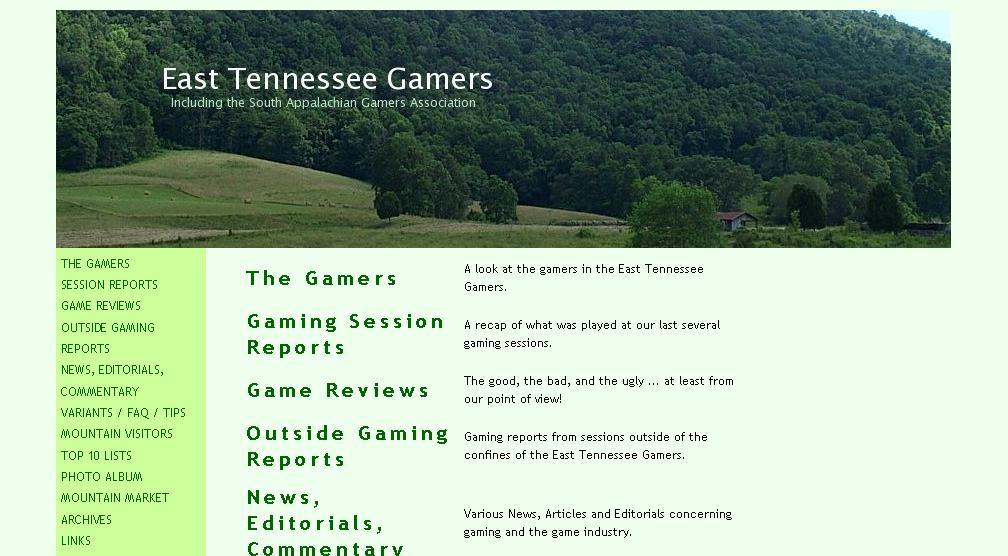
Winner: East Tennessee Gamers
Once again we pick Greg Schloesser's East Tennessee Gamers club site for it's clear navigation, rich session reports, complete bios, and other game information.
East Tennessee Gamers is our Hall of Fame pick for this category and will be ineligible next year.


Runner Up: Long Island Boardgaming Organization
Best online magazine


Winner: INDEPTH
INDEPTH is a complete full-color monthly magazine full of session reports, reviews, product information, and bonuses galore, and is our pick for best magazine or journal.
There is no Runner Up in this category.
Best online gaming site

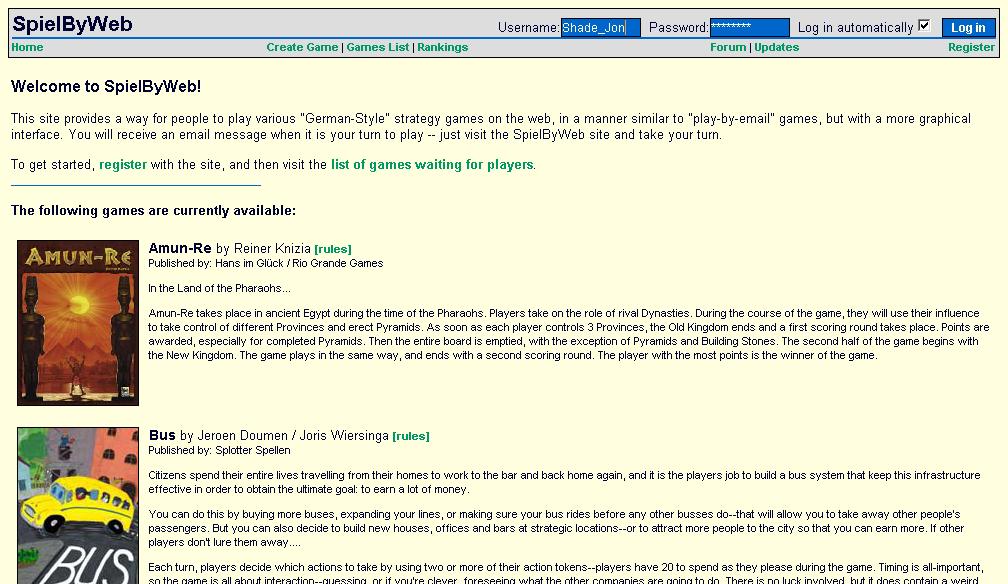
Winner: SpielByWeb
SpielByWeb continues to be an easy-to-use online gaming site with great games and no problems.
SpielByWeb is our Hall of Fame pick for this category and will be ineligible next year.

Runner Up: BrettspielWelt
Best blog



This year's winner was a tie vote.
Winner: Gathering of Engineers
Sadly ending mid-year, Gathering of Engineers was a joint blog with weekly discussion topics by some of the best game bloggers. Lucky for use, some of these bloggers continue to write elsewhere on the web.
Winner: NYC Gamer
NYC Gamer has a rich gathering of reports, reviews, analysis, and interesting writing. It jointly earns the win in this category.
Best podcast/videocast

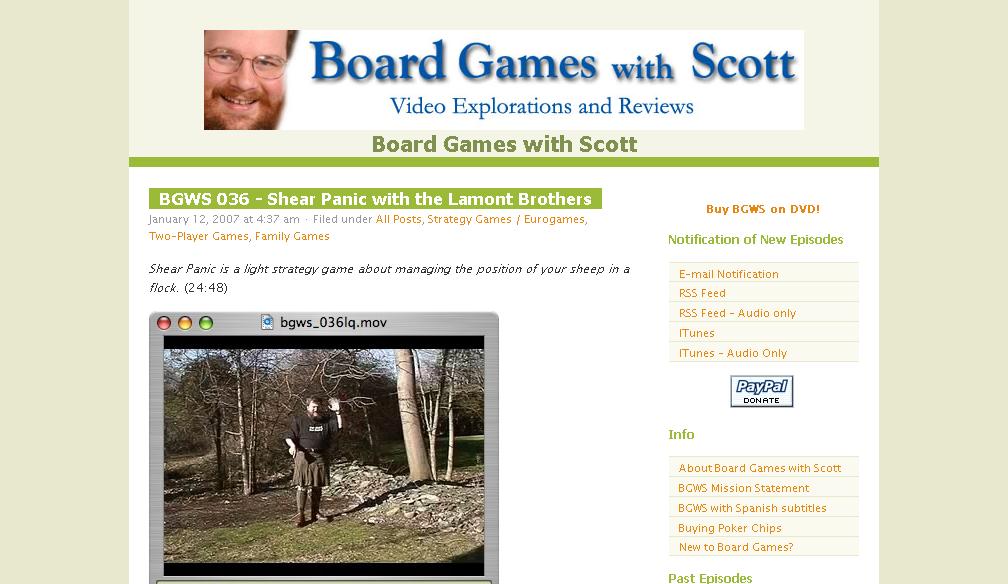
Winner: Board Games With Scott
BGWS sneaked in with a win at the end of last year, but this year really came into its own, with useful, humorous, and fluid videos about games.
Board Games With Scott is our Hall of Fame pick for this category and will be ineligible next year.


Runner Up: The Dice Tower
Best new site (2006)


Winner: Mike Doyle's Art Play
Mike Doyle's Art Play is not only a unique blog about art and form in board game design, but an incredible gallery of his unique and beautiful designs and redesigns for existing board games.


Runner Up: Journal of Boardgame Design
Best strategy article (2006)

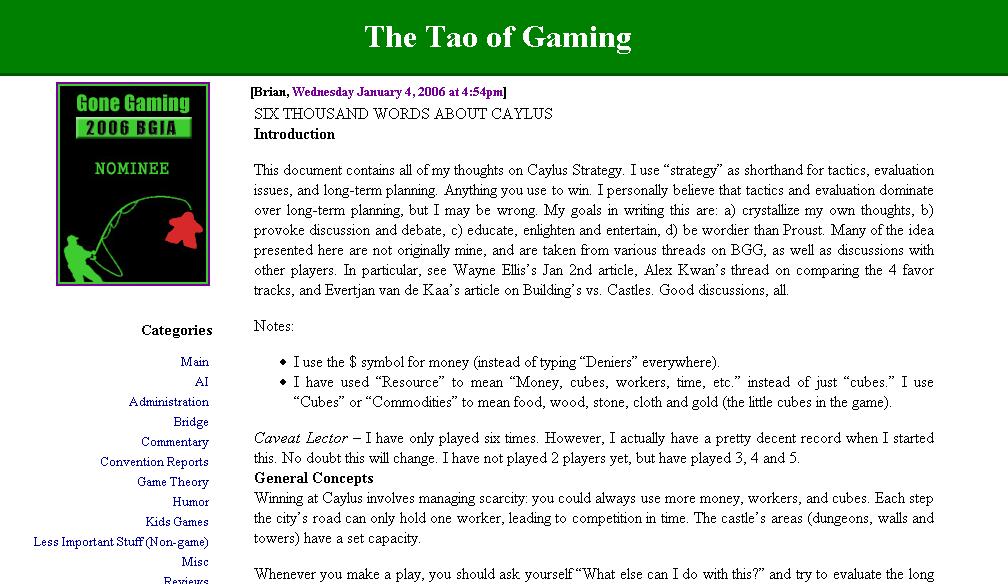
Winner: The Tao of Gaming: Six thousand words about Caylus
A huge, comprehensive, and enjoyable strategy guide to the year's hottest heavy Euro-game.
There is no Runner Up in this category.
Best review article (2006)


Winner: Board Game Geek (Tom Rosen): Carcassonne as heavy as Tigris and Caylus?!
Tom writes a clear and useful review of one of the core games of the decade, along with two of its expansions. With pictures.


Runner Up: Board Game Geek (Tom Rosen): Power Grid – Friese’s Fiddly Funkenschlag Flop
Best session report (2006)

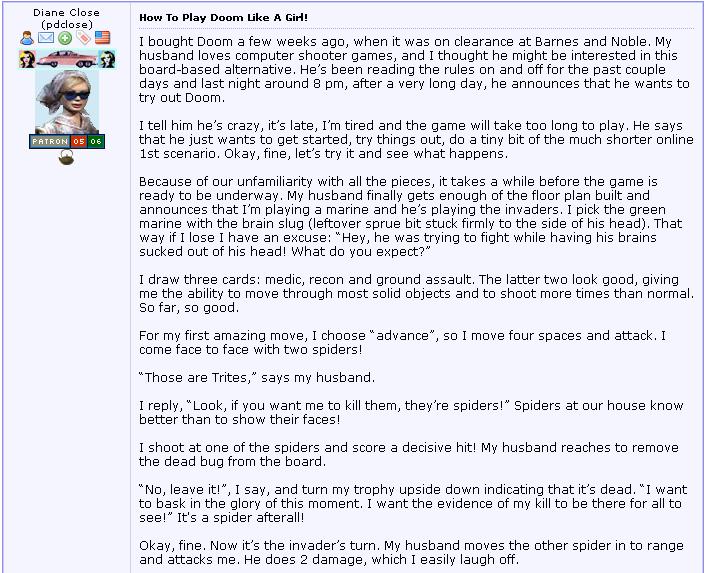
Winner: Board Game Geek (Diane Close) : How To Play Doom Like A Girl!
A surreal, humorous, and engaging first play of Doom by a woman who would prefer to go to sleep.


Runner Up: Board Game Geek (Tom Rosen): Pappenheimer Surprise
Best industry article (2006)


Winner: Chris Farrell: Here I Stand, and big decks
A thorough and interesting analysis of the effects on a card-driven war game by varying the size of the decks.

Runner Up: Boardgamers' Pastime: Fill in the Blank

Runner Up: My Play: An Introduction to Elegance
Best humorous article (2006)

Winner: Board Game Geek (Diane Close) : How To Play Doom Like A Girl!
I didn't forget to mention humorous, did I? Diane wins again for this great session report.


Runner Up: Gamer's Mind: Meeting of the Minds
Best article series (2006)


Winner: Board Game News (Jeff Allers): Postcards From Berlin
Jeff Allers writes from a unique perspective about what it's like to live and game as an American in Berlin.


Runner Up: Board Game Babylon: The Demise and Rise of the FLGS
Best downloadable board game


Winner: Scott: Pocket Civ
What more could you ask for than a portable pocket-sized game of Civilization? Thanks, Scott!

Runner Up: Axis and Allies.org: Axis & Allies Revised Historical Edition
Congratulations to all the winners and runners up. And thanks again to all of our readers for participating in the nominations.
The Gone Gaming Staff
Subscribe to:
Posts (Atom)