Saturday, March 31, 2007

Australian Toy, Hobby and Nursery Expo 2007

Last weekend, I visited the Australian Toy, Hobby and Nursery fair. Held over 5 days in the Melbourne Exhibition Centre (known to locals as Jeff's Shed, after a former premier), this annual trade-only event is also the main fair for games shops and for game sales to more general gift shops.

Proudly wearing my Gone Gaming "Media" pass, I waved the flag for boardgames (and, incidentally, for the Australian Games Expo – I think the organiser should put me on a retainer!) and scoped out what we can expect over the next year.

A poster (PDF, 1.2 MB) and brochure on "Fun and Play with toys" were available at the entry to the fair. The brochure is excellent, looking at the value of play - while it doesn't directly talk about boardgames, the quotes in it relate to all different types of play. The poster talks about "fun ways to spend 30 minutes" and is something I could see being featured quite prominently in kindergartens (preschools) and childcare centres. It includes "host a boardgame championship" and "design your own board game together" - although it also includes "Why not use your toys to re-create a soap opera like 'Neighbours'?" ...

(Note: I can't find the brochure on their website but I did find this fact sheet on the value of play.) (PDF, 1.2MB)

The message of the fair was 'licensing' – there were licensed games everywhere. Weirdest licensed property, I think, was the "Biggest Loser" boardgame – something there just doesn't sit right for me. "Learn about weight loss while playing a board game!" it screamed. I think I'd rather play Die Macher on a treadmill, thanks anyway.

There were a number of nicely-produced children's games around the fair, as well as the dross branded games. I didn't have an opportunity to play anything at the fair, so my opinion is expressed cautiously and I would love to be proven wrong.

Please note that all prices are given in australian dollars. US dollar prices are usually around 40% of australian dollar prices, but don't count on it.

Leisure Learning

– children's games

The Spider's WebSentence SaysRoundabout

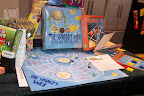
The Spider's Web bills itself as a game of escape, in which 1 player takes the role of the spider and the others play the flies. A quick scan of the rules suggested that it was a fairly simplistic roll-and-move game, but it did have a sticker proclaiming it the winner of the Creative Child Magazine Game of the Year award for 2006, as well as of several other awards.

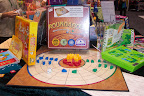
This company featured a few other games quite prominently: Sentence Says, Pet Detectives, 'Bouta Face and Roundabout (probably the most interesting of the lot – a 2-4 player dice-based game with abstract qualities - it looked quite aggressive)

Games Workshop
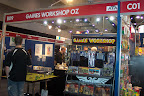

Games Workshop Oz stand


Games Workshop's stand was next. This featured their retail lines, including a new range of miniatures and their Citadel "Foundation paint" range, which they told me will "revolutionise the hobby" by reducing the need for layering of different paint colours. I'm not a minis gamer, but I was impressed with this new range of paint – it gives good coverage, good colours (even over black) and still leaves the detail on the miniature clearly visible – I saw this demonstrated with chainmail. There will be a range of online articles about painting with this range, as well as support in White Dwarf magazine. And it comes in 18 new colours (they sent me away with a sample pot of purple – now I just need to decide what gets painted before my kids find it).

Ventura Games



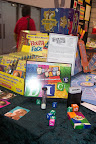
Ventura - Family GamesVentura - German and Strategy GamesVentura - Children's Games

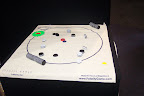
Ventura Games is one of the major games importers and publishers in Australia, and the staff have a real commitment to promoting (and playing) boardgames. Among other things, they publish a version of Carcassonne locally, making it much more affordable than other imported games. As well as labelling one of their stands "German and Strategy games," they had 'our games' scattered across their booth. I've never seen Polarity for sale in Australia, but Ventura were one of at least three distributors who were ranging it at the fair – its new box makes it a much more saleable item both for and to retailers. The newest game I saw here was Klaus Teuber's Struggle for Rome.
Polarity


Ventura also stock the Gamewright children's range, as well as a full range of chess and poker products. Their featured title was the Wildlife DVD game (International Toy of the Year 2007 at Nürnberg). Also promoted were the "Find it!" puzzles. These are tubes full of coloured beads. Each tube also contains a range of items that are listed on each end - basically, you shake the tube and mark the items off until you have found them all (a feather, a toy elephant, ...). These will go well on shop counters as once you start fiddling with one you tend to keep going.

Weirdest product was probably the "Shuffle up playing cards" – I'm still not sure I like this idea. BoardGameGeeks questioned the need for the product but we're not really its target market. I suspect there is a market there in people who don't currently play cards – and also possibly for people with a disability that makes it hard for them to grip regular cards. I doubt they'll be a big seller, though.

Funtastic


The next stand I visited – Funtastic – had strict rules against taking photos (I took one before I realised and the security guy told me off, then stood over me and watched my camera to make sure I deleted it). They had a range of licensed games, including quite a lot of Bratz games (Baby Bratz Storybook Collection 3D Memory Match; Bratz Genie As You Wish Board Game; Bratz Sweetz Party Board Game; Bratz SleepOver Board Game; Bratz Game Mall Crawl; Bratz P4F Board Game; Bratz Charmed Life Board Game) and a massive range of DVD trivia titles (Australian football, World War 2, Cricket, Cinema), and were heavily promoting a game called "Eternity II" – "the puzzle and the $2 million prize". There was no information about how to play it, or what it was about – but there was lots of fake money around the displays! I guess that was enough to get people to order it. Worldwide launch date is 28 July 2007 so I guess we will probably hear something more by then. The order form suggests that it will retail in the $50-$60 price bracket, with hint packs sitting around $25-30

My favourite of everything at this stand was Speed Stacks. Yes, folks, there is now a game of competitive cup stacking. Give me enough sets of these, and I could actually build my giant game of The Bucket King. It even comes in pink!

JP Toys
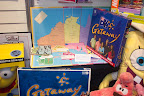

Getaway


JP Toys had a game based on the popular travel show Getaway. It's a follow-up to another successful Getaway title they've had in major stores like Target for around 12 months, and it will be out in June-July, priced around $30-$35. Players pick up an itinerary card, and must visit a number of different locations by answering trivia questions about recent events. Sometimes they have to take a detour. I had no opportunity to play this, but nor did I really want to. It will probably do well just off the back of the Getaway brand, but it struck me as unimaginative and dull, with questions about that were recent but unlikely to be remembered in a couple of years.

JP Toys also stocked a range of Popomatic games, 3-D Snakes and Ladders and Jungle Jitters, a talking version of Barrel of Monkeys. My pick of the stand, though, was the Dora the Explorer water dispenser - I'll pass on the games.

Even Toys and Games

- Playroom


Even Toys and Games - coming soonEven Toys and Games - CognoEven Toys and Games - Playroom titles

After those last two booths, Even Toys and Games was a delight. They are the Australian reps for Reinhard Staupe's Playroom titles, as well as Spy Alley, which was the Australian Games Association's 2005 pick for Game of the Year, Killer Bunnies and a range of other titles. The staff are friendly and knowledgeable and the products excellent – what's not to like? We had a sneak preview of the packaging for Bull in a China Shop (VERY different from our much-more-grown-up-looking German Elefant im Porzellanladen) and In Limbo. We enjoy Elefant and were underwhelmed by Diabolo but it should do well for non-gamers – reception at the fair was very positive. I think the very cartoonish packaging may make Bull in a China Shop a harder sell, which is a shame. Another title they were promoting heavily was Cinematique, which looks like a movie trivia game for dedicated movie buffs.
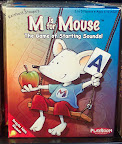
M is for Mouse


The new Playroom title, M is for Mouse, comes with three different rulesets of varying difficulty – one which we would play with Otto, one which we would play with Biggie, and one which we'd leave to Biggie and her friends because we wouldn't be evenly matched with her. Like the rest of the range, it looks like a very strong children's game.

David from Even Toys and Games spoke very highly of Cogno, a science/general knowledge game. I'll reserve judgement on this one – it looks like it could fit in well for classroom/curriculum support use but I doubt it's going to be on our list of fun family games.

JEDKO

– boardgames & puzzles
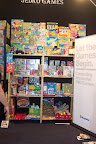

JEDKO: Children's gamesJEDKO standImagination


JEDKO, a local wholesaler with a significant retail presence in Melbourne and online, had a reasonable-sized stand with some Euros and American games displayed, as well as a big display of "garden games". They shared their stand with Adelaide-based company Imagination, who have had some success on the international market with – you guessed it – licensed DVD product. Their products feature the hosts of the appropriate TV shows – their Deal or No Deal has sold a million copies in the USA, Family Feud II around 300,000. In their "Board Games" range they have the Tetris Cube puzzle (I suspect it's a rebadged soma cube) which can be branded for companies in their colours and/or with their custom pattern. They're also selling LCR, Fact or Crap, Backwords and a Travel Trivia Challenge, none of which looked particularly exciting to me, although all are likely to be popular in the retail channel. They have two new games coming out soon. Snipe It is a trivia game where the last person to buzz in with the correct answer wins the point. Mind Twist looked potentially more interesting, but all I have is a box and a blurb from a catalogue: "Take a deep breath, and dial up 1 of 3 numbers. Will your opponent guess correctly, or can you fool them in order to move ahead? It's a battle of nerves, brains & wits, with an added twist." From a design perspective, it looks pretty impressive on the box (although there wasn't even a prototype available to fiddle with at the fair) – I have, obviously, no idea about the game play.

BLUE OPAL

– Some new Australian games



Colin and Darren, designers of the Ned Kelly game True LiesGame as Ned Kelly

The next stand I visited was Blue Opal, where I met Darren McMurtry and Colin Stott. Darren and Colin are the designers of Game as Ned Kelly, due out in June at around $40-$50 retail. This game is for 2-20 players, playing in two teams: the police and the Kelly Gang. It's a roll-and-move, but players have several pieces and can choose which piece they want to move and in which direction. The police aim to capture the Kellys and put them in the Old Melbourne Gaol; the Kellys aim to give away all their money (13 £1 notes) and escape to New South Wales. It looks like a fairly straightforward children's game with a reasonable combination of luck and strategy. There's an action card deck, but it is not reshuffled when it is exhausted; the game continues without action cards. It's nicely produced: the playing pieces are helmets and the sides of the box give information about the history of Ned Kelly. The game is pitched at ages 8+ which ties in nicely with Australian history in the school curriculum, and I'd expect it to be popular as a souvenir from museums like Sovereign Hill as well as in the regular retail channel. They also make a lightweight polypropylene Ned Kelly helmet which should be a hit.

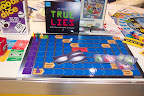
Darren and Colin have also designed True Lies, a party game for ages 7+, which will be released in May. In True Lies, one player draws a card which says, for example, "This card has the word COUNTRY." They then EITHER read it out verbatim (truth) or they change the word on the card: "This card has the word ACTOR." (lie). All the other players now bet on whether they think the player was telling the truth – they have six cards each, allowing them to bet 1-3 movement spaces on whether the player is telling the truth or lying. If their bet is correct, they move the number of movement spaces shown by their card. The person who read out the card does not move. I think this will go over well as a light party game and it should be playable by adults and children together or separately. The board is not really necessary but it does list the words on the cards, so that inexperienced players won't show their lies by using a word that isn't included ("This card has the word GUATEMALA.")

Roll over Sidney Nolan, this Ned Kelly has connectable textas


The Blue Opal stand was also home to one of the expo's funnier moments. They had someone wandering around the expo dressed as Ned Kelly, to promote their new game. Ned had attracted plenty of attention – including that of Tony Faber-Castell (of Faber-Castell stationery), who appeared at the stand in his own Ned Kelly helmet, made of Faber-Castell Connector Pens, complete with his own gun (also made of pens). I didn't see the shoot-out, but I saw Ned later, and he had replaced his gun with the Faber-Castell one, so I am guessing that the outlaw won.

Crown and Andrews

– traditional boardgames

Crown and Andrews had the usual traditional and TV tie-in boardgames, as well as a couple that looked interesting. This was where I saw the Biggest Loser tie-in game I mentioned earlier.

Make 5, designed by Matthew Browne, is a game of short words for 2+ players aged 8 and up. Each player has a sheet with a 5x5 grid. Players draw a card which shows a letter, and they fill it in somewhere (secretly) on their grid. The object of the game is to fill in your grid so as to make it show the most words.

Gibberish seemed to be some variant on competitive Mad Libs. It actually looks like something that Biggie and I might enjoy – I am a sucker for light word games, and this looks a similar weight to Scattergories.

Sorts was another new twist on an old idea. It's a trivia game, but instead of finding one answer to a question, players must identify which answers are true and which are false. For example: Which 3 of the following are insects? Fleas, butterflies, termites, dolphins, ticks. This one is a variation on a theme (trivia) that I think is pretty tired, and my suspicion is that the questions are too tricky for it to really appeal to the 8+ age group that I think the game is targeting.

The stand-out game at Crown and Andrews, though, beyond a shadow of a doubt, was Frog Tennis. I think this game rivals even the great Loopin' Louie.

(Answer: fleas, butterflies and termites are insects. Ticks are arachnids. Dolphins are neither.)

The Dr Wood Challenge Centre

- A new Australian entrant to the games market.
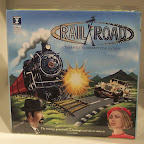

RailRoadKingdom QuestTotem


The Dr Wood Challenge Centre, an Australian company based in Brisbane, produced the "Kaleidoscope Classic" puzzle which was popular a couple of years ago. I understand it has done particularly well in Europe.

This year, they are launching a number of games onto the market. I played a couple, and looked at others.

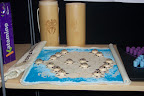
The first Dr Wood game I tried was Kaleidoscope enKounter, which is played on the Kaleidoscope Classic board. In this game for 2 or 3, players take it in turns to try to place their polyomino pieces on a board made up of squares in 3 different colours. Placement scores points for covering each space as shown on the board (there are several different boards available). Any leftover pieces at the end of the game are worth – 2 points per square. I was trounced quite resoundingly by Frank Dyksterhuis, one of the game's creators. While the game has obvious similarities with other games like Blokus (placing pieces on a board), the need to match patterns and the opportunity to vary the gameboard are quiet different and should appeal both to families and also to the more overtly educational market.

Another game based on the Kaleidoscope puzzle is kaleidoscope krusade. I didn't have a chance to play this but this looks more like a traditional game than the other Dr Wood games. It still incorporates the spatial puzzle-solving elements that seem to characterise the Dr Wood range.

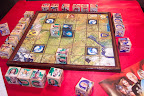
Next up was Kingdom Quest. This game uses an unusual mechanic that I've not seen before. Each player has 5 cubes, which are the playing pieces. Each side of the cube is printed with a different character – the Queen, the King, the Princess, the Prince, the Court Jester and the Knight. On their turn, a player may either place a new cube onto their 'entry' square, or move another cube – by rolling it onto the next square, showing a different face. The object is to conquer the other players' pieces, which you do by moving one of your own pieces into an adjacent square, showing the right face ("facilitating an alliance"). So if I roll my cube to make my Queen face-up beside another player's King, my Queen captures that King. The available pairs are: Queen and King (conquer each other), Prince and Princess (conquer each other), Knight and Queen (conquer each other). In addition, a Jester is so funny that any adjacent Prince or Princess is captivated and cannot move until the Jester does. A "special" Genie cube allows players to turn an adjacent cube.

This game felt very abstract to me. I could see the themed artwork particularly appealing to teenage boys (I am afraid we have dubbed one of the pictures the "slutty princess") and I really liked the novel (to me) movement and conflict resolution mechanic. I'm looking forward to playing it properly.

RailRoad is another game from the same company. Players take turns to place tiles showing either road or rail track on the board (one player takes road, the other rail). Each piece has a different number of track 'connectors'. The object of the game is to have the fewest connectors left at the end of the game; if a player may completely enclose a space (including at the edge of the board) then the opposing player may not place any of their pieces in that area.

The Dr Wood Challenge Company will be at the Australian Games Expo in June and I hope to try out more of their games. These aren't "gamers' games" as such, but there is a little more to them than the very average games that we see in the shops, and I hope that they will do well. They should be popular with the education market, as each seems to be part puzzle, part game. Their stand was excellent and the team of demonstrators (including Dr Mark Wood and Frank Dyksterhuis) was enthusiastic and welcoming. The games are available now in Australia, and will be available soon in India. Kingdom Quest is going into Europe at the moment, and they hope to have their games in the US by the middle of the year.
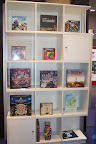
The Dr Wood Challenge Company's gamesThe Dr Wood Challenge Company's other games were:
  • Lokulus - the reincarnation of Archimedes = "the world's oldest puzzle meets the 21st century!" (Update: This appears to be a puzzle rather than a game)

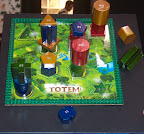
  • Totem - "To win will require all your powers of logical thinking, anticipation and cunning"

  • Akumulate = "go forth and Multiply!"

  • Kra$h - "The game is in your hand!"

  • Heist - "it will challenge your powers of deduction to the max ..." (Update: This appears to be a puzzle rather than a game)


Divisible by Zero


The Divisible by Zero stand was busy when I passed, but Blokus was strongly represented, with a giant Blokus set on display at the front of their stand.

Divisible by Zero have done fantastic work promoting Blokus and ensuring its very wide availability in Australia.

Funatical
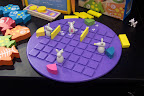


Quoridor KidsPowershot SoccerTortuga

Funatical are another big Australian games distributor. Their excellent stand featured Squatter, represented by its inventor Robert C Lloyd, who was absolutely delightful to chat with. Squatter is a favourite for Fraser and Biggie to play, and it is now over 40 years old.

Funatical had the Gigamic games range including children's versions and the new adult game, Tortuga; the GIPF range (which doesn't do well in Australia, for some reason); a range of Swedish children's games from publisher Användbart Litet Företag that they have just started to bring in; and many other games.
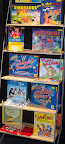
children's games from Sweden


I was interested to see Khet, as well as the Eye of Horus Beam Splitter and photos of a prototype 2-level tower which actually reflects the beam up to the new upper level tower of the game.

Funatical were also looking at a copy of Zoch's San Ta Si which looks interesting not least because it is by Jacques Zeimet, designer of our new favourite gateway game, Bamboleo.

Powershot Soccer, a new card game from Singapore, looks like a winner. Each deck represents a different team in the soccer league, with a different spread of abilities. Players play 'matches' against one another and the word from those in the soccer know is that this is an engaging and well-thought-out game.

Funatical also had a couple of new Australian games.

Hotchpotch gives players 9 letters (including one 'mandatory' letter) which they must combine to make words. This reminds me of the 'target' puzzles in my newspaper which I do religiously for a few weeks every year before getting sidetracked by something else. It should do well in the Boggle space and should be popular with children and possibly also with older people who enjoy word puzzles.

Schmegeggie is a new Australian game, which will be released in mid-year. It's played with cards and tokens; mixed in with the regular cards are 5 'cancel' and 6 'schmegeggie' cards. Each schmegeggie card shows a different victory condition – but only the last one to be played will actually apply to the game. This sounds light and fun and is one to watch for.

Wrap-up


I hadn't been to a trade expo for years, and I forgot to wear my comfy shoes, which wasn't such a great idea. It was a good show to visit, despite the relatively low percentage of stands with boardgames and the lack of opportunity to actually try any of the games out.

It was disappointing not to see Ravensburger, Selecta and Haba represented at the fair. (Biggie will be disappointed that I didn't see any Winx Club branded anythings, either). Licensed properties, especially with a DVD, are clearly a big money-maker for companies; it's disappointing that there aren't more really good games of this type being produced. The companies that do buy and sell quality games are promoting them much more than in the past, but they're still a long way from the mainstream. Demo copies definitely help, as do enthusiastic and informed demonstrators.

Now if only I could find the name of the distributor with the life-size inflatable DALEK, my life would be complete.

More photos (disclaimer: they are happy snaps, not professional publicity shots!)

Happy gaming!

Melissa

Friday, March 30, 2007

The Head and the Heart

The other night at the Appalachian Gamers meeting, I played just two games: Beowulf: the Legend and Goa. I had never played Beowulf before, but I remembered Chris Farrell raving about Knizia’s game on his blog, and I had been wanting to try it. I had tried Goa just once a year or more ago, and I had only vague memories of it. It was time to give this well-regarded game another go.

It wasn’t until I was reflecting on the evening that I realized that the two games appealed to different parts of my anatomy: the head and the heart. Or maybe I should say, the head and the gut. I mean that although Beowulf required thought, it seemed to be primarily a suspenseful emotional experience. Goa, on the other hand, seemed to be a very cerebral game which touched my emotions little or not at all.

It’s easy to see why Goa appeals to the head rather than the heart. After the auction phase at the beginning of the turn, the game is multi-player solitaire. Also, players steadily advance toward victory; there are no major catastrophes in the game to inspire nervousness. And it is difficult to tell who is winning. Progress often seems to come in small incremental steps, and dramatic upswings of fortune seem to be almost as rare as disasters. All of these factors make Goa a game in which players constantly ponder how to advance their cause most efficiently—and feel little suspense about the process.

If there is a problem with the game, it is that the strategies seem so subtle that I’m not sure how to improve my game. Other than trying to be a bit more economical during the auction phase, I don’t know what I would do differently next time to improve my score. If Goa has limited appeal, it may be because the game’s very virtues make it more brainy than some gamers enjoy.

In contrast, Beowulf is a surprisingly suspenseful auction and hand-management game that could be mistaken for a skill-less luck-fest. The major luck element comes into play when players arrive at Risk spaces and draw the appropriate required cards or receive a minor injury token. This card-drawing Risk event can also take place during auctions when desperate players try a last-ditch maneuver to get the cards they need and stay in the auction.

In our game, most players proved to be surprisingly lucky most of the time, and remarkably lucky once in a while. In one memorable auction, player after player drew cards to stay in the auction, and time after time they were rewarded with the correct cards. This surreal experience generated lots of stunned laughter after creating tense suspense. These auctions can wear on a player’s nerves because the losers may suffer severe penalties even as the winners reap rich rewards.

It seems to me that lots of games appeal primarily to either the head or the heart. In many cases this can be an over-simplification, of course, but it can also be a useful tool when deciding what kind of game will appeal to certain players. If you notice that a particular player avoids abstract cerebral games, you might try offering an emotion-laden game and seeing if that will appeal.

Some games that I think of as primarily cerebral are Puerto Rico, Caylus, Reef Encounter, Silk Road, Taj Mahal, Die Macher, and Power Grid.

Some games that I think of as offering more adventure, suspense, and emotion than strategy are Lord of the Rings, War of the Ring, Descent, Arkham Horror, Fury of Dracula, Railroad Tycoon, Ticket to Ride, Around the World in 80 Days, and Shadows over Camelot.

It is possible for a game to move from one category to another. When I first started playing War of the Ring and Railroad Tycoon, they were strategy games that required a lot of thought. But lots of experience with these games has reduced the difficulty in decision-making because the best move now often seems obvious (whether the seemingly-best move really is the best is another matter; it may be that familiarity breeds over-confidence). Once familiarity with a game makes decision-making seem easy, the experience of playing the game for me is often less about the strategy and more about the fun of the journey.

Some games are in transition for me. I’ve played Union Pacific enough to have a good grasp of the game, but I regularly lose when playing against the other Appalachian Gamers. Maybe if I played Union Pacific another dozen times or so it would seem more emotional than cerebral. But right now, for me, it straddles the categories.

There’s no reason you have to dissect your emotional/intellectual experience of playing games. But doing so can yield surprising results. If someone asked me if I enjoyed brainy games more than emotional ones, I probably would have answered with an energetic yes. But if I ask myself which game I enjoyed more, Goa or Beowulf, the answer is not so clear. Thank goodness there is time enough in most gaming evenings for both types of games.

Thursday, March 29, 2007

Anatomy of a Game: The Carcassonne Standalones, Part Two: Rules Changes

Welcome to what just might be my last game design article on Carcassonne. In case you've missed them I've written five previously. The first four extensively covered the main game and its expansions while the last article instead looked at the standalone variants, and examined how their tile selection and scoring differed.
This week I'll be continuing my look at the six standalone Carcassonne games and taking a look at how each one offers different answers to some major game design questions. I've identified three major elements, each of which differs quite a bit from game to game. Examining them offers some interesting insights both into game design and how the Carcassonne series has changed and evolved.


Orig.H&GArkCastleCityDiscovery
2-Tile
Penalty
Scores as
Unclosed
No
Nugget
None
Minimal
Smaller
Market
Value
Scores as
Unclosed
Edge
Matching
Yes
Yes
Yes
No
No
Yes
Stuck Meeple
Balance
None
Minimal
Ark
Easier to
Recover
Easier to
Recover
Recover

We'll look at each of these elements in turn.

2-Tile Penalty

The original rules for Carcassonne (and the ones still used in the "official" Rio Grande edition) call for a 2-tile penalty: if you make a city out of just two tiles, you only get 2 points, not 4. The reason behind the 2-tile penalty has never been clear to me. I suppose Jurgen-Wrede thought it was too easy, and that it might encourage tactical in-and-out play where you never got to build larger cities. But, having always used the current German rules for play (which get rid of the 2-tile penalty), I just don't see that, and generally I don't see any reason that allowing two tile plays might be a bad thing.

Conversely it was pretty clear that the rule to disallow them was a bad thing. It added unnecessary complexity to the game by introducing a seemingly arbitrary special case. The SdJ committee was probably correct in demanding that it be removed, and I expect the game is better for it.

Only one standalone game has tried to match the original game's rule, and that's Discovery, and I think the results speak for themselves. Though Discovery is for the most part an elegant game, it introduces the 2-tile penalty to every type of terrain which adds an intimidating grid of possibilities to the game where each terrain can be scored in three different ways, which turns out to be the biggest barrier to getting people into the game.

However, if we assume there is some good game design reason for the 2-tile penalty, we might not want to see it utterly removed. Instead more elegant mechanisms should be constructed where players don't have to remember an arbitrary rule, but instead play as they are "supposed to" because of more organic gameplay mechanics. A few of the other Carcassonne standalones show how this can be accomplished.

Hunters & Gatherers introduces an organic 2-tile penalty in a very clever way. All of the forest tiles except "caps" have gold nuggets on them. The result is that if you make a 2-tile forest you don't get a nugget, while if you make a forest of 3 or more tiles, you do. (And you want the nugget, because it gives you an extra play.) This pretty much exemplifies how you can take a rule and turn into an integral part of the gameplay instead.

In City Jurgen-Wrede does something very similar. Markets score based on how many colors they include, and there's just one color per tile, so you're encouraged to build markets to include all three colors--which will be at least three tiles. Like H&G this is a great alternative to the original because it depends on the pieces not the rulebook.

(Conversely Ark just ignores the 2-tile issue, while Castle mostly does; in the latter you're encouraged to build big houses to score the "largest house" and you might work on a big house or tower if you have a doubler tower bonus tile, but you won't encounter either element in every game.)

Edge Matching

In most of the Carcassonne games you have to match every element on the edge of tile. However in Castle you only have to match the roads, not the other terrains. Jurgen-Wrede then mirrored this approach in City.

The difference has a few different results, but I think the largest has to do with 2-player game.

After numerous two-player games of Carcassonne I've come to the conclusion that it fails as a 2-player game, at least for casual and fun play with your family. The reason is that it's too easy to get into someone else's terrain. Particularly with the original set of Carcassonne it's often possible to play a single tile that will almost automatically grant access to your opponent's large city or field. Granted, there are ways to play the game better to try and avoid this, but sometimes you just have to take chances, and if you do the opportunity of getting screwed is really high in a 2-player game.

This is a result, I suspect, of Carcassonne being designed for multiplayer play rather than 2-player play. In a 3-player game it's fun to have two people in a terrain because it creates cooperative opportunities, and at the same time you have two people trying to keep that third person out of the terrain. Conversely in a 2-player game if someone shares your terrain with you it effectively takes all of your points away. You can spend a few turns building, and then your opponent takes it away with a single play.

The partial-edge-matching of Castle and City is exactly what's needed to fix that. A player can no longer play a single tile that can give him almost guaranteed access to your terrain. Because there are so many tiles that can be played in any location, you're much more likely to block him. On the other hand there's still some opportunity to get in, if you can match the roads before your opponent can. Thus it's a nice match of risk-tasking where the risk and reward are in much better tune for 2-player play than in the edge-matching Carcassonne games.

Stuck Meeple Balance

I've long thought that the expansions and variants of Carcassonne have largely served to resolve problems in the original game. One of those problems was definitely that your meeples could get stuck, slowly decreasing your options (and frustrating you!) as the game went on. Expansions to the original Carcassonne just tended to multiply this problem by extending the game length (and thus giving you more time to lose your meeples). Conversely some of the standalone games have tried to solve it.

Hunters & Gatherers, the first standalone didn't really do anything. You can sometimes play huts if your meeples are stuck, but those huts also resulted in you having a smaller number of meeples which can make the problem worse.

Castle
and City didn't directly address the problem either. However the partial edge matching makes it harder to totally block a space, and thus it's more likely that your meeples will come back you. They also both introduced city walls which can speed up the process of getting your meeples back by blocking off one (or more) sides of a terrain. These all combined to offer a pretty decent solution to the issue.

Then, wwhen we get to Ark and Discovery, we find that each game much more explicitly offers an alternative to the stuck-meeple problem through an alternative action that you can take rather than picking a meeple up.

Ark is a bit more elegant. You can move the Ark of the Covenant around the board, and when it hits your meeples on the board, you get points. Thus not only do you have an alternative action when you can't place a meeple, but you actually can be rewarded for your meeples being stuck.

Discovery instead attacks the problem dead-on. Instead of placing a meeple you can remove a meeple, scoring it as you do. So that life isn't too easy you only get half the normal points if the terrain wasn't closed.

Both of the latter solutions work pretty well, while conversely the partial-edge-matching is a decent answer too, meaning that all four of the latter standalone games have pretty good solutions to this original problem.

Conclusion

When I first started playing Hunters & Gatherers , I thought, "This is Carcassonne done right. I can no longer say that, because I think every variant of Carcassonne has improved on the game in some way. Generally, I'd rather play the variants than the original as a result.

Overall, if I had to pick, I'd say that Castle and City and the two best. This is primarily thanks to Reiner Knizia's design. He's one of my favorite designers, and Jurgen-Wrede was very right to pick up many of his ideas for City.

However, as this and the last article shows, there have been improvements through all the Carcassonne variants, and they've pushed the original game's design in interesting new ways.

Wednesday, March 28, 2007

Good News/Bad News


Here in the lovely Black Hills of South Dakota, it looks and feels like Spring is here; the grass is turning green, the bulbs are flowering, the honeysuckle and apple tree are coming back from their winter’s rest and the temperatures recently are anywhere from cool to down-right hot. That’s the good news.

The bad news is that this means there are lots of chores to be done. Anyone who owns a home knows how long that list can be and the more you do, the more things you think of that need to be done. The result is there’s less time to play games and so little energy left in your tired body that you can’t even work up the desire to set up a game.

I recently bought Combat Commander since I couldn’t deny the inner child in myself any longer. Actually, the game was my 25th Wedding Anniversary gift from my husband. Anyway, I’ve gotten to play through the sample game twice—once with our friend, Mike, when he dropped by the day after I got it; and once with my husband, Richard—and the first scenario once with Richard. From that little bit of experience, we all agreed we liked it. There are a lot of rules to deal with, many which are easily forgotten in the heat of battle, but at its core, it’s not that complicated. I like the hand-management even though, or maybe because, it’s very different from the command & colors system.

I’ve been anxious to play again ever since but life keeps interfering. Don’t you hate that!? Work and exhaustion have kept us from setting it up and really getting into it. I’m dying to delve into it and explore the different scenarios, and become comfortable with the game play but no…the yard needs to be raked/watered/mowed/seeded/fertilized, the bikes (motorcycles, that is) have to be maintained, the dishes/washing/dusting/vacuuming have to be done, and my husband has to go to work and earn money. What a nuisance!

All of that just to explain why I don’t have something interesting for you to read today. Maybe next time. Until then, I hope you get more game time in that I do!

Mary

Monday, March 26, 2007

Magic Realm Part one - Why?

Following up on my theme of games that promote obsession1, I am left to recount the past two months2 of time spent with an old Avalon Hill flatbox. This flatbox happens to be Magic Realm.

I've broken my thoughts into two parts - this one covers why I remain interested in this game, and why i spent two months learning how to play (again note, that is learning -how- to play. Not actually playing.)

Awe-inspiring is the third edition rulebook. Over 100 pages (including index and reference sheets), this tome will consume not only your printer, but your mind. I spent at least a week pouring over the rules, trying to give myself a solid foundation in the rules. While I eventually succeeded, I am still incapable of finding the answer to a question quickly. The index is not as stellar as it needs to be.

So, why should anyone bother with Magic Realm now4?

Magic Realm is one of the first adventure boardgames release in the late 70s. It took on an Epic status early, primarily due to the incomprehensible first edition rulebook, later redone in a 50% better version known as second edition. The seventies had seen the rise of Dungeons and Dragons, and Magic Realm was Avalon Hill's response for a complex fantasy themed game. As a historical period piece, it is very interesting. But that's probably not enough to convince you to plow through a 100 page rulebook and then coerce your friends into a game.

Magic Realm has several features that are noticeably absent from most other adventure boardgames.

1) It has a wide range of truly different characters to play. Characters can be divided into four general groups - light armor, heavy armor, light magic, and heavy magic. While each character demands different approaches to the game, the differences between the general groups is particularly dramatic.
This is a strong contrast with games that followed. Most other games have only superficial differences between the characters, and each player will follow a very similar path towards the end of the game.

2) Cooperation and Conflict between players is open-ended. Players can cooperate to their mutual benefit, or choose to go on a spree of player killing. There are no game mechanics that enforce cooperation or conflict (like newcomers Descent or World of Warcraft), but the game system supports choice in player interactions.

3) Combat has a strong Deterministic component5. In most adventure games combat is directly tied to a die roll. In Magic Realm, depending on your character, you can predict the exact outcomes of a one-on-one fight prior to the encounter. For example, the swordsman (thief-type) can automatically run away from almost any enemy, but successfully kill very few.

4) As much detail is placed on Civilization as the Wilderness. In addition to the requisite wilderness filled with beasties and treasure, there are 'dwellings' and
'native groups', or factions of knights, rogues, wandering mercenaries and more. Players can attempt to hire or fight these Civilized enemies. Some of the characters are actually best utilized to fight natives, not monsters!

5) Extensive Magic system. Lots of spells, and a system of casting rituals, colored mana and more. A level of detail that you would expect out of an RPG, not a boardgame.

6) Random setup A full set of hex tiles and a slightly complex setup that allows for the semi-random distribution of monsters and locations. Good stuff, promising extended replayability. This is probably the least unique feature, with mention going out to Return of the Heroes for a similar concept.

--

If all these ideas have intrigues you, let's tease you some more. Here are what I consider the big myths of Magic Realm.

1) The game (or Setup) takes forever. Certainly not true for multiple playings, what really takes forever is the first person learning the rules. Gameplay itself moves at a good clip. Setup is complex, but is comparable to setting up all the different card decks in a game of FFG's Arkham Horror. However, compared to a modern boardgame, this game is not playable 15 minutes after the box is opened. I believe that this myth comes about from people attempting to sit down and play Magic Realm with only a passing familiarity with the game, or none at all. I have never successfully consulted the rulebook in under two minutes. In total, the two fully face-to-face games I played both ended after about 3 hours (including setup and rules)

2) The game is Hard. Actually, the game is easy. Again, it is learning the game from the rules that is hard. It's hard to define why. Here's a number of reasons that might be true: Poor rules, Complex non-intuitive rules, multiple subsystems, Poor graphic design (more on this later). Ultimately, Magic Realm played with one person who knows the game is fairly easy to grasp and play.

--

There's one item that I don't think enough is said about - and this is where my obsession breaks down and betrays me. The Counters. Magic Realm has a large number of counters, and when I sat down to inventory my copy of the game, I found that it was in fact First edition. Which meant that the errata for the counter manifest is about a page long. There's a recommendation in the rulebook to simply toss your counters and buy ones from Second Edition.

Instead of doing that, I tracked down a set of redesigned counters (easy enough - linked off the 'geek) and set about recreating the game of magic realm in cardboard and color printing. I'm not completely finished, but by the end of my second game, I was never so glad I spent hours on a craft project.

The redesigned counters take about a hundred pounds of rules weight off the players. I would not recommend playing this game without the new counters - they are simply that much better than the original avalon hill ones. Why?

1) The new counters contain all the information necessary for the monsters. Using the old avalon hill counters you are missing about 3-5 pieces of data about each monster, which you will have to look up in the rulebook.

2) The second thing they do requires some rules knowledge - which I've been avoiding because it's easy to find rules recaps elsewhere. In Magic Realm, when your character moves into an unexplored tile, they find either a site or a sound chit (or both). This chit determines what monsters could be present in the tile. On the original AH counters, the chit might say 'smoke'. When you roll for monsters, you will cross reference your die roll with a chart, look down the row for any instance of the word 'smoke', check back onto the board to see if you are on a mountain or Cave tile, then get the right monster.
The New counters say 'smoke [2] Dragons' When you roll for monsters, you look at your tile, and if the number you rolled matches the number on the chit, you grab the next available monster of that type. It's easier, more intuitive, and it lets relatively new players predict what is about to happen in the game.

If you are going to play Magic Realm, Get the counters. Make them. They improve the game.

Next week I'll get into what might stop you from playing Magic Realm, and how the age of the game presents some barriers to play these days.


ciao

aaron

--


1 To recap - games that suggest, or even demand repeat play to fully enjoy. The reason behind this can vary from deep strategy, incomprehensible rules, complex rules, or sheer fast and furious play. Magic Realm itself promotes obsession at first through incomprehensible rules, passing briefly through complex rules, and eventually settling into the new category - one million variants.

2 Two months, two face-to-face games. 3 Ouch. Ratio of play to obsession time is quite low here...

3 Okay, this is the requisite mention of RealmSpeak. RealmSpeak is a Java based implementation of Magic Realm. It turns the above boardgame into a computer game, either for a single player, or networked for multiple players. There are some incomplete sections (certain spells, etc), but for all intents and purposes it is fully playable.
I have played a large number of solo RealmSpeak games in the past two months. First to help figure out how Natives worked in combat, and then later to try to quantify the various parts of the game. It is kind of like playing Ticket to Ride online. It's tons faster than the board version, but ultimately leaves the player without a real understanding of how the game is played. I find this to be a general failing of computer implementation of games. Without the actual rules knowledge, some decision making becomes compromised (more true with Magic Realm than with Ticket to Ride).
RealmSpeak is okay. It is both better than the tabletop game, and much worse. Worse, because when sped up, Magic Realm becomes more pedestrian and sterile. It is better because it does all the work for you. Ultimately, I have to ask myself why I am playing RealmSpeak. Is it because I can't get anyone to play Magic Realm with me? then fine. If it is because I want to play a solitaire computer game for awhile, then there are probably better options...

4I actually found that MR had more buzz online than I expected. I think much of it is due to RealmSpeak (see 3).

5 For those 'in the know' I'm referring to the base combat rules, not the optional combat rules, which I'll eventually address.

Saturday, March 24, 2007

Some early thoughts on CRTs and Card Driven games.

I had pretty much drifted out of wargames before card driven wargames became popular and as such have only relatively recently played any card driven games. My experience so far is limited to Memoir ‘44, Command and Colors: Ancients and Combat Commander: Europe, although I expect this list to grow over time.

I suppose I grew up on CRTs (Combat Result Tables), sometimes they were on charts on other games they were printed on the map or board. Usually it was just a matter of adding up the attacker’s strength and the defender’s strength dividing the attacker’s total by the defender’s and finding the ratio on the CRT. Then roll the die, in some games a modifier was possible due to other factors such as air support, weather etc. The die roll meant that usually you were not entirely sure of the result. To me the randomness of the die roll meant that it was the influence of things that you could not control, or had not taken into account when planning the attack. Depending on the game it could be anything from local weather conditions, morale, timeliness of supplies, improperly maintained equipment or just plain dumb luck. If you had a huge majority you could be reasonably confident of a victory, however the smaller your majority the less confident you could be of any level of success.

At times in history battles, both big and small, have been won against seemingly impossible odds, the CRT with die roll helps simulate this.

In card driven games the CRT has been replaced by rolling hits on a die. The stronger the attacker the more dice they roll (or in the old system the better column they were on). The same basic outcome applies, with a large majority for the attacker you would be more confident of winning. As the attackers strength decreases, your confidence of winning also decreases.

In the traditional hex and counter wargame, you could usually move all units every turn, subject to supply and interlocking zones of control of course. There may have been some games that had something akin to an action point system, i.e. you only had a certain number of moves, or a certain number of action points to spend each turn, although at the moment I can’t actually name any.

In the card driven games I have played so far, you are restricted to moving units based on the cards you hold. It is rare to be able to move or order all of your units to do something in a single turn unless you have very few units left of course!

As all the card driven games I have played so far are at a tactical level, this would seem to simulate that you cannot have command and control over all the units all the time, you are concentrating on some of the forces at your disposal at any given time. Of course it could be argued that if you had ordered that if you had ordered a squad to advance to the farmhouse engaging any enemy units that it encountered, you don’t really need to be concentrating on that unit until it has reached the farmhouse. A little bit swings and roundabouts really, although it can certainly be frustrating when you want to order particular units and you just don’t have the cards for it.

Games like Combat Commander: Europe have done away with physical dice and have a multi functional card deck. The cards are the subset of orders that you can issue your forces, they can also trigger random events, resolve the random events, have functions separate to the normal orders at special times (e.g. when the deck is complete) and replace the dice rolls and as such function as a dice deck. As far as I can tell the Combat Commander: Europe deck is two complete result sets of rolling 2d6, i.e. there are two “2”s, two “12”s and twelve “7”s. Any given turn of the card in isolation is the same as roll 2d6, however as you work your way through the deck this becomes less and less true, because the result set in the last few cards in the deck is strictly limited, where as with the roll of the dice the complete result set is available at all times. For example in my first game of this I had seen all the eleven and twelve results already appear so I started burning through the end of the deck as quickly as possible so the deck could be reshuffled and they could be put back in the mix of the result set. This phenomenon can on occasions influence tactical decisions, but is not a game breaker.

As I said at the start my experience with card driven games is limited, I would be interested in seeing if there are many strategic or grand strategic games, my gut feel is that the mechanic is more suited to a tactical level. I presume over time I will find out, it should be interesting.

Friday, March 23, 2007

Download the Rules

One of the more useful miracles that the internet has wrought in the gaming hobby is the ability to download the rules of games you have not yet played, and indeed games that have not been published yet. Some smart publishers post the rules on their websites shortly before their games are available, and this can be a fine advertising tool. If the game company is willing to show me their rules before I buy, I feel certain that the company is confident about their product. And reading the rules has turned some of my considers into must-buys.

Here are some recent games that have offered downloadable rules and my responses to them.

Age of Empires III

Because of positive reports from people who had played the prototype, I was already interested in this Glenn Drover game before I read the rules. After reading the rules, this game soared to the top of my must-buy list. It has a lot of elements I like: it is a Euro-wargame hybrid, it features the agonizingly-fun worker-placement mechanism, and it has special ability tiles (another favorite design element).

The Pillars of the Earth

This game seems to send people into two camps: those who think it is Caylus Lite, and those who don’t. But most people in both camps seem to have positive things to say about the game. After reading the rules, I’m tending toward the Caylus Lite camp. And for me, that is a very good thing. I hope this is available soon so I can get a copy.

Caylus Magna Carta

The real Caylus Lite. Before reading the rules, I was wondering if I really needed a simplified version of Caylus. I love the regular version, but how many versions do I need? After reading the rules, I began to have visions of playing something other than Ticket to Ride with my in-laws. This version may be quick and simple enough to appeal to non-gamers.

Coliseum

This is the one case when reading the rules made me not want to buy the game. It’s not that Days of Wonder’s new auction and set-collecting game won’t be fun. It looks like a quality game, and seems to have the wonderful physical production that we’ve come to expect from Days of Wonder. But if I am going to buy a set-collection game, I’d prefer it to have a touch of the wargame about it (as Age of Empires III does). One of the Appalachian Gamers will probably pick this up at some point, and I will probably play it and enjoy it. I just don’t feel I have to own it ASAP.

Owner’s Choice

This stock market game from Z-Man Games seems easy-to-learn and quick-to-play (the rules were only about six pages long). This looks to be another game that may appeal to non-gamers. I’m not going to pre-order this immediately, but I will be watching out for reviews.

If you’ve seen those announcements on Boardgamenews or the Geek that rules downloads are available, but you have never taken the trouble to actually click on them, I would advise you to reconsider. Especially if you buy several games a year that disappoint you. Research and rule-reading saves money and heart-ache.

I could belabor this point, but you get the idea. And besides, the rules for Guatemala Café are waiting to be read.

Thursday, March 22, 2007

The News in Reviews / Old Puzzler Answer / New Fortnightly Puzzler

The Allure of Classic Games

Lately, I've been playing a lot of checkers and chess. I still play several new games a month, but I go back to these games again and again.

Why? Newer games offer more variety, theme, and a ton of varying levels of difficulty, all for the player to choose to his or her liking. Newer games are prettier and clever and often accommodate more people.

However, classic games hold a certain magic over me. What classic games lack overall they make up in hardiness and depth. Let's take a closer look.

1) Time Already Invested. In recent years, I've added Cathedral, Gipf, Jambo, Hive, and Pente to my two-player arsenal. These are good games. Pente and Gipf in particular I hold in high regard, but I don't go out of my way to play them. Probably the games I've played the most often out of the newbies are Pente and Cathedral and that mainly because they're such short games. I have put in thousands of hours playing chess and checkers over the course of my life. I have a certain loyalty to those games because of it.

2) Magic in Combinations. Many newer games I've played incorporate combinations into the game play which is a great thing because combinations spark the imagination. Magic: The Gathering, Jambo, and Puerto Rico all have neat combinations to be made; the first two with card combinations, the latter with well-timed actions. But the combinations are pre-set. The creator made the game with those over-the-table combinations in mind. I had a fascination with M:TG for two years, but eventually, the repetition of game play wore on me. The card combinations that the designers created were eventually combinations that I discovered and used. This got boring. In chess and to a lesser degree checkers, the combinations are born of the moment. Some get repeated, but some I'll never see again. The pieces have an inherent combinatorial power that is inexhaustible. I play for that magic.

3) The Advantage. In many newer games I've played, say Yspahan or Louis XIV, the "advantage" is that you're winning. You get the lead, and barring a massive mistake, you keep it. Other Euros like Puerto Rico simply eliminate the scoring track, but it doesn't eliminate the idea that if someone gets ahead they can usually keep the lead. Checkers is like this as well, but you do have fighting chances. Chess on the other hand has a beautiful advantage-making capacity built right into it. For players at my level (intermediate or ~1600), retaining a subtle advantage becomes a game in and of itself. My opponent can attempt to negate it or work around it; the main idea is that the game is far from over. I can't just cruise to a victory off a little advantage. The advantage is slippery and must be fought over. I love that.

4) Easy to Find Opponents. These days, you can find so many games on-line. Brett Spiel Welt is an amazing resource for gamers. Yahoo! has its own amazing array of games, both traditional and non-traditional. If you're a gamer, the internet is for you. But I prefer person to person games, and I'm not just going to happen to stumble upon a six-player game of Power Grid. Those have to be planned. Chess and checkers, on the other hand, are played around Missoula. I can walk into a coffee shop and stand about a 65% chance of finding a game of either.

5) Willingness to Explore Depth. Many of the newer games I like best offer depth. Power Grid, Caylus, Goa, El Grande, Puerto Rico, and Taj Mahal all have depth to them in their own right. They are heavy games, and the designers have earned their depth. I can't really say that I like one newer game's depth over another's. I like the thinking involved in all of the above games. It comes down to my willingness to explore a game's depth. I just don't see myself playing for an extended period of time with any one Euro-game. I'm much more of a flavor-of-the-month type with Euro-games. With checkers and chess, I am committed to learning much more than I have right now. Perhaps it's a combination of some of the above listed reasons; I don't know. They say checkers is a solved game. Well, not for me, it's not. And chess's depth is so dark and miserable; it goes on forever. Somehow, that appeals to me.

6) Exclusive nature. This is my one beef with these otherwise great games. Most of the Euro-games I've played allow me to interact with a group. I love that. The more I get comfortable playing with people over the board, the more I can joke around with them and get to know them outside of the game. With chess and checkers, I tend to completely shut out the world. I rarely joke. I find myself responding to questions about dinner with vague interest. It's terrible, really, this power to cut off everything. And yet, if it didn't have this aspect, I probably wouldn't be playing it as much as I do.

I don't believe I'm alone in these beliefs, and I doubt seriously if anything will change during my life. But I'm curious about the other side. Who favors modern games better and why?

Thanks for reading! That's the News in Reviews!

***********************************************************************
***********************************************************************
***********************************************************************
***********************************************************************
***********************************************************************
***********************************************************************

Old Puzzler

Q: What do all long-distance hikers start out with?Here's the two-word answer, in code:5.8, 1.4, 14.1, 11.7 4.2, 7.6, 10.9, 2.3Crack the code to get the answer.

A: SOFT FEET – You round all the numbers to get 6, 1, 14, 12 and 4, 8, 11, 2. Then you take the first letter of each number to get the words. And while there are bound to be a handful of hikers with trail-worn feet, the vast majority have 'soft feet.'

***********************************************************************

New Fortnightly Puzzler

I'm thinking of two syllables. Let's call them Syllable A and Syllable B.

If you said A-B-B, you'd get a classic insult.
If you said, A-A-B, you'd get a modern musician.

What are the syllables?

Wednesday, March 21, 2007

GenCon Trade Day

As a teacher, I’m always on the lookout for games that could possibly be used in class. Unfortunately, I’m a high school science teacher, which significantly reduces the possibilities. If I were a social studies teacher, I could look to card-driven historical games which are in a mini renaissance at the moment with games like Here I Stand and Twilight Struggle having significant historical content. (In fact, the historical event cards made my wife a fan of the area control/light wargame Twilight Struggle. One of the upper level teachers in my building has a home-brewed World War II game that is played over several weeks as part of a modern history class. I believe this is the same instructor who does a class-wide simulation of the oil rush along with barons and shady dealing.

So, without wars and historical events to bring a game into my classroom, I settle for those games in my collection that either encourage logic and reasoning or have a decent level of science-related theme. Logic games are quite popular, the two most common styles come as puzzle-type games like Rocochet Robot and Fearsome Floors or deduction games like Zendo and Mystery of the Abbey. Of these, I think I enjoy the pure logic/deduction rulemaking found in Zendo the best. If I taught Biology, I might be able to justify bringing in a few of my biologically themed boardgames like Evo or Wildlife.

It seems that most games with a biological theme tend to take advantage of the species evolution style of play. Evo, Wildlife, and my favorite Primordial Soup all have players trying to grow and diversify a race of creatures by reproducing as well as granting new species abilities. However, there are a few gems that stand alone with strong biological themes without the evolution aspect. Of these, the most notable is probably Reef Encounter. I consider my copy of the game the cornerstone of my collection. I paid a pretty penny to get it imported from Essen, so I have a “nonstandard” edition, but the theme simply shouts style and uniqueness. When I tell people I have a game that involves players growing and invading each other’s coral reefs via polyps and guardian shrimp, they smile and nod benignly. That one statement is enough to explain that YES, I have a lot of weird games.

All this educational game discussion brings me to the title of my post. I recently received a press release from Gencon announcing Gen Con Trade Day. What is it, you ask? It is a special day set aside for “game industry” people. While I’m sure retailers and game companies will appreciate the additional assistance they will be given for getting their jobs done, a third segment of the day will be targeted at librarians and educators. This is quite exciting to me, and I hope that fellow educators will be able to take advantage of it. While there isn’t much information to go on, so far, I will do my best to try to attend, if only to see what direction the future holds. I expect the main challenge will be to convince teachers and other educators to actually attend the event. From what I read on the internet, there seems to be quite a number of teacher-types who enjoy boardgaming as a hobby. I’m sure many of them will show as a part of their GenCon experience, but here’s hoping we can get some additional folks onboard who would otherwise never see any part of GenCon. I, for one, promise not to scare any of them off by dressing as my favorite Meeple.

Saturday, March 17, 2007

The Bottoms Game - or, It's got spikes all over it

It's my turn to blog for Gone Gaming and I haven't prepared anything, I'm afraid. I've been immersed in work deadlines, problems with my parents' health and Otto's fourth birthday party.
Gratuitous photo:


We did manage to play a game last night.

For her birthday, I bought her a game called Picco Popolino, published by Selecta. A friend suggested that it might have come from the Special Shop for Warped Parents, known only to me. I don't think it's that bad, although it's pretty odd.

The game components are two sets of discs with pictures of animals. The small discs have pictures of animals' heads. The larger discs have pictures of an animal's head on one side, and its bottom on the other side.

To play the game, the big discs are laid out face down on the table, and the small discs are placed in a face-down pile (or just face-down in the box). Players take it in turns to draw a small disc and then describe the animal. The other player(s) try to identify which bottom belongs to the animal that is being described.


So, Otto and I took it out last night and played. Two-player, it's more about turn-taking and describing things - but I was surprised by some of the descriptions. See if you can identify which animal she is talking about.

1. It's green and it loves to jump and it's got spikes all over it.

2. It's pink and it's got a squeezy tail ... it's a farm animal.

3. It's silver, like the mouse is silver, cos the elephant is silver ... oops

4. It's white and black and it likes to MOO! MOO!

5. It's brown and it likes to wave its tongue out and it likes to wave its big floppy ears.

6. It is silver and it likes to stick its tail out and it is a ... it likes to eat fishies.

7. It is silver and it likes to (trumpeting noise). It's big and it's an elephant.

8. It likes to wave its tail and it likes to eat meatballs or play with a ribbon.

9. It's got a tall neck and it likes to eat leaves from the trees and d'you know what it is?

Answers later in the week, in comments.

Betcha don't get all nine!

Friday, March 16, 2007

Games for Soldiers

Tomorrow there’s going to be a game day at the West Virginia University Institute of Technology. It’s in Montgomery, West Virginia, and it’s from nine in the morning until midnight. So if you’re in the area, drop by. Admission is five dollars. The money will go to buy games that will be sent to our soldiers overseas.

That started me wondering what a soldier’s game CARE package would contain. What would you send to our men and women overseas? The question might be phrased as what would they like to play (as opposed to: which of my favorite games would I send them?).

COMPLEXITY

I think we have to assume that most of our soldiers aren’t hardcore gamers, and the games we send them should reflect that. As much as I admire Caylus, Die Macher, and Here I Stand, I think those games would fascinate soldiers just until they actually got a look at the rules booklets. I think Ticket to Ride or Settlers of Catan or Around the World in 80 Days would have a much better chance of being played than any of the above titles. I believe that most of the games should be newbie-friendly.

VARIETY

I prefer strategy board games over other types of games, and so do most of the people I game with. But our soldiers would probably enjoy a greater variety of games. Any package we send them should include card games, party games, and abstract games. I would never buy Wits & Wagers myself, but it is a decent party game, and might be a candidate for inclusion. A luck-fest card game like Bang! is also not my style, but it is easy to learn, and accommodates wildly varying numbers of players. A popular abstract like Rumis might be included. Easy filler games like Aton or High Society might also be good candidates.

WAR GAMES

I would think that men and women serving in a war zone would want to avoid anything to do with carnage and violence when off-duty. But I saw a TV news segment that showed off-duty soldiers in Iraq playing first-person shooters on a TV. So maybe one or two combat games might not be inappropriate. Again, complexity is an issue. I think highly regarded games like Hammer of the Scots or Memoir ‘44 might be candidates. Maybe a semi-wargame like Twilight Struggle or Imperial.

A STEP UP

Although the vast majority of games should be low-complexity, maybe we could throw in one or two medium-complexity games for those want a challenge. I might pick Railroad Tycoon (still available at Funagain.com), but that’s just me. Others might argue for Puerto Rico or Midgard or Cleopatra and the Society of Architects or El Grande or Fury of Dracula or Power Grid or (insert your favorite middle-weight here.)

A FINAL THOUGHT

It occurred to me that sending games to our men and women in uniform could benefit the hobby by creating new gamers. During World War II, the major cigarette companies sent free smokes to our service men, and this helped create a new generation of tobacco addicts. In a more benign way, sending games to soldiers may broaden the population of gamers in the USA when our service personnel return from overseas.

Thursday, March 15, 2007

Anatomy of a Game: The Carcassonne Standalones, Part One: Tiles and Scores

Last year I wrote a series on game design articles on the original Carcassonne and the expansions for that game. If you haven't read them yet, those articles are:
I've long intended to to follow those articles with another part or two talking about the game design of the Carcassonne stand-alone games, and now I've finally been encouraged to do so by the publication of my Carcassonne overview in Knucklebones Magazine.

So, what are the Carcassonne expansions, and what do they bring to the original game?

This week I'm going to start off by talking about the games, the tile distributions, and scoring, particularly focusing on how changes to the tiles and scoring change the feel of the later games. Then in two weeks I'm going to finish up the topic by talking about more far-reaching rules changes.

The Six Carcassonnes

There are, to date, six distinctive Carcassonnes available for play.

Carcassonne: The original game, as extensively discussed in my first anatomy article and my original review.

Carcassonne: Hunters and Gatherers: A complex variant intended for the more advanced player. Meeples are much more valuable because of their scarcity, and there's a whole new piece to score, the hut. However land terrains are largely the same, except for changes introduced by the hut, and the fact that fields are much more constrained. See my review.

The Ark of the Covenant: A close cognate to the original game created for the religious community. It also simplifies fields, adds an ark which you can move if your meeples are all committed, and exchanges monasteries with something just as hard to score. See my review.

Carcassonne: The Castle: A 2-player game by Reiner Knizia that shakes up the game with a sharply constrained playing space, non-edge-matching tiles, special powers if you hit certain scores exactly, and bonus points for "majority control" and overall tile layout. See my review.

Carcassonne: The City: A 4-player max game that was printed in an expensive limited edition. It builds on some of Knizia's ideas and also introduces a whole new bit of wood--wall pieces which are added as the game goes on. See my review.

Carcacssonne: The Discovery: The newest Carcassonne, and a Leo Colovini design. It's back to basics in many ways, without the bells and whistels of other recent productions. The only notable innovation is that meeples can be removed without closing areas down. It was distributed badly for a year thanks to an exclusive deal between Rio Grande and Funagain that kept it out of the mainstream. I've finally gotten a copy, but I've only played it twice and never reviewed it.

Generally my experience is that every single one of the Carcassonne standalones is a better game than the original Carcassonne without expansion. (As I wrote in previous articles in this series, it took two expansions before the original game really got its tile distribution down straight.)

Beyond that they have a lot of interesting elements that are worth discussing.

The Changing Carcassonne Tile Distribution

In my original articles I talked a bit about the tile distribution of the original Carcassonne game and the fact that it was somewhat flawed. There were a number of different problems, but two are notable here for how quickly the first new Carcassonne game, Hunters & Gatherers, fixed them: fields and cities could both get too big, way too big in the case of fields.

Fields: One way to measure average field size is by looking at the field-to-tile ratio, which is how many distinct fields that are on the average tile. For the original Carcassonne that ration was 1.75, and it was brought up to 1.96 through the first two supplements (an increase which slowly made fields smaller).

Hunters and Gatherers, the first standalone game, immediately went in the same direction, offering a field-to-tile ratio of 2.0.

Cities: Cities being big in the original game caused two issues: it made them frustrating to close, but also quite valuable. This also changed quite a bit in Hunters and Gatherers thanks to changes in tile distribution.

The following chart shows the different types of tiles for cities/forests. Here's how the two games compare:


Orig.H&G
Caps2332
Corners1023
Three-Part71
Full10


(Caps have at least one edge that is a single, unconnected city/forest; corners have two city/forest edges that are connected; three-parts have three city/forest edges that are connected; and fulls have a connected city/forest taking up the whole tile.)

The difference is striking and greatly affects the styles of play in the two games. In the original Carcassonne there is a lower percentage of caps and corners, and a higher-percentage of three-part and full city tiles, while in Hunters & Gatherers there are no four-part tiles, only one three-part tile, and a ton of caps and corners.

As a result cities tend to grow into huge masses in the original game, while in Hunters & Gatherers the majority of forests tend to be three tiles large, a size supported not only by the gold nugget rules (which we'll meet next article), but also by the tile distribution itself.

Another notable change from Carcassonne to Hunters & Gatherers is in the way the tiles with three city/forest edges are designed. In the original game, the were all three-part city tiles. Hunters & Gatherers meanwhile had about the same number of three-edged tiles (8 vs. 7), but they're almost all divided forests, to support the three-tile forest ideal already mentioned. Of its 8 three-edged tiles, one is a three-part forest, two are triple caps, and five show a cap and a corner.

I suspect I could look at similar tile distribution changes in all the other standalone games, but for now I'll leave it here: subtle changes can, and I think do, make pretty big changes throughout the Carcassonne standalones and are a simple way to polish up the gameplay.

Carcassonne Scoring

One of the most consistent changes from one Carcassonne standalone to another is scoring. Though the original three games are all pretty similar, from there things get more different. The following chart lays out all the differences, and as we'll see they've also resulted in various game design changes too.

ElementOrig.H&GArkCastleCityDiscovery
"City"
City:
2/tile +
2/pennant
Forest:
2/tile
City:
2/tile +
2/scroll
Tower:
2/tile
Market:
1-3/tile
Grasslands:
2/tile
"Road"
Road:
1/tile
River:
1/tile +
1-4/end
Road:
1/tile +
1/oasis
Path:
1/tile +
2x if well
Street:
1/tile +
2x if size 4+
N/A
"Field"
Field:
3/city
Meadow:
2/animal
Field:
2/animal
Court:
3/market
Residential:
2/market
Mountains:
2/city
Special
Monastery:
1/adj. tile
Hut:
1/fish
Temple:
7 points
House:
1/tile +
bonus
Guards:
2-3/building
Sea:
1/tile +
1/city

Here's some thoughts on the results of the changes.

Cities: Cities have always scored based on how many tiles they contain. Two early games--the original Carcassonne and the very similar Ark of the Covenant--both feature bonuses (pennants and scrolls), but Wrede very quickly realized that bonuses weren't required. The cities were already valuable enough. The City is the one game that has the potential for cities to be even more valuable, but it's based on the number of different colored tiles in the city (market), from 1-3. This can be hard to attain, and also makes the city a huge target for blocking or stealing if it's one of the "good" 3-point ones.

Roads: Conversely roads were undervalued in the original Carcassonne at just 1 point/tile compared to 2+ for the cities. So we've seen roads go up in value throughout the standalones, just as cities as decreased a little bit. H&G and Ark both did this with iconography. In H&G the two end tiles of your road (river) gave you bonus points, while in Ark ever tile could have bonus value for roads. The solution in H&G felt like the better one because it was easier to see and felt less random.

Castle took an entirely different tack. You could put a well on your road, doubling its value (and also putting it on par with cities), but you also took the chance you'd get nothing at the end if you did, rather like the inns on the road from the first Carcassonne expansion. It not only gave roads the opportunity to be more valuable, but made it a strategic element.

Finally the City offered the least elegant solution. A 4+ space road is worth 2/tile. It works, but every other solution is prettier.

Fields: Fields were definitely one of the most troublesome elements in the original game because they could get really big and dramatically valuable. Sometimes the original Carcassonne game would come down to a battle over fields. In addition, the original method for scoring was pretty tricky since it correlated one element (the field) to another element (the city). Standalone games have offered two different solutions.

The first three Carcassonne standalones, H&G, Ark, and Castle all offered the solution of putting icons in the fields: animals, sheep, and markets. Then you scored 2-3 points for each icon in the field. It was a lot easier to score than the original, and also simpler to control from a game design point of view. The first two games also offered the fun catch that you could put "bad" animals into a field, giving players another orthogonal choice when placing tiles.

The last two Carcassonnes, City and Discovery have each gone back to the original methodology of scoring a field based on a nearby terrain. The City is almost identical to the original with you earning points for markets (cities) next to your residential areas (fields). Fortunately the non-edge-matching made fields smallers, though it could also make those markets more plentiful.

Discovery actually combines both methods: you get points for icons (cities) but you get points for all the icons in your mountains and in the grasslands that connect to it. This is actually a pretty confusing rule for many newcomers, but on the other hand it combines the advantages of the original rules (since you can beneficially build one terrain next to another) with that of the later ones (since the icons are easy to count, once you've figured out which to count).

Special: Each Carcasonne has had one type of special scoring.

For the original game that was the monastery, which gave you points for every adjacent tile. It was originally a problem because it gave so many points, and when you put a lot of expansions into the original game it became a different sort of problem because it was easy to get your guys stuck. Ark tried to clean this up with the temple, which gave you 7 points if you filled in 4 adjacent tiles. It was a little fewer points and a little less chance to get stuck, but still not that interesting since control of these areas randomly went to the players who drew the scant tiles.

H&G is the only game to introduce a new type of scoring piece, the hut. It's kind of interesting because it's a different resource to manage, and thus can offer an orthogonal option in your decision matrix--do I use a hut or not--but in actuality its use is very proscribed. You put it down if there's an option for a great river or you have nothing better to do.

Castle and Discovery each offered a new scoring terrain that was somewhere between a road and a city, which is to say between 1 and 2 points. For Castle that's a 1 point/tile house that can give a 5-8 point bonus at the end if it's the largest. I generally find it to be a pretty low-valued tile, just like the original road. For Discovery that's a sea that gets the normal 1 point/tile plus 1 point/icon. It's never as good as a city (grassland), but you might be adding cities to a nearby grassland (that benefits your mountains) at the same time. The interconnetiveness of Discovery is kind of cool.

Finally the guards in City are a totally new and kind of complex subsystem. They add a lot of value to the game because they can be very valuable but you have to carefully control when the city wall gets built in order to take advantage of them. They're also the only special scoring pieces which requires you to commit a normal meeple for the whole game--like in a field--which makes them interesting from yet another angle.

(The huts are game-long commitments too, but they don't require you to reduce your normal meeple allocation like a guard does.)

Overall the various scoring elements for Carcassonne have grown in three ways: cities have slightly decreased in value, roads have notably increased in value, and various other scoring elements have popped up to make the game more interesting.

Conclusion

Six games in, we've definitely seen a lot of changes to Carcassonne. Most of the big-name tile and scoring changes were already in place with the first standalone game, Hunters and Gatherers and I don't think those elements improved a lot from that place, though the variety is fun. However as we'll see in two week other rules changes have added a lot to the game.

Wednesday, March 14, 2007

Guest Writer

Pub Life

By Morgan Dontanville

I was asked to write a series of articles by the inexorably likable Mary Weisbeck. She’s the kind of lady that you can’t turn down without feeling some kind of extreme guilt – something akin to not feeding a starving kitten. I figured that it would be a learning exercise, but who the hell wants to read yet another jerk yammer on about his self-important opinion of games everyone has already played. So, after weeks of not having a clue as to what I should write about, I figured that perhaps I should take a new angle on this. I would turn in something different; something fresh. I would write as a self-important jerk yammering about publishers.

Anyway, the following articles will be a series examining the through-lines and heartstrings of publishers that I respect.

Here’s Egg in Your Face (Part I)

If there is one thing that you can say about Eggert-Spiele games is that they are not for everyone. Imperial has a fragile opening game that can leave a player hanging with nothing to do from turn one; Neuland is a dry, clinical logistics puzzle; Space Dealer is an absurd frantic storm of chaos; Die Dolmengötter is a whacked out abstraction of semi-blind bidding area majority game; and Antike is a sterile game of jockeying for position as you elbow your way to a drawn out end game. I've heard that Global Powers boils down to who has the most overpowering cards as it devolves into a take that game; Tacara has a run away leader problem; John Silver is unintuitive; Flößerei is “broken” and well Duhner Wattrennen is just so hard to find I can’t get enough information to even parrot a brash criticism. These guys are the real underdogs of the industry. All in all I've loved every game of theirs I've played and really look forward to playing anything I can get my hands on and anything they put out in the future.

I didn’t know what to think when I saw my first Eggertspiele game. I’d heard whispers about Global Powers on the then young and scrappy Boardgamegeek. The minor chattering equated to something like Richard Heli’s 2003 Essen Release list and some random all inclusive geeklist about games with a world map in them (this was the time when I would read everything on The Geek). Around that time, I started to become more aware of the world of Boardgaming and began to see that it operated on a much larger scale than what I had presumed. About 2003 I started to realize that Rio Grande games didn’t publish their games themselves and that there were a number of independent publishers that put out their games first in Europe and if all went well someone would pick it up here. More importantly, it became clear to me that there were going to be a number of great games that just weren’t going to make it to the United States. The curtain had fallen.

That year I paid attention to this minor get together called Spiel that publishers had in Essen. One of the games that stood out was Global Powers. There was practically no word on it at all, and only a couple of pictures accessible on the net. So, I had to make up what it looked like in my head. There was a certain look of the time that led me to believe that all Euro games had a standard. All the boxes stacked, and came in a nice linen finish.

Picasso had a blue and rose period. I was simultaneously going through my poor and unemployed period, so buying this was out. My friend had tracked down a copy of Global Powers and I couldn’t wait to try it. I raced over to his place on the first free day to paw it for a little bit. Well, presumptions didn’t prepare me for reality. It was a thin glossy brick of a game, with a cover that looked like it was lifted off of a telecommunications pamphlet. It had a ton of bits, which I was excited about, but then it dawned on me…it also had a ton of cards…in German. At the time I was far from an early adopter when it came to games, so it was a real disappointment to get the chance to play a game that you’d really wanted to try only to discover that even in my grubby mitts I wasn’t going to get to play it. My friend was more experienced in these ways and planned to set forth in translating the cards. An impressive task, of course I don’t think I knew about Babelfish at the time.

Then worst thing happened, it got played without me. More importantly, it got played without me and tanked. This meant that it was never going to hit the table again and it wasn’t my copy so I couldn’t tote it along to groups that didn’t play it yet. To make matters worse the game didn’t tank enough for him to want to sell me his copy for cheap, and if no one liked it there was no way I was about to buy an expensive import game. Global Powers faded into the recesses.

From that point on I only gazed at Eggertspiele games longingly without ever getting them on my table. Soon all that changed. (End of Part I)

Monday, March 12, 2007

Older Games, but really Potatoes

Let's be blunt. I love old games1 New games are great too - In fact, these days I tend to learn about two new games a week 3. But the games that I tend to obsess over are mid-70s titles, primarily from Avalon Hill, but occasionally from SPI, or even older 3M titles. Sometimes i'll slip into the non-hobby games and force a mid-century classic like Careers onto my ever-patient friends.

Interestingly, at least for me, the older titles have a tendency to support obsession in a way most modern games can't4. The older games have an inelegance that demands lots of attention, not only during the game, but also before and after the game, figuring out how the different parts of the game interact and what decisions are meaningful.

Even the older Eurogames have some of this quality. Last night I finally got to play the potato game (Dicke Kartoffeln) (1989), which I've been hoping to play for goodness knows how long5.

Kartoffeln is an early Doris and Frank game, about growing potatoes in a profitable and organic manner. The winner must attempt to optimize profits while keeping their fields healthy. The potato market actually differentiates between organic and non-organic potatoes!

The result was a moderately fun game with lots of time spent wondering exactly how anyone was going to win, and a good fifteen minutes afterward spent trying to figure out exactly what happened, and what the different pieces of the game contributed. It's not exactly an underrated classic, but it's a fine example of an economic planning game - and a game that demands repeat play to really feel like you understand your own choices. To contrast Kartoffeln with a recent game that i enjoy - Taluva - is interesting. Both are engrossing games, but Taluva brings a lot of the modern sensibilities to the forefront. Taluva is well developed, streamlined and ultimately a simple, deep placement game. Kartoffeln is expansive and convoluted, supporting repeat play from the complex interactions and the harsh decisions that it forces upon the player.

Ultimately, for me, modern games tend to focus on the table time - grabbing you as you sit at the table and vanishing away once the game ends. Older games tend to demand brainspace outside the gametable - from pouring over rules, to theorizing about strategies or even tweaks to the game system. And that last item strikes me as especially telling - because I have not spent any time thinking about how to modify Taluva, but I've already thought about how players should be able to save potato seed from one year to the next in Kartoffeln.

But really, this is all just a lead in to the fact that I have a current old game obsession7, and i'll be back in two weeks with my reports on that, because I was aiming for this week, but really - sometimes your obsessions get away from you.

ciao

aaron


1"old" in this case is twenty to thirty years, which doesn't really seem very old when you think about it - I actually don't play many games that are older than I am - Probably only the card games, abstracts, and dexterity games, games that are now firmly ensconced in the public domain. So i suppose that saying 'old' is a bit of a misnomer, but since the 1970s were really the early years of the hobby boardgame 2, it seems okay to be labeling them old.

2I also like the history of boardgames, and there are plenty of great, though sometimes dry, books out about the subject. Prior to the 1960s, there really weren't the sort of hobby games we have today - The giant publishers were not yet the monolithic edifices that Hasbro and Mattel are today. Most boardgames were made for the mass market - and the mass market had more variety than it does today. Of course, since the mass market was the only market, the variety of games was actually much less - and hence I feel it was the early years of the hobby boardgame.

3And let anyone who says that there aren't more games published in english within 2005-2006 than there were in 2003-2004 feel my wrath. I've played about the same amount for the past six years and I've never learned as many new games as I have in the past six months.

4Allowance given for the Monster games from Fantasy flight. Yes, Descent truly does support Obsession. With a capital "O".

5What I really want to do is pair Dicke Kartoffeln with Garden Competition and The GrainGrowin' Game6 for an evening of argricultural goodness!

6"A game of chance, luck, risk, and guts... Just like real grain farming in western Canada!"

7Magic Realm

Saturday, March 10, 2007

Last 30 Days revisited

Back in October 2006 I discovered a feature on BoardGameGeek which showed you the games you had logged as played in the last 30 days, with the recommended image for each. I thought it was time to revisit this and see the differences.

My earlier entry was made not long after our month at Melbourne Museum and spring had not sprung weather wise. This thirty day period covers a hot summer, back to work for the parents, back to school and kindergarten for the girls and this year Daughter the Elder has homework and it is our preference that homework is done before games.

There are a lot less games played over the last thirty days than back in September/October last year. A lot of this due to weather and work/homework commitments.

So here are my play counts (face to face only) from the last 30 days.

Who’s The Ass - 14 plays.
The game de jour at lunchtime these days, at least when we don’t have four players. We played three to six players. The hands seem better although it is much more cutthroat with
three players, but it works well with any number. It has no defined finish, so we just play until our time is up.

Tichu - 5 plays.
As before when we have exactly four people at lunchtime games and a deck handy this is the game of choice. Last week we started an eight player tournament where all the players will playing with all the others as partners. It will mainly get played at Gamers@Dockers sessions on Thursday nights with possible fill in sessions at the monthly Eurogamesfest.

Bamboleo - 3 plays.
A very recent acquisition. When pulling it out of the box our initial thought was this will never work, but we were very wrong. An excellent dexterity game, hideously expensive in Australia.

Santiago - 2 plays.
I first played this about two years ago, liked it a lot, acquired a copy and never played it again. I recently took it off the shelves and took it into work so it was available for a lunchtime session or Gamers@Dockers. Three player with two newbies can be done in under an hour, not sure about four players though. Having played it again, I have also joined about ten games at SpielByWeb although I don’t log those ones. I am still not 100% sure about the open money at SBW, but I can understand the reasoning for their implementation.

Gang of Four - 2 plays.
This used to be the number one lunch time game, we had a day where we had four players and no Tichu deck so brought Gang of Four out of retirement.

Mü und Mehr - 22 plays.
Prior to Who’s The Ass arriving on the scene if we didn’t have four for Tichu then this was the standard default game for lunchtime at work. It has taken a back seat recently.

Kingdoms - 1 play.
I originally played this as Auf Heller und Pfennig at BGG when I thought I was signing up for a Tigris & Euphrate game. Having not read the rules it was a little confusing! I picked this copy up recently and have tried it two player so far. It is one that I think Daughter the Elder might like.

Lost Cities - 1 play.
We played this at Daughter the Elder’s suggestion, she says that this is her first victory against me.

Midgard - 1 play.
El Grande light perhaps? After one play I would classify it as a good short game, I think it only took about an hour. Mr Skeletor won, but he felt it was a hollow victory and he hadn’t enjoyed the journey there. That could have been the game or the people picking on him :-)

Indonesia - 1 play.
We had a four player game and nobody had played it more than once previously. It took us about four hours, although it didn’t feel like a long game, there was always stuff happening. I think you need that first game just to get an idea of what is going on and what other possibilities exist. We all liked it and would play it again.

MidEvil - 1 play.
A Beer & Pretzels game at best. The map tiles are too flimsy and the figures look nice but are a bit flimsy and why oh why do some of the player figures have to be exactly the same colour as the skellingtons? Most of the five players who were playing were happy to wrap it up as quickly as possible and go and play something else.

Power Grid – Central Europe - 1 play.
And this was the something else after MidEvil. My first play on this map, I didn’t suffer from the no nukes policy or gain advantage from the Vienna’s cheap garbage. Two people got hemmed in and the two of us on six cities were content to stall for a while to build up some cash. As usual with our Power Grid games, the final result required a cash count.

Age of Steam - 1 play.
Interesting the two player Scotland expansion doesn’t have an entry on BGG. I wonder why? The final game for the evening at this month’s Eurogamesfest. Being two player it is not a game to play by the seat of your pants, at least if you want to win.

Combat Commander: Europe - 1 play.
Chee-Yan and I arrived almost at the same time to Eurogamesfest and everyone else was playing something, so he offered one of his selection of two player wargames. It has been a long time since I played a wargame so I was happy to give it a go. We played one of the easier scenarios. My Germans managed to hold off his determined Russians hanging on to the majority of the objective hexes for the win. A squad level game, I’m still not entirely used to card driven wargames, but I enjoyed it.

Commands & Colors: Ancients - 1 play.
This was the next game out of Chee-Yan’s bag of games. Theoretically simpler than Combat Commander although I found that I could get by on my old wargaming memories in Combat Commander but for this game I think a bit of experience in the actual game is required to go well. That said I only lost 4-5, but I was not confident on what I was doing and I am sure Chee-Yan was being nice to me. Next is to get him to teach me some of those Columbia games I picked up!

Taluva - 1 play.
It’s got pretty pieces and tiles, but it is an abstract at heart. We got a five player game up with all newbies. Forget the mineshaft gap, the temple gap would seem to be all important in this game, if somebody gets a leading position, your only chance is that you have set yourself to be able to catchup, otherwise they have probably won. I imagine that more experience in the game would help alleviate that.


Mmm meeples taste like…

Friday, March 09, 2007

Free At Last for Free

I caught the flu this week, and I missed the weekly meeting of the Appalachian Gamers, and so I was afraid I wouldn’t have anything to write about. But I also had more time than usual to surf the Geek, and I came across a free game that I thought looked interesting. I haven’t played it yet, but I have read the rules, and I’d like to make myself a copy of the game if I can figure out how to print out a game board. I’m talking about Free At Last, Ted Torgerson’s game about the Civil Rights struggle in the USA in the years from 1955 to 1965. It can be found at http://www.boardgamegeek.com/game/23312, and the components can be downloaded from the site. You can also find a professional game board for Free At Last at http://www.west2productions.com/Mapology/E2.htm. This map is by talented game artist Mark Mahaffey, and it can be downloaded for free as well.

Free at Last is a card-driven political game in the same style as Twilight Struggle. The Civil Rights player mobilizes black leaders and various followers in Southern cities in an attempt to win voting rights, integrated schools, and accommodation rights (integrated buses, movie theaters, and lunch counters). The Segregationist player mobilizes southern politicians and segregation followers in attempts to stop integration and arrest large numbers of civil rights protesters. The Civil Rights player must achieve certain levels of political victories in southern cities to win. The Segregationist Player wins by either preventing the Civil Rights player from scoring high numbers, or by forcing the Civil Rights movement to depart from its policy of non-violence.

Both players have hands of cards which can be played for their operational points or can be used to trigger events. I am not an expert on the Civil Rights era by any means (I’ve read Parting the Waters, the first volume of Taylor Branch’s monumental three-volume biography of Martin Luther King Jr., and I’d recommend that book for anyone who can handle anvil-heavy tomes), but Mr. Torgerson appears to have done his historical homework.

There are a few oddities. The Segregationist player can play a Malcolm X card which pushes the Civil Rights movement away from non-violence. While Malcolm X did not embrace Gandhi-style values, if he were alive today he would probably have some angry words about any game that makes him even an accidental ally of white supremacists.

There are also some interesting twists. The game cleverly defuses the issue of having the Segregationist player constantly trying to assassinate black leaders. Even a game that salutes the civil rights movement could be distasteful if one of the players ends up saying things like: “Give me the die. I want to try to kill Medgar Evers.” Instead, the Segregationist player is allowed to play Klu Klux Klan units, and these units can automatically eliminate black leaders if the Civil Rights player is unlucky with his die rolls. In the end the game still simulates the horrifying violence of the extreme Segregationists, but no player is obliged by the gaming system to directly pull the trigger on the cardboard counterparts of the courageous historical black leaders.

The game also allows players to influence the presidential elections of the era in the hope of getting a president sympathetic to their cause. And the Civil Rights player can try to recreate certain historical civil rights victories ( like the Montgomery Bus Boycott, or the integration of Ole Miss) for extra points.

I don’t admire everything about the game. The paste-them-yourself units could have been bigger. The leader units need to have their names on the counters; the black leaders look like generic black guys, and the white leaders look like generic white guys, and I suspect it will be annoying to constantly have to look up and see which face goes with which name. And the follower units could use their identifying letters on them. I’ll probably mark my counters with the appropriate N’s, S’s, and B’s. But these are minor gripes.

As I mentioned, I haven’t played this game, and I have no idea whether the game system works when it is really up and running. But I like medium-complexity political/historical games and this certainly fits that category (Free At Last has only five pages of rules). I hope to give this game a try in the near future. Thanks for the free game, Mr. Torgerson.

If you’ve actually played the game, post a message and give us some comments.

Thursday, March 08, 2007

The News in Reviews / Old Puzzler Answer / New Fortnightly Puzzler

At World Games of Montana, I have varied recommendations. I listen to a customer's specific gaming history, and then I recommend something. If you like Munchkin, you may like Killer Bunnies. If you like Puerto Rico, you may like Caylus. And so on.

But more often than not, there's no gaming history, and therefore a huge nebulous question like 'Can you recommend a good game for me or my family?' becomes a matter of luck. In cases like this, I always recommend Aquarius.

Created by Andy Looney and produced by Looney Labs, Aquarius is a simple domino-style card game in which players match like pictures.

To start, players are given a goal card. Goal cards have one of five pictures on them: earth, fire, air, water, and ether. You receive your goal and keep it a secret. The goal in Aquarius is to create a chain or cluster of seven of your goal's picture.

Three cards are dealt to each player. One picture card is flipped face up in the center of the table, and this becomes the starting point. Players on a turn must draw a card and play a card.

There are two types of cards: picture (or domino) cards and action cards.

The majority of cards are picture cards. Picture cards have from one to four pictures on them. To play a picture card, a player simply matches the card orthogonally to another card on the table so that two pictures touch along an edge. It's ok for other pictures not to match as long as one pair does. In this way, the playing area grows out in all directions.

Action cards have one of five actions on them: 'Move a Card,' 'Zap a Card,' 'Trade Hands,' 'Trade Goals,' and 'Shuffle Goals.' In each, you place the card in the discard pile and execute the action. This is a player's entire turn. Each is self-explanatory except 'Zap a Card' which allows a player to take a single table card out of the play area and into his or her hand.

The first player to make a chain or cluster of seven of their current goal wins the game.

Aquarius is admittedly quite simple. But I will just as easily play Aquarius as I will a game of chess or Taj Mahal. As of late, I have tried to figure out why this is.

In no particular order, I have come up with the following:

1) Aquarius is relaxing. You're unlikely to win Aquarius even if you're really trying to. It just doesn't work that way. Aquarius rewards people playing poorly as much as people playing well. That said, it eases the strain that other more strategic and complex games tend to exert upon the players. Aquarius is laid back, and I'm laid back. It's a match!

2) Aquarius is a bluffing game. When people have played it often enough, they invariably realize that bluffing must occur to have even a remote chance of winning. This gives players an opportunity to figure out what other people are up to. I enjoy this kind of investigation, even if the information gets destroyed because of a 'Shuffle Goals.' It's like a puzzle every turn!

3) Aquarius is pretty. Andy Looney did the art as well as the game design. Little details like the peace sign on the van in 'Move a Card' are awesome. I also like how the background to each action card corresponds to a different picture (or element). The attention to detail is a huge plus.

4) Aquarius is easy to learn and can be played by a wide age range. Often, I'm with people who don't know a lot about newer games (family, customers, friends, etc.). With Aquarius, you match pictures, and a game can't get much easier than that. I've had customers say that Aquarius is a hit with the family because it accommodates a five year old, a fifteen year old, and the parents. With so many different people with so many different needs, Aquarius is the perfect fit.

5) Aquarius has a few cool alternative games. The most notable are the following: a) The Aquarius Challenge, b) The Aquachicken Rule, and c) on-line Javaquarius.

The Aquarius Challenge is about making a chain of seven of each of the five pictures within a single table layout. A Nano-fictionary Blanks set contains a single Aquarius Wild Card, though you can use anything in its place. The instructions dictate that the Wild Card should in one play complete each of the chains of five pictures.

The Aquachicken Rule dictates that you don't look at your goal until you absolutely have to. Similar to the game of Chicken with cars, Aquachicken is a lot less likely to end in death, and it's a whole lot more fun. It's fun figuring out what other people have if they've looked. If they haven't looked, then just go with it.

Looney Labs has an on-line version of Aquarius called Javaquarius on their website www.looneylabs.com. Just click on the icon of Aquarius, and you'll soon find it. In it, you play computer players who are actually pretty observant. While definitely hard to win, it's a lot of fun trying.

6) Aquarius is cheap. At ten bucks, you'll be hard pressed to find a better alternative.

That's Aquarius in a nutshell. It's in my Top 25 games for entirely different reasons than some of my favorite games (chess, checkers, Yspahan, Power Grid, Coloretto, Goa, Louis XIV, Samurai, etc.). And while I have attempted through the above list to understand my enjoyment of Aquarius, I feel I have only come close to it. My favorite games often lack a strict definition of why I like them.

And that's the News in Reviews!

***********************************************************************
***********************************************************************
***********************************************************************
***********************************************************************
***********************************************************************

Old Puzzler

Q: What festive drink can be made from the letters of GONE GAMING? You may use the letters of GONE GAMING as a word bank; that is, no letter can be used more than once unless it has been used more than once within the phrase GONE GAMING. What is the drink?

A: EGGNOG. I also received GIN as an answer from Jonathan Wandke.

************************************************************************

New Fortnightly Puzzler

What do long-distance hikers all start out with?

Here's the two-word answer, in code:

5.8, 1.4, 14.1, 11.7 4.2, 7.6, 10.9, 2.3

Crack the code to get the answer.

Wednesday, March 07, 2007

The Holy Grail of Solitaire Gaming

(Apologies for the late post. I couldn't connect to upload in the airport. I can claim its still Wednesday in the time zone where this was written!)

I’ve been traveling a lot lately and, ever hopeful, I bring along a game or two “just in case” I rustle up a few people to play a game. Unfortunately, I’ve spent most of my time in hotel rooms monkeying around on my computer or reading fiction, with no gaming opponent in sight. I came to the realization that what I really needed was a good solitaire game. However, after analyzing the situation further I understood that what I was truly looking for probably didn’t exist. While there are some solitaire games that will satisfy my gaming itch, the aspects of boardgames that excite me the most just don’t translate over to solitaire play. The simple explanation lies in the joy of interacting with friends and acquaintances. A solitaire game just can’t provide the fun of hanging out with friends, and it can’t provide the challenge of playing against a creative, responsive human opponent. To further complicate things, I pride myself on being a rather persuasive gamer, which gives me a slight edge in games requiring direct player-player interaction and adding to my enjoyment of them. Ignoring the glaring lack of human interaction, there has to be some sort of optimal solitaire game. Here is a small attempt to qualify what that Holy Grail of solo gaming might include.

I always claim that I enjoy games because it gives me an opportunity to analyze a set of rules and try to put together an optimal strategy. If that were wholly true, a solitaire game would be just fine. It could contain a set of rules and I would simply do my best to “solve the puzzle” as it were. Unfortunately, I’ve never been much of a puzzle-lover and comparing a boardgame to a puzzle makes it far less attractive to me. Clearly, a solitaire game needs a random element for it to be satisfying. If the entire game is laid out in advance, the game can be completely “solved” using a single method and there is no room for responding to the game itself. Too much randomness will also doom a game. Planning and developing a strategy is a very satisfying experience, one that just won’t happen in a game where chaos reigns at every turn. Solo Yahtzee is not for me, so an optimal solitaire game must employ some randomness to force the player to respond to situations, but not so much that it eliminates any possible forward planning.

Closely linked to small amounts of randomness are multiple paths to victory. Having multiple victory paths allow players to specialize in one or more areas. Hopefully, they are trading strength in one area for corresponding weakness in others. Thus, the random events will affect the overall play of the game. One player may favor the generalist route to a cautious victory, while another may prefer a riskier specialist strategy leaving open the greater possibility of failure. While multiple victory paths will definitely increase a game’s complexity, it doesn’t preclude solitaire play. Increasing the complexity of a solitaire game is possible, but it does make balancing all the other game aspects that much more difficult.

Another aspect of games I enjoy is the snowball effect. I compare it to tending a garden, where you put in work and effort and slowly enjoy more and more of the fruits of your labor. Many Eurogames have this element. Similar to a well written story, a game can reach a frenetic climax can occur in the end game as players finish up their strategy. Again, nothing precludes a solitaire game from including a snowball effect, but balancing a system of rules to stand up to the rigors of intelligent players is a challenge. Unless everything is rigorously developed and playtested, a snowball design can end up flawed due to an overlooked rule.

One possible route to a solitaire game is by taking a well-loved game and developing a set of rules for opponents to follow. While this can be done, I wouldn’t want to include such a thing in my search for the Grail of solitaire play. At its simplest level, the imaginary opponent will either be playing randomly (and thus requiring a handicap for the human player) or it will have a complex behavior that might as well be played by a computer. I enjoy playing boardgames against the computer as much as the next guy, but it isn’t the focus of my search. Alternatively, if an opponent strategy is simple enough to not require a computer to manage it, the human player will essentially be playing against the solitaire ruleset and not the game itself. (Imagine a game of Goa against an imaginary opponent. If each tile was assigned a set value, a human player could then just try to pick up any tiles undervalued by the imaginary player’s ruleset. The game would be more an optimization of the non-player’s decision tree rather than a true game of Goa.)

Surprisingly, there is a small subset of games that comes close to my ideal solo game. Many of the games with a strong role-playing flavor either play well or can be adapted into being decent solitaire play. For example, with a few adaptations to deal with (ignore) inter-player combat, the World of Warcraft Boardgame can be played solo as a race against the event deck. Arkham Horror also makes a decent solo game. Although I haven’t tried it, I assume Lord of the Rings might be playable solitaire, but I think it would lose a bit without inter-character assistance. Leaning even more towards the role playing side of things, the old choose-your-own adventure style books that included game rules (basically role playing modules designed for solo play) worked well for a few (but not too many) plays. Each of these games have a good balance of overall thematic objectives, but also include short term random encounters or events requiring appropriate response by the player. As the characters progress through the game, they typically gain new abilities – a limited snowball effect. Role-playing style games are not for everyone, but they currently remain as the best fit for my ideal solitaire game.

When all is said and done, the best gaming moments are shared with friends. If solitaire gaming isn’t yet up to my hopeful ideals I guess I’ll fall back on solitaire “games” of unpacking and reading the rules for a new game, reading up on game-related news and discussion online, and planning my next boardgame gathering.

Saturday, March 03, 2007

Gardner and the Multiple Intelligences of Boardgames

One of the most valuable concepts that Biggie has learned in three and a bit years of school can be summed up in one small quote: “I accept your apology.”

When I was at school, the vast majority of our learning was “curriculum material” – English, maths, science, and so on. These days, though, the teaching encompasses areas that may not be part of the typical curriculum. Take “I accept your apology,” for example – I remember being informed by a grave-faced 6 year old that you should NEVER say “That’s okay” when someone apologises, because it WASN’T okay at all when they did it. This is the overt discussion that is helping our children to interact better with others and become more confident in those interactions and more assertive in their relationships..

Leading on from this, Biggie’s class’s main focus for the term is “How we learn”. They’ve been talking overtly about how they approach tasks, as well as more explicit discussion about learning. Last week, she came home with a set of categories that describe the way children learn – clearly based on Howard Gardner’s theory of multiple intelligences.


Gardner, a professor of education at Harvard, believed that traditional definitions of intelligence were too limited. He suggested a set of seven different types of intelligence:
  • Bodily-Kinesthetic intelligence
  • Interpersonal intelligence
  • Intrapersonal intelligence
  • Logical-mathematical intelligence
  • Musical intelligence
  • Spatial intelligence
  • Verbal or Linguistic intelligence

Later, Gardner suggested an eighth intelligence be added to the set:

  • Naturalistic intelligence

There is also discussion of a possible ninth “Existentialist” intelligence – defined as “asking the big questions”. In the classroom, this led to the following conversation:

L (child in the class): “Why are we even learning about
this?”

Biggie (smartass in the making): “If you ask that, then you
are an existentialist learner.”

Now, I’m a novice at Gardner and at educational psychology, but it is interesting to apply Gardner’s theories to games – more specifically, to classify games into these ‘intelligence’ categories. This may also help to suggest why some people are naturally drawn to games where others lack interest, and why different gamers are drawn to different types of game.

Bodily-Kinaesthetic intelligence

These people learn best by using their body. This is the home of dexterity games – Make ‘n’ Break, Bamboleo, Tier auf Tier, Carabande, Hamsterrolle. Also of children’s games like Dancing Eggs and Balance. This is a very under-represented part of Fraser’s and my games collection, and one which I’m trying to build up at the moment.

Interpersonal intelligence

This category is concerned with the ability of the individual to relate to others – to “understand the intentions, motivations and desires of other people.” I think this is the province of co-operative games (including those with a traitor, like Shadows over Camelot) as well as ‘psychology’ games like Werewolf. This is also where the diplomacy elements in negotiation and alliance-building games like Diplomacy belongs.

Intrapersonal intelligence

This is the ability to understand yourself and your own motivations and desires. It’s also my stumbling block – I can’t think of a single game that you play with yourself in order to get to know yourself better! Except for working out whether you cheat, that is …

Logical-mathematical intelligence

According to Gardner, this ability enables someone to detect patterns, reason deductively and think logically. As well as games addressing direct mathematical concepts like Halli Galli and Plus and Minus, the deductive quality of this ‘intelligence’ includes games like Cluedo (Clue) or Mystery of the Abbey.

Musical intelligence

This is the intelligence associated with recognising musical notes and patterns. I found it hard to identify games in this domain, but I think that listening games like Igloo Pop and Hear ‘n’ Seek probably fit this category. Musical trivia games would also suit this category.

Spatial intelligence

This is the ability to recognise and use patterns. I’d say that Carcassonne and other tile-laying games fit this category very clearly. Other games that include a spatial element include movement planning games like The Amazing Labyrinth and Fearsome Floors as well as games with limited playing area like Princes of Florence. And I think this is also the place for Blink and Set. (Is it also the place for Settlers? I think so)

Verbal or linguistic intelligence

It’s easy to find games that explore verbal or linguistic intelligence. Apples to Apples, Attribut, Scrabble, Boggle, Scattergories spring to mind immediately, but there are so many word games out there it would take days to list them all.

Naturalistic intelligence

This is the “nature smarts” intelligence, and seems to be less clearly defined than the other intelligences that Gardner identifies. I can think of games with a theme of nature, but I’m drawing a blank in identifying games that actually apply the skills of naturalistic intelligence (“a proficiency in identifying, understanding, organizing, and classifying patterns in the natural environment or the plant, animal and human world.”) – and I need to read more about this intelligence to see whether general classification and organisation skills are included here (and, if so, what its relation to logical/mathematical intelligence would be). It's possible that the "guess the animal's bottom" game that I picked up today (Popolino, from Selecta - not yet on the 'Geek) might fit this category.

Existential intelligence

The ability to be sensitive to, or have the capacity for, conceptualizing or tackling deeper or larger questions about human existence, such as the meaning of life, why are we born, why do we die, what is consciousness, or how did we get here. Again, I’m not sure that this is reflected in any games – or maybe I’m playing the wrong kids of games!

Of course, individual games don’t belong to one category exclusively. I proposed Apples to Apples as a verbal/linguistic game, but it’s definitely also a game of interpersonal skills, guessing which card the judge will pick. Similarly, Attribut is a verbal/linguistic game with bodily-kinaesthetic elements (grabbing the card first) as well as interpersonal elements. Make ‘n’ Break involves pattern recognition (spatial) as well as dexterity (bodily/kinaesthetic skills) and many games involve interpersonal skills, not only in negotiating but also in predicting what others will do.

Sources & Further reading:

Friday, March 02, 2007

Age of Empires III and the Workers of Fun

I noticed that the rules for Age of Empires III were posted recently on the Geek, and so this week I downloaded them. Age of Empires III is a board game version of the famous computer game franchise. The board game version was developed for Eagle Games by Glenn Drover. When Eagle Games went out of business many wondered if this game would ever appear on the shelves (or the websites of online retailers). But apparently Mr. Drover’s new company will be publishing the game, and I hope it will appear this summer.

I was especially interested in this title because of the positive reports that came out of Origins last year when Mr. Drover was showing around a prototype. After reading the rules, I can see why people were excited about this title. Although Age of Empires III may not have a single original mechanism, it seems to be a fine synthesis of many elements of popular Euro-games. It’s like a greatest hits album of modern board game mechanisms: worker placement, area majority, set collection, special ability tiles, multiple ways to score, bid for turn order—it’s all there.

Also this week, I downloaded and read the rules for The Pillars of the Earth, another anticipated title from Mayfair Games that should be available in a month or two. And when I saw that this game also uses the worker placement mechanism, I knew I had the subject for this week’s blog.

I first encountered the worker placement mechanism in Caylus (there may be another name for this design element, but if there is I haven’t heard it). In Caylus players have a half dozen worker tokens and they take turns placing them on areas of the game board. Each area usually has it’s own special ability, and usually only one worker placed there gets to use the ability of that area. After all workers are placed, the abilities of each area are executed one by one. Players collect resources, convert resources into special ability buildings, and acquire the victory points provided by each area until every area has been executed.

The fun and agony of this mechanism is that it forces hard choices upon players. The game board usually provides a menu of attractive areas, and players know that if they place a worker to claim one area, many of the other areas will be captured by other players before they have a chance to place a second worker. Players must cope with unexpected developments; other players may surprisingly leave a particularly valuable area unclaimed, or they may grab the one space on the board that you need to move your plans forward. Often one of the spaces on the board indicates turn order; if you first place a worker there, you can be assured of going first next turn and having first choice of the next turn’s pickings.

This is a fine mechanism in its plain vanilla flavor, but we are now seeing different varieties of worker placement showing up.

First, there are differing kinds of placement areas. In Caylus, most of the placement areas hold only one worker, and it’s winner take all. But many of these games have area majority mechanisms. Ys and Aladdin’s Dragons both feature placement mechanisms that are purely area majority; the players with the highest value tokens in the area get the benefit of it. Age of Empires III features both kinds of placement areas. The merchant ship area on the board is an area majority space, but the special buildings area offers a menu of buildings that go to the first player who puts a token on them. Age of Empires and The Pillars of the Earth also feature areas without limitations. The Discovery area on the Age of Empires board holds as many units as players want to place there, and every player can execute one or more voyages every turn.

Secondly, in some games workers are all of equal value, but in other games workers have differing values and abilities. Caylus is an example of the first kind of game; every worker is worth the same as any other worker. But in Leonardo Da Vinci every player has a big worker who is more important than an ordinary worker. In Ys and Aladdin’s Dragons, worker tokens have a whole range of values which may be kept secret from other players when they are placed. Part of the challenge of these games is trying to grab area majority when you don’t know how powerful your competition in any area really is. In Age of Empires, players start with workers who all have a standard value. But players soon can obtain specialist workers (captains, merchants, soldiers) who have extra value when placed in certain areas.

A third variety of the mechanism concerns the cost of placing workers. In some games like Ys and Aladdin’s Dragons, placing workers is free. In Caylus, placing workers has a uniform cost, and money management is important only in that you need to have enough to pay for all the workers you want to place. But The Pillars of the Earth has a new twist on the placement mechanism: workers are chosen randomly, but workers placed first have a higher cost than later workers. The workers I’m thinking of are actually called Master Builders in The Pillars of the Earth, and they are placed in a bag each turn and drawn out in a random order. The player who owns the first Master Builder drawn from the bag has the option of placing the token by paying the highest cost. If he decides not to pay the high price, this Master Builder is set aside until all other tokens have been placed. The price for placing subsequent Master Builders goes down with every builder drawn.

The worker placement mechanism, like area majority, is a solid gaming design element that can be used in a wide variety of games without getting stale. Age of Empires III and The Pillars of the Earth are two upcoming games that provide new and welcome twists on this mechanism. I’m looking forward to both of them.

Thursday, March 01, 2007

MiniReviews: Factory Fun, Monstermaler, On the Underground

As I wrote last year in My Life in Gaming, I've had quite a few gaming interests over the years, prime among them roleplaying, board gaming, and computer gaming, in approximately that order. Roleplaying had been at a low ebb for several years, but in the last year or so I've been growing more enthusiastic for it, and as a result I've started doing something that I hadn't done seriously in about a decade: writing for the RPG industry.

Currently I've got two different major RPG projects on my plate, a book for RuneQuest and a book about the history of the RPG industry. As you might expect, this is taking up a lot of my free time. It's one of the reasons I've dropped back to biweekly here, and it's also caused me to drop back the frequency of my board game reviews to about one a week.

The downside of that is that I'm not reviewing a lot of the coolest board games that are coming out. So, I'm going to try and correct that in brief this week (and probably again in the future) by writing some mini-reviews.

Following are discussions of three of the best games that I've played over the last few months. They've just got two plays each, and so I haven't come to a final decision on them, but nonetheless after two plays enthusiasm remains high.


Factory Fun

BGG: http://www.boardgamegeek.com/game/24417
Publisher: Cwali
Author: Corne van Moorsel

In Factory Fun you're trying to build up a factory. You do this by building machines in an interconnected web of piping. Each machine has inputs (of red, blue, yellow, and brown goo) and outputs (of those same color goos, plus "black", which is a final product). The goal in the game is to play efficiently, and you do that by building machines close together, without a bunch of piping, and by connecting the outputs of some machines to the inputs of others.

The trick is that machines are selected in real-time. A set of machines is put out, one per player, then each player grabs the one that fits his factory best. The problem is that if you select the wrong machine it can be really, really inefficienct. On one of my first draws of my first game I grabbed a machine that had a red input to the left of a brown input, thinking it was exactly what I needed, but really I needed a brown input to the left of a red input--the opposite of what I got . The result was a huge mess of snaking pipes.

The reason that I really like Factory Fun is the creativity. You can build and rebuild your factory in totally arbitrary ways, which results in some really freeform possibilities--which generally really jazzes me about a game. It's really a puzzle, but a very thoughtful one with many different answers.

The potential problem, of course, is AP. If you get players who stare at their boards for too long, it'll ruin the game. A sand timer for the final player might help, giving that player a minute after the previous player finishes up. Or it might just introduce too much stress into the game. But, with the right group of people, this can be a joy.

Monstermaler

BGG: http://www.boardgamegeek.com/game/26147
Publisher: Bewitched/2F/Casasola (no American distribution)
Author: Friedemman Friese, Marcel-Andre Casasola Merkle, Andrea Meyer

This is one of the simplest games ever. You're handed a piece of paper with a rough sketch of a person on it. There's a list of notable people on the back. You can choose one of those, or come up with something freeform. Once you've selected a subject you write the name down, then you fold your piece of paper in half along the vertical axis. You draw half the person (using the existing sketch as a blueprint) then you hand the piece of paper to the person to you left. He looks at who you decided to draw, but not what you drew. He then fills in the other half of the person. When everyone's done, the drawings are revealed one by one and everyone but the artists tries to guess who it is. They get one guess each. If you guess a drawing you get points; if no one guess what you drew you and your partner for that piece lose points.

This is again a creative game, but here the joy is actually in the humor. The mismatched pictures can be really funny, but it can also be awe-inspiring when you and your partner draw the exact same major iconography for a figure. When I played Monstermaler I drew four times: Blackbeard, Huckleberry Finn, Rodin's the Thinker, and Madonna. They all g0t guessed except for the Rodin. The Madonna was my masterpiece. When both halves were revealed we discovered that my partner and I had both given her long eyelashes, high heels, fishnet stockings, and conical breasts. It was a beautiful match (albeit, in different styles). Apparently that woman has made an image for herself.

There are always some people who don't feel comfortable playing drawing games, but this removes some of the pressure because you aren't drawing live--and thus aren't trying to get obstinate people to figure out what you drew. You draw ahead of time, and then everyone gets one guess. There's no frantic need to keep redrawing the same thing and pointing.

On the Underground

BGG: http://www.boardgamegeek.com/game/24773
Publisher: Rio Grande Games/JKLM
Author: Sebastian Bleasdale

This is at heart a connectivity game. Each player is given two or three colors of track and over the course of the game he uses those tracks to form two or three different rail lines. You can get points for lots of different things, including connecting together certain stations, visiting certain stations, and encircling areas (though I'm not sure the last happens very much). The unique element of the game is a passenger. Each turn he chooses to go to a different station, and runs over peoples' tracks giving them points. You can build to try and get the passenger on your lines, using either long-term or short-term strategies.

In many ways this was a game that was inevitably going to be liked by me. I like railroad/connectivity games, and I especially like the connectivity games where you get to "use" your lines, as the case here. It's also got a big element of creativity: you can build your rail lines out however you want, with a lot of different paths to victory. You never have enough turns, you're constantly worried about other players taking your routes, and you have to make tough decisions every turn. However, I think my favorite element in the game is how it's designed to look a lot like the beautiful and iconic London Underground maps. A lot of gameplay elements, from the choice to give players multiple colors to the encouragement for loops were all clearly put in to build up this visual element.

On the Underground does have some downsides. It feels like an indie game that wasn't developed enough, keeping a really good game from being a great game. One clear example of this is the aforementioned loops, which I don't think have enough value to really encourage people to fight for them. This game also can have considerable downtime depending on who you're playing, and I wouldn't suggest it with any of the high player numbers. I suspect it's ideal for 3, maybe 4 at the outside.

But, if you don't mind some sharp edges, and especially if you love connection games, this one is unique and interesting.


The April issue of Knucklebones magazine is now out. I'm continuing to write for those folks, and you'll find my overview of all the Carcassonne games in this newest issue. I'm going to try and complement that in two weeks by continuing my series on Carcasonne game design here. Time permitting, I'll see you then.