Friday, March 31, 2006

Game Notes

Played the new Phalanx version of A House Divided a few days ago. We played the advanced version and I liked it. I do want to play again, and soon.

Although there was much rolling of the dice, there weren't that many DRMs (die roll modifiers) to keep track of. I've recently come to the conclusion that I don't mind lots of dice rolling, it's keeping track of all the DRMs that is a major turn off for me. I much prefer wargames with only a few logical DRMs. Try as I might I get confused with more than 2 or 3 DRMs. As soon as I think I understand all the DRMs my leader dies, my troops mutiny, or my nation revolts and I have a new set of DRMs to contend with. A House Divided was pretty intuitive. I probably won't get to play again soon. It's tough to fit two player wargames into my schedule. Game nights are usually multi-player affairs.

Played one game of Twilight Struggle. Wasn't too impressed. Seemed like a basic area control game with too much chrome. Edit the rule book down to 8 pages and you could have the definitive Cold War game. Martin Wallace could take this basic design and create a killer game.

Played the Revised Axis and Allies the other day. Played with my regular game group. Had fun. No one was more surprised than I. Two of the players had never actually played A&A before. I expected the game to go a couple rounds, the down time would get to us and everyone would agree to throw in the towel. We could then play a good game before the night was wasted.

Didn't happen.

We did quit a little early, but it was clear that Germany and Japan would pull out a win by the next round and the Allies were powerless to stop them. I think the designers really added some good improvements to the new version. It is a much better game than the original Axis and Allies. Victory conditions were changed to require the capture of a certain number of cities. The Sahara, Himalayas, and neutral countries are impassable. Destroyers and artillery were added. Most importantly Germany and Russia have more points of contact, I think that did more to revitalize the game than any of the other tweaks. I'll be able to go several years without playing Axis and Allies again, but it is fun to pull out occasionally, especially now that it was revised for the better.

Speaking of waiting years between games, I played a five player game of Advanced Civilization at a game convention over the weekend. The game started at 11 a.m. Everyone understood that three of us would have to leave by 6:30 p.m. Yes, seven hours makes for a pretty short game of Civ, but the time just flew by. We made it right up to the Early Iron Age/Late Iron Age. I eked out a win.
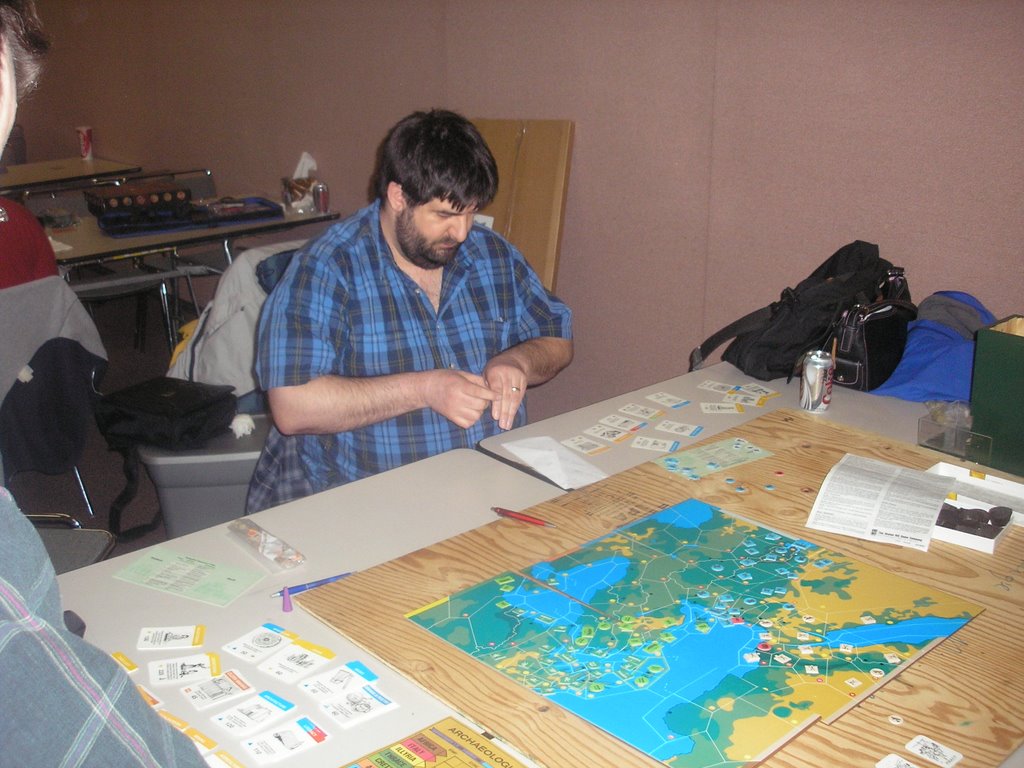


The original and Advanced versions of Civilization continue to keep their rightful place at the top of the heap among long empire building games. If you have never played Civ nor Advanced Civ you need to find someone with a copy, set an entire day aside and learn the game. You will be hooked.

It's not a new game, but the more I play Napoleonic Wars the more I like it. DRMs be darned. Of course I still struggle with strategy that is second nature to experienced wargamers. The frequent rulebook checks still irritate me. I know. That's just part of wargaming. Then there is the standard wargame response, "I just checked ConSim and that rule was changed last week." Arrrrrrrgh.

Living rules, my butt. It's a game. Wargamers just accept this nonsense? Try telling the guy from the IRS that the deduction in question was allowed last year, if he responds with, "the rules were changed to keep things more balanced," you would want to kick his smarmy teeth in. Have you ever had to deal with the Environmental Protection Agency? Same thing. The EPA specializes in "living rules". Living rules are a form of legal harassment. Why do we want to introduce this concept into our hobby?

Rules are rules. Rules that change when someone whines are not rules. Make a rule and stick with it. Don't change the rule to reflect popular group-think.

When did wargamers buy into this notion that if it is posted on the web it is official? If a rule is important enough to change I want a phone call. At least an e-mail. Don't post it and expect everyone to go find it. If you don't care enough about the change to give me a call, don't make the change.

Living rules as applied to wargames represent nothing more than a bunch of repressed wanna-be bureaucrats who've appointed themselves as arbiters of fairness, because nothing in life should ever be unfair.

If there is a mistake fix it. If there is simply unbalance, tweak the rules in the next edition. [/rant]

I've played a few games of Elasund, and I have come to the conclusion that it is not a very good game. There is more hosage than your typical Settlers variation, which makes the game worth trying, but play a friend's copy. Do not buy Elasund hoping your wife will like it because she likes Settlers. There is no trading. There is no player interaction.

The four phases to each turn are not intuitive. After several games I still find I need to constantly refer to the step by step chart to make it through my turn. If I don't follow the chart I forget to do something major, like place a building permit, or take my two gold. I always forget if I need two or three influence cards to perform different actions, and if the cards need to be the same color or different colors.

Elasund is a very simple game, yet it feels like Advanced Squad Leader after a couple rounds. Instead of asking "What phase is next?", "Do you get to shoot at me in that phase, or the next one?", "When do I get to rally my guys again?", like I do in ASL, I'm asking "Do I take two gold before I move a building permit?", "Did I already place a building permit?", "How many influence cards do I need to do that, again?". Shortly after it starts I find my mind wandering and wishing for the game to end, but it just won't end.

I'm holding off on pronouncing Reef Encounter good or bad. (So far it is bad.) I am intrigued enough that I want to play a few more times. (That would be an indication that it is good.) And by the way, alga? Alga? A Google search indicates that alga is the Australian Local Government Association. Is alga common usage across the pond?

Theoretically I should like Reef Encounter. Maybe if the parrot fish looked more like a parrot fish instead of a box, and there was some algae in the game...

Thursday, March 30, 2006

Anatomy of a Game: Carcassonne, Part One: The Original Game

Carcassonne was originally released by Hans im Gluck in 2000. It won the SdJ that year, and since has become a phenomenon. There are now 4 large Carcassonne supplements, 4 small Carassonne supplements, and 5 variant games. Within our Eurogame community, only The Settlers of Catan has been more successful in sheer bulk of releases.

This week I'm beginning a series that will analyze that phenomenon--talking about how Carcassonne works and also examining how the game system has evolved over the last six years. This first installment will examine the mechanics of the original game, while in future articles I'll be talking about how the game has evolved through a series of expansions and new games.

Before we get started, if you're now familiar with the game and its supplements, you may want to look at my reviews of the same. I've fallen down on the more recent Carcassonne supplements, because I don't feel like they fit the vision of the original game (which I'll talk about in the next few articles), and I haven't bought Leo Colovini's Discovery because I don't agree with its manner of distribution, but everything else is there.

Original Carcassonne Reviews: Carcassonne w/River (B+), Inns & Cathedrals (B), Traders & Builders (A-), King & Scout (B+), The River II (C)

Carcassonne Variant Reviews: Carcassonne: Hunters and Gatherers (A), The Ark of the Covenant (A), Carcassonne: The Castle (A-), Carcassonne: The City (A)

Not Reviewed: The Count of Carcassonne, The Cathars, The Princess & The Dragon, The Tower, Carcassonne: The Discovery

Analyzing the Gameplay

Last week I provided a broad overview of terminology for analyzing gameplay. Though I'm sure I'll use it again in the future, the immediate purpose was to provide a lexicon for this article. Broadly, Carcassonne's gameplay is very simple, but I'm going to break it down part-by-part.

Components. Each player has a small set of static personal tokens which he'll use to mark ownership of terrains in the game, but which don't move once they hit the board.

The board, meanwhile, is a classic example of an evolving environment that's constructed turn-by-turn. Each of the tiles used to create this board is accessed via an arbitrary draw, which we'll get back to when we cover Luck.

Activity. The overall activity of Carcassonne is split, linearly, among three parts: play a tile; play a token (meeple); and score completed terrains. As with most games, these activities are ultimately defined by component interaction.

The first activity is best defined as environment placement: you're creating the board through your tile draws.

The placement of the meeples, meanwhile is token placement. You're moving a token on-board, and will never be able to scoot it around the environment.

Finally the scoring portion of the activity centers on token conflict. Or, to use a more common term, it's majority control. It took me a long time to see it, but Carcassonne actually falls into the same category of games as El Grande or (perhaps more clearly) Entdecker. It's about getting the most personal tokens into an environmental area to control and thus score it. Carcassonne looks a bit different because you're building out the environment as you go, and because getting multiple tokens into a terrain is actually a trick rather than a standard mechanic, but nonetheless it follows a lot of the same conventions as the broadly understood majority-control category of gameplay.

Decisions. Last week I spoke of decision constraints and the need to keep options small; Carcassonne sort of tries to follow the "rule of 7" that I suggest, which means it tries to constrain any individual decision to just 7 options, to prevent a player from becoming totally paralyzed. But, it doesn't do so perfectly, especially not for inexperienced players.

Technically when a player draws and places a tile this is largely unconstrained. The tile could go in any legal space in the board, which is usually a couple of places at the start of the game, but could be a hundred (or more) different places by mid-game. I find this a serious problem for first-time players, who don't know how to quickly analyze the best board positions, and thus take agonizingly long amounts of time to decide where their tile goes.

A more experienced player usually quickly constrains a choice to 7 or less options. First, he looks at his current on-board positions (which, as it happens, maxes at 7 tokens), and sees if the newly drawn tile may be useful to: (1) close out a position; (2) expand a position; or (3) block others from getting into his position. Alternatively the player sees if he can use the tile to create any new on-board positions, and again this is usually constrained by a couple of "best choices" at any time. Finally if and only if he can't expand, he can't close, and he can't create, then the player may use a tile solely to block other players. Each of these main categories of options is pretty individual, and a good player will usually assess which is best based on the tile, on his current positions, and on his current token supply--but a new player can't.

Technically where a player positions his token on a tile is almost always constrained to seven or less options (excepting, perhaps, some road crossroads which could give the options of four road placements and four field placements, for a grand total of 8). However in actuality there isn't good separation between the placement of a tile and a placement of a token. The one so directly affects the other that they might as well be one decision. Thus a good player figures out his token placement as part of his 7 or less options that he quickly assesses when he looks at a tile, while an inexperienced player just sees it as a multiplier to his tile-placement decision, thus meaning that all told he probably sees several hundred choices. For me this has proven a very real failing of the game when playing with a certain type of relatively serious gamer who has some problems with Analysis Paralysis and hasn't played much Carcassonne. I literally can't play with them because games take hours.

Luck. The main luck in Carcassonne is arbitrariness, which comes about through the draw of the tiles. Some people see a ton of luck in the game, but I think it's phenomenally well controlled, and that's because of the multiple tokens. You can easily set yourself up in a situation so that most draws will benefit you: one type of tile drawn might expand your city, one might build out your road, and one might keep people out of your field. The original version of the game was a bit more "lucky" than later versions, solely because roads were always less valuable than cities, and thus you could do poorly if you only drew them. This has been corrected in most later versions, and through the expansions; I'll talk about this balancing act in the next article in this series.

The remaining luckiness tends to revolve around getting a very specific tile that you need. However, I think this "luckiness" actually results from poor gameplaying. If you're waiting for one specific tile, and there aren't many of it, then you shouldn't have let yourself get into that situation (or else you should congratulate your opponent who put you there).

There is also chaos in Carcassonne, and this centers around the landscape of the game changing between your turns. As you'd expect, the chaos factor gets bigger the more players you have. In a 5-player game you can have set yourself up with a perfect, well-defended city, then have one opponent place a tile which makes you vulnerable, and have another take advantage of that, all before it can back around to you. The arbitrariness of the tile draw can also multiply the chaos, since it can sometimes be several turns before you can respond to something.

Because of the chaos factor, I think the ideal player number for Carcassonne is 3. Two really doesn't work, for reasons I'll discuss when I talk about the Carcassonne variants (in part five of this series) while with 4-6 the chaos keeps cranking up.

Victory. Finally, looking at victory conditions, we realize that the token conflict activity translates into environment control victory. The exact formulas for those environmental control valuations are a bit varied, but the basic idea is obvious: the more environment you controlled during the game, the better you'll do.

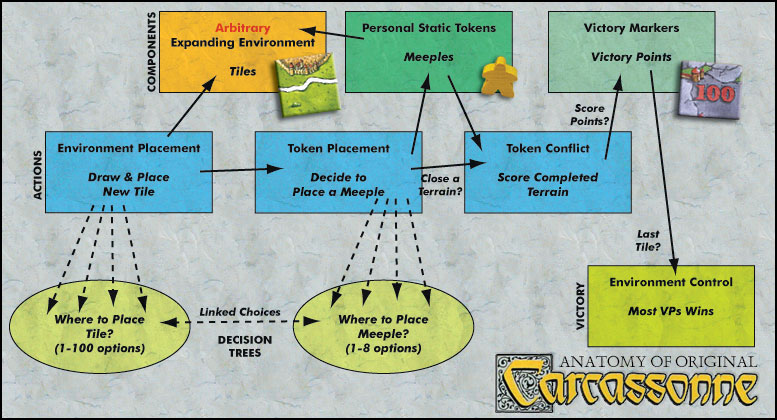
The following chart shows these various elements of Carcassonne's game design in a more graphical format. Note that the different elements are color-coordinated. Arrows represent interrelations between the parts of the game and dashed lines represent decisions.

You can click on the diagram to see a larger version.


What I found particularly notable about the chart as I put it together is how simple Carcassonne really is. There's just a couple of components and just a few decision points, but the result is a very rich, replayable game.

Carcassonne Strategy

I don't really intend this to be a full strategy article, but I think it's worth looking at a few points of Carcassonne strategy to show how they illuminate the gameplay.

I already mentioned one of the most crucial bits of Carcassonne strategy, which is that you need to play a multivaried game. You have multiple tokens and you should use them to insure that every tile draw is a good one. If you've got good fields, good cities, and good roads, then tile draws will always help you out.

Much strategy comes from how precisely the tiles are laid. You have to make sure that you place tiles so that it's easy to complete your terrains, and hard to get boxed in. In addition you have to try and place your tiles so that it's hard for opponents to get into your terrains. You could probably write an entire article just on these intricacies.

A lot of the strategy of Carcassonne comes through a balance between cooperation and competition, which are elements that I'm going to talk about more two articles from now.

Cooperation means that you should try and share terrains with some of your opponents, particularly those opponents who are behind you in scoring. You'll both get points and you'll jointly earn more points than you could have individually. Inexperienced players can think that sharing a terrain with an opponent is bad, but this just isn't the case in a 3+ player game--unless the player getting into your terrain is ahead of you in scoring.

Competition means that you should try and harm your opponents, particularly those who are ahead of you in score, and particularly when you can do so without costing yourself actions. Placing a tile in such a way that it makes it harder for an opponent to close a terrain is almost always better than placing that tile somewhere out of the way, provided that your own token placement opportunities are similar in both opportunities. An experienced player will know a couple of the rarer tile types (for example "road, field, city, field", or if you prefer "a road running into a city" of which there is only one tile in what I call "classic Carcassonne") and may purposefully block a player by creating the need for that very rare tile. I'll get quite specific about tile distribution in the next article in this series.

Conclusion

Carcassonne is a very simple game system that nonetheless provides a lot of depth. However, that simplicity has also begun to change through many supplements. In my next three articles in this series I'm going to talk about Carcassonne's expansions; as we'll see, the gameplay has changed and evolved over the last five years, and if you're playing a game with all the expansions, you are playing a very different game from the original gameplay experience.

However, I don't want my portion of Gone Gaming to become the all-Carcassonne-all-the-time channel, so I'll be taking a break next week to discuss a different topic. But I'll see you in 14 to discuss game balance and tile distribution, with an emphasis on the "good" Carcassonne expansions.

Wednesday, March 29, 2006

A Game I'm Looking Forward To


Here are simple overviews of several games that I enjoy playing. How many can you name?

-Area control game where you move all the pieces in one area to an adjacent area. Scoring is done when an area is totally cut off from all other areas.

-A race game where you play a card to move ahead and move backwards to collect more cards.

-An area control game where you not only fight for control of the ever-merging areas, but also for control of the majority color in an area.

-An area control game where the areas are decided by a pawn which moves along triangular spaces.

-An area control game where you place pieces in vertical sections of the board but the areas to control pass horizontally through 3 to 5 vertical sections.

If you recognized and enjoy these games, you join me in looking forward to the English release of Leo Colovini's Mauerbauer (Masons for those who are German-language handicapped). A Colovini game always has a unique twist to it, something new to it that challenges my thought processes. I get the feeling that if games are basically mathematical, then Colovini’s games are more geometric than algebraic; more about the special awareness than the numbers. I like that since I always hated algebra. I also like that his games usually have simple rules, and I don’t mind that the themes are thinner than one-ply toilet paper.

Sunday I got to play Europa 1945-2030 for the second time when Mike brought it to game day at my request. This one is a bit more involved than most of Colovini’s games and dealing with the overlays for each country is a pain in the butt but it’s still an interesting game with area influence and a little negotiation which can result in either happy cooperation or nasty back-stabbing. I was playing a bit nasty towards the end and it jumped up a bit me hard as a result. That means instead of being the winner, I came in 3rd out of four. Still, it left me wishing to play again.

An English translation of the rules for Mauerbauer from the Hans im Gluck site can be found on the Geek. This is probably not one of his most original designs since the ability to merge 2 cities before you score reminds me of Titicaca, another game that I thoroughly enjoy. That’s alright because it sounds like there’s plenty newness here for area-control freaks like myself to love. One twist, I think, is the fact that you do not own a particular color but are trying to place pieces in order to fulfill the requirements on the cards in your hand. Also the areas will develop differently each time you play so will be a totally new challenge, a feature I've liked in other games like Trias and Fjords.

This is one of the few new games that I’m really looking forward to. That’s actually a good thing since we just bought a new truck and will have payments to make for the first time in 4 years. You know what that means: either go on a starvation diet or slow down the game-buying mania. Well…I COULD stand to lose a little weight!

Oh, in case you were stumped by my Reader’s Digest condensed version of the games above, the answers are Clans, Cartagena, Carolus Magnus, Alexandros and Meridian.
~~~~~~~~
Until next time, don’t trust King Arthur just because he’s king.

Mary

Tuesday, March 28, 2006

If - A Europoem

If you can keep your king when all about you
Are removing theirs and blaming it on you,
If you can draw red tiles when you need them
But make allowance for having no reds, too,
If you can fake frustration with your drawing,
Thereby inviting an external conflict,
Or being the attacker, choose your victim,
Carefully, to maximize what you inflict:

If you can plan-- but not make plans your master,
If you can think-- but not only on your turn;
If you can smartly strike with each disaster
And from a lost position still return;
If you can bear to watch a mighty kingdom
Broken into parts by all your foes,
Or watch the monument you sacrificed for
Taken by your enemies, with repose:

If you can make four heaps of all your vee-pees
And see them grow in equal colored counts,
And not expend a useless tile playing
For a color you don't need in your accounts;
If you deceptively can place a leader
Into a kingdom soon under attack
And lose it, thus removing several tiles
And keeping your opponent's kingdom back

From encroaching on your other leaders,
And still not think that any certain kingdom
Is every really owned by anyone;
If all the other players think you're losing,
When you know that you've already won,
And can control the end-game at your choosing,
Yours is the Tigris and Euphrates rivers,
And--which is more--you'll win the game, my son!

--Reinard Knipling

Monday, March 27, 2006

GAME STORE CONFIDENTIAL ~ Somebody Needs A Hug

Having already written one blog entry about the issues that arise being a gamer and not having a suitable space to play games in, I figured that subject wouldn't come up again. I was wrong. It is on my mind today and it's also partly the reason I'm posting this entry later than normal.

Saturday night I had a few of the local gamers over for an evening of gaming. Three guests to be exact because five people would have been a tight fit in my little rental hovel. RoBee was supposed to bring his even larger brother, Jumbo-Tron with him but while Jumbo was in the shower RoBee came to town and Jumbo was stuck out in the tralier because the lights don't work on his Audi. So that meant just me, RoBee and his cousins Lyle and Shaun. We decided one of the Mayfair crayon RR games was perfect and began playing Empire Builder. During the game it continued raining as it had all day long. In fact, it had stormed heavily in the afternoon. About 45 minutes into the game Shaun blurted out, "Woah! There's water here!" and he began scrambling for someting to wipe up the small puddle of water near the board. We looked up and noticed water dripping right down the ceiling light fixture, onto the table.

Now a normal person would have done something about it. I'm uncertain what you can do about a roof leak, during a rain storm, on a Saturday night, in a podunk town 30 miles from anything even remotely resembling a city. But that was not a problem for us. We simply put a plastic cup strategically under the light and kept playing.

I'd have been pissed off if the water had shorted the circuit, because playing a crayon rail game by candlelight is difficult. Not to mention Lyle is color blind and has enough problems to start with when it comes to identifying features in a game.

So this morning at 7am the owner of the hovel called me and said he and the roofer would be here this morning to get the repairs underway. One distraction after another and here it is, almost noon, and I have leaky roofs on my mind.

At least we managed to work around the leak and continued gaming until 1am Sunday morning without ruining any game boards or pieces.

None of this has anything to do with something about the board game community that constantly amazes me and probably you too. That's the emotional attachment some people get to specific games. Not the physical game itself, although that may be a factor for some. But what I'm talking about is the need some people have to attack games that aren't the ones they like.

I noticed this trait from time to time when I owned my store. It surfaced most often with RPG's and CCG's, although some wargamers were very defensive about thier chosen favorites. I've heard enough conversations about why D&D sucks and GURPS rules (or vice versa) to last a lifetime. I'm not a role-player so I could care less. I feel the same way about CCG's because after I went through my MTG phase I lost all interest in new and ingenious ways to tap a card.

Over the years I've spent lurking and posting on BGG I have seen more petty rivalries about which board games rule and which ones suck than almost any other topic. Well, except for the endlessly boring Thrift Store lists or the pleas for which games to play with your spouse/children/cousin/parent/etc. Since the release of RailRoad Tycoon last fall it seems that a new level of intensity has surfaced from the lovers of Age of Steam. There are about a half a dozen Age of Steam zealots who apparently log onto BGG for the sole purpose of finding any thread that mentions RailRoad Tycoon so they can slam it with their AoS-party "talking points".

It's gotten to the point now where I'm completely lost about why some people cannot feel better unless they convince the entire world that thier preferred game is better than anything remotely similar. This reminds me way too much of politics and religion. Although, I admit that I enjoy inciting political battles on sites like BGG. I am praying (figuratively) that Hillary Clinton runs for US President in 2008 because I know I'll love the battles of the mindless and clueless that will take place on the Geek.

Unlike politics and religion though, why does it matter to anyone if somebody prefers a game they don't personally care for? I don't get it. My dad shot many a Japanese enemy in WWII and now drives a Toyota. If he can do that how come a board game Geek can't just sit back and view board games the same way WWII vets view the world economy?

Abstract games come to mind for me. I don't care for them. Solution? I don't buy or play any abstracts. I look like crap in yellow. So I don't buy yellow articles of clothing. I also don't log onto BGG and seek out threads asking for advice on abstracts and then rant about how much they suck. I admit though, when I see a man wearing yellow or pink I sometimes tell him he looks girlish.

Music has the same phenomena in it. I like most kinds of music. My favorites are your basic Rock & Roll, Country Western, Blues, Classical Guitar and then oddball stuff like Devo, Del McCoury, George Clinton, The Chieftans, etc. I can't even begin to count the number of times people have gone out of their way to make a negative comment about what I was listening to.

Country Western? "Total crap man. That's not music, it's background noise for trailer parks."

George Clinton? "What is that garbage? If it wasn't for that Funk crap we wouldn't be plagued with Rap music!!!"

Nonetheless. I cannot understand what anyone hopes to accomplish by denigrating me, my Country Western music, my board games, my choice of truck and even the motorcycles I own. Do the RailRoad Tycoon haters think that if they repeat their rants often enough everyone will throw out their RRT games, order Age of Steam and then buy a beer for them? Does the guy at the hamburger joint with the Kawasaki Ninja really think that by putting down my Harley I'll see the light and be like him?

Okay, okay... I admit, I do understand some of what underlies the deviant fans of specific games. It's a lack of confidence. A feeling that one doesn't really have any place unless that place is perceived as superior to the place of other games and their fans. It's a desire, in an odd and possibly even dangerous way, to prove that they are somehow more knowledgable, better schooled, more discerning or perceptive than the rabble.

Take the game For Sale. I like it. I think it's fun. It's easy, fast, social and attractive. Well, except I wish there was some sort of animal on the Space Station card. All the other cards have an animal and it drives me crazy there isn't one on that card. They could at least have put an alien on there. They didn't though, I've looked. Many times. With a magnifying glass. But back to the game. RoBee doesn't like it. So if he doesn't want to play we normally don't. I don't rant about what's wrong with him because he doesn't see the same things in a game I do. I don't need to anyway because I always make fun of him for wearing goofy looking hats and those giant shoes with the laces undone.

My point being, it doesn't make me feel less valuable as a person because not everybody enjoys what I do.

Am I missing something? Perhaps. Feel free to correct me if I'm wrong, but when you strip away all the apparancies of impartiality, the college degrees, the affluence and other embellishments most gamers have adorned their lives with, the ones who feel an irrepresible urge to put down games they don't like, and the people who enjoy them, are really just crying out for attention. They need help. They probably really just want someone to hug them and tell them that they really are okay and despite the fact that they are irritating, annoying, unlikeable and even downright creepy... that they are still welcome in the global gaming community.

In my view they are a vital part of our community... because they make the rest of us look normal.

Sunday, March 26, 2006

OLD "habits" are 'hard' to break

While a tiresome 'relic' from the "past" has been "resurrected" upon the "Geek" recently, and I'm talking upon that "Jack Chick" crap fest of purported "religious enlightenment" 'propaganda'. Which brings to 'mind' about IF "Patriotism" is the "last resort" of a 'scoundrel', then just WHAT is "religious fervor", or "Zealotry", considered AS in this 'manner'? I do so HOPE that there is a *Special* HELL 'reserved' for these 'folk' and their "ilk", as it would certainly seem a befitting 'place' for their 'likes'. NOW if only these "deities" would "call HOME" their 'emissaries', then the WORLD could become a much more "better place" for the remaining populace! "IMAGINE" there's NO 'religion'? I wonder IF y0u can? NO "God" to die for, a "brotherhood" of MAN! Yes, for those "people" without ANY 'qualms' about inflicting pain or misery upon others, then WHY wait for some "Supreme Being" 'justice'? I say MAKE an "example" of 'them', for any would-be OTHERS with sinister 'intentions' to mull over and consider. HAVE the 'punishment' FIT according TO the 'crime'! Then, make this ever the MORE "abhorrent" as a 'determent', and publicly displayed to boot, in order for SOME to 'learn' from the "mistakes" of another. The more "heinous", the BETTER, since just WHY should 'someone' who concocted and performed some "torture & torment" upon their 'victims' BE "treated" any better? YOU don't have the 'stomach' for such? Then allow the 'victim's' relatives to mete out "justice" instead. Many HAVE wanted to, and I don't 'blame' ANY in the least, of those who managed to for their "circumstances". Now, go and 'play' some "D&D" why doncha? oh yeah, and "Eat 'fecal matter' and DIE" there "Jack Chick", if that's your 'real name'!

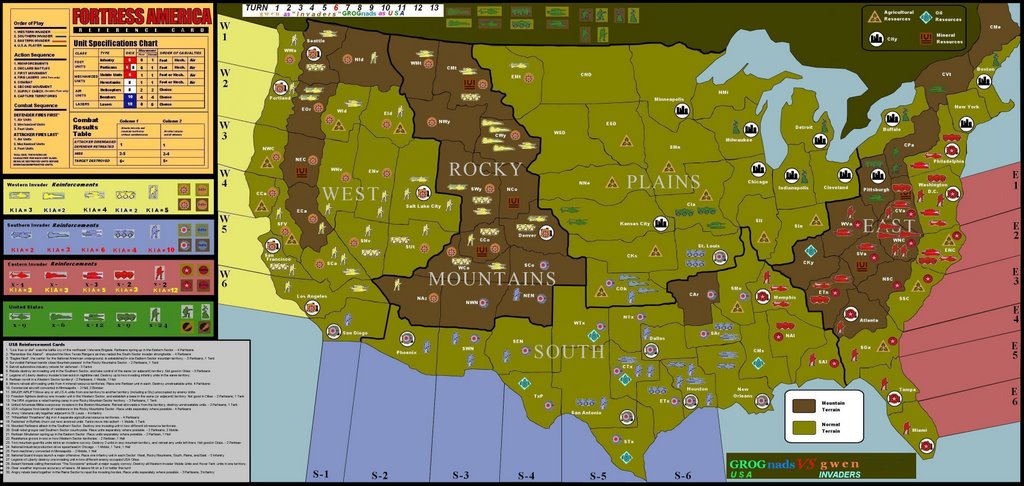
ONTO "gaming" matters then, and 'props' TO my current ongoing "gaming partner" over in Belgium, Mrs "Gwen Dons", with HER as the "Invaders", of which I place here our most recent "Turn" in this then:
It may "look" a tad 'bleak' for the "good guys" in this here, but IT ain't 'over' until it's OVER! There is yet the "USA" Turn to conduct and for anyone wishing to follow along, then just check out my "Glog"-('Gaming Log') here:
GROG's "Glog"
while I'm going to provide the most recent "update" within that here shortly. We have been resolving the "dice rolls" WITH actual "die rollings" conducted within varying "Chat" programs for it all. Since we're NOT doing this for anything but the "fun" of it, then we completly 'trust' one another, for those who are wondering. There can become another means in which to actually "game" with one another, such as "web-cams" and the like, or those 'PbEm' methods, I have to resort to this "manner" due to my computer NOT allowing myself to 'do' otherwise. "Good Gaming" then everyone!


Saturday, March 25, 2006

“Sleep Well, darling. Don’t let the Meeples bite.”

Something a bit different this week. I hope you enjoy.

Inspired by the story of a family who read the rules of a game ("Return of the Heroes") to their kids as a bedtime story, I present three bedtime stories for gaming (or gamers') children.


How the Meeples invented Time Travel

Once upon a time there were some little Meeples. They lived in a big box on Mummy and Daddy's shelves and, when the stars were right and the children were tucked up safely in bed, they came out to play.

The little Meeples had a friend who they called Bubba. They liked to play with Bubba, but because he was the biggest and the best at counting they often sent him to the Great Scoring Track on the Other Side of the Table. Bubba liked to count, but best of all he liked to play in the Meadows with his little friends, even though he was so big that it took two of them to beat him at leapfrog.

Sometimes they built cities on the edges of the Meadows where the Meeples played. Some of the Meeples moved to the cities, and others liked to play on the roads that linked the cities together. It's never safe to play on roads, though, and those Meeples were never seen again. (You should remember that when you are out walking.) Others moved to Monasteries and surrounded themselves with wilderness (and sometimes with the wilderness of a city).

These Monastic Meeples liked to study the history of Meepledom. Especially, they liked to learn about the Olden Days, when ancient animals roamed the world. They told stories to the other Meeples of a race of prehistoric Meeples with one hand permanently raised in salute.

These prehistoric Meeples were a pre-agrarian society, and liked to hunt and fish for their food. They would forage in the jungles, and had special rituals to scare away the sabre-toothed tigers that lurked in the wide-open plains.

One day, one of the prehistoric Meeples escaped from his box and found his way into the other little Meeples' box.

The Meeples were so excited to meet him, and the Monastic Meeples wrote down all his stories. He told them fantastic stories of a King and a Count, a dragon, a princess and a fairy, and of a great Castle in a far-off land, inhabited only by Meeples of colours never seen before in the Land of the Meeples. He told them of a tower so big that it could hold all the land in the world. They told him of the Great Blue Bag from which all the land came, and of the Giants who laid it.

The little Prehistoric Meeple was so excited, he ran back to his box to tell his friends. Sadly, he went one box too far and was eaten by two dinosaurs named Jill and Fred, who we will read about in our next story.

The End.


A prehistoric love story

Once Upon a Time, there were two little dinosaurs. Their names were Bill and Fred, and they lived near the South Pole, even though they didn’t know it was the South Pole.

Bill and Fred liked to move about and explore their world. As they moved around, they made friends with some of the other dinosaurs that lived nearby. Their special friends were Susan and Jill. They liked Susan and Jill so much that they got married and decided to have some little baby dinosaurs together.

As they all got older, the world around them started to change. This was caused by continental drift, although the dinosaurs wouldn't learn about that until it was too late. Sometimes they would go to sleep on dry land and wake up in the water, swimming for their lives.

There were other groups of dinosaurs that lived nearby, but Bill and Fred and Susan and Jill (who were great-grandparents by now) were shy and didn't know how to speak to other dinosaurs, so they tried to stay with their own family. Sometimes they would graze on the same trees as other dinosaurs, but they preferred to stick together and find lovely big islands where they could roam free.

One day, Jill and Fred were drowned in a freak flood. Their children survived, though, and continued to grow and explore the wonderful world that they lived in, until one day the Earth was hit by a giant meteor and all the dinosaurs died.

Their bones lay buried for many, many years, until one day people found them and started to learn all about dinosaurs again. They found them so interesting that they wrote books about them and made models of them, and even made movies and games about them.

And so, Jill and Fred and Sue and Bill will never truly be forgotten.

The End.


My Mother was a Pirate

Once Upon a Time, Mummy was a Pirate. She liked to sail the seas in her boat ship, collecting lots of treasure by entirely legal means, because of course it would be Wrong to Steal. Daddy was a Pirate, too, and he liked to collect lots of treasure, especially if he could take it before Mummy got to it. This is called Healthy Competition and it is very good for married couples, as long as neither takes it Too Seriously.

Mummy and Daddy were both very scared of the Dread Pirates. Sometimes the Dread Pirates weren't very scary, but often they would hurt Mummy and Daddy's boats ships and make Mummy and Daddy have to limp home to Pirates' Cove to perform essential repairs.

There were lots of islands in the seas, and Mummy and Daddy liked to visit them all. Daddy's favourite island was Tavern Island, because Daddy likes to play with cards. Mummy liked Treasure Island best of all, because she got to dig holes and hide her treasure, and mark it with special little flags.

Mummy and Daddy were very good pirates, with very powerful boats ships. They both had very big sails, and Daddy’s had a very big hold, which is the place where you keep your treasure. Mummy had lots of crew, who are the people who work on boats ships. She kept her crew busy firing the ship's cannons at Daddy's boat ship so that Daddy would have to go to Pirate's Cove a lot. Then she would go to Treasure Island and make her crew dig holes and hide her treasure, while she drew clever maps to help her find it again.

After they had been pirates for one year, Mummy and Daddy decided to get married, so they went to Treasure Island together and dug up all their treasure and then Mummy stole it and left Daddy behind on the island they got married and lived happily ever after with their lovely daughters.

The End.

Friday, March 24, 2006

Be careful what you ask for. You just might get it.

Late last year I extended an invitation to Sexy Amy from Boardgamegeek to write a piece for Gone Gaming. Due to various circumstances we had to wait until March to finally coordinate, which turned out to work quite well for me. I have been rather busy this week. I was working extra shifts and preparing to attend the only game convention in Alaska, BRIMFROST, which will be held this weekend in Anchorage.

I must admit that I was duly warned. Amy told me several times that if she wrote something it might not be your typical boardgame blog. She worried that I might need to edit it for Gone Gaming, to which I replied, don't write anything you don't want me to post, 'cause I ain't gonna edit it.

Well, it isn't nearly as trashy as I had hoped, but I'm going to resist temptation, stick to my guns and not
edit in any gratuitous sex and violence.

For further reading, here's Amy & Friends' boardgame site
Amy's Artifacts. It's not a blog. It's a website.

Brian


Chess and the City

Part III: The Fianchetto


I have this girlfriend. For the sake of this story, let’s call her Carrie. We grew up on the same block of one of those tree-lined streets in the Magnolia District of Burbank. One summer when we were twelve and just beginning to discover boys, our parents sent us away to chess camp. That kind of thing happens when your fathers are, respectively, an academic and a rocket scientist—even in LA.
I remember how, right in the middle of one of our chess games, Carrie leaned over the board and said, “You are really cute. And that pisses me off!” But Carrie was smarter. A few months later when our school tested our IQs, she scored a full ten points higher than me. “That pisses me off,” I told her. “Good !” she said. “Now we are even.”

OK, now skip ahead ... wait, I’m counting ... yeah, skip ahead eleven years.

Carrie is now some kind of programmer for some kind of Silicon Valley startup. When the company went public, she made a killing in the IPO and bought a million-plus house in Palo Alto—in California real-estate terms, an 1100-square-foot cottage on a busy street. Still the address is prestigious and carries just enough cachet to peg her as an up-and-comer in the coding world.
Carrie and I are now in the process of reconnecting. We meet for coffee on campus or at the local Borders. Occasionally we even play chess.

One day she calls and asks me if I can meet her that evening for drinks in Sunnyvale. I recognize the name of the place—a bar famous for its geekiness—where the next great thing—the next iPod, maybe—gets invented on the back of a paper napkin.
I get caught in traffic and arrive thirty, maybe forty, minutes late. I find Carrie playing chess at a corner table—with a guy.
“Hi,” he says. “I’m Kev.” And, oh god, this guy is gorgeous. I see that right away, even in the light from the fifteen-watt bulb that hangs above the table. He’s wearing a polo shirt that he totally fills out, and he has these dazzlingly attractive arms that he’s built up to the point that they threaten to burst out of their shirtsleeves. Apparently this Kev saw Carrie alone with a chessboard and invited himself over for a game.
As it turns out, Kev is a pretty bad chess player. When I arrive he is already down a knight and a bishop. But then, all of a sudden, Carrie starts to blunder badly. She is playing quickly, so maybe that’s an excuse, but I can’t help wondering if it has something to do with me. By the time they reach the endgame, their positions seem about equal.
Out of nowhere, Carrie announces, “I need to go to the ladies’ room. Amy, you want to come with me?”
“Look,” she says when we are down the hallway and out of sight. “He’s already given me his number. Would you mind leaving now?”
So I do.

Two days later, I’m going through my purse. I find a slip of paper with a phone number. “Call me,” it says. “Kev.”

Now any reasonable person would tear it up, right? But I don’t. “I’ll tear it up later,” I say to myself. “I’m not going to call anyway. So what’s the rush?” My god, I’m pathetic.
Later, my cell rings. It’s Carrie. “Sorry about the other night,” she says. “But Kev and I hit it off right away. I know you understand.”
Yeah, I do understand—all too well.

Women don’t play chess as well as men. Statistically. Many explanations for this have been asserted. The most common one is this: Women lack the killer instinct. Well, I can think of about half-a-dozen explanations. Lack of killer instinct isn’t one of them. Look, there are a lot of ways to kill. I prefer not to use a gun. Most women don’t. It’s way too messy.
In chess I’ve always preferred the fianchetto defenses. You, sir, open with the aggressive d4? I reply with the shy Nf6. You stake out even more territory with c4? I meekly try g6. Most of the time it doesn’t work. I get lazy or can’t figure out what to do with my bishop or end up with doubled pawns. But it’s a style that fits my personality.

When Carrie and I meet for coffee now, she usually talks about Kev. At first their relationship seems hot and heavy. For a few months, while his house is being remodeled, he even stays with her in Palo Alto. But honestly— and I see this right away—there is no spark. It takes longer for Carrie to see it.
Kev is a weak chess player, despite his biceps. And that bothers her. She laughs about it, but it is the first chink in the armor. Those little things add up.
In the meantime, I stall for time. I push a pawn here, retreat a rook there. Inevitably my cellphone rings. “Kev and I broke up,” Carrie says. She is in bad shape—crying, almost hysterical. Of course, I commiserate. We have been friends for a long time. All the way back to Burbank, all the way back, even, to chess camp.
When she hangs up, I’m surprised at how calm I feel. I cross my bedroom and open the nightstand. I pull out my copy of Modern Chess Openings. I remove the bookmark and look at it. “Call me,” it says.

Thursday, March 23, 2006

A Theory of Board Game Design: Definitions of Terms

In early 2003 I wrote a series of what would eventually become 20 or so articles on the topic of strategic game design. They appeared in my continuing Skotos column, Trials, Triumphs & Trivialities, and I later reprinted them as a group in my now-defunct RPGnet column, Thinking Virtually.

It's now been almost three years since I finished up the core of the series, and I haven't quite decided what to do with it. I've learned a lot about board game design since, so I could revise them quite a bit for posting here, but on the other hand there's enough material for a book if I could find someone to publish it.

So, I'm leaving those articles in stasis for now, but at the same time I do want to talk about some of the ideas I originated there. Thus, I've decided to write up this article, which is a summary of some of my design ideas, and a general outline of how I analyze board game design, part-by-part. Consider it a definition of terms. (And if you prefer to go read the entire original and somewhat out-of-date series, it's available at Skotos.)

Broadly I think a game can be defined using the following elements: components, activity, decisions, luck, and victory.

Components

Four types of components define most games: environment, tokens, markers, and randomizers.

Environment is the board upon which a game is played, though it may actually be a tabletop, a score sheet, or something stranger. You can have abstract environments (like a chess board), representative environments (like most Euro boards), randomized environments (like Settlers of Catan), evolving environments (like Carcassonne), and more.

Tokens are pieces which are placed upon that environment. They differentiate themselves from environment by the fact that they're dynamic. They enter play, leave play, move, or in some other way change. Broadly they're often "pawns" and they're defined by who they belong to, whether they move, and what they depict. You can have personal tokens, shared tokens, public tokens, dynamic tokens, static tokens, representative tokens, and many combinations thereof.

Markers are game elements which exist outside of the environment and which effectively replace a tic upon a piece of paper. They usually help you keep track of some quantity, such as dollars. You can have scoring markers (VPs, money), trading markers (goods), and more.

Randomizers are game elements which also exist outside the environment, and which in some way introduce luck into a game. See the discussion on Luck, below, for different types of randomizers, but the most common types are random randomizers (dice, spinners) and arbitrary randomizers (cards). Randomizers can sometimes combine with other types of components, such as the Carcassonne tiles, which are arbitrary environment and the Diceland dice, which are random personal tokens.

Tokens and environment tend to be the two more important types of components. By cross-referencing them you can usually say a lot about a game. For example, you could define The Settlers of Catan as using "personal representative tokens on a randomized environment" while some The Seafarers of Catan scenarios instead have "personal representative tokens on an evolving environment". Which is a fancy way of saying you have settlements and cities in both, but in one the board is randomized, but set at the start of the game, while in the other the board is randomized and can grow during the game.

Activity

I define activity as the mechanics that describe component interactions in a game. In other words they're the rules that say if you're allowed to change one marker into another ("wood for your sheep?") or if you're allowed to remove someone else's token ("die evil red army!").

I'm not entirely happy with my activity descriptions from my original article, but I still think they inevitably are classified by different ways that you move your components around. Following are some off-the-cuff definitions that I'm using for the moment.

Token activity might include: token conflict, where tokens directly affect each other, like Risk; token movement, where you're moving your tokens, often to some deliberate endpoint; the simpler token placement, where you're placing tokens on-board from an off-board position; or token removal, which is often a type of token conflict, but with a predefined result, such as when a dragon eats a meeple in Carcassonne: The Princess & The Dragon.

Environment activity usually centers on environment exploration (and/or environment placement), where you're trying to figure out what's in an environment and/or take advantage of it, such as in Anno 1503 or Goldland. It could also include environment conflict, if you're having environment in some way fight each other, though I can't immediately think of any games which meet that definition.

Marker activity includes almost any type of logistical game and most resource-management games. I usually classify them as marker collection and/or marker placement. The Settlers of Catan, Parthenon, and many others feature one of these as their main game activity.

Inevitably the activity within a game is defined by activity points (or "action points", to use their more common name), which define how many activities you can take during your turn. There are two degenerate cases which actually define most activity: where you have 1 AP, and can thus do just one thing; and where you have infinite APs, and can do do as many things as you want, subject to resource exhaustion. These cases usually don't actually define their activity as using APs. However, many gamers' games (particularly those by Kramer & Kiesling) make their APs explicit, and give you 2-10 to spend on a turn.

Decisions

Decisions are what make activity interesting, because they offer different choices for you to make. You can usually define activity as a set of decision sets, each of which has two or more options.

Decision sets can cause Analysis Paralysis, which can be the downfall of a good game, and thus it's important to constrain them and thus make them more manageable. Some of the constraints I suggested in my original article include "constraint by turn phase", "constraint by game phase", "constraint by ability", "constraint by needs", "constraint by attractiveness" and "constraint by results".

The purpose of all of these constraints is the same: to reduce an infinite set of options to decisions sets which have 7 or less options each (using the psychologist's "Rule of 7" as a good thumbnail for what an individual can easily concentrate on). It's much preferred to have a 5-option decision, followed by another 5-option decision, then to have a single 10-option decision, and that's where constraints come in.

Luck

Luck is primarily used to determine the outcome of an activity. As I mentioned recently, in my second article on luck, I define four broad categories of luck.

Randomness is essentially selection with replacement. You get a random result from a set that never changes. These are dice.

Arbitrariness is essentially selection without replacement. You get a random result from a set that shrinks as you select from it. These are cards.

Chaos is the way that other players affect you & your plans.

Uncertainty is centered on hidden information, which is to say things that you don't know, but that other players do, which could have affected your decisions.

Dungeon Twister was a game that struck me last year for its claim that it has no luck. But it does: primarily chaos. Your placement of characters and items and your opponent's selection of the same can dramatically benefit one of you or the other through no real strategy. There's also some arbitrariness related to the placement of the room tiles. If my opponent's Dragon ends up on a big open square where it can flame lots of nearby rooms, and mine ends up on a square that's surrounded by walls no matter where he goes, then my opponent got lucky and I didn't.

Which is a long way of say that no dice doesn't mean no luck.

Victory

Just as activity is defined by activity points, victory is defined by victory points (and thus victory markers). Some games define a single victory point and some define five or ten required to win, but most constantly give you VPs throughout the game, and you call that a "score". Perhaps more confusingly some games use victory points as a resource within the game too (such as in Oltremare and many others where victory is money).

Victory Points are usually given out for component interactions (or, to put it another way, for certain types of successful component activities). Broadly, VPs are awarded for: token creation, destruction, collection, or movement; environment creation, destruction, control, or exploration; or marker creation, destruction, or collection.

As with activities, my definitions of victories have changed a bit since my original articles, and they're probably not quite settled yet.

Conclusion

This week's article was mainly intended to be a glossary. I suspect I'll refer back to it when I talk about game designs, starting with an upcoming series of articles on the design of Carcassonne(s). I hope I didn't bore too much; clearly defining everything here should pay off in months to come.

Wednesday, March 22, 2006

No Easy Answer


I saw a question recently on the Geek: If I like Ingenious, will I like Through the Desert? This kind of question comes up occasionally and isn’t always easy to answer, especially if it isn’t accompanied by other information like what kind of other games you like and how many players you usually have.

Sometimes the games are so alike that it’s almost a given like Gemblo and Blokus which are, at their core, the same game. Other times there’s a superficial similarity in the play or feel of games, like Puerto Rico and Princes of Florence. These games both have a fairly complex interplay of components, offer different strategies and patterns of play to explore, and if the Geek ratings are to be trusted, the answer is a fairly confident “yes”. (I know some of you will want to complain and debate my comparison of these two games so go ahead; at least I’ll know someone out there is reading this!)

When games have almost nothing in common, it’s not so easy to give a useful answer. “I’m looking for a train game. Which one should I get?” I’m sorry, but without a lot more information to go on, there’s no way to answer that question with any confidence. Train games aren’t really about trains most of the time. They’re about collecting stock, point-to-point connection, moving goods, set collection or not going broke. They range from light, family fun to heavier, strategic brain exercise.

Even when games seem to have an important common element, the answer may be harder to answer correctly. I’m not a fan of auction/bidding games but I’ve enjoyed my online games of Amun-Re. If I were new to board gaming and was looking for suggestions with Amun-Re as my only tidbit of information, you might immediately think of Goa as a likely match. You would be wrong. Goa has my most-dreaded auction, the once-around.

There’s no way to compare Ingenious to Through the Desert except they both have neat pieces and the rules are pretty easily explained. The only answer that might be of help is, “I like them both so maybe you will, too.” In fact, I like Through the Desert much more than Ingenious.

There is no magic formula to answer the question If I Like X, Will I Like Y? But you’ll get much better opinions and more suggestions if you include as much information about your tastes and needs as you can when asking this question. After that, it’s a crap shoot, isn’t it? Hey, if I like Craps, will I like Roulette?
~~~~~~~~
Until next time, keep your cardboard dry.

Mary

Tuesday, March 21, 2006

Generic mainstream news articles, so you won't have to read all those other ones

1. "The next Monopoly"

Board games have been in steady decline since the early 1980's, when console gaming and computer games took over the gaming industry. With the exception of Monopoly, Trivial Pursuit, Cranium, and a few other old standbys, board games no longer sell to today's youth.

In this day of flashing lights and video games, plain old dusty board games sit in the closet like platform shoes and polka-dot mini-skirts. Now ______ _______ wants to change that. He/she has invented a new board game that he/she hopes will become the next Monopoly or Trivial Pursuit.

"People today don't spend time together anymore, whether it's fast food, computers, or television. It's nice to have an actual board game for people to sit around. We're all really hungry for social contact."

The brainchild of __________ is the game ________, which combines the strategy of _____ and the luck element of _________. ________ created the game after being laid off at his/her current place of employment. He/she says that he/she can teach the rules in only thirty seconds, but that the game has lots of depth and is fun to play over and over for kids and grown-ups, alike.

Asked whether he thought today's kids would really have the patience or interest in playing an actual board game, he said that they would. "I was surprised at how good a reception the game got. When I first showed it to my kids, they weren't that interested. But when they started playing they were like, 'Wow! This is awesome!' Then they wanted to play again, right away. They brought their friends over to play, too. They can't get enough of it."

______ says that the game is not only fun, but can teach kids important concepts, such as pattern recognition/aiming to achieve a goal/economics/colors/ecology/how to sit still and pay attention.

______'s family raised the money to produce the first 2000 copies, which he/she is now trying to convince local game sellers to stock.

2. Board game group tries to revive the art of face to face games

At a local coffee shop, a group of adults huddle together over a table in furious discussion and laughter. They're not reading the sports section of the newspaper or discussing local politics. They're playing a board game.

Remember in days gone by, when families use to sit down together to play a board game? Well, this local group is trying to revive that old tradition. The _______ group meets every ______ to play board games.

In these days of computer games and video consoles, getting together with real people is a rare and welcome luxury. Board games are undergoing a resurgence in popularity, thanks in part to game groups such as this one.

"People think we're crazy, but there's a lot to be said about board games. Board games are good for you," says ______, the group's founder. "They teach strategy, get you thinking, and require you to deal with a real live person. They teach you how to sit still and pay attention. They're also a lot of fun."

People are rediscovering the old games that they/their parents once liked to play. Great board games to play are the classics: Monopoly, Clue, Snakes and Ladders, Candyland, and Sorry.

"People really connect to each other when playing a game," says _______.

3. The latest board games go digital

In this day of video games and computers, the old fashioned board game is having a hard time competing. Board game companies have found new ways to breathe life into the old classics, by marrying these old games to the TV screen.

"Kids nowadays don't relate to a flat board game. It's boring. Frankly, I don't blame them. They need fast moving pictures and electronics. And they have to be able to play the game in five or ten minutes, tops."

New games to bring out the budding board game player in your children include Scene It(tm), World Poker Championship, Candyland DVD, and Clue: the DVD edition, which are played using your DVD player. Each game comes with a disk which you simply pop into your DVD player. After the DVD starts up, away you go.

Kids love television, so these games are a natural fit. They are also educational, teaching kids to recognize colors and shapes, and offering basic counting and pattern recognition skills.

These games also offer the convenience of being able to play solo, when you can't find a partner. However, they are best enjoyed with company. The games only take 5 or 10 minutes, and they can be paused and resumed later, if necessary.

---

There you go, Ward. That should free up a lot of your time.

Yehuda

Monday, March 20, 2006

GAME STORE CONFIDENTIAL ~ I changed the names to protect the guilty

BRIIIIIIINNNNNNNNGGGGG!!! BRIIIIIIINNNNNNNNGGGGG!!! BRIIIIIIINNNNNNNNGGGGG!!!

"DW's Game Shak, DW speaking"

"Hey! You buy used D&D books right?"

"Yup."

"How much do you give for them?"

"I'd have to see them first."

"Mine are in good shape, like new man."

"Like I said, I need to see them."

"Well, I need at least $50 for them, are they worth that?"

"I dunno. I'd have to actually see them first."

"Well, they cost me over $100 so I need at least $50 for them."

"Okay, hold them up to the phone so I can get a better look."

"Huh?"

"Hold them up...to...the...phone. I can't see them otherwise."

click

______________________________________________

"That's not what the rule says DW!"

"Look Gare, if you read the entire sentence, you'll see that it says specifically that your Orc is NOT ALLOWED A FREE ATTACK UNLESS HIS LEADER IS WITHIN FOUR INCHES."

"But it doesn't specify when the leader had to be within four inches, my leader has been within four inches of that Orc a number of times."

"Gare... will you open your mouth very, very wide please?"

"Eh?"

"I just want to make sure I can get the entire rulebook down your throat."

"Gurk. Glak. MMMMmmmpppffhh. "

_____________________________________________

"Hey DW."

"Yeah?"

"That hot chick from the deli is out here...she wants to talk to you."

"Really? The one with the body that was personally handcrafted by God to punish every man on planet Earth and remind them of the fact they are worthless and undeserving of such grace and beauty? The one who causes men to line up for blocks just to watch as she sensually spreads mayonaise on the tuna salad? You mean the 5'3" vixen Heather? The 22 year old bombshell who single-handedly caused the corner deli to be awarded the most successful small business of the year plaque?"

"Yes, that one. And she's dressed to the Nines dude."

"Well, no wonder you're shaking uncontrollably. Let's go see what she wants."

- sounds of men struggling to get through a narrow doorway at the same time -

"Hi DW"

"Uhhh.... hello.... errrr.... Heather."

"I was thinking, how would you like to go out with me and have a drink or two this evening."

I knew it all along... Gamers really are chick magnets...
__________________________________________________

ding-dong

"Hi there Sally, can I help you?"

"Yes. My loser husband got arrested again and I've had it with him this time. He's going to prison, I'm filing for divorce and taking the kids back to Pocatello."

"Ah."

"So I'm selling all his game stuff."

"I see, well you have three large boxes there. How much did you need?"

"Just gas money. How about a hundred bucks?"

"Done. I sure hope I can get my money back though for all these old Beta Magic cards, this set of Unlimited Magic cards, the complete D&D library, the unpunched copy of Campaign for North Africa, the three 40K armies and all those old Avalon Hill games."

"Whatever DW, I just hope he misses the stuff. Bastard!"

"Oh, I'm sure he will Sally."

____________________________________________________

"blahblah, gurblegurble, argueargue, bleatbleat, grumblegrumble, me-me-I-I-me-me-I-I-me, moangroan moangroan, etcetcetc!!!!!!!"

"Hey Bruce!"

"What?"

"I want you to walk out of my store this instant and then stand outside for a moment before getting in your car and look the place over very carefully, noticing each detail and lovingly committing to memory all the pretty games in the window and seeing all the laughing gamers inside at the tables having fun and partaking in the pleasure of each other's company."

"Why would I do that?"

"Because it's the last time you'll ever see this place."

A round of applause is heard as Bruce storms out the door.

_____________________________________________

~~~~~~~~beep-beep-beep-beep-beep~~~~~~~

What? 7:30 already? {{{{yawn}}}}

I need to get to my pc right now and write this stuff down so I won't forget. You know how dreams tend to fade..... wait a minute! Those weren't dreams! They were memories.

Heh....heh.

_____________________________________________

Before I finish this week I figure I'd better rant a bit about game production. In particular, Euro Games. And in specific, particular games like Princes of Florence and Medici. Why those two? Well because they are very good games that annoy the hell out of me due to the stupid cards and the idiotic fonts and artwork chosen by the Euro Snoots who published them.

Medici is one I just played on Saturday when a bunch of BGG locals got together again and had a game day. The cards are just dumb. The flowing and near unreadable script adds at least twenty minutes to the game as each person in succession needs to ask the current player what each card says. They're unreadable. The ages ranged from old (me) to young (Ro-Bee) to very young (the 11 year old and annoyingly intelligent son of JohnnyBravo). None of us could read the cards. And the art didn't help.

"I've got one of these piles of stuff that says 5 on it", was the most common conversation as the player held up the card for all to squint at. The grain looked like a heap of dead convicts from 2 feet away. The furs looked like...well... piles of yard debris. The dyes looked like paint pots at my boy's pre-school.

Any one of the Age of Steam elitists who sneers at RailRoad Tycoon's score track just needs to play Medici. If that doesn't shut them up then they are just plain prejudiced against American production values. The Medici score track and money calculation is both bizarre and torturous.

Too bad. It's really a good game. Ugly thing though.

I ranted about the Princes of Florence cards for the same reason. It's as if the makers of Euro Games sit around their apartments at night, sipping wine, eating hard bread and stinky cheese and conjur up ways to make their game components appear elegant and superior while being nearly useless at the same time. Screw elegance, how about making a board or a set of cards that can be deciphered from more than 6 inches away?

Since we played all Euro-style games I just thought I'd comment on Modern Art and how I discovered something about it that reminded me of why I'll never play Puerto Rico again. It's the damned Fixed Price auctions. If you have a sub-optimal player or newbie sitting to the right of a competent player everyone else is screwed. Inevitably the newbie will throw out a card that is priced too low and will allow the superior player to his left to continuously control the game.

In the future I will only play Modern Art at JohnnyBravo's house if he's sitting to my left. And if I'm ever roped into another game of Puerto Rico ~ which is what I envision an eternity in hell to be ~ I want Ro-Bee sitting on my right. Unless, of course, I happen to run into Heather again, she'd make hell a whole lot easier to take and I'd play Puerto Rico with her anytime she wanted.

Sunday, March 19, 2006

the "Doctor" is in the 'hizz-ouse"!

YES! We're finally getting this T V 'show' airing here on a regular basis NOW! I had caught just one episode before this, upon a 'Canadian' station-(thank you "Oh Canada"!), and they graciously had shown '2' of these back to back last Friday night upon the "Sci Fi" channel! Since WE here aren't having any sorts of "UNcommon Destitute Gamings" going on, then it was nice to be able to relax and take in this at a leisurely 'pace'. While I know many have even gotten out to take in a 'movie' such as "V for Vendetta"-with a few having regretted such already-then it is hoped that many anew "fanzoid" for THIS, will get behind the rest of US on the matter as well. So I wonder WHY the "good Doctor" don't figure out a useful 'means' for them "Daleks", such as roving "street lights" with them going around and 'saying' their 'bit' instead as "I-L-L-U-M-I-N-A-T-E-!" eh? Since we'll have to await for the NEXT "Season" for "Battlestar Galactica", then this ought to fill the 'void' in the meantime. "South Park" is going to be having theirs this upcoming Wednesday night as well, so keep that in mind for you "fanzoids" of theirs. While just now I'm watching upon the "Gladiator" movie and of course I don't take this too "literally" and barely "figuratively" for that matter. We' ve got a "nice day" going on around here as well with the "SUN" making a full day of this, while yet others "below & around" are having "Cyclonic" fits in their parts of the World, so take care down there.

I also take *note* of "Cavedog_pdx" bringing up within a "list" of his on the "Geek" about some folks desiring upon some "Heavier Strategy" types of games. It seems to ME that there already ARE plenty available these days, what with "Europe Engulfed" or even "Caylus" from what I'd 'gathered' about such. I know that he's just trying to bring UP this 'topic' to alert those "idjits" around the 'industry' upon this FACT, but don't hold your collective "breaths" for anything spectacular, what with the more recent spate of "releases" and the 'let downs' that they've managed to elicit. Yet again, then I have to point OUT to many about this concerning just since YOU are "giving away" YOUR hard earned 'monies' for this 'stuff' on a regular basis-akin to 'feeding' your "wallet" some monetary "Ex-Lax"-then you are getting what you 'deserve' eh? Yep, them "fools" and their "moneys" are 'parting' at "Ludicrous" speed! I didn't wish to put up with their "crap" any longer, so that is mainly WHY I don't "buy into" this any longer msyelf. But then of course, I've got plenty to keep me "busy" in the meantime as well, so that's really of little consequence regarding 'moi'. This also brings to mind for ME about what is the "delay" upon having MY "game submission" becoming "approved"? hmmm? I 'devised' that "MEEP" "WARZ!" game for use IN their "chat" and we've even been conducting some "gamings" of this, although our "room" is so 'lag ridden' as to make that more like some sort of "Snail's PACE" for the time being. I would write to 'them' upon the matter, except that a "gnat fart during a Hurricane" would probably obtain better 'notice'!

I shall also bring up about HOW this 'blog' tends to have its share of 'problems' every so often and many HERE know of what I 'speak'. I don't have any idea just what is going on for that, and no quick 'answer' about this is forthcoming. Sure, they could be working upon this somewhere and 'whomever' just happens to be the "unlucky" 'person' being subjected to such at the moment. It is just another "thang" that we have to put up with and since this is FREE, then we have little "room" to complain about it all.

Here's my "shout out" to them 'good guys' of "Scott & Jason" over at "Point 2 Point" for their "grognard" podcasts! They've even gotten UP a "webpage" for that now and here's a couple of LINKS for this:

"Point to Point"

"Point2Pointsource.com-webpage"

Keep up the "Good JORB!" you guys, along with the many others out around the WORLD doing their 'part' for the benefit of many others!

Saturday, March 18, 2006

A quiet night at Gamers@Dockers or the night Twonky got his guns

The spectre of street closures and parking chaos due to the Commonwealth Games meant that numbers were down compared to usual, although local readers should note that there were no particular transport problems at all. Note to American readers - the reason that the English threw the American War of Independence was so that you would not get invited to the Commonwealth Games, which is basically the Olympics for old English colonial countries who did not fight wars of independence.

First off was a three player David and Goliath with Tim, Greg and myself. Tim said he had played it once or twice before. They way he casually destroyed us time and time again implied that either he is a natural at the game or has played it a few more times than he admitted. To add insult to injury on those rare occasions that Tim deigned to let us build a legitimate scoring pile he gave us 1's or 2's from his seemingly limitless supply of low cards.

Luckily for Greg and I, Ben arrived and we switched to four player where despite a concerted effort by Greg and myself Tim still did very well.

We were now up to five people and broke out Paul's Avalon Hill version of Robo Rally. By the time we had decided what board or boards to play and had almost set up we were up to seven players.

I have played the original Robo Rally quite a few times over the years, but this was my first time with the new version.

The addition of the player mats and the starting board are very useful. I am not entirely sure why the virtual bots were removed, but I can live with it. The opinion of the table was that the 30 second timer was useless. If it is to be started as soon as the penultimate player has finished then it should be only 10 or 15 seconds, alternately you could make it 60 or 90 seconds and start it before people look at their cards.

We played that nobody started with any option cards (I am not sure what the standard rules for this actually are).

We had two or three newbies and played the board that has four square fast conveyor belts, quite a few rotating gears and a number of lasers. In fact it looked almost exactly like this except that the main board was rotated 90 degrees and the third flag was one square closer to the start board.

The start was peaceful enough, but by the third turn things started getting hectic. Most people had cleared the starting area and encountered either each other or the speedy conveyors which general played havoc with their programmed movement. With seven bots in play the most direct route to the first flag soon became crowded and naturally a lot of pushing, shoving and shooting ensued. It was rare for anyone to be positioned at the end of the turn even remotely near where they had planned to end up.

The first deaths were quite early, Paul pushed Ben off the map and was moving so fast that he followed him off. The mayhem continued with a large number of power downs required for people to keep moving in a vaguely controlled fashion.

Paul was the first to reach the first flag, Frank was very close behind after being pushed and having a locked register due to accumulated damage he found himself careering off the edge of the board the very next turn.

Having taken the long way around to make a pass at the first flag I (Twonky) got pushed and found myself on a speedy conveyor belt and waving bye-bye to the flag in a fairly damaged state. At this stage I decided to power down whilst enjoying the ride around the conveyor belt. When I powered up again my cards were not going to help me reach the elusive first flag, so I decided to visit the repair place and pick up an option card. I did this and got the howitzer (five optional shots which push the target bot one space in addition to the normal damage). My next pick up of cards had all turns except for a Move 1 and a backup. I wasn't going to be able to get near the flag, but I could return to the repair spot and pick up a second option card, so I did and got Fire Control (instead of causing damage you may choose to lock a register of your choice on the target bot). It is worth pointing out, that I was the only player to get any option cards during the game. They did give me an advantage, however it had cost me two full turns to pick them up.

With some new cards and my newly installed weapons I was now ready to strike out towards the first flag and possibly cause some havoc along the way. By this stage Paul had already left the second flag behind and three others had completed the first flag and were heading there way towards the second flag. A few more deaths had occurred by this point. Paul had pushed Frank off the board and soon after he had been caught in the crossfire of two other bots and been shot to pieces.

Unlike my first attempt at the flag, my second attempt was successful, avoiding being pushed by the other bots and getting there with nothing other than a few laser hits. As I left the first flag, Paul was zooming up the edge of the board towards the third flag. I decided I may as well move out and position myself for some opportunity fire towards the third flag, especially since I only had two Move cards to play that turn.

As my luck would have it, the instant I turned towards the third flag Paul appeared in my sights. He was on the edge of the board about to win the game, what is a poor young bot with a brand new howitzer meant to do? Fire One! Yes, I shot him with the howitzer, pushed him off the board and he was eliminated from the game.

During the this time, three people who were new to Gamers@Dockers had arrived. Greg explained David and Goliath to them and helped them play in between his turns.

Quite a bunfight was brewing around the second flag. I couldn't resist the opportunity to shoot Tim with the howitzer to push him into Greg who was then pushed off the board. During another entanglements Frank ended up being eliminated.

After David and Goliath finished, Frank and Paul started up a five player game of Ra with the new people.

Tim made it to the to second flag as I powered down just near it and then he made a good run towards the third flag. On the way towards the third flag, I irritated any other bots that got into my sights by using the Fire Control to lock one of their registers, usually a fun one like U-turn or Move 3.

It was a race to the third flag between Tim and I and Tim was a fair way in front. I positioned myself to be coming up the map on the speedy conveyor belt that had direct line of sight with the third flag. The phase that Tim reached the flag, I had just come around the corner of the conveyor belt and had a shot lined up, so used the howitzer and pushed him off the flag. The next phase Tim turned and I was still on the conveyor belt facing the flag and Tim. This time I used Fire Control and locked his first register, which was Move 3. His final card was a turn that left him facing the edge of the board. He was now two spaces away from the edge with a locked Move 3 as his first card and thus went sailing off the edge to return to flag two. I had the right cards to sail off the conveyor belt and straight on the third flag to claim victory in a damage filled game.

The game of Ra was continuing at the other table, so the surviving bots (Tim, Ben, Doritos and I) broke out Alhambra. Neither Ben nor Doritos had played before, however in a tight finish Doritos pipped Ben by a point who in turn pipped me by a point. Tim was a bit further behind, but he had a very symmetrical palace, which may have been worth a few style points, but no victory points.

A very pleasant eveing, no problems with the Commonwealth games, three games played and three new people to Gamers@Dockers. Thanks as usual to Frank for the lift home.

Friday, March 17, 2006

Gaming from 60 B.C. to 1 A.C/The pre-history of modern games

60 years before Catan to the release of Catan.

The modern era of boardgaming began during the Great Depression. Prior to the widespread release of Monopoly in 1935 themed boardgames were viewed as a childish pastime. Boardgames often had a Biblical theme, or were merely tools to help teach children to count and read.

Most of the readers to this blog know that the following story is a load of malarkey, but for our purposes it will suffice. Actually, this small snipette of the story is probably true.

According to the popular story Charles Darrow was making copies of a game in his garage for his friends. Soon demand was greater than he could meet in his home workshop. Charles took his game to Parker Brothers who after several refusals eventually picked up the game and started mass producing it under the name Monopoly. In doing so boardgaming would make an epic shift for the better.

Who knows why popular culture takes the turns that it takes? In the case of Monopoly it seems to be a matter of timing.

During the Great Depression Monopoly provided a diversion which allowed adults to momentarily forget about the poor state of the economy and to play with large sums of money, albeit play money. In times of economic downturns people tend to be more inclined to stay at home to find entertainment, hence the traditional increase in birth rates during times of economic downturns (the Baby-Boomers being the notable exception to that rule). These two forces; the fantasy spawned by tossing around money frivolously and the economic impetus to stay at home converged (a convergence in the forces if you will) to make Monopoly popular with adults.

Who knows all the reasons Monopoly caught on with adults? I suspect there is probably a certain amount of truth to both of the reasons I presented, but I doubt that either can account for the current popularity of Monopoly. However it happened, catch on it did and our culture has changed for the better.

More boardgames designed with adults in mind followed in the wake of Monopoly. The Monopoly Stock Exchange Add On in 1936 (which may be the first game expansion); Stock Ticker in 1937; Tripoley in 1938; Scrabble in 1948; Yahtzee in 1956; among many other games captured the fancy of many adults.

The release of Tactics II in 1958 marked another turn in popular culture. Not only was Tactics II a game designed for adults, it had no pretensions about being a family game. With the release of Tactics II we see the coalescence of tactical wargames as another branch of boardgames. Charles Roberts, the creator of Tactics II, founded the Avalon Hill game company in 1958 and promptly released another wargame, Gettysburg. Diplomacy and Risk were both released the next year and the era of popular wargaming was officially underway.

Although renown for its line of wargames Avalon Hill published many types of games many of which were targeted at a young adult (read: college students) and older audience. AH published the original 18xx Railroad games, Rail Baron, Shakespeare, the Status Pro series, numerous race car games and other games too numerous to mention. In 1974 AH acquired the rights to many games in the 3M line including the venerable game of Sid Sackson design, Acquire.

Acquire was first published in 1962. At the time of its release Acquire was considered to be a pretty good game, and stayed in print for the next 40 years. Acquire wasn’t a game that changed boardgame culture on its own, but its influence has been felt for decades after its release. I have often considered Acquire to be the “Velvet Underground” of boardgaming. Brian Eno once said of the band Velvet Underground: “Only a few thousand people ever bought a Velvet Underground record, but almost every single one of them was inspired to start a band.”

I doubt anybody was inspired to start a band after playing Acquire, but the game has come to be known as a very inspirational design.

Acquire has only recently, within the last 10 years, become widely recognized as the original designer game or German game. No one gets eliminated in Acquire. Each player is in control of his own destiny and not at the mercy of dice. Skillful players have an advantage, but random tile draws give new players a chance to win and keeps each game fresh. Players don’t actually control game tokens in Acquire, players own stock in companies and can only influence companies in a small way each turn. Several players can own stock in the same companies. This concept in game design, arguably, did more to influence future game design than anything since the invention of dice.

That’s a lot of innovation for one game. At some future time I will argue that Scrabble actually did several of those thing prior to Acquire, but no game designer ever put all those elements together in the same game as successfully as Sackson did with Acquire.

By the late 1980s boardgames were again considered to be a childish pursuit in most circles. Dungeons and Dragons had long before started its meteoric ascent and a slew of role playing games designed for the teenager and very young adult would appear in its wake. Most importantly the era video games, both arcade and home versions, was in full swing. The wargaming arm of the boardgame hobby and possibly Scrabble were the two exceptions where adult players still thrived. Luckily in Germany boardgames were still considered a family hobby.

Game design in Germany developed along different lines than the rest of the world. In Germany the topic of war was taboo. Wargames were taboo. Not only were wargames taboo, but game boxes that depicted certain German WWII insignias were illegal to import (and still are). This aversion to war games, coupled with the fact that more games are produced and sold in Germany than any other country, eventually lead to a new worldwide shift in the way adults think of boardgames.

In the mid to late 1970s the era modern "German games" was starting to bloom. The German designers had scrapped the traditional "roll and move" mechanism, and were designing games with no player elimination. Some of the other hallmarks of a German game were, and still are; simple rules, clever mechanisms, <2 hours in length, if there was any luck in the game it was managable, lots of player interaction, and quality production.

In 1978 the German game industry created the Spiel des Jahres (Game of the Year) award to promote the best family games coming out of their country. The first winner was Hare and Tortoise (Hase und Egal) in 1979. In the years since the Spiel des Jahres was established it has become a mark of excellence. Today a winner of the SdJ can easily sell a quarter million copies.

By the 1990s games of German origin were starting to make their way out of the country and into the hands of game enthusiasts in other countries. Word of mouth and small publications like Mike Siggins’ Sumo helped spread the word about the “German games”, but the rise of the internet in the mid 90s was the real turning point for German games. Or should I say; the rise of the internet coupled with a minor game that you have probably never heard of called “Settlers of Catan”.

The internet became a point for enthusiasts of boardgames to congergate and exchange information about games. With the internet a gamer in Jerkwater, Alberta could read a review about a game produced in Germany, and buy it from an on line store. Not only could he read a review, but an English translation of the rules would eventually get posted, and reposted to other boardgame websites. Gamers who had never heard of Sumo nor Mike Siggins could now easily get information about games produced around the world.

For many (self included) the internet opened our eyes to a boardgame world that we never new existed.

Just as the internet was becoming a household word the spark that was the German boardgame industry turned into a blaze with the release of Settlers of Catan. How odd that Monopoly, the game that gave legitimacy to boardgames for adults, would come to be viewed as a child's game in the wake.

But again, who knows why cultures take the turns they take?

Thursday, March 16, 2006

The Problem with Luck II

Last year I wrote about luck in board games, with attention to the fact that most well-designed luck in games actually asks you to balance risk versus reward.

Last week I played two luck-filled board games, Parthenon and The Settlers of Zarahemla and in each case I lost due to some "bad luck". But, I was entirely happy with the results because the losses were ultimately the result of me risking and losing, and that's exactly how I think it should be in a game with a random factor. Thus, I'd like to use these two game sessions as case studies, to show what good, controllable luck looks like, and how you can risk and lose.

In the process, I'm going to talk about several different types of unpredictability in games: randomness, which I define as sample with replacement, such as a die roll; arbitrariness, which I define as sample without replacement, such as a deck of cards; and chaos, which I define as player interaction. (A fourth type of unpredictability, uncertainty, which depends on hidden information, didn't really come up in either game.)

Case #1: Parthenon

Parthenon was one of the more interesting games released in 2005. I wouldn't say it was high profile, but that's mainly because it came out from Z-Man who is still building their Eurogame creds (though they came out with a pile of great games in 2005). Nonetheless, if this game had been put out by Rio Grande, everyone would have been talking about it. Parthenon got quite a bit of good, early press as either a Civilization-light or a new Settlers of Catan. Then, as it reached a larger audience, people started complaining about the randomness, saying that it ruined an otherwise good game. As of today Parthenon is still ranked #586 on BGG, which is entirely respectable, and in the same area as Relationship Tightrope and Around the World in 80 Days, both good games. I personally gave Partheon a solid B.

The basic idea of Parthenon is to build 16 buildings on your home island. This is done through resource management. You collect various goods, among them the hard-to-get gold and papyrus, and use those to build your buildings, and at the same time you're influenced by current events, and the harbor status of the ports that you want to trade at.

In my recent game of Parthenon I had a very strong position going into year 3. By the end of the first season I had 15 or my 16 buildings built, with my second Wonder of the World being the only obstacle. But when I drew the plans for that second Wonder, I learned that the conditions for building that Wonder were very difficult given my particular setup and the particular conditions of the game.

In order to finish the Wonder I had to give away one gold, then one papyrus during the island trading phase. Unfortunately I didn' thave either in hand at the time, and the papyrus was very hard to get. It could only be traded for at Egypt, and Egypt had a "tribute" harbor status, meaning that you could only carry two goods there to trade, unless you had an army to protect them.

I had no army which meant I was indeed limited to those two goods in Egypt. I further had no way to build an army because I'd elected not to construct the Fortress building which would have allowed me do so. Since I was limited to trading just two goods in Egypt, I wouldn't be able to trade for both gold and papyrus on the same turn, and I'd further never built a second ship, which meant that I couldn't trade for gold somewhere else on the same turn that I got papyrus from Egypt. Oh, and the other players were embargoing me because of my strong endgame position, which kept me from trading for basic goods that I could have used to create gold at my marketplace. In other words, I was all-around out of luck. It would be at least season 4 before I could finish up my wonder, and if I met a single hazard-related setback, I'd never finish at all. And, I did.

It would be easy to say that I ended up in such an untenable position because of a bad card draw, and I suspect that many detractors of Parthenon's randomness would say exactly that. However, looking closer, I think it's pretty clear that my downfall was entirely my fault. Parthenon is at heart a logistical game of efficiency, as many resource management games are. This means that you try and make better use of limited goods and turns than your opponents. I had chosen to try a path of minimalism during this game. I hadn't bought any armies (or gifts of Poseidon or warships), because that would have slowed my path to victory. I hadn't bought any extra ships for carrying my goods for a similar reason.

If I'd drawn a better Wonder plan, I might have won in year 3, season 1 thanks to my superb efficiency to that point. Contrariwise if I'd taken a safer path, it might have cost me a season or two or efficiency, but I would have been in a better position once I got the Wonder I actually drew. With a ship or an army I had an opportunity to win the season after I drew that plan.

I didn't lose because of the card I drew. I lost because of the risk I took.

As I said in my previous article on luck, good luck in games should be controllable. There are a large number of different luck factors in Parthenon, but I believe every one of them is controllable. You takes your chances and you reap your rewards. Or not.

Here's a chart of those luck factors, which will probably be more meaningful to people who have played the game:

ElementTypeControl
EventsArbitraryNegotiate with the Archon.
Build appriopriate structures.
Hold appropriate goods.
Buy Nihilism.
HazardsArbitraryBuy Gifts of Poseidon, Warships.
Buy Stoicism.
Harbor StatusesArbitraryBuy Armies, Warships.
Buy Epicureanism.
Wonder PlansArbitraryBuy plans early.
Buy Materialism.

One of the players in our Parthenon game mentioned that Stoicism is often the first Philosophy bought, because hazards come up so often. However, I'm no longer convinced that's the best strategy, because hazards can be controlled in other ways (especially through the all-purpose-hazard-avoidance Gift of Poseidon card), while other arbitrary card draws are much harder to control. If I'd purchased Materialism instead of Nihilism, I would have been taking my chances with events, but I would have been able to finish off my Wonder.

Before I close out on Parthenon I'd like to mention that the risk/reward structure is slightly more complex than what I discuss above. You have to expend resources to purchase the various cards which can allow you to offset risks, as I already mentioned. However, for all the aegis cards (that's the Army, Gift of Poseidon, or Warship) you actually have to put it on a boat, taking up one of your 6 cargo slots, in order for it to take effect. Since I've often had cases where I needed all 6 of my cargo slots in order to achieve the trade I wanted, this can be another large risk/reward decision.

Of course you can have your cake and eat it too. You just buy a second or third boat (cost: 1 or 2 gold), and then you will have to buy the correct aegises to protect that boat too, and you're set; you can now carry an extra six cargo, minus the slot(s) for those aegises. Of course you've spent more resources at this point, to lower your risk further.

Because of its multiple levels of risk decisions, I increasingly think that Parthenon is a very fine example of this particular genre of risk/reward game.

Case #2: The Settlers of Zarahemla

The other game that I played on my "lucky" game night was The Settlers of Zarahemla. It's a licensed version of The Settlers of Catan that I'm more likely to carry around when I'm interesting in a Settlers game because it's very beautiful and it has one slight addition: a pyramid to build, with a 2-point "best builder" VP bonus in contention. There are a few terminology changes: instead of sheep you have water as a resource, and they call ore stone.

As is often the case in Settlers my bad luck came about because of my setup decisions. I was greedy, and I made my initial placement decisions in order to try and corner two scarce-looking resources: stone and water. In the process, however, I placed my two settlements pretty close together, and right in the center of the board.

As the game proceeded I very quickly realized that I was in a bad position. I was getting cut off in multiple directions and every time I started to build in a direction, someone else got there just before me. I eventually had to build four road segments (off of a bad production of brick + wood) before I could get a third settlement down. I don't know that this all cost me the game, per se, because we had some strong players, but it definitely ensured that I was out of the competition.

Now I'm sure a lot more people are familiar with Settlers, and it's thus a lot easier to see some of my decisions as plain bad. For a start, if I was going to put myself in a board position where I needed to build out quickly, I should have made sure I had the brick and wood to do so, not the exact opposite resources. Further, striving for longest road (which I did, and which I held for a time) was pretty dumb when I had no wood resources. Instead I should have been working on the temple, which took brick and ore. I had brick, and as you may recall I made an effort to corner the ore market.

However, I can also measure my choices as risk/reward. I took a bad risk--hoping that the other players wouldn't cut me off before I really got my resource machine going--and I'd balanced it against a questionable reward--grabbing a set of resources that I'd decided were nice. And this is how risk/reward games are often lost: in measuring your risk or reward incorrectly, not in drawing the wrong card or having an opponent cut you off at the wrong time.

During my game of Settlers I also got hit by the robber 2 or 3 times, losing my hand when I had 8 or more cards. As with my building choices, this often comes down to greed. I was building up for the big win, rather than buying a development card or doing something else less efficient. If I'd taken a more tactical approach to the game, I might have been able to inch ahead a bit, but instead I took the risk of long-term strategy, and lost out.

As with Parthenon, the luck and the control of Settlers can be mapped out in a chart:

ElementTypeControl
Development CardArbitraryNone. (Or perhaps: Buy more.)
Die Roll: ProductionRandomSpread out settlements by production number.
Die Roll: RobberRandomBuild, even if it's suboptimal, to keep hand size below 7.
Opponent BlockingChaosSpread out settlements by geography.

Controlling the luck of Settlers doesn't map out quite as cleanly as controlling the luck of Parthenon, but it's still there. You just have to work a little harder to achieve it, and you have to think a little more about it because the game system is a bit more tightly woven, and thus you don't hae elements that scream out, "I'm here to control luck for you", as is the case with Parthenon.

Conclusion

Luck is a fine element in a game if it can be controlled, and Parthenon and Settlers provide two great examples of games that were designed with controlling luck in mind; if anything writing this article has assured me of how deliberate this design was in Parthenon.

If you can't deal with randomness, fine, but let's stop hearing about how you lost due to bad luck, when there were options for control that you could have taken advantage of and opted not to.

Wednesday, March 15, 2006

Miss Manners: Online Play


I was playing an online game with a stranger the other day and although I tried to strike up a conversation, I received no reply. Maybe I’m old-fashioned, but I consider this bad manners. I enjoy the chit-chat of online gaming as much as I do the game itself otherwise it feels like playing against an AI.

The regular group of gamers that I play with talk about everything from the weather in their corner of the world to the newest games they’re looking forward to. We throw trash-talk at each other and make sure to congratulate the winner. It’s as close to face-to-face gaming with friends as you can get and turns even a crappy game into something special.

Another thing that I think is rude is joining a game which is specifically set up for a certain group. Some online sites don’t allow passworded games or invites, so the best you can do is put in a comment that it’s for so-and-so group or such-and-such friends and the next thing you know you have a stranger where John Doe should have been. Is it so hard to read the comment? Do you just see an open game and join without regard to the wishes of the person who created it? If there are no open games for you to join without stepping on virtual toes, you should create one of your own; it’ll be filled up in no time.

Lastly, I’ve heard of people who register on a site with 2 different names and use both in games cooperatively in order to raise their standings. I’m sure it doesn’t happen often since most gamers play for the fun of it rather than the prestige and have too much honor to think that any rankings gained through such subterfuge is worth anything. But there will always be a few who find a way to cheat and think it’s alright to do so no matter how little value is placed on their gains. These people are the most pathetic, lowly, contemptible, worthless, under-handed, miserable, cowardly waste of gamer life on the web. If that’s the only way they can win, they should sell all of their games in favor of a stack of jigsaw puzzles and an Exacto knife.
~~~~~~~~
Until next time, I’m trusting you to keep the vampire population down.

Mary

Tuesday, March 14, 2006

Do You Like Brussel Sprouts?

I think Bohnanza is a kid's game. So do most of the players in my gaming group. Greg Schloesser doesn't agree. In fact, neither do most of the people not in my gaming group. But let's not talk about Bohnanza.

Thinking about my game group's Bohnanza preference sparked a whole lot of other observations about my game group:

* Everyone who likes Puerto Rico in my gaming group likes playing with my expansion buildings. In fact, we almost never play without them. Yet just about no one else around the world has picked these up (with a few exceptions here and there).

* Games in my gaming group often take 1.5 times the maximum length on the box. Games in many other gaming groups take about the minimum time on the box.

* None of us liked Citadels. Almost every other group everywhere likes Citadels, and some groups consider it one of their absolute top games.

What is going on here? Are we just strange?

I don't think so. I'm willing to bet that just about every group of players has several unique characteristics about it that distinguishes it from other game groups.

Why?

One of the basic questions we hear all the time is, "Why do people like games?"

There are a number of articles that try to answer this question. These articles group players into categories of reasons, such as: self-mastery, escapism, socializing, roleplaying, competition, and so on. People are then grouped into one or more of these categories. Other articles tend to lump players according to their culture, e.g. the Spanish like to play this, or Mexican women in the 18th century played games like that.

These answers are too simplistic because the question is too simplistic. Think about what games you like, why you like these games, and how you tend to play in a certain way.

The answers are not really straightforward. That's because the games you like now are probably different than the games you liked when you were 2, 5, or 13. Not only that, but the reasons that you like games changes over time, too. In fact, what games you like and why you want to play a certain game can change from one minute to the next. It can depend on your mood, what you just ate, what you just played, and who you are with. How can you say why you like games, when the answer today is going to be different tomorrow?

Here is a better question: what factors induce people to want to play a particular game at a particular time?

Instead of, "Why do some players play slowly (analysis paralysis)?", try, "What factors contribute to a person playing slowly?"

Similarly: What factors contribute to people giving more or less advice during a game? What factors would result in a person being more or less likely to enjoy a certain style of game?

In other words, the questions must be defined as a complex interaction of contributing factors. Because no person "does or does not" like a wargame. Each person chooses to play or not to play the game at any particular moment. Each person derives more or less enjoyment from a particular game based on what has happened to them, what is happening to them, how they feel, and who they are with at a particular time.

Without quoting any real data, I would guess that a whole lot of the factors that directly determine what games you like and how you play are cultural. Games and play styles tend to bunch up around certain cultures.

For instance, players in a particular age group tend to enjoy certain games more than others. Player of a certain sex tend to enjoy certain games more than others. And so on with regards to family, game group, city, country, year, decade, century, civilization, social status, and even economic status. Of course, there are games that transcend some of these groups, some more and some less. But I bet that the reasons that people in each subgroup enjoy a particular game, even the same game, and even how they play that game, tend to be different.

Where does an individual's preferences come in? There are plenty of games in our game group that one person likes, while everyone else hates it, and vice versa. I'm sure the same is true with every group. Without discounting the reasons listed in those articles, I would guess that some combination of the adaptive and rebellious tendencies within a person at any particular time shape that person's play style or likes and dislikes for certain games.

When a person adopts an adaptive personality, they want to fit in to the group in which they identify, and will tend to like or dislike the game for the same reasons that others in that group like or dislike it.

As an example, when we were playing Citadels, one person said that they thought the game was unengaging, and it snowballed from there. Other people who were playing then noticed the same problem. The game was played with little enthusiasm and remarks about how problematic it was.

Possibly, if one of the people who ended up disliking the game had instead been playing with a group that already liked the game, that person might have ended up liking it. The group would have been playing more enthusiastically, laughing, getting involved, and the new person may have had a great time.

The flip side is that when a person adopts a rebellious personality, they will stand out from their group's opinions. If you are in a mood where you balk at the idea of being influenced by others as they all march to a certain tune, you may retain a presence of mind to judge the game by yourself. Maybe you will imagine what the game could be like if played with other players with sensibilities more similar to your own. Of course, there is a social danger in being rebellious, in that you will find yourself just slightly alienated from your current group ... unless you can drag some other rebellious people with you.

Each person not only meshes both aspects of these tendencies, but also flips between them depending on the circumstances. I'm sure that many times you weren't in the right mood for a particular game. Or something about the way someone taught the game bugged you. Or you clicked with it, but didn't know why. Or had a great time playing a silly game. Many of you have played a game that you loved the first time and then hated, or hated and then loved. Or hated with a certain group but then loved with others.

So is it cultural taste that makes you like or hate blind bidding, or personal taste? Obviously, it is some mixture of both. I think that the cultural and environmental influence is strong, although we still maintain our own personal likes and dislikes.

It is not a coincidence that a large number of people in one culture will like violent games of confrontation while a large number in another culture won't. The same for play styles, such as slow, confrontational, or lots of table talk, and the same for games with adult themes, gambling, certain types of sports, and so on. Yet, within that culture, an individual's particular taste will be unique.

As a weird metaphor, the model for cultural bias in determining a play style or predisposition to liking a style of game seems to me to be a lot like the old double-slit light experiment. When you let light photons through a screen with two slits one at a time, each one appears to hit a second screen in a seemingly random location, apparently uninfluenced by any other photon. Yet, as the photons continue to accumulate, you see patterns of waves start to take shape. Apparently photons are a lot more like people than we realized.

Of course, it may be that what looks like patterns to me is only the result of stereotyping. Research needs to be done.

I would have thought that a single game group is too small a sampling to really produce a style of game likes or dislikes or play style; but then how do you explain one game group where they all give advice freely and another where table-talk isn't allowed? Or why some groups think that Puerto Rico is always won by the first player who takes Hospice?

I think that, ultimately, our adaptive personality takes precedence over our rebelliousness.

Yehuda

Monday, March 13, 2006

GAME STORE CONFIDENTIAL ~ Friendless John Farrell's cultural advice

I invited John Farrell, who lives somewhere near Brisbane, Australia (wherever that is), to be my guest today. John goes on BGG by the username Friendless, which I really doubt is true, but when you look at the avatar he selected you might suspect there is something to the name.

Anyway, John's article from his own blog impressed me as a very good analysis of the tools a board game fan can easily use to generate opportunities to play the games they enjoy. I learned a lot reading the article and I'd hate for you to miss it. Thanks John!

Building a Gaming Culture

BoardGameGeek has become a fantastic success, both as the gaming database and community site that it was designed as, and incidentally as promotion for the hobby. Thousands of new members join each month. Some of those members get the disease, the compulsive obsession with the hobby that draws them to buy new games, read the site perpetually, and evangelise the hobby to anyone who'll stand still long enough to listen. I know these people exist, I am one. You probably are too. For those inductees into the hobby, there is one burning question: will you play with me?

The sad fact is that not everybody else in the world is a board game geek. It may not seem so, but we are members of a small and mostly unloved subculture. This means, like other small and unloved subcultures (choose one appropriate to your part of the world), we need to proselytise our hobby. Don't worry if you don't know what proselytism is, that's what this article's about anyway.

I can't claim to be an expert on finding gamers. I don't have the easy extroversion of a Derk Solko, the grand poo-bah authority of a Greg Schloesser, or the innocent energetic enthusiasm of a Tom Vasel. In fact, I'm a fat bastard with no friends. However I do have a passion for games and a few ideas. In the remainder of this article I'll be discussing groups of people you can try to convert, along with the best ideas I have had so far for getting them to play with me.

Firstly, your family. Your children make the best game buddies because they are captive in your house and you rule their lives and can make them go to bed if they take the Craftsman. Also, they usually love to play games, and you don't usually have to force them at all. Once your kid is about 4 there's a chance you'll be able to play interesting games with them and it gets better as they get older. If they're younger, you'll have to settle for some not-so-good games, but just think of the time spent as an investment for the future. A is for Apples to Apples, B is for Bohnanza, C is for Caylus... and who says bed-time stories can't be San Juan strategy guides?

And how did you get those kids anyway? Your spouse is a prime target for playing games. Many spouses barely tolerate games, but you may be lucky. My wife likes card games - 500, Rummy, etc, so I have more than my fair share of those sorts of games, and I mostly enjoy them (thanks Mike Fitzgerald!). If you have a spouse who is not so keen on games, but might be convinced, buy games to suit them. Trying to convince your spouse to play Diplomacy when they want to play Lost Cities is doomed to failure, and if there's one thing that can ruin your gaming life it's an unsupportive spouse.

The other big difficulty with family gaming is that your family may not have a gaming culture. My family used to have a television culture, and that's a hard habit to break. I think persistence pays off. I now know when my wife's favourite shows are, and design our gaming around that. As a result, she's happier to play games and will often game with us rather than watching her second-favourite shows. I often get away with turning the TV off, and on very rare nights it doesn't get turned on. After about a year of gentle suggestion, my wife is not surprised when the kid and I ask her to play a game with us.

What about playing games with friends? Well, what would I know about that? I have co-workers, and they're different. So I'll talk about how I might try to interest my wife's friends in gaming. The first thing is, let them know you're a gamer! They probably think you're a nerd anyway, it's not like their opinion of you will change. And they might be a gamer themselves! That actually happened to me three times last year! But usually they're not, yet. I like to leave games set up in the corner of the room, because someone might say "that looks interesting" and you can suck them in. Another tactic is to have your wife bitch about how many games you've got. Or to always carry a pile of games in your car. Anything to let people know that you'll play when they're ready. Of course, you could even suggest playing a game with them, but pick your target wisely (more on that later).

What about gaming with your workmates? If your work is anything like mine, your workmates know your personality better than most other people, and you know which of them are smart, funny, and polite under pressure. You can tell who you would like to game with, and can probably guess who would be interested. And the guys at work are quite possibly geeks just like you, which is a good start. I work with one guy who plays Magic: the Gathering, and one who plays on-line shooters, so at least they're not going to sneer at my hobby, and one day when they've seen the error of their ways I'll teach them Tigris & Euphrates. I do some game shopping during my lunch hour at work, so my workmates regularly notice I've got new toys, and occasionally show a little interest. If I had a regular lunch hour I'd bring along games to play, as I believe some of the guys wouldn't be able to resist a mental challenge. As it is, my workplace is not particularly friendly to gaming, but there's a lot of smart guys there, mostly with kids, and one day they will see the value of what I do.

Now, to BoardGameGeek. Wherever you are, even if you're in Victoria, Queensland, there's a game group forum for you. Or if there's not, just ask Aldie and he'll create one. I posted the first article in the Brisbane forum nearly a year ago, and have had several responses out of the blue since then, resulting in new people coming along to the various game groups. Keep an eye on the forum for your area, and with the massive growth in BGG membership you should find someone eventually.

I also recommend putting your town in your BGG profile. When I see a new poster from Australia I always check to see where they are located. Sometimes they don't say, but if they say they're in Brisbane I drop them a note and ask why I don't know them. I guess that doesn't work so well for Americans, but in any case, you are more likely to be invited to a gaming event if people know you're nearby.

Probably the best thing to happen for me due to my involvement on BGG was the formation of the Critical Mass game group. Mr Critical Mass used BGG to locate a number of Brisbane gamers, contacted them, arranged a hall, and a new game group was born. I think we're about to have our 12th monthly meeting this week. If there is no game group in your area, BGG makes it easy to locate players whom you can invite. Often they are just as game-deprived as you are, so they'd be ecstatic at your suggestion.

Now if you live in a place like Brisbane (pop. 2 million), you know for a fact that there are other gamers out there. It's just a matter of finding them. With some research (i.e. Google) I have found quite a few games groups of various persuasions in this city. I also searched for Yahoo groups related to board games, and found a few of those in Brisbane as well. I joined everything I could. Some games shops apparently have gaming at their stores. That doesn't happen for board games in Brisbane (tell me if it does!), but it's worth finding out about. If your game shop supports it, you could put a note in the window with your email address, asking to be contacted by other gamers. Apparently a lot of people find gamers at their church, and I guess you can try to find people in any similarly social group.

My most recent project for locating gamers has been the Settlers of Brisbane mailing list, for which I sent email to every Chess, Scrabble, Bridge, Go, board game, miniatures game, and role-playing game club I could find in the city, and asked them to forward my invitiation to join the list to their members. It was mostly ineffective, but I think I contacted a few people.

You can also try attending games conventions. You'll need to search the 'net for information on which cons are in your area, but there should be at least one within reasonable travelling distance. You never know who you'll meet there, and you're assured of a good time. With any luck, you'll find someone who's familiar with the gaming scene in your area.

You can also start a games group. Because nobody wants to drive to my house (hey, I live near the beach, I can't have everything) I haven't been able to do that, but when other people start games groups I play with them. If you have a private games group, you could try expanding it and taking it public. Some cafes and bars will let you play at their tables if you're buying their stuff and don't come at a busy time. Who knows who you'll meet? If you run a public games group, have you thought about running a convention? Brisbane has an organisation designed to run games conventions, there may be similar support in your area.

What else needs to be said here? I guess you should be careful not to annoy people. Your enthusiasm might be irritating rather than infectious, and demanding that games be played at every social occasion, while acceptable to me, will just lose you friends. Let people be drawn in, and if you don't succeed in drawing them, try someone else. You don't want to be known as that annoying guy with the games. Even if it's true.

The fundamental strategy for enriching your gaming lifestyle is the same as for playing Settlers: don't wait for it to come to you, get out there and make it happen. Let it be known you're a gamer. Attend events. Organise events. Talk to people. Ask people to play. Be prepared to do the work - researching games, learning rules, teaching games, calling people. It's not easy to develop your gaming life, but it's much more likely to happen if you do something about it.

Sunday, March 12, 2006

What's NEW "pussycat"?

Yeah, I'm trying to 'get' that "song" imbedded into your HEAD here, for the time being. It leads into what I'm going to relate here for ALL to benefit from, and for which a few already have "experienced" as well. For those fortunate ones, then they even now are quite familiar with "broadcasting" over the "intarwebz" with various 'systems' out there. Our own fair "Melissa" has even been doing a "heckuva JORB! 'brownie'!" with that too, and I implore upon one and ALL to check out hers firsthand to 'see' and 'listen' to this for yourselves. I can even imagine where a SET of back & forth responses can then become "recorded" within an "interview" sort for this, and then permit others to actually HEAR the 'person' responding in this 'manner'. You can discover HOW this is going abouts with what they're 'doing' over upon "the Dice Tower" with their "call in" phone number here: 1-866-203-1407 and yes, I 'plug' this "show" along with many others. From what I understand upon that "phone number" then it is ONLY accessible for those folks in the USA & possibly Canada for the time being, but I've been on their tails about having an 'International' sort for this as well. Then they'll get to 'deal' with ALL kinds of "accents" from you ALL for this, and that ought to be worth the whole 'shebang' eh?

Okay then, here's the 'answer' for the album cover that you 'see' here, and just a couple of folks will recall just WHAT the featured "artiste" here is most famous with. I've 'played' a "tune" of HIS that most are not at all aware of, while some of our fellow "Geeks" have had the 'pleasure' of hearing that particular 'one'. They weren't able to discern that this WAS of his`ns at the time, as it is so radically 'different' from his usual "stylings", that you'd be amazed as well. We accomplished this little 'feat' with the use of the "Google TALK" program, while a few of them have 'dubbed' such as "GROG-radio", and it is NOT at all like "I'm onna 'Mexican' R-A-D-I-O!" either! Although 'they' can at least proclaim that: "they 'heard' IT! they 'heard' IT! they 'heard' IT! on the 'GROG'!" or something to that 'effect'. I even got to give a listen to some of the "tunes" of others in this fashion as well, while I won't divulge their 'secret' favourites unless they don't happen to 'mind' if I did . The quality of the "sound" will depend upon the variables of the 'speakers' or 'headset' that you happen to have, as well as the distances involved, since we've noticed that over vast lengths with these transmissions, then this is fraught with little *pops* & 'clicks' due to whatever. We even 'discovered' that you could 'play' a music CD in your computer just as long as your 'mic' can transmit this decently enough for its purpose and is a great means to enlighten others upon varying 'tastes' in this regard. It might even encourage others to obtain-('legally', I might add here) those "tunes" later on, from where they can. I have even associated certain "songs" with particular "Geeks" here, and they KNOW who they 'are', while I shall continue to 'imbue' yet others with like-minded demeanor. Now, wouldn't it be NICE to then give a 'listen' upon WHO is 'with' which "tune"? That way YOU to could appreciate their 'distinction' of such, in addition to many others that already are doing just that! Oh yeah, and I've "laid claim" upon the 'Jefferson Starship' "song" of "Familiar Stranger" for myself, just so's you 'know'!

I'd even be inclined to suggest that possible 'playings' for like CHESS, or GO, or others like this, could become "playings" while engaged upon the "Google TALK", where it is possible to 'relate' the positionings as they transpire. With others, then there would need to become a 'grid' created upon their "playing surfaces" for this utilization, while I could imagine it for the likes of "PLOY" or even "Feudal" for those who desire this. I know that there have been such as 'this' "procedure" conducted by some enterprising folks for their own 'playings' of various "gamings". Now, we're just awaiting upon the "web-cam" group to do likewise in this regards for the 'posterity' of the matters, while it will sometime soon then become the 'norm' for those who can manage to bring this ALL together for their's, and other's enjoyments!

One 'item' that ole "Koldfoot" failed to 'mention' upon IS to AVOID what this 'fellow' is actually 'doing', and that is to:
"doncha EAT that 'YELLOW' snow!"


"Happy Day-AFTER-Birthday" wishes to ole "OTTO" away "under & around" where SHE is 'at', and keep UP the "Good JORB!" of 'digesting' those "games" for which YOU are most 'fond' of, while it would probably be a good idea to get some of them "Gummi Meeples" for this too.

Saturday, March 11, 2006

Where the Geek and I (occasionally) disagree

Another audioblog. (about 16 minutes long, 3.8 MB)

I think the sound quality is not very good on this one - I should not try to record while the rest of the family (including interstate guest) are sleeping.

Happy third birthday to my gorgeous little Otto.


This week, I steal an idea from John Farrell a.k.a. Friendless and talk about the largest disparities between my ratings and the BGG averages:


Largest 10 Disparities
NameMelissa's RatingAverageDisparity
Medici 1.0 7.09 6.09
Basari 3.0 7.04 4.04
Snakes and Ladders 6.0 2.64 3.36
Captain Treasure Boots 3.0 6.04 3.04
Imaginiff 3.0 5.98 2.98
Ys 5.0 7.49 2.49
Werewolf 9.8 7.33 2.42
Nobody But Us Chickens 4.0 6.39 2.39
Crocodile Pool Party 7.0 4.65 2.35
Nightmare 3.0 5.30 2.30


Tell me what you think - and have a great week,

Melissa

Friday, March 10, 2006

Count Your Blessings

I was going to post an audioblog and an audioblog primer today. Fortunately for the readers of Gone Gaming the gods of blog boredom intervened and I was unable to post anything this morning. I kept getting a message saying you are unable to connect to Blogger, click here to try again, please.

I picked my kids up from school this afternoon and headed over to “Ice Alaska” home of the “World Ice Art Championship”.


The weather was brisk to say the least, but ideal for ice art. My four and six year-old had to go to the snack shop 2x to warm up with some hot cocoa, but I completely filled my digital camera with 66 pictures and was wishing I had more space. I decided to scrap the audioblog primer and upload some pictures of ice art. Hope you enjoy it.

Competitors in the multi-block competition were still putting the finishing touches on their sculptures. Teams were from all over the world. Russian (or some Russian sounding language of eastern European origin) was probably the prominent non-English language I heard spoken this afternoon by the various teams.


The single block competition was over. Yes, those sculptures, some of which are ten feet tall (3 meters) were sculpted from a single block of ice.


The “Kiddie Park” is generally the busiest part of “Ice Alaska”. It was too cold for the teardrop spinners to spin, but there was no shortage of slides. There was an ice slide every 20 feet.


I haven't been to Ice Alaska for several years, but I am glad I went and even more glad that I remembered to bring my camera. Forgetting the camera is a classic, patented Coldfoot move.

CF

Thursday, March 09, 2006

A Theory of Computerized Board Game Design

Last week I wrote up mini-reviews of six different computerized board games. This week I'd like to enlarge on that topic a little bit by describing some lessons learned: my own personal "do's" and "don't's" list for computerized board game design, offered as advice to future computerized board game designers.

Choosing a Game

To start off with, I think there's a very specific type of game that works best as a computerized board game. It has to have good depth of play and variability, though I'm not sure that straight-out complexity is needed (or even desired).

The reason for this is that a good computerized board game will get played a lot. For me my most popular tabletop board games might rack up 10-20 games a year. Contrariwise a computerized board game could easily score 10x that many plays. In January I had to build a new computer system, and since then I've played my computerized version of Carcassonne (plus expansions) a mind-number 252 times. That's 3-4 times a day.

If a game's too light, or if it doesn't change enough from game to game, it won't stand up to that many plays, and thus it's not an optimal choice for a computer version.

Contrariwise, as I said, pure complexity may not be the way to go. There's something less visceral about playing a computerized version of a board game, and for me at least that makes it harder to keep track of what's going on in a game with a lot of variables.

Looking at the games I reviewed in my previous column, Samurai was on the slightly too light side, El Grande and Puerto Rico were on the slightly too heavy side, and Ticket to Ride, Carcassonne, and Iron Dragon were all dead-on what I think works when choosing a tabletop board game to convert.

Displaying a Game

The first tricky question in converting a tabletop game to computer form is figuring out how to display it. The average game player, or at least the average game player who plays these games of ours, has a fairly small monitor. According to current stats at RPGnet, 53.9% use 1028x768, 18.26% use 1280x1024, and 8.99% still use 800x600. It's pretty hard to fit a four-panel or six-panel board onto less than a million pixels.

Computer games tend to have two solutions for this:

First, some scrunch the board down into the resolution available. This can be the best solution if you've either got a fairly simplistic design to start with, or if you're willing to simplify the design to make it look better on the computer screen. Carcassonne: Hunters & Gatherers actually redrew all of its tiles in the computer version to make them much clearer and easier to read.

Second, only show part of the board. This works best in a game like Iron Dragon where you really do only need to concentrate on a small part of the board at a time. Still, you have to keep a player apprised of what's going on in other parts of the board, or you start to isolate your player from the game. (Samurai, contrariwise, was a game that didn't jump to different parts of the board when other players took their actions, and it was to the games' detriment.)

Computerized board games also tend to have a unique problem: they use pregenerated, hand-drawn artwork, and so they might not display well at different sizes. This is notably a problem on LCD screens, which often can't resize on the fly the way a CRT can. We've seen this issue on the recent releases of both Ticket to Ride and Puerto Rico. A first fix for this problem may be to offer the graphics to your game in a few different pre-generated sizes. A second fix is to not run your game full-screen, particularly if you're running on a screen larger than your game can really support.

Offering a UI

Ultimately it's the User Interface (UI) that makes or breaks a computerized board game.

To start off with, you have to make it really easy for a player to follow what the other players are doing. Here's some ways to do this:
  • Show all opponents' actions as animations, with cards moving across the screen, pieces moving onto the screen, etc. Our eyes are attracted to movement, and so this is an easy way to get players' attention.
  • Always include delays in AI moves, preferably with that time filled with your animation. This ensures that players have the time to see what's going on, but the animation makes them feel like something's really going on, and they're not just sitting around waiting. Also, let players adjust this delay as they see fit.
  • If it's at all possible, highlight the last piece that each player played or moved, and keep it highlighted, so that when it gets to be a player's turn he can easily scan the board at that time and be reminded of what all was done.
  • Do include an action log listing the last few moves, and use emphasis to make that action log easy to read. You might note different player's actions in their player colors or note the starts of new phases of action with bold or with a blank line. You don't want to go overboard, but almost every action log I've seen is useless because it's a solid block of text, like a book with no paragraphs. Samurai is a rare game that did a good job by using different colors in its log and by separatin turns with horizontal rules.
  • Always let a player acknowledge taking his own action, even if it's obvious what has to be done, because a player needs to know when his personal status changes. If you're afraid of slowing the game down (for multiplayer play), put a timer on that acknowledgement and then take the action if a player hasn't responded by then.
  • Alert players when they need to take an action with high-contrast, easy-to-read text or graphics that always appear in the same location. You don't want them to scan the whole screen because you've decided to put different notices in different places.
  • Also make good use of audio effects. This isn't just about making your game sound cool; instead audio effects should be used as a secondary method to convey information. Have a standard sound to mark the start of a player's turn, and use clear, obvious, and distinct sounds to mark actions that other players take which the player should know about.
One of the biggest failures of a computerized board game can be a feeling of isolation. Using video and audio cues to help a player keep track of how the game is progressing can dramatically overcome this.

The other side of UI, how a player actually takes his actions, doesn't deserve as much attention; game designers tend to have a better idea of how to do that because the same rules apply to computer programs of all type.

There's one notable rule for computerized board game player actions, however: always give players a chance to undo. All the way up to the end of his turn (or a point where he finds out the result of a random die roll or arbitrary card draw) a player should be able to undo a mistake that he made. Most games do this pretty well, but the ones who don't are that much more painful.

Offering an AI

I'm astounding by how bad the Artificial Intelligence (AI) is on many computerized board games. Otherwise good games like El Grande, Ticket to Ride, and Iron Dragon are hampered to various degrees by AIs that win very small amounts of the time.

If you think AI isn't important, you're wrong, because if there's one thing that all these computerized board games have taught me, it's that it's very hard to actually develop a good online community of players. Of the six games I reviewed in my previous article, Ticket to Ride succeeded dramatically at developing their online community (and had done so even before their SdJ win). None of the other games have. Even at Days of Wonder's own site, it's hard to get people to play their Fist of Dragonstones and Queen's Necklace.

I've played around with some expert-rule sets, but in general I don't know how to program good AI (despite taking a class in the same back in college). I have to presume that it's a pretty hard task, to some extent depending on the openness and the strategies of the game. But my advice here is simple: if you don't know how to either, get someone who does.

Offering Ranking

When you develop your computer game, you're probably going to want some way to record player wins. My simple advice here is: use ELO ratings. I've written more extensively on them elsewhere in an article on competitive rankings. ELO is a mathematical construct which measures the probable result of a game, then awards a player more if he defeated a better opponent and less if he defeated a worse opponent. The math is a bit hairy, but a computer's taking care of it for you, so who cares? ELO ratings work particularly well if you have multiple levels of AI, as is the case with the Carcassonne games.

The purpose of rankings (using ELO, or any other competitive ranking system) is to give players a metagoal to strive for. They're not just trying to win an individual game, they're also trying to improve their ranking until it's better than their opponents'.

If you don't want to use ELO rankings, you should still include some type of metagame. From worst to best, you can: do nothing; post high scores; post high scores divided by specific type of play; use win-loss rankings; and use full ELO rankings.

Managing the Aftergame

Even after your game is out, there's going to be a few additional things you have to deal with.

The first is the inevitable technical support. Hopefully you tested your game pretty extensively, but even if you did you're going to run into some problems. The more clever developers nowadays build ways to auto-update programs from the 'net, which resolves all but the worst crashes in a way pretty invisible to the users.

As more and more games are sold online, an increasingly big problem is that of how to manage license files. Before I changed machines in January, my "Program Files" directory on my old machine was wiped out, and so when I got onto my new machine I had to rebuild everything from scratch. This involved redownloading and relicensing the six computerized board games that I had on my computer at that time: three versions of Carcassonne, El Grande, Iron Dragon, and Samurai.

Downloading all of the programs was a snap. In each case I just had to go to the site in question and click a link. Relicensing Carcassonne and El Grande was pretty simple because my full license info was available at the website I bought the games from. For Iron Dragon and Samurai I had to email the developers to get new copies of my registration & licensing info. An automated website, where I could have saved the information with a standard login & password would have saved everyone a lot of time.

(And, do you want an idea for the next great dot-com company? It's "savemyreginfo.com", where you can login and save your registration information each time you purchase a new product. It's paid for with a micropayment, just $1 each time you login to record one or more registration numbers at the same time. I'd like a 10% cut of the company if you think this is a great idea and go and do it.)

In any case, think about the aftergame, and make sure you have good, automated ways to update your game and relicense it.

Conclusion

As I said in my previous column on this topic, I hope to see a lot more computerized board games in the future. They're not a replacement for real play, but they're a nice complement. However, before I see a lot more games, I'd like to see a lot more people actually applying the lessons learned thus far, and delivering the right games, with good displays, good UIs, and good AIs, because a bad game can be a lot more frustrating than none at all.


I also write a biweekly column for my game company, Skotos, called Trials, Triumphs & Trivialities. It centers on game design and other issues surrounding an online gaming company. I usually keep my TT&T and GG articles separate, but in this case I've crossposted this article over to Skotos because it straddles the line between online & boardgames. If you enjoy discussions of online games, you may want to read TT&T and the rest of the Skotos articles.

Wednesday, March 08, 2006

One Is The Loneliest Number


So you’re sitting around the house all alone or at least you feel alone since no one wants to play a game with you. What can you do to pass the time? You could read a book or watch the boob tube but you really need a gaming fix.

Do you dig into that pile of downloaded rules? I know this is a favorite pastime for may board game addicts. There’s nothing like a good set of rules to make you yearn to get your hands on the game, one way or the other.

Do you visit the Geek? This can be a dangerous choice as it may tempt you with an appetizing new game which then leads you to an online store to see if anyone has it in stock. Choose this option at your own risk. The reverse is also true: dropping by an online store to see what’s new, then checking the Geek only to find this is an Excellent game for you which you simply MUST have.

Do you game online? There are many gamers who rely on BrettSpielWelt for their game fix. There’s a large selection of games from which to choose, from the old, familiar and comfortable to the new and exciting unknown.

Do you pull out a game to play by yourself? This is a very good choice if you have a brand new game that you haven’t played yet. New games need that initial imprinting just like a newborn; touch the pieces, understand the rules and talk yourself through any questionable areas. There are a few games that actually play pretty well solo. For me, Memoir ’44 works since my memory skills are so poor that I forget which cards my “opponent” is holding. If you want some more suggestions, here’s one of my favorite GeekLists that I wrote almost a year ago.

Do you turn on the game console of choice? Oh, come on, I know some of you have Xboxes, Game Cubes and PS2s. You can admit it, I won’t tell anyone. I have a PS2 and wouldn’t part with it any more than I’d part with my favorite board games. My all-time favorites are Ratchet and Clank, Katamari Damacy and Half-life. They may not be as stimulating to the brain but they’re excellent for improving your hand-eye coordination.

Do you stand in front of your collection reliving past glories and envisioning future ones? Or deciding the ONE game you absolutely MUST play the next time you get a chance? Or do you only see that gaping whole in your Alea big box collection and dream of filling it in? Which leads you to the next choice.

Do you search eBay with wild hope in your heart yearning to grasp and hold an elusive Holy Grail? Oh, look! Chinatown in “excellent” condition! All you need to do is sell your year-old car and replace it with a beat up Rambler, and you can win this bid.

Do you tell yourself now is a good time to start that print-and-play project you’ve been putting off? I know how you hate to do all that cutting but keep your eye on the prize: a brand new game to play and it didn’t cost you a thing. Well… all that ink and the other various supplies… Maybe later.

Do you blog? Head to the net and check out what’s new on the gaming blogs. With a wide variety of opinions and ideas, there should be something new to read which will satisfy the gaming centers of your brain. Maybe you have your own blog so you decide to add your thoughts about the game you finally got to try, or you just feel like bitching because nobody wants to play a game.

So tell me what you do to assuage your gaming demon when he raises his head and screams to be fed.
~~~~~~~~
Bolide

I recently got Bolide, a racing game from Italy, and after a couple of 2-player, a 3-player and a 4-player game, I’m very happy with it. You can read my initial thoughts and a quick summary of the play on the game at my blog, Meeple Monologues, since I’m too lazy to reproduce it here.

Mark Johnson, on his Boardgames To Go podcast (Episode 51), had a totally different view of it after his initial playing and I can understand that. To him, it was something-old-made-new-again; it’s a physics lesson that someone made into a game. To me, my husband and 2 gaming friends, it was something new and unique that was both fun and thought-provoking. Maybe when we've played it enough that the mechanics become formulaic, it'll cease to be fun.

Mark did admit that he may have been in the wrong frame of mind when he played it and I think he’s probably right. You can’t picture this as a physics homework project that has a solvable, absolute move. One of the 4 players I played with took way too long on some of his moves, staring at the board and picturing his next moves 3 or 4 turns into the future. This slowed the game down to teeth-grinding speed and left the fun part back on the starting line. At some point, you just have to say, “This does what I want it to do, puts me where I want to be for the next move and after that, we’ll just have to see.” A game should be fun to play which may mean leaving something to chance or, in this case, intuition.
~~~~~~~~
Until next time, may your Alhambra have many Towers and Gardens.

Mary

Tuesday, March 07, 2006

Skype Me

I tend to think of myself as a bit of a techno-luddite. I simultaneously try to understand my tech while also trying to use as little of it as possible. Unfortunately, life doesn't let me do the latter enough.

It took me a long time to move into the mobile phone world. I kept resisting it. I knew that when you have instant access to people, and they have instant access to you, that you lose your strategic planning skills. After all, you no longer have to coordinate your day, arrange pick-up and plan contingencies. You can just wing it, assuming that you will be able to contact whomever it is when you get close to them.

But with a wife, an ex-wife, and four children all going to different schools, I knew that I had to give in after my umpteenth missed connection.

Of course, once I decided to do it, I had to do it whole hog. That meant reading through the phone manuals to understand all of the phone's features, checking on Google for any unlisted features, and ensuring that everyone in my family knew how to use the phones for calling, messages, voicemail, received calls, and so on (all except my wife, who can't be bothered).

I had been keeping the same distance from IM for almost as long. I couldn't figure out why IM was necessary when you have email. However, once voice over IM joined in, and it was free and easy, I knew I had to give in. VOIM, available with Skype, as well as other IM clients, is just peachy. Yeah, you need to be sitting in front of your computer and have it turned on all the time. But if your computer is turned on anyway, it's totally worth it to learn how to use it.

As far as regular IM goes, I remember using the VM/CMS talk program back in the late 80's when calling people was still expensive. I used to talk from the computers in Cornell to my friends in Boston. I still have no desire to send SMS using my mobile phone, since the interface is too difficult. But it is pretty fast and nifty to send a quick message to someone without having to use a full email. Google's Gmail/Google Talk, which doesn't require you to even download a client, kind of did it for me.

What I like about Google Talk is that is has nothing but chat. What I hate about all the other chat programs (except Trillian) is that they want to control your world, just like other obnoxious software programs, such as music and word processors. That means that after I had installed one of the IM clients, I had to slam down on the firewall several times, quickly go through everything that was installed and uninstall all but the chat part, check my registry and remove the program from starting up with Windows (sorry, wish I was using Linux or Mac; what can you do?), disable all unnecessary programs by changing their extensions, turn off almost every feature in the client, and so on. And I still get occasional popups and animated advertisements. With Google Talk, I have a box, a list of people, and a button. Dat's it. And dat's all I want.

So, now that I'm seriously able to be online with IM and Skype, I feel closer to people around the world. And that means that we can play games.

What should we play?

Now, I'm not talking about playing games online interactively with other people, like you can do on various sites. I'm not even talking about the excellent Vassal server which can be used to help people track game positions. I'm more interested in real games to play with people who are not physically present, but can be heard. And in some cases, poorly seen. Since Skype allows you to include up to five people on a party line, I'm looking for games that can be played by five people over Skype in real-time.

Back in the mid-nineties I used to play Magic over the phone with my friend. We would put down proxy cards representing whatever the other person said they played. Sometimes it was the only way we could get time to play. It was fun, but labor intensive.

But generally speaking, games with decks are a problem for 3-5 players not physically present in the same room. Games with secret negotiations are a problem. Games where you have to see the other people are a problem.

Basic abstracts with no hidden information would work well, so long as each player has a copy. Chess, Dvonn, and so on. When one of you makes a move, you just tell the other person. People have been doing this by phone for a while. Heck, they've been doing this by e-mail and even snail mail for a while.

Do we assume that for any game to work, each player must have their own copy? For instance, for Settlers of Catan to work, one person must set up the board and then all players have to keep carbon copies of the game going in front of them. That's also kind of labor intensive, but maybe not too bad. Oops. But then you've got the development cards. A problem.

Suggestions welcome.

Once we have a list ... let's play some games.

Yehuda

Monday, March 06, 2006

GAME STORE CONFIDENTIAL ~ Sick Day

I had visions of this incredibly intelligent article I was going to write yesterday about board games. Every one of you would have been stunned by how clearly and correctly my razor-sharp mind dissected the entire genre of high-brow games. You would have admired me, of course, but the article would have been so well written that you would begin to glow yourselves, as you basked in the admiration that I subtley inserted in my paragraphs for you, the homo sapiens who have risen above the masses and become... homo novus gamerus.

I didn't write that article. That's because I was sicker than the proverbial dog all day Sunday. Plus, my latin sucks so bad that I have to resort to making stuff up that sounds latiny.

Here's what happened...

Saturday at about 1:30 in the afternoon I somehow managed to wedge JumboTron and his equally large brother Ro-bee into my truck. That may sound easy, it's a full-size truck with extra doors and everything. But apparently Dodge needs photos and dimensions of gamers to add into their computer modeling software when they design their next generation of trucks, it was a tight fit, at best. We then drove over the hill into the Boise area and spent until about 1am at fellow BGG member JohnnyBravo's house playing games. There were 11 or maybe even 12 people playing and it was a total blast. We got to meet another BGG member (Rickwa??) who everybody liked quite a bit because he not only wasn't annoying ~ which is a little suprising because he's a gamer and a tech nerd ~ but owns several games that we have only heard about here in Idaho. He's in like Flynn, that's for sure.

As the day progressed into evening the little cold I had got worse and worse. My nose was red, my lungs were filling up and I was miserable. But I soldiered on because I am a team player. Not to mention I actually won a game of Railroad Tycoon, which puts me at I think 4 or 5 wins out of about 30 or so plays. JohnnyBravo had traded for Santiago and that was played. It didn't suck as bad as I thought it would but I doubt it'll end up on my list of games to get.

The other thing I got roped into was Werewolf.

Okay, I want to be very clear about this. I really despise games like Werewolf. My contempt remains high even after three plays, but I will concede that the particular group of people playing made the experience enjoyable. I remain unconvinced that this is actually a game though. Werewolf is more like high school, a not-so-subtle verbal attack on everyone but you and those who you are pandering to at that particular moment.

By 1am I was beyond miserable and Jumbo, Ro-Bee and I re-inserted into the truck. As I was driving along a county road some headlights snapped on ahead of us and when I drove past them I saw it was a county sheriff.

Great. Earlier that day I had pulled the registration and insurance packet from my truck because I was looking online at some insurance quotes. In the rush to leave for the game day, I left the packet at home. And now, here we were, nearly 2am on a Saturday night, barrelling along a darkened road with a sheriff behind us, running my plate. I told the boys I'd probably get a ticket, at least for the missing papers and if the sheriff was a pissy little cop, he'd write me up for the 5mph over I was doing when we passed him.

Sure enough, he pulls me over. I grab my license and prep myself for the most propitiative and ingratiating demeanor I'm capable of and handed him my license when he got to the window. At that moment we all heard the crackle of his little lapel radio speaker and he spoke quickly into his mic and said "Three One".

And that was it. he never said a word to us. he handed me back my license and left.

One of these days I'm going to write a book about the dozens of times I have been stopped and not gotten a ticket. I get maybe one citation for every 15-20 stops. And yes, for some weird reason I get stopped a lot. Saturday night I knew it was because of Jumbo and Ro-Bee. I'm fairly certain the sheriff just caught a glimpse of this dark truck speeding by with these two huge hulk-like masses in it and he must have figured I was a PETA member who had just stolen two bears from the zoo and was heading out to turn them loose in the nearby wilderness.

So yesterday was a recovery day. And I might mention, for my fellow motorcycle racing fans, it was also the 2nd race in the World SuperBike series, held down at Phillip Island, south of Melbourne. The Aussies should be proud. Race one was taken by Troy Courser and Race two by Troy Bayliss. Both natives of Oz, both former World Champions and both very personable (and wealthy) people. My money this year is on the Brit, James Toseland. He's been the most consistent and now has the points lead due to Courser crashing in race two.

Okay, so there's my gaming, traffic stop and motorcycle report. Now that I think about it, the whole concept of homo novus gamerus is a little strange, so I'll pass on that and stick with what I know in the future. I plan to teach a few wargames to the current group I game with and that ought to provide me with an endless supply of laughs and blog ideas well into the summer.

One other thing... JumboTron bought a Chizo Rising starter and then contacted the Temple Games people because he wants to be the local "go to guy" for the game. He has convinced me that despite this game being collectible, that I'll like it. So when he gets more stuff later this week I am going to sit down and learn the game. I am skeptical. Not because I doubt the game is fun, but because collectible games just don't seem to work with me. If it's good, I'll let you know. If it sucks, I'll let you know. But what I did see of the game is very, very high quality.

Oh and one other thing... I was thinking of forming a support group for gamers who have failed miserably at understanding the Reef Encounter rules. Let me know if you're interested, perhaps we can all get together sometime, burn our copies of Reef Encounter and then publically riducule any gamers who claim they understand it.

Sounds like great summer fun.

Sunday, March 05, 2006

"Tactics & Strategy" of 'development': the Watching

WELL, I certainly DO have some "grognardian" developments of which I'll be most happy to share here! From the fine folks over at 'Worthington Games', then they have "For Honor and Glory" featuring '10'-LAND 'Battles' of the "War of 1812" (and based upon their previous 'design' for "Clash for a Continent"), along with their "Forged in Fire: the 1862 'Peninsula' Campaign" covering "McClellan's" ambitious 'plan' to capture the "Secessionist's" Capitol during the "American Civil War"-BOTH of which are available even now. While for their "in the works", then they have "The Cowboys: Way of the Gun"-projected 'release' for "Summer `06"; "Blood of Noble Men: the Alamo"-projected 'release' for "Fall/Winter `06"; "Wars for America Series Part III: the Mexican American War"-(also based upon "Clash for a Continent")-projected 'release' slated for LATE `06-EARLY `07; and "For Queen and Country: the ZULU Wars"-(somewhat 'based' upon "Clash for a Continent" albeit on a much smaller scope for the actual 'Units' involved) and slated for LATE `06-EARLY `07. Here's a LINK to their "website":
"Worthington Games"
The last '4'-mentioned "Games" are upon their "Pledge LIST" and you can 'pre-order' those at quite the considerable "savings" for them, while you won't even be REQUIRED to submit your "Credit Card" information for this! Around '4' to '6' weeks PRIOR to actual "shipping" for them, THEN you are kindly 'asked' for "payment" upon those that you have expressed an interest upon. You can also partake of their "Forums" while following along those "in development" with the LINKS for those upon their 'site' too. Oh yeah, and be certain to 'wear' your "Pledge PIN" upon your 'uniform' for some "extracurricular" stable activities!

The next fine folks are from "Khyber Pass Games" with their "Battle of the Little Bighorn" concerning the "7th Cavalry & Custer"!-(along with the rest of the 'cast'). That has always been a great 'topic' of interest for myself and many others, no matter what their dispositions may consist of about the underlying "Tactics & Strategy" of the belligerents. They also have some "games in development" that take a different 'tack' for their 'subjects'. One of these is called as "The Battle of Tonga 1914" and is set within "Imperial German East Africa" with some tactical aspects for this. Then there is the "Battle of the Rosebud"-and NO it is not a 'fight' over WHO 'gets' to 'use' that damm "sled" of movie fame! This actual 'Battle' took place
on June 17th, 1876, just over a week prior to the demise of "Custer" and around half of his 'Command' during the very same 'Campaign'. It was a portent of what the U.S. Army would be encountering that particular year, unlike what they were previously 'used to' when taking on their erstwhile "Native American" opponents. I am particularly 'interested' in THIS 'Battle', as not too many have even deigned to tackle the subject matter since the "7th Cavalry" GAME had done so, way back almost 30-years ago! Then they also have "Prairie Aflame!" and it is NOT for "World in Flames" you one-track-minded "numbwits", as this covers the 1885 'Rebellion' in "Northwest Canada" instead. These are also upon their "Pledge LIST" for those who are interested in them, and check them out when you can. I'm not certain just exactly WHAT their 'policy' is for "pledging" so you will need to contact them upon such matters. You can also join in on their "Forums" with LINKS for those from their "website" and here's the LINK for that as well:
"Kyber Pass Games"
One important 'aspect' I shall make mention upon is that they ARE a "desktop publisher", but don't let this dissuade YOU from delving further into these, as they seem to be of the utmost higher 'quality' companies out there, while these have been increasing their "street cred" in recent years.


Saturday, March 04, 2006

Watching the development of Strategy and Tactics

Sorry to disappoint the Grognards amongst you, but this is a piece about the development of Strategy and Tactics in a gamer child, not an SPI retrospective.

Daughter the Elder is currently seven and half which means that we have been playing games with her for around five years. Of course the first couple of years most of - who am I kidding all of - the games we played involved a strategic aim no more complicated than "I want to win" and the tactics were no deeper than having your turn.

Games that young children will like are ones where they can compete on an even footing with adults and as such are heavily or entirely luck based. Hopefully they can be entertaining and educational too.

Being entirely luck based does not necessarily rule out tactical thinking however. Snakes & Ladders was one of the first games where Daughter the Elder displayed tactical thinking. She would look at the board and say "I need a five" (to land on a ladder) or "I hope I don't get a three" (to avoid a snake). To me it was evidence that she was looking at her position in the game and analysing her options. Admittedly unless she could guarantee the outcome of her die roll she had no concrete choice about these options. The important thing is that she had recognised the different outcomes that were possible on her turn and could distinguish between the good, the bad and the indifferent ones which is quite a step up from just rolling the die, moving the counter and exclaiming "Yay I landed on a ladder!". This tactical thinking also required her to use her mathematical skills in working out what was a good or bad number to roll, which is an added educational benefit.

The progression in Junior Labyrinth has been interesting to observe. In the early games her moves were very direct, her ghost usually only moved a short distance to or towards the objective. In later games her moves were much more considered her ghost would often end up travelling a much more convoluted path to the objective but would almost always reach it.

In other games that came later the strategic, long term, thinking came more into play. It is no longer really enough just to want to win, you have to consider how you are going to win. In Settlers of Catan Daughter the Elder devised a strategy that favours ports and development cards and she much plays it most of the time. My critical review would be that there are times or situations that this strategy is not necessarily the best one and possibly a different approach should be tried. That said, she has certainly had her fair shares of wins employing this strategy - which could say a lot about my critical reviews of strategic thinking!

Interestingly enough the game that really brought home to me the growth in Daughter the Elder's strategic thinking was Connect 4. I knew she had been playing it at school last year but over the recent (Southern hemisphere) summer holidays I realised that she must have been playing it a lot. We chalked up over a hundred games and it was pretty much dead on 50-50 win ratio.

As I played game after game with her I realised she quite obviously had a number of different strategies or set plays depending on what her opponent did. She also would often be planning two different connect fours at once, prepared to sacrifice one to me whilst snatching victory with the other.

I would not have been at all surprised to hear her say "Ah so you are using the Nabovski opening, I shall stop that with the Yanescu method" or "You think you can trick me with the Arbuckle gambit? Everyone knows that that is easily countered by employing the Du Bois defence".

Now she didn't actually say these things, but based on her attitude and results I am pretty sure she was thinking them!

I am also seeing emerging thinking in the way she plays games like Pick Picknic and Frank's Zoo.

I am looking forward to many, many, more years gaming with her and also going through the same developmental period with Daughter the Younger over the next few years.

Mmm, meeples taste like...

Friday, March 03, 2006

The Search for Kids Games

I've been playing with a group of children fairly regularly for the last year and a half. Last year it was primarily a group of rowdy boys from 5th to 9th grade. HeroScape, Doom: The Boardgame and Star Wars: Epic Duels were the perpetual favorites. Throw in some Knizia's Lord of the Rings, Formula De, Pirate's Cove, Pitch Car, maybe Bang and the crowd would be happy.

Times were fun. Enthusiasm was high. I thought I had this gig figured out.

This year things are different. Most of the boys from last year are gone. A couple of the boys are still there, but they are now too cool to play boardgames. This year's group consists mainly of young girls and the smart boys, most of whom are elementary school age.

What a difference a year makes.

Pirate's Cove still gets requested, but I think it has more to do with box art than anything. Attention to Pirate's Cove is usually waning by the middle stages of the game. Half the kids want to fight and the other half want to win. Half way through the game the fighters realize they aren't winning and lose interest in the game. Last year no one was concerned with winning. Sinking the other guy was the unofficial goal of the game.

I must shamefacedly admit that I've even sat through a game of Uno this year.

What can I say? Every kid wanted to play Uno.

Twice.

The game that has received the best response this year is Villa Paletti. Niagara went over pretty well, as did Carcassonne. Gulo Gulo keeps them interested and Star Wars: Epic Duels is still pretty popular, but as much as they like it, few of the kids can handle the text on the cards.

I just picked up Sac Noir (Bausack) for a very good price. I think it will probably get played. Star Wars Miniatures also holds promise. I think small 30-40 point squads of commons will be work well with these kids, I just need to remember to borrow the game.

Another problem is that I never know if there will be 2 kids or more than a half dozen. Last year I had a fairly stable group. Talisman is a game that scales well and appeals to kids, but I tend to get agitated when I have to tell a kid to get the cards out of his mouth for the umpteenth time.

It's Talisman man!!! Second Edition!! Put the cards on the table, these things don't grow on trees. And don't put the chits up your nose!!!

If I were a kid I wouldn't enjoy playing Talisman with me.

Anyone have any suggestions? I need to find a couple more games that are currently in print, that scale well from 2-8 and appeal to kids from first to sixth grade.

________________________________________________

Initial Impressions

Indonesia: Oooooooooooooh, big fiddley game. I'm sold. Turns out to be pretty good to boot. Might be as good as Roads and Boats and less fiddley.

Reef Encounter: Huh? How is this an upper tier game again? I'm with DW on this one, you read the rules multiple times and still need a tutor to learn the game. I can see how it can get much better with familiarity.

Siena: Still need to play this one. The rules are right up there with Reef Encounter. You need to read them several times to begin to get a feel for the game. Whereas Reef Encounter rules are actually pretty well written for a game with lots of depth, Siena seems to have poorly written rules to go with a game with less depth. And oh, did I mention "counter-intuitive"? The game seems to be about competition to produce goods and climb the social ladder. Hidden somewhere in the rules is a blurb that the point of the game is to earn "consent points". (Actually consent points are mentioned in the opening paragraph and not mentioned again until page 9.)

Elasund: Its predecessor Candamir was a dog. A big dog that left big doggy-doo piles on the carpet. The next game in the series has a lot to overcome. Elasund does not leave me wanting to poke my eyes out to make a polite escape to the emergency room instead of finishing a game. It might even grow on me. It seems kind of fun and might be more challenging than most games in the Settlers series.

Euphrates and Tigris Card Game: Pretty good job of transferring an upper tier boardgame to a cardgame format. What's the point, again? Any game based upon Tigris and Euphrates will be a lesser game. I would just as soon play Tigris and Euphrates, which remains my favorite game. The E&T Card Game is much more like the original than the San Juan cardgame was to Puerto Rico. If anything it is too much like the original.

Commands and Colors: Ancients: Hmmm. Better than and more tactics involved than Memoir '44. I think if you like Memoir '44 or Battle Cry you will like C&C more, unless you are strictly a Civil War or WWII buff.

Descent: I like it. It's better than Doom: The Boardgame which I liked quite a bit. Just wish I had friends that liked this kind of game. Played once. Made lots of mistakes, and spent too much time searching the rules. Really, really want to play again.

Thursday, March 02, 2006

Computerized Board Games: Six Mini-Reviews

For me this has been a great Winter, with the release of two computerized board games, Ticket to Ride from Days of Wonder and Puerto Rico from Eagle Games. Don't get me wrong: I love tabletop games. That's clearly the proper way to play These Games of Ours, because you get the joy of the physical components and real interactions with real people.

Sometimes, however, I prefer a solitaire experience, and for this I look hopefully toward PC conversions. And, I'm not talking about games that allow good online play. That might be a nice add-on, but if I want to kick a game out in 5-30 minutes I don't want to have to deal with someone else's slowness, and if I'm feeling tired or grumpy, I don't want there to be any expectation that I'm going to actually talk to someone else. So I look hopefully not just toward PC conversions, but toward PC conversions with good AIs that can really give me a challenge.

Over the last couple of years I've played slews of these games in web-based forms, but the best are inevitably those that I can download from a professional site or purchase on a CD, and I've decided to offer an overview of those today. You'll find them listed below, from my favorite to my least favorite, with some comments about what makes them good ... and what doesn't.

As I've written this article, I've been somewhat frustrated to learn that a couple of the games are no longer commercially available, but I've still included them herein to document what I think makes a great computer game.

Carcassonne (A/B+)
Full Review: http://www.rpg.net/reviews/archive/11/11234.phtml
Purchase Link: Softunity.com (German, original game no longer available)

Carcassonne is, flat-out, the best adaptation of a tabletop boardgame that I've played. To start off with, it adapts the game faithfully. But, beyond that, it hits all the right notes for a computer conversion.


Viewing size is always a bit of an issue with board games, but Carcassonne manages that well: it allows a variety of zoom sizes, and you'll probably slowly zoom out during the game. At the largest size everything is huge and easy to see. At the smallest size you can usually see the whole board (though not always when you have the additional tiles from the supplements). Some effort was apparently made to slightly simplify the tiles, which helped a lot in viewing them at greater zooms.

Beyond that, Carcassonne also goes the extra mile. There are a bunch of different skins for the board and for your playing pieces, so that you can modify the game view to your precise preferences. You can also choose from a set of different rules, such as all the different farmer rules, whether to use the river or not, etc.

Carcassonne truly shines in two areas: its AI and its ranking. First, there are ten different levels of AI, which indeed get progressively tougher. It took me a few months of improving gameplay before I finally felt comfortable playing against the "7"s and the "8"s. Now I can play against the "10"s with a fairly decent chance of success, but I'm well aware that if I show the slightest weakness, they'll crush me. I don't do nearly as well against the AIs in Hunters & Gatherers, which seem a little slower & a lot brighter.

Combined with this, Carcassonne has a ranking system that I suspect is ELO based. You win or lose points as you play opponents, based upon comparative rankings and thus expectation of victory. Trying to struggle up the ladder against the AIs adds a whole extra dimension to this gameplay.

Softunity originally offered the original Carcassonne, plus an expansion which included Inns & Cathedrals and Traders & Builders. They also offered, in a very similar package, Carcassonne: Hunters & Gatherers. It looks like the original game may no longer be available through them, but they still have H&G, and I highly suggest it. You'll have to struggle through German pages to purchase the game, but once you get it downloaded you can just change the language to "1" in your configuration file, and it'll turn into English. I'll also comment that my rating for Hunters & Gatherers alone (B+) isn't quite as good as my rating for Carcassonne with the expansions (A). I really think the expansions add a lot to the replayability of the game.

Ticket to Ride (A-)
Full Review: http://www.rpg.net/reviews/archive/11/11899.phtml
Purchase Link: ticket2ridegame.com

Ticket to Ride is overall a strong computer game, but its strength comes through a criteria that I've partially disavowed here: multiplayer play. Of all the games that I'm reviewing here, Ticket to Ride is the only one that's reached critical mass for an online community of players, and it's done a superb job there. Games start every few seconds any time of the day or the night.


Graphically, Ticket to Ride doesn't come across quite as well as the games developed by actual software houses. The graphic design is quite nice, but it's fairly flat, as opposed to the more 3D feels of Carcassonne and Samurai. The user interface also feels somewhat basic, and I suspect this has something to do with the game's ancestry. It's a Java-based implementation (but a solid one, without the rocky feel of some Java clients that I've played ... and developed).

Ticket to Ride actually includes three different games, the original U.S. map, Ticket to Ride Europe and finally a Switzerland map that's only available as part of this package. That last feature highlights how the best computer games can really expand a game for a fairly low cost.

As with many computerized board games, Ticket to Ride's failing is its AI. The AI is poor. I usually play three-person games, and one of the AI's manages to win 5-10% of the time. There's not much tension in the games as a result, and if it weren't for the fact that Ticket to Ride is creative and constructive, like Iron Dragon, but at a smaller scale, I wouldn't get a lot out of solitaire Ticket to Ride play.

Again, note that this is all in reference to Ticket to Ride as a solo activity. For multiplayer play the CD version of the game is a great step-up from the online versions of the games, and it also allows you to play the unique Switzerland map with other people online.

Puerto Rico (B+)
Full Review: http://www.rpg.net/reviews/archive/11/11988.phtml
Purchase Link: eaglegames.net

In many ways, Puerto Rico is an ideal candidate for computer game conversion. It's got sufficient depth of play and sufficient variability that you'll want to continue playing it again and again. Unfortunately the current version of Puerto Rico has some UI problems that leave the game lacking. It's still worth getting, mind you, if you enjoy Puerto Rico, but I do have concerns with it.


Graphically, Puerto Rico is a pleasure. Like Ticket to Ride, it's fairly basic, but looks nice. Excellent design work has been done to create an interface full of wood, rope, and texture. You can easily see all of your plantations, your buildings, the current state of the ships, the current state of the trading house, and how many VPs, settlers, and goods remain. There's a bit of an information overload, but you get used to it. You only get to see complete info on one opponent at a time, but you can see everyone's goods, and you can click in between different opponents if you want.

The game also made the excellent decision of including the expansion, which adds a huge amount of variability to the game.

The AI is just adequate. As a casual player, I don't overwhelmingly defeat the computer players, but I suspect if I paid more attention I'd win more often than not. Still it's clearly better than the bad AIs I discuss herein (Ticket to Ride, Iron Dragon, and El Grande).

Where the game starts to fall apart for me, however, is the turn sequencing. The game just whizzes through all the players' turns, and there's no particular attention given to what they did. You can read a textual display at the bottom, but I find that pretty inadequate. The game will even skip parts of your turn if the choices are "obvious" (such as when the trader phase was called and you can't trade for whatever reason). Overall I have a huge sense of isolation when I play the Puerto Rico game. I can't follow everything that's going on without a fair amount of concentration, and there's no meaningful contextual sounds of other prompts that would help me keep track of things.

I suspect some of this would improve if playing with players rather than AI, because their turns wouldn't go as fast, but as I said I'm evaluating these programs as standalone games that I can play on my own, and although Puerto Rico is technically sucessful in that regard, I wish a lot more attention were paid to player experience rather than to pretty graphics.

Reiner Knizia's Samurai (B)
Full Review: http://www.rpg.net/reviews/archive/10/10879.phtml
Purchase Link: Klear.com (demo only)

Samurai was a game that I played for the first time in computer game form. It was many months before I picked it up as a tabletop game. Like Carcassonne, it's a very faithful rendition, and like Carcassonne it also offers a few additional methods of play.


Among your choices: a more random method of setup; seeing current scores before the start of each of your turns; and a different endgame condition where everything is removed from the board. However the best extension was offered with version 1.5 of the game: a couple of new maps so that you can play Samurai on some dramatically different gameboards. They were even certified for use by Reiner Knizia himself. Like the new map in Ticket to Ride, this really helps the game to shine.

Samurai's AI is fair to good. It comes in three different levels. None of them is good enough to stand up to a good human player in head-to-head play on a regular basis, but none of them embarass themselves, and the best AI will at least keep a good player on his toes. However Samurai is one of those games that gets more chaotic (and less strategic) as you increase the number of players. This gives the AI the edge that they need. In a 3-player game I feel pretty well matched against the two higher level AIs.

There are some small nuisances with this game. In the 4-player version I can't quite see the whole map without scrolling even at the highest zoom, and I prefer not to zoom to that level because the board gets a little blurry. There's no high score list and no ranking, so nothing to really shoot for in a solo game, other than an individual win. But still, it's a very well done implementation, with its variant rules and variant maps showing a lot of the power of a computer adaptation of a board game.

(Ultimately Samurai is rated a little lower than some of the other offerings here because its replayability is lower. I've largely played out the game in computer form after 60 or 70 games, while Carcassonne is still going strong hundreds of games in, and Ticket to Ride maintains its interest if you have human opponents, though not necessarily if you're playing against the AI.)

Rail Empires: Iron Dragon (B)
Full Review: http://www.rpg.net/reviews/archive/10/10393.phtml
Purchase Link: Irondragon.org

I enjoy Iron Dragon at a level that's much higher than its programming deserves, and that's mainly because it's an ideal game for translation. I really enjoy the Empire Builder games because they're creative, constantly different, and fairly deep. Unfortunately the game length keeps me from playing more than a couple games a year. Having a computer game that I can play whenever I feel like it, and that plays twice as fast as the tabletop version is a godsend. It's a way to play a game that I couldn't otherwise.


Unfortunately, Iron Dragon is starting to look like old technology. The previous games I described all have slick interface and/or high-quality graphic design. Iron Dragon meanwhile has a very flat, hand-drawn looking board. (Mind you, that's a huge jump up from the plain white Iron Dragon board game map.) Something about the interface just looks old to my eye.

As with many of the other games, Iron Dragon gives you some nice options for different play. There's some variant rules for different locomotives, cross-grades, and loans (and a bunch of other options that I don't use). They don't create variability like those new maps and such that I described above, because I just set my defaults and leave them, but at least I get to play exactly the game I want.

Moreso than any of the earlier games, Iron Dragon tries to use its existence as a computer game to make things that were hard on the tabletop easy on the computer. Most notably you can click tickets to quickly jump to sources or destinations, which probably shaves 30-45 minutes off any game on its own. Unlike some of the other games, there's no way that Iron Dragon could ever show you its whole map at once, but the game easily corrects for this, by jumping around the board as your opponents take their turns, so you can always see what they're doing.

Unfortunately, Iron Dragon has a notable problem too: the AI is very bad. Bad to the point where in a 3-4 player game against 2-3 AI, one of them usually gets stuck and can't continue on. (I've on occasion run over a stuck AI's track out of mercy, just to give them a little money and get them going again.) Also, I feel like the AI has close to zero chance of actually winning. It's often $100k behind me in total revenues raised over the course of the game by the time I win. If Iron Dragon weren't such an experiential, creative game, these would be fatal flaws, but because I enjoy laying the tracks and the experience of earning money as fast as I can, it works. I'm pretty sure that Iron Dragon is my third-most played board game conversion (in solitaire hours spent, if not total plays), right after the aforementioned Carcassonne and Samurai, and it may end up passing Samurai up, now that I play the latter much less.

El Grande (B/B-)
Full Review: None
Purchase Link: Softunity.com (German)

As I wrote in my gaming thanksgiving, El Grande was my stairway game, the one that introduced me to the depth possible in German games. I was thus very excited when I downloaded a copy of the El Grande computer game and bitterly disappointed (at least initially) when I actually tried to play it.


It's not what really turned me off, but I find turns on El Grande slightly hard to follow. Mind you, the game does most of the right things: showing other players' moves with animated displays that catch the eye, and pausing in between some turns. There's just so much information in El Grande that it's sometimes hard for me to keep track of what happened without the visceral feeling of a board in front of me (and there's also some slight room for improvement, such as the need for a better contrasted and longer-lasting highlight for recent moves).

Where El Grande really falls apart, however, is in the AI. There are two general classes of AI within El Grande: the dumb ones and the smart ones. The dumb ones are atrociously, embarassingly bad--as bad as the AIs in Iron Dragon that regularly get stuck. They do stupid things like always moving their cubes from the castille to Galacia. Even if the king's there.

The smart ones, meanwhile, are quite good. They're going to keep kicking my butt until I can get a better handle on the game and better concentrate on what's going on. Unfortunately they're built very slowly and ineffeciently. Until recently I was using a circa 2000 IBM NetVista machine, and whenever one of the smart AIs got a complex move (usually involving an intrigue card) it was take 2-4 minutes to figure out what to do, which is utterly unacceptable in a computerized board game.

So until recently I found El Grande utterly unplayable, because I wasn't willing to sit watching my computer think and unlike Iron Dragon it's not a sufficiently experiential game to enjoy even if your opponents are laughably stupid. However, in January I started using a machine that's several times better than my previous one, and I've been delighted to find that the El Grande smart AIs now run in an acceptable amount of time. The worst lag I see is 5 or 10 seconds, not several minutes.

So, last month I wouldn't have recommended El Grande at all. This month I can say that it's probably OK if you have a decently modern machine, though I'm still a bit unhappy that there's no middle ground: the dumb AIs are pathetic, and the good AIs kick my butt.

El Grande is a German release, but as with the Carcassonne releases, there's a simple flag you can flip in one of the config files to turn English on.

Conclusion

It's been great to see the increasing release of German board games as computer games in the last few years. I hope to see more of them in the future, either great standalone releases like Carcassonne or even great, well-supported online releases like Ticket to Ride.

There's still some lessons to be learned with AIs and with UIs, and I'm going to talk more about that in a future week, but for now I hope that more companies will be producing more of this like, hopefully with some lessons learned from the current crop.

Wednesday, March 01, 2006

A Guest Speaker

Friday I was contemplating what I could write about this week when I came upon a post on BGG by Jason Little (ynnen) looking for something to occupy his mind over the weekend. I decided to ask him if he’d like to write something for Gone Gaming and lucky for all of you, he said yes, otherwise you might be sitting here reading my session report on Litter Box Maintenance. Please give a hearty Gone Gaming greeting to the King of Geeklists, Jason Little.
~~~~~~~~

Games that Tamper with the Space-Time Continuum
Jay Little/ynnen

Boardgaming is an engaging, spirited hobby that exercises a player’s creativity, decision making prowess, sportsmanship and a variety of other attributes. But what many people fail to realize that gaming has significant scientific impact, as well – the ability to warp time and space.

A common phrase heard in our household is “it’s what o’clock?” This is usually said in outright shock as I look at the clock after a long night of gaming or when my wife asks if I was ever planning on coming to bed when I’m sucked into juggling some MMORPG, play-by-web or online boardgaming at BrettSpielWelt.

I swear it had to be 11 or 11:30 p.m. at the latest. How on earth did 2 a.m. get here?

The Space-Time Continuum is a fragile and fickle thing, especially with regards to gaming. Some games have a predictable effect on the Space Time Continuum, while others have a wildly variable impact. There’s just something about games, though, that has the potential to either make time grind to a complete halt (not a good thing) or the exciting opposite, where time warps past and the hours melt away like minutes.

Games create this positive Time Warp by developing a setting where I can easily immerse myself in the gameplay. This seems more likely to happen with games featuring strong thematic elements, a wide variety of turn options or results that unfold in interesting game narrative. Even if such a game has a fair amount of downtime between player turns, I find myself engrossed in my opponents’ turns almost as much as my own.

Then there are those rare gems, those stellar games which create maximum time warpage by incorporating several of these elements – greatly impacting the Space Time Continuum.

Thematic Time Warp: A strong theme, especially fantasy or science fiction for me, can help a game transcend its mechanics and limitations to become a truly immersive experience, quickly compressing time. Component quality, art and other aesthetic touches can add to this vibe. Feeling that your actions are tied somehow to the theme can go a long way to creating a time-sliding sense of immersion – not necessarily as a simulation, but where you can suspend your disbelief and imagine “what would I do in their shoes?” regarding the gameplay. Sometimes we also ham it up and get into character, adopting bad accents or letting theme influence our decision over strategy.

The chaos and simplicity of something like Talisman doesn’t prevent the game from sucking me in as I revel in the great artwork and fantasy theme evoked by the components. I’ve wasted entire days playing Talisman before, where I’d swear only a few hours had gone by before realizing that the sun had already set. I’ve got a powerful Troll decked out with armor and a sword – you bet I’m going to go fight that Ogre in the mountains rather than slink off to the forest.

Other games that provide this level of Thematic Time Warp for me include Organized Crime, Blood Bowl, Cosmic Encounter and Monsters Menace America.

Strategic Option Time Warp: Having a lot of options can help time zip by as you reel off the myriad possibilities in your mind. But when it’s not your turn, this may end up bringing time to a standstill as you wait for your opponents to go. This is where the Space Time Continuum shows how fragile it can be. So a delicate balance is needed. I think a lot of two player games benefit most from this, where I can still reasonably plan out and enjoy the immersion of decision making while my opponent makes his move – but more players may introduce enough chaos where that sort of planning is impractical, or simply adds so much time between turns that I lose focus.

This is the type of immersion that determines whether or not an abstract game (by my definition ineligible for thematic immersion) appeals to me. I can really get into a game of Abalone or Zertz. They provide a good mix of compelling and open-ended decision making – each decision with its own forking paths of possible outcomes. At the same time, I’m still engaged during my opponent’s turn, either by hoping they overlook a certain move or starting to create contingency plans for the variety of options he has to choose from.

While this time warping may not have an appreciable effect after just a single play, a good abstract will often call for a quick rematch or best 2-of-3 series – after which, time easily warped to a much later point than I would have imagined possible.

Other games that provide this level of Strategic Option Time Warp for me include Samurai, El Grande, Santiago and Caylus.

Gameplay Narrative Time Warp: The most immersive quality to me is a game that tells an interesting story as the game goes by. These are the sorts of games that keep me the most engaged during an opponent’s turn or hold my attention even after I’ve been eliminated from contention. This is the stuff of The Great Session Report. After a game with a strong narrative, I feel like I’ve just read part of a good book or an episode of a TV show.

Despite its length, Twilight Imperium 3rd Edition keeps me on the edge of my seat as time tumbles past. I can’t wait to see if my opponents start their own border disputes, if certain stretches of space will be explored, or what sort of impact the political system will have on this sort of game. These are the games you tell stories about when you and your gaming buddies get back together. “Remember that game when the Xxcha decided to go military and almost took over Mecatol Rex before the Hacan recovered and beat ‘em back? Man that was great!”

Other games that provide this level of Gameplay Narrative Time Warp for me include Mall of Horror, Hammer of the Scots, Wallenstein and Minion Hunter.

Thanks to (grandslam) over at BGG for bringing up this topic in the first place – which quickly led to a few sleepless nights thinking it over.