Thursday, November 30, 2006

The News in Brief * / Last Puzzler Answer / New Fortnightly Puzzler


Reiner Knizia Threatened by Sudoku

‘It’s either me or the number puzzle,’ he tells friends

London, England – Late last Saturday at a gathering of London gamers, gaming legend Reiner Knizia admitted feeling threatened by Sudoku, the popular Japanese number puzzle.

Dr. Knizia, creator of more than 200 games, is best known for incorporating the numbers 1 through 9 in many of his designs. Upon hearing about the international success of Sudoku, which also uses the numbers 1 through 9, Knizia was reported to have felt a wave of nausea, after which he fled to the bathroom.

Witnesses reported hearing heavy sobs and the repeated phrase ‘It’s like Lost Cities never happened.’ After several tense minutes, Knizia emerged from the W.C. and announced, “I’ve decided to draw a line right here, right now. It’s either me or the number puzzle.”

Game tester Dieter Hornung was torn. “I don’t see why we have to choose,” said Hornung. “I like Sudoku, and I like Poison. I mean, what’s next, Puerto Rico?”

“Can’t live without Puerto Rico,” he added.

Friend and illustrator Doris Matthäus was concerned for Knizia. “I’ve known Reiner for several years, and he’s never been shaken this badly. Klaus Teuber and Settlers of Catan rocked him a little bit, but nothing before has used numbers so exclusively and without a hint of theme,” said Matthäus. “Sudoku has really invaded his territory.”

Knizia did his best to explain the ultimatum. “This is a war between me and Sudoku,” said Knizia. “I got a PhD in numbers. I understand the elegance of number seven, the elusive nature of number five, the simplicity of number one, the infinitude of number eight. All Sudoku knows is how much it’s getting for syndication.”

Knizia gave his friends nine days to decide. There was a feeling of unease as people left the gaming club, admitted one bystander, yet Knizia seemed confident he had made the right decision.

“Sudoku doesn’t care about you,” he said loudly as gamers left the room, “but I do.”


==================================================================
==================================================================
==================================================================
* 'The News in Brief' is fictitious. While real people are mentioned, any resemblance to real events, statements, or happenings is purely coincidental.
==================================================================
==================================================================
==================================================================


Old Puzzler and Answer


Old Puzzler: A friend of mine works for National Instruments or NI for short, so I wrote an NI puzzle for him. Here it is: there is a common road sign in two words, four letters in the first and four letters in the second. Three letters in the first are repeated in the same order in the second, though not consecutively. Were I to remove these repeated letters, the remaining letters would be N and I. What’s the sign?


Answer: NEXT EXIT

===================================================================

New Fortnightly Puzzler*


I am thinking of a color in 8 letters. Go three letters into the word and stop between the third and fourth letters. From this point to the front of the word, you get a name. From this point to the end of the word, you get a name. Both names are main characters in a famous Science Fiction series. What's the color and what's the series?


* There's no adverb that I know which means every two weeks, so I figured a little cut-and-paste with the English language wouldn't hurt. Thus, I have a new title.

Wednesday, November 29, 2006

Thanksgiving Weekend


Our Thanksgiving day was a little different this year because both of my kids spent the day with the families of the people they’re dating. Instead, my husband invited a co-worker and his wife, who were going to be alone for the holiday. Bo and Kathy are not gamers but they enjoy playing games so, of course, in the back of my mind were plans to introduce them to something more enjoyable than Bunco.

Luckily, the day was nice so while the men were keeping a wary eye on the turkey deep-frying in the driveway, I asked Kathy if she likes card games. When she said she did, I brought out Lost Cities.

I’m the first to admit that I’m not the greatest rules explainer; I almost always forget something until an instance comes up to prompt that memory cell in my brain. For this first-time gamer, I wanted to get it right so I kept to the theme—exploration expeditions. From experience, I also know that some rules don’t make it past the listener’s ears until they can see how they work while playing the game so I often point out options or how certain rules work during the first game. This worked very well and I’m pleased to say I didn’t mess up the rules at all. Kathy liked the game well enough that I’m adding a copy to my next game order for her.

After our turkey feast I set up Around the World in 80 Days, another very thematic game which is easy to play but seems to have a lot of rules to explain to a pair of brand new gamers. I was a little leery of starting them with this one but the truth is I’d rather take a chance on this than play the easier-to-explain Ticket to Ride.

Again, keeping to the theme and reinforcing rules as we took our first couple of turns worked very well. These are the first people I’ve introduced to strategy games that actually were impressed and a little surprised that there are games that let you make decisions. We had a lot of fun playing—imagine 2 long-married couples that know how to tease each other and laugh about it. Kathy would have liked to play again but she had to be to work at 4:30 for the After Thanksgiving Day Sale.

Just as they were leaving, another truck pulled into the driveway—our old friends from Omaha whom we hadn’t seen in about 7 years, Wade and Rosa with their 5-year-old, Leah. They were going to stay until Sunday and after 2 days of catching up and telling enough airplane and motorcycle stories to bore 2 wives to tears, I decided to show off my obsession on Saturday evening.

I again chose Around the World in 80 Days since it had had such a good reception on Thursday. The rules explanation went smoothly and they picked it up in no time although Wade is like me in that it doesn’t quite make sense until you’ve seen it through the first time. He was first to London but it took it him ~97 days. Rosa did well, arriving in 81 days with me right behind at 79 days. Poor Richard got shut out but would have reached London the next turn in 82 days.

We took a pie break (coconut cream, mmmm) and played a second time. This time Wade was a lot more careful but it still took him one more day than the next player, Rosa, who had 81 again. I took 78 days but the winner was decided 2 turns earlier when Richard reached London in 67 days!

The next morning before they left, Rosa asked where I got my games. I wrote down a couple of online addresses and included the BGG site, of course.

It was a wonderful Thanksgiving weekend even if we hadn’t gotten to play any games but the success of AtWi80D was just whipped cream on the pumpkin pie.
~~~~~~~
Mary

Tuesday, November 28, 2006

32 Things to do with the Monopoly Game your aunt unthinkingly gives you this Christmas

1. Donate to a children's hospital or shelter.
2. Salvage the components and use them to create a prototype.
3. Return for store credit.
4. Combine with previous versions you received to build a fort.
5. Recycle to built a tree house.
6. Shred for wall insulation.
7. Stack and take pictures to sell collection on eBay.
8. Place under other games on floor of cellar to prevent water damage to better games.
9. Create collage around house.
10. Compare and analyze version differences, write up paper, and submit for thesis.
11. Play with GG's variant, or make up one using my Rejuvenation post.
12. Wrap in paper and leave as bomb scare; watch as police blow it up.
13. Use pieces to decorate tree or kid's dioramas.
14. Look up place-names in Atlas/Encyclopedia and learn something.
15. Cut out places to use as table doilies or cup coasters.
16. Shred money to use as pillow stuffing.
17. Use money as alternate currency for doing household chores or for school events.
18. Place on floor while painting.
19. Place under car wheels for getting out of ditch.
20. Use to fan Barbecue grill; or for kindling.
21. Plant in your garden; ask neighbor to borrow weed wacker to remove weeds.
22. Cut into strips to make maze for your pet rat "George".
23. Wet and roll into vases.
24. Sew together to make Halloween costume, including pieces for earrings.
25. Wet and press into blocks to make path in garden.
26. Strengthen bottom of cardboard boxes.
27. Repack good game into boxes and send to game geek friends as joke gift.
28. Use boxes to store office supplies.
29. Use minis for role-playing games ("And then the giant shoe takes a five foot step ...")
30. Stack pieces on other side of room; throw dice in air and use boards to bat them into the pieces.
31. Give to children of neighbors you don't like in order to create discord.
32. Regift to aunt next year.

Yehuda

Monday, November 27, 2006

Game Store Confidential ~ A kinder, gentler DW

If you're the kind of sick & twisted individual who checks here on Mondays to see who I'm going to try and piss off today... you're out of luck.

That's because I spent so much time gaming lately that I haven't had a free moment to contemplate all the many things that irritate me about games, gamers, the game industry, game design and the selling of games.

So instead, how about a quick overview of my feelings about some of the games and gamers I spent time with lately? Okay, here we go:

Hive ~ A boring and silly looking product. A bunch of wood hexes with stickers that are beneath the quaility of the stickers Steve Jackson games prints for that tiddly-wink insect game. In fact, I'd rather play any Steve Jackson game than Hive. And I like stickers. My thanks to Johhnybravoh for wasting 15 minutes of my life.

Railroad Tycoon ~ A masterpiece. It's distant cousin, Age of Steam, is an unforgiving and anal offshoot that pales in comparison. But, some people just don't have the huevos to play a real game, so Age of Steam does have it's niche. With three noobs and one expert who made a huge error and the host sucking on scotch, this was an easy win for me.

Rhinelander ~ Hmmm. I think we played this wrong. Other than that though I can see how this game sucks even if played correctly. I won by eventually ruling the universe.

Formula Motor Racing ~ I love this game. It has little plastic race cars. This is not a game to get all wordy about. If you think this game sucks then you are really, really stuck-up and snooty. That RK guy who designs a lot of games designed this one. But I think he just kind of altered a similar game from the 60's or something.

Liars Dice ~ What can I say? Anyone who doesn't enjoy this game is not worth gaming with. Even though I never seem to win I get great pleasure out of lying.

Wizards ~ You know, I used to sell this game in my store. For years and years. I never even looked at it. It was just some dumb card game and I was a.... real gamer! But we played this and I was transported in time back to the winter of 1967 and 1968 when I was stuck on the UK, freezing my keister off in a frigid hovel in South Godstone, playing Oh Hell! with a bunch of English welfare recepients for a penny or two a point. Two things happened that winter... I earned enough money from the Brits to get to Spain... and I developed a passion for trick-taking games. I haven't played a trick-taking game for 25 years and I am definitely going to start again. Great game.

Risk 2210 ~ My thanks to Pugwahn and Ski, two former employees in my old store for coming over and teaching me that not all Risk is bad Risk. Now I understand why this version gets decent marks on BGG. I thouroughly enjoyed playing this even though I didn't win. I despise Risk but I think I'll hunt this down. A nice one.

Bang! ~ Because of my local standing as a Game Guru and the fact that most people I game with are irritated by my running commentary I tend to get shot at by everybody in this game. I was dead before my second turn. That freed me up to walk around the table, as a ghost, making irritating comments about the players who weren't dead. Next time maybe they'll learn.

Lawless ~ I used to like this little card game. It's not as entertaining as it used to be. It needs to leave my collection.

Now I want to comment on Amun-re. When someone brought this out I took one look and suddenly remembered I needed to get home before midnight. I left as the game was being opened. The next day one of the players, Jason... who is often evil and annoying when we game, showed up for the next day's gaming and said he'd never play Amun-re again. He said it was slow, boring beyond belief, nothing more than a Puerto Rico solitaire knock-off that wasn't even as good as Puerto Rico, which he has total contempt for to begin with. I was sort of amazed because evil Jason does like Euro's and he also likes Age of Steam... which leads me to believe that he has even greater emotional issues that are outwardly evident.

What does this all mean? And how am I to reconcile Jason's hate of the game with Joe Gola's tremendous session report on BGG about it? Phew! What a quandry. Thankfully, despite there being cool looking little plastic pyramids in the box, I didn't see any real signs of a game there so it all just adds more evidence to my suspicion that the vast majority of highly ranked Euro's are nothing more than self-induced feelings of superiority by gamers who are not mature enough to deal with randomness, chance, buckets of dice and the shouts of glee and wimpers of defeat in a real game.

Again, I apologize about not being inflammatory this week. I'll try and get back on my game before next Monday.

Saturday, November 25, 2006

Thinking about classification

I had an OCD moment this week. (Some would say, one of many)

I was sorting the girls' toys to tidy them away, and I realised why I always have a pile of them on the floor that don't get put away: I don't have a classification system for them. Or, to be more specific, the taxonomy that I have for toys doesn't allow for those particular toys - and to create a 'miscellaneous' category would be to concede defeat.

We have classification systems for everything, whether we realise it or not. At the slightly scary OCD end, there was my friend who alphabetised the contents of his kitchen cupboards (well, the food - plates were not found between pistachios and potatoes, thank goodness) - most of us have some sort of system but it tends to be rather more informal than that. Another friend physically moves clothes to an "out of season wardrobe" (I just tend to dig underneath the off-season clothes, I confess).

Someone once told me that the secret to a tidy home was to think like a kindergarten - where everything has a place - usually a labelled shelf and plastic tub. I'm not sure that would work for the whole house, but it certainly works for the toys - once I find a way to sort them.

Oddly, and to bring this back on topic, we don't have a well-developed classification system for storing our games - and what we do have is very much a hybrid. They're mostly stored by size (and manufacturer, although - heresy - we don't even have all our alea games together), with a nod to target audience (kids or adults). The ones we play most frequently, or that we want to play more, tend to be in the dining room; the others, including Fraser's old wargames, are all in the spare room. This is a very flexible categorisation, because we tend to move items from one room to another fairly often. Card games are stored in a plastic tub, and game accessories including the store of ziplock baggies are in an empty game box.

Then there are the games that live in bags or boxes, because we take them to gaming events - and the ones that live at Fraser's work, or in my handbag.

I'd like to have a more formal system, but I'm at a loss to find one - letting desire to play rule which room the games go in seems very logical, and sorting by box size lets us get the most games on the shelves in the neatest looking way.

What's your system? I hope it's better than mine!

Friday, November 24, 2006

Deja Vu All Over Again

The most recent good new game that I’ve played is Mykerinos. It’s a decent middle-weight strategy game that plays in an hour and a half or less. All of the Appalachian Gamers who tried it thought it was a quality game that forces players to make hard choices.

It was an area majority game.

What? Haven’t we had enough area majority games? I mean, c’mon. El Grande is a classic game, one of the all-time greats. But then came San Marco. Capitol. Web of Power. Liberte. Louis XIV. Attila. Aton. Mission: Red Planet. Twilight Struggle. And still to come is Midgard.

And those are just the ones I can think of off the top of my head. I’m sure there’s more.

When does a gaming mechanism wear out its welcome? Isn’t it time for designers to give area majority a rest?

I’m not sure it is.

For one thing, a mechanism is usually just part of a game. It’s the relationship between the mechanism and the rest of the game that helps give a game its own unique flavor. As long as each game combines familiar elements in new and innovative ways, then each individual game may seem fresh and creative even if details of the design evoke other games.

After all, wargamers don’t usually complain about too many games having zones of control or ranged fire. Lovers of economic games don’t complain when yet another game features play money. Fantasy gamers don’t write complaining e-mails to game companies about yet another monster-stocked dungeon game.

In fact, there’s loads of evidence that gamers value the familiar over the innovative. Columbia Games specializes in wooden block wargames, and many of their recent games seem to be Son of Hammer of the Scots, Cousin of Hammer of the Scots, Maiden Aunt of Hammer of the Scots. In the GMT winter catalog, the company claims that gamers are demanding more card-driven wargames, not less.

Of course, I’m as guilty as the next guy of wanting familiarity. It was just a couple of blogs ago that I was urging game designers to make more manhunt games using the Scotland Yard/Fury of Dracula system of hidden movement. I argued that this was one gaming mechanism that designers hadn’t exploited enough. I still feel that way.

In truth, gamers are often like those Hollywood development executives that screenwriters joke about—the ones who demand that scripts be new and innovative and just like (insert this year’s highest-grossing movie).

Why do we like familiarity? Why are so many games like other games?

1) The familiar is easy to learn. A wargamer playing his twentieth movement-allowance-and-zones-of-control wargame will have an easier time learning the system than a Euro-gamer who is coming to the system for the first time. Even as the rules of Mykerinos were being explained to me, I began to think about the tactical implications of the game system. This was possible because area majority is such a familiar mechanism.

2) The familiar is easy to design. Some designers may try to create game systems unlike any other. But often, game designers are willing to adapt pre-existing systems to new subject matter. This saves time because they don’t have to re-invent the wheel, and allows them to focus on the game’s theme.

3) The familiar is easy to sell. Game companies get some peace of mind if they know the basic system of their new game works, and will be accepted by the gaming community. The GMT folks know that there is a core market for any card-driven wargame they make. Days of Wonder can feel confident that an Alan Moon train game will always have a certain high volume of sales.

In the end, I judge a game less on whether its systems are innovative than on the overall experience of playing the game. Does the game force me to make hard choices? Does it reward long-term planning? Does it embody the theme in believable and meaningful ways?

If the majority of answers in these areas are yes, then the game has captured my interest.

Thursday, November 23, 2006

Expansive Theories (Or: The Horror! The Horror!)

Gaming expansions. They're a way of life, particularly if your game has just won the SdJ, or alternatively is published by Fantasy Flight Games. (If both happen some day, we can only assume that the expansions will have expansions.)

Frankly, I like expansions, or at least I like the basic theory thereof. If a game is well-designed or otherwise enjoyable, I want to be able to play it more, but on the other hand my constant need for novelty requires me to go out and find new games to play. Expansions for games that I already like meet both needs.

However last weekend while playing The Dunwich Horror, the second and newest expansion for Arkham Horror, I increasingly realized that in my mind some expansions work, and others are, to put it topically, turkeys. Now don't get me wrong, I enjoyed The Dunwich Horror, and it's going to get played again, but I also think that FFG is advancing right down the path that makes me most leary of gaming expansion.

Generally, I categorize gaming expansions into four types: permanent expansions; one-time expansions; replacements; and alternative games. As we'll see, The Dunwich Horror falls into the first category, and the one I like least.

Permanent Expansions

A permanent expansion is an expansion that you purchase and then insert into your game, and it pretty much never comes out.

The clearest example of a permanent expansion is Carcassonne. My Carcassonne set includes the original game, Inns & Cathedrals, Traders & Builders, and the five terrain tiles from King & Scout. And, it's just about impossible to ever separate them because none of the newer tiles have any special markings. I suppose I could pull out the tiles that showed inns, cathedrals, or goods, and that'd get some percentage of those expansion tiles, but beyond that my Carcassonne and expansions are just one big, unformed mess.

Arkham Horror has largely taken this route too, at least thus far. The first set Curse of the Dark Pharaoh had a pile of cards that got mixed in to your main decks, and now The Dunwich Horror has done the same. There's also an expansion board that comes with The Dunwich Horror, and that's easy enough to pull out, but that doesn't address the many cards that might refer to the new board. At least with Arkham Horror every new set of cards has a special symbol on it, so you could sort them out if you wanted, but it sounds to me like a big pain.

Overall, I think the permanent expansion model is flawed, and again no game shows that better than Carcassonne. As I said in part four of my Carcassonne anatomy series, "I actually had a lot of trouble diagramming out the megaCarcassonne gameplay. Part of that was due to the restrictions of designing a diagram in a ratio that would be easily visible on the web, but part of it's because when you try and put the systems of all the later Carcassonne games together they form a spaghetti-like mess. Just trying to figure out the ordering of some of the interrelations, such as the ordering of the Princess knight-stealing and the dragon meeple-eating proved to be a challenge. I think the result is accurate but not necessarily obvious."

Arkham Horror is just one minor and one major expansion in, but the complexity is already up from the base game. There are several new decks of cards, and a whole new game subsystem working in Dunwich. It's all still manageable, and I enjoyed my game this weekend (even if Glaaki did turn us all into his glassy-eyed slaves), but I foresee the release of Kingsport Horror (or whatever is next) moving things up that extra level, and potentially forcing the painful removal of older cards.

One-off Expansions

A few games have tried another method, which I call the "one-off expansion". Here the idea is that you introduce just one or two expansions into a game at a time, and pull them back out when you're done--and hopefully it's easy to do so.

Alhambra is one of the few games that has pushed this model pretty hard. Every one of their expansion boxes comes with four different ways to change the game, and thus it's easier to put in or pull out a pretty small set of cards or tiles. It also doesn't feel like you're supposed to put it all into one megagame, because you're given a lot of different variety.

This was also the method originally used by The Settlers of Catan. You don't always have to play Seafarers or Cities & Knights (or both); instead you introduce just the sets you see fit. (Though Catan did make its expansions difficult in another way, thanks to the identical looking but different random number markers which appear in every set, and which are easy to accidently mix together.)

Overall, those one-off expansions work better than temporary expansions, I also think it's sort of a weak methodology, because the whole idea of whether an expansion should always be in or not is really up to the game buyer, and thus my one-off Alhambra expansion might be part of someone else's bloated mess.

Replacements

And here we come to the method that I actually think works the best, the replacement, were some core module of the game is replaced with some new module. You know that the expansion won't be part of every game, because you had to take some other core system out, and in addition there's a limit to how many replacements you can introduce at once (because they'll replace each other too).

Most games have adopted this expansion method by introducing new maps. Power Grid and Age of Steam are obvious examples of this, as are the historical expansions to Settlers of Catan. AoS and Catan both went a step forward, and introduced new rules for the new maps, which I think is even a step better. Again, you get the advantages of variety, but in clear, discrete parts. You know that the pyramids are in Cheops, but not the Great Wall of China, for example.

After my Dunwich Horror game, I wondered why FFG didn't use this method. Rather than the sub-board for Dunwich they could have introduced a new full-board, with 10 new neighborhoods rather than the abbreviated 3 neighborhoods. You could have carried over stuff like items and spells from the base game, and you could have had the new Dunwich monster rules--only when you used this new board--and you also could have left elements like the Silver Twilight Lodge and the Police Station back in Arkham. Complexity is thus limited. But, it was not to be.

Memoir '44 is a final game that fits into this class of replacement expansions, and I think the most successful. You get new maps (and new terrains which form the maps), but you also get new troops which have new powers. Thus, even more gets replaced from one expansion to the next, allowing for more variety, but it's all still in distinct categories.

Overall, replacement is my favorite method for expansions. Whereas I feel like Carcassonne was corrupted by its own success, and I fear Arkham Horror may end up there a few supplements down the road, I have no such concerns about Memoir '44 or Age of Steam, where each expansion offers a new playing experience without multiplying complexity.

Alternative Games

Finally, it's worth mentioning a fourth, pseudo-manner of expansion: the alternative game. This is when a company introduces a totally new game that uses the same base system. Here you find the five Carcassonnes or the three Ticket to Rides or even the four Command & Colors games.

This is somewhat more confusing than just replacing parts. I sometimes lose track of which Carcassonne is which, for example, because the designers feel more free to change the rule. But still it seems like a viable method to expand games without multiplying the internal complexity.

Conclusion

As I said, I love game expansions, but I beg game companies to think about the different ways to do this. There are usually better ways than multiplying the complexity through expansion after expansion, resulting in a Carcassonne-like mess, and they can still provide very rewarding and interesting, yet novel gameplay.

Wednesday, November 22, 2006

Your basic boardgame blog

As is my habit let me begin by wishing all of you a Happy Thanksgiving, even if you are in another country, or in a country that celebrates it in the wrong month.

Taj Mahal has been on my "must play soon" list for a couple years now. I scored a German version on E-Bay at least two years ago, but forces beyond my control have conspired against the game actually hitting the table. I finally had a chance to play Taj Mahal at BGG.CON. I ended up playing several times. Taj Mahal represents Herr Knizia at his best.

The game does feel a lot like poker, as I had long read. Players are constantly faced with playing the odds, or playing a hunch. Do I fold now and take a small victory having only expended a card or two? Is there more to be gained by staying in the bidding? Are my opponents bluffing? Is this region worth the effort or are there more points to be gleaned in another region?

Those of you who have had the opportunity to play know exactly what I am talking about. Those who haven't had the opportunity are left wondering, "Is that any different than any other game?" Yes. It is different.

Every round there are 6 items that can be claimed. Every turn players have the opportunity to play one card face up. Each card only has 2 items on it. If on your turn you have more of the appropriate symbols of a given item than any of your opponents you may "fold" and claim the item(s). You then get to draw two, and only two, cards to replenish your hand. Scoring is based upon set collection, and linking regions on the board by winning and placing castles.

With more play I can see Taj Mahal replacing Puerto Rico as my second most favorite game. I don't see it replacing Tigris and Euphrates as my favorite game.

I also had the chance to play Canal Mania. CM seems to be getting a little backlash after receiving some promising introductory praise. I liked the game. I liked it a lot. However it might not offer enough change from game to game to make the long term cut.

Canal Mania is another railroad canal building game, in a recent string of railroad building games. It is deeper than Ticket to Ride, and more forgiving than Age of Steam. I would call Canal Mania a bit more involved than Railroad Tycoon and not as long. The free-wheeling, build-anywhere, build-everywhere, feel of most railroad games has been curtailed in CM. In order to build between two cities you first need to acquire the government contract. The contract specifies how long the canal can be, and the length requirement does not give players much leeway. In order to build players must collect the appropriate assortment of cards, which is done exactly like Ticket to Ride, but certain cards are more rare than others. After canals are built players can start moving goods about the board, earning victory points by doing so.

I will be buying Canal Mania when it is widely available. Until I've had a chance get a couple more games under my belt I'll give it a solid 8.

In case you haven't heard the buzz, the Wits and Wagers people have made a deal to have their game available in Target stores. (Contrast that with Hasbro's decision to destroy all the remaining copies of "Vegas Showdown" just as it won the Games Magazine "Game of the Year" award). Wits and Wagers could be another small publisher hit similar to Apples to Apples. The game has enough mass market appeal that your relatives might be suggesting a game over the holidays. I recommend getting familiar with Wits and Wagers, playing with a grateful attitude, and using the opportunity as a springboard to suggest a family game of Twilight Imperium.

Lastly, since many of you are tired of BGG.CON after action reports, I will bury my praise at the end of this entry. The convention was truly the most fun I have had in a long, long time. The staff and volunteers did a marvelous job of running and putting the con together. The attendees were a pleasure to be around. I met many great people who I was hoping to meet, and met many, many more who I was not familiar with before the convention. I made the acquaintance of at least a half dozen people who I had never met before who I would not now hesitate to call a friend. I would encourage anyone reading this blog to try and attend next year. BGG.CON really was as much fun as you have been lead to believe.

Brian

Tuesday, November 21, 2006

I Must Obey

Board games! That's what this blog is about, and that's what you're gonna get. Board games. And nothing but board games.

Now, here's our first article on board games:

The atmosphere is tense. The players eye each other warily. Each waits patiently to make his move.

Yes, this by now familiar scene went on late last night at Manhattan bank, where members of the board of directors debated into the night about the latest mergers and acquisitions offer from their larger competitor, New York bank. The discussions went late into the ... uh, the night and the ... uh, chairman ... um

No?

What?

...

Oh.

Sorry.

Ahem.

Board games! Yes, the thrill of competition, the agony of defeat. These players spent four years training in the chilly winter weather of Canada to compete in the new Olympic sport of snowboarding. Here's what the captain of Montreal's team had to say:

"Yoo Englishmen. You mak me zeek. Yahr mozher was a hamstair ..."

Yes, snow, sun, ... ah, snow, ... uh ... sun ... snow?

What? What now?

Well. You don't say.

Harumph. I'll come in again.

(3 2 1)

Board games! Yes, here in Woschtershochsterchestershoosterchire the hotels have been short-changing their guests by refusing to serve a complete breakfast, despite promising full room and ... uh .. room and ... er

...

Hmmmmm ....

No, no. I got it. You don't have to yell.

*grumble*

OK, here we go, a 1 and a 2 and a

Board games! Intel on Monday announced that a shortage in circuit boards is expected for ... no! no! no!

Board games! Telephone companies have been silently dropping calls to the ....

Board games! New airline security procedures make getting on an airplane a ....

Board games! Printers Corp announces that they will be using new cardboard stock in their ....

Board games! New building materials are now reaching American shores for ...

At the latest diving competition, a great many competitors are jazzing it up on the ...

Pushed into the side of the hockey arena, Wayne Smith recovered and ...

On the side of the H. M. S. Pax Americana there is ...

Surfers in California report that ...

Today's BBS's ...

Uh ...

Excuse me a minute ....

*BANG*! *CRASH*! *BAMF*! *BANG*! *SMASH*! *tinkle* *tinkle* *tinkle*

...

*SMASH*!

*THUD*

Now, where were we?

Oh, yes ...

Ahem.

3 ... 2 ... 1 ...

In today's news, new concerns have arisen over the idleness of children, who could instead be more productively using their time. [there we go!] New research has been carried out in order to find ways to encourage even children in utero to more actively exercise their mental life.

Yes, today's bored gametes are *KERPLOW*! *click* *KERPLOW*! *click* *KERPLOW*!

drip drip drip

bleed bleed

...

...

... ohhhh... *KERPLOW*! *thunk*

......

We apologize for this week's post. Yehuda will return next week with a new brain.

If there is any spare tapioca pudding lying around.

Sunday, November 19, 2006

GAME STORE CONFIDENTIAL ~ Sex, Collectible Games & Expanding Universes

Sorry about missing a few Mondays. It's all about this new "job" I accepted and since nothing about the job has anything to do with board gaming... I'll skip the details. Suffice it to say I'm pretty confused about how anybody stays in business. Working for a large company does nothing to dispell the gloomy sense I have that the earth is spinning madly out of control.

Anyway. Games.

I visted BGG several times over the last 2 weeks and discovered that the same-old, same-old is being discussed. While there is a good deal of content dealing with actual game descriptions, reviews, session reports and other items that I would call "information", the bulk of the content that draws a crowd is about contentuous subjects.

So today, I figured I'd address something that keeps cropping up and attracting at least as many posts as The Great RR Tycoon Vs. Age of Steam debate. Or the even greater Local Merchant Vs Online Discounter argument. That is -- the seriously impaired discussion about collectible/expandable games.

First off, let's define, for purposes of this article, what collectible in the gaming or entertainment "sense" means.

Collectible refers to a product that has an intended rarity level for specific key parts of the entire product range. It does not imply that the gaming product is useless unless it's all "collected". Merely that some parts of the game aren't sold in a manner that the consumer can be assured they are getting the more rare of the items that make up the total game or system.

The tradition of collectibility in board games is not a long one. Starting with the Magic CCG in 1993 and perhaps somewhat pre-dated by publishers and manufacturers such as Games Workshop who produced LE, or Limited Edition, items, collectibility in board games is a more recent phenomena. One of the main talking points on BGG (and I suppose other web sites) is the supposedly covert and even evil nature of the publishers who produce collectible games. There is the typical outrage and cries of "foul" from gamers who, I suppose, view games that cost more than $20-30 as evil and somehow intended to make their personal lives unlivable. The idea here, I think, is that if the publisher had any morals or ethics they would never design and publish a game that wasn't already complete. In fact, the main argument seems to be that if it costs more money than the whiner is willing to spend to get the game, it's the publisher that is greedy, not the mooch who wants a $60 game for $20.

Oddly, I've never read where anyone suggests that maybe the gamer who desires ALL of a collectible or expandable product might think about making enough money to buy it all. But that's not really the point from the "victim's" way of looking at things. Their point is simple... they want it all and they want it cheap. Any publisher who fails to deliver is therefore evil and greedy.

Right.

Board gaming politics is like real politics. Words and phrases are crafted specifically to support a theory or platform and any information that doesn't bolster the "point" is left out of the dialog. So... that means a game like the upcoming Battlelore is collectible... at least to those too frickin' cheap and niggardly to pay retail and get some .10 cent hunk of Hill Giant plastic. Whereas games like Carcassone are not collectible. Despite the fact that the Carcassone pantheon of products includes some items that are "more rare" and limited than I suspect the Hill Giant will be for BattleLore.

In the war of words against collectibility WOTC, the publisher of Magic, is the one true God of Evil Publishers. The argument basically runs that MTG is designed in such a fashion as to create a "need" in the gamer to constantly dip into their pocket book for the next booster pack, the next expansion.. the next big thing. Okay. I'll buy that. That's exactly how MTG is designed and marketed. What is hilarious is that the execution of that design and marketing is somehow evil. Because, if MTG is evil then so are the following:

Comic Books
Trading cards
Diecast cars
Movies with sequels
Console games
Cars
Motorcycles
Boats
Houses
Children
Marraige
Music
Furniture
Art
Books
Wine
Stocks
Education
etc...

My point being, most things in life are expandable. Some actually are collectible in the sense that there is a limited availability of certain specific pieces of the whole. If you want those items that are rare, then you have to pay up. If you either are incapable of paying up or unwilling to... then too bad. The only thing wrong in that case is that you're a loser because you are unwilling to make the sacrifices and have the discipline needed to be able to easily afford the rare and expensive items, yet you insist they be given to you at a price you set. The manufacturer is commited to the idea of getting you to part company with your money. If they can do it, then they are what I call "successful". If they can't, then they are what I call "unsuccessful".

Wouldn't the same be true of an outraged gamer who wants something they either can't afford or are unwilling to afford?

So let's use marraige as an example. Assume for a moment that you're a man. And being a man, you'd want a hot chick in your bed every night. She ought to be sexy, good looking, a gracious hostess, a fantastic cook, a skilled masseuse, have a six figure income, be faithful to a fault, agree with you in every way, laugh when you fart or leave the toilet seat up and believes in her heart that the Kama Sutra is the finest book ever written.

Now, if that ain't a rare item then I don't know what is. What I do know is that she exists. In fact, there are multiple copies of her. The problem in getting a wife like that into your collection is this --- she costs a lot. Not just in money either. Getting a rare wife means you too have to be rare. You have to be smart, funny, healthy, talented, understanding, a skilled masseur, a hard worker, a fantastic listener, strong, courageous, helpful, disciplined, compassionate and most of all... you have to be in touch with your feminine side.

Phew! That last one is a real deal breaker for me.

Collectibility always has a price. Frankly, I'd like to have a wife or two like the one I described above. But damned if I'm willing to do what it takes to get one. So... no Black Lotus of marital harmony for me... I'll be plenty satisfied with a few Vesuvan Dopplegangers or the occasional Stone Troll.

Children are the same. You want a good one? Then quit being so effin' selfish and greedy about your personal time or your own needs and wants. You can get a good kid only by sacrifice, the enduring willingness to put up with bullshit for several thousand days in a row, constant vigilance, a total commitment to the future and well-being of another life and a case-hardend outer shell that is immune to the fact that, for the most part, you will spend a good portion of your life being hated and reviled by the very people who sprang forth from your loins and who you gave up damned near everything you hold dear so they could have a good future.

With that in mind... is it really suprising that the planet is teeming with socially retarded drug-users who jam sewing needles through their genitals, tattoo tribal death symbols on their foreheads, dress worse than an Ethiopian refugee, treat everyone they know like dirt, spend their days free-basing and playing GTA and only work when it's time to get a new bong or a concert ticket?

You might think I'm stretching things just a bit to compare games to something as deadly serious and important as marraige and child-rearing... but to me there are similarities in the amount of emotion and anger that spews out when publishers don't do what some gamers think they ought to do. Gee, being upset about someone not doing what you think they ought to do? And there is some question about how I see that as similar to wives and children?

Game publishers who produce games that have a collectible, or even expandable nature are actually doing what we, the main gaming public, want. They are extending their franchise deeper into our gaming lives. That's exactly what we want. That's how I felt when I first played MTG and that's how I feel about Memoir '44. When I got hooked on Formula De I realized that above all else, at least regarding Formula De, I wanted more tracks. And more and more and more tracks.

When I read some condescending jerk on BGG asserting that publisher X is a greedy and unethical publisher because they designed the product to have expansions, I shudder... because I get claustrophobic just thinking about how cramped and tiny a mind you'd have to possess in order to be so thoroughly tunnel-visioned that you'd actually announce publically that you're a cheap screw who is childishly pissed off because you didn't get a Mercedes for the same price as a Ford.

BattleLore, Carcassone, Settlers and games like them are NOT collectible. But if you make a personal decision to own all the parts to them, they are more expensive than say... Monsters Menace America. Which is neither expandable or collectible. That's the way the games are designed and anyone who is suprised or angered by that is, to put it nicely, a total idiot. Not to mention a greedy and quite possibly evil little screw. The agenda of these greedy attack-gamers seems to be simple... if a publisher gets positive reviews for a game that somehow can't be purchased with all of it's parts at a drastic discount... then it's the publisher that is greedy. So long as the reader's attention is focused on, in this case, Days of Wonder, it won't be looking at why a person would spend any time at all bitching about something that doesn't even cost as much as a concert ticket to any of the popular geriatic rocker bands from the 60's and 70's.

Some people are just cheap. It's not an illness, it's a condition. And it's more than okay to be cheap. Hey, I shop at Costco too. That means a game system like the upcoming BattleLore or Settlers or any of the dozens of popular systems designed with expansions in mind probably aren't targeted at the uber-cheap game geek. My beef isn't with a gamer who understands what he wants and needs and adds that to his life within a budget. No, my beef is with the screeching freebie-whores who rant and rave endlessly on BGG about how awful publishers are for having the temerity to target a game system at someone other than them. And, to top it all off, to produce the system in a manner that makes it cost over $30.... even with the mega-parasite online discount.

Anyway, I'm mighty pleased to be writing about games again. I'm even happier that BGG has provided me with a new source of enjoyment and amazement. If I get the time I'm going to head over there and troll for a while.

Have a great Thanksgiving and keep the shiny side up!

TGWP

I recently heard the acronym, TGOO, which stands for “These Games of Ours” and is meant to describe the general category of European/Designer games that are so popular nowadays. Today, I would like to take a break from that and talk about TGWP, which stands for These Games Wii Play. Those of you who are aware of pop culture may have stopped reading already, as I have shown my hand by using the word Wii instead of We. Today is the official launch date for the Nintendo Wii, the newest video game console by Nintendo (to be contrasted with Microsoft’s X-Box 360 and Sony’s Playstation 3, but the Wii really shouldn’t be compared directly with those other two consoles.) Before you give up reading right now, my thoughts today are not going to focus so much on videogames in general, but I would like to make the case that fans of Boardgames should sit up and take notice of this new release, as there are some technical developments that should rock the world of videogames and be of interest to the types of people who play boardgames.

Even the most die-hard boardgamer or grognard has to admit that computers have been a good thing for the hobby. While some purists may scorn at playing games online, the many resources for discussion and information are simply too useful to overlook. For many, videogames serve as a stop-gap gaming measure for those unable to get out and about to game as much as they would like. With today’s introduction of the Wii console, videogaming has taken another step closer towards meeting a small part of the average boardgamer’s needs. Before you exclude yourself from this list, take a moment to consider your feelings towards filler games or the party game genre. If you’re willing to spend 10 or 15 minutes playing Loopin Louie or some dexterity game like Crokinole, you should seriously think about some of the opportunities provided by videogames.

Yes, there are those games where players sit in front of the television for hours, their eyes drying up and their mouths slackjawed as they single-handedly save or destroy the world, but I’m not talking about those games. You might as well judge the entire world of boardgames by pointing out Tic-Tac-Toe or some of the worse rip-offs of Monopoly. In recent years, there has been a number of videogames that are fun to play in groups, are immersive, and are far from passive entertainment. One of the most popular new styles of videogame would be Dance Dance Revolution, known as DDR in videogame circles. In this game, a player stomps around on a 3x3 game pad to try to match a rhythmic pattern onscreen. This is one example of the rhythm game genre which requires players to perform actions in response to a beat. These typically play quickly (each song lasting just a few minutes) so even though they typically remain two player games, by rotating through players they work well as entertainment for groups of 6. Other games in this genre include Guitar Hero where you play a mock-guitar, Donkey Konga where each player takes a pair of bongos, and Taiko Drum Master where you play a special drum with sticks.

If rhythm isn’t your thing, Sony came out with a very revolutionary gaming interface when they produced the Eyetoy. It is a very simple USB video camera, and the various Eyetoy games are designed to watch your outline (primarily your head and hands – best if they are different in color than the background of the room) and force you to use your whole body as a game controller. This is possibly the best little-kid videogame currently made. Put it into “play mode” and kids can see themselves on television. By moving around they can pop balloons, make feathers float, or even pretend to teleport. Adults have a blast as well when they attempt to perform karate moves, or try to wipe the screen clear of soapy water.

The universal feature of these games is the minimal learning curve. While many game players grew up with a controller in their hands, the general population hasn’t had that same experience. If a game is made simple and fun, it can capture the attention and imagination of a large segment of the population. The first game I came across with this ability was a little game that was part of the Nintendo 64’s Mario Party. In this game, one small part of the game had players standing on bowling balls on a green island in the sea. It was called Bumper Balls. Players simply moved their balls around by using the joystick and tried to ram each other off the island. If I could just get a group of people to try the game out, they could easily stay at that same game for an hour or more. Another great feature of videogames comes into play when you just don’t feel like beating your opponent into the ground. The computer can serve as an opponent for the live humans to trounce. My favorite videogames are games that I can play with a friend or three and all win together, whether that’s playing the role of a superhero as I put the bad guys behind bars, or simply trouncing little computer cartoon characters in a good game of tennis.

This brings us to today, and the launch of the Wii. (Yes, even videogame fans think it’s a stupid name, but bear with me.) The Wii does not have normal videogame controllers. Instead, you hold on to a short stick, a bit slimmer than a telephone handset, and wave it around in the air. The stick (a Wii-mote, uggh), has motion sensing capabilities. Want to play tennis? Simply start the game and start swinging your arms around like you were playing tennis. Go bowling by swinging your arm down by your side and press the button when you’d normally let go. Using the “Wii-mote”, player’s actions are very natural and instinctual. No longer are videogames just for those who have “trained” and learned how to use the little gamepads to the best effect. There is even a plug-in to the bottom of the Wii-mote that connects a second slim rod by a cord. This can be held in your other hand and results in a sort of nunchuck-looking arrangement. In this way, the game can track motions of both your hands at the same time.

What Nintendo has done, has been to focus on the user interface (the game mechanics, if you will) rather than focus on making a more powerful graphics engine. Since the release of the Nintendo 64 – the first game system that was designed for four players at the same time, they have promoted the idea of multiplayer gaming. With the Wii, they continue that trend and make videogaming more accessible to the casual player. The new Wii-mote controller scheme brings yet another innovation to casual gaming with friends.

You may see a lot of hype this holiday season comparing the new Sony PS3 to Microsoft’s X-Box 360. The grognards of the videogame world demand a comparison of the super-duper graphics and capabilities of the two systems, but for the wider public, what is truly interesting will be the new Nintendo Wii system. Thankfully, it should be far more available than the under-produced PS3. If you are willing to play silly games like Loopin Louie or are able to act foolish enough in a game of charades, you should consider the opportunities available in the Nintendo Wii. If you think smacking a lever to maneuver a plastic airplane around in a circle is a hoot, just wait until you get your friends dancing around the room with a little plastic cylinder in their hands – trying to keep a little monkey in a ball from falling off a ledge. The Wii is no substitute for a nice, juicy, deep boardgame, but gamers of all types shouldn’t dismiss its possibilities.

Saturday, November 18, 2006

Skill and Luck in games

This week's guest blogger is Daughter the Elder, who gave the following presentation on games to her Year 2 class this week.

Two aspects of games are skill and luck.

Take Spy Alley for one example. You are a spy from a nation and you are trying to collect information about other nations. When you are going around the board, you are collecting passwords, disguises, code books and keys. The object of the game is to keep your identity a secret and to destroy the other players by guessing their identity. You need to be prepared for anything in Spy Alley, which is skill, and when you try to guess which spy another person is it is mostly luck but you can base it on what they are collecting.

One game that is mostly skill is Number Chase. In Number Chase, one person thinks of a number between 1 and 50. You have 50 cards, which are laid out on the table. Players take it in turn to guess what the number is. Each number has a question on the back of it that will usually help you to guess the number. For instance, on the back of 49 it says, "Is the number in the range of 5-45?". 48 asks if it’s an even number, and 35 says, "Is there a 7 in the number?" The object of the game is to guess the number that the person is thinking of. The skill is how you describe numbers.

Some games are either only skill or only luck.

One game that is only skill is chess, because you are not rolling any dice or playing cards. You are just moving pieces to a point where you can check or furthermore checkmate your opponent, and you make all the decisions yourself whereas Snakes & Ladders is only luck, because you are only rolling dice to move yourself and it is lucky if you land on a ladder but unlucky if you land on a snake. In rolling dice, you can’t control what you roll and where you go but by moving a piece in chess you have control in where it goes.

Games can use lots of different skills.

In Catch the Match, the skill is pattern matching. You need to find the one and only matching picture in two cards.

In Halli Galli, the skills are quick hands and good addition and subtraction in getting to 5.

In Make 'n' Break, you have a timer and ten blocks. The object of the game is to build the building on the cards as quickly as possible. Some cards let you use any colour of block whereas the other cards give you the colour of block so you must use exactly that colour block. The skill is how fast you can build and also pattern matching because you have to match the colours on the card to the blocks.

In Iglu Pop, you have 12 igloos. Each has a different number of little balls inside it. You have to pick up the igloos and guess which number of beads are in there. The skill is how good your hearing is, except it is hard when there is a small amount of beads in there because they can move around easily so that means that it sounds like there are more beads than there really are.

In Loopin’ Louie, you have three chickens and there is an aeroplane which is trying to knock over your chickens. You have a flipper which helps you block Louie’s aeroplane and stop it from knocking your chickens. If it knocks all your chickens, you lose. The skill is how you flick the aeroplane because sometimes you flick it with not enough power and sometimes you flick it with too much power, so it skips the other players’ chickens and hits your own.

In Dawn Under
, you have 20 vampires and coffins on the board. When it is your turn, you try to find a colour which matches one of your outer two vampires. The skill of Dawn Under is memory.

Knowledge you use in games

When you play Snakes & Ladders, you need to be able to read the numbers up to 100 and also add the number on the die to the number on your space.

Space Shuffle is a game about the order of the planets. You also need to do lots of addition.

Friday, November 17, 2006

A Return to Wargames

A few weeks ago I played a genuine wargame. Man, it’s been a long time.

Sure, I’ve played quite a few games of War of the Ring, and wargame-Euro hybrids like Struggle of Empires. But everyone knows that real wargames have cardboard counters or wooden blocks, not plastic orcs. Yes, Struggle of Empires has cardboard counters, but somehow it doesn’t have that 100% wargame flavor. I’m not knocking the game, mind you, just being pedantic about categories.

What was the wargame, you ask. Hammer of the Scots. A true gateway game into the wargaming world.

I discovered wargames when I was a boy and found a copy of Avalon Hill’s Tactics II in the closet. Someone had given a copy of the game to my father and he had never played it. I was soon pushing cardboard chits over a cardboard landscape with my cousin. And then I discovered the SPI game factory which seemed to crank out games like Hershey bars. I subscribed to the original Strategy & Tactics magazine, and I was thrilled when I got games like Plot to Assassinate Hitler in the mail (I was less thrilled after playing the game).

Flashforward thirty years. I’m living in Los Angeles and the only gamers I know are computer geeks who work with my wife. They introduce me to games like Settlers of Catan and Lord of the Rings. I pick up Hammer of the Scots cheap at a gaming store’s going-out-of-business sale, but I have no one to play it with.

Flashforward to last month. Dave, one of the newest members of Appalachian Gamers keeps bringing Commands & Colors: Ancients to our gaming sessions. I can see that he is a wargamer, but I feel sorry for him. Two-player games seldom hit the Appalachian Gamer table. But when he mentions Hammer of the Scots, I suddenly remember that I actually own a copy.

A couple of weeks later, we make time to try it. And in spite of winning the majority of the battles, I get my butt kicked. I realize that great tactics don’t do me much good if I’m ignoring the strategic situation. This makes me realize two additional things: 1) The game is a good one if it punishes poor strategic thinking so readily, and 2) I’m pretty damn rusty at this whole wargame thing.

Hammer of the Scots certainly doesn’t need me to sing its praises; I think the gaming world recognizes it as a modern classic. So I will merely suggest that any Euro-gamers out there who have been contemplating sticking a toe into the wargame pool could do a lot worse than trying Hammer of the Scots. It’s simple, elegant, and plays in two to three hours. Maybe even faster if you’re familiar with the game.

And then last weekend, I dove into the deep end of the wargaming pool: I participated in a three-player climb of the Here I Stand mountain. For those who are GMT-challenged, I should mention that Here I Stand is a multi-player game of warfare and religious conflicts in the age of Renaissance and Reformation.

I think the mountain-climbing metaphor is a good one. Unless you’re a hardcore grognard who plays Totaler Krieg or Paths of Glory every weekend, Here I Stand is going to be a serious challenge to learn and play. You’ll probably need to read the rules, play the game, re-read the rules to learn all the things you missed the first time, and then play the game again to let it all sink in. Here I Stand is not a leisurely hike up a hill; it’s a serious assault on a summit that has avalanches and storms to repel the careless and foolhardy. Yes, I know that the rules may be a paragon of clarity. Yes, I understand that many of the sub-systems aren’t that complex in isolation. But they’re not in isolation. They’re sitting in the middle of forty pages of small type. If you’re a guy like me who’s had Caylus as the marker at the far end of the complexity scale for quite a while, Here I Stand is going be a challenge.

But once you get to the summit, what a view. The achievement of learning the game makes you appreciate the greater achievement of creating the game. One soon suspects that Ed Beach must have read every book on Renaissance politics, religion, art, war, seamanship, piracy, exploration, and economics as well as maybe twenty or thirty biographies of leading figures of the era. And he processed that information and came up with a game that embodies it all while still being playable within a single weekend.

My favorite moment of the game came when the reckless King of France foolishly attacked my Hapsburg army, counting on a combat card to give him victory. But I had a combat card of my own, and the French reeled back with heavy losses. My Hapsburg counter-punch destroyed the rest of the French army and captured foolish Francis I. The fact that this game event roughly simulates the historical capture of Francis by the Hapsburgs only added to my delight.

Twilight Struggle has captured most of GMT’s awards this year, and it is certainly a worthy game, and probably deserves every accolade it gets. But I can’t help thinking that Here I Stand is an equally deserving game, but one that is handicapped by it’s high entry fee of complexity and playing time. Twilight Struggle seems like a popular musical that’s a hit show on Broadway, and that then gets turned into a terrific Hollywood movie. Here I Stand is a brilliant five-hour opera. It may be an equal or superior artistic achievement, but there ain’t no way it’s ever going to be as popular.

I just hope that Here I Stand inspires other designers to head down the path toward hybrid wargames. Games that let players compete economically, culturally, artistically, religiously, and scientifically as well as militarily can often be much richer than games that simulate military conflict alone.

I don’t think I’ll be playing Here I Stand again with the Appalachian Gamers. The rules are too complex and the playing time too long for our group. But if I may switch metaphors once again, I think Here I Stand may be for me one of those great gals that I never got a chance to date. You know the situation: you’ve been going steady for months with a great girl, and you’re perfectly happy. But then you meet someone special, someone with beauty and brains, someone who is just a little bit different from the ones you’ve dated before. But the timing isn’t right, and you’re not the kind of guy who’d cheat. You have one conversation with Ms. Special that confirms all your expectations. And you’re left thinking…if only…if only

P.S. I realize that some of you are saying to yourself “Doesn’t the jerk realize he doesn’t have to play games in person? There are people playing Here I Stand every day by e-mail and computer.”

Yes, I realize this. But I have resisted the whole playing-boardgames-on-the-computer phenomenon. Partly, this is due to my techno-phobia that makes me nervous doing anything new and different on my computer. And partly this is due to my suspicion that I don’t need anymore aspects of the hobby sucking away my time. I’m not afraid that boardgaming-by-computer won’t appeal to me. I’m afraid that it will.

Wednesday, November 15, 2006

The News in Brief / Weekly Puzzler / Hive Thoughts


Front Porch Classics to Release Shut-the-Box Sequel

Shut-Your-Box Promises Great Family Fun, Says Exec

Seattle, WA – This past Monday, Front Porch Classics, Inc. announced the release of the much anticipated Shut-Your-Box, just in time for the holiday season.

A sequel to FPC’s classic game of chance Shut-the-Box, Shut-Your-Box is about making other people shut up. The box itself is shaped like a mouth, and instead of numbered tiles, Shut-Your-Box contains several "teeth" that players "knock out" with dice rolling.

"I don’t know why we didn’t think of it sooner," said FPC CEO Helen Rockey. "I mean, knocking the crap out of someone is practically an American tradition. With Shut-Your-Box, you can bring home the joy of a good ass whooping to your living room coffee table. I guarantee hours of great family fun."

Other FPC executives agreed. "Shut-Your-Box promises the same math skills as the original," said Product Development Manager Dan Tibbles, "as well as the thrill of knocking the teeth out of someone’s mouth. You simply can’t beat this kind of entertainment."

Some parent groups expressed concern over the new release. "It’s so violent," said Betty Smithwick founder of Smart Parenting Now, "It just doesn’t sit well with me." When asked to compare Shut-Your-Box with FPC’s Dread Pirate and the built-in themes of theft and high seas anarchy, she replied, "Come on. I’m talking about a big mouth with busted teeth in my living room, not some numb-nuts pirate game."

Several consumers were glad to purchase the game. "Sometimes I want to knock the living daylights out of my kids," said one parent who wished to remain anonymous, "but that ain’t right. With Shut-Your-Box, I can come real close to the real thing and not go to prison. To me, that’s worth the fifty bucks."

Forever committed to producing high quality-looking games, Front Porch Classics executives are already responding to customer demand. "We’re excited about the response to Shut-Your-Box, and we’re already planning a third game in this series," said Rockey. "I can’t give away too much right now, but the working title is ‘Shut-Your-Ass.’"

==================================================================
==================================================================
==================================================================
Credit and thanks go out to Jonathan Crummett for the original seed to the above article.
==================================================================
==================================================================
==================================================================

A friend of mine works for National Instruments or NI for short, so I wrote an NI puzzle for him. Here it is: there is a common road sign in two words, four letters in the first and four letters in the second. Three letters in the first are repeated in the same order in the second, though not consecutively. Were I to remove these repeated letters, the remaining letters would be N and I. What’s the sign?

=========================================

A quick update on the Hive playing:

I think I was way off on my earlier guesswork. I still think White (or whichever color goes first) has a huge advantage, but perhaps not as big as I originally thought. If Black plays several pieces on the board (a sort of waiting game), then he/she can respond to White’s moves with a bit more force and timeliness. One thing is for sure and that is that Black (or whoever goes second) must make many defensive plays early on to have any chance for success in the game. The stats right now are in White’s favor, but Black had a breakthrough victory this week. There is more to this little insect game than meets the eye.

A Touch of Essen and a Dash of Miscellaneous


I know I’m a little late with comments about Essen since that was a whole MONTH ago, but this is the first chance I’ve had to voice my thoughts so set your Wayback Machines to Oct. 25th.

Sitting in my quiet home in South Dakota reading the Essen reports and GeekLists felt a little like 4 days of Christmas where I can only watch while others open their gifts. It was fun but I want something new and fun in MY hands. Instead I sit in the corner making a Wish List of goodies that I want while everyone else is playing with their new toys.

The top two to make my list caught my eye because of their Carcassonne-style of tile laying: Taluva and Gheos. They would have made my list for this reason alone unless the verdict on them had been a total thumbs-down but many good things have been said about them. They both start with the simple tile laying but their play is quite different from Carcassonne and each other, and there’s more direct attacking of your opponents than in simple Carcassonne. Don’t bother wrapping those; just stick a bow on them.

Another game that is a definite buy for me is Yspahan. I haven’t tried Ys or Mykerinos and I didn’t care for Caylus but the rules for this one just clicked for me. It sounds like a lighter game but with lots going on to give you several choices on your turn, and a touch of nastiness.

There are a few others that people have oh-ed and ah-ed over that I think my family would like: Mr. Jack: a little deduction combined with making the right moves. Is it too hard to win as Jack?

Der Dieb Von Bagdad: a light game but is it too light? From my experience with Queen games, it’s got a 50/50 chance of being a winner.

On The Underground: I like path/connection games but I’ve heard comments that it takes a lot of time to figure which path is the correct one for the tourist to take.

Die Baumeister Von Arkadia: this looks like a lot of fun and challenging but will constantly setting up the next player to benefit from your move leech the fun out of it?

I’m going to wait for some more people to try them before I put them on my Wish List.
~~~~~~~
My game shelf is near to bursting so I’ve been thinking of weeding out some of them. This is a tough decision to make but most of us get to this place sooner or later. There are some great games in my collection but, sadly, they don’t appeal to my family and/or myself and will never get played. So they should go and make room for other games that WILL get played, right? Right. So I’ve added them to my For Trade/Sale list.

Kontor. An area majority game that I should by all right like but I don’t. The areas aren’t scored by a simple majority but by the difference between them. I had a hard time dealing with that twist for some reason and it sucked the fun out of it for me.

Acquire. I got this in a trade because of all the people who say it’s a wonderful game but I cannot get myself to put it on the table and play it. I read the rules and think, “meh” and put it back on the shelf.

Medina. I enjoyed this a few times when my daughter and I played the 2-player variant but it wore out its welcome very soon. There are other games I’d rather be playing than this game of chicken.

Tikal. I know. How can I not like Tikal? To me, there are just way too many options and too many Action Points to spend. This makes for a very analytical turn as you plan all the ways you can spend your points and drags the game down to a crawl.

Tigris & Euphrates. Again, I hear many groans. But I’ve played this online many, many times and have finally concluded that I’m never going to “get it”. This leads me to feel frustrated and who needs that?

Whew! That’s enough weeding for one day. Mustn’t overdo.
~~~~~
I’m not really much on bidding games so I’ve steered clear of Ra but a recent computer version by Gabriel Rocklin (Snapper) has given me the chance to try it out. I was very surprised to find that I really like it.

“Why,” I ask myself. Why is this one fun when it’s nothing but auctions? The answer seems to be that it doesn’t take several plays to understand the worth of what you’re bidding on or how important it’s likely to be to another player. At its heart is a set-collection game where you’re not going to be able to collect everything you’d like so you have to decide on a balance between losing points and gaining them. The disasters add another dimension to this decision which seems vitally important to the whole game.

I persuaded (forced) my husband to watch a game as I played, explaining as I went, and he ended up getting into it, offering advice and pointing out the pros and cons of a set of tiles to be auctioned. Oh, joy! He likes it, too. Guess it goes on the To Buy list.
~~~~~~~
I received my copy of Die Macher in perfect condition even though the shipping box had a 5-inch crunch on one corner. The quality of the components isn’t bad; not top notch but better than many. My one main complaint is in the graphics chosen for the Policy/Opinion cards. I would have liked them all to have one simple icon like the Genetic Engineering tomato or the nest egg representing Social Security rather than the tiny detailed drawings on several of them. We had a hard time with two of them especially: Economic Redevelopment and Nuclear Power Development.

The game itself is amazing. It totally immerses you in the theme of controlling a political party during a heated election. I especially like the Media control which gives you some control over public opinion and let’s you ignore opinion polls that would hurt you. All of your actions blend together and intertwine, making for tough, important decisions every step of the way.

I’ve only gotten to play one 3-player game and I know it’ll be much more competitive with more players, but we all had a great time and were amazed at how smoothly this complex game actually plays. The only real drawback to this game is the length of time it takes to play it; not because it seems to drag on but because that means there’s 3 or 4 other games that I’m not playing. And you know what we gamers say…

So many games and so little time.
Mary

Tuesday, November 14, 2006

X But Not Y

"I play board games but not war games."

"I play war games but not computer games."

"I play RPGs but not CCGs."

You probably think that this is going to be another one of those "why can't we all just get along" or "All game types have good things about them" posts, but it won't.

I'm interested right now in how, or why, we define game types at all.

We already know that hybrid games exist. We have half-Euro, half-war games. We're getting half-CCG, half-RPG games. Half-CCG, half-computer games. So our lines become blurrier.

Even without the blur, what makes us define THIS and THAT?

I'm guessing that there is enough commonality within all things we group as THAT to assure us that the likelihood that we will like another one of THATs is fairly small. For instance, the likelihood that I will like a war game is small, since I don't like the common basic war-game idea ... which is ... um ...

Uh.

I think two-player, multiple moving pieces, direct confrontation resulting in the loss of pieces, combat tables or dice rolls, and simplistic objectives of enduring, securing, or overwhelming. But I don't know. Even if this is all true, I guess that there are some I might enjoy.

Does the definition prejudice me? I.e. do I see a game that is like other war games and not like it because the overwhelming parts that correspond to games I didn't like don't allow me to enjoy the other parts?

Does the definition prejudice the designers/publishers? I.e. do designers and publishers keep creating similar games so that I am less likely to not enjoy one if I don't like the others, instead of creating games out of a free field of ideas (which would produce more hybrids)?

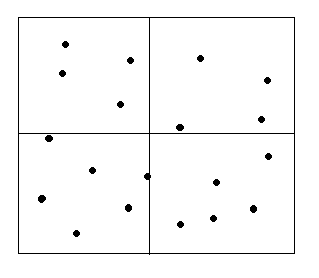
People love to divide things into groups. Here is a graph of all games:

Now I divide them into groups:

That's pretty clear, right? But wait:

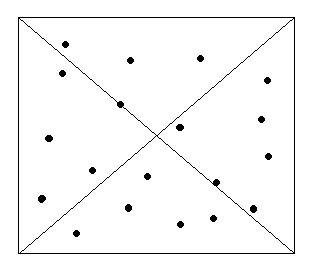
And how about:

Which is right? There is a branch of mathematics that finds patterns and matches plots to curves. But games don't work that way. The more games you get, the more noisy the graph becomes.

You may not like a certain theme, generally, but like a particular game. Or you may not like a certain mechanic, but like a certain game.

But wait. "Game"? What is this "game" about which I speak?

Many people define games, anything from an amusement or pastime to a competitive scored activity with rules and goals.

So. You like games, do you? But not what? Not play? Not activities? Not non-competitive activities?

We have a need to define game. We enjoy "games" and not those other things, which are not really games. Is that need ours? I.e. to allow us to separate the types of things that we usually like from those that we don't. Or is it the designers/publishers? I.e. to create things that they think we'll like based on what we already like.

The past few weeks I presented some alternatives to the classical win/lose situations for games.

Now I want to ask the following: how much different is an activity from a game, anyway? What hybrids do we have? What avenues are we blind to?

Yehuda

Monday, November 13, 2006

More GoVF teasers

In my estimation the Gathering of Virtual Friends (BGG.CON) was a smashing success. I had more fun in Dallas than I have ever had at any time with my clothes on. Those of you who missed it need to make it a point to attend next year.

Looking through my photos I realize that I don't have several that I thought I had. The best picture that I can't find was a photo of Derk. For background, various people at the con had ribbons under their name badge. There were director ribbons, vendor ribbons, sponsor ribbons and several others. Derk was wearing a rainbow of ribbons. He was wearing more ribbons than a Mexican general, however... the few times I saw Derk he carrying around a trashbag and asking people for their for garbage.

Here are a few photos that did turn out.


Chaddyboy

Ynnen


The other photo that I can't find is the one of Michael Chapel. Michael looks absolutely nothing like I had envisioned. No, he is not a hideous John Kerry look alike, as you might have guessed, but even Michael told me that he had other people tell him the same thing.

It is late. I just got home from the con, and I need to get to bed. Just allow me to thank Aldie, Derk, and the numerous other organizers and volunteers for the event. It was a smashing success.

Saturday, November 11, 2006

Top 10 reasons NOT to go to BGG.con

10. 17 hours on a plane is 17 hours you are not on BSW.

9. All the Super-Deluxe-Advanced Civilisation games are too short.

8. The game library is too small.

7. People you know on the internet are not people. They are computers posing as people with little fake avatars. This myth can be prolonged as long as you are not in the same room as the computer.

6. The myriad bloggers and photo-posters updating regularly make you feel like you are there anyway.

5. Who needs free game give-aways?

4. Someone said it would be boring. (OK, they weren't a gamer and had never been to BGG ... but still ...)

3. We have Irish Pubs and Mexican food in Australia, too.

2. Essen games are so widely available in Australia, who needs to go overseas to play them?

1. Derk in a catsuit.

Friday, November 10, 2006

BGG.CON teasers

Thanks to Sandysidamo for letting me use her computer.

You may know him as Sleestack


Werewolf survivors


Not Greg Schloesser and the video-girl-avatar-lady, Anye

Wherre Are All the Manhunt Games?

The other day I saw a thread on Boardgamegeek by a guy who suggested that someone should adopt the Scotland Yard system to the Star Wars universe. The Luke Skywalker player would use hidden movement to run about the board and do rebel stuff, while the Empire player uses his numerous forces to search and destroy the pesky Jedi. Actually, to be accurate, it sounds like he wants to adapt the Fury of Dracula system to the Star Wars universe.

I had planned to someday write a blog on the Fury of Dracula/Scotland Yard system, and the unexplored possibilities of the manhunt game genre. The Boardgamegeek thread merely made me think that the time was right to write.

If you haven’t played Scotland Yard or Fury of Dracula, all you need to know is that they are manhunt games. One player uses hidden movement to move a single character while the opposing player or players move multiple characters in an effort to find and capture/kill the slippery fugitive. Fantasy Flight’s FoD adds combat, event cards, special supernatural Dracula powers and other flavoring to create a game both more complex and more fun than Scotland Yard. I’ve played as Dracula a couple of times, and although I’ve lost quickly both times (in daylight Drac can be killed by an angry girl scout armed with a spatula), the game was always fun. FoD is one game that will be pulled out every Halloween, and sometimes in non-October months as well.

Considering how much potential this game system has, I’m surprised that there aren’t more son-of-Scotland Yard games (There is a Manhattan version of Scotland Yard, but the basic rules of the game are the same).

In fiction there can be a thousand variations of one genre. The modern manhunt story was probably created by Frederick Forsyth’s Day of the Jackal, the story of a British hitman trying to kill France’s President DeGaulle and the detective determined to stop him. Other plot-against-an-historical-leader novels include Jack Higgins’ The Eagle Has Landed (a plot to kidnap Winston Churchill), Glenn Meade’s Snow Wolf (Stalin), David Mason’s Shadows over Babylon (Saddam Hussein), and Philip Kerr’s Hitler’s Peace (the Big Three) Other fine manhunt novels that feature either World War II commando action or modern terrorist threats include Ken Follett’s Jackdaws, Stephen Hunter’s The Master Sniper, Thomas Harris’s Black Sunday, and Joseph Finder’s The Zero Hour. And these are just the books I can remember off the top of my head.

So why not some more manhunt games? I mentioned in passing in a previous blog that Fantasy Flight could easily make a werewolf variant for FoD. I also could easily imagine a Lord of the Rings manhunt game. Not that we need another Lord of the Rings game, but the subject matter and the game mechanism would seem to fit. And there could easily be games based on more situations that don’t involve fantasy, science fiction or horror.

Here’s a possible scenario:

The rogue nation of Werdistan has defied the United Nations and built its first nuclear weapons. The American President has decided to end this threat to world peace by sending a covert team of elite Army Rangers into Werdistan to seize both the weapons and Werdistan’s top nuclear scientist.

But when the Rangers raid Werdistan’s desert nuclear facility, they discover that the atomic bombs are gone. A captive scientist reveals that the bombs are being delivered to a terrorist group that very night.

The race is on. Can you guide your commando team to victory by finding and seizing the nuclear weapons? You can raid other Werdistan instillations for resources and clues as to where the terrorist rendezvous will take place. But time is not on your side, and any encounter with Werdistan’s security forces could result in a deadly battle.

As the leader of Werdistan’s security forces, can you locate the fast-moving American team before it ends your diabolical plot? Your security forces are plentiful, but their training and morale are low. You will need an overwhelming force to find and crush the elite American unit.

The fate of the world is in your hands.

I can even imagine some kind of spy game in which players control both hidden-movement espionage agents and wet-work thugs looking for other players’ agents. Players get points for both stealing other players’ secrets and eliminating other players agents. When a player loses an agent, he gets another one, but the new agent must start at the players’ home base costing the player valuable time. (This hypothetical game owes a lot to SPI's Spies! game, but that game lacked true hidden movement).

We’ve all seen innumerable area-majority games, countless card-driven wargames, and whole families of train games. I think the market would support a couple more manhunt games.

Let’s hope for some good hunting.

Thursday, November 09, 2006

Three More Traditional Card Game Styles

The January, 2007 issue of Knucklebones magazine is now out, and it features my second article for them, "Clubs, Spades and ... Orange Chameleons?!" The article generally discusses how traditional card styles are increasingly being updated into modern, commercial games by professional game designers. In the article I overview three different styles of play:


StyleTraditional
Example
Commercial
Example
Trick-Taking
Bridge
Mu & More
Four Dragons
Set-Collection
Rummy
Coloretto
Mystery Rummy
Hand-Comparison
Poker
Havoc
Parlay


Go take a look at Knucklebones if you'd like to read more; the January issue has stuff on Mattel, Immortal Eyes, and reprints too. In the meantime for this week's Gone Gaming I have a sequel to this month's Knucklebones article: a discussion of three more styles of traditional card games being adapted for commercial play that didn't make it into the main article for space reasons.

Value Climbing Games

Value-climbing games are a traditional card game mechanic widely seen in Asian games but not in America. The object of these games is to empty your hand of cards. This is done by playing “tricks” of a sort, except that players may play multiple cards over multiple rounds of a single “trick”.

A “trick” starts when a player either plays a single card, a pair, a triplet, or a five-card hand (which can be one of several Poker-like sets: a flush, a straight, a full house, or a straight flush). Players then follow in the trick by playing the same number of cards, but of higher value—or else by passing. So, a pair of twos might be followed by a pair of sevens. Or, a flush of green cards could be followed by a flush of red cards, then a straight, then a full house. Play continues around (and around) the table until no one can play, and then the last person to play to the trick takes it and gets to start a new one. Carefully breaking down your hand to figure out how to get rid of all of your cards is important, as is controlling the lead so that you can start the right sorts of tricks to optimize your cardplay.

In 2002 two companies released relatively traditional versions of these games. However, because of their Asian origin these games use unique decks of cards that couldn’t be easily copied with a traditional American card deck. One was Golden Deuce (Playroom Entertainment) which is a family-oriented version of the game with some elements of luck, while another is Gang of Four (Days of Wonder), which is a serious and strategic variant. Gang of Four was just re-released in a new edition this Summer.

Mark Kaufman, in discussing his company’s publication of Gang of Four, reveals that even when a commercial company produces a fairly traditional game, they still tweak it to try and improve the gameplay: “While Gang of Four's underlying mechanics are similar to Choh Dai Di and other Chinese street card games, Lee Yih introduced several aspects that are subtle but have a significant impact on the game. The use of only 3 suits of cards, tightens up the tactical play. The scoring system, which is more punitive to those who are caught holding high numbers of cards, really effects the meta-game of how people work with or against each other to improve their position in the game. And the possibility of the Gang of Four [a four of a kind] being dropped at anytime adds a very important element of risk that you might be trumped, no matter how strong your play.”

The Great Dalmutti (Wizards of the Coast) and Dilbert: Corporate Shuffle (Wizards of the Coast) are party games in the value-climbing genre, while another strategic entrant, this one originating from Germany, is Tichu (Abacus Spiele). Each game offers some slight variants on the standard value-climbing gameplay.

Card Matching Games

In card-matching games players try and empty their hands of cards by matching (via some method) the last card played. Crazy Eights and the commercial Uno (Mattel) are the two best known examples of this gameplay. Steve Jackson Games published the thematic Spooks in this genre while Mike Fitzgerald’s Lord of the Rings Tarot Deck and Card Game (U.S. Game Systems) is another themed commercial example.

Solitaire is a sort of one-player card-matching. Many variants have been created with traditional card decks. A commercial variant is “Solar Solitaire”, one of the games in Space Dominoes (Games & Names), where you try and create structures by matching the three-piece dominoes shown on each card.

Card Fishing Games

Card-fishing games feature a central pool of cards. You take cards from that pool by playing certain (matching) cards to the table. Casino, one of the few traditional games in this style, disappeared after the 19th century, but modern games like Anathema (APE Games) and “Safarü” in Mu & More (Rio Grande Games) keep the genre alive.

Conclusion

If you've read many of my reviews or my TT&T articles at Skotos, you know that I love classifying things. I find patterns in game design (or elsewhere) interesting and intriguing. As a game designer it's interesting for me to break down these patterns to better understand the possibilities for a new game (would a card matching mechanism be viable here? how about hand comparison?) As a player I also find classification useful, because it helps me to find other games in similar categories to those that I already like.

And thus I present six of the most traditional patterns in card game design: trick-taking, set-collection, and hand-comparison (for more on which, see Knucklebones); and value-climbing, card-matching, and card-fishing.

Now get out there and play some cards!

Wednesday, November 08, 2006

Dallas or Bust

Been working like a dog for the last couple weeks so I can take some time off for BGG.con. Took Monday, October 30th off to play a couple games with a new guy, but that was it. Been working every day otherwise.

I leave for Dallas just after midnight tonight and will arrive Thursday afternoon. The temperature at Coldfoot Manor has been hovering between -10 and -20. My biggest fear is that the air conditioner in my room at the Westin has been turned off and I'll have to suffer those unforgiving, tropical, Dallas temperatures.

I've already checked the CDC traveler's guide and there appear to be no flags for the Dallas/Fort Worth region. Just to be on the safe side I did get my malaria booster, a snake bite kit, and picked up a Texan/English phrase book at Barnes and Noble.

The CIA World Factbook has only spotty information about the Dallas area. There was one warning of an increased probability of being a victim of a violent crime when in the vicinity of a Dallas Cowboy, but that information has not been updated since 2003.

Jimmie Dale Gilmore doesn't appear to be playing within 100 miles of Dallas during the weekend in question. There would seem to be no reason to leave the hotel. I shouldn't have to brave the outdoor heat, or accidentally insult a native with a botched phrase, or risk the possibility of coming into contact with a Dallas Cowboy.

BGG.con will be my first big boardgame convention, and I am looking forward to it. The two conventions I have attended were in Anchorage and were primarily for miniature gamers. I had fun, but it just won't be the same as the local con. I am especially looking forward to meeting BGGers. It will be nice to be able to finally put a face with your avatar.

By the way: If I have access to a computer, perhaps at an internet cafe, I will try to post some pictures of the con to this blog.

Plenty of games, no wife, no stressing about getting tickets to the Jimmie Dale Gilmore concert. Looks like a good weekend for gaming. See you there.

Tuesday, November 07, 2006

Winning Alternatives 2

In last week's post, Winning Alternatives, I presented some alternatives to simply "winning" a game. I will take the idea several steps further in this week's post.

Remaining Problems

First of all, as Rob Herman pointed out in the comments last week, a simple payoff based on point differential leads to conservative game-play. In other words, if you have a chance of getting 9 points easily, or risking a chance between 8 or 10 points, you will only risk to get 10 points if there is a disproportionate extra payoff for doing so.

Second of all, I didn't resolve the problem of when two experts play each other. If two people each play a great game, why should one be the "winner" and the other be the "loser"? Shouldn't they both be winners compared to another game where two newbies are playing each other? Conversely, shouldn't even a newbie who plays well be a winner? Don't we want games to reflect that, rather than having to implicitly understand it?

Third, I neglected the huge state change that still happens between winning and losing. In Puerto Rico, a score of 1 to 44 and a barrel is a loss. 2 to 44 and a barrel is a loss ... 44 to 44 and a barrel is a loss. But 45 to 44 and a barrel is a win, and now the 44 and a barrel is a loss. Is this sudden changeover really a good thing?

Risk vs Reward

I'll start with the first problem, the lack of risk taking.

Rewards should be commensurate with risk. Or rather, players should be able to evaluate the proportionality of reward for risk along each path available to them, so that they can choose paths accordingly. A low-risk taker may choose a lower reward, even a proportionally lower reward, for lower risk, while a high-risk taker may choose a higher reward for a higher risk.

Paths with high-risk and little reward should not be considered paths at all, unless they are disguised in such a way as to hide this fact, or the only path left in a desperate situation. And the same is true for the inverse. If a path too obviously leads to high rewards for little risk, there's not much point in considering anything else.

In the case of rewards commensurate with points, rather than all or nothing for the best score, the trick is to ensure that all players at all times have multiple meaningful options from which to choose.

When a player is ahead by 100 points in a game that scores around 120 points, the leading player has no important choices left to make; neither, in fact do the losers. By adding rewards based on points, all players still have reasons to continue making decisions.

To provide tension, and to prevent dull, conservative play, we want to make a greater risk for a greater reward just a little more enticing. That is why the answer has to be some sort of proportionality, where incremental advances yield greater rewards.

In other words, in a typical all-or-nothing game, advancing 1 or 10 points is about the same as far as reward goes. You beat player A but you haven't beat player B. It didn't matter if you beat player A by 1 or 10 points. Only 12 points matters, because then you beat player B. And then it doesn't matter again until you get to 25 points in order to beat player C.

A proportionally rewarding system would make a gain of 1 point yield payoff X, 2 points yield payoff 3x, 3 points 6x, and so on, making both conservative play and risk-taking both viable options at any point in the game. In fact, this is the ideal solution to the "runaway winner" problem in games.

Good Play

All good players know that we don't play to win or lose, but just to, uh, beat my previous score, ... I mean, to, uh ... feel good about my own play.

We all know it. And yet we sound so defenseless when we say it, because the language of games treats this as outside the game experience. The games says "win" and "lose", not "nice try". Wouldn't it be good to put this into the game itself, so that we don't have to search around for it?

When we say "good play", what we mean is "good play for someone of your experience", or "good play for someone who encountered the challenges that you faced". In other words, rather than comparing ourselves to our opponents, or to the scoreboard, we are playing mental duplicate and comparing ourselves to a hypothetical average gamer of our level playing the same game that we are. If we perform better than that guy, we played well. If we perform worse, we played poorly.

The first way to address this is to create duplicate game experiences. Great databases of games can be stored on the Internet, tracking the experience of the players and the order of random events in games, and providing rough comparisons between games played in similar or identical contexts. Advanced A.I. could eventually evaluate performance based on certain positioning, such as how well a player does against a similar occurrence.

Players could download "Shuffle #232a" for Torres and compare their results against other players who played the same shuffle. Unless we assign a neutral party to order the deck before the game starts, this type of thing may only be possible for online games or once we achieve integrated electronic game tables.

A second way to address this is to create standard lists of hypothetical scores to beat for each game. The lists could be either absolute expected scores, or a percentage of score relative to other players. A look on the chart might cross check a novice player playing with two intermediate players and a guru for an expected value of X, or X relative to the guru. Any score close to X is average, less than X minus delta is poor, and greater than X plus delta is good; of course, the greater the granularity, the greater the incentive to score higher.

A third way to address this is to record specific instances of good or bad play. For instance, better moves gain you one or more tokens, and poor moves cost you one or more tokens. This would be the hardest idea to implement, because good and bad play is very hard to pin down in many circumstances. On whose judgment does it depend, yours or your opponents? Or a third party judge after you submit the game to gamejudges.org? How do you evaluate the quality of a good play? What about lucky plays - were they good? And so on.

Each of these methods depends heavily on the type of game, as some games will easily lend themselves to this type of methodology, while others will be harder to fit.

Winningness and Losingness

Now we come to the possible elimination of winning and losing altogether. Can it be done, or is this as bad an idea as eliminating dice from combat games (he asked, sarcastically)?

Let me quote you the rules from Puerto Rico:
Each player gets blah blah blah and you choose a role blah blah and in the Captain phase blah blah lets you store an additional blah blah blah wakki wakki wakki and the third way the game ends is if you need to fill the colonist ship and there are not enough colonists left to do so. The game ends at the end of the round that this happens, that is, after all players have taken a phase, and just before the Governor would pass to a new player.
That was about twelve pages of rules. The rules don't actually stop there, however. They add two more sentences:
The winner of the game is the one with the most points. In case of a tie, the winner is the player with the most barrels plus doubloons among tied players.
Now, what would happen to this game if we simply eliminated the last two sentences? Would the game be less challenging? Less fun to play?

Don't we know that the object of the game is to get the most points? Or, most points versus your opponents? I suppose we might have thought that the winner is the one who can produce the most tobacco at the end of the game, but we can specify: the goal of the game is to get the most points, and in any case more points than your opponents. What changes by eliminating winningness and losingness from the game?

You might have less need to end the game quickly before your opponents can achieve a higher score. But no, not if the goal is still to get the highest score relative to your opponents.

You might be tempted to turn the game into a cooperative game. Imagine Puerto Rico as a cooperative game, where players try to achieve the maximum overall score on all boards before the game ends. As in all cooperative games, you would have to limit or eliminate player discussion in order to prevent the same dominant players from running every game. But again, this violates the goal.

Isn't this what we do anyway, when we "don't really play to beat our opponents but to play against ourselves?" Why not make it official? Try rewriting the ending of your games and see what happens.

I admit that this may be a radical change for board game makers to introduce, so as an alternative for the more conservative among you, I will retreat to something a little less radical: partial winning and losing.

Imagine that instead of completely "winning" or "losing" you are assigned a percentage of winning and losing. For instance, beating your opponent by one point nets you a 50.1% win, while your opponent nets a 49.9% win. By two points is 50.3% to 49.7%. And so on. All we're really doing here is keeping the score percentages at the end of the game, instead of translating them into the binary notion of 100% win vs 100% loss that games prescribe.

Could it really be that simple?

Action Items

Most games we have don't really need much changing to implement these ideas. They only need to reword the last paragraph in the game. Harder will be the education campaign for gamers and game designers, to convince them that competition can still have a point even if you don't absolutely crush your opponent at the end of it.

Yehuda

Sunday, November 05, 2006

Strategy and Tactics, a couple of definitions

I have only recently been able to play Shear Panic and Caylus, two games that made a big splash in Germany last fall. I enjoy both games very much, but they set me thinking upon on of my favorite topics, a comparison of the concepts of strategy and tactics. While someone else may want to provide a textbook definition, I will presume to provide my own for the purposes of this column. Tactics would be a consideration of possible responses to a specific situation, such as a single turn in a boardgame, whereas strategy is best applied to situations where decisions are made about very long-term goals. A strategic choice will help dictate how to proceed in the present, with an eye towards some general future, but a tactical decision focuses on the here and now. A strategic decision can be made even before a player is confronted with the specifics of the game-state on their turn, whereas a tactical decision relies almost entirely on the situation at hand.

As is the case with most attempts to separate things into two neat categories, this perception of strategy and tactics can be argued to be more of a continuum. A tactical decision of quality will include the consequences of a move for the next turn, the turn after that, and so on. One can argue that a _good_ tactical decision will thus include thoughts that roll on off into infinity making the decision far closer to a strategic one (since it is actually long term). So, if the future consequences can be well predicted, a tactical decision will have a strong strategic aspect. In the same way, if the long-term consequences of an action are unknowable due to chaotic conditions, most decisions will have to remain entirely tactical. This trend can even be continued back into the past, prior to a decision being made. So that a chaotic situation leading up to a decision forces a player to play in the moment, making each decision a tactical one, and inhibiting any long-term strategy.

To help explain what I’m talking about, here are some concrete examples…. Let’s start with the classic game of Chess. Since there is a single way to win in chess, taking the opponent’s king, one could assume that chess and most other abstract games should be thought of as mostly tactical – responding to one’s opponent. On a given turn, a chess player has a limited number of reasonably intelligent moves. In a standard game, an opponent will probably respond with one of a limited number of intelligent moves. Thus, it is actually possible to predict a number of moves into the future. A good player will try to predict which of this branching-tree of possibilities is the best choice, and is thus implementing strategy. A second way to implement strategy is to have a game that is very closely analyzed. As with Chess, if a game has been the subject of deep scrutiny, broad-based concepts can be applied to a decision in such a way that a player is actually implementing strategic rather than tactical play. Chess openings have been studied to a great extent, so a player may choose to go with one or another set of opening moves with only a cursory connection to the plays their opponent are making. A mediocre chess player will play the game as an exercise in tactical decisions, but a higher class of player will consider the multiple branching elements of possibility and play on a level I consider strategy. So, with enough background, thought, and training, what is basically a tactical game can turn into one of strategy.

All this rambling is to lead in to an analysis of my opinion on Shear Panic and Caylus. I have found that, while I find I am better than average at playing tactical games, I much prefer a game that allows strong strategic elements. I can find elegant and surprising actions that will help further my goals, but I enjoy doing so much more if it is furthering some larger, master plan. In Caylus, I have found an excellent strategic game. As is the case for most strategic games, in the first few turns of the game I have several strategic choices open to me for a long term goal. I may have preferences for one strategy or another; as in the various lines on the favor track or a building-focused strategy, but one strategy will tend to rise to the top as I analyze the opportunities available in the initial few turns. Once the opening of the game is past, my long-term strategy is set and many of my later decisions are affected by that. Of course, no good player will stick to one strategy no matter the cost, it will often need to be modified and adjusted as the game progresses. Puerto Rico is an even better example, as deciding to go heavily into shipping goods or a strong income/building strategy will affect the entire second half of the game. Compare this to Shear Panic. I find Shear Panic to be an enjoyable game, but in a three or four player game all the decisions are almost entirely tactical. After two or three players have taken an action, the entire board will be readjusted as the sheep cluelessly wander hither and yon subject to your opponents’ whims. Some small amount of strategy can be employed in conserving your “best” moves for later, and for those rare times when a scoring round looms close enough to make a few predictions about an opponent’s next move. However, the chaotic nature of the game makes it remain primarily a tactical one.

So, since I prefer strategy to tactics, I do find myself enjoying Caylus far more than I do Shear Panic. Both games have their place, particularly since Caylus is about 3 times longer (or more) than a game of Shear Panic. The cute little figures and silly theme are what Shear Panic is all about, and those attributes easily overcome my prejudices against tactical games.

I am not a game designer (I attribute this to my tactical skill, I’m much better at playing with what is there and abusing it for my own nefarious designs, rather than creatively coming up with something entirely new) but can see several ways in which strategy can be introduced or removed from a game. The first is randomness. As random events or values cannot be predicted, the more randomness present in a game, the more tactical it will become. Thus, I find the random tile draws in Tigris and Euphrates to make the game entirely too tactical for my taste when it seems to cry out to me to be a strategic game. The second way to affect the amount of strategy is to introduce multiple players. Humans are notoriously unpredictable and could be considered randomizing factors. The more players present the more chaotic the game, and the more tactical a game will tend to be. This is minimized when all the players are of high quality and most information is public knowledge. Thus, if other player’s moves can be predicted with reasonable accuracy, a longer-term strategic plan can also be constructed. A third way to introduce strategy into a game is to include multiple paths to victory. This is even more important if those paths are true paths and require multiple stages for success. If there are several choices to be made throughout the game, players will begin to commit to one or the other and it will then affect further choices that have yet to be made.

I love a good strategic game, but that doesn’t mean I refuse to play anything else. However, if I plan to play a game that lasts a while, I much prefer it to have a good dose of strategy. Playing a game is so much more rewarding when I can have a plan and watch it grow to fruition throughout the course of play. If I sit down and spend hours in a game, I find it rather wearying for it to be one where each turn has little affect on previous or later turns and it ends up being simply a series of short optimization problems.

Saturday, November 04, 2006

This week in gaming.

I missed Gamers@Dockers this week, although we had games at our place on Friday night and we arranged babysitting this afternoon so got to spend about six hours at Eurogamesfest today to make up for that.

Monday
Tichu at lunchtime at work.


Tuesday
Tichu at lunchtime at work.

Daughter the Elder is a big fan of Loopin' Louie. If there are only the two of us, we play two colours each, one for each hand. We played four games before her bed time. Daughter the Younger joined us for the last one.


Wednesday
We were one player short for Tichu at lunchtime so we played three handed Gang of Four instead.

Daughter the Elder requested a quick game or games before bed. We played The Itchy and Scratchy Game five times. I only managed a single victory.


Thursday
Back to quorum so Tichu at lunchtime at work.


Friday
Tichu at lunchtime at work.

At games night, we got through ten plays of Diamant. We started out with four players, then six players and then down to five players for the last few. Scores varied wildly, with some rich cave systems and some truly appalling ones including the eight card cave where the first seven cards consisted of one of each of all five disasters and a mere two gem cards being 1 and 7. Not many players will run out of the caves with one gem in hand and two in the kitty, I don’t really need to tell you what the eighth card was do I?

As an example of the changing scores in our four player plays, 37 points got first place in the first game and 37 points came dead last in the next two.

Diamant is a push your luck filler but it is good fun. There’s also the psychology of trying to determine when the other players are likely to cut and run so that you don’t cut and run at the same time. I must say that the little gems that come with the game do make it more enjoyable, it wouldn’t have the same feel to it if they were cardboard chits.

After the Diamant marathon two of our players went home. Vincent had his new copy of Mission : Planète Rouge . Melissa said that she had read reviews that commented on how difficult it was to open the box. They weren’t kidding!

With all four of us working on it, it still took us about two full minutes to get the box open – once that lid is on, there is no chance of it slipping off accidentally, none at all.

I had played this once before a couple of weeks ago, but it was the first time for the others. Including the rules explanation it took us 90 minutes for a four player game.

In both games I have played I have seen Saboteurs blow themselves up. In the first game by the time the Saboteur’s turn came up there was only a single ship, he put himself and the bomb on the ship. In last night’s game there were two Saboteurs in the same turn and two empty ships left. Saboteur number one placed herself in ship #1 and her bomb in ship #2. Saboteur number two came along and placed himself and his bomb in ship #1. No more Saboteurs. Another previous Saboteur was successful, but it would seem to be a dangerous life.


Saturday
We arrived at the start of Eurogamesfest, there was a game of Traders of Genoa set up at one table waiting for their fourth and fifth players to arrive. We gathered the other people and started Diamant. During our first game the other table got a phone call that their fifth player would be late so started with four. We played three games of Diamant waiting for some extra people to show up so we could start a heavier game.

We then started Melissa’s favourite game, Princes of Florence. I thought I was doing advanced planning when at the start of turn six I knew what the next four actions I was going to do were. Melissa informed me later she usually plans out the next eight actions. No wonder she tends to do better than I do.

Some of the other tables had also finished, but Traders of Genoa was still going strong.

We reformed groups and I ended up playing a four player game of Acquire. This is a game I bought a couple of years ago, but have only managed to get off our shelves one time. Melissa just doesn’t want to play it. The copy we were playing was an old Avalon Hill bookcase edition. The game ended when Luxor Corp went sailing past the 41 limit.

Guess what? It was now four hours since we started our first game of Diamant and Traders of Genoa was still going! I have played it with all newbies before, it really shouldn’t take that long.

The winner of our Acquire game headed off home. Christie had been waiting quite a while for the Traders of Genoa game to finish because she wanted to play Acquire with some of the people from that game. Since it didn’t look like it was going to finish any time soon, we started another game of Acquire so that she could play the one game she had come along to definitely play. I made out like a bandit in the three of the four last mergers and came out on top when we finished only a little behind Traders of Genoa. [Note to self – do not play Traders of Genoa with those people].

I also bought two second hand games today, Duell and the Avalon Hill Robo Rally. I think that both Melissa and Daughter the Elder will enjoy Duell and Robo Rally is a game that I regret not buying when it first came out. My reasoning back then was that I had friends who had it, so I didn’t need it. I have since found that friends can move away and not leave their games behind them, so I was happy to pick this up.


Sunday
Is yet to come, perhaps Duell with Daughter the Elder?


Mmmm meeples taste like…

Friday, November 03, 2006

Game Related Activities

I was looking at Yehuda’s latest essays and Shannon Appelcline’s Mathematics and Game Design essay of a couple of weeks ago, and I started thinking that a lot of the Gone Gaming blogs seem to written more for game designers than casual game players. Nothing wrong with that; casual gamers with intellectual curiosity could be nearly as interested in these kind of essays as aspiring game designers.

And this started me thinking about how many members of my local gaming group are more than just casual gamers. On an average night no more than seven or eight gamers will gather at Ted Cheatham’s house for the weekly session of the Appalachian Gamers, but almost all of us have been a playtester on at least one professionally produced game. With the publication of Silk Road, Ted himself has become a game designer, and there seems to be a good chance that one or more of his other designs will be published in the next year or two. One of our members--Travis Reynolds--is a founding father of a gaming convention--Charcon. Yours truly writes a gaming blog. And this month, some of our group members will be putting in time at local libraries demo-ing games for the public.

To me this seems like a lot of Advanced Game-Related Activities (AGRA) for such a small group. And that makes me wonder about how our group compares with others. Was I exceptionally lucky to stumble upon an elite group of gamers when I moved to West Virginia two years ago? Or are most gaming groups full of folks who indulge in AGRAs when they have the time? I know that there is a huge group of Long Island gamers who have their own magazine, but it might be that the percent of AGRA-active gamers in that group is quite small compared to the size of the group as a whole.

Post a reply here and let me know about your group. I’m curious what other exotic game-related activities are out there. As anybody with a nodding knowledge of statistics will know, this won’t be a scientific sample because it will be self-selecting. Gamers who belong to groups with members who do nothing but play games probably won’t bother to respond. But so what. This is for our amusement, not for a sociological journal.

Let me know—

…what’s the most unusual game-related activity you’ve witnessed.

…the silliest.

…the most work for no reward.

…the most intellectual.

When I start to add up the hours that I’ve spent on AGRAs this year, and when I consider that a lot of members of the Appalachian Gamers devote considerably more time than I do, I start to realize just how emotionally engaging this hobby is. And I suspect that the devotion that the hobby inspires has led to some strange and wondrous tales.

Tell me yours.

Thursday, November 02, 2006

Crank Calls and Hive

Doctor’s Fastfood Puzzle Question and Answer

Q: I was driving down the street when I noticed that a fast food place had a peculiar quality to its name. When I read the syllables backward (just reversing the order of them), I got something that a certain kind of specialist doctor probably had to take in med school. The new phrase was phonetically constructed from the fast food business’s two syllables. What is it and what do some specialty doctors have to take in med school?

A: QUIZNO’S and NOSE QUIZ

======================================

I don’t have a puzzle for this week, but I’ll leave you with a couple of things I’ve said on the phone to people:

a) I called R&M Distributors in California and spoke with a guy named Mike. Good guy. Anyway, I asked for a couple of Ouija boards, which he put on our order, and then asked about the availability of "Deluxe Ouija: Devil’s Edition." He was silent for several uncomfortable moments before I told him I was kidding.

b) I called our phone service Blackfoot Communications to inquire about what I could do to get our fax machine to work harmoniously with our phone service. The employee started describing the different set-ups and options, and then I asked if it mattered that our fax machine had a hand crank. She was absolutely silent, then went hysterical when I told her I was kidding.

Oh, I love those phone calls. Normally, it’s all business, business, business. I gotta shake it up with a little silliness or else I’ll go nuts.

============================================

So I’ve been playing a lot of Hive lately. Definitely a neat game. It came out several years ago, and got a lot of attention recently with Mensa. It’s been dubbed "Insect Chess," though there is an arachnid in the group.

With Hive, each player gets either black or white hexagonal pieces with bugs on them. The pieces include a queen bee (like the king in chess), ants, spiders, beetles, and grasshoppers. These pieces are placed together to form the hive.

The object of the game is to surround the opponent’s queen bee, with any combination of pieces, including your opponent’s.

Each piece has a unique movement. The queen bee slides one hexagon at a time. The ants can slide any number of squares around the perimeter of the hive. The spiders can slide/jump exactly three squares in any direction around the perimeter of the hive. The beetles slide one hexagon at a time around the perimeter of the hive or can crawl on top of the hive itself (that is, on top of other bugs). The grasshoppers can jump over any number of pieces in front of it.

Each player places a single piece together. This is the core hive. After that, pieces may be added only to a player’s color, while taking care to avoid touching the opposite color. Once the queen bee has been placed, an action which must happen within the first four moves, players have two options: either add a piece or move a piece. Maybe I’ve glazed over a few details, but that’s pretty much it.

I have two observations:

1) The rules need some clarification.

The way we’re playing it right now is that the spider can "jump not slide" three spaces around the edge of the hive. If not, it’s just a weak ant. Maybe it’s supposed to be a weak ant, but we prefer something that makes it different. Also, the beetle can crawl, but can it crawl over and into a blank hexagon (the hive structure might contain a blank hexagon surrounded by six bugs, the beetle being one of them. Can the beetle crawl directly into the hole, or must he waste a move crawling onto an adjacent bug to get into the hole on the next turn? I don’t know.

2) The player who goes first has an overwhelming advantage.

After several plays (perhaps over a dozen, with a few different opponents), I believe that the first player has a distinct advantage, perhaps as high as a 75% chance of winning. It is hard to figure out how to play defense with an ultra-aggressive opponent. When you consider how the game functions, you can see why. The player who goes first can get on the offensive right away and stay on the offensive. A piece can be dropped in one move to make a threat, while to defend against the threat takes two moves (dropping the piece, then using it defensively). I know of no way to fix that, either by the creator or through player suggestions.

That said, it’s still pretty entertaining. In fact, it’s fun to play black because the odds are against you. The challenge then becomes survival.

I’ve had a good time with how the game looks and feels and plays. The makers are proud that the game is played without a board, and there is a certain appeal because of it.

I think another dozen plays is required to see if the winner’s advantage is wrong or if the ratio improves a little with more game plays. Right now, though, I’m content with the game, and I’m impressed with the overall concept and design. I’ve got a list of fun two-player games, and Hive has certainly crawled its way into a spot.

Wednesday, November 01, 2006

The Quality of Fantasies

I’m happy to have another great article by Mikko Karvonen for you today. Clap if you believe in Orcs and Dwarves.

I love fantasy as a genre. I enjoy it in books, comics, movies and tv-series and, of course, in games. I have to admit that fantasy-theming alone is often enough to get me to take a closer look at any given boardgame. However, partly because I am so strongly attached to the genre, I also tend to be rather critical towards it. A bland generic fantasy with your average orcs and elves does very little to impress me, while an original take on the subject can be enjoyable in itself. So I thought I'd take a look at some of the latest fantasy boardgames, the way the genre is implemented into them and how it affects the playing experience.

To narrow my scope, I'll focus on selected games of different types published after the year 2000 with fantasy worlds developed solely with non-computerised gaming in mind. This excludes games like Warhammer Fantasy Battle, HeroQuest, World of Warcraft: the Boardgame, Game of Thrones and War of the Ring. Some of them I like, some of the I don't, but I want to make sure I'll actually be able to finish this piece at some point. So, on to the games. Please note that I focus only on the fantasy elements of the games, not the quality of the game otherwise.

I'll start with Wizard Kings, even though it's a bit older game than my other examples, as it offers the most generic and bland implementation of fantasy I could find. This is mostly due to the way the game is put together: no background information, no personalities, no special powers. Nothing to add the meat to the bones. Just a bunch of units with fantasy-themed names and pictures. There are some interesting elements in various different armies, like the boarmen, but they are not utilised at all. Even the maps consist of your average environments, with only the stone circles to add a touch of otherness to them. Rating (1-10): 2

Battleground: Fantasy Warfare does not fare much better. The developers have, perhaps wisely, declared that they have intentionally avoided publishing any information about their game world to give themselves room to develop it more, but they have also given the players a little motivation beyond traditional fantasy clichés to create their own scenarios and vendettas. This hasn't exactly been helped by the selection of the first armies: humans, orcs, undeads and, as the first expansion pack, elves. The last have a bit of unique twist to them thanks to elk-riding cavalries and animal-commanding wolfkin and bearkin, but other races have just copied the regular strengths and weaknesses of their equivalents from other miniature games. Rating: 3

Another example of badly developed fantasy world can be found in HeroScape. It does have a vague background story about angelic beings recruiting warriors from various times and spaces to fight for them, but frankly, it's just an excuse to include all sorts of fantasy and science fiction characters in one game. Luckily, the developers have had the courage to go all the way and really come up with lots of different flavored units and even get a bit of personal touch into the miniatures here and there. This helps to save HeroScape's face a bit, but still I would have loved a bit stronger environment to encourage certain kind of combinations instead of throwing practically anything into the battlefield together. Rating: 4

Magic: the Gathering is a bit trickier customer in this analysis. In first glance, it does seem to have the same problem as HeroScape: you can throw almost anything together if you wish. However, MtG has a couple things to support its cause. First, various theme-decks are actually a fun, and sometimes even viable, way to play the game. Second, the colour-scheme makes sure that usually most cards in any given deck are at least thematically linked. Third, there is actually some interesting story-information in the art and the flavour text of the cards. Fourth, the developers have not been shy about making unusual twists to old fantasy favorites or creating new ideas of their own. Some cards have actually made me say 'Wow' when I've seen their art or flavour details. Rating: 7

So far I've been quite critical about old, familiar fantasy clichés, but sometimes they actually work. All you have to do is give them a touch of personality, a game where they fit the basic idea really well, and be really honest and sincere about it. A good example of this is Runebound (and Descent, which takes place in the same world). It's got all the traditional elements you can think of: big heroes, treasures, magical items, nasty monsters, evil necromancers and powerful dragons. But since the idea is to create the ultimate, quintessential fantasy adventure, it's all good and workable. There is enough originality and details to make them work. The magical sword is not just a magical sword, but the mighty Sword of Light! The enemies are not just average zombies but a temple of evil necromancers! And the heroes are not quite your usual fantasy types (despite the Red Scorpion and Her Amazing Levitating Boobs! -act), but wizards are a bit crazy and warriors either not-so-pretty non-humans or suspicious looking über-males. Various expansions help the cause as well by adding different spices to the usual fantasy mix: Island of Dread a touch of Cthulhian monsters, Midnight (based on FFG's own RPG) a world where the ultimate evil has won the great war and the upcoming Sands of Al-Kalim a shade of Arabian nights. Rating: 7

Yet the most impressive fantasy worlds are filled with unique or unusually well-developed ideas. One of my personal favorites is found in the miniature game Warmachine and further developed in it's RPG-version, Iron Kingdoms. It mixes an original take on many fantasy races with a world going through it's industrial revolution that is fueled not only by coal and iron but also magic, allowing the creation of huge machines of war, steampowered robots called steamjacks. It's an impressive vision filled with lots of background detail, rich and well-thought versions of old favorites like elves, religion and undead, and heaps of very, very cool opportunities for gaming. The only small problem with Warmachine (if you don't mind the ridiculously large shoulder pads many characters choose to wear) is that it actually fails to utilise the potential of the world as so much extra has been developed for the purposes of Iron Kingdoms RPG. But I know several people who own the core rules and some miniatures of Warmachine just because steamjacks and other unique aspects of the world are so awesome, so it's clearly doing many, many things right. Rating: 9

Perhaps a bit ironically, the most original and charming fantasy world in the current boardgaming scene comes from the man often blamed for dry and thinly themed games: Reiner Knizia. I am, of course, talking about Blue Moon (and BM City). It's main attraction are it's different races and characters. In Blue Moon, we don't get elves, orcs, centaurs or even minotaurs, but a set of definitely unique, yet still familiar enough to be understood, people. Knowledge-preserving technomages, reckless birdmen, passionate traders, spiritual guardians of different elements and gangs of childlike people that get everywhere. I've never been able to decide which of them I like more. Okay, it has its race of (half)-naked amazons which, admittedly, is a bit cheesy. But even that works, since the women in the cards are portrayed so strong, spiritual and capable that they are much less objects and more emancipated than you'd expect. Which brings us to a very important point, sadly overlooked by some of the other games on this list: the world of Blue Moon is enhanced by stunning art. Impressive visuals go a long way in crafting a truly unique world with a clear sense of wonder, fantasy and otherness. Rating: 9,5

Finally, let's take a little peek at the future and the game that may be the Next Big Thing: BattleLore. Of course, we don't know everything about it yet, so I won't make a final assessment. Based on the current information, it seems to be taking a very traditional approach on fantasy. We get the holy quartet: Warriors, Rogues, Wizards and Clerics. We get very, very traditional races and monsters from dwarves to hill giants. And we get them all mixed up with historical events. Frankly, I'm not very impressed by this. Medieval Europe had a wide range of folk stories, mythologies and legends that would have offered an excellent, yet rarely used background for supernatural and fantasy elements that would fit the history well. Instead they seem to use the bland, D&D-ized version of fantasy with a bit of local colour. It may work, but at this point, I'm quite skeptical.

So, it is obvious that the same theme can be implemented into a boardgame for better or worse. When I look at this list of games, all of which I happen to like, I know I'm far more likely to play the ones that do this thing well. It's an extra layer of dedication put into the development of the game and thus adds it's own bonus to my gaming experience as well. I don't mind playing an abstract game, or one with a thin theme and good mechanics, but when I'm looking for a strongly genre-influenced game, I prefer one that does its theme well.

It's also worth considering: would spending a bit more time on adding extra bits of theme to more German-styled games be worth it's while. After all, there are several good examples of this paying off very well. Havoc: the Hundred Years War is basically a variation of poker, but it has gotten a lot of praise for its medieval art and historical tidbits. Funny Friends owes a lot to its non-politically correct approach, part of Reef Encounter's charm is just its strangely captivating theme and I'm fairly certain that Ticket to Ride wouldn't have been the hit it is on a generic map and cities A, B, C...