Saturday, April 29, 2006

Gaming with the Infantry

The 3 year old infant, that is.

Fraser's taking a break this week so I have a bonus turn at the picspam blog.

We've just this week really started gaming with Otto, who turned 3 in March - and my goodness, was she ready for it!

The first game we dug out was Colour Clowns - you can read about our second session at BoardGameGeek. This is an old game, which is still available in very limited quantities, where each player has a mat with a picture of three colourful clowns. Players roll dice (one shows colour - purple/orange/green - and the other shows shapes - triangle/circle/square) to see which part of which clown they need to make - the hat (triangle), face (circle) or tummy (square). If you roll a purple circle, you need to make the purple clown's face (which is blue) purple - by placing a pink perspex circle on top of it. There's not much game there, and it gets bogged down at the end as people roll three or four purple circles in a row when what they need is a green triangle ... but for a three year old who is just learning about mixing colours, it is fantastic. It's still her first choice off the shelf, although these days she prefers to play with the shapes rather than bother with the dice:

Otto lining up the shapes

Otto dealing cards for I have...The second game we tried was "I have ..." - we picked this up for about $7.50 from our FLGS last Double Discount Day ... and I have to say, we overpaid. This is billed as a game for 5 year olds and up - it's a simple card game, where each card has a picture of an animal with the statement, "I have ..." on the front - and a picture of a DIFFERENT animal with the question, "Who has ...?" on the reverse.

One player starts by playing one of their cards into the centre of the table: "I have an elephant." They then flip the card and ask, "Who has a snake?"

Any player with a snake card can then play their snake, flip it and ask, "Who has a giraffe?" - etc etc

Again, not much of a game. It's billed as great for early readers/pre-readers - and, to its credit, it is well designed enough that Otto, at three, can play it quite competently. She's learning to deal cards and is learning about trick taking and game responses.

And practising animal noises.

I recorded part of our game this evening. (107 KB, 27 seconds, MP3)

Piggies!The third game we tried was more of a success from our perspective. Piggyback, or Rüsselbande, is a simple roll-and-move game with two things that make it stand out. The first is the pig meeples (peeples?) which you can use to make all sorts of shapes. The second is the fact that pigs can take rides on each other - if your pig lands on the same dot as another pig, it takes a ride on that pig's back until your next go.

This is a delightful game, and a good introduction to the use of dice, without the intense yawnfest of many roll-and-move games. Also, it's short.

Preparing for our Family Boardgame Night at Biggie's school, we've broken out some other new kids' games this week - Catch the Match, Frog Juice and Gopher It. They're all good games for kids around 5-8 years, but they're not games I'd get out to play with adults.


Lastly, since a couple of people asked for these, here are the photos of the completed Tikal game from last week.

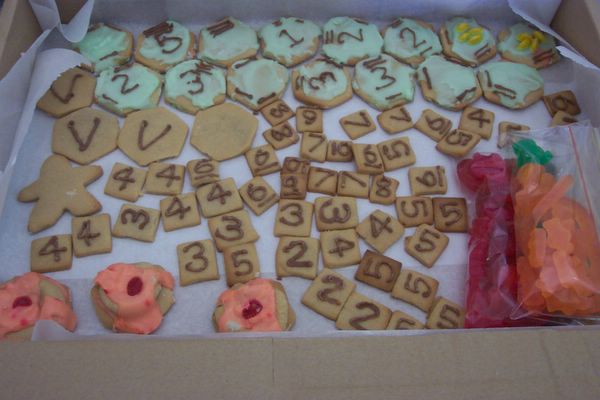
many gingerbread tilesI realised on Monday morning that I didn't actually need a set of 10 nesting square cookie cutters to make the tiles, I could just cut squares of gingerbread - so another batch was baked, and we went for full playability.

just one tile on there nowAs you can see, the '3' square fits nicely on this '2' temple hex ... it's when we add more tiles that it turns into a dexterity game...


oops


That's ten ... but for how long?

Biggie and I had fun counting out sweets for the pieces - small jelly babies for explorers and big ones for leaders, 'squirts' for tents and snakes for temple guards.

Here are the final photos of the game all packed up for presentation:


Until next time, happy gaming!

Melissa

Friday, April 28, 2006

Odds and Ends/Here I Stand

I was contemplating my circle of game friends. Except for my wife they are all single. A couple are single due to divorces. I made a list. I included everyone who I would be likely to play with at least once in the next year. Came up with about fifteen names. There is only one local couple and another couple in Anchorage on the list.
-------------------
Been organizing DenaliCon II. This is an RSVP boardgame event held over the Fourth of July Weekend in Denali Park. Last year there were about two dozen people who attended over the weekend. We had a frickin' blast, even went whitewater rafting. This year the fourth is on a Tuesday. It's more difficult for people to attend this year. Many won't be able to take a four day weekend or even a three day weekend. If you are from Alaska or northern Canada or will be visiting Alaska over the Fourth of July weekend and are interested in a camping/boardgame event drop me a line. There is a fee. koldfoot@hotmail.com

I'd love to hold the event closer to Anchorage in the future. If we can get more participation from that area it might happen. If you can't come this year, but would consider participating next year drop me a line.
-------------------
My daughter is now old enough to attend the Boys and Girls Club, so I brought her for Thursday evening games. The physics of weight and balance involved in Villa Paletti eluded her, but she kicked butt on Pirate's Cove. She picked it up much quicker than the older kids who had never played. I was quite proud. She was pondering which opponent was likely to go to which island and who she could beat in a battle. She was deciding if she needed money or if her hull could even carry the treasure she would earn at an island. I was quite proud. Did I say that twice? Oh well. If not for needing help with the Tavern Cards (and the game could be played without them) she could have played by herself. Six years old, by the way.
------------------
Die Macher has been sitting unplayed for a couple years now. I dug out my English translation of the rules and started reading. I fell asleep about the time I got to the components list. I usually make it to page 7 before I give up. Those are some dry rules, and there are twenty-odd pages of them. Every time I try to figure the game out it becomes clear that I need someone to teach me. This is one game I need to play at BGG.CON.
-------------------
Keythedral, Antiquity, Anno 1503, Mallworld, Tongiaki, Rommel in the Desert, Taj Mahal, Silverton, 2038, Siena, Ricochet Robots, Beowulf, 7 Ages, Punct, among several others also sit unplayed. Wallenstein, Wilderness War, Age of Steam, Railroad Tycoon, Tower of Babel, Command and Colors, Descent and a couple others have been played once or twice and I'm chomping at the bit to play again.
-------------------

Played Here I Stand for 10 hours on Saturday. Took a lunch break for about an hour, spent another couple hours looking up rules. With experience I think we could whittle down the playing time to about 5 or 6 hours If you can get six gamers together for an entire day I would recommend Here I Stand. Further play might reveal some flaws, but we had a blast. Here I Stand is a card-driven game set in the early 16th century. It is based upon the wars of the Reformation era. It is a wargame by any definition, but it is not like any wargame you have ever played. All six players have different goals and abilities. It is not your typical conquer-territory-to-win wargame. In many instances players can't directly affect the victory points earned by their opponents.

Briefly:

Ottomans: The Ottoman player mainly earns victory points (VPs) by conquering territory, but can also earn VPs by engaging in piracy in the Mediterranean.

English: Henry VIII wants a male heir. The English player can spend one turn each round advancing to the next wife and rolling a die to see if a male heir was conceived. If Edward is born the English gain 5 VP. Otherwise the English gain VP by exploring the New World, having home spaces converted to Protestantism, and by conquering territory in Europe.

The English player is further encouraged to produce a male heir, because if Mary assumes the throne upon Henry's death the Pope (Catholic player) has a 50/50 chance of being able to use the card played by the English instead of the English player. (Mary was staunchly Catholic).

French: The French earn VP by building Chateaus. One turn each round the French can build a Chateau, otherwise the French can earn victory points by conquering territory and exploring the New World.

Hapsburgs: The Hapsburgs begin the game in control of much of Europe. The Protestants are gradually taking control of Germany, but the Hapsburg player cannot affect the religious status of his territory. The Hapsburgs can fight Protestant troops, but not in the early rounds of the game. Killing troops makes it harder for the Protestant movement to spread, but can only slow the spread. The Hapsburgs gain VP by conquering territory and by exploring the New World.

Catholic: The Pope has a small army and can earn VP by occupying territory, but mainly earns points by building St. Peter's Basilica and by maintaining religious control of Europe. The Pope can call debates against reformers (and vice versa). If a debate goes badly for the reformers they can be burned at the stake for Catholic victory points, or the Protestants can earn VP for disgracing the Catholic debater. The Pope can excommunicate European leaders, causing them to lose a card each round they are excommunicated. To get back into the good graces of the Church the Monarch gives up a card and the value of the card is committed to the building of St. Peter's Basilica.

Protestants: The reformers earn victory points by changing the religious affiliation of European cities, by translating the Bible into English, German and French, and by winning debates with the Catholics. There are six electorate spaces in Germany that provide extra VP if they are controlled by the Protestants.

Although the rulebook is thick, each player only needs to concern himself with a portion of the rules. For example, the Ottomans, Catholics and Protestants can't explore the New World, only the Catholics and Protestants have to know the religious debate rules, every player has nation specific victory point considerations, etc.

Your first game will go much more smoothly if nation assignments are made prior to the game and each player has a chance to study the rules that are nation specific.

Here I Stand could be my favorite game of 2006. There is a ton of room for each game to develop very differently.

Thursday, April 27, 2006

Last Season's Hot Games: A Top Ten from Essen 2005, Part One

Last year I worked up a list of the top ten games to be released at Essen 2005. Now that several months have gone by, I've actually had the time to play through all of them (other than no-show Tempus). As a result, this week and next I'm going to offer up a summary of my opinions about the best (and worst) games from my list.

This week, the top five games, which I grade between an "A" and a "B+", all well above average.

#1: Caylus (A)

My Thoughts: first impression (12/05), comparison to R.E. (2/06), 2nd comparison (2/06)
Authors: William Attia
Synopsis: resource management & city development
Background: France, 1289
U.S. Publisher: Rio Grande Games

Caylus entered life on BGG with people claiming that early playtesters were artificially inflating the ratings. Several months later, on 2/18/06, two of the top threads at BGG concerned Caylus. One contained a scholary discussion of whether to use your own production buildings, while the other breathlessly asked, which is deeper, 2-player Caylus or Chess?. What a difference a half-a-year makes.

There is no question in my mind that Caylus is grossly overhyped and that the alternatively worshipping and over-intellectualized discussions concerning it are excessive. There's also no doubt in my mind that Caylus is a good game. I doubt it deserves to be credited as the #2 game of all time, but I suspect it will stay in the top 3 at BGG, contradicting my stance of last year. I don't know what rating it actually should have, because the length of the game puts it outside of my own enjoyment zone most of the time, much as happened with the previous year's Power Grid, which I'd also acknowledge as a good game.

Caylus' success comes through excellent design of a resource-management mechanic. You are constantly forced to balance spending actions to earn resources and spending actions to spend resources; this is a mechanic that is also used to excellent effect in Union Pacific and Ticket to Ride, and gets the design going from the start. Even once you have a resource, you must also decide in which of multiple ways to use it, and each of those answers can have very different results.

Another real advantage of Caylus is its variability. The game can develop quite differently from play-to-play, and there's also the option for different styles of play to really throw things up in the air. This will help to keep the game fresh.

Caylus' greatest challenge will be its length. It runs too long for casual play. The provost/bailiff mechanic can either shorten or telescope the length (depending on how you look at it), so there's a lot of variability, and I think that's generally to the game's detriment when it goes to the longer side. The amount of strategy in the game is also deceptive. Other than the royal favors, most of the game is pure tactical, with little or no ability to plan more than a turn ahead at best, and that again clashes with the length.

The real reason that I don't think that Caylus deserves to be at a #2 is that it's not a well-developed game. It's pretty good, but there are some sharp edges. I think a good developer would have pulled down the game length, figured out a way for players to have more strategic basis in the buildings that they'd created, without undercutting the basic idea of renting buildings, and would have done something with the provost and bailiff to ensure that they couldn't crack the game length up or down by an hour or more at the players' whim. And that would have made Caylus a top-3 deserving game.

As it is, however, I still rate Caylus as the best of show for Essen 2005, beating the new ed of Reef Encounter by a nose. If you like serious, heavy-strategy games, if you don't mind a 2+ hour game length that can vary wildly, and if you enjoy indie games, sharp edges and all, Caylus was the must-buy from the show.

And let me finish up by offering kudos to Rio Grande who are now making the coins & the new tile from 2nd edition Caylus available to 1st edition purchasers for just $4 sent their way via Paypal. I got my new pieces just a few days after I made my order. Yay for remembering the early purchasers.

#2: Reef Encounter (A)

My Thoughts: Comparison to Caylus (2/06), 2nd Comparison (2/06), Review (2/06)
Authors: Richard Breese
Synopsis: resource management, tile laying & set collection
Background: A Coral Reef
U.S. Publisher: Z-Man Games

Reef Encounter was first released back in 2004, but in a limited 1000-copy run. It didn't hit the mass market until late 2005 with the Z-Man Games edition. That's a shame because I think it lost a lot of momentum in the meantime, and that it hasn't really received the attention it's deserved since the new release. Reef Encounter was my second Richard Breese game, and after being very disappointed with Keythedral I was very impressed with Reef Encounter.

The solid heart of Reef Encounter is a superb tile-laying game. You have to carefully manage two resources needed to lay tiles (larva cubes and polyp tiles) and you also have to pay a lot of attention to the board(s), figuring out where to lay tiles, and how to do so in such a way as to keep your tiles safe, to generate more resources that you need (in the form of consumed tiles), and to take advanctage of current coral dominance. Reef Encounter's intricate ecology of tiles, cubes, and cylinders really keeps you on your toes.

Reef Encounter also works because it hits two emotional centers that I think are crucial for the best games. The first emotion is anxiety. You're constantly worrying about other players taking your brilliant moves or else attacking your coral--and you can never keep it all safe. The second emotion is joy. You can make the sort of brilliant single-turn moves that you find at the heart of the best tactical games, and really feel like you improved your position notably and meaningfully.

Though Reef Encounter is another indie game, like Caylus, I find it very well polished. Richard Breese knows his art even without an external developer. Still, it does have faults. I have some concerns over the variability of strategy possible. It feels like you always need to move in the same broad directions. I also think that the game could have been much more fruitfully started several turns into the current gameplay without any loss of strategy. And that would have also resolved another problem, which is once again length, though Reef Encounter seems a little shorter than Caylus, and can't telescope to the same extent based solely on player play.

I've gone back & forth on whether I think Caylus or Reef Encounter is actually a better game. Like Caylus I think that Reef Encounter is almost a must-buy for the most serious gamers who don't mind longer fare, with my only concern being eventual replayability.

#3: Il Principe (B+)

My Thoughts: Review (4/06)
Authors: Emanuele Ornella
Synopsis: auction, logistics, majority control
Background: Renaissance Italy
U.S. Publisher: Z-Man Games

I've had a weird relationship with Italian games these last few years. The more I play games published by daVinci, Mind the Move, ZuGames, and Venice Connection, the more I think that Italian game designers have minds that work in weird ways. I have an increasingly long list of Italian games that just didn't click in my head when I read the rules, and which sometimes befuddled me with their multilayered strategies. It includes Go West, Lucca Citta, Oriente, Ostrakon, Palatinus, and Tuchulcha. And now it includes Il Principe too.

Don't get me wrong, this isn't necessarily a bad thing. The Italians are doing things that other designers aren't, and because they're so unusual that sometimes throws me when I try and grasp the games. I also suspect these Italian designers are overloading mechanics more than their modern German brethren, so that a single decision can have many more results, and thus you have to think harder to arrive at a good strategy. I've noted that German games seem to be getting simpler in recent years; perhaps we should be looking to Italy for the next surge of designer games.

But more on all of this in a future article about "The Italian Design Scene"; for now let's talk about Il Principe specifically.

Il Principe has a little bit of everything in it. There are simple auctions which give you resources and those resources can be used to build cities or just to increase you resource majorities. Both building and resource majorities can give you board-based majority control tokens at various times--or even straight-up victory points. The resource majorities actually give their various benefits through an intermediary: a set of 10 roles. You gain majority in a resource, you win a role, then you get a benefit as a result. The systems all work together quite well, but trying to figure out all the various effects and make good look-ahead moves is tough.

In fact overall, I'd say Il Principe is a very tough game: high on the complexity scale--not necessarily in its rules, but instead in its strategy. But, for a complex, logistical game it does great. After a first play I found it fascinating, interesting, and deep and after a second play I felt much less overwhelmed and I was able to play better. It's the same trajectory I followed on the aforementioned Reef Encounter, and I think they both fit the same category of building simple mechanics into complex and meaningful strategy.

#4: Elasund: The First City of Catan (B+)

My Thoughts: Review (11/05)
Authors: Klaus Teuber
Synopsis: city development & conflict
Background: Catan
U.S. Publisher: Mayfair Games

I think a lot of us were kind of expecting another Settlers before we played Elasund and were surprised that it was an original and innovative game, probably Teuber's best new work since ... I'm not sure what.

Elasund is a game of city building where you pay gold to lay down building permits and build building, and sometimes get into conflicts with other players as a result. In many ways Elasund simplifies Teuber's standard idea of random resource creation & management by cutting it down to just those two elements: gold and building permits. But, that's not where the game really is. Instead it's in the potential for interpersonal conflict--the way in which you can steal other people's on-board resources (the building permits) and even destroy their buildings. It's an original conflict style, and ends up creating a game that will probably appeal more to players of Domaine (which also had an original conflict style) than to players of The Settlers of Catan.

However after three games I continue to have the same feeling I had after my first play: it's very dry. I also find the back-and-forth of the Victory Points a little frustrating. As a result of the particular method of conflict, you can almost get to the end of the game, then the winner's top building can get knocked down, adding 30 minutes to the game.

Nonetheless, if you don't mind your games a little dry, and you like some in-your-face conflict, Elasund is a good game. Fans of the original Settlers of Catan need not necessarily apply.

#5: Railroad Tycoon (B+)

My Thoughts: Review (12/05)
Authors: Martin Wallace, Glenn Drover
Synopsis: economic, resource management, connections
Background: United States, The Age of Steam
U.S. Publisher: Mayfair Games

Railroad Tycoon is a fun boardgame that meets many of my criteria for creativity & strategy, but which I will almost never play. The main problem is length, because Railroad Tycoon takes 30-45 minutes to play per player, and the ideal player number is somewhere in the 4-6 range. If I could guarantee a 2-hour game every time, it'd be OK, but when it easily runs 3-4 hours, that's just more than my personal gaming can support.

That's a pity because Railroad Tycoon does a great job of making Wallace's Age of Steam more accessible, and thus more enjoyable for a more casual player like myself. The biggest problem that I have with Age of Steam is its unforgiving nature. If you come up a dollar short you just can't do what you want to it, and this results in intense logistical calculations at the start of every turn. Railroad Tycoon turns that around by the simple act of allowing you to raise money at any time; the core economic system is still there (albeit in a modified form) but now you don't have to plan as far in advance, and there's no opportunity to get shut down by a simple mathematical mistake.

Despite the long game length, I think that downtime is mostly resolved by the use of threaded turns, with each player taking one action at a time. Beyond that you have the essence of Wallace's refined railroading system: construction with tiles, tactical pickup and delivery, and tough economics.

Whether Railroad Tycoon is the epitome of Wallace's railroad games is up for negotiation, but I'll stand by the belief that it's the apex of the system for more casual gamers, particularly more casual Anglo-American gamers, raised on History of the World and Axis & Allies, who are much more used to games of this length than the average Eurogamer.


I find it interesting that I've written in recent times about German games getting lighter and shorter. However, three of my top games here are anything but short. Caylus, Reef Encounter, and Railroad Tycoon all crack the two-hour barrier, which has always been unusual for German games, while Elasund and Il Principe run more in the 1-2 hour range.

Are German games getting more challenging again, or are these games anomalies? I suspect the latter, given that four of the five are originally indie designs (by Ystari, R&D, Warfrog, and Mind the Move), and indie designers haven't been subjected to the same market pressures which are affecting Hans, Kosmos, Alea, and others. Simply put, I bet big profits aren't as big a concern for an indie designer as a corporation.

And as for Klaus Teuber, I bet he gets to publish whatever he wants.

I wouldn't be surprised if, as the next few years progress, the only real gamer's games are coming out indie workshops on the continent, or else from publishers in Italy and America, who seem to have different gaming priorities. But, it'll be a trend to watch for in the future.

Next week I'm going to finish up my Essen list, with a few more games I really like and a number that disappointed me.

Wednesday, April 26, 2006

Getting Literal, in More Ways Than One

I read somewhere about an upcoming game from Asmodée called Iliade. Apparently this is based on the poem by Homer, as cards representing Achilles and Hector and the rest of their posses were mentioned in the post; however, also mentioned were cards representing elephants and catapults. Now, here's the thing: there aren't any elephants or catapults in Homer. No mention of any siege engines are made, and according to Wikipedia catapults did not come even into use until 400-300 BC, whereas the events in the Iliad are supposed to have taken place some 900 years earlier. Meanwhile elephants are pretty much out of the question. One can conceivably imagine Homer forgetting to discuss ballistas and whatnot, as the walls of Troy are not actually stormed in the time frame of the poem, but one would have to think that an elephant was worth a mention. Three entire pages are devoted to an argument about whether or not charge the Trojan lines before or after breakfast; you'd have to think that an elephant stomping around the place would rate an entire chapter. Moreover, even assuming the bronze-age Greeks knew where to get their their hands on an elephant, how would they bring it to Troy? Surely the sleek, black-hulled ships were far too small for that sort of thing. You could maybe bring some baby elephants over, but I'm guessing that the military applications of a baby elephant are rather few in number.

So here's the question: what was Asmodée thinking? How did they manage to know enough about the Iliad to include all the major characters and yet not know that there were no pachyderm charges? On the other hand, maybe they just figured no one would ever know the difference? It may even be that that degree of faithfulness to the source is beside the point. It is just a game, after all. "We've got Achilles, we've got Hector, good enough." Hell, why not have Agamemnon driving a tank? Athena would have been all over that.


What started it all: Paris must choose between the three hottest chicks in Ancient Greece. Ring a ding ding! Note the conspicuous lack of catapults.

Speaking of random weirdness on the web, I just read a very good article about the history of gaming, but it includes the phrase "the immortal Sid Sackson." Now, I certainly hope that the legacy of Sid Sackson will live on throughout the ages, but isn't "immortal" going a little too far? I mean, the man is dead, after all. As long as the guy still had a pulse you could hold onto a glimmer of hope that he would be the one human being to somehow manage to elude the grim reaper, but when he hasn't been breathing for this long a time you have to start facing facts.

Tuesday, April 25, 2006

Game Koans

An aspiring game designer came to see Knizia to learn how to design games. Knizia brought out a blank deck of cards, some plain wooden cubes, and a pair of faceless dice. The designer waited, but nothing else happened. "Why are you not teaching me how to design a game?" asked the designer. Answered Knizia, "I have given you everything you need to design the game. I cannot also give you the game."

Andreas was playing Puerto Rico with two students. One student took the Craftsman. "Why did you do that?" asked Andreas. "If he takes Trader, I will trade my coffee," answered the student. Andreas went to the games closet and took out a wheat card from a game of Settlers of Catan. "Why did you get that wheat card?" asked the student. "If he takes Trader, I will trade my wheat," answered Andreas. The student was then enlightened.

Knizia and Kramer were playing Tigris and Euphrates. Kramer removed his leader from one kingdom and moved it to another kingdom. "That is no longer my kingdom," said Kramer. Knizia slapped Kramer on his face. "That is no longer my face," said Knizia.

Richard Garfield came upon a student who was looking through all of her magic cards. "What are you looking for?" asked Richard. "I am looking for the best card," answered the student. Richard's eyes began darting around the room. "What are you looking for?" asked the student. "I am looking for the best air," answered Richard.

Several students were playing El Grande with Kramer. One student was agonizing over which card to take. "How shall I know what is the right thing to do?" asked the student. "I can tell you what is the right thing to do," answered Kramer. "Please do," begged the student. Kramer answered, "You must take a card."

Moon was setting up a game of Ticket to Ride in order to teach some disciples how to play. "You start the game with no claimed routes on the board," said Moon. "In order to have no claimed routes on the board, you must give to me all of your claimed routes." "But you haven't yet given us any trains," said one of the disciples. "Then you must give to me all of the claimed routes from your mind," answered Moon. "How can we give you claimed routes from our mind?" asked the disciple. "Very well, you may throw them out, if you prefer."

Sheinwold was once playing bridge when he made a risky finesse. The finesse worked, and Sheinwold made his contract. His partner remained silent. Later in the evening his partner scolded him for making the play. Sheinwold answered, "I played the finesse several hours ago. Are you still playing it?"

Olotka was once singing to himself in a field when it began to rain. One his students ran up to him and said that he should come inside before he got wet. Olotka looked at the water dripping off of the head of his student and replied, "I am not wet. I am playing Cosmic Encounter. You are wet."

Teuber was laying out the board for a game of Settlers of Catan with his students. The first student said, "I hope I get to place my first settlement first." The second student said, "I hope I get to place my settlements in good locations." The third student said, "I hope I win." Teuber said "I hope I play."

Yehuda

Monday, April 24, 2006

Apologies.

Blogger was not functioning for DW today, and Grog has been having trouble with it for the last couple weeks.

The problem has been ongoing and seems to affect each of the contributors to this blog on different days.

Note: The Blogger spellchecker doesn't recognize the word blog or Blogger.

Brian

Saturday, April 22, 2006

In the kitchen

It's been a kitchen kind of day today.

Every month or so, Biggie and I go to the Queen Victoria Market on a Saturday morning and buy a ridiculous amount of meat, fruit and veggies. Then Fraser takes the girls out in the afternoon while I chop, marinade and otherwise prepare all the food and load it into the freezer. Fresh food is nicer, true, but this way there's always something good to eat at home, however tired we feel.

Today was that day - I think I have 20 family meals plus assorted in the freezer now.

You'd think I would have given up on cooking for the day (I did make Fraser cook dinner tonight), but I still had a way to go.

You see, on Tuesday we're going to our game pimp's house to celebrate (somewhat belatedly) her birthday. And what do you get the gamer who has everything (and then some)? *Stefanie, if you are reading this, stop now. Or at least soon.*

Last year, inspiration struck. Biggie and I sat down and made a batch of gaming-inspired cupcakes. They were a big hit, and mostly recognisable. I think this one was probably my favourite:


This year, we're trying something more comprehensive. A friend taught me to play Tikal recently (thanks Jon), so it's on my radar. And on Monday, I found a hexagonal cookie cutter. The final factor was the Tikal tile breakdown that someone uploaded to the Geek ... you can see where this is heading, can't you.

My goal for the evening has been to create a full, playable copy of Tikal - in gingerbread.

My mum has probably the yummiest recipe ever for gingerbread in the world. It's a soft, honey gingerbread that is great for kids (especially if you ice/frost it) - but adults love it too. The mother of one of Biggie's friends confessed recently that she looks forward to the Bigster's birthday parties because of Nanna's gingerbread.

Because I'm writing this while I wait for the gingerbread to cool enough to add some decorations, I'll fill this in by giving you the recipe - still in Imperial measures, it's so old.

---

Judy's Gingerbread


12oz plain flour
Pinch salt
Level tblspn ground ginger
4 oz butter
6 oz soft brown sugar
4-5 tablespoons honey

Sift flour, salt and ginger into a bowl. Rub in butter with fingertips (I cheat and do this bit in the food processor), mix in brown sugar.

Bind together with honey and knead on a floured benchtop until smooth.

Rollout onto a floured surface and cut into shapes.

Bake @ 400F, 2nd shelf down, for 5-10 minutes.

(I bake them for 5-6 minutes @ 180 in my metric oven)

Makes lots.

---

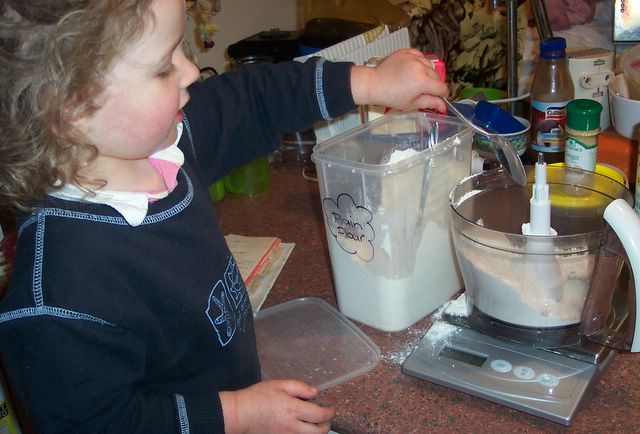
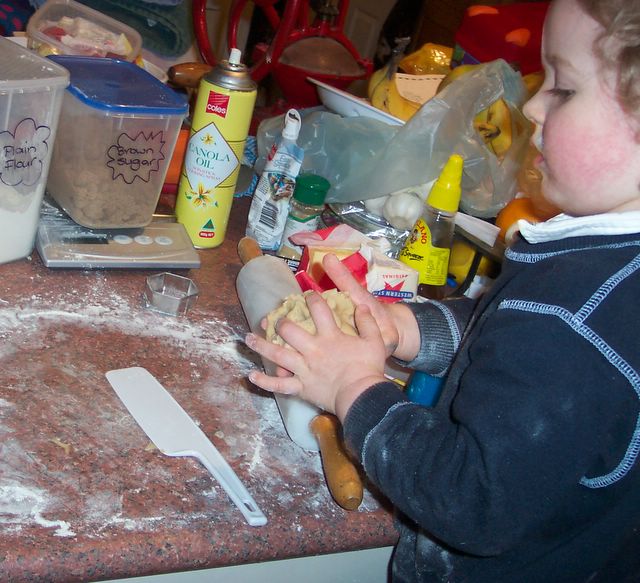
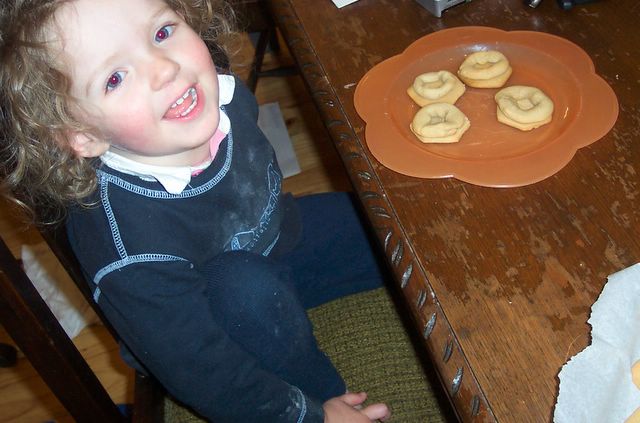
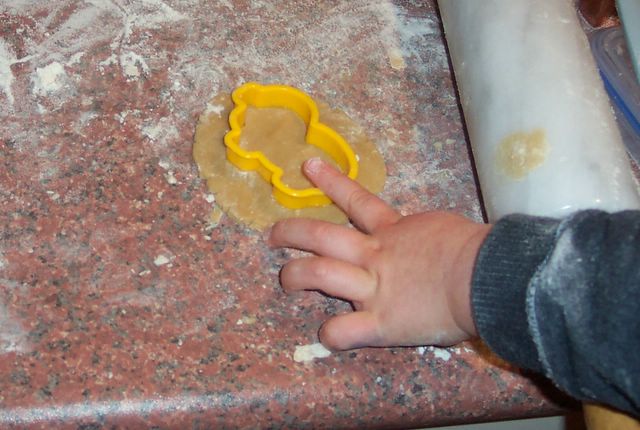
It didn't take long to make a batch of gingerbread - although longer than it need have, since Otto decided to help too. The hex cutter is a great size, too.


The goal of exact playability was lost when I thought about the need to cut ten different sizes of square gingerbreads, each slightly smaller than the last. We'll find a work-around -- and it will probably involve SMARTIES.

Of course, there had to be a Meeple (isn't there one in every game box, whether it belongs there or not)


Volcanoes ready to ice:


Mixing the orange icing was another game tie-in -- Fraser and I have been playing a lot of Colour Clowns with Otto, who is just learning how to mix colours to make orange, green and purple. She remembered enough to tell me to make the orange icing by mixing yellow and red, so clearly although it's a very ordinary game, it has some educational merit.

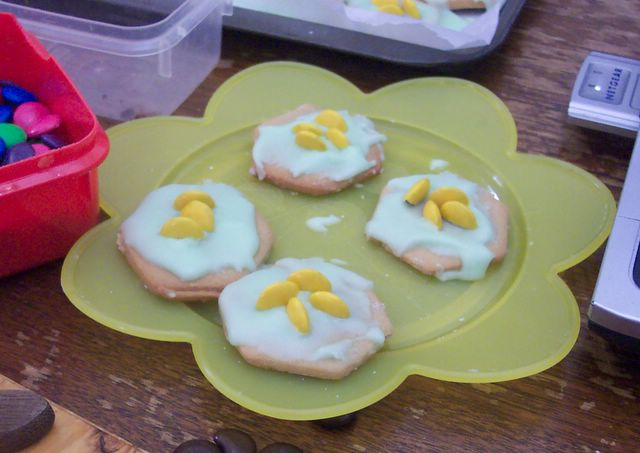
That's what I'm using for Treasures, and I think there will be jelly babies for the playing pieces. (Intriguingly, in the FOUR BOXES of smarties I bought, there were exactly 21 yellow pieces ... and a Tikal set has 22 treasures. Cutting smarties in half is hard work!

And here's what they look like with Treasure:


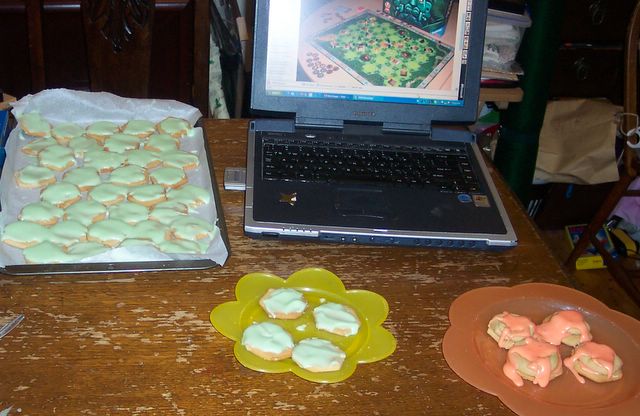
Iced and ready to decorate (check out the Volcanoes):


Otto had to make her own shapes too. Now you you or me, this shape is a sideways pig - but to Otto, it is Jack-Jack from The Incredibles.


That's as far as I have got. I have four colours of smarties for playing pieces, and plan to buy some giant smarties to be the Leaders. I still need to find tents for base camps (maybe mini toblerone pieces?) and draw the stepping stones and pyramid bases.

I have no idea how to do the pyramids, though. I think perhaps I will just pile on brown smarties.

Friday, April 21, 2006

Al Grande: Private Eye

It had been a hectic week. Somehow word got out that I was posting boardgame reviews on a blog under the name Catanfan. Even Patrick the Wino who begs for change in front of my office had heard about my hobby.

“Evenin’ Al.”

“Evenin’ Pat,” I said as I handed him a buck.

“I hear that you been dissin’ Caylus, Al.”

“What?! Caylus? You know Caylus?!”

“Yeah, it’s a great game. Best game to come out of France since Civilization.”

“Well… I don’t kn-“

“Ya ought not be dissin’ Caylus, Al. It’s got some subtle strategy.”

It doesn’t happen often, but I was speechless. Patrick had been a fixture outside the strip mall since I moved my office 5 years ago. Now he was giving me grief about my internet reviews? This week just needed to end.

“How… how do you… um… know a... about my… ummm… Caylus review?” I said after I picked my jaw back off the pavement.

“The bookstore next to the mission has wireless internet. One-Leg-Frankie has a laptop. He let that crackhead Isaac use his laptop to order the Puerto Rico Expansion. Ya see, Arnie down at the Comic Shop can’t get the Puerto Rico Expansion into stock. He says his supplier doesn’t carry it. Anyhow, Isaac was looking to buy the Puerto Rico Expansion and somehow he stumbled across the Catanfan blog.”

“Oh.” I was still speechless.

What could I say?

Speechless.

Me.

I shook my head, turned and walked to my car. It was Friday. It had already been a long week and after talking to Patrick I needed a stiff shot of something made from a single-malt. “Humffff." Subtle strategy. What does he know? Two words Patrick, Royal Favors.

I headed over to O'Malley’s. When I got there the happy hour crowd was just starting to arrive. I wanted to be alone. Luckily everyone was seated near the table with the happy hour hors d'oeuvres. I found a stool at the far end of the bar.

“What can I get for you tonight, CF?”

I looked around, “CF?”

“Catanfan.”

“Oh stop it! Not you too Jimmy.”

Jimmy chuckled and said, “Yeah, I read what you had to say about Chinatown. I’m disappointed Al.”

“Disappointed? What’s to disappoint? If anything you should be disappointed in the game Jimmy. It’s a good attempt at a pure negotiation game, but it’s just not fun.”

“Not fun? You just need to play with the Westbank Gamers variation, Al. The Westbank Gamers variation is becoming the default version of the game, in the States anyway.”

“I make my judgments based upon the rules as written Jimmy, and what do you know about the Westbank Gamers anyway?”

“The rules are written in German Al, and you don't read German." He had me on that point, not that I saw it made a difference. "And," he continued, "as for the Westbank Gamers, I used to belong to that group.”

It was a good thing Jimmy hadn’t given me my drink yet or I might have choked. As it was I almost swallowed my teeth, and the teeth that I do have aren’t fake.

He must have seen the astonishment on my face. “Yeah, before I moved up here I used to live in New Orleans across the street from... from... what was his name? Oh yeah, Gregnard. Played boardgames every week at his house.”

“Gregnard? You mean Greg Schloesser?”

“Yeah, that’s him. We called him Gregnard back then. That was a few years ago. Nice guy. Heck of a gamer.” I was stunned. I had known Jimmy for at least 3 years. He was the only bartender in town who didn’t know how to play cribbage or euchre, yet he was a boardgamer? And he used to game with the Grand-Pooh-Bah of boardgaming? For the second time in less than an hour I was speechless.

Jimmy looked down his glasses at me. “So what can I get you, Al?”

“The usual, Jimmy,” then added, “just the usual, and let me be alone for a while.”

I had my glass in hand slowly swirling the ice cubes as I stared at them. I was lost in my thoughts and didn’t notice that the bar was gradually filling up.

“Is this seat taken?” Her voice startled me.

I looked up. All I saw was cleavage.

It took a few seconds to focus on her face, but only because I couldn’t take my eyes off her shirt. It said, “Boardgamers do it on the kitchen table”. It took a while to read it all, what with all the distractions.

“Sure. Sit down. Let me buy you a drink.”

“Are you Al? Al Grande?” This time I noticed a slight German accent. Bavarian probably.

“I might be. Depends on who’s asking.”

"You can call me M. O."

"In that case you can call me Al, Al Grande. At your service ma'am. And if I might enquire, what does M. O. stand for?"

"Not M. O., Mr. Grande, Mem-mo." She spoke slowly and enunciated each syllable, "my name is Busen Memmo."

To Be Continued... Maybe...

Thursday, April 20, 2006

Anatomy of a Game: Carcassonne, Part Three: Cooperation & Competition

This is my third article on the game system of Carcassonne. In case you missed the others, the first article looked at the game design of the core game and the second article look at how the early supplements affected balance and tile distribution.

With that out of the way, onward!


I picked up a copy of Carcassonne: The River II in March, and it was the first Carcassonne supplement that I'd bought in some time, due to a variety of factors.

One factor, that's beyond the scope of this series of articles, was that The Cathars was released exclusively through a German magazine. Because I didn't want to spend outrageous amounts of money for four tiles I ended up with a gap in my Carcassonne collection, and thus some of the symptoms of The Collector Bug abated.

A second factor was that I'd had an entirely bad experience with The Count of Carcassonne. I bought it immediately upon release, as I had every Carcassonne supplement to that point, and then when I read the rules I was boggled by the damage it did to the basic non-confrontational Carcassonne gameplay. To this day it's never been played.

The third factor was that I actually ended up removing the previous supplement King & Scout from my mega-Carcassonne box because the additional complexity of the two majority-control tiles from that set (the King and the Robber) were enough to make my eyes roll back in my head, and generally decreased my Carcassonne enjoyment.

This article is the first of two in this series where I'm going to talk about this "dark evolution" of Carcassonne in recent years. Some people might like Carcassonne's new post-2003 direction, but it's definitely very different from what we saw in 2000-2003. This week's article is going to cover that issue cooperation v. competition which first popped up in The Count of Carcassonne and in the next article in this series I'll hit the issue of complexity that started to be an issue for me with King & Scout.

Cooperation & Competition

The original Carcassonne treaded a fine a line between cooperation and competition. Clearly, you wanted to win the game, but at the same time you could form temporary and informal alliances with other players in order to jointly gain points in relation to other opponents. This is one of the aspects that I think really works in Carcassonne, and it's also one of the reasons that I think Carcassonne works best as a three-player game. (That provides enough players for these dynamic alliances to work, but few enough to keep the chaos out of the game that ramps up as does the player number.)

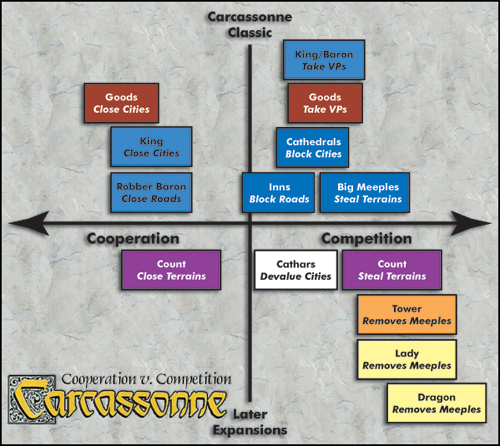
Classic Carcassonne: I think that Klaus-Jurgen Wrede agrees with the value of cooperation, because the classic Carcassonne supplements (Inns & Cathedrals, Traders & Builders, and King & Scout) notably increased the reasons for cooperation.

Traders & Builders did this most dramatically by giving reasons to close other people's cities. You got goods & those could be used to score bonus points at end-game. So suddenly you weren't just cooperating to share points with someone, but you were also doing the good deed of finishing up a city, just for the possibility of an end-game reward. King & Scout repeated the exact same trick. Now you could get points for having completed the biggest road and the biggest city.

Granted, these cooperative methods all introduced a longer-term competition, for the goods markers and the king and robber tiles, but that was perfectly staying in tune with the mixture of cooperation and competition enjoyed by the original game: cooperation in the short-term for the hope of long-term gain.

Along the way there were some minor competitive elements added. The big meeples of Inns & Cathedrals which you could use to entirely steal someone's terrain was definitely the biggest. In addition, as noted in my last article, the cathedrals (and less frequently the inns) or Inns & Cathedrals can be used for blocking purposes, to deny people points in the end-game.

But on the whole those first supplements made Carcassonne feel more friendly and cohesive.

The Later Exansions: The more recent supplements have dramatically changed this, and each new expansion just seems to add to the aggressive nature of noveau-Carcassonne, a nature that I generally find antithetical to the original game's design.

The Count of Carcassonne starts off safely enough, with your getting to place meeples in the 12-tile city of Carcassonne if you close someone else's terrain without scoring points yourself. That's the same cooperative method used for each of the earlier supplements. However whenever a terrain is closed, players can move their meeples to that closing terrain to try and take it over, creating the most direct token conflict yet seen in the game.

The Cathars allows placement of siege tiles simply to spoil other peoples' cities.

The Princess & The Dragon allows you to directly attack (and remove) other players' meeples with princess tiles and the dragon token.

And The Tower provides yet another method to remove meeples, here with towers.

On BoardGameGeek recently I saw the suggestion that people should buy two copies of Carcassonne, placing Inns & Cathedrals and Traders & Builders in one, and The Princess & The Dragon and The Tower in another. Spice with the appropriate mini-supplements as you see fit. King & Scout would clearly go in the first set, The Count of Carcassonne and The Cathars in the second, and The River(s) in whichever you prefer.

I'd have to agree, because the most recent expansions betray the cooperative nature of the original game, while contrariwise, players weaned on the aggressive clashing of the more recent sets would probably be disappointed by the kinder, gentler earlier releases.

Beyond that I have to question the wiseness of such a drastic change in the feel of the gameplay a few years in. I'm sure I'm not the only disappointed player who's going to carefully question every release from here on out (though as I'll discuss in the next article, I've come up with a potential method to this apparent madness).

The following chart summarizes the competive & cooperative nature of the Carcassonne supplements.


A Question of Theme

Though The Cathars and The Count of Carcassonne played around with the idea, The Princess & The Dragon was the first major Carcassonne supplement to upset the cooperation-competition balance of the original game. It also made another major change: it dramatically shifted the theme of the game.

To that date every supplement for Carcassonne has been lightly historical. In 2004 the franchise seemed to embrace its historical background even more, by putting out the very authentic Cathar supplement. Then 2005 came out and we suddenly had a supplement full of fairies, dragons, and magic gates.

I said at the start of this article that there were three things that contributed to my not buying any Carcassonne for a few years: the exclusivity of The Cathars, the competition of The Count, and the combined complexity that appeared when King & Scout came out. But, I'm actually quite weak when it comes to collecting, and even though I'd been disappointed three supplements in a row, for various reasons, I would still have bought The Princess & The Dragon ... if it weren't for the theme.

I don't think talking about the theming of the Carcassonne supplements is nearly as interesting as some of the other topics I've been discussing in this series, but it's still worth this brief note: changing your theme can turn some customers off.

Conclusion

With the advent of The Count of Carcassonne, the Carcassonne franchise saw a sea change. We already saw last week that tile distributions started to devolve and that balance starting to wildly skew. Perhaps more important, however, was the fact that Carcassonne was turned into a very confrontational game, quite far from its original family roots.

In my next article in this series I'm going to finish up my survey of the Carcassonne expansions by asking, "What have we wrought?", and looking at the multiplicative complexity of the Carcassonne expansion system. I'll also end on a positive note by talking about how nice the new River II is and how well it shows off the evolutionary process of a game.

Wednesday, April 19, 2006

Gaming with Parents, Uncles, Aunts, Cousins


One key to happiness – GAMES


By far, most of my gaming experience has been with family members, throughout my life. Certainly, I have played games with friends, co-workers, and strangers, but the majority of the time I have spent gaming has been with family.

The first game I can recall playing was Crazy Eights, which my parents taught me to play with a regular deck of cards when I was about 4 or 5 years old. That is also the only game I can recall playing with my parents, until after I was married, and I only remember playing it occasionally with them for a couple of years. My dad enjoyed playing Canasta in those days and joined a neighborhood group that played on a regular (weekly? monthly?) basis. I do not believe my mother cared much for playing games.

When I was about 7 years old, I was visiting, with my mother, with an aunt and uncle. They had two children who were several years older than me, but they were not at home at that time. Another aunt and her son, my cousin, who was two years younger than me, were also visiting there. My younger cousin and I noticed some games our aunt and uncle had, and we asked whether we could play with one of them. They got out Uncle Wiggly for us, and I embarked upon my first adventure with a boardgame. My cousin could not yet read the cards, but I was more than happy to do so for both of us. Because it was the first commercial boardgame I had ever seen, I was fascinated with it. What fun we had, teaching ourselves that game. I know that several times after that, when we both were visiting that aunt and uncle, we were allowed to play that game.

Not long after discovering Uncle Wiggly, my cousin and I were present when four of our older cousins were engaged in playing what appeared to be a much more interesting boardgame. It was Monopoly. We asked to join them, but were told we were too young to play with them. Of course, that just whetted my appetite to play it. Unfortunately, I had to wait until a neighborhood friend of mine showed me his family’s Monopoly game several years later, and he taught me how to play it.

I had three sets of aunts and uncles (my mother’s sisters) who loved to play games. I do not know why my mother seemed to be the only sister who did not enjoy games. The others always played games when we were at family gatherings. I had six cousins in those three families, two younger than me, and four older. There were a few games almost all of us enjoyed playing – croquet, horseshoes, and cards. There were two card games that were the mainstays of these gatherings – Pitch and Rook. I seldom played Rook, but Pitch became my life-long favorite card game. One of my uncles would play Pitch at the drop of a hat, and he was hard to beat. I learned a lot about that game from playing against him. He and another uncle would always split up and be partners with me and one of my cousins; sometimes, we played three-member teams, so six of us could play at the same time. They taught me many variations of Pitch, and I learned to like virtually all of them. I suspect that one reason I enjoyed learning Pitch was because my uncles were great to play with. They always played to win. They were tough competitors, but they always played fairly and had fun doing it. After a hand, they might explain what we had done wrong or could have done better, but they never blamed us for making a mistake – it was always a learning experience. It was always a positive experience, even in losing.

After my family moved away from the old hometown, I only played games with aunts, uncles, and cousins at family reunions or special holiday gatherings. I always looked forward to those opportunities. Since I had no siblings, and my parents were not interested in games, most of my gaming through high school was with friends, and even that was very limited.

Several years after Sue and I married, and my parents had retired and moved back to their hometown, they got more involved in playing games. I was quite surprised. Interestingly, my parents and the two uncles (and aunts) with whom I had played so much Pitch moved onto the same street, within a few houses of each other. They were all retired at that time, and they got together very frequently. Many of those visits involved playing one of two games – Yahtzee or Wa-Hoo (marbles, they called it – a form of Pachisi or Parcheesi). Here’s a photo of our Wa-Hoo board from those days. One of my uncles was so into game-playing that he made his own Wa-Hoo board, which they all played on. Whenever we visited my parents, we almost always played one or both of those games. That was the first time I realized that my dad actually enjoyed games very much. I don’t know whether he didn’t show so much interest earlier because he knew my mother did not enjoy it, or whether he felt he finally had the free time to play, after he retired. I believe he and I could have enjoyed many hours of games together, as I was growing up, but it just didn’t happen. Perhaps that realization contributed to my interest in playing games with our children frequently.

The uncle who was such a game-player even purchased an early electronic baseball game that connected to his TV, some time before we bought our Atari 2600 at home, for us and our kids. He was a major influence on my love of games. He managed a grain elevator, after many years of farming, and I’ve seen him work long hours at the elevator during wheat harvest, and then come home and be willing to play horseshoes or Pitch for a couple of more hours. I think his desire to play games was insatiable.

With three uncles, three aunts, and six cousins who loved to play games, it was natural that I would grow up to be a game-player. It was a most enjoyable way to grow up.


--- Gerald … near Denver, Colorado; February 2006
aka gamesgrandpa -- A grandpa who is a mile high on gaming

Tuesday, April 18, 2006

Topic Du Jour: Game Burnout

Everyone is talking about game burnout: Mary, Alfred, Jason, Greg, Spielfrieks, and even The Dice Tower and Board Games to Go mentioned it.

What is burnout?

The American Heritage® Dictionary of the English Language, Fourth Edition defines it as "Physical or emotional exhaustion, especially as a result of long-term stress or dissipation."

For our purposes, games burnout is a state where you feel less or no desire to play games for an indeterminate period.

Burnout implies that the state prior to burnout is tolerable as worst, or desirable at best. Before you were burned out, you were happily going about your life as you wanted to. On the way to burnout, you became more and more dissatisfied with something. Probably, you ignored these warning signs, continued doing just what you were doing, until something that used to be tolerable suddenly and very quickly became intolerable.

What causes burnout?

There are two possible seeds that lead to game burnout: the person or the games. In either case, the rewards you now gain from playing games has now diminished versus the effort involved.

When I speak of reward, I am referring to why you play games. When I speak of effort, I am referring to mental effort to think through the games, the social effort to tolerate your game companions, and physical effort to attend, set up and clean up after the games.

Burnout: the person

People burnout on games as a result of normal, healthy personal growth or due to leading an unhealthy lifestyle.

People who lead happy lives playing games may simply move on to other activities. They may move houses. They may feel that they once gained something from playing games but no longer feel that it represents a challenge to them or that it is helping them with their personal growth.

They may have found some new interest which is more absorbing, or simply be spending more time with a new group of friends or partner.

I'm not sure if this would be considered "burnout" per se. "Real Gamers" may disparage people for abandoning games to pursue other things, but, hopefully, most of us realize how silly that is.

Mind you, I believe that playing games even occasionally is an important and healthy part of everyone's life. When friends tell me that they don't play games at all, I think they are sadly missing out.

On the other hand, people who were "real gamers", and by this I mean devoted to the hobby of gaming as a whole, as opposed to simply willing to play a game as the occasion arises, may burnout for unhealthy reasons.

Often this will be as a result of realizing that they have spent a lot of money or a lot of time while ignoring other important aspects of their life: intellectual growth, emotional well-being, physical exercise, or connecting with real friends and family. Greg's article, to which I linked above, discusses that aspect of burnout.

Burnout: the games

For this I refer you first to an earlier article that I wrote on this blog: The Game Hordes.

Assuming a healthy lifestyle, and no particular changes in circumstances or dissatisfaction with the idea of playing games, I think that players who play less games to more depth are far less likely to burnout on games than those who buy and/or play new games continuously.

For one thing, there are simply too many bad games. Even good games, which you may rate 6 or 7 on the BGG scale, chip away at your enjoyment of games if you play continuously. You are constantly settling for inadequacy, an imperfection that you can feel on either a conscious or unconscious level, in order to participate in the gaming experience. Play after play, this feeling is going to build up into resentment. Why are you doing this?

I don't blame the game companies any more than I blame the movie industries for putting out vapid movies or the food companies for putting out colorful, expensive sub-nutritious food. That's what they do.

But take a long honest look at the games produced in the last five years, and even your favorite game companies. There are thousands of games produced for one reason, and one reason alone: to take your money. No one is putting out games for the benefit of the game players.

If you are buying a lot of these games, or playing a lot of these games, you are either a) a game reviewer; more power to 'em, or b) victim of the marketing industry that hypes every product as the next best thing.

Do you buy based on publisher? Game designer? Theme? Packaging? Play time? Cost? Don't. All of that is crap. Reiner Knizia's name on a box is just as much marketing smoke as the primary colors and pictures used on the cover of the box. It means nothing. It's a hook to get you to buy the game.

You don't need all of those games. And from the sound of all of you who are suffering burnout, you don't want all of those games. That's not what gaming is about.

You may whine and moan about how much fun it is to open a new box, look at all the pretty components, and learn new rules without having to play people who are already better than you are, but I just shake my head at you with pity. Oh, I believe you; that's what you like. You are addicted to candy, and a whole lot of people are happy to keep you addicted that way.

Playing games is about playing excellent games. Playing new games is about looking for new excellent games. Excellent games are the games that you can replay numerous times without getting bored of them; not ten times, but a hundred times or a thousand times. They have multiple levels of skill and give you a feeling of having accomplished something real after playing them. Or, they are passtimes whose entire purpose is not gaming but socializing, and the game play is irrelevant.

What can you do?

  • Stop denying that you have a problem. Start doing what you really want to do: connect with your family, get outside, play games that you like.
  • Stop spending all of your time with people who you would not ordinarily have conversations with.
  • Have alone time to read or meditate and get comfortable with yourself. Don't define yourself as only happy when you are a cog in a game.
  • Say no to bad games. Don't buy the hype.
  • Stop playing a lot of new games and start replaying the games that you really want to play.


Yehuda

Monday, April 17, 2006

GAME STORE CONFIDENTIAL ~ Why Easter sucks & four miniature game recommendations

I used to own a Commodore 64 home computer. Some of you people owned one of those also, didn't you? It was a terrific little machine that I equipped with a word processer, a basic spreadsheet and a few pc games. Why am I bringing this up in a blog about board games?

Well, because my favorite site on the internet is boardgamegeek. I know, I know... it's a sad testimony that in an era where there is more porn than any normal human being could ever imagine, many of us are sick, twisted individuals and use the power of the net for something other than sexual fantasies. The plus side to me not being a pornoholic is that if I get run over by a bus anytime soon my kids won't be saddened by what they find on my hard drives. They will be pissed about what they find in my bank acounts though.

Anyway, back to the C64 wonder machine and boardgamegeek. I bought a game called Bard's Tale, a popular game in the 80's. Half of the adventure took place in a town and the other half took place in the sewers and underground locations beneath the town. So... let's say you got the needed equipment to kill something that needed killing... now you went down below the town. This action required a very delicate process on the part of the C64, one which would bring tears of frustration to C64 owners as well as beads of perspiration as they sat by their computer willing it to succeed at the intricate task. The task? Bard's Tale required the Commodore to access the disk drive for data every time you went below ground or resurfaced.

The small red disc access light on the C64's floppy drive became an instrument of the most extreme torture for C64 owners. That single light must have been designed by NASA, that's how bulletproof it was. In fact, I think they could build an entire space shuttle out of the material Commodore used for the light... it was unbelievably resiliant. It was a tiny red cyclops that could actually burn a hole in your forehead if you stared at it long enough. And many, many, many of us stared at the disc access light... entranced, mesmerized, hypnotically fixated, focused so single-mindedly on the small red dot that we imagined we could one day control it.

But we couldn't. The disc access light ruled the life of many a pc gamer in the 80's. If I drove down a residential street at 2am I would often see the flicker of televisions behind the drapes of homes... ah, some insomniac watching bad movies eh? But every so often I'd glance at a home and see a small red dot glowing malevolently from deep in the recesses of the house and I'd know that there was some craven geek, hunched on his chair staring at the disc access light mindlessly while spittle ran down his chin and a tipped over Mountain Dew pooled on the floor. Someone in that house was playing Bard's Tale... of that I was certain.

What does all this about 25 year old pc's and disc access time have to do with board games? Plenty. Have any of you tried to use boardgamegeek lately? If so, and if you used to own a C64, does the page load time remind you a little bit of playing Bard's Tale and suffering through the red light trauma?

What's up there? And even when BGG is running a bit faster it's missing a few features. Like avatars or sometimes images altogether. I happen to like my BGG avatar and I miss it. I want it back. I also don't want my BGG experiences to remind me of 1995, my 28.8 modem and the anxious minutes I'd spend listening to the squealing of my modem asking someone elses modem if it could connect.

And then, right in the middle of this whole issue, Aldie and Derk go trapsing off to something called "The Gathering of Friends"... which I understand to be a yearly board game hoedown sponsered by Alan Moon and a bunch of people who wear XXL t-shirts on XXXXL bodies.

Aldie certainly needs to get this problem fixed soon because when I have logged on the last couple of weeks I've noticed that the only people who seem to be posting are the ones who do enormous lists of games they want to buy, games they can get some wretched and shrewish wife to play or ones where they lie about finding shrinkwrapped holy grail games for $1.75 at a thrift store in Carbuncle, Ohio or Sludge-on-Trent, England.

That stuff is boring. Who cares? I like the other geek lists and threads... the ones where people piss and moan and agrue and fight. I like the ones that get people's blood boiling and generate 100 responses in a matter of hours. I'm not sure that BGG could process 100 responses in 24 hours right now. Once they get it fixed I'll probably celebrate by doing another Geek List myself... one designed to annoy as many Canadians and Europeans as possible. Oh, okay, I'll try and annoy some Americans too.

Bye Mary

Sadly, we're temporarily losing our Wednesday writer Mary. I'll miss her. She's so, so, so frickin' normal. I love her stuff. Mary brought this group-mind the balance it needs... a healthy, clean and interesting look into the kitchen table game life of a mentally healthy American family. Hmmmm... now that I think about it, maybe it's the rest of us that are normal and Mary's family that is rare. Whatever. I am saddened that she won't be around for a while and I fear that her replacements will be gamers who are as disturbed and unbalanced as the rest of us.

Easter means no gaming

That's right. No gaming this past week-end. Why? Because it was Easter. What is rideculous about that is my normal game buddies are definitley not Church people. Well, maybe they secretly went to Church, but still, why do religious holidays mean no gaming? It's as if the entire world has to go on hold because of a holiday that everyone other than you celebrates. And even if you are Christian, church is on Sunday. That still leaves Friday and Saturday night. Bah.

I celebrated Easter by buying a copy of a book called The Da Vinci Code and reading it. What a dumb story. I was half way through the book and realized that these people had gone from the Louvre, to a Swiss Bank, to a huge estate outside Paris, onto a private jet, landing in the UK, then to a hidden Templar monastary in downtown London and not once did either of them have to go to the toilet. Total garbage. Any normal person would have crapped down their trousers by the time the hulking albino accosted them in the tombs.

Okay, enough griping for a Monday. The bright side of my life is that in less than two weeks I'll be in my new house. I'll enjoy a brand new dining table, purchased specifically because it can hold games all the way up to the size of Railroad Tycoon and Conquest of the Empire... and the room which will be for my office is just large enough that I can set up a portable table for Europe Engulfed. Since I'll be having my son Wyatt with me more often after I move the need for a seperate room for war games ought to be obvious to any of you with toddlers. And since GMT is apparently serious about producing the Pacific Theater version of Europe Engulfed I'll want to work the kinks out of my new house before that one is published.

Miniature Games

Okay, my last thought for the day. Once I get settled I plan on teaching some of my local boardgamers a few old miniature games. Not Warhammer and not WarMachine. Well, WarMacine is okay, but I burned out on Warhammer years ago. When I find my Undead and Chaos Dwarf armies they're going directly onto eBay. Here are the games I saved:

Legions of Steel
Man O' War
Flintloque
The Great Rail Wars


Of that group only Flintloque is still in production. The others are long gone. Except for Man O' War I suspect you can get copies of the rules and miniatures at a fair price on eBay or via the trade utility on BGG (assuming it's currently working). Each one of these miniature games has unique mechanics, unique settings and offers something that many popular miniature games don't offer... they require only a few miniatures to play. Legions of Steel needs no terrain as it uses a board mechanic that is similar to Space Hulk and Flintloque and Rail Wars are squad level games that can easily be played on a 5x4 or smaller table with a minimum investment in terrain. I saved three Man O' War fleets, a few isalnds and a 4x6 screen printed sea mat and that is all I need to enjoy Games Workshop's best evar table-top game.

I'm done here. The Harley-Davidson dealership over in Boise is having some sort of parts and accessories sale that starts today so I need to run down there and geek out on my other fetish in life. Have a great week.... and if you pray, pray that Aldie and Derk fix their damned website.

See you next week.

Sunday, April 16, 2006

A Tale of Two Cities

So here I am, a Melbourne local sitting in Adelaide, about to write a little something about Formula Dé. A tale of two cities? Why?

DW Tripp could probably tell you. A while back when Formula One racing returned to Australia it was held in Adelaide, but then Melbourne took/stole/won the race from Adelaide and it has been held in Melbourne ever since. Which word is used depends on who you talk to, or more realistically where they come from.

An interesting aside to the tale is that Formula One racing used to be held in Melbourne a long time ago and back in those days Jack Brabham was a very well known Australian driver, not to mention three times Formula One World Drivers Champion. One of Jack's technical team at the time was one of Melissa's uncles and the reason that we are actually here in Adelaide at the moment is to celebrate the engagement of one of that uncle's daughters, although DW probably didn't know this aside bit.

I mentioned last time that I had been interested in Formula Dé for some time and finally got around to playing it. I bought some tracks a couple of days later, but was unable to obtain the game for another week when a friend picked up a copy from a geographically inconvenient game store for me.

The next day I managed to convince Daughter the Elder to try it out with me.

For our first game we played Zandvoort 1, mainly because it looked like we could go faster than we could at Monaco! I explained the basic rules and we were off and racing - a one lap race with just one car each. The first race was reasonably close most of the way, I did notice that I was much more inclined to take risks like zooming towards corners in 5th gear than Daughter the Elder was. She finished the race with her car in pristine condition, but I had finished first.

We played another game on the same track straight away and she still played fairly conservatively, but this time beat me home.

The next day I introduced her to some of the advanced rules, slip streaming and pit stops. So we had a two lap race with two cars each, playing on the Barcelonatrack. The first lap had a lot of changing of the lead, but there was very little wear and tear on the cars at all and so as we came around the last corner all the cars screamed down the straight ignoring the pitstop. Daughter the Elder actually seemed a bit miffed that there was no reason for her to make a pitstop. The second lap was a little more harsh on the cars, but since we were racing for the finish no pitstops. She actively pursued slipstreaming opportunities whenever she could.

A day or two later I had a happy moment as gamer dad. Daughter the Elder requested that we play a game, she requested Formula Dé and she even chose a track to play on! A two lap race with one car each (as it was getting close to her bed time) on the Hockenheim track.

I'm not sure if it was because she was playing more adventurously or because she was intending to make a pitstop anyway, but she drove faster and burnt a few tire points coming out of corners too fast this time during the first lap. She had the lead and gleefully made a pitstop to get all her tire points back. Unfortunately she had a slow pitstop and was not impressed to come out of the pits in 4th as I zoomed down the straight in 6th and snatched the lead. Needless to say I had to change down gears rather heavily in the corner at the end of the straight, but I managed to keep the car in one piece and on the track much to Daughter the Elder's annoyance.

Unfortunately Formula Dé is a bit too big to take away with us, so it is at home at the moment. However when we get home I will review the advanced rules to see if there are any more worth introducing for our races and we will see if we can get Melissa to join us too. As yet she has not, but if we keep badgering perhaps she will.

We have seven tracks at the moment, so should be able to set up our own little home league with relative ease and when we get home I am looking forward to playing a few more games and working towards that.

Notes for a long car trip
If your seven year old asks to buy a big book of Knock Knock jokes - just say No. Feel free to remind Melissa of this.

Mmm meeples taste like...

Friday, April 14, 2006

Settlers Primer

Being a very successful game, Settlers of Catan has spawned numerous related games, both expansions and stand alone games. I am sure that many of the readers to this blog are tired of Settlers, yet have friends who still like to play. Luckily there are a ton of variations that should spice things up if you are getting bored but still have to play once in a while. Some variations introduce a few new concepts, some introduce a ton of new concepts. Most are good, a couple suck. This is a guide to help those of you who enjoy Settlers of Catan, but are looking to change things up a little.

This guide does not include the 2-player card game nor either of the “Catan Adventure” games, Candamir and Elasund.

Settlers of Catan: The grand daddy of all the Catan games was released 11 years ago and continues to be a best seller. Simple rules, lots of player interaction, different layout every time it is played, and the 60 to 90 minute playing time all serve to make Settlers of Catan a very popular boardgame.

I assume everyone reading this blog is familiar with Settlers of Catan. If you haven’t played it, buy it and play it tonight. I’ve been playing Settlers of Catan for about six years and it still frequently hits the table.

I seem to be in the minority in that I prefer the 3-player game to the 4-player game. The 4-player game gets crowded as soon as you start, and one player always seems to get screwed in the early stages. The player who doesn’t produce very much in the first few rounds and is unable to expand early will frequently get “squeezed out” of expansion opportunities. That player often has no place to expand his empire, except to a couple sparse hexes that produce very poorly, he just plods along with no chance to win, rolling the dice and gritting his teeth waiting for the game to end.

Barring extreme luck in the early stages of the game that scenario just doesn’t happen in the 3-player game. Three player games are usually pretty tight, right up to the end.

Ditto with the five and six player expansion. With the 5-6 player expansion the 5 player game is the better game in my opinion. The 6 player game will almost always have one unlucky player who has little chance to expand in the early stages of the game.

Seafarers of Catan: Seafarers is an expansion for basic Settlers of Catan. Gold fields are added, along with ships for shipping routes. Shipping routes are just roads on the water. Basically, if you like Settlers of Catan you will like Seafarers. It takes the basic system and adds just enough elements to keep the game fresh. Less than one minute of explanation is required to ease someone from the basic game to the Seafarers expansion.

Seafarers comes with a Scenario Book. The book is used to set up the board in a very specific way for each scenario. The number of victory points required to win vary for each scenario.

Cities and Knights of Catan: C&K is another expansion for the base game. It isn’t much of a stretch to say that if you like the basic game you will not like Cities and Knights, and vice versa. Cities and Knights changes basic game play in some very significant ways.

For starters, C&K lengthens the base game considerably. Expect playing time to double or even triple if your group plays basic Settlers quickly. Knights, event cards, city walls, buildings, the Metropolis, an extra dice, 3 different commodities and barbarians are all added to the game.

Every time a barbarian ship icon is rolled on the third dice the barbarians move on the barbarian track. Three of the six sides on the extra dice depict the barbarian ship. On their seventh move the barbarians attack. The strength of the barbarians is equal to the number of cities on Catan. To counter the barbarians the players must have as many or more active nights than there are barbarians. If they can’t match the strength of the barbarians, the weakest player has a city reduced to a settlement. If the players do defeat the barbarians the player who had the most knights gains victory points.

Knights can also be used to chase away the robber, but doing so flips them to their deactivated side (as does fighting barbarians). Knights must be activated in order to fight the barbarians. It costs one grain to activate a knight. It costs one wool and one ore to create a knight.

Every city wall that a player builds allows that player to increase his hand size by two cards. For example, a player with walls around two cities wouldn’t have to lose any cards if a “7” was rolled unless he had 12 cards in his hand.

Cities will often produce a commodity in addition to the normal resource when activated by the dice roll. Commodities are cloth, coins and paper. Cities on a pasture hex produce one wool and a cloth, cities on a mountain hex produce one ore and a coin, cities on a forest produce one wood and a ream of paper. Commodities are used to buy and upgrade buildings.

There are 3 colors of buildings. Remember the barbarian dice? The other three sides of the dice have a blue, green and yellow symbol. Each of those colors corresponds to a building. When a color is rolled it activates all the buildings of that color and may allow players to take an event card of that color. Event cards grant some advantage to the player.

When a player builds the fourth building in a color group he gains a Metropolis. A Metropolis is basically a city worth 4 victory points.

As you can see, Cities and Knights of Catan changes the base game significantly. For brevity I did not cover all the changes. I don’t care for all the changes myself. In my opinion Cities and Knights of Catan is just a bunch of clutter. In a nutshell, you take a very good game (Settlers of Catan), spend another $30 on an expansion and turn it in to an average game.

Settlers of Canaan: This variation of Settlers of Catan is a stand-alone game. Instead of the modular board that is different from game to game, the board is a map of the “Promised Land”, otherwise known as the area in and around present day Israel. Each hex is also numbered for its production value and that number will never change.

Gameplay is nearly identical to the original Settlers. A copper hex is added, which when activated gives the player(s) with an adjacent settlement a good of their choice. Players can also spend one brick and one ore to buy a “stone” to contribute to build the Temple. The player who has contributed the most stones to the Temple gains two victory points. The development deck has some different, interesting cards. Priests have replaced Soldiers although they serve the same function.

In order to contribute a stone to the Temple players must have a settlement at the south end of the board, otherwise they have to link by roads to another player’s settlement and pay that player an additional resource to contribute a stone to the Temple.

Settlers of Canaan has more hexes than standard Settlers and in my opinion is the superior 4-player game.

Settlers of Zarahemla: Settlers of Zarahemla is the only game in the Settlers series that I will discuss that I have not played. The big difference between this and basic Settlers is that the board is comprised of “strips” of hexes instead of individual land and water hexes. The strips are arranged into a hexagonal board, just as in the original game. A center strip, which is five hexes long, is placed in the center of the board, two strips four hexes in length are placed on either side of the center strip, etc.

The strips are placed into a larger frame designed to hold them in a hex pattern. Although there are ports in the game there are no port tiles, instead the ports are depicted along the edge of the frame and will always remain in their same relative positions. Unlike Settlers of Canaan, number chits are placed on the individual land hexes. Like Settlers of Canaan, players can contribute to the building of the Temple for victory points.

Just as Settlers of Canaan has its roots in the Old Testament, the theme of Settlers of Zarahemla is based upon the Book of Mormon. Apart from flavor text on some of the development cards there is little in either game that gives either game a religious feel. I liken the religious theme of both games to the “stated” theme of Ticket to Ride. The Ticket to Ride box states:

“The stakes: $1 million in a winner takes all competition. The objective: to see which of them can travel by rail to the most cities in North America – in just 7 days”.

Ticket to Ride? Well, maybe. It might sound nice, but traveling for 7 days for a million dollars has nothing to do with game play, so too is religion not a factor in either of these Settlers variants.

Settlers of the Stone Age: As with Settlers of Canaan and the Historical Scenarios, Settlers of the Stone Age is played on a set map with fixed numbers on each hex. There are only four land types/resources available in this version, in contrast to the usual 5 in the other versions. The four resources are stone, bones, hides and meat.

Players start with three camps and an explorer in Africa. Each camp functions in the same way a settlement does in other versions. Players must expand outward to the rest of the world from these humble beginnings. For a meat and a hide a player can build an explorer, for the cost of one meat he can move him. When an explorer is on an intersection he can be upgraded to a camp for the cost of one stone, hide, and bones.

Each player only has 5 camps at his disposal. If he builds a sixth camp he needs to move an existing camp. This is not usually much of a detriment to the player. When each new camp is established the player earns a victory point chit. As the game progresses Africa slowly turns into a desert. At least one of a player’s three starting camps is likely to be adjacent to multiple deserts even though the camps started out adjacent to productive land.

Near the edge of all the continents there are numerous chits placed face down. The first player to move an explorer to each chit gets to collect it. A few chits are worth victory points, other chits cause portions of Africa to become a desert. The player with the most exploration chits earns victory points, similar to the “Longest Road” in the basic game.

There are also 4 development tracks that each player can improve upon. One track allows explorers to travel further, another allows the movement of the Neanderthal or Saber Tooth Tiger (each the equivalent of a robber). Development on the clothing and shelter tracks is required before a player can move an explorer to various regions to collect exploration chits. For example, a player needs to be on the first or second level of both tracks to explore northern Europe, and on the third and fourth level of both tracks to explore Greenland and the South Pacific.

Advancing to the first level of each track costs a stone. The second level costs a bone. The third and fourth levels each cost a stone and bone. Only one player can reach the fifth level on each track, but the fifth level is worth victory points, it costs a hide, stone and bone to advance to the fifth level.

For some reason there tends to be little trading in this version of the game. Players are free to trade as always, but it just doesn’t seem to happen very often. The game is also longer than standard Settlers. In my opinion it lasts about 45 minutes longer than the fun it provides.

Starfarers of Catan: Settlers in space. How can you go wrong?

In Starfarers each player begins with three colonies, each colony adjacent to two planets. From there they need to send trade ships and colony ships to distant planets to establish more colonies and trade with alien races.

Again this version of Settlers is not played on a modular board, however each planet has a random, hidden production number. When a player is adjacent to a planet with a spaceship he can peek at the value of the planet and decide if he wants to found a colony there. When a colony is founded the numbers on the adjacent planets are revealed.

Some planets are “pirate planets”. Each pirate chit has a strength on it. Before a player can found a colony on a pirate planet he needs to “out-gun” the pirates. This simply mean that if the pirate planet is a “3” the player must have a spaceship with at least 3 guns before he can found a colony. Likewise some planets are “ice planets”. To found a colony on an ice planet the player needs to have more freight rings on his spaceship than the value of the ice planet.

Players can also found trade outposts with alien races. To do so he flies a trade ship to one of the four the alien race areas. The person with the most trade outposts with each alien race earns victory points. Each trade outpost also allows the player to choose a card which imparts some advantage to the holder.

Players have encounters in space. Each time a player moves his spaceships he “shakes” his mothership. The mothership has 4 different colored balls in it. Two of those balls appear, and based upon which two colors appear the player can move that many spaces. If a black ball appears the player has an encounter. An encounter card is drawn, and read. Encounters will state something like, “you encounter pirates who offer to trade with you, do you trade?” If you trade with the pirates they may steal from you, if you don’t trade with them they might attack you, there are many possibilities. If a battle ensues you “roll” against either the player to your left or right, the card will stipulate which. Again, you shake the mothership calculate value of the two balls that appear and add the guns you have added to your mothership.

Players can spend resources to buy guns, freight rings, or booster rockets to add to their mothership, or spend resources to found space colonies, trade posts and space ports.

Again, trading in this game seems to happen much less frequently than in basic Settlers. The game is much longer than standard Settlers. Starfarers is a 4+ hour game and only provides two hours worth of fun. Each colony is only adjacent to 2 resource hexes and no colony will ever produce two goods in the manner of a city in the base game. If the number of the planet is rolled and there is a colony on the planet it will produce only 1 good. Resources are collected very slowly, and unlike other versions of Settlers encounters can cause players to lose stuff that they purchased earlier.

So, how can you go wrong? Suffice it to say you can. This version lasts about 2 hours longer than the fun it provides.

Also note that the motherships are notorious for breaking.

Historical Scenarios I: As far as I know both Historical Scenarios are only available in German. An English translation is included with each.

The first Historical Scenario (as well as the second) is an expansion for the base game. Historical Scenario 1 includes both the Alexander the Great and the Cheops scenarios on a double sided board. The Cheops scenario stays pretty true to the original game. Again, Cheops can be explained to a person familiar with the base game in less than a minute. The Cheops scenario is based in ancient Egypt.

In Cheops if someone has a settlement on a port anyone can use that port if they can trace a road from their settlement to the port. It does cost one gold to do so. There are two hexes that produce gold when activated. Players can also contribute to the building of the Great Pyramid. The player who contributes the most stones to the pyramid gets victory points.

The Alexander scenario is not so simple to explain. Players represent generals in Alexander’s army. Players start with no settlements, no cities, no roads, no nothing on the board. Players do receive resources each turn, for a few rounds. Very soon those resources will run out and players must depend upon settlements and cities to earn resources.

Every turn Alexander moves one space on the map. Alexander simply follows the route markers on the board. When Alexander lands on a settlement it is auctioned to the highest bidder. Players bid a number of resource cards and must return them to the supply if they win. Once players have a settlement they can expand according to the normal rules of Catan.

Some of the spaces Alexander will land on will cause players to bid against each other to build bridges, monuments, do battle, and provide food. The player who wins the most auctions will become Alexander’s “First Advisor” and gains 4 victory points, there will also be a “Second Advisor” and “Third Advisor” who will each gain a lesser number of victory points.

Soldier cards can be played as normal to move the robber, but once they are played a player can use soldier cards as a resource card to bid when Alexander has to battle and only do battle.

Both of these scenarios should appeal to people who like the base game and are just looking to spice things up a little, especially the Cheops scenario. The Alexander version changes the game a little more.

Historical Scenario II: This expansion is also only available in German. Both scenarios in this expansion can be played with up to 6 players. Both scenarios are played on a set map. Again, the board is double sided.

In the Great Wall scenario each player is responsible for one section of the Great Wall of China. As the game progresses players can strengthen their portion of the wall and Huns are gradually added to “assembly areas” north of the Wall. When the number of Huns in an assembly area exceeds the strength of the wall in that section they pour over the wall into China.

The player who was responsible for the area of Wall breached takes negative victory points. Every area the Huns occupy produces nothing. Huns can be removed with soldier cards.

The robber in this version is a pirate. The pirate is placed on ocean hexes and blocks the use of ports until moved.

The Trojan War scenario can either be played with 4 or 6 players. The Trojan War scenario pits players against one another, but no one can be sure who is supporting whom. In this scenario players are secretly dealt a card at the beginning of the game. Each player will secretly support Troy or Mycenae in a war. Once per turn each player can contribute resources to the war. A player can secretly contribute 1, 2, or 3 resources to the war and earns one trade point chip for contributing.

When there are 10 resource cards (13 with 6 players) in the war area the war is resolved. The cards are shuffled so no one can be sure who contributed which resources. Ore and sheep count as support for Troy, wood and grain count as support for Mycenae, brick counts as nothing. The side that wins gets to move the war marker one space in their direction. The further the token gets to one side or the other the more victory points are awarded to the players supporting that side.

Trade point chips which are acquired by contributing to the war are required for the building of ships. Each ship a player builds imparts a trade advantage to the player or victory points.

Settlers of Nurnberg: Diceless Settlers. This is a stand alone game that (as far as I know) is only available in German. The game is played on a set map. The map depicts the usual Settlers hexes and roads to various European cities.

Yes, Settlers of Nurnberg is a diceless game. On his turn each player draws an event card. That card also has a number on it. Settlements produce based upon the number on the event card. The event on the card generally moves the robber or moves the pawn on the timeline. The game is over when the pawn reaches the end of the timeline if no player has yet reached 13 victory points.

Players can build settlements as in the original game as well as toll stations, workshops, city walls and towers. Toll stations are placed to help control trade routes to the various European cities. Workshops produce goods which are then sold to the various European cities for gold. Tolls must be payed to the player who controls the road to the city the goods are sold in.

Building city walls costs gold, but earns players “prestige points”. Prestige points can be used to gain “council cards” (similar to the longest road or largest army”). The player with the most prestige gains 4 victory points, the players with the second and third most prestige earn 3 and 2 points respectively.

Towers can be built for victory points.

I haven’t played this version enough to rate it, but the German text seems to be a significant hurdle to overcome, much more significant than in either of the Historical Scenario versions. I enjoyed Settlers of Nurnberg, but it was a struggle to get through.

Thursday, April 13, 2006

Anatomy of a Game: Carcassonne, Part Two: Balance & Tiles

In my first article in this series, I talked about the design of the game Carcassonne, breaking it down by parts and seeing how they all work together. However, Carcassonne is a lot more than than just the basic game. Nine supplements of various sizes have slowly expanded that base game, moving it in various directions (and not always the ones suggested by the original game).

Over the next few articles in this series I'm going to examine those supplements, to show how they've evolved the SdJ winning Carcassonne's gameplay. But first, a brief overview of all the supplements to date.

Each supplement adds new tiles to the game, but also provides some big new ideas:

The River. Adds a new starting setup to the game: a 12-tile river. (Now available as part of the base game.)

Inns & Cathedrals. Adds inns, which made roads worth double or nothing, and cathedrals, which made cities worth triple or nothing. Adds a "big meeple" who is worth double the value of the other meeples in token conflict. (Originally published as "The Expansion".)

Traders & Builders. Adds cities with goods; a player closing a city now collects goods, worth VPs at the end for majority control. Adds pigs, which increase the value of one field. Adds builders, which allow faster building of one city or road.

King & Scout. Gives VPs to players who close the biggest road and city.

The Count of Carcassonne. Adds a new starting setup to the game: a 12-tile city. Adds a Count who can allow players to move meeples to regions just as they close & score.

The Cathars. Adds Cathars besieging cities, who decrease the value of the city to knights, but increase its value to farmers. (An exclusive micro-expansion; I mention it here for completeness, and I'll include it in my various charts, but don't think it has much relevence to the evolution of the game.)

The Princess & The Dragon. Adds a dragon which removes meeples. Adds a fairy which protects from the same & gives points when a location it's at is scored. Adds magic gate tiles which let you place on any open, unoccupied region. Adds princess tiles which remove a meeple from a city.

The River II. Yet another alternative setup for the game: a 12-tile river, this time with a branch. Fixes some of the field size problems of the original river, and also has a link to each of the major supplements to this point.

The Tower. Introduces towers which can be used to capture nearby followers, or which can be "capped" by one of your meeples to protect your own.

In my articles on Carcassonne's expansions I'm going to draw a distinction between two sets of supplements. First is "Classic Carcassonne", which is the original game plus the first two major supplements, Inns & Cathedrals and Traders & Builders. If you bought the gold-box Carcassonne that was sold in stores a couple of years ago, this was it. I also tend to include the mini-expansion, King & Scout, in this category. Second are the "later expansions", which center on the two large supplements, The Princess & The Dragon and The Tower as well as the mini-supplement, The Count of Carcassonne, and the micro-supplement The Cathars. There's a number of huge changes in design between King & Scout and The Count of Carcassonne, as we'll see.

This week I'm going to concentrate on the "good" evolution of Carcassonne: how the classic expansions helped to balance the game and the tile mix (though we'll also get our first hints at how the later expansions begin to turn from early ideals).

Balancing the Game

One of the real problems with the original release of Carcassonne was tile balance.

In general the four different types of terrain could be pretty easily ranked. Roads were the weakest, because they scored just 1 point/tile. Cities came next at 2 points/tile, then cloisters, which were typically worth 4-5 points at placement and could be finished while working on other terrains. Fields, meanwhile, were the best, not because of their straight-up valuation, but because they could become so large that a single field could easily be worth 30-40 points at endgame.

Balance among arbitrary randomizers (e.g., cards or tiles) isn't always desired. However, the less balanced they are, the higher the luck factor. Carcassonne suffered from two issues because of the lack of balance of the early terrains: (1) the arbitrary nature of the game was, as noted, increased, because a player could do considerably better or worse depending on which terrain types he drew; and (2) the strategy of the game degenerated down to a single most successful path, the control of fields.

Classic Carcassonne: Classic Carcassonne, managed to notably improve this gameplay by improving this balance:

The value of roads and cities were improved respectively by the inns and the cathedrals of Inns & Cathedrals. The improvement to roads was the biggest because it upped the maximum value by 2x. Cathedrals, meanwhile, improved maximum value of cities only by 1.5x. Inns and cathedrals could each be used as spoilers, to devalue a road or city late in the game, but this is usually only of value in a city, because roads tend to be much easier to close and harder to block. Because of the blocking possibility the marginal increase of value to cities is even less than the 1.5x implies.

When the next supplement, Traders & Builders, came along roads and cities were further improved thanks to the builder. He allowed you to double build on the appropriate terrain type. I find that his best use is for road construction. Even after the classic supplements, roads are still a little less in value than any of the rest of the terrains. The builders lets you control your luck (for more on which, see my articles, Luck and Luck II). If you're unlucky enough to get a lower-value road tile, here's a way to make it more valuable: you get another turn.

The effect of the supplements on cloisters is a little more subtle. The main issue with cloisters tends to be that it's possible to get your meeples stuck there after your initial 4-6 point windfall for placement. In the original set, where you have 72 tiles and 7 meeples per player, this isn't a big deal. If you get a meeple stuck every ten tiles (or every 2-5 turns, depending on the number of players), that's fine. However with the tiles from the three classic supplements you're up 47 tiles, and just one meeple, so your 7:72 ratio is suddenly 8:117. You now have to hold on to your meeples 40% longer before losing them, and thus the valuation of the cloisters drops.

The fields are actually slightly increased in value through the inclusion of the pig in the Traders & Builders supplement, who makes one field better. It's very similar to the inns & cathedrals from the previous supplements, but not quite as good and not quite as plentiful. The field valuation did also decrease in these early supplements, but it was due to tile distribution, not any specific rule. I'll talk about tiles shortly.

On the whole, looking at the new rules in the classic Carcassonne supplements, roads are notably improved in value, cities are somewhat improved, cloisters are devalued, and fields are slightly improved. Generally, points went up, but everything also moved toward a better balance.

(I haven't discussed big meeples and goods. These and many other expansions had nothing to do with the idea of balance; I'll talk about them more when I discuss issues of competition, cooperation, and complexity, in my next articles.)

Later Expansions: The later Carcassonne supplements seem pretty single-minded in bashing any higher-value terrain types. The Cathars decreases city values and The Princess & The Dragon makes cities chancier by giving Princesses an opportunity to remove meeples from them. In addition both The Princess & The Dragon and The Tower discourage long-term meeple placement on the board, by introducing dragons and towers to take them away. This hurts all meeple placement, but it's farmers that it particularly discourages, because they're the only one who stay on the board the whole game.

It's possible that the later Carcassonne supplements actually continue to move valuation in the right direction. Dragons & towers introduce a player feedback loop, which gives players the explicit opportunity attack any high-scoring terrains which remain too valuable. Meanwhile, the princesses attack only cities, and the value of cloisters continues to decrease thanks to the increased tile count. 7:72 becomes 8:165 with all the supplements in, over double the original ratio. Meanwhile, roads are scarcely touched, since they'll be some of the last terrains hit by dragons and towers.

My feeling is that it's been overdone, but that's partially because I don't like how the competition to cooperation ratio has changed, which again will be discussed more in my next article.

Below is a chart showing all the valuation changes in the later Carcassonnes. For reasons of space I haven't listed the fact that dragons and towers can hit every meeple type; I've just listed their effects on fields, because it's considerably greater than other results, thanks to the long-term commitment. Nonetheless, cloisters and cities can be dangerous thanks to these new predators too.


If you want to play a Carcassonne game with any particular terrain type valued more highly or lowly than normal, this chart should help out. It could make for some interesting variation.

Tile Distribution

The tile distribution of the original Carcassonne game was a bit subpar. Its biggest problems were threefold: (1) fields got too big; (2) it was too easy to block a space by making it impossible to fill; and (3) it was too easy to get into an opponent's large terrain by a diagonal placement of a meeple near the terrain.

Thanks to Caracsssonne's expansions, this distribution has changed a lot.

Classic Carcassonne: The following diagrams show the tile distributions for the original Carcassonne and each of the first two major supplements. In each case you can click on the thumbnail if you'd like to see a larger copy of the picture:

Main GameI&CT&B


(Thanks to Roy Levien [Aldaron] over at BGG who gave me the OK to use his helpful distribution pics in this article.)

Decreasing Field Size. Even just glancing at the tiles it's easy to see that the newer distributions were intended to combat the large field problem. In the original 72 tile set there is just one full-tile city, which is exactly the sort of thing that starts to spread fields out. In the 18 tile set from I&C we have 2 full-tile cities, plus one tile with an entirely internal field. In the 24 tiles from T&B we find another 2 tiles containing only one internal field, plus another 2 tiles with an internal field as well as an external field.

In addition these supplements feature the first tiles which purposefully elongated cities to cut off fields. There's one city "cap" in I&C (#7 in the I&C diagram) which cuts down to the opposite side of the tile and there's three city "corners" in T&B, each of which draw out a corner to cut the field in two (#5, #10, and #16 in the T&B diagram, with oddly enough one per good type, one of many symmetries in tile distribution).

Perhaps a better way of looking at this is mathematical, by counting the number of distinct fields on a tile, ignoring all of those full city tiles. Distinct fields within a tile could be connected up based on how other tiles are laid above them, but clearly the higher the field/tile ratio, the more likelihood that fields will be cut up. The original Carcassonne has a field/tile ratio of 1.75. Inns & Cathedrals has a much higher 2.26 ratio and Traders & Builders edges up even more, with a 2.36. Playing all three sets together pulls the original Carcassonne's average up to 1.94 fields/tile.

(For what it's worth, the 5 new tiles in King & Scout had a field/tile ratio of 2.25, right in line with the new average, plus one more full-city-and-internal-field tile.)

Looking at those numbers there's little doubt that decreasing field sizes was a real goal as additional expansions were released.

Decreasing Blocking. One of the frustrations with the original Carcassonne is getting blocked in such a way that no tile exists that can close your terrain. Fortunately the first few supplements introduced a couple of tiles to fit common situations that the original game didn't. I&C includes two city-road-city-road tiles (#5 & #10 in the above chart for I&C), one city-city-road-field (#8), one city-city-field-road (#11), and one road-field-city-file tile (#9); each of these was a guaranteed block before. T&B supports city-city-road-field (#8 & #16) and city-city-field-road (#10 & #14) even better and also offers the only city-road-field-field tile (#2). (The opposite, road-city-field-field tile was remarkably neglected until King & Scout.)

Blocking is an acceptable and often good strategy in Carcassonne, but ensured blockage, with no chance of a tile draw for release can be very frustrating.

Decreasing Stealing. Finally the classic Carcassonne supplements managed to make it harder to steal someone else's terrain by putting a meeple diagonally adjacent, then building in.

This was never a problem with roads, since there was so many tees. However, with the original Carcassonne it was impossible to keep someone out of your field if they placed diagonally, except by making the space in between impossible to fill (which is actually an OK strategy for fields, since you don't need to close them). For cities, there were two adjacent double-cap tiles in the main set (#14), but that was the only way to keep someone diagonally adjacent out of your city, and here you don't want to block out the space usually.

As already noted the classic supplements introduced four elongated city segments, which could be used to block off diagonal fields. Much more notable were the city dividers, each of which could be used to create multiple adjacent cities. There are 9 in the two classic supplements (I&C #3, #4, and #6; T&B #6, #7, #9, #13, #18, and #23) bringing the ratio from 2/72 to 11/114, tripling the tile percentage from 3% to 9%.

The notable increases both overall and from I&C to T&B suggest that the designer saw the overease of capturing other peoples terrain as a continuing issue.

Later Expansions: I'd originally thought that I didn't need to talk about the newer supplements when looking at tile distribution. After all, the aforementioned problems were largely fixed by the classic Carcassonne sets, and thus the newer ones didn't need to worry much about changing the tile distributions.

I was surprised when I crunched a few numbers to see that the newer supplements in general go backward on all of the issues I mention above (other than blocking). If you add in The Princess & The Dragon and The Tower fields start getting larger again, and it starts to get easier to get into other players terrains once more.

The follow chart shows how field/tile ratio, and the percentage of separator tiles have changed from major release to major release:


Orig.I&CT&BP&DTower
F/T Ratio1.752.262.361.802.06
Full Tile %1.4%11.1%8.3%0.0%0.0%
Field Sep. %0.0%5.5%12.5%3.3%5.5%
City Sep. %2.7%16.7%25%6.6%11.1%


The field to tile ratio is acceptable in The Tower but everything else is moving notably back toward the tile distributions of the original game, and the attendant problems.

Conclusion

One of the reasons that I like the classic Carcassonne supplements, meaning Inns & Cathedrals and Traders & Builders, is that they were all about tweaking the base game. The original Carcassonne was clearly a good game, else it wouldn't have won the SdJ, but it had balance problems both in scoring and in tile distribution. These first supplements largely fixed those issues via a number of different and clever mechanisms.

In my next article in this series I'm going to look more at how cooperation, competition, and theme, and start to show how later Carcassonne supplements have dramatically changed the direction of the game.

Wednesday, April 12, 2006

Time For A Vacation


When I first discovered Euro-games in 2003, I was totally enthralled. Here was a different breed of game that wasn’t long and boring, that offered a different experience each time you played. I found that I couldn’t get enough of them and thought about them constantly.

Like most new game geeks, I bought games at a rate that amazed not just my family but myself. A new game would get one or two plays before the next shipment would arrive but still the hunger persisted. I wanted to experience all there was of these amazing games.

In the last month or two I’ve felt that enthusiasm waning until the bonfire has burned down to a few coals. I can’t believe it, but I have no desire to buy or learn a new game, or even play an online game. I realized that I hardly think about games now except to try to find something worth sharing with you, and I don’t feel that I’ve been very successful at that lately. Obviously my brain felt the need for a vacation and made reservations without consulting me.

Summer is actually a good time to take a vacation from the gaming scene since any free time my husband and I have will be spent doing home improvements like painting the house (phhtt!) and repairing the sidewalk (double phhttt!).

I hope I’m able to find my “groove” again but until then Yehuda told me not to stop writing so I’ll try to put some thoughts in my personal blog even if it’s just day-to-day activities with an occasional nod at something game-related. I hope you all will drop by once in a while and talk to me.
~~~~~~~
Until next time, place your bet on the Colossus.

Mary

Tuesday, April 11, 2006

Opponents say the darndest things before you squash 'em

inspired by Dragon Magazine ish #129: "Adventurers say the darndest things before you squash 'em"

There's too much luck in this game.

You made a mistake last round.

You shouldn't have traded with Joe, he's winning.

I thought you had played this before; it doesn't look like it.

What's the score?

I'm not worried. I always win this game.

Well, what are you going to do about that?

Draw?

I have you now!

I'm attacking with everything.

That was pretty stupid! What did you do that for?

Do you really like this game?

No, I wasn't looking at your cards. Honest.

Let's make a treaty; that way I can leave my border with you unprotected.

I hope you don't mind; attacking you made the most sense.

Base for a base?

Are you sure that's what the rules say?

Is it my turn? Are you done yet?

I can't think of what else to do.

This game is just like Monopoly.

What does that large piece do?

I hope I roll high!

That's ok. I like a challenge.

I'm hoping he won't see the right move.

I play games for fun.

This game is boring. There's no strategy.

Why bother with money? You need victory points to win.

This looks like a safe play.

I didn't think you could do that.

He won't attack. It wouldn't be to his advantage.

He would have to have three red tiles to beat me; unlikely.

He won't take Captain.

I don't like to think so hard.

I've never seen anyone do that.

You take games too seriously.

Can I take that back?

I rolled a 1. Is that good?

Oops.

I think this might work.

Damn! I'm just one shy. If I only had a ... Do you want to trade?

I don't have any more money ... I mean, your turn.

I'll risk it.

It's ok. I read the strategy guide, and this is the right way to win.

You've got another one? How many do you have? What, have you been saving them up?

I can't believe you would do that. After all I did for you.

There's no way he can get all the way to this side of the board in one turn.

You can't do that! I need that space!

That's not your best move.

What can he do with only one unit?

You think too much.

---
Yehuda

Monday, April 10, 2006

GAME STORE CONFIDENTIAL ~ The Politics of Gaming

I sat down the other night to try out the Power Grid expansion boards. Shaun and Lyle, two of the local gamer people were the only other players. Before I get to what occured to me that evening I'll say this about the Power Grid expansion... I really liked it. France is a great 3-player board. The small "tips" section warned of concentrating overly on the inexpensive Paris connections, three links with no access fee, and since I won the die roll to be the lead player both Shaun and Lyle cut me off from the western section and forced me into Paris. Because the links to the south and east are very expensive I had to pay very close attention to stay competitive. I believe their error was both of them began their connections in the west. Had one of them chosen the eastern region we selected I probably wouldn't have won the game.

Needless to say, in a 3-player Power Grid game using France I recommend garbage-fueled power plants... at least it worked for me and I eked out a narrow victory. France apparently works well with both nukes and garbage.

But back to what has been on my mind... politics and world issues. Here's why, during the game I made an offhand comment about the American economy. Basically I just grumbled a bit that despite having a roaring economy, record employment, record home ownership, low interest rates, a healthy stock market, cheap gasoline, reasonably fair tax structures, cheap education, an outstanding infrastructure, free press, religious tolerance and so forth, the supposedly "unbiased" polls give the President a below 40% approval rating and the Congress a below 30% approval rating.

Shaun and Lyle grumbled about the same thing, slinging out a couple of comments about biased media. Whatever. This is a Red State. Idaho is to Republicans like the Texas I grew up in was to Democrats. Back in the 50's and 60's all you had to do was have a "D" next to your name and you could get elected. Thus the term Yellow Dog Democrats. Essentially, in the Old Texas even a Yellow Dog could get elected to public office if it was a Democrat.

Okay, continuing on here... that was all the politics we discussed. We played Power Grid and had a fine time. Which made me think about the fact that I have rarely, if ever, had discussions about politics, religion or money with my gaming friends over the decades. I suppose that's because being a gamer transcends personal beliefs or ideology. It's just not important, nor is it appropriate for the hobby. If anything, discussing current events is not only a distraction but it could potentially be a disaster for the group. Given the fact that both Lyle and Shaun are hard-working blue collar types who would lend you money if you were broke, lend you their backs if you needed to lift things or help you out with no expectation of compensation, I was hardly suprised they voiced somewhat conservative commentary about the media. I suspect I have gaming buddies who lean to the left and my guess is they'd help me move something if I needed it. I'm not so sure about the money though, most of the more liberal people I know are affluent and a bit miserly. You may have different experiences in that regard but I'm thinking my private poll is probably about as accurate as the official polls that sample about as many people as I have gamed with in the last decade.

Which brings me to the politics of gaming.

Is there a distinction between the games people enjoy that somehow corresponds to their political views? About the only way I can gauge that would be to review the people I know strictly via the internet, meaning www.boardgamegeek.com specifically because I have pretty much abandoned other internet sites for human interaction. After a brief review of the BGG members who I selected as GeekBuddies and those who I read most often, I can't see any lines being drawn that seperate gamers by politics. There's one guy up in Canada who is a self-avowed socialist (though he seems to have acquired many more games that he personally needs, a direct contradiction to the socialist doctrine, so I'd recommend he send some of his extras to me) and a wargame fan. Then there are people like the very vocal and funny lefty in NYC who I long ago realized is a frothing Bush-hater, but who I take advice from because he is an excellent gauge of the quality of games and is intelligent about why certain games are worth the money and others not.

There's the Manly Man and his his Dice Tower review-happy buddy in Korea and I suspect they both line up politically with me, but each of them rates certain games much, much higher than I do. The list would go on and on to case after case of people who are in harmony with each other only in the area of board games and when they're not they don't take it personally. Even though the guys in Korea rate some games higher than I do, their likes and dislikes are as similar to mine as many of the supercilious Lefties on BGG.

Politics seem to be meaningless when it comes to games.

I could sit down to a table of board game fans and I could have a terrific time for hours on end and never once think about whether they align with me on any subject other than what is being played at the moment.

So what are the Politics of Gaming?

I only ask that rhetorical question because for most "believers" in any ideology there is an uncertainty about the truth of their beliefs that manifests itself in an annoying and habitual need to convert others to their way of thinking. This ought to be obvious to all but the most dull humans on the planet. Be it religion, politics, national pride, racial pride and other assorted dividing lines among humans, the weak links are the ones who proselytize the loudest. It's annoying because I always come away with the feeling that the preacher of that viewpoint was really just using me as a sounding board to convince himself that he really is right.

So I have come to the conclusion that the Politics of gaming can be compared to Michael Moore and Shawn Hannity. Moore is a fat and piglike Uber Liberal who makes a very, very handsome living attacking Conservatives, making biased movies and writing books telling you that you, unlike him, are doomed to being oppressed. Hannity is a fit and toned Uber Conservative who makes a very, very handsome living attacking Liberals on his TV show, writing biased books and telling you that unless you become a conservative you will make Michale Moore right and be doomed to a life of poverty while Michale Moore consumes every piece of meat in North America.

I suspect both of these individuals have a problem. They are secretly so unsure about themselves that they must assert their viewpoints and convert you. Every conversion they make augments their personal sense of self-worth and each conversion is another little brick in the foundation of their ideology.

It sure seems to me that BoardGameGeek has a similar political environment. Actual politics aside, the most heated discussions and name-calling threads that occur on The Geek revolve around the merits and the rank of certain games. Be it Puerto Rico, the #1 ranked game, or War Games as opposed to Euro-Snoot games, or CCGs, or even the methods of acquiring games... there is a lot of heat regarding position and worthiness. It escalates frequently to the point where people will be shunned, shun others, cease to participate or even (and this really happened once) make sinister threats to the targets of their ire.

Am I wrong here?

I dunno.

Every time I play Puerto Rico I lower it another notch. When it hits a 5 for me I'll get rid of my copy and eliminate my rating. How on earth does that game rate #1 unless it has an entire movement of advocates behind it? But the real question is this: Does it matter to me that Puerto Rico is rated #1? The answer is, no. But it sure seems like it matters to the Puerto Rico Politcal Action Commitee. And those people are fearful of The Caylus Contingent... because Caylus seems to be a game that might threaten Puerto Rico's Top Dog status.

And let's don't go into the recent bruhahah over the revision in ratings that, for some, was intended to humiliate War Game advocates. I found that to be an unusual and unsatisfactory solution to a problem that I am still not quite able to define. Why do that? It's arbitrary to the extreme. Yet still, seeing my personal favorite Command & Colors:Ancients go from #4 down to #20 in the revision didn't shake my commitment to the game.

I suspect that the human need to convert others to your thinking in order to eliminate the nagging feeling that you may not be right in your thinking is as prevalent in the arena of boardgames as it is in the arena of music, politics, religion, sexual proclivities, truck model choices and the great Coke versus Pepsi dilemma. I am all for finding out what's good or bad about a game and it was BGG that convinced me to buy Puerto Rico in the first place. But my point is this... Puerto Rico really isn't the best board game on the market. Not by a long shot. If you haven't played it 30 or 40 times then you may still be convinced that it is. Trust me on this though, it isn't.

Gaming politics, like real world politics, is all about finding concepts that cause a desired effect to the largest possible number of targets with the least possible expension of energy. In short, like in the real world, gaming politics is all about selling an idea. For the casual gamers it's a vanity issue. So, if I like Puerto Rico and I can get you to like Puerto Rico then your affinity for the game validates my choice. Once we have a Puerto Rico Politcal Action Commitee then we're kind of, sort of, stuck with it. To abandon something one has preached high and low about is to abandon one's own structurally weak self-esteem.

Which brings us right back to Yellow Dog Democrats and Texas politics of the 60's. I grew up there and many people in my circle of friends and family voted Democrat because...well... because they had already commited to that ideology. I'm having trouble seeing any difference between those politics and the Puerto Rico politics of the internet gaming community.

Mostly, this whole dialog today is meaningless. I certainly don't expect too many people to agree with my viewpoint and thankfully, I don't care an awful lot about that. It just happened that I made that comment to Shaun and Lyle and that led me to thinking how little real world politics matters when people assemble for leisure activities.

I have a very good friend here in the little valley I live in who is a committed gamer. I've known him for about 20 years. He is a great guy. Shortly after we met he married and now he has 6 kids. I had known him for 10 years before I discovered he was a Morman. Even now, after 20 years, he has never even mentioned it in passing to me except to explain why he can or cannot game on certain days or evenings. I have no real idea what his politics are, though since he's an ex-military officer and a native Idahoan, I'd assume he's conservative. But our discussions have always been games, horses, hay, trucks, games, tractors, cattle, games and then games.

He seems to me to be a person who's personal beliefs are so strong that he has zero need to augment them by converting others to his way of thinking. This guy knows what works for him and he knows why and he doesn't need any help to keep on knowing those things. I mention him because he seems to me to be in actuality what a lot of preachy gamers I have met strive to be, but aren't.

Every time I see a list or thread on BGG asking for advice on what to buy I know before opening that link who the main responders will be. Not that I'm picking on those people for responding, I've done so myself, but it is part of the politics of gaming to reach out to the newbie and add another number to your gaming ideology. One thing is for sure though when you read enough of those threads, some respond to offer sincere advice and others respond to keep the newbie from buying into a political faction of gamers that they oppose.

All this makes me wonder...

...do you suppose ego has anything to do with the politics of gaming?

_______________________________________________________

Other thoughts for today

* I'm not a techie and I'm sympathetic to Aldie and Derk's issues with their site. But 30-120 second page loads are way too remindful of my old dial-up days. Will someone email me please when BGG becomes useful again?

* I grew up on the Texas/Mexico border and have watched the recent demonstrations with interest. Especially interesting to me is the planned May 1st, "Day without Hispanics" boycott. Wasn't there a movie called "A Day without Mexicans?" So anyway, what if all the non-Latino people in the USA decided to do a "Day without non-Mexicans" strike? I think that would be much more effective in establishing for the sucking, greedy, bottom-dwelling politicos in America who they ought to be listening to.

* In keeping with the recent political character of France, President Chirac has caved in and decided that the rioters are right in their assertion they deserve womb-to-tomb state-sponsered job security. This concerns me because Asmodee is a French company and I like their games. I suspect they will soon transfer their headquarters to the USA. I would if I were them. Can you imagine hiring a game designer who created one good game and then being forced to keep publishing his inferior games until he died? Wow. That'd be way too much like WotC or Steve Jackson Games... except that those companies do it because they can, not because they must.

Sunday, April 09, 2006

YOU may be NEXT

So, do you think that you're "skating along" just 'fine' there? Why, of course you do, and only WHEN you encounter strange "happenstances" taking place, will a modicum of 'doubt' enter into your mind upon those. These may just BE "coincidental" sorts, and let's just hope that they are. While should they manifest into ever the MORE with a regular frequency, then it is realized by yourself that something 'sinister' is afoot. Now many folks like to "kow-tow" for the majority of people, so that they will become readily "accepted" by such as them, and others-myself included-tend to 'blaze' their own "path" as they go through "Life". Nobody could ever "walk a mile" in another's 'shoes', and then fully understand the entire situation of that person. Not even "twins" and the like are able to fully experience what every individual undergoes in their day to day existance. Since we're ALL ever "evolving" as we learn about something NEW & 'different', with what we ascribe from a 'norm' that WE had established, then there's plenty of deviation going on for those that are more inclined for it. For the "ULTRA Conservative" person, then they're happy with the likes of the over 100 'editions' of "Monopoly" around-and increasing versions of this constantly, while the just plain "Conservative" kinds will break out the "Acquire" on occasion. The colloquial descriptive 'term' of the "Conservative", means standing FOR a "non-changing situation" to remain, and when applied in the WHOLE for anything, then that indicates that someone is "satisfied" to KEEP 'thangs' in this manner that THEY developed a "rule of thumb" upon. There was a notable person who declared towards the end of the 19th Century that there should be NO more 'applications' taken for "inventions", as EVERYTHING that was "needed" had already been 'created'. That'd BE something that an "ULTRA Conservative" would espouse, as 'they' would become "accomodated" in this manner, without regard for anyone else besides themselves. Since not all of US are in the same precise "situation", or as "better off" that many another already are, then WE have to continue along our 'course' until such "time" that a determination has been achieved, and eventually "arrived" as well for ourselves.

Carving out a "niche" for oneself isn't too difficult, it is just a matter of "exposure" to any others who THINK likewise as yourself, for whatever you desire to undertake. While NOT everbody is going to agree upon something no matter WHAT it is, unless it were some 'item' such as revoking "Taxation" in its entirety. And those who RELY upon "taxes" will certainly give an odd 'look' upon just the very "notion" for this, since they FEEL that they're "deserving" of taking those 'funds' and DOING with them what they will, with some sort of lame "attribution" about it, such as "for the CHILDREN" or "for your OWN 'good'!". The general outlook for those folks is that THEY "know" what is 'best' upon anyone else's "concerns", and YOU should just "take their word" for this, and GIVE them your monies, so that they can then "get busy" with that. Take a quick look around yourself, and then mentally 'note' upon the many "differences" that YOU and any other person, happen to involve yourselves with. These may have many similiarities to some of your very own, but you can be certain that there are quite a few "subtleties" when you take a closer look. For myself, then many would consider ME as some sort of a "Radical", should anyone recall just what THAT entails. The "Liberal" appellation really doesn't apply upon "yours truly" in any manner, since I am tolerable of many "circumstances", while SOME tend to go too far or are too extreme for even MY 'likings'. Of course, I LIKE to "shake things UP" in whatever demeaner I can, as is readily evident to many, and I shall continue to DO thusly, despite whatever obstacles are placed in my way.
"the Good Lord forgives!"~while I am of the 'mindset' that MYSELF then:
"I shall get EVEN!"~plus 'added' VALUE!
as determined on a case by case basis.

Saturday, April 08, 2006

Busy few weeks

We have a busy few weeks coming up, starting with another interstate trip over the Easter weekend (this one west to Adelaide, for a cousin's engagement party).
Two weeks after that is the first of our Big Gaming Events for the year; we're hosting a Family Game Night at Biggie's school.

I'd heard people on the 'Geek talking about their experiences running Family Game Nights, so I'd hedged around the topic with a couple of classroom teachers but got nowhere. Eventually, I bit the proverbial bullet late last year and wrote to the school principal, suggesting that the school consider offering a Family Game Night and offering Fraser's and my time to co-ordinate it. Her reaction was very positive, and we agreed to discuss it again early in the school year.

Last Friday, I met with the principal and vice-principal to finalise the details. They're both extremely keen – they commented that they saw this as a regular event in the school calendar. I started to say something about "yes, we could do one every year" before I realised they meant that we could hold them as often as every term. (This is the school that has made chess classes a part of the maths curriculum for all children in years 3-4; it shouldn't really surprise me)

So what arrangements have we made?

We've booked the hall for the first Friday in May, and set a limit on the number of people who can attend. School Council has agreed to supply tea and coffee (and something for the children to drink) at no charge; this is a community-building event, not a fundraiser.

I drafted a flyer, which went home with every child in the school last Friday (there are around 450 children enrolled). We've invited them to "bring your own games, or try something new" and asked that families NOT bring electronic games or gameboys. I'll put reminders in the school newsletter in a fortnight and then the week after that, encouraging families to come along and, hopefully, enthusing them about the evening. I know that all the parents I've spoken to about it have been keen to attend.

The other thing that I'm in the process of organising is to have some games available for sale on the night, and possibly also offer families the chance to order games for delivery directly to school. We're negotiating with a FLGS for a discount for parents as well as a cut to the school, ideally that could be used to buy some games for the school. I keep NEARLY offering to start a game club and then remembering all my other commitments and pulling back … I'm sure I will succumb at some stage though.

Other promotional activities will include speaking at the whole-school assembly in a couple of weeks, and possibly (if there is interest from the staff) taking a display of games in to school to show to (or play with) the teachers as well. We've put in quite a bit of thought as to which games we should take – we're looking at games for children aged from 5-12, and trying to make sure that we have a range of mechanics and ability levels covered. The big task before we take any to school will be to inventory the contents of each game and make sure that each game has a list of what should be in the box!

I'm confident that this will be a really fun evening, and optimistic that we will get close to our maximum 100-120 people from within the school community. What I need to work out is how we can juggle co-ordinating the evening and teaching games, as well as probably selling games on behalf of our FLGS.

If I had more time, I would be thinking about how to decorate the room with game-related artwork.

Our aims for the night are:
1. To enhance the community spirit within the school;
2. To encourage families to play games together; and
3. To (maybe) suck some new people into the hobby – or at least to show them that there are new and interesting types of games out there, that they might enjoy.

Look for a report next month on how the night went.

I'd encourage anyone who has children at school to consider offering to organise something like this. I was amazed by the enthusiasm that the principal & vice principal showed for the idea - especially as I was willing not just to suggest the event but to co-ordinate it as well.


Meanwhile, we've had some gaming fun this week.

Last Saturday, we went to Melbourne Eurogamesfest. We started with a 3p game of Caylus, and followed it with Elasund and Diabolo (the Michael Schacht cardgame). I liked Elasund a lot, and would probably have bought it on Sunday if it had been available. (Ditto Caylus – we're still waiting for general stock of Caylus to make it to Australia). Diabolo was a light filler – fun, I wouldn't complain if someone gave it to me, but we probably have enough games like that already.

Our FLGS had a double discount day last Sunday, and we got a little carried away. We've stocked the pressie cupboard with a range of games for Biggie's friends, and worked a good way through our respective wishlists. Of course, that meant we had to play some of our new games…

On Sunday, we played San Juan – a game which I find not nearly as good as its famous sibling, but which is quicker and very much easier to set up than PR. We played it again with Biggie (7) a few days later; her verdict was "I like it, but I think I would prefer Puerto Rico." Someone has been listening to what her dad says!!

We also sampled Ravensburger's Make'n'Break, a nice dexterity game where players place building blocks to match a design on a card – definitely one to take to school – and Boomtown, which we also enjoyed very much. Fairy Tale is now officially burning a hole in my bookshelf.

The other gaming I've been doing this week has involved learning some new games through PbW (play by web) sites. I'm playing mostly with a group of people who I know through the 'Geek, and who I know are happy to play friendly, chatty games and help newer players. Ron Stuckel is reminding me how to play Amun-Re, David Perrey is teaching Reef Encounter and Jon Wandke is teaching Tikal. In return, I'm teaching a couple of people to play Hansa.

With most of the rules available online, I find learning a new PbW is as much about learning the interface as it is about learning the game. As others have noted, some are definitely better than others.


May your vision targets all be wolves,

Melissa

Friday, April 07, 2006

From the Book of I Teuber Chapters 12 & 13:

Chapter 12

1. In the Year of Torres The Lord appeared unto Derkes and Aaldie in the land of Dallas in the form of a barrel of Coffee. Upon seeing their fear He said unto them, "Be ye not afraid for I have chosen you," and Derkes and Aaldie were calmed.

2. And the Lord spaketh, "Go ye therefore into the lands of Geekdom and speaketh unto the Children of Hasbro saying, These are the games ye shall not play among all the games on the Earth,

3. Whatsoever game is based upon a movie, or cartoon shall ye not play, not ever, for these games are unclean pap.

4. Nevertheless a game may come along from time to time that has a movie or cartoon theme. If such a game could have some other theme such as farming in ancient Egypt, or Medieval warfare, it may be played, but not without much whining and trepidation.

5. Whatsoever game requires players to roll and move shall ye not play, for they are an abomination in My sight.

6. Whatsoever games that are collectible shall ye not play. As surely as a drunkard promises he will touch neither wine nor strong drink day after day, yet stops by Moe’s every morning for an “eye opener”, so too are collectors drawn to collectible games.

7. Whatsoever game is published by Parker Bros. shall ye not play.

8. Whatsoever game is published by Avalon Hill shall ye be skeptical of, whether that game be old or new. Lo, even though the game looks good and My Servant Vasel has naught but Praise, ye shall be skeptical. For Vasel lives in the Orient and he often eats too much kimshi causing his judgment to become clouded.

9. Whatsoever game is based upon a previous successful game shall ye also be skeptical of, unless that game is based upon Monopoly or Parcheesi. If a game shall be found to be based upon Monopoly or Parcheesi ye shall destroy it. Burn such games to ashes, drive the demons out, and flush them. Such games pollute and are unholy and I sayeth unto My Children that they should separate the clean from the unclean and destroy that which is unholy.

10. And when playing games ye shalt find an appropriate place to play. Neither on a bus nor on an elevator shalt ye play games, for only simpletons would do such.

11. Neither shalt ye play games in a pasture with the cattle, nor near the river with the alligators, nor in the trees with the squirrels.

12. Neither shall the television be on in the same room when playing games, for the television is an unholy distraction and unclean in My sight. Those who watch television whilst playing will oft ask, “Whose turn is it? Is it my turn? What did you do? Was a seven rolled?”

13. Tell My children that I will smite and strike down such players. Great shall be My Wrath, and they will feel the hand of God upon them and know that it is I, so sayeth the Lord your God.

14. Find a well lit, clean space to play boardgames, and if you love the Lord Your God turn off your cell phone.

15. Go Forth and give My message unto the Children of Hasbro that they might not walk in darkness again."

16. Derkes and Aaldie saw that their Lord was wise and gave His message unto the Children of Hasbro. And the Children of Hasbro threw off their chains and lived many prosperous years in the Land of the Geek.


Chapter 13

1. Many days passed and the Lord again spaketh unto Derkes and Aaldie, “Go ye unto the corners of the Earth and spread My Word and the Games of the Lord thy God. Spread My Word among the Children of Nintendo, and the Children of Trivia, and the Children of D&D, and lo, even unto the Children of Scrabble.

2. Bringeth with thee classic games from Mayfair and Rio Grande. Bringeth also with thee games from Fantasy Flight, Z-Man, and Days of Wonder. Bringeth with thee Tichu and Mu for those who have only known Cribbage and Poker.

3. Bringeth with thee children’s games. Bringeth HeroScape, Villa Palleti, and Gulo Gulo, for those who are numbered as children are captivated by the bright colors and simple play.

4. Bringeth with thee several Spiel des Jahres winners. Lo, after ye leave the lands of the Game Gentile they will need to be able to decide for themselves which games to play. Instruct them in the pros and cons of numerous game awards, and warn them about the abomination that is the Mensa Game Award. So sayeth your Lord.

5. Teach My games, but be ye not pushy. People who have never heard the names Kramer nor Tresham will deem you foolish. Do not let those who are ignorant of My Games deem thou to be both foolish and pushy, for My Will is not served if thou are shunned and looked down upon as a dweeb.

6. When teaching a new game to strangers Heed the words of My Prophet Reiner who said, “How does it feel doing these shows so unprepared?”

7. Reiner is wise. Heed Reiner. He whom heedeth Reiner not heedeth Me not. Reiner does not live in the Orient and only occasionally indulges in kimchi. His judgment is sound.

8. Be ye therefore familiar with the rules of the games ye are teaching.

9. Be ye familiar with the rulebook prior to teaching games, for questions will arise that thou canst not answer and thou shouldst be able to quickly and efficiently findeth the answers.

10. Teach the people to shun games sold in box stores, for the games in the box store are unholy and that which is Holy cannot abide with that which is unholy.

11. Teach the people to provide snacks when hosting a game and not unclean snacks such as bacon and greasy salted nuts nor healthy snacks such as celery and bran crackers.

12. Teach all the people of the Earth that he who brings Cheetos to a game event will be forever cast out of My sight for Cheetos are the fruit of the wicked and an abomination unto Me. Just as the fool who farts in an elevator and laughs is doomed, so too shall the Cheetos-bringer be doomed to play tic-tac-toe on a 2x2 grid for an eternity with Bobby Fischer.

13. Take My instructions and go forth unto all the People of the Earth teaching them that which is good and not teaching neither Crocodile Pool Party nor Dungeon Twister.

14. To show that you are the Messenger of the One True God, greet those you meet with “Hellooooo Ev’rabuddy” for this will show that you are obedient to My Word and are the true messenger sent by Me."

15. And Derkes and Aaldie again did as Their Lord had commanded. Their work was Blessed and the fruit of their labours continues to be seen unto this very day.

Thursday, April 06, 2006

The Problem with Blind Bidding

"1 ..."

I had two, perhaps three seconds left to make a decision, and it would decide the entire game.

"2 ..."

We'd tied at rock last time, and the average person shifts upward, which meant Eric was most likely to go to paper. But Eric was bright, and he probably knew that, which meant he'd stay at rock to crush my scissors when I displayed that to cut his paper if he did shift up as expected, but if ...

"Shoot!"

My gyrating hand came to stuttering stop, stuck on rock because I was frozen in indecision.

And Eric had counted on my indecisiveness, as was evidenced by by his wide spread hand.

"Paper smothers rock!"

To be honest, I've never understood why paper beats rock in the first place.

Stupid game.


If there's a single game mechanic that's more maligned than randomness (for which see my articles The Problem with Luck and The Problem with Luck II), it's blind bidding: simultaneously making selections at the same time as other players.

As usual, I think that the nay-sayers don't understand the mechanic.

However, I think that some designers don't understand the mechanic either, because I've played games with good blind bidding mechanics, and I've played games where the blinding bidding mechanic is bad. To my frustration, bad blind bidding designers don't seem to understand the problems with their game, and thus I can to some extent empathize with those players who have been burned.

A Definition of Terms

I've been using the term "blind bidding" thus far, because it's the term most frequently used when people explain how blind bidding games fall somewhere between Monopoly and Candyland in their strategic basis. However, I don't think it's really the correct term to describe what's actually a broad class of very similar, but subtly differentiated mechanics.

To better define that class of games I'd use the phrase simultaneous selection (though that term is sometimes used exclusively for the second subcategory I note below). Broadly, there are three major subcategories of simultaneous selection.

First is what I actually consider to be blind bidding. This is the the simultaneous selection of differently valued markers. It's an auction mechanic, what's commonly called a closed-fist or sealed-envelope auction. You can find it in Fist of Dragonstones and Modern Art.

Second is simultaneous action. This is simultaneous selection of different actions; often these actions become less valued when more people take them. This mechanic is found most obviously in Basari and Goldbrau. I think it's the best classification for Rock, Scissors, Paper too.

Third is simultaneous ordering. This is the simultaneous selection of what order a set number of items are evaluated in. This has been used as the combat system for both Age of Mythology and Dungeonville (though not successfully in either case).

As usual, I've got lots of reviews of these games if you'd like some more insight:

Blind Bidding Games: Caribbean (B+), Fist of Dragonstones (B-), For Sale (A), Modern Art (A-), Money! (B), O Zoo Le Mio! (B-)

Simultaneous Action Games: Basari (B), Goldbrau (C+), Hoity Toity (B), Rock, Scissors, Paper (D-)

Simultaneous Ordering Games: Age of Mythology (C+), Dungeonville (C), Fairy Tale (A)

Some of these games do seem to cross the boundaries.

With Caribbean it looks and feels like bidding, but on the other hand you get your money back each turn, and you have to bid in very discrete amounts; it would have been easy to classify it as "simultaneous ordering" instead.

Meanwhile Fairy Tale is just barely simultaneous ordering, but the order can matter infrequently (with "hunt" and "flip" cards). If it weren't for that, I could probably have classified it as simultaneous action, since each turn you select 3 actions from a set of 5.

But no definition's perfect ...

The Problem with Design

One of the reasons that blind bidding had gotten a bad rap is because some people don't understand how to design it well. Roshambo (or Rock, Scissors, Paper) offers an example of gameplay that just barely works, and sadly there's worse than that in actual published games.

In order for any type of simultaneous selection to be meaningful, the different choices have to have different values. In Roshambo this is marginally true because of the selection method. Players have no way to make a truly random selection among the three options while playing in person, and so human psychology tends to influence the result. Players will start off with rock more often than the other two options, and as I noted above, people will often move upward, choosing the option that would have won the last round.

If Roshambo were played with a method where people could randomize their choices, say if each player had a rock card, a scissors card, and a paper card, and they could either select one or truly randomize one, then any strategy in the "game" would disappear.

The wikipedia page on Rock, Scissors, Paper has a fine explanation on this strategy devolution:
Mathematically optimal play (according to game theory) is a simple matter of selecting randomly, and so the game may be considered trivial in that sense when played in a way that eliminates psychology, as with a computer. But "optimal" in this sense means only "incapable of being defeated more than expected by chance", while it does not imply that the random strategy is best at taking advantage of a suboptimal opponent. In fact, if the opponent is human or a non-random program, it is almost certain that he plays suboptimally and that a modified strategy can exploit that weakness.
Now the problem with some simultaneous selection game design is that: (1) like Roshambo there's no true difference between the value of the selections; and (2) you often have cards which you can randomize to make a selection. If you're the player that's playing suboptimally, you should immediately switch to randomizing your selections, thus giving a superoptimal player who could read your moves only a few marginal wins before play returns to the random chance at the heart of this gameplay.

Dungeonville and Age of Mythology are two published games which fall into this exact trap. In each game you're setting up one-on-one battles between yourself and an opponent, and you're doing so by ordering your troops so that your first troop will fight your opponent's first, your second will fight his second, ... etc. In Dungeonville in each battle the better (lower numbered) troop wins. In Age of Mythology each troops tends to have a advantage against one other type of troop and a disadvantage against another, and that will often decide the result.

To be clear: This. Mechanic. Doesn't. Work.

It amounts to an entirely random selection unless one player is stupid, and pretending anything else just tends to waste time, wherein players carefully try to select an order that really doesn't matter.

And it gives a bad name to blind bidding, simultaneous selection, simultaneous ordering, or whatever else you want to call it.

The Problem with Play

Now a well designed simultaneous selection does something very different: it ensures that different options have different values. As a result, a random selection is no longer superior to a non-random selection, because you might be getting high-value results less often than you would have if you'd actually selected.

Pure blind bidding does this sort of by default, because if you bid more for something, that's clearly more cost to you (thus making the item you're bidding for lower value), and if you bid a little, that's lower cost. It's simultaneous action and simultaneous ordering games that have to think about this design more carefully.

If you examine the design of Basari, it's a fine example of game that does place different values on the different options. First of all, any of the options (points, gems, movement) may have a higher value to you personally. You might currently have a high-point value or a high-gem value depending on what space you're on. Second of all, each of the options has an overall desirability which might increase or decrease its personal worth to you depending on how many people you expect to take it. If everyone is on a high-point value space, you might feel the value of gems is higher to you, because of the lower likelyhood that anyone else will take it.

The heart of a good simultaneous selection design is, thus, the ability to make guesses about which optimal actions other people will take ... and then start second-guessing whether they'll actually take those optimal actions or not.

Which brings us to the heart of what a simultaneous action system should mean to a player, and it's a term that I've talked about before: risk vs. reward.

In Basari and any other good simultaenous selection game, there's usually a clear best choice to you, but taking that clear best choice is often risky, because there's opportunity for other people to spoil it. Thus, you decide whether you want the best reward, and if you do, you understand you're taking a risk to try and attain that reward.

And, just like in those situations with controllable luck that I've been talking about lately, if you risked too much and you lost ... it's your fault. Period. End of story. Quit complain'.

Conclusion

Simultaneous selection games--including blind bidding, simultaneous action, and simultaneous ordering--should have at their heart the same basis as any luck-based game: the ability to assess risk versus reward.

If a game doesn't, because all options are equally valued and thus the various simultaenously selected rewards are the same, then the simultaneous selection mechanic has probably been badly designed. You were right. The blind bidding sucks.

But, most simultaneous selection games do have the ability to make that assessment. If you want to win them--and you can, and you can do so with some reliability--then you need to undestand that you're taking your risk if you're going for the big reward.

And live with it.


By happestance last night I played three of the games listed herein: two games of Fairy Tale, one game of Beowulf, and one game of Money!. I did well in the Beowulf--despite having really bad luck with wounds--but winning at Fairy Tale and Money! remains beyond me. In this three games I picked up two fifth-place results and one third.

That I could do so reliably poorly in the two pure simultaneous selection games (Fairy Tale and Money!) just points out the strategy implicit in this sort of game--and apparently, my inability to grasp it.

Wednesday, April 05, 2006

Conversations in Gaming


-What do ya wanta play?

-I don’t care. Whatever you wanna play.

-Wanta race?

-Nah.

-How about a card game?

-Not really. I want something a little heavier.

-Blokus?

-No, I’m not in the mood for an abstract.

-Carcassonne: The City then?

-Perfect. You know me so well.
_____

-What do you get if you cross Carcassonne with Daytona 500?

-I don’t know.

-Meeples that can only make left turns.

-I’m guessing you just made that up.

-No, it’s been handed down in my family for generations! Of course, I just made that up. How about this: What do you get if you cross Monkeys on the Moon with Command & Colors: Ancients?

-Ummm…ancient monkeys who ride elephants?

-Nope. Romans who like to monkey around.
_____

-The weather forecast for tomorrow says “almost balmy”. What do you think that means?

-Haven’t a clue but obviously there’s some technical data that determines a cut-off for balmy.

-Well, whatever it is, it sounds better than “nearly frigid.”

-We’re still talking about the weather, right?

-Depends on who wins this game.
_____

-Did you know you’re looking awfully cute today?

-Am I?

-Uh-huh.

-I think you’re trying to distract me from the game.

-Would I do that? I know you have a mind like a steel trap. Of course, a few of the teeth are missing.

-Good thing for you or I’d totally annihilate you instead of just kicking your butt. How’s that for a play?

-Oh, that wasn’t very nice.

-I know. Am I still cute?

-The cute is getting a little fuzzy around the edges, dear.
____

-What’s on TV tonight?

-Well, you have a choice: stupid crap, boring crap, asinine crap, reality crap or plain ole crappy crap.

-So then…another game?

-Oh, yeah.
~~~~~~~~~
Until next time, may your “Q” always triple score.

Mary

Tuesday, April 04, 2006

A Gamer's Haggadah

For the uninitiated: Passover and Haggadah.

Preparation: you must remove all traces of roll-and-move and trivia games from your house. Spiritually, you must try to remove them from your heart, as well.

-All-

These are the games of affliction that the monolithic board game manufacturers have foisted upon us, our fathers, and our forefathers. Yesterday, we were slaves to Monopoly, today we are free to play games from all countries. Yesterday we were slaves to Trivial Pursuit, today we are free men and women.

-Youngest child-

Why is this game night different from all other game nights?

On all other game nights we play all type of games; tonight we play only Eurogames.

On all other game nights we invite the Nudelman's who play only Charades, and badly at that; tonight we have lots of interesting people with good manners who look intelligent, don't smell funny, and don't pinch my cheeks.

On all other game nights we invite that ugly woman that you said is loudmouthed and a busybody and wouldn't know how to close her mouth if she were handed a six-page, fully illustrated ... ! Hey! I don't have to go to the bathroom! Hey!

-Leader-

Ahem. Kids. Heh.

We were slaves to Hasbro in America. Then Mayfair brought over Settlers of Catan and marketed it. Now the roots of freedom have taken hold and other game companies are flourishing. Niche game companies heard our cry and brought us games that are worth playing. If it were not for these game companies, we, and our children, and our children's children, would still be trying to pry colored plastic wedges jammed the wrong way into fat plastic pizzas.

-All-

There are four sons:

The Wise son

The Wicked son

The Simple son

The son who does not know what to do when it is his turn

-Leader-

The Wise son asks, loudly: Can you teach me the rules to that expensive Eurogame that you bought with the money that you promised Mom you were going to spend on repairing the sprinklers ... mmmph!

Whereupon you must bribe the Wise son with $20 to keep him quiet and let him borrow the car.

The Wicked son asks: You call this a game? I'm had more fun watching paint dry! Can't we play Sorry? This is stupid! Who likes to sit around playing board games, anyway? Get a life!

Whereupon you must knock the teeth of the Wicked son and tell him that he was adopted and his real parents are buried alive in that mud-puddle and if he looks close, he can see the bubbles coming up. Ha ha. I'm just kidding. Your parents are really dead.

The Simple son asks: What are you playing?

Whereupon you begin to explain the rules to him until he asks again "What are you playing?" Whereupon you tell him to be patient and again begin to explain the rules to him, until he asks "What are you playing?" and shoves the meeples in his mouth. Whereupon you tell him to shut up and go bother his mother.

As for the son who does not know what to do when it is his turn, you suggest to him that Aunt Katy is really winning and he should trade with you, instead. That will teach him to think on his own turn and stop asking dumb questions.

-All-

In all generations we were taught to play bad games, and if it were not for Eurogames, we would still be taping together the money that Billy ripped up after he landed on Park Place for the second time and threw yet another temper tantrum.

-Leader-

A story is told about five sages who stayed up all night playing games until their wives came to them and told them to cut it out already.

All who do not say these three things have not fulfilled their obligation, and these are the three things that you must say: Knizia, Kramer, Klaus Teuber.

-All-

Gesundheit!

-Leader-

Let us thank the game companies for all the great games we now enjoy:

-All-

If you had only given us Acquire, but not given us a great bunch of books, it would have been enough!

If you had only given us Settlers of Catan, but not given us Cities and Knights, Seafarers, Starfarers, Starships, Crossfarers, Knightsettlers, Stoneeaters, Lightsabers, Crossdressers, Turtlewhippers, Crackerjackers, and Whippersnappers, it would have been enough!

If you have only given us Carcassonne, but not given us Inns and Outs, Arks and Barks, Hunters, Bunters, and Punters, Castles and Knishes, Pickles and Tickles, and Towers, Powers, and Flowers, it would have been enough!

If you had only given us Tigris and Euphrates, but not give us Ra, Amun-Re, Age of Mythology, Ark of the Covenant, Antike, Attika, Attila, Aktilla, Antiquity, Antiquitee, Antikwitty, Anti-kitty, Aboker, Abarker, Aboukir, or Acucumber, it would have been enough!

If you had only give us Princes of Florence, but not given us a list of games about mediaeval Europe, the absurd number of which can be compared to the list in the previous verse, it would have been enough!

If you had only given us BGG.con, and not given us Bubercon, Napacon, Silicon, Proseandcon, Emoticon, Thewrathofcon, and Yourenotinvitedcon, it would have been enough!

-Leader-

Now we play the games.

Games are played. After four cups of wine, you sing the songs.

-Songs-

Who knows one?

1 is the robber in Settlers of Catan
2 are the colors of the disks in Dvonn
3 is the best number to play San Marco
4 are the players for Blokus, righto
5 are for Amun-Re, a goodly number
6 hours for a Civ game, when I start to slumber
7 cities in each area for Power Grid connecting
8 meeples each player starts Carcassonne by selecting
9 areas in the provinces on the map of Wallenstein
10 can play that Apple game, if you've got enough wine
11 blue pieces each if you're up for playing Hive
12 pages in the ASL:SK rulebook, that's no jive
13 El Grande power cards, ain't it good to be alive

Fall asleep in your chicken soup, here.

Monday, April 03, 2006

GAME STORE CONFIDENTIAL ~ How two French guys ripped me off and stole my game design

I know the title to this week's blog is somewhat inflammatory. I have nothing against the French, they are probably nice people and I admit to having been in their country on several occasions and once it was explained to me that the French humor is all about bad manners, ignoring Americans while taking their tourist dollars and playing jokes on us by taking us Americans on psychotic cab rides around Paris that remind me of the chase scene in The Pink Panther, I ended up chuckling right along with the rest of the world. Those craaaazy Frenchies, they are so funny.

But still, having personally designed the world's best racing game and then seeing it stolen, altered and then sold in large quantities by a couple of French guys is mildly unsettling.

This all goes back to 1983....

Back then I owned a small miniature company called Dark Horse Miniatures. I also had recently opened a game store called Dark Horse Games. I like the name Dark Horse. Anyway, I was partnered in the miniature company with a friend by the name of Ian Lungold, who shared my personal love of all forms of motor racing. Ian and myself, along with a number of other board game fans played hundreds of games of 3M's USAC Auto Racing, Speed Circuit and Regatta. All of the little cars and boats from the games were painted up in custom colors and our enthusiasm for race games infected a number of friends and customers.

So it happened that Ian and I made a long drive back to California one January to retrieve one of my motorcycles and some other goods I had left in storage there. We started talking about racing and the games we enjoyed. Having been a motorcycle road racer myself for a number of years I started jabbering on and on about why I had kept spending money and time and suffering through broken bones, broken motorcycles and the cold, glinty stares of my wife so I could keep racing until I was almost 30 years old. I explained to Ian that racers such as myself didn't race because we believed we would be champions, we raced for the drug-like high we received from our own bodies in the form of adrenaline, endorphines and dopamine.


My lovely wife Cinthia was always very supportive of both my racing and gaming obsessions. I'm certain her loving show of support, evident here in this picture, reminds many of you of your own wives.

The wheelchair, while temporarily sidelining me from becoming a World Champion racer dude, came in handy for gaming. It was very comfortable.


That was my intellectual way of explaining to him that as a racer I had all the willingness required for success, but lacked any of the actual skills that would have made me a champion.

To which Ian replied, "So, what you're saying is that you couldn't stay focused. You didn't have the attention needed to succeed."

I was stunned. He was 100% right. I sat there in the truck for the next few minutes reviewing what would happen to me in a race, the unbelievably awesome roar of my motorcyle, the insane speeds, the sounds and motion as I passed others or, more often than I liked, was passed by faster racers. The feel of my knee dragging through a corner at 90 MPH, all of it was so intoxicating that I couldn't have cared less about Victory Lane, I just wanted the rush that going fast and risking my body gave me.

But I lacked the "attention" to race at a championship level.


As you can see I didn't lack the proper equipment or background scenery to suceed as a macho racer guy. What you can't tell by looking at this image from 1978 is that I was missing only the skills and discipline to do anything but go very, very fast until I fell down and hurt myself.


What happened over the next several hours was an intense discussion between Ian and myself about race games, dice and attention. Using the Speed Circuit game as a launching pad we discussed how a game could be designed that replaced dice or speed dials with something closer to what a racer really needed in order to compete well. That would be, in our minds at that time, attention. Or, if you prefer, focus.

I grabbed a pad and pen and wrote while Ian drove. When my turn to drive came he took notes. By the time we got back to Idaho we had a game designed. The Speed Circuit tracks were good enough to do a couple of test runs and fix a few broken rules but eventually we designed a few hand-drawn tracks and began play testing.

The game was awesome. We named it "Victory Lane".

If you have played Formula De you know that each die is custom made to represent a specific gear. It's random, true, but because, for example, a D12 returns results only from 7-12 rather than 1-12, the random factor is reduced and a player quickly understands that a 9 or 10 is the most likely result. Even then, gamers who reject any random factors in their games tend to dismiss Formula De as a "dice fest". I disagree, but that's not going to change anyones mind.

In Victory Lane we developed the concept of Attention Points. If you've played Formula De you know that in the advanced rules you have "build points" which allow you a moderate degree of customization for your car. You can add tires, fuel, brakes and so forth. In Victory Lane our customization extended into two aspects of the game; the driver's innate "attention" quotient and how the driver utilized his attention points during the game. Using a pile of markers (in our play tests we used pennies) the player would expend his attention points during his turn, making decisions on the fly and pushing the required attention points in front of him as he spent them.

Each race car was customized as well and the remainder of the base points any player had left was the total of Attention Points his driver had to use during a race.

Did I already mention that Victory Lane is an awesome game?

We play tested for about a year, designed half a dozen tracks that were large enough to use Matchbox cars on and we ended up with a series of arrows through the corners that are duplicated almost exactly in Formula De. When I felt like we had a playable game I started doing a little market research. Too bad the internet didn't exist then, or BGG for that matter. Life would have been easier and my phone bill wouldn't have been enormous. I even got to the point where I was communicating with the CART marketing department ( CART stood for Championship Auto Racing Teams, it was the organization that ran the Indy car race league) and had their requirements for licensing. I took all the estimates for art, boxes, cars, rulebooks, tracks and other associated costs and tallied them up.

$40,000.00

And this was in 1984 dollars.

Woah.

We could certainly have made a version of Victory Lane that cost perhaps half that amount, but I didn't want to do that. If I was going to be a game publisher I wanted a game that was high quality or none at all. So Victory Lane became a shelf ornament. Then, in 1995 or so I was at Origins in Ohio and sat down for a demo of a very interesting looking race game called Formula De. I played it several times, purchased the game and all the tracks and when I returned to Idaho pulled out my Victory Lane folders. Formula De was essentially a dumbed-down version of Victory Lane.

Those damned French.


This is the finished product that the two French guys purloined from me via their telepathic hijinks. Despite the fact that I actually designed this game without the messy dice, it plays very well as it is and I highly recommend you buy a copy. The French could apparently use the work these days


So assuming that great minds think alike, that a butterfly in the Amazon flapping it's wings can cause a tsunami in Australia three years later and that the French really aren't total meatheads (once you get away from their insane politics) I was not at all suprised to see a similar design, with more "user friendly" mechanics do as well as Formula De has done.

All of this brings me to the point of today's blog entry... I'm considering revamping Victory Lane, bringing it up to the standards of the current century and then shopping it around for a publisher. My theory behind why this might work now is simple... television and miniature cameras.

If you have read anything I've written here or on BGG you already know that I have a racing sickness. I love the stuff. I record everything from Formula One to AMA Superbikes, to the Dakar Rally and more. I am a racing slut. And Speed Channel, satellite TV, cameras in the noses of race cars or on the helmets of motorcycle racers and the intense technical coverage of strategy, tires and pit crews has popularized motor racing well beyond what it was 22 years ago. I really think there might be more of a market today than there was then. If anything the French guys who designed and succeeded with Formula De have proven my point for me.

I don't for a moment believe there is a fortune to be made. In fact, I so don't believe it that I have already revealed the secret inner workings of my own personal game design. So what? I'm actually considering redesigning Victory Lane with the help of anyone reading this blog who wants to help. Then, if I end up with a great design I'll keep all the money and fail to acknowledge your contribution. Which, if you think about it, is what those French guys who designed Formula De did to me. Let's not get hung up on small little details about the fact that they designed their game independent of mine, on a different continent, about 10 years later. The fact remains that they "picked up" the vibes of Victory Lane out there in the same ether that turns butterfly wing flaps into hurricanes and so they deserve to be punished. Or at the very least, they should be made fun of.

Depending on the response I get from this article I'll think about making the basic rules to Victory Lane available for anyone who cares to give it a go using their Formula De tracks. It might be a month or so before I can do this because I am finally moving at the end of April into a more gamer-friendly home and it's unlikely that I will have the time to dig everything out, enter it on my pc and then make it available.

Interested?

Okay, here's an email you can contact me at - dwtripp@gmail.com

Drop me an email and put Victory Lane in the subject line and when I get moved I'll pull out the old rules, enter them into a Word Doc or maybe just scan them and you can have at it. This isn't a plea for playtesters, it's really more like a free set of rules that may end up back on the on the shelf someday. If I get enough positives by the end of the summer then maybe an old idea, dusted off and updated, might be worth pursuing.

If this whole Victory Lane thing works out I will haul out two other products that were stolen from me. One, a fantasy naval combat game, stolen by Games Workshop and turned into Man O' War and the other a post-holocaust autmobile combat game that Steve Jackson filched from me in 1980 and renamed Car Wars.

Both my designs are far better then the stolen ones and no doubt someday I'll be a game publishing tycoon and all those French, British and Geeky Texans will be begging for my attention and favor. Imagine... you too might play a vital role in this future success story.

Enough of this... I have lots of brooding and plotting to do.

Saturday, April 01, 2006

Two evenings and an afternoon of gaming.

Work has been busy, to put in mildly, this week, so I managed to miss most of the lunchtime sessions. However, my gaming life was saved by Gamers@Dockers on Thursday, friends visiting on Friday night and Eurogamesfest (Melbourne) on Saturday afternoon.

It must have been a bad week for other people at work too, because at Thursday lunchtime we only had three people. We played three handed 6 Nimmt!. Since our regular group gets up to 8 people now, 6 Nimmt! has become the gaming standard. So much so, that I may need to order extra copies from Germany since this game does not seem to exist in Australia in any edition. We always deal from the full deck of 104 cards regardless of the number of players, so sometimes adding a card three or four higher that the top of the stack can become a bit of an interesting gamble. It is a nice simple game and has been a hit with all the lunchtime players (at least when they are winning) and we usually manage to finish two complete games in the allotted hour.

At the evening session of Gamers@Dockers I sat in on a hand of Dr. Jekyll & Mr. Hyde. The concept of getting other people to play your card for you is an interesting one and I will need a few more games to get my head around what is going on.

Next up was four player Domaine. If I remember correctly about what I have read and heard around the traps this is the "nice" or more friendly version of
Löwenherz
. It was smaller and quicker that I had thought it would be. I don't actually know why I thought it would be a big and long game, I just did. In some respects it reminds me of Through the Desert because you usually want to do three or four things each turn, but can only do one. I need to play it again, if only to come up with some sort of concrete idea when the end of the game is going to occur. I was way off in this game, I had plans for things that would have covered the next two turns, but alas the game ended. With some games, like Power Grid for example, I have a very good idea of when the game is going to end and work towards it or even trigger it deliberately to take advantage of it, but with Domaine I was happily sailing along and suddenly it was over. First game inexperience probably accounts for a lot of that, but I would still like to play it again. Since it is currently AUS$99, I am not entirely sure that I will be rushing out to get my own copy though.

After Domaine we played Formula Dé . I have been waiting a long time to play this. I have been interested in playing it, but didn't want to buy it without playing it. Now that I have played it I am happy to buy it, or would be if there were any copies available in Australia - very annoying especially since the local FLGS is having a 20% off sale for Gamers@Dockers members tomorrow and I won't be able to get it :-(

It is certainly not a heavy game by any means, but we played an eight player, single lap game and it was enjoyable. We had good banter throughout the race, with the crowd calling for collisions and daring the drivers to take corners in 5th or 6th. I am pretty sure Daughter the Elder would like it too, so I will keep a look out for it.

The last game for the evening was five player Die Dolmengötter. It plays very quickly and there is quite a lot going on. I am told it works well from two players and up. If I saw this around I would snap it up. Had you told me that you could make a decent abstract type game about Druids and Druid Circles I probably wouldn't have believed you, but you would have been correct.

Thanks to another joyous day at work I didn't get home until around 8:15 pm on Friday and I don't think we started gaming until close to nine. With seven players and not enough time for Civilization or Diplomacy we settled on Finstere Flure (Fearsome Floors). With seven players it is a bit of a traffic jam at times, and then the monster comes careering though the middle of it all and scatters the players, quite often because somebody had lured the monster into the pack!

After Finstere Flure had finished we still had four players left so played four player 6 Nimmt! because it did not seem right to end the night after just one game.

Moving forward to Saturday afternoon, Daughter the Elder and Daughter the Younger went to visit their grandparents and Melissa and I went to Eurogamesfest.

First of was a three player game of Caylus with Stefanie. I have tried this a few times online at BSW recently, but I prefer it face to face. I really like Caylus but I still find that I am playing it by the seat of my pants. I have no grand plan or strategy and just seem to jump around. I don't do badly, but I have yet to win. If this ever becomes available locally we will certainly get it, or we may well just buckle under and do another big order from Germany and include it and the myriad of other things not available in Australia.

Next we added Jonathan to the group and played Elasund. Stefanie had played about a third of a game at Essen last year, but that was it. We had a quick run through the rules and started up. A little way in we realised that we had been placing the building permits anywhere on the board without paying the influence cards so decided it would be best to restart. It certainly has more combative player interaction than normal Settlers, from the placement of building permits to the overbuilding of other player's buldings. We found that the end game had a definite bash the leader feature to it, but that certainly didn't deter us. This ran two hours, but it was our first game and not being quite used to the mechanics or flow. I think the second game would come in at 90 minutes or less and the third should be close to an hour.

To finish off the afternoon before collecting the girls we played Diabolo, that the Schacht, not the Knizia. I can sense that there is some of sort of strategy possible in this game, but after four or five hands I can confidently say I haven't found it yet, luck can work against you though much more so than with its sibling Coloretto. In late breaking news we have found that we got some of the rules wrong, so should definitely give it another go.

That brings us to the end of three partial days of gaming. A BGG friend is returning to Melbourne from America for a short time in the near future so we should be able to squeeze in some game time with them, but otherwise it will be a slightly quiter spell for a while.

Mmm meeple taste like...