How many times have you seen that on BGG this week? This month?
There seems to be a lot of talk and plotting amongst boardgamers on the best way to introduce our hobby to others. Game geeks are constantly seeking advice on which games to spring on their friends or coworkers. I have noticed this trend for the 3 or 4 years I have been visiting Boardgamegeek, and occasionally in the game blogs.
Do other hobbies have this "you'll love it if you only try it" mentality. Sky divers? Possibly. Surfers? Quilters? Scrap Bookers? Horse riding enthusiasts? I doubt it.
Do Dead Heads talk about the best songs to use to introduce the Grateful Dead to their uninitiated friends? Do AC/DC, Garth Brooks, and Dead Clown Posse fans do the same thing?
And spouses. What other hobby has so many enthusiasts concerned about the exact item needed to lure their significant other over to the hobby?
Now, don't get me wrong. It can be quite satisfying to share a hobby with your spouse. Camping, hiking, partying, golf, poetry, gardening, and the like are all hobbies that are frequently enjoyed by a couple. My in-laws enjoy hunting. My parents are rock-hounds (digging for sapphires in particular). Couples that enjoy these hobbies together are often more content than couples who have no mutual hobbies. But do gardeners lose sleep and consult other gardeners over how to best lure their spouse into the magical world of perennials?
Many enthusiasts are eager to share their hobby with others, this is to be expected. However, rarely do they plot to lure in people who would otherwise have no interest. People who volunteer to teach shooting at the local gun club don't want to teach people who were blackmailed to be there. The people who come to learn shooting made the decision on their own and come seeking guidance on their own free will. Teaching willing participants to shoot properly is a rewarding activity for gun enthusiasts.
A fellow who thinks Ronald Reagan is the greatest President, and collects Reagan paraphernalia may be eager to show his collection to his friend. However, when it becomes apparent that the friend isn't interested, most collectors don't seek advice from other collectors as to what one item he needs to add to his collection to really impress his non-collecting friends.
I've been to miniature gaming websites, and miniature collectors/players don't seem to obsess about drawing their friends/spouses into the hobby. Wargamers on BGG sometimes obsess about introducing the hobby to their peers. Wargamers on ConSim World don't. Hmmmmmmmmmmmmm.
What sets boardgame geeks apart? Is it that other hobbies can be enjoyed without a group? Boardgamers need at least one other partner and preferably several to be able to participate in their hobby.
Is it that we tend to have no friends? Are we socially inept?
While those are distinct possibilities, I doubt it is the root of the phenomenon.
While it is true that most hobbies can be enjoyed alone, boardgames are best with a group. That might be where the distinction lies, except for the fact that other gamers, such as bridge and poker enthusiasts, seem to be content to let non-card playing friends remain non-card playing friends.
I just don't know. I wonder, but I don't know.
Friday, September 30, 2005
Wednesday, September 28, 2005
Would You Like to Play a Game?
Posted by
Coldfoot
at
7:35 AM

What do you do when no one wants or has time to play a game with you? Head for the Internet, of course. There are quite a few games out there, of which I've only tried a few.
My first online experience was when Jody Ludwick invited me to try Cartagena at youplayit.com. Imagine the meeting of minds of the #1 Mom in Indiana and the #1 Mom in South Dakota over a virtual game board. We played and chatted about husbands, kids, food, chores, pets--just 2 friends sitting around with a cup of coffee and our respective four-legged company. Of course, we talked about games, too, and I have Jody to thank for several games in my collection including El Grande. We then tried Lost Cities at flexgames.com, which also has a nice presentation of Schotten-Totten. Both of these sites have very nice interfaces and I recommend them for someone looking to pass some time in light gaming.
I was shown around Brettspielwelt by Gerald Cameron, who offered to teach me Princes of Florence. BSW is a scary place when you first arrive mainly because it's so big, it's in German and you don't know anyone. A quote from a Gene Wilder movie, The Frisco Kid, comes to mind: "Find thyself a teacher" and I had found an excellent one. Gerald showed me how to get BSW to talk to me in English, some shortcut keys, and introduced me to some people with whom he plays regularly. If you ask around on BGG, I'm sure you'll find someone more than willing to introduce you to the wonders of BSW.
When I showed interest in playing Tigris and Euphrates, Richard Fawkes volunteered. He enlisted two other Geeks, Chester Ogborn and my BSW friend, Gerald, and started a game on BGG to teach me the intricacies of T & E--we've been playing together ever since. The interface for T & E is excellent and you can even set it up to play by yourself if you just want to practice or get the feel for it. As a warning, I must tell you that there is one small omission in the rules--you can not remove a Leader from the board. Don't let that stop you from giving it a try. If you've never played, all you need do is mention that you'd like to learn and teachers will answer.
I've played a couple of games of Puerto Rico at puertoricogame.net and while the interface is a good one, I did have one minor problem with it, though it may have been my browser: the mouse-over for buildings which explains their benefits would only show part of the explanation such as "gives you an extra VP for..." If you're unfamiliar with the game, keep a list handy.
Ludagora.net has several popular games of which I've played Through the Desert, Vinci and Medina. The first two are very nicely done with great graphics and useful mouse-overs everywhere in English. My first, and only, game of Medina is still ongoing and has been a pain in the (insert body part of your choice). The problem comes when you can no longer place a castle piece since it doesn't automatically discard them. There is a pop-up that you activate (mind you, this game is all in French) which gives you a place to vote to discard that type of piece. But ALL the players must vote and if you're playing with strangers who don't speak very good English and are unfamiliar with the game and/or who don't show up unless it's their turn, the game is stuck.
Lately, I've been playing a lot of Torres at boiteajeux.net. A great interface though the numbers can be hard to read on the pieces and blocks, especially the 5 and 6. When setting up the game, you can choose between the three variations for the Action Cards: draw one from a single pile, draw 3-choose 1 from your own set, or all cards in hand. The site, for now, is all in French so put Babel Fish on another tab and give it a shot. Boiteajeux.net offers several other games as well including Alhambra, DVONN and GIPF.
And lastly, for now anyway, is Wallenstein which can be found at spielbyweb.com. This is a complicated game with a lot of information to display and I think they've managed it very well. Alas, the virtual dice tower is just as arbitrary as the real thing but that's part of its charm. Hoity Toity and Bus can also be found on this site.
These sites, except for BSW and flexgames, are Play By E-Mail so you can take your time to decide a move, fit a move into your lunch hour or during a commercial break, or in the middle of the night when you have insomnia. How great is that?
Now stop complaining and get out there and play a game.
~~~~~~~~
Until next time, play with your mouse.
Mary
Tuesday, September 27, 2005
Encounter 4/9
Posted by
Yehuda
at
10:00 AM
Encounter
By Yehuda Berlinger. Copyright 2005, Yehuda Berlinger. All rights reserved.
(Chapter 3 is here.)
Chapter 4: Mind
"Rabbi Nachman of Bretzlov told the following story: Once there was a King who had everything he wanted, including a good son for a prince. The prince was about to be a man. Soon he would be married. The future of the kingdom seemed assured. And then, one day, the prince took off all of his clothes, crawled under the table, and began to crow like a rooster."
Sarah shivered in her bed, her head fuzzed like her NetMind. Sweating, she reached for her bedside table, knocking a Snickers bar to the floor and upsetting the half glass of tepid water for which she was reaching. She wi'd the table's halogen light to a dim diffuseness. The water glowed black on the edges of the table as it seeped over.
Mom?, she sent.
What do you need, dear? I’ll send David up.
Briefcase swaying with the rhythm of her long legs, Sarah briskly walked the hallway with her usual, purposeful stride. Behind her, Sarah and Mitchell followed side by side. Beneath a fresco of peeling white paint, yellowed in the timid hall lights, Sarah walked hastily, glancing furtively at Mitchell, whose eyes casually took in both the cracked walls around the door frames and the alternating light and shadow on the back of the figure before them.
"For days, for weeks, for months, the prince would do nothing but crawl around under the table, without any clothes, eating scraps off the floor, and crowing like a rooster. The king didn’t know what to do. He brought in all the great advisers, scientists, philosophers, whomever he could think of, to help cure his son. He offered a great reward to anyone who could solve the problem. Nothing helped. The prince continued to act like a rooster."
Moments later, a hesitant knock, and her brother appeared in the dim light by the doorway. Her brother, two years younger than her, was short and sandy-haired, with a speckled, convivial face. He was holding a tan towel and full glass of water. Refracting his navy shirt in the faint light, the water looked like a glowing cobalt tube of energy.
Sarah's wi winked and the door slid open while they were still ten feet away. They entered a short hall which opened on the left into a kitchen and then on the right into a large living room. The floors of the apartment were scraped up old-style hardwood and the furniture covered in old faded and starched fabric of an indeterminate color and yellowed plastic. The cobwebbed black light fixtures were just bright enough to read by. A heady air of pizza, humid metal, and shampoo permeated the room.
There was a table in the middle of the living room, and a tall thin unshaven man with a kippah and a slightly shorter woman with a blue kerchief laced with gold were sharing a beer. They were resting their hands on the head of a pretty young girl between them who appeared to be asleep, and talking over her head.
Isn't that uncomfortable for her? Mitchell messaged.
That's Avital, their daughter. She's asleep, so I guess she doesn't mind, Sarah messaged back.
"One day a little Jew was passing through the town and heard the story of the prince. He went to the palace and presented himself before the king. 'I can cure your son, but you must let me do it in my own way and promise not to interfere' said the little Jew. Everyone looked at him and laughed. This little Jew thinks he can cure the prince, when all the great advisers, scientists, and philosophers couldn't? But the king was desperate, and was willing to let the little Jew try. 'After all, what can it hurt?' the king thought. The king promised the little Jew a great reward if he succeeded."
David's smile faltered a little when he saw her damp forehead. "Hey, how are you feeling?" he asked.
"Don't you start. You sound like Mom," Sarah answered, raising her arm towards the glass in David's hand.
"Heh. Oh, here," he said, handing the glass to her. Held in her hand, the water was once again clear liquid. It was cool and felt like honey to her hot throat. She placed the half full glass on the bedside table, avoiding the black puddle.
Others sat around the table; Mitchell already knew their names. The couple was Daniel and Marla. The blond, Swedish looking guy on Daniel's right was Chris. The two brothers on Marla’s right were Charlie and Alan. After the quiet of the hallway, conversation erupted around them like plane engines starting up.
"Hey! Hi! Hi, Sarah. Mitchell! Good to meet you. Same here. You're looking great. How are you feeling in Long Island? Where's uptown Sarah? Yeah, she's starting a class on Hassidut, remember? It goes for nine weeks. Aw, that sucks. Did they get your order right for once? I think they got it right for once. Really! That's a surprise. They never get it right! What are we playing?"
"The little Jew went straight to the room with the prince, took off all of his clothes, went right under the table, and began crowing like a rooster, just like the prince! The prince, who assumed that the little Jew was a rooster like himself, was very happy for company. All day long for a week the prince and the little Jew sat under the table without any clothes, eating scraps from the floor and crowing like roosters."
David pressed the towel onto the black surface of her bedside table, and then threw it onto the floor near the bed, moving it around with his foot. He turned to go, and then back as Sarah said, "Wait. Want to play a game? I can't sleep." She smiled up at him, weakly.
"Sure." David grabbed a chair from her desk and sat down on the opposite side of the bedside table. The black table surface changed under the water glass, displaying a black and white menu of different games. The water now looked like newsprint.
"Bring the TCP board. I don't want to have to lean forward so much." Sarah told him where to find it in the closet. Shutting off the table, David rummaged the game out of the closet. He pulled the board from the box with a clatter of plastic pieces falling onto the table and floor and plugged the board into the side of the table. David's face glowed in the soft white light that illuminated the three thin levels of clear plastic hexagons. He sorted the pegs into colors and gave her half of them.
Sarah apologized about the twists. At the suggestion of Daniel, the group started off with two light games.
While Mitchell played, he leaned back in his chair in the hot apartment. Sarah saw that his face wore that same damn ever-present grin. Mitchell messaged as often as he opened his mouth. While his eyes and attention gave due respect to all players in the group, they generally returned like a compass to his pretty classmate.
Meanwhile, the two Sarahs' eyes met frequently as they shared thoughts that required no NetMinds to convey.
"One morning the prince woke up to see his new friend wearing a pair of pants!
"'What are you doing wearing pants? Roosters don’t wear pants!' he said to his new friend. 'Aren’t you a rooster like me?'
"'Yes, I am a rooster,' answered the little Jew. 'Just because I wear pants doesn't stop me from being a rooster. Besides, it's cold on the floor. So I'm a rooster wearing pants, big deal!'
"The prince thought about this and decided that his new friend was right. He also decided to put on pants. For more days they crowed under the table, eating scraps."
Each of them chose their winning row of colors. David started placing pegs first, sliding a blue peg into a slot on the lower level on his side of the board. Sarah followed with a blue and a red into two of the middle slots on her side. As they played, the colors slid towards the center of the board, crossed, and changed from blues, reds, and yellows to greens, oranges, purples, and browns. The colored pegs dropped out of the ends of the board as new ones entered.
After some discussion, Sarah found herself seated opposite Mitchell for a game of Mugwump, together with Daniel and Marla. The others played something called Tigris and Euphrates, a game pronounced "not for beginners". Mitchell was unfazed at this pronouncement. Sarah was slightly disconcerted to be playing alone with Mitchell without her other self, having expected him to play, if not exclusively, then generally with the other Sarah. She gave him a friendly smile, but sent "Help!" to herself. Down on the other end of the table, Sarah stuck her tongue out at her.
Mitchell played with the graciousness of a prince and the cunning of a fox. His pieces always seemed to be positioned so that he collected what he needed, while giving away useless items in return. Each round he collected his disks, allocated what he needed for battle and kept the rest reserved for energizing. His battle allocations were prudent but sufficient. By the time the Mugwump appeared on the board, he had two thirds of the crystal cards he needed to win, twice as much as anyone else.
"One day the prince woke up in the morning to see his friend eating with a fork!
"'What are you doing eating with a fork? Roosters don’t eat with forks!' he said.
"'I am a rooster eating with a fork, so what?' answered his little friend. 'Just because I am a rooster doesn't mean I can't eat with a fork. And just because I eat with a fork doesn't make me any less of a rooster. I'd just like to see someone try to tell me that!'
"And so the price also began to eat with a fork."
David spun the middle level a third of the way around and added another blue piece. Sarah picked up a yellow and red piece, one in each hand, and moved them towards each other at eye level until they overlapped. They became orange.
"Are you ok?" David asked.
"Now it gets tricky," Sarah warned Mitchell, "since the Muwump always chases the leading player. You're playing very well. Are you sure you haven't played before?"
"Not that I know of. Can I get this microwaved?" he asked, holding out the last limp untouched slice of pizza.
"Sure. I'll get it," said Daniel. He took it and headed for the kitchen.
"Time went on. Eventually, the little Jew got the prince to wear a shirt, sit in a chair, and so on, until he was acting like a prince again. The king was overjoyed and paid the little Jew a handsome reward, for the prince was cured."
Sarah closed her eyes, and opened them again.
"Who am I, David?" she asked.
David's eyes narrowed. "What do you mean?"
"Thank god for the microwave," Mitchell remarked, smiling.
Avital raised her head, and recited:
And went back to sleep.
"That's part of a poem Avital wrote last year for school," said Marla, her hand lazily stroking Avital's straight brown hair. "You can Google the rest. We don't know whether to be proud of her or to drop her off somewhere in the Amazon rainforest to finish out her childhood."
"Marla doesn't know," added Daniel, returning with the pizza. "I voted for the woods ages ago." Eyes still closed, Avital's hand swung out, swatting her father.
"But was the prince really cured?
"The prince was acting like a prince, but he still thought he was a rooster. If you act like a prince, talk like a prince, and eat like a prince, does this make you a prince? What you do on the outside is good enough to fool everyone else, but can you fool yourself? Who are you, really?"
"... Never mind." Sarah paused looking at her yellow piece. After a moment, she spun the top board 180 degrees, slid the red piece into the top level, and said, "I've won." She lay back down on the bed.
"Let me see," David said. He uncovered her winning row and quickly found the corresponding colors on the board. "Hey, good game."
But Sarah was already asleep.
Keeping one step away from the Mugwump at all times, Mitchell won easily three turns later.
By Yehuda Berlinger. Copyright 2005, Yehuda Berlinger. All rights reserved.
(Chapter 3 is here.)
Chapter 4: Mind
"Rabbi Nachman of Bretzlov told the following story: Once there was a King who had everything he wanted, including a good son for a prince. The prince was about to be a man. Soon he would be married. The future of the kingdom seemed assured. And then, one day, the prince took off all of his clothes, crawled under the table, and began to crow like a rooster."
Sarah shivered in her bed, her head fuzzed like her NetMind. Sweating, she reached for her bedside table, knocking a Snickers bar to the floor and upsetting the half glass of tepid water for which she was reaching. She wi'd the table's halogen light to a dim diffuseness. The water glowed black on the edges of the table as it seeped over.
Mom?, she sent.
What do you need, dear? I’ll send David up.
Briefcase swaying with the rhythm of her long legs, Sarah briskly walked the hallway with her usual, purposeful stride. Behind her, Sarah and Mitchell followed side by side. Beneath a fresco of peeling white paint, yellowed in the timid hall lights, Sarah walked hastily, glancing furtively at Mitchell, whose eyes casually took in both the cracked walls around the door frames and the alternating light and shadow on the back of the figure before them.
"For days, for weeks, for months, the prince would do nothing but crawl around under the table, without any clothes, eating scraps off the floor, and crowing like a rooster. The king didn’t know what to do. He brought in all the great advisers, scientists, philosophers, whomever he could think of, to help cure his son. He offered a great reward to anyone who could solve the problem. Nothing helped. The prince continued to act like a rooster."
Moments later, a hesitant knock, and her brother appeared in the dim light by the doorway. Her brother, two years younger than her, was short and sandy-haired, with a speckled, convivial face. He was holding a tan towel and full glass of water. Refracting his navy shirt in the faint light, the water looked like a glowing cobalt tube of energy.
Sarah's wi winked and the door slid open while they were still ten feet away. They entered a short hall which opened on the left into a kitchen and then on the right into a large living room. The floors of the apartment were scraped up old-style hardwood and the furniture covered in old faded and starched fabric of an indeterminate color and yellowed plastic. The cobwebbed black light fixtures were just bright enough to read by. A heady air of pizza, humid metal, and shampoo permeated the room.
There was a table in the middle of the living room, and a tall thin unshaven man with a kippah and a slightly shorter woman with a blue kerchief laced with gold were sharing a beer. They were resting their hands on the head of a pretty young girl between them who appeared to be asleep, and talking over her head.
Isn't that uncomfortable for her? Mitchell messaged.
That's Avital, their daughter. She's asleep, so I guess she doesn't mind, Sarah messaged back.
"One day a little Jew was passing through the town and heard the story of the prince. He went to the palace and presented himself before the king. 'I can cure your son, but you must let me do it in my own way and promise not to interfere' said the little Jew. Everyone looked at him and laughed. This little Jew thinks he can cure the prince, when all the great advisers, scientists, and philosophers couldn't? But the king was desperate, and was willing to let the little Jew try. 'After all, what can it hurt?' the king thought. The king promised the little Jew a great reward if he succeeded."
David's smile faltered a little when he saw her damp forehead. "Hey, how are you feeling?" he asked.
"Don't you start. You sound like Mom," Sarah answered, raising her arm towards the glass in David's hand.
"Heh. Oh, here," he said, handing the glass to her. Held in her hand, the water was once again clear liquid. It was cool and felt like honey to her hot throat. She placed the half full glass on the bedside table, avoiding the black puddle.
Others sat around the table; Mitchell already knew their names. The couple was Daniel and Marla. The blond, Swedish looking guy on Daniel's right was Chris. The two brothers on Marla’s right were Charlie and Alan. After the quiet of the hallway, conversation erupted around them like plane engines starting up.
"Hey! Hi! Hi, Sarah. Mitchell! Good to meet you. Same here. You're looking great. How are you feeling in Long Island? Where's uptown Sarah? Yeah, she's starting a class on Hassidut, remember? It goes for nine weeks. Aw, that sucks. Did they get your order right for once? I think they got it right for once. Really! That's a surprise. They never get it right! What are we playing?"
"The little Jew went straight to the room with the prince, took off all of his clothes, went right under the table, and began crowing like a rooster, just like the prince! The prince, who assumed that the little Jew was a rooster like himself, was very happy for company. All day long for a week the prince and the little Jew sat under the table without any clothes, eating scraps from the floor and crowing like roosters."
David pressed the towel onto the black surface of her bedside table, and then threw it onto the floor near the bed, moving it around with his foot. He turned to go, and then back as Sarah said, "Wait. Want to play a game? I can't sleep." She smiled up at him, weakly.
"Sure." David grabbed a chair from her desk and sat down on the opposite side of the bedside table. The black table surface changed under the water glass, displaying a black and white menu of different games. The water now looked like newsprint.
"Bring the TCP board. I don't want to have to lean forward so much." Sarah told him where to find it in the closet. Shutting off the table, David rummaged the game out of the closet. He pulled the board from the box with a clatter of plastic pieces falling onto the table and floor and plugged the board into the side of the table. David's face glowed in the soft white light that illuminated the three thin levels of clear plastic hexagons. He sorted the pegs into colors and gave her half of them.
Sarah apologized about the twists. At the suggestion of Daniel, the group started off with two light games.
While Mitchell played, he leaned back in his chair in the hot apartment. Sarah saw that his face wore that same damn ever-present grin. Mitchell messaged as often as he opened his mouth. While his eyes and attention gave due respect to all players in the group, they generally returned like a compass to his pretty classmate.
Meanwhile, the two Sarahs' eyes met frequently as they shared thoughts that required no NetMinds to convey.
"One morning the prince woke up to see his new friend wearing a pair of pants!
"'What are you doing wearing pants? Roosters don’t wear pants!' he said to his new friend. 'Aren’t you a rooster like me?'
"'Yes, I am a rooster,' answered the little Jew. 'Just because I wear pants doesn't stop me from being a rooster. Besides, it's cold on the floor. So I'm a rooster wearing pants, big deal!'
"The prince thought about this and decided that his new friend was right. He also decided to put on pants. For more days they crowed under the table, eating scraps."
Each of them chose their winning row of colors. David started placing pegs first, sliding a blue peg into a slot on the lower level on his side of the board. Sarah followed with a blue and a red into two of the middle slots on her side. As they played, the colors slid towards the center of the board, crossed, and changed from blues, reds, and yellows to greens, oranges, purples, and browns. The colored pegs dropped out of the ends of the board as new ones entered.
After some discussion, Sarah found herself seated opposite Mitchell for a game of Mugwump, together with Daniel and Marla. The others played something called Tigris and Euphrates, a game pronounced "not for beginners". Mitchell was unfazed at this pronouncement. Sarah was slightly disconcerted to be playing alone with Mitchell without her other self, having expected him to play, if not exclusively, then generally with the other Sarah. She gave him a friendly smile, but sent "Help!" to herself. Down on the other end of the table, Sarah stuck her tongue out at her.
Mitchell played with the graciousness of a prince and the cunning of a fox. His pieces always seemed to be positioned so that he collected what he needed, while giving away useless items in return. Each round he collected his disks, allocated what he needed for battle and kept the rest reserved for energizing. His battle allocations were prudent but sufficient. By the time the Mugwump appeared on the board, he had two thirds of the crystal cards he needed to win, twice as much as anyone else.
"One day the prince woke up in the morning to see his friend eating with a fork!
"'What are you doing eating with a fork? Roosters don’t eat with forks!' he said.
"'I am a rooster eating with a fork, so what?' answered his little friend. 'Just because I am a rooster doesn't mean I can't eat with a fork. And just because I eat with a fork doesn't make me any less of a rooster. I'd just like to see someone try to tell me that!'
"And so the price also began to eat with a fork."
David spun the middle level a third of the way around and added another blue piece. Sarah picked up a yellow and red piece, one in each hand, and moved them towards each other at eye level until they overlapped. They became orange.
"Are you ok?" David asked.
"Now it gets tricky," Sarah warned Mitchell, "since the Muwump always chases the leading player. You're playing very well. Are you sure you haven't played before?"
"Not that I know of. Can I get this microwaved?" he asked, holding out the last limp untouched slice of pizza.
"Sure. I'll get it," said Daniel. He took it and headed for the kitchen.
"Time went on. Eventually, the little Jew got the prince to wear a shirt, sit in a chair, and so on, until he was acting like a prince again. The king was overjoyed and paid the little Jew a handsome reward, for the prince was cured."
Sarah closed her eyes, and opened them again.
"Who am I, David?" she asked.
David's eyes narrowed. "What do you mean?"
"Thank god for the microwave," Mitchell remarked, smiling.
Avital raised her head, and recited:
We thank thee happy microwave
That speeds us on to early grave
By radiating vegetables
And other fine comestibles
And went back to sleep.
"That's part of a poem Avital wrote last year for school," said Marla, her hand lazily stroking Avital's straight brown hair. "You can Google the rest. We don't know whether to be proud of her or to drop her off somewhere in the Amazon rainforest to finish out her childhood."
"Marla doesn't know," added Daniel, returning with the pizza. "I voted for the woods ages ago." Eyes still closed, Avital's hand swung out, swatting her father.
"But was the prince really cured?
"The prince was acting like a prince, but he still thought he was a rooster. If you act like a prince, talk like a prince, and eat like a prince, does this make you a prince? What you do on the outside is good enough to fool everyone else, but can you fool yourself? Who are you, really?"
"... Never mind." Sarah paused looking at her yellow piece. After a moment, she spun the top board 180 degrees, slid the red piece into the top level, and said, "I've won." She lay back down on the bed.
"Let me see," David said. He uncovered her winning row and quickly found the corresponding colors on the board. "Hey, good game."
But Sarah was already asleep.
Keeping one step away from the Mugwump at all times, Mitchell won easily three turns later.
Monday, September 26, 2005
Game Store Confidential ~ The Dice Gods Are Smiling
Posted by
DWTripp
at
2:02 PM

The three games I’ve played the most of in the last month are Runebound, Axis & Allies Miniatures and Conquest of the Empire. All three are total dice fests. Admittedly I’ve had a round or two of Power Grid and even the always boring snooze-fest, Through the Desert. But It's been a pretty steady diet of dice-driven games lately.
About a week or so ago Joe Gola posted a really nice article here about dice, and since he posted it in the middle of a four week dice festival of gaming out here in the sticks, I’ve had dice on my mind a lot.
Game Geeks are really, really weird. About dice that is. Probably about other things too, like politics, hygiene, Star Trek trivia, historical minutia, math, clothing, Mountain Dew, Doritos, Ziploc baggies, file transfer speed, totally rank music and perhaps even women. But those things aside, nobody is weirder about dice than Gamers.
So Lyle, his brother Sean and I are in a game of Conquest of the Empire and both of them are carping about how horribly they, in particular, roll dice. As the early game progresses I lose a few battles here and there and even a particularly important one in the province of Numidia. But oddly enough, when I’m getting my ass handed to me early in the game I’m not hearing them bitch about dice.
Same thing when I’m playing a couple of rounds of A&A Mini’s with my tree-farmer buddy Tony. He waxed me completely, twice in a row and never once did he moan about dice. But let him get pounded in a game of Runebound or Memoir '44 and he’ll complain endlessly about how he never, ever gets any luck with the dice. The good part about Tony beating me up in A&A Mini’s though is he ended up buying a couple hundred bucks worth of the booster boxes.
Makes me wonder if I ought to think about losing gracefully more often.
But back to the game with Lyle and Sean. After the early setbacks I suffered in North Africa as well as being shut out of Italy by Lyle building a large army there and posturing aggressively, they left me alone for a while. Being brothers, they much preferred to start beating up each other in the fertile lowlands of the eastern shores.
If you've never had a chance to play Conquest of the Empire then you probably are unaware that the worst thing you can do is to leave a guy like me alone… in Spain… with taxes rolling in… and a shipyard cranking out triremes… and catapults rumbling down the roads to the north and south… and hordes of foot soldiers and cavalry hankering to earn an extra measure of salt… and four generals all vying for the Caesar’s attention.
You do that and you’re asking for trouble.
And trouble is just what those two got. After a particularly humiliating sea battle where Lyle lost a significantly large army that was heading to Egypt, followed by Sean losing almost 50% of everything he owned in the heated up sands of North Africa, the whining about dice started.
“Man, I never get any good rolls!” Lyle moaned.
“How come I can’t get the rolls you do DW?” Sean complained.
A compassionate and caring person would have explained to Lyle that his lost fleet was more about doing something really dumb than it was about the dice. A kind man would have advised Sean that buying only infantry because they’re cheap means you can’t take advantage of any rolls for catapults or cavalry.
But I’m neither kind and compassionate nor caring when all I’m hearing is that the only reason I’m kicking someone’s butt is because I’m lucky.
For the last 23 years I’ve stood behind a game store counter and watched literally thousands of dice-chucking role-players open a set of dice and roll them 20, 30 or 40 times on the glass-topped counter. Besides making an incredibly annoying sound, it’s scary to imagine what is going through what passes for a mind when the customer is rolling the dice. Is he praying? Meditating? Conjuring? What’s the point? What on earth is standing at a counter and rolling a D20 going to tell him about a game session that night, next week or whenever?
Faced with illogical fear of the unknown – otherwise known as being real dumb – the typical dice-chucker would probably stand at the counter for hours rolling and rolling until some metaphysical event shone a ray of intelligence at him and broke the neural shut-down mode that excessive dice rolling creates in role-players. So to help them out I normally choose to offer a suggestion that will get the Geek to stop the incessant and irksome dice rolling and get to the part where he buys the frickin’ things. My usual suggestions are:
“You know… keep that up and you’ll roll all the 20’s out of that one.”
Or:
“Pick the ugly ones. Dice are like women, the prettier they are the more capricious, mean and destructive they can be.”
Or maybe:
“If you roll those dice one more time I’m going to reach into your chest, pull your heart out and hand it to you while it’s still pumping.”
That last one always does the trick by the way.
So, back to Lyle and Sean. I smoked them. No surprise there, based upon the fact that they are typical gamers in that they actually believe that the randomness and chaos of dice in a game have anything at all to do with winning. They see dice as the reason, the source or perhaps the cause of wins and losses. And so long as they view dice in that fashion they’ll never get the understanding that chaos, while technically uncontrollable, can be temporarily corralled and used when you apply brainpower to a game that involves dice.
Sure, sure, sometimes you get a great roll when it’s not important and that’s followed up by a bad roll in a critical situation. But if you remove the situational bits and just look at the results over the course of a game you’re usually going to see that you average out, rolling just about as many good rolls as you do bad ones.
To me that is the challenge. To understand that you can’t control the dice, but you can avoid doing really dumb stuff where dice results will compound the negative situation.
“Hey DW, why don’t you just attack Sean there now?’
“Well Lyle, Sean has 12 units and two extra dice for the fortified city and I only have 14 units.”
“So what? He hasn’t been getting good rolls and you have.”
See what I mean? Duh.
Two turns later I land two triremes with an additional 10 troops and two generals and simultaneously attack from the west. In the interim Sean has bought 4 more infantry and sent them off to the meat grinder that I created just for him.
The net result? I take North Africa from Sean and Macedonia from Lyle in one turn… and the dice get all of the credit.
As we’re putting away the game, all neatly in separate Zip lock baggies of course, three dice-chucking geeks stroll in, wander over to the counter and announce, “We need to see a few sets of dice.”
Yeah,” adds one of them, “Mine have gone bad on me so I need to get a set that matches the color of my rogue’s cloak.”
“Sure guys, I’ll get some out for you, but remember, if you roll them too much you’ll use up all the 20’s.”
All three of them nod sagely at me, confident in the knowledge that they shop at a game store where the owner understands how fickle dice can be.
Yep. That's me. A guy who understands. Not to mention a guy who's in need of a career change.
Sunday, September 25, 2005
The 'issue' WITH ''Re-issues''

Posted by
GROGnads
at
8:00 AM
For those wishing to delve futher into the matter regarding 'rights' to publish something or another, then Good Luck! I know that it was mentioned at one time, about those for a certain game, of which it could be 'obtained' for the paltry sum of around $10,000, yet I wouldn't believe this until I actually saw the 'contract' concerning that. Still, many an owner of the original games under serious considerations feel somewhat justly, that theirs would somehow become 'devalued' with re-releases of them. Then there are the folks who just HAVE to 'have' the very first 'version' of one, for its 'collectibility' factor no doubt, and I'm not really that type, but if I can then I would get me one, and I have on several 'accounts'. But for the most part then I just 'lucked out' on these since I might have another later edition of which I happen to like better for the more obvious reasons on this. While even with the later & greater looking products, then it is just nice to know that having the ''one that begat the others'' has that certain desirability and will garner envious appeals from others. A very good example of this has to do with the original series of the ''Star Trek'' T V show and their 'Concordance' for that. Some of you might recall this with its slick front cover and the multitude of information minutae for the episodes of the '3' seasons contained within this. But what you probably didn't know until NOW, is that there was an earlier version of that and of which I happen to have a copy of IT! Mine 'only' contains & covers the very first '2' Seasons of the series, and is very plain looking with just Black & White typeface & drawings of the contents. I took this one time to a devout 'Trek' shop in the Tacoma area to get an appraisal from the owner of that establishment, and the look on his face was...''priceless''! He'd never seen or even heard of this particular 'one' that I had, and of course he wanted to 'buy' it from me at the time, but I said NO way! I'll bet that he's been trying to 'find' one ever since and this was like 7 or 8 years ago! They may not be too RARE, but they're most likely 'very' and I've never seen another just like this one, although the later version can be found much more easily. Yep, I'm fully admitting being a ''Trek'r'', while I'm NOT the 'only' one and I could 'name names', but I won't.
In relation to that as well, then I also have a copy of ''Lou Zocchi's'' Rules Set for the ''Star Fleet Battle Manual'' and then he lost the 'publishing rights' to another, of which 'Task Force Games' managed to get that. They made quite the pile'O'money off`n that, while yet another company might even be doing thusly even today. I even recall ole 'Lou' being the first to offer some very nicely detailed MINIS for the game, with some of these being White plastic, Clear plastic, and even ''Glow in the DARK'' plastics! For any 'die-hard' fan of whatever, then they don't care WHO happens to produce this sort of stuff, just as long as they can still get their 'fix' on the most recent product of it. I don't know if any of the ''Up Front'' crowd got the chance to actually 'see' the expansions that have just become available for that, but I did! It was even ON the BGG site and is where I got to view those, although I can't even recall their exact 'names' for them, but I did notice that one covered the Polish, and another was on the SS forces, and maybe '2' more, but I forget their exact details, so get busy and 'find' them yourselves since I've never 'cared' for this myself. Hey! I did discover one of these and it is called ''The Waffen SS'' (subtitled 'Fuhrer's Firemen') with the BGG Game ID of 19588-heh heh heh-''veeeeeery interestink!'' Maybe contact the guy who submitted this and then you too can take a gander at the others that I attempted to recollect. They must have been just submitted to the site during the past week, so if it helps anyone in their 'Quest' or search on this, then good for you! It sure was nice of 'moi' to at least have mentioned this for anyone else to partake of those once they've located them, although I couldn't re-locate the others from this one 'source', but maybe someone else will be able to?
Saturday, September 24, 2005
The Problem with Colors
Posted by
Shannon Appelcline
at
6:00 AM
So, you're sitting down to play your favorite game, you pop open the box, and you start pulling out the pieces. And it's then that the pre-game activities begin, starting right off with the squabble for color.Because game pieces innately come in colors. We've been trained through years of playing that it's how we recognize which pieces belong to whom. When a game like Tigris & Euphrates comes along, which marks player pieces with symbols instead of colors, it's a problem. I don't know how many players I've seen who didn't understand that they couldn't be blue, red, black, or green in T&E. Personally, I found that I had to make my brain leap through strange hoops the first time I played that much esteemed game because symbols didn't make sense, and colors do.
Some players have their favorite colors, while others don't care. One of my regular game partners chooses yellow whenever he can, while another always goes for green. In my review group players tend to pick colors that match their clothing; that means I often get black when such a color is available. When I pick, however, I tend to pick red, but I'm not too deeply attached to it because, as I've learned, red is one of the favorites among game players. One of the other players in my group used to pick red, just to try and throw me off.
All this talk of colors doesn't sound like a problem so far? It's not unless your squabbles descend into fisticuffs, clawing, and biting, and I've yet to see that in a gaming group. However what can cause problems are poor choices of colors in the production process.
Color Standards
Most games use a pretty standard palette of colors. I was writing up a review for Go West! a few weeks ago and I noticed how traditional its colors were: green, red, yellow, and blue. They're the same four colors that I found in the next three four-player games I picked up: Samurai, China, and Rumis. When I quizzed my wife, those were her guesses for the most popular four colors too. Carcassonne adds a fifth player and a fifth color, black, while Ticket to Ride uses that exact same set of five colors for its players. TransAmerica uses the traditional four, but adds in an uncommon white and a fairly unusual brown for its fifth and sixth colors.I was pretty surprised to see how consistent the four-player color scheme is among games. The Settlers of Catan is a pretty rare four-player game that breaks this mold. Though the back of my Mayfair-edition box shows the standard colors (red, blue, yellow, and green) in its pictures, inside I actually have blue, red, orange, and white, a color scheme repeated throughout many of Teuber's games.
With so much consistency (barring Settlers) I figure there has to be a reason. Perhaps it's that red, green, yellow, and blue are easy to distinguish; after all it's not like anyone were ever red-green colorblind or anything. Or maybe it's just that the wood wonder-workers of Germany have found trees naturally tinted red, green, yellow, and blue, taking the laborious dyeing process out of game manufacture.
There's little purpose in ranting about the problems caused by adventurous game manufacturers who add in an unusual fifth or sixth color, which ends up being totally indistinguishable from something else in the game, because it's already been talked about a lot. Fresh Fish is my biggest pet peeve, with its largely identical looking red and orange pieces, though thankfully the used set I got has the orange-painted-gold pieces that the publisher thoughtfully offered. There's at least one geeklist dedicated to the subject of poor color choices in games, with the red-orange-brown-pink spectrum generating the most complaints. (Publishers take note.)
By the by, if there's one thing I've learned about colors in games, it's that you want to play games in the most brightly lit room you can. I never would have considered the colors in Coloretto hard to tell apart, but then one day I played it in a dimly lit Living Room and started having problems. Fortunately Coloretto does something that more manufacturers should: it matches up colors with different textures, making them a little easier to tell apart. (Ticket to Ride just uses a symbol for each color, making things even easier.)
A less frequently discussed problem, however, is that of using all unusual colors. Take a look at Hansa as an example, which has player colors in purple, gray, yellow, and white. Pueblo is another weirdo, with dark blue, turquoise, red, and purple pieces. I'm pretty sure that the Hansa colors were used to distinguish from the goods colors (on which, more in a second) while the Pueblo colors were meant to be nicely thematic American Indian colors. Both of these are good reasons to include very different colors in a game. However they also open up a very real danger:
You don't know who's who.
As I said at the start of this article, many of us have our favorite colors, and thus it's usually easy for me to glance at a board if I'm playing with any of my regular opponents, and remember who's who. But in a game with really unusual colors (and maybe this just means that I'm getting old) I can have troubles figuring out not only who the other pieces belong to, but also which are mine!
There's an easy solution to this: give each player a marker that sits in front of them to show their color. Really, I think this should be a law in every game, a literal "Thou shalt not hide thy players' colors", even those which use the standard RYGB, but it's especially important if a game uses unusual colors. Hansa gives you a money-bag in your color, and that's more than sufficient. Pueblo sort of backs into a correct solution, because you'll usually (but not always) have pieces of your color sitting in front of you.
Tutankhamen, on the other hand, is an offender. Its unusual player colors are white, black, beige, dark brown, gray, and gold, and your pawns, which you put on the board, are the only things that mark those colors. Last game we played several players just plain forgot what colors they were at certain points in the game, resulting in a few minutes of, "Well, I think I'm black, and wasn't Chris that light brown, so you must be gold or dark brown ..."
Matching Colors ...
Simply have selected a set of 4, 5, 6, or 7 player good colors isn't enough. Games can still get themselves into troubles based on how they match or differentiate player colors throughout their game.Matching up a player color through all of a game's components can be a real issue. Games that mix together wood and cardboard seem to have the most problems here.
La Strada is I think the worst example I have of this, to the point where I really have to puzzle through which of the various components belong to which color whenever I play. What I really don't understand is the fact that some of the cardboard pieces use different hues for the same players. There's one player who has a red scoretrack, ochre tiles, and dark brown cubes, for example. The white scoretrack meanwhile matches up with the light gray tiles and the gray cubes; the ivory scoretrack matches up with the yellow tiles and cubes, and the black score track matches up with the dark gray tiles and the black cubes.
I think.
Having worked in publishing, I can say that color printing is very hard. I'm still disappointed with how the colors printed on some of the game book covers that I sent to press almost a decade ago. But this also all points out the need for spot checking what all of your components look like before you send a mess out to your players.
... And Differentiating
A somewhat more subtle problem in games is differentiating colors that are used for very different things.Ticket to Ride, like all of Days of Wonders' games, has very carefully constructed & well-designed components. But it also makes one faux pas: it duplicates player colors with colors used for another purpose in the game (here, railroad track routes).
As I already mentioned, the player colors in Ticket to Ride are a very common red, green, yellow, blue, and black. However there are also eight track colors: red, green, yellow, blue, black, brown, white, and purple. I've never explained Ticket to Ride to a new player who didn't get confused between the player colors and the track colors, since there's overlap. Now, maybe the DoW folks were willing to accept that moment of initial confusion in order to use common, easily distinguishable colors, but it's also a small hurdle every time I explain the game.
As I mentioned earlier Hansa is a game that gets around this problem of differentiation by using weird player colors. As a result there's no overlap between the player colors (purple, gray, yellow, and white) and the goods colors (red, green, blue, orange, pink, and black). Thus it ends up being one of my favorite games colorwise. It avoids repeats of colors used for different purposes in the game and it uses unusual player colors but gives players a marker to help them remember it.
The point of all this?
Games are items with a surprisingly large number of moving parts. And it's amazing how a single one of those parts, such as the color of the pieces, can bring the whole machine to a grind halt if poorly constructed
Friday, September 23, 2005
The Second of Many
Posted by
Coldfoot
at
12:04 AM
Dane Peacock (aka Sky Knight X, aka The Master BSer) was another boardgame enthusiast on my short list of people to ask to contribute to this blog. I have always enjoyed his commentary on BGG, as do many other readers.
I asked him if he could submit an occasional guest entry for Gone Gaming and he said yes.
Without further ado here is the second of what I hope becomes a regular feature, guest bloggers on Gone Gaming.
Enjoy.
CF
When asked by Mr. Coldfoot to contribute to the Gone Gaming blog, I jumped at the chance; not necessarily because I have anything of value to share, but rather, I need help with a problem.
I have yet to hear any good suggestions for removing fiberfill from a game. Using compressed air would be a disaster, and vacuums are a big mistake.
Maybe it is just my gaming group, but it still surprises me that there is no mention of it.
One unique demographic about my group is that a large percentage of the players is female. Frequently, I am the only male there.
As far as educational background is concerned, we don't really have any PhD’s in the group. We are mostly college students. I go part time at nights and have a full time job during the day. The others are full time students, most of them majoring in P.E.
There is diversity in the ages of the group also. The ages range anywhere from 18, clear up to 25.
There is a mixture of careers as well. Most of the group is on scholarship for dance or cheer squad or whatnot. I am in management, as are possibly a couple of the others: The Head Cheerleader and the Drill Mistress.
For the most part I think the group is fairly open-minded. This was apparent during our first session, when I proposed a modest dress code for the group and it was quickly shot down.
Hobbies outside of gaming include the standard things: music, videos, mammoplasty, sports, and movies.
We are also a diverse group when it comes to the types of games we enjoy. We play the modern German style games, of course, but we like the occasional war game. (You know the one, with playing cards...) We also enjoy some of the traditional American classics, like Twister.
Don't get me wrong, I really like my group, but there is one tiny quirk that bothers me: We can never, and I mean never, make it through a complete game without a pillow fight breaking out.
Thus, my problem with fiberfill and also goose down.
It is also starting to bug me that every game night has to end up in a slumber party...
I asked him if he could submit an occasional guest entry for Gone Gaming and he said yes.
Without further ado here is the second of what I hope becomes a regular feature, guest bloggers on Gone Gaming.
Enjoy.
CF
When asked by Mr. Coldfoot to contribute to the Gone Gaming blog, I jumped at the chance; not necessarily because I have anything of value to share, but rather, I need help with a problem.
I have yet to hear any good suggestions for removing fiberfill from a game. Using compressed air would be a disaster, and vacuums are a big mistake.
Maybe it is just my gaming group, but it still surprises me that there is no mention of it.
One unique demographic about my group is that a large percentage of the players is female. Frequently, I am the only male there.
As far as educational background is concerned, we don't really have any PhD’s in the group. We are mostly college students. I go part time at nights and have a full time job during the day. The others are full time students, most of them majoring in P.E.
There is diversity in the ages of the group also. The ages range anywhere from 18, clear up to 25.
There is a mixture of careers as well. Most of the group is on scholarship for dance or cheer squad or whatnot. I am in management, as are possibly a couple of the others: The Head Cheerleader and the Drill Mistress.
For the most part I think the group is fairly open-minded. This was apparent during our first session, when I proposed a modest dress code for the group and it was quickly shot down.
Hobbies outside of gaming include the standard things: music, videos, mammoplasty, sports, and movies.
We are also a diverse group when it comes to the types of games we enjoy. We play the modern German style games, of course, but we like the occasional war game. (You know the one, with playing cards...) We also enjoy some of the traditional American classics, like Twister.
Don't get me wrong, I really like my group, but there is one tiny quirk that bothers me: We can never, and I mean never, make it through a complete game without a pillow fight breaking out.
Thus, my problem with fiberfill and also goose down.
It is also starting to bug me that every game night has to end up in a slumber party...
Thursday, September 22, 2005
Tichu: The Basics
Posted by
Alex Rockwell
at
1:13 PM
In writing this I assume that the reader is familiar with the rules of Tichu, but not necessarily the strategy. I recommend for those who don't know the game at all to go read the rules first.
I first learned the game President (aka many other names, some of them bad), at a summer science camp in Indiana, at the Rose Hulman Institute of Technology. For that three week period, my days were about 8 hours sleeping, 8 hours working on our project and learning the basics of computer programming, and 8 hours playing either President or Euchre.
For those who don't know, President, like Tichu, is one of a family of 'climbing' games, in which the goal is to be the first player to run out of cards, and you can play cards which are of the same type as the previous play (i.e. singles, pairs, straights, etc), but higher values. The Great Dalmuti and Dilbert, Corporate Shuffle are other examples.
These games are sometimes described as trick taking games, which is highly inaccurate. In a trick taking game, each player plays exactly one card, in order, and then the highest card takes the trick. The goal is generally to take tricks. In a climbing game, play continues around and around until all players in a row (except the last to play) pass consecutively. Players may either pass or play. The last player to play takes the cards, but the goal is generally not to take the cards, but rather to get cards out of your hand.
By playing President, I learned the 'Big Rule Of Climbing Games' (BROCG). That is that cards, or sets or cards playable together, are of four types:
Type 1: Winners. Winners will gain you the lead when played, because others will not beat them. A single of the highest value for example, is a winner. In Tichu, an Ace is usually a winner as well, along with the Phoenix and Dragon. Other winners include bombs of course, and very high pairs or triples.
Type 2: Losers. Losers are cards that you will be unable to play (or very unlikely to be able to play, except when you have the lead, and which will be beaten by others. A single 3 is a good example of a loser. So is the Dog.
Type 3: Losers that wont get beaten. That is, you wont ever be able to play this set of cards unless you have the lead, but if you do play it, no one will beat it and it will be your play again. A good example of this is a 9 card straight.
Type 4: Cards you will be able to play sometime, but will not win the trick. Most mid level cards are in this category. A single Jack for example, or a pair of 9s. You'll play this at some point when the cards are going around.
The Big Rule Of Climbing Games is that you must save one winner for every loser you have. If you do not, you will get stuck holding the losers and will not be able to go out. Further, the purpose of a winner is to gain the lead, to enable you to play a loser. The purpose of a lead is to get rid of losers, because that is the only time you can get rid of them.
Thus, if you get the lead, you will first lead things which are losers that cannot be beaten. But only if they really cant be beaten. This isn't the time to lead a 5 card straight or a two pair stair or a full house. An 8 card straight or a 3 pair stair is okay.
Next, one would lead their worst loser, usually a low single, but occasionally a pair ,straight, or whatever.
If one is in a position where they have as many winners as losers, they are in good shape.
If not, they must wait until others play high cards, like aces, such that their kings could become winners.
If one is in a position where they have as many winners as other sets of cards, for example, the hand AAJ77, then they are ready to make a move to go out. If one added a 9 to this, they would have to wait until the play allowed them to get rid of one of their other sets of cards, the 9, J, or pair of 7s, and then they would be ready to go for it.
I have seen many times where players in climbing games will play high cards to get them out of their hand, when they would not win a trick, and they did not have as many winners as losers. These players end up stuck with a low card at the end and don't get to go out. I have likewise seen times where a player will get the lead and just lead high cards, trying to keep the lead. They are then stuck with a couple low cards left at the end. They likewise will not go out. These people do not understand the Big Rule Of Climbing Games.
So how does this apply to Tichu? First of all, it helps you know when to call Tichu. The biggest question new players often ask is: 'How do I know when to call Tichu?' To which the common response is 'when your hand is good enough'.
Well, here is a better response:
Sort your hand into Winners (Aces, Phoenix, Dragon, or maybe a pair/triple of Kings), sets of cards you will be able to play at some point (face card singles or pairs, possibly stuff like 10s, 9s, etc), sets of cards that you need the lead to play but which will not be beaten (very long straights or stairs), and Losers (low singles, low pairs, etc).
If the number of Winners is greater than the number of Losers, you can probably call Tichu. Thats it. Now, for a more refined system, if the number of Winners is just barely more than the number of losers, and you have a bunch of 'cards you will be able to play at some point', then you probably don't want to call it. If in this case you have several Winners and only one loser, you can probably control the lead enough to make it work. Or if a bunch of your cards will disappear in a long straight play which will give you back the lead, then it will again work, even if your number of Winners is only one greater than the Losers.
This will tend to work for you more often than not, however, you can still fail to make the Tichu due to bombs or very good hands for your opponents. If someone has already called Tichu, and you are considering it yourself, then you must have more than you otherwise would to call it. For example, you must have something like at least 2 more winners than losers, and you had better have most of your cards in things like a long straight, a full house, long stair or something, and not in 'cards that you can play at some point, but wont win'. Because when someone else is attempting to go out for their Tichu, you probably wont get a chance to play those cards.
Finally, on calling Grand Tichu, I tend to call it if 3 of my first 8 cards are Ace, Dragon, Phoenix, or Dog, or one of those plus a bomb.
Next week I will cover more advanced topics, such as how to pass.
I first learned the game President (aka many other names, some of them bad), at a summer science camp in Indiana, at the Rose Hulman Institute of Technology. For that three week period, my days were about 8 hours sleeping, 8 hours working on our project and learning the basics of computer programming, and 8 hours playing either President or Euchre.
For those who don't know, President, like Tichu, is one of a family of 'climbing' games, in which the goal is to be the first player to run out of cards, and you can play cards which are of the same type as the previous play (i.e. singles, pairs, straights, etc), but higher values. The Great Dalmuti and Dilbert, Corporate Shuffle are other examples.
These games are sometimes described as trick taking games, which is highly inaccurate. In a trick taking game, each player plays exactly one card, in order, and then the highest card takes the trick. The goal is generally to take tricks. In a climbing game, play continues around and around until all players in a row (except the last to play) pass consecutively. Players may either pass or play. The last player to play takes the cards, but the goal is generally not to take the cards, but rather to get cards out of your hand.
By playing President, I learned the 'Big Rule Of Climbing Games' (BROCG). That is that cards, or sets or cards playable together, are of four types:
Type 1: Winners. Winners will gain you the lead when played, because others will not beat them. A single of the highest value for example, is a winner. In Tichu, an Ace is usually a winner as well, along with the Phoenix and Dragon. Other winners include bombs of course, and very high pairs or triples.
Type 2: Losers. Losers are cards that you will be unable to play (or very unlikely to be able to play, except when you have the lead, and which will be beaten by others. A single 3 is a good example of a loser. So is the Dog.
Type 3: Losers that wont get beaten. That is, you wont ever be able to play this set of cards unless you have the lead, but if you do play it, no one will beat it and it will be your play again. A good example of this is a 9 card straight.
Type 4: Cards you will be able to play sometime, but will not win the trick. Most mid level cards are in this category. A single Jack for example, or a pair of 9s. You'll play this at some point when the cards are going around.
The Big Rule Of Climbing Games is that you must save one winner for every loser you have. If you do not, you will get stuck holding the losers and will not be able to go out. Further, the purpose of a winner is to gain the lead, to enable you to play a loser. The purpose of a lead is to get rid of losers, because that is the only time you can get rid of them.
Thus, if you get the lead, you will first lead things which are losers that cannot be beaten. But only if they really cant be beaten. This isn't the time to lead a 5 card straight or a two pair stair or a full house. An 8 card straight or a 3 pair stair is okay.
Next, one would lead their worst loser, usually a low single, but occasionally a pair ,straight, or whatever.
If one is in a position where they have as many winners as losers, they are in good shape.
If not, they must wait until others play high cards, like aces, such that their kings could become winners.
If one is in a position where they have as many winners as other sets of cards, for example, the hand AAJ77, then they are ready to make a move to go out. If one added a 9 to this, they would have to wait until the play allowed them to get rid of one of their other sets of cards, the 9, J, or pair of 7s, and then they would be ready to go for it.
I have seen many times where players in climbing games will play high cards to get them out of their hand, when they would not win a trick, and they did not have as many winners as losers. These players end up stuck with a low card at the end and don't get to go out. I have likewise seen times where a player will get the lead and just lead high cards, trying to keep the lead. They are then stuck with a couple low cards left at the end. They likewise will not go out. These people do not understand the Big Rule Of Climbing Games.
So how does this apply to Tichu? First of all, it helps you know when to call Tichu. The biggest question new players often ask is: 'How do I know when to call Tichu?' To which the common response is 'when your hand is good enough'.
Well, here is a better response:
Sort your hand into Winners (Aces, Phoenix, Dragon, or maybe a pair/triple of Kings), sets of cards you will be able to play at some point (face card singles or pairs, possibly stuff like 10s, 9s, etc), sets of cards that you need the lead to play but which will not be beaten (very long straights or stairs), and Losers (low singles, low pairs, etc).
If the number of Winners is greater than the number of Losers, you can probably call Tichu. Thats it. Now, for a more refined system, if the number of Winners is just barely more than the number of losers, and you have a bunch of 'cards you will be able to play at some point', then you probably don't want to call it. If in this case you have several Winners and only one loser, you can probably control the lead enough to make it work. Or if a bunch of your cards will disappear in a long straight play which will give you back the lead, then it will again work, even if your number of Winners is only one greater than the Losers.
This will tend to work for you more often than not, however, you can still fail to make the Tichu due to bombs or very good hands for your opponents. If someone has already called Tichu, and you are considering it yourself, then you must have more than you otherwise would to call it. For example, you must have something like at least 2 more winners than losers, and you had better have most of your cards in things like a long straight, a full house, long stair or something, and not in 'cards that you can play at some point, but wont win'. Because when someone else is attempting to go out for their Tichu, you probably wont get a chance to play those cards.
Finally, on calling Grand Tichu, I tend to call it if 3 of my first 8 cards are Ace, Dragon, Phoenix, or Dog, or one of those plus a bomb.
Next week I will cover more advanced topics, such as how to pass.
Wednesday, September 21, 2005
Why Do I Need So Many Games?
Posted by
Coldfoot
at
7:22 AM

~I would like to preface this week's blog by saying that when I started writing it, I had no idea what Jehuda's article this week was going to be about but by a strange coincidence my article seems to touch on his topic just a bit. ~
I discovered the BoardGameGeek about 2 years ago and became fascinated with the idea of games that allowed you meaningful choices during your turn and a level of control that is missing in the American games I'd always played. Since then I've bought over 100 games, most of which are very good or excellent games (thanks to the research I could do on BGG).
Like many gamers, I don't have a large game group--usually it's just my husband and me; sometimes our daughter will join us, and ocassionally Mike and Teresa will come down from Lead for a few hours. I don't have a weekly Game Night--I count myself lucky if I get to play a couple games a week. So why do I need so many games? An even better question is why do I keep looking for and buying more games? As it is, I could spend the rest of my life playing the games I own without becoming bored with most of them.
I would love to be able to play a game until I had it "figured out", or until I knew it well enough to offer useful strategy tips, but I can't really see that happening. Many of my games have been played only once or twice before I'm off pursuing the next prey. Yes, I'm one of those people who love the idea of trying something new, seeing what the designers have come up with that may be novel, dreaming of the next big hit with the family.
One reason I can think of is that I love variety. I have 100's of books to choose from so when I want something to read I can choose anything from sci-fi to Louis Lamour; there are 100's of movies on VHS and DVD so I always have a huge selection of what to watch; I have CDs and records (you youngsters, find someone over 35 to explain records to you) ranging from Johnny Cash to New Age so I never want for just the right music to fit my mood; I have dozens of cookbooks to browse when I feel like something different from the usual; and my game collection likewise shows variety, in mechanics, themes, number of players and general feel.
Maybe it's the exploration phase we go through when our eyes have been opened to something new and wonderful. There's a need to experience it all, to explore everything we've been missing. My game buying has slowed down very much lately. In fact, there isn't anything that's seriously calling to me at this time. Of course, with Essen coming up, I don't expect that to last long.
Why do I need so many games? I really don't know, and thankfully my husband has stopped asking, just like I don't ask why he has 5 working motorcycles in the garage and 2 in the shed that need CPR.
~~~~~~~
Games
I just got Crusader Rex but haven't played with my husband yet and would love to but...
O.k., here's the 'but' and I don't want to hear any snickers from the audience: the thought of teaching it is intimidating. It's not a difficult game as war games go but the rules are more complex than any game I own except Euphrat & Tigris. It wouldn't be so scary if I had an interested, enthusiastic listener but Richard doesn't have the gamer drive to seek out new games, to explore new rules and new themes, to go where no man has gone...oops, Trekkie flashback.
So, how to teach a game with more complexities. I can't see a non-gamer sitting and listening to the rule book being read; it's too easy to space out (no Trekkie pun intended). You can't just hit the highlights, adding bits of rules as they occur as you can in some games because you need all that information to plan your move. Maybe a Reader's Digest Condensed version of the rules would work for a first play, going into the minute details as they occur such as exactly how seiges work in Crusader Rex.
For now, here's my plan: re-read the rules (for the 3rd time), then set up the game and play alone, checking rules as needed, trying to incorporate all the situations I can think of so that I'm familiar with the game BEFORE I have to teach it. And of course, re-read the rules one more time to catch anything I may have missed. Now I suppose I have to admit that I'm a list-maker, mainly because I tend to forget things easily, so I'll take notes of anything that's easy to over-look while teaching.
Unfortunately, it may be a while before I can test out my plan since we don't have 2-3 hours worth of brain power left at the end of the day. Any days off are now devoted to preparing the house, yard and vehicles for winter. If anyone has any suggestions, hints or first-hand stories about teaching Crusader Rex, or any war game, they'd be very welcome.
~~~~~~~
Until next time, talk nice to your dice.
Mary
ADMIN
Posted by
Yehuda
at
6:58 AM
Only after 1.5 months did anyone bother to inform me that the combination of a) forwarding every comment posted to this blog to the admin mailing list, and b) bouncing everything to the admin mailing list that doesn't come from a member of said list, has been causing every comment to this blog to receive a bounce message from the admin mailing list.
Sheesh. Problem resolved. Sorry for those bounce messages, everyone,
Yehuda
Sheesh. Problem resolved. Sorry for those bounce messages, everyone,
Yehuda
Tuesday, September 20, 2005
The Game Hordes
Posted by
Yehuda
at
10:00 AM
A while ago Jeremy Avery posted an article about people who learn games too well, thereby making the playing experience uninteresting for those who don't. He was mostly talking about the people who act sniffy and snobbish about it, as opposed to the actual idea of people learning to play games and getting better at them. Mostly he was saying that he preferred playing a thousand different games once, rather than spending time getting good at only a few games.
This seems to be an idea rife within our community: that we are a group of people who enjoy playing many different games, rather than focusing on one game, or getting better at the games we play. That it is not enjoyable to play with people who play better than we do.
I also once wrote a blog entry about it being enjoyable to rotate games. I must have forgotten this entry when I later wrote a different entry in which I found something wrong with this attitude; an entry that I subsequently deleted for being paternalistic, although not before some people received it via RSS feed, undoubtedly.
Well, I still find something wrong with this attitude; and I'm still paternalistic about it.
1. 90% of Everything is Crap - Theodore Sturgeon
Lots of people say that they got out of Magic because they were constantly buying new cards, spending a lot of time collecting the whole sets, always buying the new stuff, etc... Well, hello? Isn't this what you're doing with board games? Isn't buying every new board game the same as buying every new Magic card? Isn't playing game after game looking at the new mechanics and artwork the same as playing deck after deck looking at the new mechanics and artwork?
Are you on board game crack, just like you used to be on Magic crack?
People say that too many games come out each year. I suppose you might feel that if you think that you personally have to go out and buy every one of them. But you don't.
Do you go see every movie that comes out because you just have to see every movie? 90% of all movies are crap, because, well, 90% of everything is crap. Well, so are 90% of all board games, including at least 70% of those 700 board games you've bought.
Let Rick and Tom and the rest of the game reviewers buy and play all of these games. That's what game reviewers do, just like movie reviewers. Movie reviewers are paid to sit through 300 movies. Game reviewers, unfortunately, are not yet paid to do this (they should be!), but lord almighty, why inflict it upon yourself unless that's really what you want to do? Kudos to them - the rest of us are grateful. If they didn't do it, someone else would have to do it. I suspect that their enjoyment comes more from providing a valuable service to the gaming world than in enjoying every one of those games.
The rest of us have to face the truth: we make critical decisions about the movies we watch. You can't watch 300 new movies a year, unless you really like to waste your time. Don't play 300 different board games. 270 of them are a waste of your time. Spend your time better, more valuably. Let the reviewers make their judgments and then buy only 30 games. You may still get some misses, but the risk is the same as going only to the four star movies.
So my first problem with playing game after game is: you are going to play a lot of bad games.
2. Why we Play Games
For me, a major point of the game is the ability to get better and have that reflected in the game.
This is something you don't get when you play game after game each night. The first time you play a game, even a game without any luck elements, is like playing a party game. Anyone can win.
Games of chance and party games - they have their place. The adult U.S. population playing typical Hasbro games knows nothing but party games. Monopoly, Life, Sorry, Trivial Pursuit, etc. are party games. You could also call them gambling games. Games where, no matter how often you have played, anyone can win at any time, and where the chief enjoyment is waiting to see who wins by luck or by accident.
For me, a game requires something more substantial from the person playing it. I demand of a game that it demand something from me in return. I feel the same about my literature, my movies, and every other use of my time. Yeah, everyone needs to relax and everyone needs to sleep. But is that really what you want to fill your entire life with? Is that the way you want your children to spend their time? Is that all there is to games? Would you rather read Archie comics all day or read literature that transforms you? Would you consistently rather watch dumb TV shows or something equally enjoyable but with content that makes you think? Do you want to play the game equivalent of candy, or a game that challenges you to grow?
Of course, there is another extreme end to this spectrum: games that are lifestyles. You know, the games that people devote their whole lives to, such as Chess, Scrabble, and ASL. In some cases, like Go, the game is even more than that, it becomes practically a god. This is where I receive the brunt of my own criticism: I am too lazy, immature, and not enough of a gamer to want to do this with such devotion. I also want candy, sometimes. But more power to them.
So my second problem with playing game after game is: playing games becomes pure entertainment with no substantial value.
3. Disservice to the Game
The first time I played Dvonn, the game looked like total chaos. In fact, my first few plays I felt that the whole game was almost random. If I had given up then, I would have missed a whole depth of understanding.
I could almost say that the first few times I played Dvonn I was not playing Dvonn, at all. I was playing "the introductory game that teaches you how to play Dvonn". The next few times I played were like playing a different game, entirely. You might even say: each time I play Dvonn, it is like I am playing an entirely new game.
They say that the first fifty games of Go are a learning experience. (I don't think that they say this about The Game of Life.)
If the game you are playing is any good - and by good, I mean "has depth", not only "is fun" - you are just not experiencing the game by playing it only a few times. Now, nobody owes anything to a game. What you owe is to yourself.
What can you say about exercise if you exercise once and then quit because you didn't lose weight? The experience of playing a game to a certain depth is the act of getting to know something, which goes beyond surface impressions.
This is where the similarity between games and movies part. It is very rare for a movie to be worth watching several times. Twice or three times, maybe, but not more than that. Games, on the other hand, really do change as your experience with them changes.
So my third problem with playing game after game is: you are not even playing the game.
Somewhere in the middle of all this is a happy balance. A few games at which you spend time getting better by pushing yourself. A few games that you play for new ideas and interactions. A few games you play as party games. New games once in a while, to learn something new and rotate out the solved and staid.
Any more than that and you're better off going out and getting some more exercise.
Yehuda
This seems to be an idea rife within our community: that we are a group of people who enjoy playing many different games, rather than focusing on one game, or getting better at the games we play. That it is not enjoyable to play with people who play better than we do.
I also once wrote a blog entry about it being enjoyable to rotate games. I must have forgotten this entry when I later wrote a different entry in which I found something wrong with this attitude; an entry that I subsequently deleted for being paternalistic, although not before some people received it via RSS feed, undoubtedly.
Well, I still find something wrong with this attitude; and I'm still paternalistic about it.
1. 90% of Everything is Crap - Theodore Sturgeon
Lots of people say that they got out of Magic because they were constantly buying new cards, spending a lot of time collecting the whole sets, always buying the new stuff, etc... Well, hello? Isn't this what you're doing with board games? Isn't buying every new board game the same as buying every new Magic card? Isn't playing game after game looking at the new mechanics and artwork the same as playing deck after deck looking at the new mechanics and artwork?
Are you on board game crack, just like you used to be on Magic crack?
People say that too many games come out each year. I suppose you might feel that if you think that you personally have to go out and buy every one of them. But you don't.
Do you go see every movie that comes out because you just have to see every movie? 90% of all movies are crap, because, well, 90% of everything is crap. Well, so are 90% of all board games, including at least 70% of those 700 board games you've bought.
Let Rick and Tom and the rest of the game reviewers buy and play all of these games. That's what game reviewers do, just like movie reviewers. Movie reviewers are paid to sit through 300 movies. Game reviewers, unfortunately, are not yet paid to do this (they should be!), but lord almighty, why inflict it upon yourself unless that's really what you want to do? Kudos to them - the rest of us are grateful. If they didn't do it, someone else would have to do it. I suspect that their enjoyment comes more from providing a valuable service to the gaming world than in enjoying every one of those games.
The rest of us have to face the truth: we make critical decisions about the movies we watch. You can't watch 300 new movies a year, unless you really like to waste your time. Don't play 300 different board games. 270 of them are a waste of your time. Spend your time better, more valuably. Let the reviewers make their judgments and then buy only 30 games. You may still get some misses, but the risk is the same as going only to the four star movies.
So my first problem with playing game after game is: you are going to play a lot of bad games.
2. Why we Play Games
For me, a major point of the game is the ability to get better and have that reflected in the game.
This is something you don't get when you play game after game each night. The first time you play a game, even a game without any luck elements, is like playing a party game. Anyone can win.
Games of chance and party games - they have their place. The adult U.S. population playing typical Hasbro games knows nothing but party games. Monopoly, Life, Sorry, Trivial Pursuit, etc. are party games. You could also call them gambling games. Games where, no matter how often you have played, anyone can win at any time, and where the chief enjoyment is waiting to see who wins by luck or by accident.
For me, a game requires something more substantial from the person playing it. I demand of a game that it demand something from me in return. I feel the same about my literature, my movies, and every other use of my time. Yeah, everyone needs to relax and everyone needs to sleep. But is that really what you want to fill your entire life with? Is that the way you want your children to spend their time? Is that all there is to games? Would you rather read Archie comics all day or read literature that transforms you? Would you consistently rather watch dumb TV shows or something equally enjoyable but with content that makes you think? Do you want to play the game equivalent of candy, or a game that challenges you to grow?
Of course, there is another extreme end to this spectrum: games that are lifestyles. You know, the games that people devote their whole lives to, such as Chess, Scrabble, and ASL. In some cases, like Go, the game is even more than that, it becomes practically a god. This is where I receive the brunt of my own criticism: I am too lazy, immature, and not enough of a gamer to want to do this with such devotion. I also want candy, sometimes. But more power to them.
So my second problem with playing game after game is: playing games becomes pure entertainment with no substantial value.
3. Disservice to the Game
The first time I played Dvonn, the game looked like total chaos. In fact, my first few plays I felt that the whole game was almost random. If I had given up then, I would have missed a whole depth of understanding.
I could almost say that the first few times I played Dvonn I was not playing Dvonn, at all. I was playing "the introductory game that teaches you how to play Dvonn". The next few times I played were like playing a different game, entirely. You might even say: each time I play Dvonn, it is like I am playing an entirely new game.
They say that the first fifty games of Go are a learning experience. (I don't think that they say this about The Game of Life.)
If the game you are playing is any good - and by good, I mean "has depth", not only "is fun" - you are just not experiencing the game by playing it only a few times. Now, nobody owes anything to a game. What you owe is to yourself.
What can you say about exercise if you exercise once and then quit because you didn't lose weight? The experience of playing a game to a certain depth is the act of getting to know something, which goes beyond surface impressions.
This is where the similarity between games and movies part. It is very rare for a movie to be worth watching several times. Twice or three times, maybe, but not more than that. Games, on the other hand, really do change as your experience with them changes.
So my third problem with playing game after game is: you are not even playing the game.
Somewhere in the middle of all this is a happy balance. A few games at which you spend time getting better by pushing yourself. A few games that you play for new ideas and interactions. A few games you play as party games. New games once in a while, to learn something new and rotate out the solved and staid.
Any more than that and you're better off going out and getting some more exercise.
Yehuda
Monday, September 19, 2005
GAME STORE CONFIDENTIAL ~ Anti-rant Rant
Posted by
DWTripp
at
12:22 PM
This week I’ve decided to cover another subject so I’ve put several of my lighthearted and highly informative insider views of game store life on the shelf. Plus, I ran out of humor on some I’m working on because just remembering some of the total jerks I’ve had to deal with gets my blood boiling and makes me want to hunt those specific people down and whip the dog tar out of them.Actually, I’m not exactly sure what dog tar is, but I guess if you whip somebody enough you’ll eventually find out.
I want to address Grognad’s perpetual criticism of Hasbro… or, as he prefers to call them, HASBORG.
All the ranting and raving Grogs does about Hasbro is pointless. He accuses them of a multitude of historical inaccuracies, he indicts them for being profit motivated, he slams them for glossing over little known and meaningless historical minutia, he even blames them for making cheap components. To top all that off, he actually ranted that the anti-tank guns in the new Axis & Allies Miniatures game have the wrong wheels… or was it tires?
So my answer to Grognad’s rant is this: so what?
It’s not as if Hasbro is taking an existing pool of gamers and reducing the total number of people in that pool. Is it? Quite the opposite in fact. Hasbro, along with its subcorps WotC and AH are increasing the number of gamers on our planet. Right? Ranting and raving about Hasbro making historically abstract games in a historically abstract fashion is the equivalent of accusing Ford of not making Porsches.
I also noticed our good Geek from the Frozen North chimed in and mouthed his displeasure at Hasbro as well. And when I followed the same thread on Boardgamegeek that Grogs referred to the harshest criticism of the new Axis & Allies game came from one or two people who hadn’t played the game, won’t play the game and therefore, the game sucks.
So despite the fact that Grognads and Coldfoot are two of my favorite Geeks, I want to go on the record right now and state very clearly: they are both wrong and they probably know it… deep, deep down inside their little gamer hearts, they know it. I think they’re just jealous because they didn’t make both the game and the subsequent millions that Hasborg…errr… Hasbro will make.
___________________________________________
Next subject ~ Joe Gola and his Dicefest article
I liked that article quite a bit. Well done Joe, but then I expect anything you write to be well done. The article reminded me of the inherent chaotic nature of Dicefest games and the criticism they take. Joe highlighted that very well.
I happen to believe that games involving dice are, by and large, the best games made. I like dice. I like chance, I like the chaos and I like the fact that I can win or lose a game despite my excellent strategy and brilliant moves, because of a bad die roll.
I’ve looked at Gola’s game ratings on Boardgamegeek and while he rates many games high that I don’t care for I think we see eye to eye on the subject of chance in a game. I suspect I’m in a fairly unique position as regards Boardgamegeek and certainly here on Gone Gaming… that’s because I have probably taught and witnessed more games over the last 24 years than almost anyone you could think of. I have run literally thousands of game nights, taught several thousand people how to play several hundred different games and I’d guess I’ve personally played somewhere between 500 and 1500 different games myself. And one thing is crystal clear about 99% of gamers, they like dice. They like randomness.
So if you remove the twelve or thirteen people on Boardgamegeek who decry any game that has any sort of chance factor in it you’ll understand one of the most successful mechanics of any game is that the game ought to have some measure of chance in it, be it dice, cards or a random tile or chit selection.
Back in about 1967 I was living in St. Louis and an older guy I knew well was a master gunsmith and the National Benchrest Shooting Champion. We took some modified Ithaca shotguns out to a private shooting club on an Army base in Illinois and spent the day shooting Skeet and Trap with several other world class benchrest shooters. When the day was done I had shot consecutive sets of 24 and 25 in both competitions using this guy’s shotgun.
He was pissed off.
He blamed it on the wind. He blamed it on the load. He blamed it on the sun. He blamed it on the ambient light. He blamed it on the humidity shift between my turn and his. He ranted and raved the whole way back to St. Louis and I was pretty intimidated by his vocal barrage. But I believe he missed the whole point… which was that I had a particularly good day and he just happened to suck that day.
It may have been the ambient light for all I know. Maybe I was just lucky, eh?
Dice are good. Chance is good. I didn’t need Joe to remind me of that but I’m glad he did. Especially since I got creamed in two Axis & Allies Miniature games yesterday because I rolled such horrible dice. If it had been Grognads he’d have blamed his loss on the fact that the anti-tank guns had the wrong tread on the tires.
Right Grogs?
________________________________________________________
Last subject ~ Mary, Shannon, Yehuda and Alex
Thanks for inviting me on board here and thanks for such great articles. I mean it, everything from rants about box size to weird multiple personality stories to articles about how to bribe your family, it all makes sense somehow and it’s great to be able to see a slice of life from various gamers around the world.
Okay Grogs, I’m ready for your next excellent rant and I have also proved to Coldfoot that I look nothing like Curly, his local game store owner, by attaching a picture of me to this article.
Besides which, my dad never owned a Ford dealership. He did own a tote-the-note used car lot in New Mexico though. And I was his Repo man on and off for a couple of years. True story… I’ll get to it one day if I can figure out how to tie repossessing 20 year old Chevy's to the subject of games.
Sunday, September 18, 2005
Speculative Gaming

Posted by
GROGnads
at
8:00 AM
''Do NOT Pass 'GO' & don't Collect 200 rounds of Ammo!''
''Take a 'Ride' on the Auschwitz Railroad and PAY with your LIFE!''
''You WON the 'Beautiful Aryan' Contest and have Dinner with Adolf! Remember NOT to 'smoke' around him, or you'll get sent to the Russian Front!''
''Go to St. Charles de Gaulle Place and PAY the owner TWICE the normal amount of 'prestige' since you have to 'kow-tow' to their 'honor'!''
''Advance to BOREDOM! Collect your 'wits' and git the 'heil' out!''
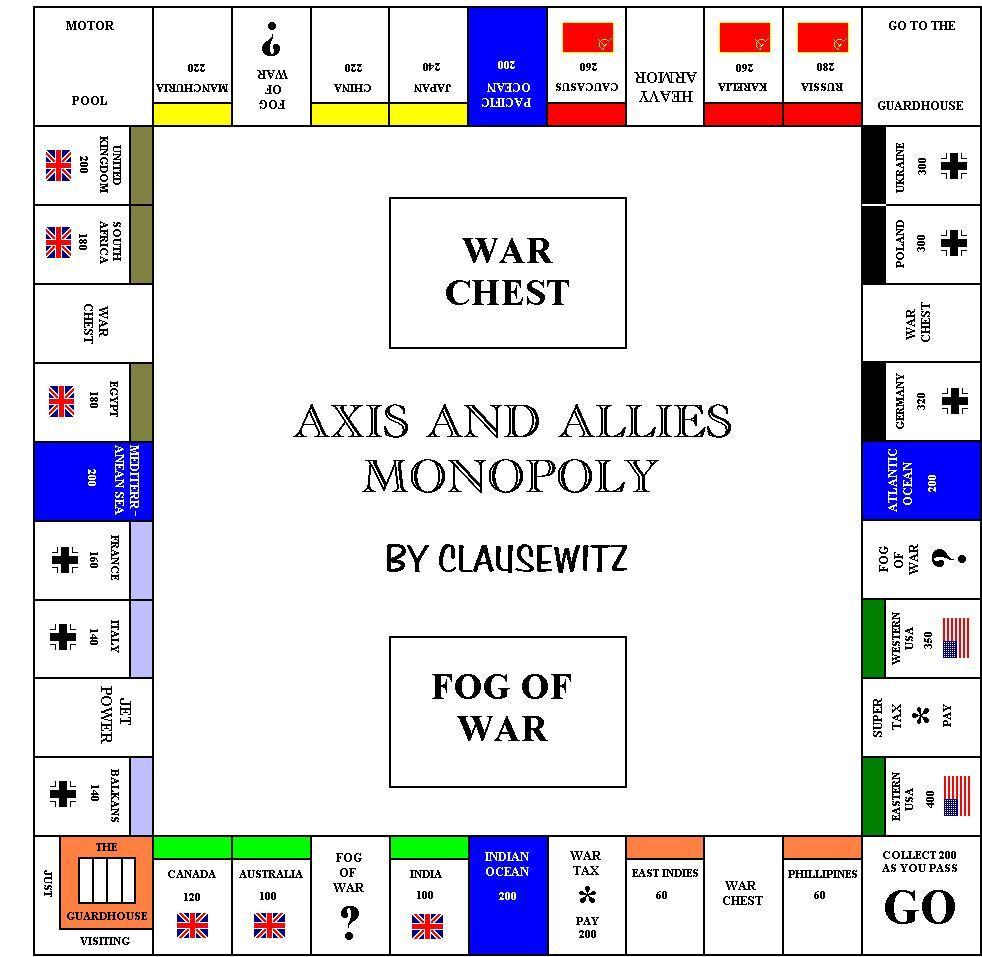
This is NOT at all representative of their ''hive collective'' mentality, but MORE akin to their ''it's just business'' approaches and a means to satisfy their ''share holders'', of which is truly their main 'concern'. I have nothing against companies making money for whatever they 'produce', but what I dislike is having the SAME ole 'crap' again, being foisted upon US-(the consumers) with just some tacked on 'theme', to have it become 'distinctive' for ''Marketing'' purposes. Of course, I'll continue to NOT ''buy into'' their 'gaming pablum' for the massively misguided folks, but don't let that stop YOU from doing such. Does anybody have any idea of just how MANY of the ''M~opoly'' games there are? More than 'one' is TOO many. So you can understand just WHY I'd 'pick' this as their NEXT 'game' release. The 'gameboard' that you see here was done up by someone I know, and has his ''Forum'' name upon this, as you can readily 'see'. He did this with regards to displaying just how INSIPID it would 'sound', and for our amusement. I do believe that he accomplished ALL of his 'goals' for that WITH 'this'!
RANT 'on': As for the ongoing 'bone of contention' regarding the 'A&A'-Minis, then I'd like to point out the MANY unhistorical inaccuracies, or downright idiotic seepage of the "Fantasy Farcical Figures" that they'll be providing. There's the ''Red Devil Cap'n'' FOR the U.S.A. forces-of which HE should 'be' British! Are there going to 'be' some ''Dreaming Beagles'' Paras for the Brit's sorts as well? Then the 'Inspiring Lt.' guy for which WHY couldn't they get a better 'name' or description with something ELSE? I wonder if they'll have the 'Curmudgeon Corporal' NEXT? Or how's about the 'Sarcastic Sergeant'? I wouldn't doubt that they'd come up with 'Major Disappointment' and 'General Lack of Concern' at the rate they're going with this. It's just plain and simply STUPID on their part, while I don't know just WHO does their 'background' on these, but they need to slap 'em upside the HEAD some for their 'contributions' on these. Get a 'grip' on reality and around the 'tard's throat that 'arrived' upon 'em, since they're definitely lacking in qualifications for THIS, and maybe even a LACK of oxygen would rectify their disposition. I don't know, but I 'wonder', just who did the sculpting for the Anti-Tank guns? as they don't look 'correct' and especially for the simple TIRES for those! I mention this since lots of people(idjits?) seem to proclaim the 'details' of them all, as being exquisite-their 'words', not mine. Maybe they ought to get out to the Game places to SEE some excellent 'examples' on display for other 'systems', and THEN make their 'determinations' eh? As for some of the 'A.F.V.'s-(Armored Fighting Vehicles or TANKS for those not 'in' on the jargon), then what's with the 'camo' schemes for some of them? The M-3 Lee has a 'Desert' look to it when it should 'be' for a JUNGLE locale instead! The SAME with the 'Japanese' Tank as well. While the 'Soviets' have what? Somebody explain to ME just where are they going to be 'Combattling' AT! They 'appear' to be on their 'way' to the North AfricanTheatre!, or somewhere thereabouts. Then there's that 'Croc-O-Tank' that don't gots its Trailer-Tank full of 'fuel' of which it NEEDS to 'spout flames'. Also of 'note' is the 'classification' for some of these, and it is THAT of which I really take 'issue' with! Their selections are truly indicative of their 'uninspired' attempts at bringing some of the RARE 'factor' into all of this. Anybody there at W.o.t.C. ever 'heard' of going to the Library? Then how's about just LOOKING these 'up' on the ''intarwebs''? I'm sure that there'll be plenty of other more inane additions to this 'listing' as they crop up, since we have the wonderfully demented folks of you-know-where going 'whole hog' on their efforts for this. While, who knows?, maybe we'll FINALLY get to 'see' some of them ''Alien Space Bats'' *popping* in with future 'boosters' for this, huh?
RANT 'off':
It just goes to show you, it's ALWAYs 'something'!
Saturday, September 17, 2005
Dicefest
Posted by
Joe Gola
at
2:35 PM
Back in the old days, when mankind lived in the world and not merely on it, the peoples would throw the bones of birds and animals into the air and ask the unknowable.
Had we been there at that distant moment in our white lab coats, we might have tried to pull a joke on those funny little men. Earlier that day one particularly light-fingered technician might have borrowed the bones, weighed them, determined their centers of gravity, and performed a few quick aerodynamics tests in the miniature wind tunnel hidden in the bushes; meanwhile one of the better-looking lady scientists might have distracted the augurer by egging him on to undertake a few informal strength tests. Hathur, you're a mighty one, aren't you? Can you lift this rock? I see! Well, can you lift this very slightly heavier rock? Fascinating! While all this is going on, a ring of temperature gauges and anemometers are erected around the village like a thin wire Stonehenge, though not so many so as to hinder the natural airflow to the valley (we don't want to actually cheat, you understand).
Then, just at the moment of release, BANG! The strobing cameras placed at strategic angles calculate the velocity, trajectory, and x-, y- and z-axis spin, and everything goes straight into the computer (cleverly disguised as a goat so as not to attract too much attention, patch cables running in under the beard and monitor and tiny keyboard under the tail). The modeling program kicks into high gear: processing, processing, there! We call the throw just before it lands. Now, we can't predict to the tribe whether the trembling little boy fighting back the tears there before us will be village chief or village idiot, but we did at least predict how the bones would fall, and that's the important thing.
Except...well, we got it wrong. It's a somewhat more complex system than we thought, really. There was that gust of wind, you see, and that one techie sneezed right in the middle of it all, and wouldn't you know it but Hathur decided to show off at the last minute with that little flick of the wrist, one of those typical medicine-man grace notes that always plays so well in the sticks.
Bummer! But not surprising. It's all a bit reminiscent of Benoit Mandelbrot and his fractals, the basic idea being that these multidimensional, self-referential, feedbacky systems are a bitch to figure out. As Benny says, even something as relatively straightforward as measurement can be tricky to get a handle on in the real world. Suppose you wanted to know the length of the perimeter of Long Island; certainly you could gauge it from the twenty-mile view and get a rough idea, but what about all those little nooks and crannies? The inlets? The promontories? That big ugly rock just south of Patchogue? If you really wanted to do it right you would get down on your hands and knees and go along the edge with a yardstick, measuring every curve and bend, but then all of the sudden the length of the perimeter is twice what you thought it was, and that's only just a rough estimate, because within each thirty-six inches of shoreline there are twists and bends of an ever dinkier nature adding flagrantly unmeasured centimeters to the real total. Two months later you're somewhere deep in the Hamptons staring at a bit of high-class mud with an electron microscope and just a moment before Steven Spielberg releases the hounds you've decided that the true length of the perimeter of Long Island is either infinite or—thanks to all the erosion and tidewrack and general disinclination of atoms to stay in any one place for too long a time—unknowable.
I see some of you scientists are bouncing up and down in your seats and holding up your hands, and yes, I'm getting to that. Some random and/or complex things are knowable, maybe not on a real-world basis, but mathematically. If you take those marked bones of the shaman and made them all regular-like—let's say a cube for simplicity's sake—and then numbered the faces one to six, you could predict generally—over the very long haul—how often any particular number will come up. You would never know what those cubic bones were going to do on any one throw, but you would be able to say that if you rolled three of them together, perhaps while asking the gods how charismatic the son of the chief would grow up to be, there would be a 0.463% chance of rolling a total of 18, which translates to roughly George Washington-level charisma (for reference, figure that a 14 is John Stamos-level charisma and a 6 Pauly Shore-level charisma). In other words, in a hundred thousand throws (well, we don't want to lose them, so let's just roll them instead), you could expect to end up with three "sixes" somewhere in the vicinity of four hundred and sixty-three times.
Now, as you can see, the journey from the dawn of man to Long Island to our own Modern Times is a long and tortuous one, but here we are, thank God, and now before us is the final goal, the highest peak of cultural evolution, in other words that particular brand of homo sapiens who we shall call homo gamer—a creature as hunched, hairy and smelly as his ancestors, but better educated, and kind of a smart-ass to boot. What is this creature's philosophy as it relates to bone rolling?
What homo gamer will tell you about the little numbered cubes is that they are very, very stupid. Why? Simple: because they're supposed to do something and they never do it. If, for example, one had the requisite savvy and foresight to secure property abutting a region that produced an important resource on a sum of 8 on a 2d6, that person could expect to be a wealthy man over the long haul of a game, earning that resource on roughly one out of every seven rolls; and yet, wouldn't you know it, turn after turn people are rolling every other number you can think of, some numbers you might even have forgotten about, but not one stupid 8. Or how about this: you're in a battle with the enemy and he needs to roll a whopping five sixes on seven dice to make you retreat out of Patchogue once and for all. The very idea is laughable, but what happens? The swine does it. Now you have to spend the winter in Bellport like a chump, and it's all the dice's fault.
Beyond even that, there's the question of whether random elements belong in games at all. How can you prove that you're the smartest player if you can't predict everything that's going to happen?
So anyway, now that we've had our fun reducing everything to meaninglessness—now that the shaman's bones have lost all their marrow—the only thing left is to ask if there is at least remaining to us in the little plastic cubes a metaphor for something larger.
I think there is.
My theory is that, at their best, games present a microcosm of life, or at least some small part of life. Even a game as dull and pointless as "war" simulates a real-life concept, which is that of a winner and a loser; nothing is really won or lost, neither player has actually advanced his position in the workaday world, but the two participants are playing at being winner or loser in the way that a child might play at being a jet pilot or a fairy princess. Nowadays of course the concept of winning or losing at a game is second nature, but imagine a hypothetical moment at some distant point in our cultural evolution when there was no playing but only reality: Neanderthal Adam and Neanderthal Eve grab at the last apple on the tree in the same instant, and Eve is just a hair quicker than the Adam, and Adam goes hungry. Winner and loser. Minutes later Adam and some smooth-talking Cro-Magnon he thought was his best friend both grab at Eve, and now we get to see just how quick Eve really is.
Time goes on, civilization progresses, and soon it's not an apple that's at stake but a whole frigging orchard. Who can take the pressure? How does one even cope with such a devastating event as the loss of apple trees? It's a bitter pill to swallow, and so the little human cubs seeing all this heartache and strife and skirt-chasing going on amongst their elders figure they'd better get a little practice in before things start getting serious with a capital S. And so they still do today: anyone who's ever played a game with wee ones will tell you that there's a certain shock that takes place the first time a child loses a game that he very much wanted to win. The concept takes some getting used to, for sure, and sometimes there is crying, and sometimes the pieces get thrown across the room, and sometimes your wife will tell you that chess is no game to be playing with a three-year-old, but in the end the little monster learns how to deal with it and everyone's happy, more or less. Twenty years later when sweet & lovely Yvette says she just likes him "as a friend," our little exercise will have hopefully granted him the maturity to not burst into tears and drop-kick her purse.
Now, dice simulate something about life as well, but it's something just a little bit deeper than simple winning and losing. One can discover in dice rolls a certain atavistic truth, a residual, instinctual species-concept which, though deeply buried, stills ring like a bell when struck hard enough, as mythological-real as true love and free lunch. The idea is that of luck as a Thing in the World, a substance that ebbs and flows, a viscid fluid that pools and drains, a mystic visitor that inexplicably comes to stay and then disappears in a puff of purple smoke. Deeper, more to the point, it is a metaphor for being anointed, being favored by the gods, to be the Golden One of the cosmos itself.
Even well-educated and crusty gamers can fall under the spell of dice in spite of themselves, and it is a wonder to watch. Haven't you seen them become crestfallen with self-loathing, with each roll just knowing that things will turn out badly, that they are the least loved of God's creations? Poor Caliban! Conversely, when things go their way they will puff up, beam from the inside, become one with the eternal Tao, and know that finally and at last has been confirmed the secret suspicion forever held deep in their hearts that they deserve to win because they are themselves. Soon other archetypal roles weave their way into the net; Underdog and Icarus swoop up and down in a dance, corkscrewing across the sky in a long, graceful double helix. What goes around comes around, and in some rare and bizarre circumstances there will be hallucinations of Karma. In patchoulied college moments I used to play Cosmic Wimpout with a certain group of chums, and it came to be understood that one did not say anything negative when another was about to roll, as such a rash and careless action shattering the harmony like shit hitting a cymbal would only rebound on one's self with double force in the form of crummy, crummy rolls. It was never spoken, this rule, but it was known, and often one would find one's self clacking one's teeth shut in mid-sentence when the dice were about to hit the table.
Those with a more agnostic outlook can still find some resident awe in the rolls of dice even without this hippie dream of a ruling goddess. After all, is there no mystery in the law of averages, the fundamental paradox between pattern and unpredictability? Is it not strange to know that these cubes that clatter crazily this direction and that are in the long run secretly turning with the stolid precision of clockwork, each side facing out in its turn with implacable duty? Or, looking at it from a yet another aspect, is it not the very concept of randomness in this world of law strange, and what if it is somehow necessary, the grimy oil that keeps the entire mechanism moving on its course? Either one of these trains of thought ought to be good for at least a second's pause, depending on whether you view the world as primarily orderly or primarily chaotic.
So now take a pair of dice in your hand, and imagine—just pretend—that for one moment your entire life would lay decided in a single roll, that somehow, by some strange conjugation of forces, this one outcome would dictate your entire fate with no dream of appeal or reprieve. Hooded, red-doubleted guards stand over you holding battle axe and chain, and behind them the icy judge with the tangled white hair, the worn creases in the hollows of his face and the iron gimlet eyes watches in silence. Crouch down on the stony, rat-crossed floor of the donjon, let fear grip your stomach, and roll, and then see if in that play of make-believe you can scratch the paint off a corner of reality and catch one tiny glimpse of the unknowable.
Had we been there at that distant moment in our white lab coats, we might have tried to pull a joke on those funny little men. Earlier that day one particularly light-fingered technician might have borrowed the bones, weighed them, determined their centers of gravity, and performed a few quick aerodynamics tests in the miniature wind tunnel hidden in the bushes; meanwhile one of the better-looking lady scientists might have distracted the augurer by egging him on to undertake a few informal strength tests. Hathur, you're a mighty one, aren't you? Can you lift this rock? I see! Well, can you lift this very slightly heavier rock? Fascinating! While all this is going on, a ring of temperature gauges and anemometers are erected around the village like a thin wire Stonehenge, though not so many so as to hinder the natural airflow to the valley (we don't want to actually cheat, you understand).
Then, just at the moment of release, BANG! The strobing cameras placed at strategic angles calculate the velocity, trajectory, and x-, y- and z-axis spin, and everything goes straight into the computer (cleverly disguised as a goat so as not to attract too much attention, patch cables running in under the beard and monitor and tiny keyboard under the tail). The modeling program kicks into high gear: processing, processing, there! We call the throw just before it lands. Now, we can't predict to the tribe whether the trembling little boy fighting back the tears there before us will be village chief or village idiot, but we did at least predict how the bones would fall, and that's the important thing.
Except...well, we got it wrong. It's a somewhat more complex system than we thought, really. There was that gust of wind, you see, and that one techie sneezed right in the middle of it all, and wouldn't you know it but Hathur decided to show off at the last minute with that little flick of the wrist, one of those typical medicine-man grace notes that always plays so well in the sticks.
Bummer! But not surprising. It's all a bit reminiscent of Benoit Mandelbrot and his fractals, the basic idea being that these multidimensional, self-referential, feedbacky systems are a bitch to figure out. As Benny says, even something as relatively straightforward as measurement can be tricky to get a handle on in the real world. Suppose you wanted to know the length of the perimeter of Long Island; certainly you could gauge it from the twenty-mile view and get a rough idea, but what about all those little nooks and crannies? The inlets? The promontories? That big ugly rock just south of Patchogue? If you really wanted to do it right you would get down on your hands and knees and go along the edge with a yardstick, measuring every curve and bend, but then all of the sudden the length of the perimeter is twice what you thought it was, and that's only just a rough estimate, because within each thirty-six inches of shoreline there are twists and bends of an ever dinkier nature adding flagrantly unmeasured centimeters to the real total. Two months later you're somewhere deep in the Hamptons staring at a bit of high-class mud with an electron microscope and just a moment before Steven Spielberg releases the hounds you've decided that the true length of the perimeter of Long Island is either infinite or—thanks to all the erosion and tidewrack and general disinclination of atoms to stay in any one place for too long a time—unknowable.
I see some of you scientists are bouncing up and down in your seats and holding up your hands, and yes, I'm getting to that. Some random and/or complex things are knowable, maybe not on a real-world basis, but mathematically. If you take those marked bones of the shaman and made them all regular-like—let's say a cube for simplicity's sake—and then numbered the faces one to six, you could predict generally—over the very long haul—how often any particular number will come up. You would never know what those cubic bones were going to do on any one throw, but you would be able to say that if you rolled three of them together, perhaps while asking the gods how charismatic the son of the chief would grow up to be, there would be a 0.463% chance of rolling a total of 18, which translates to roughly George Washington-level charisma (for reference, figure that a 14 is John Stamos-level charisma and a 6 Pauly Shore-level charisma). In other words, in a hundred thousand throws (well, we don't want to lose them, so let's just roll them instead), you could expect to end up with three "sixes" somewhere in the vicinity of four hundred and sixty-three times.
Now, as you can see, the journey from the dawn of man to Long Island to our own Modern Times is a long and tortuous one, but here we are, thank God, and now before us is the final goal, the highest peak of cultural evolution, in other words that particular brand of homo sapiens who we shall call homo gamer—a creature as hunched, hairy and smelly as his ancestors, but better educated, and kind of a smart-ass to boot. What is this creature's philosophy as it relates to bone rolling?
What homo gamer will tell you about the little numbered cubes is that they are very, very stupid. Why? Simple: because they're supposed to do something and they never do it. If, for example, one had the requisite savvy and foresight to secure property abutting a region that produced an important resource on a sum of 8 on a 2d6, that person could expect to be a wealthy man over the long haul of a game, earning that resource on roughly one out of every seven rolls; and yet, wouldn't you know it, turn after turn people are rolling every other number you can think of, some numbers you might even have forgotten about, but not one stupid 8. Or how about this: you're in a battle with the enemy and he needs to roll a whopping five sixes on seven dice to make you retreat out of Patchogue once and for all. The very idea is laughable, but what happens? The swine does it. Now you have to spend the winter in Bellport like a chump, and it's all the dice's fault.
Beyond even that, there's the question of whether random elements belong in games at all. How can you prove that you're the smartest player if you can't predict everything that's going to happen?
So anyway, now that we've had our fun reducing everything to meaninglessness—now that the shaman's bones have lost all their marrow—the only thing left is to ask if there is at least remaining to us in the little plastic cubes a metaphor for something larger.
I think there is.
My theory is that, at their best, games present a microcosm of life, or at least some small part of life. Even a game as dull and pointless as "war" simulates a real-life concept, which is that of a winner and a loser; nothing is really won or lost, neither player has actually advanced his position in the workaday world, but the two participants are playing at being winner or loser in the way that a child might play at being a jet pilot or a fairy princess. Nowadays of course the concept of winning or losing at a game is second nature, but imagine a hypothetical moment at some distant point in our cultural evolution when there was no playing but only reality: Neanderthal Adam and Neanderthal Eve grab at the last apple on the tree in the same instant, and Eve is just a hair quicker than the Adam, and Adam goes hungry. Winner and loser. Minutes later Adam and some smooth-talking Cro-Magnon he thought was his best friend both grab at Eve, and now we get to see just how quick Eve really is.
Time goes on, civilization progresses, and soon it's not an apple that's at stake but a whole frigging orchard. Who can take the pressure? How does one even cope with such a devastating event as the loss of apple trees? It's a bitter pill to swallow, and so the little human cubs seeing all this heartache and strife and skirt-chasing going on amongst their elders figure they'd better get a little practice in before things start getting serious with a capital S. And so they still do today: anyone who's ever played a game with wee ones will tell you that there's a certain shock that takes place the first time a child loses a game that he very much wanted to win. The concept takes some getting used to, for sure, and sometimes there is crying, and sometimes the pieces get thrown across the room, and sometimes your wife will tell you that chess is no game to be playing with a three-year-old, but in the end the little monster learns how to deal with it and everyone's happy, more or less. Twenty years later when sweet & lovely Yvette says she just likes him "as a friend," our little exercise will have hopefully granted him the maturity to not burst into tears and drop-kick her purse.
Now, dice simulate something about life as well, but it's something just a little bit deeper than simple winning and losing. One can discover in dice rolls a certain atavistic truth, a residual, instinctual species-concept which, though deeply buried, stills ring like a bell when struck hard enough, as mythological-real as true love and free lunch. The idea is that of luck as a Thing in the World, a substance that ebbs and flows, a viscid fluid that pools and drains, a mystic visitor that inexplicably comes to stay and then disappears in a puff of purple smoke. Deeper, more to the point, it is a metaphor for being anointed, being favored by the gods, to be the Golden One of the cosmos itself.
Even well-educated and crusty gamers can fall under the spell of dice in spite of themselves, and it is a wonder to watch. Haven't you seen them become crestfallen with self-loathing, with each roll just knowing that things will turn out badly, that they are the least loved of God's creations? Poor Caliban! Conversely, when things go their way they will puff up, beam from the inside, become one with the eternal Tao, and know that finally and at last has been confirmed the secret suspicion forever held deep in their hearts that they deserve to win because they are themselves. Soon other archetypal roles weave their way into the net; Underdog and Icarus swoop up and down in a dance, corkscrewing across the sky in a long, graceful double helix. What goes around comes around, and in some rare and bizarre circumstances there will be hallucinations of Karma. In patchoulied college moments I used to play Cosmic Wimpout with a certain group of chums, and it came to be understood that one did not say anything negative when another was about to roll, as such a rash and careless action shattering the harmony like shit hitting a cymbal would only rebound on one's self with double force in the form of crummy, crummy rolls. It was never spoken, this rule, but it was known, and often one would find one's self clacking one's teeth shut in mid-sentence when the dice were about to hit the table.
Those with a more agnostic outlook can still find some resident awe in the rolls of dice even without this hippie dream of a ruling goddess. After all, is there no mystery in the law of averages, the fundamental paradox between pattern and unpredictability? Is it not strange to know that these cubes that clatter crazily this direction and that are in the long run secretly turning with the stolid precision of clockwork, each side facing out in its turn with implacable duty? Or, looking at it from a yet another aspect, is it not the very concept of randomness in this world of law strange, and what if it is somehow necessary, the grimy oil that keeps the entire mechanism moving on its course? Either one of these trains of thought ought to be good for at least a second's pause, depending on whether you view the world as primarily orderly or primarily chaotic.
So now take a pair of dice in your hand, and imagine—just pretend—that for one moment your entire life would lay decided in a single roll, that somehow, by some strange conjugation of forces, this one outcome would dictate your entire fate with no dream of appeal or reprieve. Hooded, red-doubleted guards stand over you holding battle axe and chain, and behind them the icy judge with the tangled white hair, the worn creases in the hollows of his face and the iron gimlet eyes watches in silence. Crouch down on the stony, rat-crossed floor of the donjon, let fear grip your stomach, and roll, and then see if in that play of make-believe you can scratch the paint off a corner of reality and catch one tiny glimpse of the unknowable.
Friday, September 16, 2005
Game Store Confidential: The Other Side of the Counter
Posted by
Coldfoot
at
1:00 AM
Larry is the clerk at my FLGS (Friendly Local Game Store), but every game store has a Larry (or possibly a Moe) behind the counter.
Larry talks to the cash register with a gleam in his eye, "Damn you cursed, contraption! Take that!!!!", he says punching a series of buttons. "My evil nemesis, why won't you void? Void, I say void, ye spawn of the damned." He then resorts to punching the same button repeatedly, pausing briefly between punches to see if there is a new result.
When he finally happens upon the right combination of buttons, "Ahhhhhh haaaaaaaa. I am victor-r-r-rious again!"
Larry knows more about Professional Wrestling than anyone I have ever met. He can, and does, find excuses to discuss the Hulk Hogan/Andre the Giant match from Wrestle-Mania III in 1987.
Larry was born in 1985.
Larry thinks Munchkin is the bomb.
Larry is well read. He can discuss Wolverine and Dogbert with equal fervor.
Larry doesn't limit his appreciation for the arts to the printed word. Larry can (and frequently does) quote such noted thinkers as Principle Skinner, Cartman and Yoda.
Larry isn't a bad guy, he has just climbed the corporate ladder as high as he ever will.
Larry is not alone in the game store. No, far from it. Curly owns the store. Curly is a balding (he might prefer the term "thinning"), middle aged man with a goatee.
Curly's father has been the successful owner of the local Ford dealership since 1961. Curly's father fronted him the start-up money to open the store. His father gave up hope of ever getting his money back, and wrote-off that loan 10 years ago.
Curly knows the comic book and miniature sides of the business inside and out, which is good because most of his customers are either 40k fanatics or comic book geeks.
Curly is frequently involved in miniature campaigns in the back of the store. In his free time Curly is parked at the game table painting 40k miniatures.
Curly has a lot of free time.
Curly lets Larry handle the game orders. Curly hasn't played a board game since he went through his "Axis and Allies" phase in college.
Curly thinks "Texas Hold 'em" poker is the bomb.
Other employees come and go. There was the guy who stood 6 foot 8, the college girl who showed a lot of cleavage, and Mikey the man with monster breath. Curly and various Larrys have been there year after year.
Other game/comic book/miniature stores have come and gone in the last 20 years. All of their employees were normal. It takes a Larry and a Curly to run a game/comic book/miniature store. If they aren't there the place just doesn't feel right. Walking into a game store without a Curly or Larry (or possibly a Moe) feels like walking into a bar without cigarette smoke, or a Dairy Queen that doesn't serve ice cream.
As much as we like to have fun at their expense, the game world needs Curlys and Larrys. They are the only ones who can put up with us.
I wish them the best of luck.
Larry talks to the cash register with a gleam in his eye, "Damn you cursed, contraption! Take that!!!!", he says punching a series of buttons. "My evil nemesis, why won't you void? Void, I say void, ye spawn of the damned." He then resorts to punching the same button repeatedly, pausing briefly between punches to see if there is a new result.
When he finally happens upon the right combination of buttons, "Ahhhhhh haaaaaaaa. I am victor-r-r-rious again!"
Larry knows more about Professional Wrestling than anyone I have ever met. He can, and does, find excuses to discuss the Hulk Hogan/Andre the Giant match from Wrestle-Mania III in 1987.
Larry was born in 1985.
Larry thinks Munchkin is the bomb.
Larry is well read. He can discuss Wolverine and Dogbert with equal fervor.
Larry doesn't limit his appreciation for the arts to the printed word. Larry can (and frequently does) quote such noted thinkers as Principle Skinner, Cartman and Yoda.
Larry isn't a bad guy, he has just climbed the corporate ladder as high as he ever will.
Larry is not alone in the game store. No, far from it. Curly owns the store. Curly is a balding (he might prefer the term "thinning"), middle aged man with a goatee.
Curly's father has been the successful owner of the local Ford dealership since 1961. Curly's father fronted him the start-up money to open the store. His father gave up hope of ever getting his money back, and wrote-off that loan 10 years ago.
Curly knows the comic book and miniature sides of the business inside and out, which is good because most of his customers are either 40k fanatics or comic book geeks.
Curly is frequently involved in miniature campaigns in the back of the store. In his free time Curly is parked at the game table painting 40k miniatures.
Curly has a lot of free time.
Curly lets Larry handle the game orders. Curly hasn't played a board game since he went through his "Axis and Allies" phase in college.
Curly thinks "Texas Hold 'em" poker is the bomb.
Other employees come and go. There was the guy who stood 6 foot 8, the college girl who showed a lot of cleavage, and Mikey the man with monster breath. Curly and various Larrys have been there year after year.
Other game/comic book/miniature stores have come and gone in the last 20 years. All of their employees were normal. It takes a Larry and a Curly to run a game/comic book/miniature store. If they aren't there the place just doesn't feel right. Walking into a game store without a Curly or Larry (or possibly a Moe) feels like walking into a bar without cigarette smoke, or a Dairy Queen that doesn't serve ice cream.
As much as we like to have fun at their expense, the game world needs Curlys and Larrys. They are the only ones who can put up with us.
I wish them the best of luck.
Thursday, September 15, 2005
7 Player, 3 team Werewolf!
Posted by
Alex Rockwell
at
12:16 PM
My final post about Werewolf (at least for a while), is going to be about a 7 player variant with three teams. Each game, only one of the three teams can win, so each team is trying to kill off the critical players of the other two teams. Of course, no one knows who their teammates are at the beginning of the game, they have to figure it out, and there will be constant bluffing about roles.
The result is that the game tends to be shorter, simply because people are more willing to band together to lynch someone.
Roles are NOT revealed upon death.
The roles are:
Werewolf team:
1 Werewolf
1 Sorcerer
Demon team:
1 Demon
1 Cultist
Village team:
1 Seer
1 Cleric
1 Hunter (aka Buffy)
No player knows the role of another player at game start. No hand signaling during the night is allowed.
Night powers:
During the night, the Seer looks to find the Werewolf (only sees Werewolf or non-Werewolf), the Sorcerer looks for the Seer. The Cleric looks for the Demon, and the Cultist looks for the Cleric.
During nights 2 and 3, the Werewolf and Demon each choose a victim. (Night 1 occurs before day 1, and only involves looking powers). However, only 1 player is killed. If only one of them is still alive, that player automatically gets the kill. If both are alive, and it is the first kill of the game, it is chosen at random. If both are alive and it is not the first kill of the game, then whoever did not get the kill last time, gets it this time.
Note that the Werewolf and Demon are able to kill one another during the night, and they are actively trying to find the other in order to do this.
Game end conditions:
The game ends when both the Werewolf and Demon are dead, or if only two players remain.
If the Werewolf and Demon are both dead, the village team wins.
If the Werewolf and Demon are the only two players left alive, they kill each other and no one wins (this prevents evil teaming up, which is necessary).
If the Werewolf and Hunter or Demon and Hunter are the last two player, the village team wins.
If the Werewolf and someone other than the Hunter or Demon are the last two players, then the Werewolf team wins.
If the Demon and someone other than the Hunter or Werewolf are the last two players, then the Demon team wins.
Thus, each team needs to kill each of the other two teams killer/hunter players.
I have found the game to be won roughly in proportion to the number of player per team. that is, about 3/7 the village wins, 2/7 the werewolf team, and 2/7 the demon team.
We use the following cards for each role:
(Demon group / major suits)
Demon: Jack of Spades
Cultist: Ace of Spades
Cleric: Ace of Hearts
(Werewolf group / Minor suits)
Werewolf: Jack of Clubs
Sorcerer: Ace of Clubs
Seer: Ace of Diamonds
Hunter: Red king
Red is village, Club is Werewolf team, Spade is Demon team. Ace is a looker, non-ace is a killer. (You could change Hunter to red jack for consistency).
You can use whatever you want, but be consistent, as it is confusing. Early on in your playing, you may have a time when players get confused, and do something like think they are the Cultist when they are the Sorcerer, and open their eyes at the wrong time.
It can help to go over which card is what role right before night 1.
Strategy:
In general, on the first day, it is only safe to be thought of as a looker of some sort. If you are thought by most to be the Werewolf, Demon or Hunter, then more than 50% of the players will want to kill you. If you claim to be a specific looker role, then about half of the players will want you dead, but only with low priority. For example, if you claim to be the Seer, and are believed, then the Werewolf and Sorcerer need you dead, but the Demon and Cultist probably like you alive, since you are powerless against them and could help them identify their opponent.
Thus, the most common day 1 claims are: 'I am a looker', 'I am a good looker', or 'I am'. Claims of being an evil looker can also work, but are quite risky, as the players may decide to lynch you if they cannot figure out someone more critical to kill. For example, if you claim to be the Cultist, then each player thinks the following of you:
Hunter, Seer: want you dead with low priority.
Cleric (who the Cultist can look for): want you dead with low to moderate priority.
Werewolf and Sorcerer: want you dead with low priority. This is because they want the Cleric to be successful, and find the Demon, and the Cultist can try to get the Cleric killed first.
Demon: wants you alive.
As you can see, this is risky, unless there is a bigger target out there. Claiming to be one of the evil lookers but not saying which one will mean that the other evil looker will want you dead, but both evil killers will not, since they don't know which you are.
Coming out with the info 'I am the Cultist and that player is the Cleric' is better, but not necessarily safe. Your killer only gets the kill 50% of the time, and wants to take out the other killer/hunter foremost. And the group might decide to kill you, since the evil roles wont necessarily want to band together to kill the Cleric you have identified, since then they have shown the two evil killers to be among a group of 4, instead of a group of 7, which is much more risky.
It is probably better in that case to claim you are the Seer/Cleric, and the player you found is the Werewolf/Demon. Of course, this often leads to several Seer or Cleric claims. 'Group flipping', which is when you are in the Werewolf/Sorcerer/Seer grouping or the Demon/Cultist/Cleric grouping, but claim to be in the other, and finger someone as your target, can be quite interesting and strong. It also leads to many contradictory role claims (which is fun) :)
Because it is safe to be seen as 'a looker' but not safe to be seen as 'a killer' (Hunter is a killer), the game will often begin with each player saying who they looked at during the night, and possibly whether they got a thumbs up or thumbs down. Some might qualify themselves as a specific looker, or a good or evil looker.
Many times, the game will have a lot of discussion about one grouping, but not the other. Players in these cases may gain more information by trying to draw out info about the other grouping.
On day 2, claiming to be an evil looker becomes quite safe. People no longer have time to kill you, they have to be going after the killers/hunter.
I have shown some of the beginning strategy, but I will leave it up to you to figure out more!
The only problem I have found in the game is that it is possible for a Sorcerer or Cleric to have their teammate killed, and know it, and thus to have no win condition, and be aware of that. This is not common, but it occasionally happens, and I don't have an adequate solution to it. If anyone has ideas, let me know! Of course, most of the time, the player will not be aware that their partner has died.
In conclusion, 7 player 3 team Werewolf is my favorite variant, goes quickly, and has a ton of role claiming/deduction. Also, each player has a special, unique role, and four players have the power to find another player, so there is quite a bit of information in the game.
Up next week, by request, I will discuss Tichu. Stay tuned. :)
The result is that the game tends to be shorter, simply because people are more willing to band together to lynch someone.
Roles are NOT revealed upon death.
The roles are:
Werewolf team:
1 Werewolf
1 Sorcerer
Demon team:
1 Demon
1 Cultist
Village team:
1 Seer
1 Cleric
1 Hunter (aka Buffy)
No player knows the role of another player at game start. No hand signaling during the night is allowed.
Night powers:
During the night, the Seer looks to find the Werewolf (only sees Werewolf or non-Werewolf), the Sorcerer looks for the Seer. The Cleric looks for the Demon, and the Cultist looks for the Cleric.
During nights 2 and 3, the Werewolf and Demon each choose a victim. (Night 1 occurs before day 1, and only involves looking powers). However, only 1 player is killed. If only one of them is still alive, that player automatically gets the kill. If both are alive, and it is the first kill of the game, it is chosen at random. If both are alive and it is not the first kill of the game, then whoever did not get the kill last time, gets it this time.
Note that the Werewolf and Demon are able to kill one another during the night, and they are actively trying to find the other in order to do this.
Game end conditions:
The game ends when both the Werewolf and Demon are dead, or if only two players remain.
If the Werewolf and Demon are both dead, the village team wins.
If the Werewolf and Demon are the only two players left alive, they kill each other and no one wins (this prevents evil teaming up, which is necessary).
If the Werewolf and Hunter or Demon and Hunter are the last two player, the village team wins.
If the Werewolf and someone other than the Hunter or Demon are the last two players, then the Werewolf team wins.
If the Demon and someone other than the Hunter or Werewolf are the last two players, then the Demon team wins.
Thus, each team needs to kill each of the other two teams killer/hunter players.
I have found the game to be won roughly in proportion to the number of player per team. that is, about 3/7 the village wins, 2/7 the werewolf team, and 2/7 the demon team.
We use the following cards for each role:
(Demon group / major suits)
Demon: Jack of Spades
Cultist: Ace of Spades
Cleric: Ace of Hearts
(Werewolf group / Minor suits)
Werewolf: Jack of Clubs
Sorcerer: Ace of Clubs
Seer: Ace of Diamonds
Hunter: Red king
Red is village, Club is Werewolf team, Spade is Demon team. Ace is a looker, non-ace is a killer. (You could change Hunter to red jack for consistency).
You can use whatever you want, but be consistent, as it is confusing. Early on in your playing, you may have a time when players get confused, and do something like think they are the Cultist when they are the Sorcerer, and open their eyes at the wrong time.
It can help to go over which card is what role right before night 1.
Strategy:
In general, on the first day, it is only safe to be thought of as a looker of some sort. If you are thought by most to be the Werewolf, Demon or Hunter, then more than 50% of the players will want to kill you. If you claim to be a specific looker role, then about half of the players will want you dead, but only with low priority. For example, if you claim to be the Seer, and are believed, then the Werewolf and Sorcerer need you dead, but the Demon and Cultist probably like you alive, since you are powerless against them and could help them identify their opponent.
Thus, the most common day 1 claims are: 'I am a looker', 'I am a good looker', or 'I am
Hunter, Seer: want you dead with low priority.
Cleric (who the Cultist can look for): want you dead with low to moderate priority.
Werewolf and Sorcerer: want you dead with low priority. This is because they want the Cleric to be successful, and find the Demon, and the Cultist can try to get the Cleric killed first.
Demon: wants you alive.
As you can see, this is risky, unless there is a bigger target out there. Claiming to be one of the evil lookers but not saying which one will mean that the other evil looker will want you dead, but both evil killers will not, since they don't know which you are.
Coming out with the info 'I am the Cultist and that player is the Cleric' is better, but not necessarily safe. Your killer only gets the kill 50% of the time, and wants to take out the other killer/hunter foremost. And the group might decide to kill you, since the evil roles wont necessarily want to band together to kill the Cleric you have identified, since then they have shown the two evil killers to be among a group of 4, instead of a group of 7, which is much more risky.
It is probably better in that case to claim you are the Seer/Cleric, and the player you found is the Werewolf/Demon. Of course, this often leads to several Seer or Cleric claims. 'Group flipping', which is when you are in the Werewolf/Sorcerer/Seer grouping or the Demon/Cultist/Cleric grouping, but claim to be in the other, and finger someone as your target, can be quite interesting and strong. It also leads to many contradictory role claims (which is fun) :)
Because it is safe to be seen as 'a looker' but not safe to be seen as 'a killer' (Hunter is a killer), the game will often begin with each player saying who they looked at during the night, and possibly whether they got a thumbs up or thumbs down. Some might qualify themselves as a specific looker, or a good or evil looker.
Many times, the game will have a lot of discussion about one grouping, but not the other. Players in these cases may gain more information by trying to draw out info about the other grouping.
On day 2, claiming to be an evil looker becomes quite safe. People no longer have time to kill you, they have to be going after the killers/hunter.
I have shown some of the beginning strategy, but I will leave it up to you to figure out more!
The only problem I have found in the game is that it is possible for a Sorcerer or Cleric to have their teammate killed, and know it, and thus to have no win condition, and be aware of that. This is not common, but it occasionally happens, and I don't have an adequate solution to it. If anyone has ideas, let me know! Of course, most of the time, the player will not be aware that their partner has died.
In conclusion, 7 player 3 team Werewolf is my favorite variant, goes quickly, and has a ton of role claiming/deduction. Also, each player has a special, unique role, and four players have the power to find another player, so there is quite a bit of information in the game.
Up next week, by request, I will discuss Tichu. Stay tuned. :)
Wednesday, September 14, 2005
Antidote for a Hectic Life
Posted by
Coldfoot
at
7:55 AM

Our world has changed very much in the last 30 years. For many people it’s hard to find the time in our busy days to do all that we HAVE to do, let alone the extra time to do what we’d LIKE to do. The technology, that 30 years ago would have sounded like science fiction right out of an Asimov story, hasn’t given us more time to relax; rather it seems to push us faster, and enables us to draw away from the community and into ourselves.
I love most of today's technology: computers that are small enough to carry around with you, phones the size of a deck of cards that go wherever you go, the Internet which lets me talk to all of you in whatever part of the world you live, cars that tell you where to go and can call for help, right down to the convenience of buying a movie from the comfort of your easy chair with a push of a button and then recording it to watch over and over.
But all of these conveniences cost money which means we have to work more. Some people work 2 jobs, some put in longer hours, and many families have to have more than one “bread winner”. There's now less time for our families so when we do have time for the ones we love, we pull deep into our own little world, hiding in our castles. We put up fences, both physical and metaphorical.
Front porches where neighbors used to sit and talk have disappeared, replaced by garages that push their noses towards the street. The family room hides in the back of the house where no one can see, as if to distance itself from the world out there. The children who used to run through the front yards are now holed up in their bedrooms or the family room playing video games which can be delivered right to their front door. Adults push themselves to do the household chores, then collapse in front of the TV.
Many people find ways to stay connected to people and still take a break from their hurried lives. Some help in their community, others join local sports teams or a rock band, some have a humorous flair and do stand-up on the weekends. For us, the gaming community, the answer lies in board games.
The games take us out of ourselves and back into society, whether it’s meeting at a game convention, the local brick and mortar, or in our own kitchens. Playing face-to-face games can take us back to that simpler time when interacting with other people was more than just saying, "Have a nice day".
Gaming with our families can show our children that we're more than just the ruling force in their lives. It teaches them to think for themselves and that their actions have consequences. And there’s nothing like beating Mom or Dad or Uncle Dan, fair and square, at a game to boost a child’s self-confidence. Games can be the catalyst for communication and laughter, creating fond memories that will remain with us for the rest of our lives. They can slow down the pace and let us breathe.
Technology offers us another way to play games by letting us meet to play and chat at an online site which, in the process, lets us learn about people and ways of life that are different from our own. It’s not as good as face-to-face, hearing the laughter and watching facial expressions, but the camaraderie is still there as is the humor and conversation, the heart of playing games.
So if the world has left you feeling listless and irritable, sit down and choose a color.
*Possible side effects: laughter, renewed energy and an overall feeling of happiness.
**Some studies have shown that playing games may reduce hair loss.
~~~~~~~~
Games
This week I got to play Rheinlander for the 3rd time and I would recommend this to anyone who enjoys area control games. You create your kingdoms (duchies) along the banks of a winding river, expanding in either direction or across the river, merging areas to make them bigger, or reinforcing your color inside someone else’s kingdom to overtake it from within. This game has the feel of Carolus Magnus with its merging, growing provinces but with more variety in your choices since you can expand areas in 3 directions (4 directions in a couple of places along the river where it connects back to back).
I also like the touch of hand-management in Rheinlander since you have the choice of playing a piece to the numbered area on the card, using any numbered card as a wild card to reinforce one of your knights, or holding a card that could be useful later in the game either to join 2 areas or convert a knight to your color if you have control of the Archbishop. In the last game I played, all four players held a card or 2 for almost half the game waiting for just the right time to use it.
My opinion is that the luck factor in Rheinlander is less than Euphrat & Tigris’ tile draw and equal to Carolus Magnus’ dice roll because any card can be used to reinforce somewhere so isn’t useless, and the deck gets reshuffled regularly (sometimes after playing only 2 cards if that sneaky Jester finds himself at the top of the new deck) so the numbers you need for attacking can come around again and again. If your kingdom (duchy) isn’t large enough to defend itself, it’s more a matter of the choices you made than the luck of the draw. Keep in mind, this is just my opinion and that I love area control games.
~~~~~~~~
Until next time, may your men control the Castillo.
Mary
Tuesday, September 13, 2005
Meet Kadon Enterprises
Posted by
Yehuda
at
10:00 AM
I interviewed Kate Jones, game designer and president of Kadon Enterprises, Inc, and Stephen Sniderman, game designer and co-editor, with Kate, of The Life of Games, an on-line periodical on board games. The interview was held via email. Take a look at their site and you’ll see why I thought they would make interesting interview subjects.
Tell us about yourselves, apart from gaming.
Kate: A condensed bio sits on my website, at http://www.gamepuzzles.com/kjbio.htm . It reports that I was born Hungarian, survived World War II, the 1969 Washington DC race riots, and the Iranian revolution, and ran through a variety of careers, including advertising copywriter, librarian, graphic artist, ballroom dance teacher, competition dancer, office methods specialist, editor, proofreader, web designer, conference hostess, and consultant besides game and puzzle designer/manufacturer. It's amazing how much one can do with only 3 or 4 hours of sleep a night.
Somewhere early in that line-up of frenzied productive activity I took out a few years to marry, give birth three times, divorce, remarry (now 35 years with the right man, Dick Jones), spend winters on creative retreat in Florida, travel the world, speak serviceable Hungarian, German and Farsi, and maintain spirited correspondences on philosophical topics. Reading, especially science fiction, was a voracious affliction through my teens and an occasional hobby thereafter.
Stephen: I recently retired from Youngstown State University, where I taught American literature and creative writing (fiction) for 36 years. My wife, Marilyn, and I have three adult children. Peter and Lani are both married, and Andy is getting married in November. We have no grandchildren yet.
In addition to inventing games, I also construct puzzles, and have been a contributing editor to GAMES magazine for several years. They have published dozens of my puzzles and three or four of my games. My other hobbies include tennis and racquetball. I also volunteer at the Children's Museum of the Valley, where I have a display of play activities.
Most of my time, though, is being spent on a research project that I hope will turn into a book (or at least an article). The tentative title is The Dynasty Phenomenon. I'm interested in why certain groups of people are overrepresented or underrepresented in various skill activities. There are hundreds of examples. Here are a few: almost all the great violinists of the first seven decades of the twentieth century were Jewish; field hockey was dominated by India for about 40 years; Finns have had the best javelin throwers; a disproportionate number of jockeys are Hispanic; one high school has won over 500 badminton matches in a row; a large percentage of the best board games come from German inventors. On the other hand, there are only a handful of professional black tennis players; the Chicago Cubs have not been in the World Series for almost 100 years; only 11 of the top 500 chess players are female. (If your readers have other examples or possible explanations, I'd love to hear from them.) My question: Is there a single theory that can explain all (or the vast majority of) such phenomena?
Tell us about the history of your involvement in gaming.
Kate: IT ALL BEGAN WITH ARTHUR C. CLARKE.
Aside from traditional childhood games and a love of riddles, logic puzzles, crossword puzzles and such, I did not consider games much of a part of my adult life (see other preoccupations above). With high school friends we had spent inordinate amounts of time on Monopoly and Canasta.
Years later, during a nearly four-year stint in Iran, I picked up a copy of Arthur C. Clarke's Imperial Earth in an airport newsstand, and discovered pentominoes. Their mathematical perfection, infinite variety of challenges, and elegance of completeness found fertile soil in my brain. Hello to the world of recreational mathematics and the universe of combinatorial games and puzzles.
Having just sold my graphic arts business, I stood at a crossroads of my life. Someone said, "Why don't you go into business to make that game you invented?" (Meaning the activities I had developed for pentominoes.) And thus it came to pass in 1979. And thus Quintillions was born, and it begat over 100 other unique, original, mentally stimulating sets of tiles, picturesque game boards, radical game concepts (see Lemma), and an ever-growing company that is this year (2005) celebrating its 25 years of "creating gamepuzzles for the joy of thinking".
And what a change there has been in the world of gaming in this quarter century, where Rubik's Cube turned the world upside down, and then Dungeons and Dragons created a new genre that has suffused the culture of the world in a way no other recreation ever has before. Would the Internet have become this big this fast without games? Would computers have become this ubiquitous without games?
The special cozy little niche that Kadon Enterprises has carved out for itself is a cultural marker: the Ascendance of the Geeks. Recreational thinking. Geek chic. The brains have it. Intelligence rules. Beyond the snobbishness of chess, beyond the toy box, games are no longer just for kids or just for Russian eccentrics. Gaming is a life-time avocation for grown-ups, no longer just a pastime, but a nourishment for mind and friendships.
Games have spawned millions of players, thousands of designers and websites, specialty shops, a new style of parties, and even the proliferation of Renaissance Faires as gigantic role-playing theme villages. Big bucks all around. See our gorgeous pavilion, Ye Olde Gamery, at the Maryland Renaissance Festival ( http://www.gamepuzzles.com/renfest.htm )
What makes Kadon's games different is their unabashed aesthetics and non-predatory philosophy. The highest quality of materials are used, with durability and longevity a major criterion. Hang the expense, they need to be this way. Wholesaling is thus out of the question. Marketing direct to the consumer is by way of the website and dozens of exhibits through the year at art shows, science fiction conventions, gaming conventions, math conferences, educational events, anywhere that large groups of thinking people congregate.
We've abandoned mailing out catalogs. A catalog can still be printed out from the website, otherwise printing and postage expense become prohibitive. The only catalog we still produce is for the Renaissance Festival, written in a quaint Shakespearean verse, a literary curiosity that has won a festival award.
Kadon's reputation has attracted game designers looking for a publisher, and lately we've brought many of them into the family. One of the latest is Stephen Sniderman's magnum opus, Flying Colors, a repertoire of some 1000 game combinations, slick and elegant and ingenious. We manage to introduce some four or five new products a year, and never discontinue one already in print. An odd policy, perhaps, in an industry where turnover and the search for the next megamonster hit is the norm. Kadon guarantees lifetime replacement parts, because no product is ever retired once it is given life.
The gamepuzzles website hosts a journal, The Life of Games, with co-editor Stephen Sniderman. Its goal is to explore ideas about the whole phenomenon of games, culture and the human mind. "Ideas are the gameboard of the mind. Play on."
Stephen: I've been making up games my whole life. When I was a kid, my father worked for an industrial laundry and would take our shirts there to be cleaned. When they came back, each shirt had a piece of cardboard in it to keep it from wrinkling. This cardboard gave me an endless supply of potential game boards.
When I was 11 or 12, I sent some games to Parker Brothers and a few other game companies. Of course, they came back, but I got nice rejection letters. Nevertheless, I did not try to publish my games again for many years. I did self-publish a co-operative game called Together, which is featured (along with Order and Chaos) in a book called The Greatest Games of All Time (1991) by Matthew J.Costello.
When I found out about Kadon and Kate from GAMES magazine, I decided to show her Together, Order and Chaos, and other related "casual" games I'd been working on. (A "casual game" is a two-player game in which a tie is impossible. It's "casual" because a casual party has no ties.) Kate liked the game-system concept and published Flying Colors as part of Colormaze, which uses some of the same equipment.
Currently, Kate and I are working on another game system that involves an original set of tiles.
Is this your first attempt at a game company?
Kate: This is my second business. Had a graphic arts shop, sold in 1978. Founded the game company in 1979. Celebrating its first 25 years throughout
2005. Yay! We're survivors!
Did things go smoothly?
Kate: Not at first. Had a bitter break-up with partner in early years. Real smooth after that, especially after we learned not to make the same stupid mistakes again and again.
After the design, who does the playtesting, and who decides on the actual graphics/components?
Kate: I design and decide. Got a good crew of playtesters on board. Lately I also develop designs by other inventors.
Has anything you made succeeded beyond your expectations?
Kate: Yes, several: Roundominoes, Octiles, Game of Y, Vee-21, Royal Game of the Goose. See the list of hottest sellers on our website. Half of them were surprises. The others I knew would be hits from the get-go.
Has anything done poorer than you expected?
Kate: I don't usually have unreasonable expectations. I make something wonderful in the best way possible and let nature take its course. The only
one that has disappointed me is one of the games by Martin Gardner. The Gardner name alone was not enough to kick-start this sweet little wordgame. But then our real strength is in the geometric tilings and abstract games.
Where do you market and sell?
Kate: Direct to the consumer via website, and in person at displays in arts and crafts shows, gaming conventions, science fiction conventions, math conferences, Mensa gatherings, the Maryland Renaissance Festival, educational conferences, and occasionally by special invitation at private events...wherever large numbers of intelligent people gather. Send out email newsletters occasionally or postcard mailings, and supplies of catalog sheets to some conferences. No print advertising; it proved to be useless. Some link exchanges, word of mouth, interviews, publicity, reviews in games publications. I don't wholesale.
Pick one of your most interesting games. How was it conceived? During the design, did you hit any dead ends and start over? What issues came up during playtesting? What are its strongest distinctive points?
Kate: The game that best fits this question is Lemma. I was driving to Chicago from Baltimore one day, back in 1983, and I was musing about games - about the traditional themes of games, namely war and acquisition (chess, checkers, Othello), a race (backgammon, parchisi, Chinese checkers, Sorry, et al.), and "positional" or abstract strategy (Pente, go, dominoes, Othello). Just about every game I knew of fit somewhere into one or more of these categories. As I was driving along, the thought kept drifting through my mind that surely there had to be something else... And then it hit: a game where the players themselves create the rules. So it makes a different game every time.
Where I hit the dead end was what the board should look like. The 10 seconds of inspiration were followed by 10 months of perspiration as I struggled with the right board design. It was worth the effort.
The major issue during playtesting, before I had the final board, was that players made absurd rules and tried to overthrow the metarules. This helped me to refine the metarules, limiting the rules to only the board and pieces, and excluding body parts, articles of clothing, time cycles, and anything else that could not be shown on the gameboard.
The strongest distinctive points of the finished, polished, published Lemma game are the creative stream it produces in players' minds, the whole "meta" effect and psychological interplay among the players. It is a radically different game from anything else people have ever played. The game becomes hot when all the players want to talk at the same time, debating the pros and cons of a proposed new rule. Players can challenge a proposed new rule if it is not consistent, if it goes against a previous rule or against a metarule, if it is compound rather than a single element. The game has some great fans, and then some who just don't get it.
Stephen: Like Kate, I have noticed that most games (and sports) share a good deal in common, and I've always wanted to invent something unique, or at least unfamiliar. This led me in several directions. Since almost every game I was aware of involved winners and losers (this is before I knew about Role-Playing Games), I tried to make a game in which everyone either "wins" or "loses," that is, the players are playing the board. This led to Together, a "co-operative strategy game," which I originally self-published and eventually showed to Kate. It is now part of Flying Colors. The basic idea is to scatter 25 pieces of 5 different colors on a board and, in as few moves as possible, reassemble the pieces in groups by color. (Kate especially liked the fact that the "groups" at the end of the game formed pentominoes.)
I also noticed that virtually every game and sport I knew could end in a tie or a draw or endless play. Moreover, every game was either a "first" game or a "most" game--that is, you won by doing something first (e.g. mating your opponent's king) or earning the most points (as in Scrabble). I wondered if there could be other kinds of objects for a two-person game, objects that would eliminate the possibility of ties. I've come up with several "Otherwise" concepts: Player A wins if a certain condition exists. Otherwise, Player B wins. In addition, I realized these games had to be "bounded," that is, they had to end after a finite number of moves. I decided to call them "casual games," after casual parties (where you will see no ties). Several of these are illustrated by Chessence, which appears in the second issue of The Life of Games, along with a discussion called "Down with Ties!"
You say that you will continue to reprint any game or sell any game pieces. How is this economically feasible? Don't most print runs run in the "5000 copy minimum" range?
Kate: No, we have the capability to make even just one single set or part. We do not "print" runs. We handcraft boards and only print the rule books, in as few as 500 lots. Our lasercut puzzles can be in any quantity we want, from 10 to 30 units. We usually have spare parts lying around for when people request one piece. Otherwise we make the spare part from the existing cut pattern and scrap material. We don't wholesale, so making small volumes is not an issue.
Aside from your own games, what games do you like to play? With whom? Do you play "party" games?
Kate: On the rare occasions when we are not working, I enjoy playing any of our own, also Pictionary, Fluxx, Set, UNO (a tradition for New Year's Eve), Scrabble, and any game that friends want to try out. A really cool game I was introduced to last year was Project Kells, an ingenious and exquisite game of forming Celtic knot patterns with tiles.
Stephen: The only game I play other than my own is Trivial Pursuit, although I play several sports - most often, tennis and racquetball. My wife and I used to play bridge regularly, but that was many years ago.
What games are played by your kids and social circles (outside of work)?
Kate: We have a hotbed of D&D and generic role playing aficionados.
Stephen: My kids play Cranium and Fantasy Football. The only game my friends play is Trivial Pursuit.
If you invite someone for dinner, or you are invited for dinner, does that usually imply (or hope) a game will be played? One of yours?
Kate: Yes, the favorite for a group of 3 or 4 is Kaliko. It's the original path-matching hexagons game that's been around for over 40 years and "inspired" the Tantrix game. Another favorite is our flagship, Quintillions, which is the granddaddy of the theme that "inspired" the newly popular Blokus game. And for family groups of varied ages, by popular request we play The Royal Game of the Goose or its more serious companion, Game of the Labyrinth, which are very old, historical parlor games. When we go out to dinner with friends, I usually bring along a small game or puzzle, maybe something new I've come up with, to try out while we wait.
Stephen: Almost never, although I usually have one ready in case someone is dying to try something new. For awhile, some friends got together specifically to play games, and we tried Scattergories and Taboo, but that didn't last long. As a result, I've become my own playtester. However, I just taught a course in creating games and puzzles and got to test many games during the 15-week semester. I plan to teach that course each Spring.
Sounds great. What was the forum and the syllabus? What was the reaction
from the students and their parents before and after the course? Where are you teaching?
Stephen: I just retired from Youngstown State University in Youngstown, Ohio. I have taught American literature and creative writing for 36 years. I will continue teaching a reduced load for the next five years (on top of my pension).
We used a book called Rules of Play by Eric Zimmerman and Katie Salen, which I highly recommend for anyone interested in games and game design. They ask all the right questions and give some very sensible and insightful answers.
There were 11 students in the class, and each had to devise his or her own syllabus, indicating how many points they would receive for homework, attendance, game making, puzzle making, and so on. Until about the 10th week, we played my games, then for the rest of the semester, we played students' games, which were uniformly innovative and near-professional in their presentation. It was a very satisfying course for us all.
Almost all of your games seem to be almost totally abstract. How do you feel about the story or theme of a game? Have you played any themed Eurogames, like Ursuppe, Wallenstein, or Puerto Rico? Have you considered producing any games with rich themes?
Kate: I have played a few themed games, like RA and Civilization and the previously cited Kells High Kings of Tara. To me the richest theme is the
totally abstract, because it is all-encompassing. Any themed game can be analyzed in terms of its abstract mechanics. In fact, we do have one themed game: The Game of the Labyrinth ( http://www.gamepuzzles.com/lab.htm ). It is of very old historical vintage and a unique interpretation of an ancient artifact, the Phaistos Disk.
I prefer abstract games for the purity of the concept. Any player can invent a theme to pull over the basic structure and anthropomorphise the pieces into people in a struggle for survival. My interest is in the creation and exploration of systems: their dynamics, their evolution, their survivability. Anyone can make a game symbolic of two warring groups trying to destroy or subdue each other. It is far more challenging to come up with a conflict situation that resolves to everyone's benefit. As long as we teach our children, through games, that all life is predator-and-prey, or destroy-or-be-destroyed, the world will not find peace and security. So I continue to search for an abstract game theme that is not zero-sum. Admittedly very few even of our products come close to that ideal as yet. But I do want games where competition does not involve beating in the other fellow's kneecaps.
I see from your bio that you have a good relationship with some of your customers. Can you give me an example of a few favorite customers and maybe a funny or poignant customer experience? Any really bad customer experiences stand out (names not required)?
Kate: Yes, most of our helpers started out as customers, and many of our customers have become friends. Each has a story. Here's one of the cutest, and I've even added it to the website. Long long ago a couple of supergeeks who also frequent the Renaissance Festival and science fiction conventions happened also to be at a Mensa event I attended, so we kept crossing paths and they kept buying my wares, as gifts for each other and for themselves. I didn't realize how great fans they were until a couple of years ago when one of them, Dayle Hodge, let me know that his wife had bought him a puppy for Christmas and named it Kadon, in honor of Dayle's great partisanship of our enterprise. Now whenever people hear him call his dog, they ask about the unusual name and he can give us a little plug. So we have a furry spokesman. See him here: http://www.gamepuzzles.com/mascot.htm .
Another loyal customer, Ben Baldanza, president of an airline in his serious mode, game collector, game reviewer, has also interviewed me for Counter magazine. You can read it here: http://www.gamepuzzles.com/baldanza.htm .
Many of our oldest customers have brought up their families on our games, and after 25 years we're now selling to the next generation.
Then there's the story of Julie Stevens, who would come to the Renaissance Festival every year and buy our games for her collection. One year she sat there playing with one she already owned. Jokingly I inquired which one she was going to buy that year. She admitted as how she wasn't sure she could buy any because she was out of work. "Oh, what do you do?" I asked. "I'm a computer programmer," she said. Well, I had the greatest need for someone to take over the customer data entry into our then-new computer, so I immediately offered her the job, and she accepted. "Oh, by the way, where do you live?" I thought of asking at that point. "Over in Virginia," came the answer. "Oh." (Our place is near Baltimore.) Distance was not to be an obstacle, however. For over 10 years, Julie comes to the house, stays over for the weekend, and gets our records caught up periodically, even though she now has a real job as well, besides being deeply into singing with a Gilbert and Sullivan opera company.
Finally, a customer who became a very close friend, Dr. Kimberly Kiddoo in Coral Gables, Florida, is a psychologist and uses our games in her practice. Her major interest is education of gifted children, including her own son, Cris. Her office is decorated with our puzzles, and so is her home. And when I'm on retreat in Florida, we three get together and play all kinds of games. Kim and Cris are among my best playtesters, as well.
Overall I am incredibly fortunate that so many of my close associates have been with us for a long time. They are like my family. Each person is unique, with an area that's their specialty. And most of them are also shareholders now, owning a piece of this oddball company.
In the Bio, you mention Ayn Rand a few times. Is her philosophy influential in your life?
Kate: Undeniably. She gave words to what I already believed but could not express. Individualism: that each individual has the right to live for his
or her own sake. That life is infinitely precious, the ultimate value, but that it must the life appropriate to a rational being, not that of an animal or vegetable. That honesty, integrity, productivity are virtues in themselves, not handed down from some imagined higher power. That dealing with others as equals, by mutual agreement and exchange, is the foundation for civilization. That all values of ethics and morality can be rationally derived, and the very purpose and meaning of life defined by objective reality. Any deviation into religious belief and mystical faith leads to the most disastrous consequences for humanity, because they undermine the great truths: the Laws of Identity, Causality, and Non-contradiction.
I knew all these things by my own convictions, but Ayn Rand proved it and gave me the reinforcement to assert them in my own life, against the overwhelming pressures of parents, teachers and media. It is interesting to watch how the truth she has spoken can be twisted by knaves to make a trap for fools, as Kipling put it. Yet all she said and built up as a philosophy is reducible to what amounts to the golden rule: Treat others as you would be treated (mutual respect); love thy neighbor as thyself (equality). She put it this way: "I swear by my life, and my love of it, that I shall never live for the sake of another man, nor ask another to live for mine."
The influence of such a philosophy is that I do my work and run my life by harmonious integration. It's like a big puzzle, getting all the pieces to fit.
Your genesis as a game designer began in Iran and you spent several years there. Is Iran still a part of your life?
Kate: I have not been back there since 1979. I have dear and cherished Iranian friends in the U.S. and have warm memories of the people, the food, the culture and climate. Islam is not their original or natural religion. I can only hope that someday the Persian art and enlightenment will win out against the present situation. It is a very complex mix of values at war in the souls of the people. The Islamic revolution is a gruesome example and proof of the evils of fanatical religion. And in the name of Allah the most merciful, the most horrid deeds are justified. It bears mentioning that the Persians are not Arabs.
We've drifted rather far from games and game design with these topics, but when you look at it objectively, the global situation is just a bigger game, and the strains and conflicts among nations are the mega form of what we try to capture on gameboards. And what is really at war here are the ideas, the memes, that have taken root in the human software. It is ideas that move the engines of war. It is the survival algorithm of "us" against "them". The DNA is confused, the selfish gene is running wild. If we would only recognize that "we" and "they" are really all one and the same, all humanity, not predator and prey, we could change the world overnight. The Internet can be the great unifier, if we can just keep the politicians out of the way.
The cosmic game is afoot.
Do you regularly visit Internet sites about games, or read gaming lists?
Kate: Yes, I look at all sites about games that I learn about, at least once, to keep tabs on the state of the art. Some favorite sites, such as the ones linked from our Resources page, I check periodically for updates. I also read GAMES Magazine primarily, and receive a few other game publications, such as Abstract Games and AGPC and others listed in our Resources. What the rest of the gaming world is doing does not, however, affect my decisions of what to design and make. I'm pretty much a lone wolf, an independent artist.
Stephen: No, not regularly, but I occasionally visit game sites. I do not read gaming lists (and am not even sure what they are). My main source of information about games is GAMES magazine. As a rule, though, I'm only vaguely interested in other people's stuff, unless it is establishing a truly new direction in game design.
Thanks for your interesting answers! Any final words?
Stephen: My goal has always been to come up with a new way of thinking about games. For me, the ultimate would be offering the world a brilliant new theory about the nature of games and illustrating that theory with a brilliant new game or metagame or metametagame. Of course, that game would be enormously fun to play by any number of people of all ages and cultures, would become an instant and permanent megahit on the internet, would bring the world closer together, and would eventually lead to universal peace and harmony. And they'd give me the Nobel Prize and my name would live forever in the annals of game theory and game invention.
Kate: Sure. I share some of Stephen's philosophical angle on viewing games, and his idea of games creating peace and harmony in the world is not too far out. Games are microcosms of social memes and attitudes. We inculcate values
in children's minds from the earliest age through the games we play with them. Other childhood influences, like fairy tales, also have a powerful deep effect in forming a child's perceptions of how the world works, and how it should work.
Games of war and conquest, destruction, elimination, "enemies", are pernicious because they plant, and seem to legitimize, a view of the world divided into opposing camps where differences are settled violently and goods are appropriated by force. For peace and harmony to become the norm, games will need to teach conflict resolution, resource allocation, individual justice and fair play, intelligent decision-making and mutual trust, free will, collaboration in overcoming natural problems and disasters, mutual respect, recognition of property rights and individual
liberty, and the accumulation and rational use of human wisdom. And we need an end to the "us against them" division. If there must be an enemy, let it be the natural dangers that threaten us with extinction: disease, DNA degradation, famine, meteors, overpopulation, floods, fires, tsunamis, extremes of hot and cold, the sun running down, the atmosphere boiling away, the water supply becoming compromised, etc.
Tall order - anyone up to creating games that are based on those values? Games that are challenging and fun to play without the predator/prey scenario and the artificial excitement of destruction? I send out the challenge to all game designers: come up with such a game, and Kadon will publish it. Game invention may well be a road to saving civilization, and humanity.
Tell us about yourselves, apart from gaming.
Kate: A condensed bio sits on my website, at http://www.gamepuzzles.com/kjbio.htm . It reports that I was born Hungarian, survived World War II, the 1969 Washington DC race riots, and the Iranian revolution, and ran through a variety of careers, including advertising copywriter, librarian, graphic artist, ballroom dance teacher, competition dancer, office methods specialist, editor, proofreader, web designer, conference hostess, and consultant besides game and puzzle designer/manufacturer. It's amazing how much one can do with only 3 or 4 hours of sleep a night.
Somewhere early in that line-up of frenzied productive activity I took out a few years to marry, give birth three times, divorce, remarry (now 35 years with the right man, Dick Jones), spend winters on creative retreat in Florida, travel the world, speak serviceable Hungarian, German and Farsi, and maintain spirited correspondences on philosophical topics. Reading, especially science fiction, was a voracious affliction through my teens and an occasional hobby thereafter.
Stephen: I recently retired from Youngstown State University, where I taught American literature and creative writing (fiction) for 36 years. My wife, Marilyn, and I have three adult children. Peter and Lani are both married, and Andy is getting married in November. We have no grandchildren yet.
In addition to inventing games, I also construct puzzles, and have been a contributing editor to GAMES magazine for several years. They have published dozens of my puzzles and three or four of my games. My other hobbies include tennis and racquetball. I also volunteer at the Children's Museum of the Valley, where I have a display of play activities.
Most of my time, though, is being spent on a research project that I hope will turn into a book (or at least an article). The tentative title is The Dynasty Phenomenon. I'm interested in why certain groups of people are overrepresented or underrepresented in various skill activities. There are hundreds of examples. Here are a few: almost all the great violinists of the first seven decades of the twentieth century were Jewish; field hockey was dominated by India for about 40 years; Finns have had the best javelin throwers; a disproportionate number of jockeys are Hispanic; one high school has won over 500 badminton matches in a row; a large percentage of the best board games come from German inventors. On the other hand, there are only a handful of professional black tennis players; the Chicago Cubs have not been in the World Series for almost 100 years; only 11 of the top 500 chess players are female. (If your readers have other examples or possible explanations, I'd love to hear from them.) My question: Is there a single theory that can explain all (or the vast majority of) such phenomena?
Tell us about the history of your involvement in gaming.
Kate: IT ALL BEGAN WITH ARTHUR C. CLARKE.
Aside from traditional childhood games and a love of riddles, logic puzzles, crossword puzzles and such, I did not consider games much of a part of my adult life (see other preoccupations above). With high school friends we had spent inordinate amounts of time on Monopoly and Canasta.
Years later, during a nearly four-year stint in Iran, I picked up a copy of Arthur C. Clarke's Imperial Earth in an airport newsstand, and discovered pentominoes. Their mathematical perfection, infinite variety of challenges, and elegance of completeness found fertile soil in my brain. Hello to the world of recreational mathematics and the universe of combinatorial games and puzzles.
Having just sold my graphic arts business, I stood at a crossroads of my life. Someone said, "Why don't you go into business to make that game you invented?" (Meaning the activities I had developed for pentominoes.) And thus it came to pass in 1979. And thus Quintillions was born, and it begat over 100 other unique, original, mentally stimulating sets of tiles, picturesque game boards, radical game concepts (see Lemma), and an ever-growing company that is this year (2005) celebrating its 25 years of "creating gamepuzzles for the joy of thinking".
And what a change there has been in the world of gaming in this quarter century, where Rubik's Cube turned the world upside down, and then Dungeons and Dragons created a new genre that has suffused the culture of the world in a way no other recreation ever has before. Would the Internet have become this big this fast without games? Would computers have become this ubiquitous without games?
The special cozy little niche that Kadon Enterprises has carved out for itself is a cultural marker: the Ascendance of the Geeks. Recreational thinking. Geek chic. The brains have it. Intelligence rules. Beyond the snobbishness of chess, beyond the toy box, games are no longer just for kids or just for Russian eccentrics. Gaming is a life-time avocation for grown-ups, no longer just a pastime, but a nourishment for mind and friendships.
Games have spawned millions of players, thousands of designers and websites, specialty shops, a new style of parties, and even the proliferation of Renaissance Faires as gigantic role-playing theme villages. Big bucks all around. See our gorgeous pavilion, Ye Olde Gamery, at the Maryland Renaissance Festival ( http://www.gamepuzzles.com/renfest.htm )
What makes Kadon's games different is their unabashed aesthetics and non-predatory philosophy. The highest quality of materials are used, with durability and longevity a major criterion. Hang the expense, they need to be this way. Wholesaling is thus out of the question. Marketing direct to the consumer is by way of the website and dozens of exhibits through the year at art shows, science fiction conventions, gaming conventions, math conferences, educational events, anywhere that large groups of thinking people congregate.
We've abandoned mailing out catalogs. A catalog can still be printed out from the website, otherwise printing and postage expense become prohibitive. The only catalog we still produce is for the Renaissance Festival, written in a quaint Shakespearean verse, a literary curiosity that has won a festival award.
Kadon's reputation has attracted game designers looking for a publisher, and lately we've brought many of them into the family. One of the latest is Stephen Sniderman's magnum opus, Flying Colors, a repertoire of some 1000 game combinations, slick and elegant and ingenious. We manage to introduce some four or five new products a year, and never discontinue one already in print. An odd policy, perhaps, in an industry where turnover and the search for the next megamonster hit is the norm. Kadon guarantees lifetime replacement parts, because no product is ever retired once it is given life.
The gamepuzzles website hosts a journal, The Life of Games, with co-editor Stephen Sniderman. Its goal is to explore ideas about the whole phenomenon of games, culture and the human mind. "Ideas are the gameboard of the mind. Play on."
Stephen: I've been making up games my whole life. When I was a kid, my father worked for an industrial laundry and would take our shirts there to be cleaned. When they came back, each shirt had a piece of cardboard in it to keep it from wrinkling. This cardboard gave me an endless supply of potential game boards.
When I was 11 or 12, I sent some games to Parker Brothers and a few other game companies. Of course, they came back, but I got nice rejection letters. Nevertheless, I did not try to publish my games again for many years. I did self-publish a co-operative game called Together, which is featured (along with Order and Chaos) in a book called The Greatest Games of All Time (1991) by Matthew J.Costello.
When I found out about Kadon and Kate from GAMES magazine, I decided to show her Together, Order and Chaos, and other related "casual" games I'd been working on. (A "casual game" is a two-player game in which a tie is impossible. It's "casual" because a casual party has no ties.) Kate liked the game-system concept and published Flying Colors as part of Colormaze, which uses some of the same equipment.
Currently, Kate and I are working on another game system that involves an original set of tiles.
Is this your first attempt at a game company?
Kate: This is my second business. Had a graphic arts shop, sold in 1978. Founded the game company in 1979. Celebrating its first 25 years throughout
2005. Yay! We're survivors!
Did things go smoothly?
Kate: Not at first. Had a bitter break-up with partner in early years. Real smooth after that, especially after we learned not to make the same stupid mistakes again and again.
After the design, who does the playtesting, and who decides on the actual graphics/components?
Kate: I design and decide. Got a good crew of playtesters on board. Lately I also develop designs by other inventors.
Has anything you made succeeded beyond your expectations?
Kate: Yes, several: Roundominoes, Octiles, Game of Y, Vee-21, Royal Game of the Goose. See the list of hottest sellers on our website. Half of them were surprises. The others I knew would be hits from the get-go.
Has anything done poorer than you expected?
Kate: I don't usually have unreasonable expectations. I make something wonderful in the best way possible and let nature take its course. The only
one that has disappointed me is one of the games by Martin Gardner. The Gardner name alone was not enough to kick-start this sweet little wordgame. But then our real strength is in the geometric tilings and abstract games.
Where do you market and sell?
Kate: Direct to the consumer via website, and in person at displays in arts and crafts shows, gaming conventions, science fiction conventions, math conferences, Mensa gatherings, the Maryland Renaissance Festival, educational conferences, and occasionally by special invitation at private events...wherever large numbers of intelligent people gather. Send out email newsletters occasionally or postcard mailings, and supplies of catalog sheets to some conferences. No print advertising; it proved to be useless. Some link exchanges, word of mouth, interviews, publicity, reviews in games publications. I don't wholesale.
Pick one of your most interesting games. How was it conceived? During the design, did you hit any dead ends and start over? What issues came up during playtesting? What are its strongest distinctive points?
Kate: The game that best fits this question is Lemma. I was driving to Chicago from Baltimore one day, back in 1983, and I was musing about games - about the traditional themes of games, namely war and acquisition (chess, checkers, Othello), a race (backgammon, parchisi, Chinese checkers, Sorry, et al.), and "positional" or abstract strategy (Pente, go, dominoes, Othello). Just about every game I knew of fit somewhere into one or more of these categories. As I was driving along, the thought kept drifting through my mind that surely there had to be something else... And then it hit: a game where the players themselves create the rules. So it makes a different game every time.
Where I hit the dead end was what the board should look like. The 10 seconds of inspiration were followed by 10 months of perspiration as I struggled with the right board design. It was worth the effort.
The major issue during playtesting, before I had the final board, was that players made absurd rules and tried to overthrow the metarules. This helped me to refine the metarules, limiting the rules to only the board and pieces, and excluding body parts, articles of clothing, time cycles, and anything else that could not be shown on the gameboard.
The strongest distinctive points of the finished, polished, published Lemma game are the creative stream it produces in players' minds, the whole "meta" effect and psychological interplay among the players. It is a radically different game from anything else people have ever played. The game becomes hot when all the players want to talk at the same time, debating the pros and cons of a proposed new rule. Players can challenge a proposed new rule if it is not consistent, if it goes against a previous rule or against a metarule, if it is compound rather than a single element. The game has some great fans, and then some who just don't get it.
Stephen: Like Kate, I have noticed that most games (and sports) share a good deal in common, and I've always wanted to invent something unique, or at least unfamiliar. This led me in several directions. Since almost every game I was aware of involved winners and losers (this is before I knew about Role-Playing Games), I tried to make a game in which everyone either "wins" or "loses," that is, the players are playing the board. This led to Together, a "co-operative strategy game," which I originally self-published and eventually showed to Kate. It is now part of Flying Colors. The basic idea is to scatter 25 pieces of 5 different colors on a board and, in as few moves as possible, reassemble the pieces in groups by color. (Kate especially liked the fact that the "groups" at the end of the game formed pentominoes.)
I also noticed that virtually every game and sport I knew could end in a tie or a draw or endless play. Moreover, every game was either a "first" game or a "most" game--that is, you won by doing something first (e.g. mating your opponent's king) or earning the most points (as in Scrabble). I wondered if there could be other kinds of objects for a two-person game, objects that would eliminate the possibility of ties. I've come up with several "Otherwise" concepts: Player A wins if a certain condition exists. Otherwise, Player B wins. In addition, I realized these games had to be "bounded," that is, they had to end after a finite number of moves. I decided to call them "casual games," after casual parties (where you will see no ties). Several of these are illustrated by Chessence, which appears in the second issue of The Life of Games, along with a discussion called "Down with Ties!"
You say that you will continue to reprint any game or sell any game pieces. How is this economically feasible? Don't most print runs run in the "5000 copy minimum" range?
Kate: No, we have the capability to make even just one single set or part. We do not "print" runs. We handcraft boards and only print the rule books, in as few as 500 lots. Our lasercut puzzles can be in any quantity we want, from 10 to 30 units. We usually have spare parts lying around for when people request one piece. Otherwise we make the spare part from the existing cut pattern and scrap material. We don't wholesale, so making small volumes is not an issue.
Aside from your own games, what games do you like to play? With whom? Do you play "party" games?
Kate: On the rare occasions when we are not working, I enjoy playing any of our own, also Pictionary, Fluxx, Set, UNO (a tradition for New Year's Eve), Scrabble, and any game that friends want to try out. A really cool game I was introduced to last year was Project Kells, an ingenious and exquisite game of forming Celtic knot patterns with tiles.
Stephen: The only game I play other than my own is Trivial Pursuit, although I play several sports - most often, tennis and racquetball. My wife and I used to play bridge regularly, but that was many years ago.
What games are played by your kids and social circles (outside of work)?
Kate: We have a hotbed of D&D and generic role playing aficionados.
Stephen: My kids play Cranium and Fantasy Football. The only game my friends play is Trivial Pursuit.
If you invite someone for dinner, or you are invited for dinner, does that usually imply (or hope) a game will be played? One of yours?
Kate: Yes, the favorite for a group of 3 or 4 is Kaliko. It's the original path-matching hexagons game that's been around for over 40 years and "inspired" the Tantrix game. Another favorite is our flagship, Quintillions, which is the granddaddy of the theme that "inspired" the newly popular Blokus game. And for family groups of varied ages, by popular request we play The Royal Game of the Goose or its more serious companion, Game of the Labyrinth, which are very old, historical parlor games. When we go out to dinner with friends, I usually bring along a small game or puzzle, maybe something new I've come up with, to try out while we wait.
Stephen: Almost never, although I usually have one ready in case someone is dying to try something new. For awhile, some friends got together specifically to play games, and we tried Scattergories and Taboo, but that didn't last long. As a result, I've become my own playtester. However, I just taught a course in creating games and puzzles and got to test many games during the 15-week semester. I plan to teach that course each Spring.
Sounds great. What was the forum and the syllabus? What was the reaction
from the students and their parents before and after the course? Where are you teaching?
Stephen: I just retired from Youngstown State University in Youngstown, Ohio. I have taught American literature and creative writing for 36 years. I will continue teaching a reduced load for the next five years (on top of my pension).
We used a book called Rules of Play by Eric Zimmerman and Katie Salen, which I highly recommend for anyone interested in games and game design. They ask all the right questions and give some very sensible and insightful answers.
There were 11 students in the class, and each had to devise his or her own syllabus, indicating how many points they would receive for homework, attendance, game making, puzzle making, and so on. Until about the 10th week, we played my games, then for the rest of the semester, we played students' games, which were uniformly innovative and near-professional in their presentation. It was a very satisfying course for us all.
Almost all of your games seem to be almost totally abstract. How do you feel about the story or theme of a game? Have you played any themed Eurogames, like Ursuppe, Wallenstein, or Puerto Rico? Have you considered producing any games with rich themes?
Kate: I have played a few themed games, like RA and Civilization and the previously cited Kells High Kings of Tara. To me the richest theme is the
totally abstract, because it is all-encompassing. Any themed game can be analyzed in terms of its abstract mechanics. In fact, we do have one themed game: The Game of the Labyrinth ( http://www.gamepuzzles.com/lab.htm ). It is of very old historical vintage and a unique interpretation of an ancient artifact, the Phaistos Disk.
I prefer abstract games for the purity of the concept. Any player can invent a theme to pull over the basic structure and anthropomorphise the pieces into people in a struggle for survival. My interest is in the creation and exploration of systems: their dynamics, their evolution, their survivability. Anyone can make a game symbolic of two warring groups trying to destroy or subdue each other. It is far more challenging to come up with a conflict situation that resolves to everyone's benefit. As long as we teach our children, through games, that all life is predator-and-prey, or destroy-or-be-destroyed, the world will not find peace and security. So I continue to search for an abstract game theme that is not zero-sum. Admittedly very few even of our products come close to that ideal as yet. But I do want games where competition does not involve beating in the other fellow's kneecaps.
I see from your bio that you have a good relationship with some of your customers. Can you give me an example of a few favorite customers and maybe a funny or poignant customer experience? Any really bad customer experiences stand out (names not required)?
Kate: Yes, most of our helpers started out as customers, and many of our customers have become friends. Each has a story. Here's one of the cutest, and I've even added it to the website. Long long ago a couple of supergeeks who also frequent the Renaissance Festival and science fiction conventions happened also to be at a Mensa event I attended, so we kept crossing paths and they kept buying my wares, as gifts for each other and for themselves. I didn't realize how great fans they were until a couple of years ago when one of them, Dayle Hodge, let me know that his wife had bought him a puppy for Christmas and named it Kadon, in honor of Dayle's great partisanship of our enterprise. Now whenever people hear him call his dog, they ask about the unusual name and he can give us a little plug. So we have a furry spokesman. See him here: http://www.gamepuzzles.com/mascot.htm .
Another loyal customer, Ben Baldanza, president of an airline in his serious mode, game collector, game reviewer, has also interviewed me for Counter magazine. You can read it here: http://www.gamepuzzles.com/baldanza.htm .
Many of our oldest customers have brought up their families on our games, and after 25 years we're now selling to the next generation.
Then there's the story of Julie Stevens, who would come to the Renaissance Festival every year and buy our games for her collection. One year she sat there playing with one she already owned. Jokingly I inquired which one she was going to buy that year. She admitted as how she wasn't sure she could buy any because she was out of work. "Oh, what do you do?" I asked. "I'm a computer programmer," she said. Well, I had the greatest need for someone to take over the customer data entry into our then-new computer, so I immediately offered her the job, and she accepted. "Oh, by the way, where do you live?" I thought of asking at that point. "Over in Virginia," came the answer. "Oh." (Our place is near Baltimore.) Distance was not to be an obstacle, however. For over 10 years, Julie comes to the house, stays over for the weekend, and gets our records caught up periodically, even though she now has a real job as well, besides being deeply into singing with a Gilbert and Sullivan opera company.
Finally, a customer who became a very close friend, Dr. Kimberly Kiddoo in Coral Gables, Florida, is a psychologist and uses our games in her practice. Her major interest is education of gifted children, including her own son, Cris. Her office is decorated with our puzzles, and so is her home. And when I'm on retreat in Florida, we three get together and play all kinds of games. Kim and Cris are among my best playtesters, as well.
Overall I am incredibly fortunate that so many of my close associates have been with us for a long time. They are like my family. Each person is unique, with an area that's their specialty. And most of them are also shareholders now, owning a piece of this oddball company.
In the Bio, you mention Ayn Rand a few times. Is her philosophy influential in your life?
Kate: Undeniably. She gave words to what I already believed but could not express. Individualism: that each individual has the right to live for his
or her own sake. That life is infinitely precious, the ultimate value, but that it must the life appropriate to a rational being, not that of an animal or vegetable. That honesty, integrity, productivity are virtues in themselves, not handed down from some imagined higher power. That dealing with others as equals, by mutual agreement and exchange, is the foundation for civilization. That all values of ethics and morality can be rationally derived, and the very purpose and meaning of life defined by objective reality. Any deviation into religious belief and mystical faith leads to the most disastrous consequences for humanity, because they undermine the great truths: the Laws of Identity, Causality, and Non-contradiction.
I knew all these things by my own convictions, but Ayn Rand proved it and gave me the reinforcement to assert them in my own life, against the overwhelming pressures of parents, teachers and media. It is interesting to watch how the truth she has spoken can be twisted by knaves to make a trap for fools, as Kipling put it. Yet all she said and built up as a philosophy is reducible to what amounts to the golden rule: Treat others as you would be treated (mutual respect); love thy neighbor as thyself (equality). She put it this way: "I swear by my life, and my love of it, that I shall never live for the sake of another man, nor ask another to live for mine."
The influence of such a philosophy is that I do my work and run my life by harmonious integration. It's like a big puzzle, getting all the pieces to fit.
Your genesis as a game designer began in Iran and you spent several years there. Is Iran still a part of your life?
Kate: I have not been back there since 1979. I have dear and cherished Iranian friends in the U.S. and have warm memories of the people, the food, the culture and climate. Islam is not their original or natural religion. I can only hope that someday the Persian art and enlightenment will win out against the present situation. It is a very complex mix of values at war in the souls of the people. The Islamic revolution is a gruesome example and proof of the evils of fanatical religion. And in the name of Allah the most merciful, the most horrid deeds are justified. It bears mentioning that the Persians are not Arabs.
We've drifted rather far from games and game design with these topics, but when you look at it objectively, the global situation is just a bigger game, and the strains and conflicts among nations are the mega form of what we try to capture on gameboards. And what is really at war here are the ideas, the memes, that have taken root in the human software. It is ideas that move the engines of war. It is the survival algorithm of "us" against "them". The DNA is confused, the selfish gene is running wild. If we would only recognize that "we" and "they" are really all one and the same, all humanity, not predator and prey, we could change the world overnight. The Internet can be the great unifier, if we can just keep the politicians out of the way.
The cosmic game is afoot.
Do you regularly visit Internet sites about games, or read gaming lists?
Kate: Yes, I look at all sites about games that I learn about, at least once, to keep tabs on the state of the art. Some favorite sites, such as the ones linked from our Resources page, I check periodically for updates. I also read GAMES Magazine primarily, and receive a few other game publications, such as Abstract Games and AGPC and others listed in our Resources. What the rest of the gaming world is doing does not, however, affect my decisions of what to design and make. I'm pretty much a lone wolf, an independent artist.
Stephen: No, not regularly, but I occasionally visit game sites. I do not read gaming lists (and am not even sure what they are). My main source of information about games is GAMES magazine. As a rule, though, I'm only vaguely interested in other people's stuff, unless it is establishing a truly new direction in game design.
Thanks for your interesting answers! Any final words?
Stephen: My goal has always been to come up with a new way of thinking about games. For me, the ultimate would be offering the world a brilliant new theory about the nature of games and illustrating that theory with a brilliant new game or metagame or metametagame. Of course, that game would be enormously fun to play by any number of people of all ages and cultures, would become an instant and permanent megahit on the internet, would bring the world closer together, and would eventually lead to universal peace and harmony. And they'd give me the Nobel Prize and my name would live forever in the annals of game theory and game invention.
Kate: Sure. I share some of Stephen's philosophical angle on viewing games, and his idea of games creating peace and harmony in the world is not too far out. Games are microcosms of social memes and attitudes. We inculcate values
in children's minds from the earliest age through the games we play with them. Other childhood influences, like fairy tales, also have a powerful deep effect in forming a child's perceptions of how the world works, and how it should work.
Games of war and conquest, destruction, elimination, "enemies", are pernicious because they plant, and seem to legitimize, a view of the world divided into opposing camps where differences are settled violently and goods are appropriated by force. For peace and harmony to become the norm, games will need to teach conflict resolution, resource allocation, individual justice and fair play, intelligent decision-making and mutual trust, free will, collaboration in overcoming natural problems and disasters, mutual respect, recognition of property rights and individual
liberty, and the accumulation and rational use of human wisdom. And we need an end to the "us against them" division. If there must be an enemy, let it be the natural dangers that threaten us with extinction: disease, DNA degradation, famine, meteors, overpopulation, floods, fires, tsunamis, extremes of hot and cold, the sun running down, the atmosphere boiling away, the water supply becoming compromised, etc.
Tall order - anyone up to creating games that are based on those values? Games that are challenging and fun to play without the predator/prey scenario and the artificial excitement of destruction? I send out the challenge to all game designers: come up with such a game, and Kadon will publish it. Game invention may well be a road to saving civilization, and humanity.
Monday, September 12, 2005
Game Store Confidential ~ The Pre-order List
Posted by
DWTripp
at
9:45 AM
BRRRiiiinnnnnnnggggg – BRRrriiinnnggg - BBRrriiinnnggg-
“BFD Games, this is DW”
“Yo! Hey dude! This is Justin. You got the new expansion in yet?”
“Every week.”
“Huh?”
“I get new expansions in every week. In fact, I believe the entire game industry has devolved to a publishing niche built solely on expansions. I haven’t sold a core rulebook or basic game for any product now for going on 6 months.”
“Oh.”
Ten seconds transpire with just the sound of Justin breathing.
I guess now is the point in the conversation where I’m supposed to be Mr. Friendly Local Game Store Guy.
“So… which expansion are you after?”
“Who me? Oh, yeah… heh…heh – Marcy!!! Will you turn down that program??? You know I hate Walker: Texas Ranger!!!”
Ten seconds transpire with just the sound of Justin breathing.
I guess now is the point in the conversation where I’m supposed to be Mr. Friendly Local Game Store Guy.
“So… which expansion are you after?”
“Oh yeah, uuhhh… the new one for Dungeon Delving For Dragons & Such… it’s the Uber-Powered Mega Psionic Undernight God Kit! It’s supposed to be in all the stores right now!!”
“Ahhh. You mean the one by FUBAR Games, the fine publishers of DDFD&S Version 7.3... nope. It’s not out yet.”
“Huh?”
“It’s not out yet.”
“Sure it is dude, I saw it on the internet, I was just on their website man, and they said it was available in all better stores in July. This is July.”
“You are correct; your calendar skills are superb. But this is also July the 2nd. That means FUBAR has another 29 days to get the game to all the better stores.”
“Oh. I guess so. Okay, then can I pre-order a copy?”
And so the story goes. Another name on another list for another expansion that is listed on the internet but not exactly available in all the better stores.
Three more times that day the phone rings and I add more names to the list. Over the next week I build the pre-order list to ten names. By mid-July I have 15 names on the list and now I’m getting anxious looking gamers cruising through the store asking about the Uber expansion.
Then Fred comes in. Man. I hate it when Fred comes in. Every game store has a Fred. They are created in vast numbers by Satan and then sown on earth to torment people like myself, who's only crime was trying to bring a little happiness and joy to Geeks everywhere. I'm lucky because I only got one Fred, and my Fred covers two other stores in the area. In major metro areas there are scores and scores of Freds, sometimes each store will have several that belong to it alone.
My Fred is about 6'2", thick glasses, always wears slacks and black lace-up shoes... even with Munchkin t-shirts... he has thinning hair and a large nose that doubles as a breathing device and handy storage compartment for his index finger. He also has a degree in Theater Arts, a semi-deep booming voice, a job at the airport parking lot and he walks like his spine was welded into a column. Fred knows absolutely everything and is completely invulnerable to viewpoints other than his own.
“Greetings DW! I’m here to get my copy of FUBAR’s new Uber Mega expansion for DDFD&S.”
“Excellent Fred. But it’s not out yet.”
“Au contraire Monsieur DW! It is out in all the better stores everywhere!”
“Let me guess Fred, you saw it on the internet, right?”
“Correct-e-mundo Herr Tripp! It has been blasted across the net for the last 11 hours. People across the globe have their copies and are already posting reviews, errata, commentary and upgrade tips for the Uber Powers that will bring the qualities of the Gods to one’s character.”
Man. I hate it when Fred comes in.
“So, here’s the deal Fred. FUBAR ships out of Seattle, and the local distributors in Seattle get it the day it’s released. They then blatantly ignore street dates and give it to local Seattle retailers the same day who, in turn, blatantly ignore street dates and sell the Uber expansion to people like…like, well, like you Fred. And those people rush back to their mean little hovels and read the book while simultaneously posting in all the hot threads about the Uber expansion on somewhere between 6 and 20 role-playing websites.”
Fred was looking at me with the same moronic smile Fred always had smugly plastered across his face. So I continued.
“But, unlike all the Fred clones who live in Seattle, the real Fred, that would be you, lives in Podunk, Idaho, the state made famous for selling potatoes to McDonald’s and having entire counties where, despite the fact that we have all the rifles and trucks, the gray wolf population exceeds the human population by a large percentage.”
“Hah! That’s why I enjoy your company good sir. Always quick with a quip or a snappy retort. So, do you have it or not?”
“Fred. The street date is Friday. Today is Tuesday. That means my distributor won’t have it until tomorrow, which means it will ship then and transit via the Big Brown Truck out here to BFD games and be available for you to enjoy on Friday. Which also happens to be the official street date for the God-like Uber expansion”
“Well then, I guess that about settles the matter. My thanks to you and yours my good man. I shall see you on Friday!”
Spinning on the balls of his feet Fred executes a perfect military style turn, with heel-click and all, and proceeds out the door in his usual rigid posture. Man. That guy just drives me nuts.
The next day I get the expected call from Shane, my cheery distributor rep.
“So DW, how many of FUBAR’s new paper weight do you want?”
“Well, I have 15 pre-orders so 18 ought to do it for the first week. How’s the supply on them.”
“Let me just say this, if we actually sell all of these turkeys before I retire I’ll consider it a blessing.”
“That sounds pretty grim Shane, considering that you’re not even 30 yet.”
“Yeah, well DW, I’ll put it this way, we have three pallets of FUBAR’s DDFD&S Version 7.3 collecting dust in the warehouse and if I was you I’d cut my orders on this stinker expansion by half and then call me for more next week. If you actually need more... which you won't”
___________________
Friday Afternoon
___________________
-BRRRiiiinnnnnnnggggg – BRRrriiinnnggg -BBRrriiinnnggg-
“Hullo.”
“Hey Justin, this is DW down at BFD games. I got that copy of FUBAR’s new Uber-Powered Mega Psionic Undernight God Kit that you pre-ordered.”
“Uhhhh… you did?”
“Yes indeed Justin. Your name is on the pre-order list and I have one on hold for you.”
“Uhhhh… well, uhhhh – Marcy!!! Turn that damned TV down, you know I can’t stand Touched by An Angel!!!”
Ten seconds transpire with just the sound of Justin breathing.
I guess now is the point in the conversation where I’m supposed to be Mr. Friendly Local Game Store Guy.
“So anyway Justin, did you want to swing by and pick yours up?”
“Uhhhh… nah, I don’t think so dude. I was checking out all the forums on the net and everybody says this one both sucks and blows.”
It was starting to look like sales were going the way my Rep had suggested, not many people really wanted God-like qualities in their characters.
I resigned myself to the inevitable, knowing that it was just a matter of time before Fred arrived to spread his own particular style of Fredness around. Sure enough, not 20 minutes later the door swung open and in marched Fred, stiff as a board, with the usual idiotic grin on his face.
“Ah! Senor Trippster! I have business to conduct with you before I must to go to deal with my minions in tonight’s game.”
"FUBAR’s new Uber-Powered Mega Psionic Undernight God Kit? I have it right here Fred.”
“Nay! I say nay to that under-powered, poorly edited, re-hash of all that has gone before and was worthless when new. I wouldn’t touch that pile of rendered tree pulp with a ten foot D20!”
“Uh, Fred? You were clamoring for this thing three days ago.”
“So true Mister Game Store Man, your calendar skills are superb. But much has transpired on the net these last 72 hours and the newest FUBAR release has been unmasked and revealed for what it really is… and that, my fine friend, is a product that both sucks and blows.”
Man. I hate this guy.
“So now to business! I am seeking a copy of the latest expansion from Dem Goimans game company. It’s the new expansion for their best-selling, record-breaking board game that comes equipped with an additional 750 tiny wooden pieces, 1200 new tiles to sort and bag and a rules update in 7 languages by the undisputed master of game design, Herr Tuber Rniezia himself.”
“You mean the Drugs & Guns expansion for the Smugglers of Corleone?”
“The very one my good man.”
“That’s not due until next Wednesday Fred.”
“Perhaps DW, perhaps. But, having spent the morning Wardriving I chanced upon numerous mentions of copies being available copiously in finer retail stores everywhere. And... you need a better firewall my good fellow, I've been using your network for the last 20 minutes”
Ten seconds transpire with just the sound me not breathing.
"So, do you have it or not?"
I think I need a career change.
Sunday, September 11, 2005
Beginning of the 'Regular' Football Season
Posted by
GROGnads
at
8:00 AM
I'm including a photo here of some NEW 'figurines' that could easily become adapted for use in several game's 'settings'. Yet, for these purposes, then I was intending upon their inclusion as additional 'beings' for the ''Shadows over Camelot'' game! I thank good ole "DW-Tripp" for taking the time and effort on getting them photographed and emailing those to me on this. I've also enlisted the esteemed 'talents' of "Norbert Chan" to 'flesh 'em out' with some STATS on these, once he's gotten his SET of them from me. They are the 'Golden' ones that you see in the accompanying photo here, and they are 'known' as the ''Jack's Knight''-(left) and the ''King's Knight''-(right), while they are slightly larger than the usual, yet they should 'be' to make them even MORE 'distinguishable' from the 'norm'. Now, I'd have imagined that the one with the CROWN would be more appropriate AS the ''Kings Knight'', so you can adjust this accordingly if you want.

They are actually from another entirely 'foreign' game called ''Yu-Gi-Oh!'', but since I have no desire to get into THAT at all, then it is just as well that they find a more better 'use' for something else. There were massive amounts of those at the local $Dollar Tree store where I live, and for the 'price', then they are an inexpensive and decently attractive means of having them become useful besides WHAT they were 'supposed' to BE! This brings up what I'd like to get many others to 'do' as well, and that is to keep on the look out for stuff such as this. While that could give others IDEAS about 'enhancing' or embellishing upon their games with something along these lines. In fact, I don't even have the ''Shadows over Camelot'' game, but it doesn't prevent ME from seeking out additions for THAT, in order to further somebody else's 'interest' for 'this'. So, I'm just like 'that' in regards to 'gaming' in general, as I have this 'knack' to LOOK at something and then devise an alternate 'method' for utilizing 'bits' as game's addendum and the like.
Another fine example is when I obtained some SETs of 'Ships' in which I would then take those apart and commence to 'cannibalize' those pieces I obtained from these. NO, I didn't 'eat' or FEED them to others such as themselves, but I did manage to 'create' additional purposes for them per se, with uses within OTHER 'games'! From those, then here's what I done 'made':
A 'HQ' piece of metal casting-(it just looks like one); a 'Fortification' from the Gun Turrets; some 'Mines' from the wheel-discs that they'd roll across the floor with; a 'Tron'-like vessel-(it is big and flat, sort of what they had in that) and that was the 'bridge' piece on a 'Aircraft Carrier' while this was IN the middle of the 'deck' for that!-(dang them 'French'! jk); a "Commando" -Troop-(from the little 'liferaft' of this, combined with a kneeling 'guy'); a 'Radar' set or 'dish'; an ''Anti Laser'' contraption-(that I call ''Thor's Hammer!''-'cause it LOOKs like 'one'); a 'dual-Laser Cannon' or even just plain 'twin-barreled Gun'; and cutting the hull in HALF of one of these~a 'Patrol Boat' & 'Transport Barge' from that alone!-(for my 'lil bit'-Army Men). Not bad for some 'improvising' eh?
I have a burgeoning 'Fleet' that I'm creating for use in the OGRE 'minis' settings-yeah, I know that means that I'll have to 'create' this as well- so I'm always on the 'look out' for something to add to this. I even used some of the original ''Carrier Strike'' Aircraft Carriers MINIS for this, with massive additions for those to make them appear more "futuristic"-looking. Then I even got some of the ''Torpedo Run'' smaller vessels and ultra-modified them as well, for some sort of "Missile Cruiser". Since I wanted all of these to have a 'waterline' look to them, then this involves some meticulous cutting down, and affixing a "bottom plate" of some plastic sheet for this effect. I've even gotten some nicely done up 'Modern' vessels such as a "Super Carrier" -(USN CVN types) and a "Battleship" -(USN WW-2 kind) that I have to further alter, to make them more realistic appearing for my uses. While with the ''Carriers'' of these, then I even got some nice tiny ''Aircraft'' Fighter Jets off of the 'deck' of them, and they'll come in handy for yet another 'use' with gaming in mind. There's even '3' different types of them and they look close to what a 'F-14'-"Tomcat", 'F-18'-"Hornet", & 'A-6'-"Intruder" would look like, with a bit of 'modding' for these. Well, back to creating some other 'bits' from whatever I have laying about while I hope that anyone who enjoys watching USA "Football" gets their 'fix' in then.
Saturday, September 10, 2005
Last Year's Top 70 Games
Posted by
Shannon Appelcline
at
6:00 AM
At right you should see a new icon, "Views & Reviews". I'm doing my best to maintain a consistent style & tone at this blog, so that I always know what I'm talking about, and you always know what to expect. But I don't always want to be talking about the exact same thing. So I'm developing a few topics. You've already seen two of my "Don't Get Me Started" articles, which are rants. This is my first "Views & Reviews", which talks about my general assessment of games and the general art of reviewing.On Listing A Year's Best Games
The IGA has been much in my mind lately, thanks to Coldfoot's posting and to a number of parallel threads on spielfrieks. So I've been wanting to offer my thoughts on the best games of the last year, but not as a typical IGA nomination response, because that inevitably involves a lot of, "Well, I've heard good things about this one, but since they inexplicably choose a small-press German game which about 100 people have copies of in the US, I naturally haven't gotten to play it and thus can't say".
Instead I offer the following: a list of the 70 "new" games that I've newly played in the last 12 months, ranked in order from my favorite to my least, with comments on each and links to any reviews that I've written (or in a few cases, session reports instead).
My definition of "new" is a bit loose. My main criteria was: played for me for the first time between 9/1/04 and 8/31/05, and released in either 2004 and 2005. I could have tightened that down to only releases in the fall of '04 or in '05, but I didn't want to do that much work, so I instead listed what was easy to identify based on BGG info. Also note that when I say "released" I really mean "available to the US". I did include a couple of German-only games that I happened to play, but more importantly listed reprints of games such as Santiago that finally made it to the US for the first time after being released in Germany in a previous year.
My ranking is also, at best, approximate. Every time I look at the list I move items up and down the list a little bit. I'm sure newer games are more highly or lowly ranked than they should be. Caravans, for example, wasn't the worst game of the year despite its position at #70, but it was the game which caused me the most pain the most recently.
Also please note that, unlike my normal reviews, this is a true listing of games I like as opposed to games that I think are good. To put that in perspective: I like games of all weights, from light to German-heavy (though not wargame-heavy), but I suspect I enjoy light games more than a lot of people. I'm not that fond of analytical games which require me to count or think many, many moves head, and thus games like Santiago or Power Grid would end up lower than most would rank them. Conversely I do want thoughtful games, and if something is just an exercise in randomness with no real strategy, I'll quickly discard it. (Betrayal at House on the Hill, I'm talking to you.)
With that said, here's my listing of the top 70 games in the last year+. And the bottom 70 games. Or, most correctly, all 70 new-ish games that I've newly played.
My Listing of the 70 New Games I've Played
Generally I think that #1-#10 are top notch, #1-#25 were worth buying, and #26-#50 are mostly worth playing.
- Australia - A fun puzzle game that I think deserves a lot more recognition than it's gotten and shame on me for not reviewing it yet. (Medium)
- In the Shadow of the Emperor - Though I have some concerns about degenerate strategies, I'm currently very happy with this game, and it'd get a lot more play if it weren't fairly long. (Heavy)
- Tower of Babel - This seems like a great "simple" Knizia that still has strategic complexity, but I'm in the honeymoon phase after just one game. (Medium)
- Shadows over Camelot - Great color, great fun, nice for a real change of gaming pace. (Medium)
- Around the World in 80 Days - A very nicely done card-movement game. (Light)
- Ticket to Ride Europe - A great, slightly heavier sequel to a great game. (Light)
- Rumis - This hasn't gotten as much play lately, but the colored blocks still call out to me whenever I look at the box, and I have fun whenever I play it. (Filler)
- Maharaja - I can't believe this has only gotten 2 plays! It's a good game with some fun play, that somehow continually manages to not hit the table. (Heavy)
- Struggle of Empires - Would probably play this with some regularity if it weren't so long, and I'm hoping that Conquest of the Empire will be even better. (Heavy)
- Ingenious - Totally abstract, but fun and thoughtful gameplay. (Light)
- China - A great majority control game, but somewhat limited due to weight. (Light)
- Cargo - This is a neat puzzle game. It deserves more attention. (Medium)
- Oltremare - A fine trading game, though a little long. I expect my experience to go up if the components are improved on the new edition. (Light)
- Parthenon: Rise of the Aegean - A good resource/building game with neat trade mechanisms. I suspect it works even better among experienced players using the "Tournament" rules. (Medium)
- Alexander the Great - I expect that my rating of this may fluctuate, but thus far it's an intriguing and original game. (Medium)
- Caribbean - A very nice blind-bidding game that moves fast and has some original ideas. (Light)
- Blue Moon - This probably predates my time period, but it was a 2004 release, and I started playing it after last September. I like this but haven't been very successful in getting partners to play it so it may be getting some extra weight due to the fact that I want to play it more than I can. Still, a very clever CCG-like model. (Light)
- Louis XIV - Some neat, thoughtful systems, but nothing that really calls to me thus far. (Medium)
- For Sale - The combination of quick, light play, some strategy, and small size has this ending up in my game bag about half the time. And I finally won a game in Indianapolis! (Filler)
- Der Untergang von Pompeji - Not a lot of substance to this game, but it always keeps me interested and makes me smile. (Light)
- High Bohn Plus - Reflecting of my current assessment of Bohnanza + High Bohn Plus. This game would get a lot more play if it were just 1/3rd shorter. (Light)
- Russian Rails - I do like these games, and wish that they weren't so long & had been redesigned sometime in the last 25 years. (Medium)
- Saboteur - A great, original filler, with additional kudos because it goes up to 10 players. (Filler)
- Razzia! - Somehow after continued play this one just doesn't hold up to its big brother, and I think it's mainly a matter of aesthetics. I'm looking forward to the full Ra release. (Medium)
- Tutankhamen - A pretty decent light game. (Light)
- Amazonas - I can't believe how far this one has dropped off my radar since its release. It was a somewhat interesting game, but it's generated zero replay. (Medium)
- Primordial Soup - Some great ideas & gameplay, but also a little long because it gets repetitive at the end. (Heavy)
- Marco Polo Expedition - A neat cardplay game that seems to have failed simply because it's not a Knizia gamer's game. (Light)
- Heart of Africa - Overly complex, but with some neat ideas. I'd play it again. (Heavy)
- Iglu Iglu - Some amusing play, and it'll come out again, but it lost some of its luster after a few times through. (Light)
- Trump, Tricks, Game - Currently my first pick for a trick-taking game, I just don't play many of those. (Light)
- Go West! - Too many calculations to have it be common filler play, but the small box-size and big strategy will probably cause it to get pulled out occasionally. (Medium/Filler)
- Boomtown - An OK auction game with some nice color, but it always strikes me as a little long. (Medium)
- Jambo - Something about the randomness of this game just doesn't do it for me. (Light)
- Oceania - Somehow this doesn't thrill me quite as much as its big brother. Still, a fun game. (Light)
- Santiago - A little too arithmetic & calculatory for my tastes, but some pretty pieces and neat design. (Medium)
- TransEuropa - OK, but not very filling. (Filler)
- Cthulhu 500 - This was a lot of fun, though its American style makes it one I won't play much; besides, I gave away my copy to someone who wanted it more. (Medium)
- Im Auftrag des Konigs - Neat game systems, but dry, dry, dry. This has been my general reaction to most Adlung Spiele games. I doubt I'll be buying many more as a result. (Medium)
- Candamir: The First Settlers - I love the gameplay, but it's too long. (Medium)
- Camelot Legends - OK, but a bit complex and a bit unwieldy. (Medium)
- Geschenkt - There's very little to this game, but it's a rare 5-minute filler, and it remains worthwhile at that length. Fits into my I-never-want-to-play-this-but-am-always-willing-to category. (Filler)
- Cloud 9 - Amazed I haven't played this much. It's a cute little game, but I guess doesn't have a lot of pull. (Filler)
- Buy Low, Sell High - A very clever Knizia game, but I don't have much desire to keep playing it. Too abstract? Too much counting? I dunno. (Medium)
- Fifth Avenue - I just can't find the fun in this game, though I'm willing to look again. (That'd be try #3 if I do.) A few more so-so games and it'd drop to the bottom of my list. If it weren't for aesthetic reasons (the Alea box) this might have gone on my trade list, and I definitely wouldn't keep trying to play it without my faith in the Alea brand. (Medium)
- Senator - Had a very bad first experience with this game due to the rules being misexplained, but I think there still might be a game here. (Medium)
- Oriente - This would be rated higher strictly on its playability, but I don't ever want to try and explain it again. (Medium)
- Easy Come, Easy Go - Light as air, but fun to play. (Filler)
- Farfalia - A pretty well-designed trick-taking game, but I don't see any particular reason to take it back out of the closet. (Light)
- Gloom - An amusing game that's only down here because it's not really my style. Nonetheless, one of the best American games of the last year, with my main concern being card readability. (Light)
- Empyrean Inc. - Nothing really wrong with the game, but it didn't thrill me. (Medium)
- Goldbrau - All that money counting (adding, multiplying, dividing) was just too exhausting for me, and I eventually traded the game for Tigris & Euphrates. (Medium)
- Wench - Once was about enough for me, unless there's booze involved. (Light)
- Mallworld - I think there's a neat game here, but I'm unwilling to hunt for it. My copy is available for trade.
- Station Master - Ugly components & lots of math ended up putting me off of this one. I gave it away, but it's one that I as easily could have kept. (Filler)
- Betrayal at House of the Hill - Not broken, but way too random to be much fun. Not a good design and not particularly nice bits. (Medium)
- Dancing Dice - A cute dice game, but nothing that made me want to play it again. (Light)
- LetterFlip - The letter selection method is just too hit and miss. (Light)
- Succession: Intrigue in the Royal Court - Just not enough to excite me to additional plays. American companies don't understand how to make auctions interesting. (Medium)
- Keythedral - One of my more expensive flops. Too chaotic to allow any real game play, and somehow boring too. I now have it on my trade list, and would love it to be yours. (Medium)
- Shakespeare: The Bard Game - Some somewhat broken gameplay put me off of this game. It's mainly going to get played in the future because my wife wants to. (Light)
- Submarine - Has a number of degenerate play possibilities that have pretty much put me off the game. A grave disappointment since I like most of Colovini's games. And just added to my trade list as a result. (Medium)
- Kung Fu Fighting - Very not my type of game: all color, no system. (Light)
- Fredericus - Unfortunately, too broken to maintain my interest. (Light)
- Creatures & Cultists - Played this in the new version, and it just seemed tedious. I liked it 15 years ago. (Medium)
- Mister Bill - This set of daVinci games was directed at younger kids. (Light)
- Fishing for Terrorists - Go. Fish. (Light)
- Moby Pick - Another light DaVinici. (Light)
- Abracadabra - Not fun. (Light)
- Caravans of Ahldarahd - So boring that I'm less willing to play it then entirely broken games. (Medium)
So how did the various publishers do?
| Top 10 | Top 25 | |
| Abacus Spiele | 0 | 1 |
| Alea | 0 | 1 |
| Amigo Spiele | 0 | 4 |
| Days of Wonder | 2 | 2 |
| Educational Insights | 1 | 1 |
| Fantasy Flight Games | 1 | 2 |
| Hans im Gluck | 2 | 2 |
| Kosmos | 1 | 2 |
| Mayfair Games | 0 | 1 |
| Mind the Move | 0 | 1 |
| Out of the Box | 0 | 1 |
| Phalanx Games | 1 | 2 |
| Ravensburger | 1 | 1 |
| Rio Grande Games | 3 | 6 |
| Uberplay | 0 | 2 |
| Warfrog Games | 1 | 1 |
| Winning Moves Games | 0 | 1 |
| Wingnut Games | 0 | 1 |
| Z-Man Games | 0 | 2 |
I was pretty arbitrary in what company I associated a game with. I listed coprintings under both companies (e.g., much of what Rio Grande and Mayfair does), but only listed the most recent printing for republished games (e.g., what Z-Man Games has been doing lately), and didn't include Phalanx or daVinci under Mayfair, since they're distributing, not publishing. Basically, I used what logos would be on a box. Also do note that the "Top 25" count is just a superset of the "Top 10" count.
I decided not include the "worst" stats on this list because if I get review copies from a company I'm much more likely to get a game that I don't have any real interest in, thus it would have unfairly dinged some companies who produce "games I don't like" as opposed to "bad games".
Of note:
- An impressive showing for Days of Wonder, because they only produced 2 games in this time period (I think), and both made my top 10.
- Rio Grande Games' record continues impressively enough that it can't be explained entirely by volume. And, I don't get review copies of their games; their count might have been even higher if I'd seen everything they produced.
- Z-Man Games, just emerging into the Euro-games market, is someone to watch. To a lesser extent, Wingnut is doing some good things with their Tom Jolly line. Fantasy Flight Games is yet another U.S. publisher that seems to be trending upward (and, again, I don't think I play many of their good games because I don't see them all).
- And to finish off the notes on American companies, Uberplay did have some good releases among their third batch of games, following a somewhat disappointing second batch (including all of those small Kosmos games).
- Moving on to German originals, Amigo Spiele does better than I would have expected, producing good, though not great, games.
- Hans im Gluck does a little worse than I would have guessed, producing great games, but not a lot, and nothing else.
- For all their poor playtesting and awkward rules, Phalanx Games did produce two games that I consider worth buying (and I think they might be on an upward trend).
Friday, September 09, 2005
The First of Many... Hopefully.
Posted by
Coldfoot
at
2:15 AM
When I was asking people to contribute to this blog I had a bit of a mixed blessing. On one hand it was easy. Nearly everyone I asked said yes. It only took 2 days to get everyone on board.
On the other hand I didn't even get halfway down my short list of people to ask.
There are a multitude of good boardgame writers. I decided to invite people who were on my short list to contribute an article from time to time. Here's the first, Paul Sommer, aka TiNYTimIDFluffYBunnY on BGG.
Incidentally, Paul was one of the original people I did ask to contribute. He was the only person I contacted who wasn't able. To our loss and his gain his wife had just had a baby. Congratulations, by the way, on another little fluffy bunny (not another Tiny Tim, as you will read).
As I recall, Paul was frazzled with the in-laws and their hotel situation when I first contacted him. Now that things have stabilized Paul sent me this. I wish I had thought of it. I've been there before.
Enjoy,
Coldfoot
A Geek Flirting Guide
or "How I learned to stop worrying and spot my fellow BGGers"
It's always a dilemma isn't it, geek flirting. Meeting other Board game geeks without embarrassment, flushed faces or criminal charges being brought on you by the shop owners.
Perhaps I should elaborate a touch here to put you, the reader, into the picture.
Who hasn't been in a brick and mortar gaming shop glancing at the titles with a dazed hungry look, fondling your loose change in you pocket, trying to work out if you should buy games or food this week and what will happen if your long suffering partner should find out. The owner lies slumped behind the counter, with a look of dull resentment, cornered by a 12 year old "Magic: The Gathering" freak.
Cue: New customer enters the shop.
As you peruse the shelves you notice the other guy (or gasp a lady) eyeing the shelves. You assess their dress code, hygiene standard and waist size. Are they a BGG geek? Is that Grognads? Or Mister cranky, or Aldie in drag? How can you find out?
You continue to browse the shelves, however now you are keeping a close eye on "the other gamer" to see what he will pick off the shelves to look at the back cover.
He eyes a copy of RISK. Ha! Obvious rookie. Perhaps he picks up Munchkins. You shudder in disgust. Or he grabs Modern Art, shakes the box, feels the weight, frowns and hurls it back. You gasp in shock.
Stage 1
You decide to give them a chance as you pick a medium level, high quality game (say Power Grid) and hum loudly to yourself "Mmm. Wow, they got this baby in. Hmmmm." You replace the box and wander away leaving the trap set for the possible undercover geek. If the geek wanders over and picks up the game you looked at, he is NOT a geek, i.e. He doesn't know what is what! Ha gotcha.
Stage 1a
Repeat, but with a lousy game, if he picks that up he really is a rookie.
If, however, the person looks over at you humming over Hungry Hungry Hippos and sneers, he's a geek or works for Milton Bradley.
Stage 2.
Now comes the dangerous part in approaching the would be geek without appearing to be a rampant homosexual on the make.
You could make a comment like, "Ohh that's a good game you are looking at there!" But this can lead to embarrassment when the fellow turns out to be a lip reader or deaf or stupid.
Or you could sidle up to the bloke and ask in a sotto whisper, "Err, are you a, errr, geek? You know BGG?" Which leads to the man denying loudly that he is NOT Greek, thank you very much.
Or the best method which is to cosh them and search their wallet for credit card receipts from online game stores.
Surely we are smart enough to develop a unobtrusive hand sign which we can all recognize, a bit like the free masons or shriners, and perhaps we can get some of those red hats whilst we are at it.
But lets not choose the special forces hand sign for "Kill the owner, NOW", by mistake. That could be troublesome in the long run.
Yours Truly,
TinyTimidFluffyBunny
(incidently stop calling me tiny tim! Tiny tim is a twerpish fictional Dickins character where as I am not ...or am I?! )
On the other hand I didn't even get halfway down my short list of people to ask.
There are a multitude of good boardgame writers. I decided to invite people who were on my short list to contribute an article from time to time. Here's the first, Paul Sommer, aka TiNYTimIDFluffYBunnY on BGG.
Incidentally, Paul was one of the original people I did ask to contribute. He was the only person I contacted who wasn't able. To our loss and his gain his wife had just had a baby. Congratulations, by the way, on another little fluffy bunny (not another Tiny Tim, as you will read).
As I recall, Paul was frazzled with the in-laws and their hotel situation when I first contacted him. Now that things have stabilized Paul sent me this. I wish I had thought of it. I've been there before.
Enjoy,
Coldfoot
A Geek Flirting Guide
or "How I learned to stop worrying and spot my fellow BGGers"
It's always a dilemma isn't it, geek flirting. Meeting other Board game geeks without embarrassment, flushed faces or criminal charges being brought on you by the shop owners.
Perhaps I should elaborate a touch here to put you, the reader, into the picture.
Who hasn't been in a brick and mortar gaming shop glancing at the titles with a dazed hungry look, fondling your loose change in you pocket, trying to work out if you should buy games or food this week and what will happen if your long suffering partner should find out. The owner lies slumped behind the counter, with a look of dull resentment, cornered by a 12 year old "Magic: The Gathering" freak.
Cue: New customer enters the shop.
As you peruse the shelves you notice the other guy (or gasp a lady) eyeing the shelves. You assess their dress code, hygiene standard and waist size. Are they a BGG geek? Is that Grognads? Or Mister cranky, or Aldie in drag? How can you find out?
You continue to browse the shelves, however now you are keeping a close eye on "the other gamer" to see what he will pick off the shelves to look at the back cover.
He eyes a copy of RISK. Ha! Obvious rookie. Perhaps he picks up Munchkins. You shudder in disgust. Or he grabs Modern Art, shakes the box, feels the weight, frowns and hurls it back. You gasp in shock.
Stage 1
You decide to give them a chance as you pick a medium level, high quality game (say Power Grid) and hum loudly to yourself "Mmm. Wow, they got this baby in. Hmmmm." You replace the box and wander away leaving the trap set for the possible undercover geek. If the geek wanders over and picks up the game you looked at, he is NOT a geek, i.e. He doesn't know what is what! Ha gotcha.
Stage 1a
Repeat, but with a lousy game, if he picks that up he really is a rookie.
If, however, the person looks over at you humming over Hungry Hungry Hippos and sneers, he's a geek or works for Milton Bradley.
Stage 2.
Now comes the dangerous part in approaching the would be geek without appearing to be a rampant homosexual on the make.
You could make a comment like, "Ohh that's a good game you are looking at there!" But this can lead to embarrassment when the fellow turns out to be a lip reader or deaf or stupid.
Or you could sidle up to the bloke and ask in a sotto whisper, "Err, are you a, errr, geek? You know BGG?" Which leads to the man denying loudly that he is NOT Greek, thank you very much.
Or the best method which is to cosh them and search their wallet for credit card receipts from online game stores.
Surely we are smart enough to develop a unobtrusive hand sign which we can all recognize, a bit like the free masons or shriners, and perhaps we can get some of those red hats whilst we are at it.
But lets not choose the special forces hand sign for "Kill the owner, NOW", by mistake. That could be troublesome in the long run.
Yours Truly,
TinyTimidFluffyBunny
(incidently stop calling me tiny tim! Tiny tim is a twerpish fictional Dickins character where as I am not ...or am I?! )
Thursday, September 08, 2005
9 Player Werewolf
Posted by
Alex Rockwell
at
1:21 PM
Hi everyone,
Sorry I haven’t written for two weeks. I got so busy with work I didn’t have time for it, and wasn’t thinking about it on the weekends when I did have some time.
I want to continue to explain some good Werewolf role setups, this time, for 9 players. Again, for games with 9 or less players, I find that it is important to not reveal roles on death. These small games are all about having lots of special roles, and having people make lots of role claims, and then trying to figure out which are true, and which are evil players bluffing. For games with more than 9 players, revealing roles upon death becomes more important, as things get a lot more random, and its important for people to be able to figure out something from vote records about what is going on.
Here is a 9 player setup that works well:
“Evil” team:
2 Werewolves
1 Sorcerer (Sorcerer wins if the Werewolves win, doesn’t know who the Werewolves are and they don’t know him, during the night, Sorcerer looks at a player and sees if that player is the seer).
“Good” team:
1 Seer (only sees Werewolves, not Sorcerer).
1 Hunter (if Hunter and 1 Werewolf and the last two players alive, the Hunter kills the wolf and the village wins).
1 Priest (during the night, the priest is shown the role card of players who had dies previous to that night, but is known shown the role of the current night’s kill).
3 Villagers.
In addition, there are two more roles, but the players who have those roles do not know they have them. (This is because if everyone has unique roles, in a game this large, it becomes too easy for the village to simply all say who they are, and then kill off people who contradict each other).
The first unknown role is the Tinker. The moderator randomly chooses one of the three Villagers to be the tinker. If the Seer looks at the Tinker, they see the Tinker as a Werewolf.
This can lead to situations where a Villager is accused by the real Seer of being a Wolf, and could become convinced that the Seer is actually evil, probably the Sorcerer. If that Villager is lynched, and the Priest later reveals to everyone that they were a villager, the Seer could be in real trouble. Of course, it is mostly the potential for this to possibly occur that makes things interesting. It also gives the wolves another excuse if the Seer fingers them. They can claim adamantly to be a Villager, who must be the Tinker.
The second hidden role is the Medium. The Medium can attempt to speak with the dead. Once per game, the village can, by majority vote, attempt to hold a séance, during the day. The dead person who the village is attempting to contact is agreed upon before this vote. If more than half the players vote to attempt the séance, then the attempt occurs. Only one attempt may be made per game. Then, all players state whether they are willing to participate in attempting the séance (by raising hands). If the medium is alive and is willing to attempt the séance, it is successful. If the medium is dead or did not raise their hand, it fails, and no other séance may be attempted.
If the séance is successful, the agreed upon dead person is allowed to speak for the rest of the day, but cannot vote. This can be useful in cases where the Seer is killed for example, and the Priest informs everyone that this has occurred.
Here are a list of additional variants to try, which change the game. They will aid either the village or the wolves, as I will explain. This can be useful if your group is seeing one team or the other winning repeatedly:
1) Change the Sorcerer ability to look for the Werewolves instead of the Seer. This helps the evil team find all of its members. This is a significant help to the Wolf team.
2) Change the Sorcerer ability to look for ‘any player with a night time ability’. The sorcerer would get a thumbs up (you found your target), if they looked at a Wolf, Seer, or Priest. You can also make variants on this. This is a moderate help to the Wolf team.
3) Change one Villager to the ‘Villager with a Big Hat’. This Villager’s role is revealed upon death. This is a moderate help to the village. This Big Hat villager can often reveal themselves if under fire, narrowing down targets. It also reduces the pool of players in which a Wolf can easily hide, since if they claim to be the Big Hat villager, its easy to verify, once another person claims to be the Big Hat villager, or that player dies.
4) Change the Priest to the Bodyguard. During the night (except the first), the Bodyguard may designate a person they would like to protect. If the protected player was targeted by the wolves, then the Bodyguard dies instead. (Variants where a kill did not happen proved too powerful for such a small game). The bodyguard can essentially choose not to use their power by pointing at themselves. This is a moderate help to the village team.
As you can see, there are many configurations you can play with. A final modification, is for the moderator to choose some configuration to play, and hand out roles, but not to tell others which set of roles is being used. However, the role set should be chosen to be close to balanced. (i.e, agree on a number of close to balanced role sets, and pick one of them at random).
For example, the group might agree that there will be either a Priest or a Bodyguard, and that there may or may not be a Tinker, and that the Sorcerer power might be one of three different things. The moderate would choose which set of power to use, and then give out the roles. This might require the moderate to meet with each person, and tell them their exact role/power. Alternately, a card could be made for each power, and the moderate could only put in the cards being used, for selection.
This can create additional opportunities for role claims, bluffing and deception.
And finally, as an additional twist, one villager could be given the power to know which roles/powers are in the game, and which are not. This would be a help to the villager side of course, so it might be combined with role possibilities that would aid the wolf team.
In all cases of course, at least one of the evil players, possibly more, will need to make role claims, either privately to people or out in the open, claiming to be various special roles, and sowing disinformation. The sorcerer might claim to be the villager who knows all the role powers in the game, for example, and make up things about what there really was.
Next week I will talk about 7 player, 3 team werewolf, which is my favorite version. It tends to be faster than other werewolf games, because its much easier to get a majority to agree to a lynch, when for any given player, more than half of the other players in the game are not on their team. With a demon team added into the mix, if a person claims to be the Seer and to have seen a Wolf, 5 of 7 players will want the wolf dead, and 4 of 7 will want the Seer dead, to different degrees. But more on that next week. :)
Sorry I haven’t written for two weeks. I got so busy with work I didn’t have time for it, and wasn’t thinking about it on the weekends when I did have some time.
I want to continue to explain some good Werewolf role setups, this time, for 9 players. Again, for games with 9 or less players, I find that it is important to not reveal roles on death. These small games are all about having lots of special roles, and having people make lots of role claims, and then trying to figure out which are true, and which are evil players bluffing. For games with more than 9 players, revealing roles upon death becomes more important, as things get a lot more random, and its important for people to be able to figure out something from vote records about what is going on.
Here is a 9 player setup that works well:
“Evil” team:
2 Werewolves
1 Sorcerer (Sorcerer wins if the Werewolves win, doesn’t know who the Werewolves are and they don’t know him, during the night, Sorcerer looks at a player and sees if that player is the seer).
“Good” team:
1 Seer (only sees Werewolves, not Sorcerer).
1 Hunter (if Hunter and 1 Werewolf and the last two players alive, the Hunter kills the wolf and the village wins).
1 Priest (during the night, the priest is shown the role card of players who had dies previous to that night, but is known shown the role of the current night’s kill).
3 Villagers.
In addition, there are two more roles, but the players who have those roles do not know they have them. (This is because if everyone has unique roles, in a game this large, it becomes too easy for the village to simply all say who they are, and then kill off people who contradict each other).
The first unknown role is the Tinker. The moderator randomly chooses one of the three Villagers to be the tinker. If the Seer looks at the Tinker, they see the Tinker as a Werewolf.
This can lead to situations where a Villager is accused by the real Seer of being a Wolf, and could become convinced that the Seer is actually evil, probably the Sorcerer. If that Villager is lynched, and the Priest later reveals to everyone that they were a villager, the Seer could be in real trouble. Of course, it is mostly the potential for this to possibly occur that makes things interesting. It also gives the wolves another excuse if the Seer fingers them. They can claim adamantly to be a Villager, who must be the Tinker.
The second hidden role is the Medium. The Medium can attempt to speak with the dead. Once per game, the village can, by majority vote, attempt to hold a séance, during the day. The dead person who the village is attempting to contact is agreed upon before this vote. If more than half the players vote to attempt the séance, then the attempt occurs. Only one attempt may be made per game. Then, all players state whether they are willing to participate in attempting the séance (by raising hands). If the medium is alive and is willing to attempt the séance, it is successful. If the medium is dead or did not raise their hand, it fails, and no other séance may be attempted.
If the séance is successful, the agreed upon dead person is allowed to speak for the rest of the day, but cannot vote. This can be useful in cases where the Seer is killed for example, and the Priest informs everyone that this has occurred.
Here are a list of additional variants to try, which change the game. They will aid either the village or the wolves, as I will explain. This can be useful if your group is seeing one team or the other winning repeatedly:
1) Change the Sorcerer ability to look for the Werewolves instead of the Seer. This helps the evil team find all of its members. This is a significant help to the Wolf team.
2) Change the Sorcerer ability to look for ‘any player with a night time ability’. The sorcerer would get a thumbs up (you found your target), if they looked at a Wolf, Seer, or Priest. You can also make variants on this. This is a moderate help to the Wolf team.
3) Change one Villager to the ‘Villager with a Big Hat’. This Villager’s role is revealed upon death. This is a moderate help to the village. This Big Hat villager can often reveal themselves if under fire, narrowing down targets. It also reduces the pool of players in which a Wolf can easily hide, since if they claim to be the Big Hat villager, its easy to verify, once another person claims to be the Big Hat villager, or that player dies.
4) Change the Priest to the Bodyguard. During the night (except the first), the Bodyguard may designate a person they would like to protect. If the protected player was targeted by the wolves, then the Bodyguard dies instead. (Variants where a kill did not happen proved too powerful for such a small game). The bodyguard can essentially choose not to use their power by pointing at themselves. This is a moderate help to the village team.
As you can see, there are many configurations you can play with. A final modification, is for the moderator to choose some configuration to play, and hand out roles, but not to tell others which set of roles is being used. However, the role set should be chosen to be close to balanced. (i.e, agree on a number of close to balanced role sets, and pick one of them at random).
For example, the group might agree that there will be either a Priest or a Bodyguard, and that there may or may not be a Tinker, and that the Sorcerer power might be one of three different things. The moderate would choose which set of power to use, and then give out the roles. This might require the moderate to meet with each person, and tell them their exact role/power. Alternately, a card could be made for each power, and the moderate could only put in the cards being used, for selection.
This can create additional opportunities for role claims, bluffing and deception.
And finally, as an additional twist, one villager could be given the power to know which roles/powers are in the game, and which are not. This would be a help to the villager side of course, so it might be combined with role possibilities that would aid the wolf team.
In all cases of course, at least one of the evil players, possibly more, will need to make role claims, either privately to people or out in the open, claiming to be various special roles, and sowing disinformation. The sorcerer might claim to be the villager who knows all the role powers in the game, for example, and make up things about what there really was.
Next week I will talk about 7 player, 3 team werewolf, which is my favorite version. It tends to be faster than other werewolf games, because its much easier to get a majority to agree to a lynch, when for any given player, more than half of the other players in the game are not on their team. With a demon team added into the mix, if a person claims to be the Seer and to have seen a Wolf, 5 of 7 players will want the wolf dead, and 4 of 7 will want the Seer dead, to different degrees. But more on that next week. :)
Wednesday, September 07, 2005
Posted by
Coldfoot
at
7:12 AM
Like all of you, I have watched the news channels and been awe-struck and overwhelmed at the devastation that Hurricane Katrina has left on the Gulf Coast. I have watched the scenes roll by, crying, until I couldn't watch any more. I have raved until I was just repeating myself. The scale of the flooding is too hard to grasp, like trying to picture a billion. The film of thousands of buildings along the beach turned to rubble is more than my mind can fully comprehend.
We spent 4 years in Biloxi when Richard was stationed at Keesler AFB so I have a special feeling for that area. I saw pictures of a building on the base that looks like the same one we went to during Hurricane Elena in '85; it had 2 feet of water surrounding it. That helped put it into perspective for me, at least a little, but I will never be able to imagine the grief, anger, fear and frustration those people must feel and will continue to feel for a very long time to come.
Nevertheless, I feel the need to offer some form of entertainment so I hope you'll forgive me if I go ahead with the article I started about 2 weeks ago. I hope that, for a little while, it will take your mind off your troubles, whatever they might be.
~~~~~~~
Stop Looking at Me Like That!
Tell someone that you like to play board games and many will look at you like you just told them you like to wear fur-lined underwear. That forced smile quivers on their face as they give a little nod and say, "That's nice."
Which makes me wonder what makes US like to play games while others don't. Why do we search out like-minded people? Why do we try to infect others with our love of games? Why do we spend large amounts of money buying games? Why are we so driven that we'll set up a game to play all by ourselves?!
Is it some chemical imbalance in our brains? "You have a surprising surplus of endorphins floating around in your head, Mrs. Weisbeck. I'm going to give you a prescription that should flush them right out and have you wanting to sit around watching TV in no time."
Is it more physiological than that? "Woo-eee. I've never seen so many synapses firing in anyone before. I think we'll try a sedative so you can fit into society better."
Nah, that's just ridiculous. Probably.
But seriously, I do wonder since it seems you've either got it or you don't. Children raised in the same gaming atmosphere do not all become gamers. I wasn't raised with games except Euchre and some Barbie-goes-to-the-Prom board game. I remember that one because you could end up having to go to the prom with the dud whose name was.... Poindexter. Yeah, that'll stick with you. But this leads me to think it's not something you learn.
One explanation is our desire to be explorers when our lives give us little opportunity to be Indiana Jones. You can build pyramids, explore the South American rain forest, sail the oceans, trade with natives, direct wars, schmooze with royalty, be railroad tycoons, race down the Mississippi or around a track. The past, present and future are our playgrounds. We are the pioneers with nowhere to manifest destiny to!
Maybe it's a simple escape from the realities of life, the same as reading a good book only with
someone else. My daughter, Cori, and I had some wonderful times and a few serious laughing fits while reading Shakespeare together but prithee, let us not go thither. While playing games, we are removed from the pressures of our jobs, the horrors on the news, the price of gas, those household chores that we really didn't want to do anyway. Take a vacation into a cardboard landscape.
Or it could be the human need for competition without the possibility of physical injury unless you pull a hamstring while taking that victory lap around the room. From the beginning women have competed for the best men to father our children (we still do that!) and men have competed with nature for survival of their tribe and with each other to see who could get the most women (so we haven't really evolved that much, have we?). So it makes sense that we still have a basic need to compete and prove our prowess in some area.
I have to think that it's a combination of all of the above in the proper mixture otherwise everyone would love to play games. Not all people have a pioneering spirit; many people find an escape in television, books, music, painting, tinkering in the garage, etc.; and for others the competition is in the form of sports, gambling, fly fishing competitions or even in their jobs. Yes, I think the answer is in the proper mix of these ingredients.
Or maybe it's just low blood sugar.
~~~~~~~~
Until next time, may all your farmers lie in large fields.
Mary
We spent 4 years in Biloxi when Richard was stationed at Keesler AFB so I have a special feeling for that area. I saw pictures of a building on the base that looks like the same one we went to during Hurricane Elena in '85; it had 2 feet of water surrounding it. That helped put it into perspective for me, at least a little, but I will never be able to imagine the grief, anger, fear and frustration those people must feel and will continue to feel for a very long time to come.
Nevertheless, I feel the need to offer some form of entertainment so I hope you'll forgive me if I go ahead with the article I started about 2 weeks ago. I hope that, for a little while, it will take your mind off your troubles, whatever they might be.
~~~~~~~
Stop Looking at Me Like That!

Tell someone that you like to play board games and many will look at you like you just told them you like to wear fur-lined underwear. That forced smile quivers on their face as they give a little nod and say, "That's nice."
Which makes me wonder what makes US like to play games while others don't. Why do we search out like-minded people? Why do we try to infect others with our love of games? Why do we spend large amounts of money buying games? Why are we so driven that we'll set up a game to play all by ourselves?!
Is it some chemical imbalance in our brains? "You have a surprising surplus of endorphins floating around in your head, Mrs. Weisbeck. I'm going to give you a prescription that should flush them right out and have you wanting to sit around watching TV in no time."
Is it more physiological than that? "Woo-eee. I've never seen so many synapses firing in anyone before. I think we'll try a sedative so you can fit into society better."
Nah, that's just ridiculous. Probably.
But seriously, I do wonder since it seems you've either got it or you don't. Children raised in the same gaming atmosphere do not all become gamers. I wasn't raised with games except Euchre and some Barbie-goes-to-the-Prom board game. I remember that one because you could end up having to go to the prom with the dud whose name was.... Poindexter. Yeah, that'll stick with you. But this leads me to think it's not something you learn.
One explanation is our desire to be explorers when our lives give us little opportunity to be Indiana Jones. You can build pyramids, explore the South American rain forest, sail the oceans, trade with natives, direct wars, schmooze with royalty, be railroad tycoons, race down the Mississippi or around a track. The past, present and future are our playgrounds. We are the pioneers with nowhere to manifest destiny to!
Maybe it's a simple escape from the realities of life, the same as reading a good book only with
someone else. My daughter, Cori, and I had some wonderful times and a few serious laughing fits while reading Shakespeare together but prithee, let us not go thither. While playing games, we are removed from the pressures of our jobs, the horrors on the news, the price of gas, those household chores that we really didn't want to do anyway. Take a vacation into a cardboard landscape.
Or it could be the human need for competition without the possibility of physical injury unless you pull a hamstring while taking that victory lap around the room. From the beginning women have competed for the best men to father our children (we still do that!) and men have competed with nature for survival of their tribe and with each other to see who could get the most women (so we haven't really evolved that much, have we?). So it makes sense that we still have a basic need to compete and prove our prowess in some area.
I have to think that it's a combination of all of the above in the proper mixture otherwise everyone would love to play games. Not all people have a pioneering spirit; many people find an escape in television, books, music, painting, tinkering in the garage, etc.; and for others the competition is in the form of sports, gambling, fly fishing competitions or even in their jobs. Yes, I think the answer is in the proper mix of these ingredients.
Or maybe it's just low blood sugar.
~~~~~~~~
Until next time, may all your farmers lie in large fields.
Mary
Tuesday, September 06, 2005
Meet Haim Shafir
Posted by
Yehuda
at
10:00 AM
Note: still working on Sarah, but I've had little time with the start of school. Maybe I'll write more about that on my blog.
Haim Shafir is Israel’s most prolific game designer. His game Taki is practically the national game of Israeli children and adults alike (although I think Backgammon and Chess would be fierce contenders). Around the world he is best known for Halli Galli, as well as many other games.
Hi, Haim. Thanks for agreeing to be interviewed.
Let's start off with the basics. Tell us about yourself (apart from gaming), and then tell us about your life with regards to games.
I am 55 years year old. I live in Haifa, and I have 2 boys: Asaf, who is in the movie business, and the other, Uri, who is working with me.
Almost 30 years I have been toying with games. After completing my degree as a mechanical engineer at the Technion in Haifa, I spent 2 years as a designer of packaging lines and packing machines before I decided to become my own boss. Games and toys seemed the perfect field to combine my eagerness to innovate with my shortage of cash… I thought that since games are inexpensive, making them should not be so hard or costly…
It took me 2 years and quite an amount of lost money to realize how wrong I was. But after 2 years, I had 2 important treasures in my hand: #1 -I knew what I wanted to do in my life and was pretty sure I could be good at, and #2 - I was experienced in the field in which I wanted to excel.
In the beginning, most of what I did was adjusting and improving existing games, but gradually I started to take off and really come up with original concepts.
What was your first successful design? How did it happen?
"Success" in game developing is usually referred to numbers sold and I do not see it like this. Success in game developing is creating a game with a staying power - a game that becomes "Ever Green" – and has the quality of a "Must Have". If we define success this way, than surely Taki is my first success. Not because of the numbers sold but because in spite of the fact that its a Crazy Eight based game – it took off to new playing levels and became a "must have" even by avid UNO players.
What is your most successful game?
Halli Galli is definitely my most successful game. It is sold in more than 20 countries and became most famous in Germany, Austria, Switzerland, Korea and many more.
Did any games surprise you and do better than you expected?
Usually I am not surprised because I don't mark figures as targets but staying power. My job as an inventor is to equip my distributors with the best "weapon" but the actual figures are determined by the way they conduct the "war" of marketing. It would be unwise to have any figures in mind before the game is launched. But as far as the quality of the game is concerned, yes, sometimes I learned too late that a game was launched premature, and sometimes I learned that a game I have developed turned out to be even better than I expected.
How many games have you published?
I have lost accurate count but I can estimate over 50 games, so far.
OK. Pick one of your games. Can you bring us through the development cycle, from initial concept to published design? How did the idea come about - mostly inspiration, or mostly perspiration? Did you add a lot and then remove what was "too much"? Did you have something basic and then add to make it more complicated? How much playtesting went into it? Were there any false starts that were rejected after playtesting? Dramatic rewrites? Sudden inspirations? How did you decide where to go to publish it? How much did the publisher add to the game play itself? Who picked the artist and how was the art decided on? Did you play around with the "theme" of the game? Did you plan for expansions or other versions of the game before or after seeing if it became successful, or not at all?
WOW! Long list of questions. Enough to write a whole book….
I will try….
Every game has a story behind its birth. Every game was summoned by a different spell... Sometimes a great idea comes light a lightning (A game by the name Henry that was licensed to Tiger Electronics and later to Hasbro, was invented in 20 seconds), and sometimes, it takes several transformations before a game takes its final shape – no rules.
Halli Galli is a great example for how long and unexpected the process may be: Halli Galli was originally designed as a slow card game for the recognition of colors and quantities for preschoolers. It was one of 5 preschool card games which I developed and licensed to Jeux Nathan in France. During the process of adapting the game to the needs of the customer, the game took a dramatic turn and became a quick-reaction fast-paced game. For 2 years it was sold without the bell, and only 2 years later, while playing with friends, the idea of adding the bell sparked. Today it looks so coherent and complete, that one would find it hard to believe that it took 3 long years and several transformations until it reached its final form. 5 years later, when I found the way to further simplify the game without losing its magic, I developed the Jr. version of Halli Galli. Halli Galli Extreme - a more challenging version, which hit the shelves last year – came 15 years after the classic version was born.
Sorry for hitting you with a barrage of questions! I'll try to slow it down.
Publishers:
What kind of relationship do you have with publishers? Do you pitch ideas? Do they have a lot of input into the design? Do you work with only a few publishers or do you still shop around?
All of the above...
I understand that people still stop you in the street thanking you for making Taki. Do you have any good customer stories? Favorite customers?
People need to be able to touch what they consider the source of their joy, happiness and meaning. That is why it makes people very happy when they meet me, ask for my autograph or take a photo with me. Taki has made me "responsible" for the joy and happiness of millions of people and I am always happy to hear the stories they share with me and enjoy the great privilege that came across my way.
Look at some of the stories on my website: http://www.shafirgames.com/gallery.htm.
Let's get personal:
What games do you buy? What games do you like to play?
Usually I like cool social games or quick strategy games (4 in a Row, Othello, Go, etc.) but since playing is work for me, I mostly play games from which I can be inspired and "stretch the envelope”.
When you play with your social circle, what do they like to play?
See above.
What does your wife like to play?
Eight and a Half. She is crazy about this game.
What do your kids like to play?
Sony Playstation.
When you have people over for dinner, or if you go out for dinner, is a game hoped for or expected?
Rephrase the question….
I meant, do you tend to introduce games in the usual social situations, like joining friends for dinner? Or do you keep your game playing away from your "normal" social life?
Oh, yes, my friends are my first focus groups.
Moving on, do you go to game conventions? Which ones? Do you socialize with other game designers?
Sure. I attend Nurenberg Toy fair, NY Toy Fair, and Essen regularly, and others from time to time.
Tell me about your book. What inspired you to write it? Is this a one off idea, or part of something new? Are you attracted to other creative formats, like art?
I wrote several books. All of them about the phenomenon of playing and about creativity - two subjects I’ve earned the right to speak about. My life is "dipped" in those two subjects and writing about them is natural for me. Generally, I believe that any person who wishes to be creative and try to make a living from his own talent must experience many forms of artistic expressions through which he will sharpen his best and most profound talent.
Where can I see/buy your games and books online?
My website is: www.shafirgames.com.
The games and books are sold online through http://www.ibooks.co.il/NS_GLOBAL_05.HTM.
Or http://www.games-shop.com/.
What did you think of Settlers of Catan [I leant Haim my copy when we first met]?
It is a great game, especially when you want to have a game party, but it is only for hard core players which I am not one of. I am more of a casual player. I like a game to begin and end within max 20 minutes and if the players wish to play more they can start another round. Hard core games usually demand at least 1.5 - 2 hours which most people cannot afford.
What games do you have planned on the horizon (that you can tell me about)? Anything coming out in the next year?
My next game is Bungee!!!
I have big expectations from this one. It appeals to all ages and cultures. I cannot reveal more but it will be in the market in Israel in 2 months and in Germany next year. Hopefully the rest of the market will follow.
I am also working on a game which is based on the famous children book "Where is Pluto?" that almost every Israeli family know. Every now and then, I make games which are exclusively for the Israeli market. Israel is a small market but good games can generate big sales since Israelis believe in playing.
Any final words?
Many people ask me where my ideas come from. The truth is: I have no idea... But one thing I know for sure: creative ideas come and stay only for a split second and if we are not alert they leave and go elsewhere. So my advise to those who wish to have a tip from an inventor is: Always be ready! Ideas come by surprise.
Thanks for the interview.
Thank you.
Haim Shafir is Israel’s most prolific game designer. His game Taki is practically the national game of Israeli children and adults alike (although I think Backgammon and Chess would be fierce contenders). Around the world he is best known for Halli Galli, as well as many other games.
Hi, Haim. Thanks for agreeing to be interviewed.
Let's start off with the basics. Tell us about yourself (apart from gaming), and then tell us about your life with regards to games.
I am 55 years year old. I live in Haifa, and I have 2 boys: Asaf, who is in the movie business, and the other, Uri, who is working with me.
Almost 30 years I have been toying with games. After completing my degree as a mechanical engineer at the Technion in Haifa, I spent 2 years as a designer of packaging lines and packing machines before I decided to become my own boss. Games and toys seemed the perfect field to combine my eagerness to innovate with my shortage of cash… I thought that since games are inexpensive, making them should not be so hard or costly…
It took me 2 years and quite an amount of lost money to realize how wrong I was. But after 2 years, I had 2 important treasures in my hand: #1 -I knew what I wanted to do in my life and was pretty sure I could be good at, and #2 - I was experienced in the field in which I wanted to excel.
In the beginning, most of what I did was adjusting and improving existing games, but gradually I started to take off and really come up with original concepts.
What was your first successful design? How did it happen?
"Success" in game developing is usually referred to numbers sold and I do not see it like this. Success in game developing is creating a game with a staying power - a game that becomes "Ever Green" – and has the quality of a "Must Have". If we define success this way, than surely Taki is my first success. Not because of the numbers sold but because in spite of the fact that its a Crazy Eight based game – it took off to new playing levels and became a "must have" even by avid UNO players.
What is your most successful game?
Halli Galli is definitely my most successful game. It is sold in more than 20 countries and became most famous in Germany, Austria, Switzerland, Korea and many more.
Did any games surprise you and do better than you expected?
Usually I am not surprised because I don't mark figures as targets but staying power. My job as an inventor is to equip my distributors with the best "weapon" but the actual figures are determined by the way they conduct the "war" of marketing. It would be unwise to have any figures in mind before the game is launched. But as far as the quality of the game is concerned, yes, sometimes I learned too late that a game was launched premature, and sometimes I learned that a game I have developed turned out to be even better than I expected.
How many games have you published?
I have lost accurate count but I can estimate over 50 games, so far.
OK. Pick one of your games. Can you bring us through the development cycle, from initial concept to published design? How did the idea come about - mostly inspiration, or mostly perspiration? Did you add a lot and then remove what was "too much"? Did you have something basic and then add to make it more complicated? How much playtesting went into it? Were there any false starts that were rejected after playtesting? Dramatic rewrites? Sudden inspirations? How did you decide where to go to publish it? How much did the publisher add to the game play itself? Who picked the artist and how was the art decided on? Did you play around with the "theme" of the game? Did you plan for expansions or other versions of the game before or after seeing if it became successful, or not at all?
WOW! Long list of questions. Enough to write a whole book….
I will try….
Every game has a story behind its birth. Every game was summoned by a different spell... Sometimes a great idea comes light a lightning (A game by the name Henry that was licensed to Tiger Electronics and later to Hasbro, was invented in 20 seconds), and sometimes, it takes several transformations before a game takes its final shape – no rules.
Halli Galli is a great example for how long and unexpected the process may be: Halli Galli was originally designed as a slow card game for the recognition of colors and quantities for preschoolers. It was one of 5 preschool card games which I developed and licensed to Jeux Nathan in France. During the process of adapting the game to the needs of the customer, the game took a dramatic turn and became a quick-reaction fast-paced game. For 2 years it was sold without the bell, and only 2 years later, while playing with friends, the idea of adding the bell sparked. Today it looks so coherent and complete, that one would find it hard to believe that it took 3 long years and several transformations until it reached its final form. 5 years later, when I found the way to further simplify the game without losing its magic, I developed the Jr. version of Halli Galli. Halli Galli Extreme - a more challenging version, which hit the shelves last year – came 15 years after the classic version was born.
Sorry for hitting you with a barrage of questions! I'll try to slow it down.
Publishers:
What kind of relationship do you have with publishers? Do you pitch ideas? Do they have a lot of input into the design? Do you work with only a few publishers or do you still shop around?
All of the above...
I understand that people still stop you in the street thanking you for making Taki. Do you have any good customer stories? Favorite customers?
People need to be able to touch what they consider the source of their joy, happiness and meaning. That is why it makes people very happy when they meet me, ask for my autograph or take a photo with me. Taki has made me "responsible" for the joy and happiness of millions of people and I am always happy to hear the stories they share with me and enjoy the great privilege that came across my way.
Look at some of the stories on my website: http://www.shafirgames.com/gallery.htm.
Let's get personal:
What games do you buy? What games do you like to play?
Usually I like cool social games or quick strategy games (4 in a Row, Othello, Go, etc.) but since playing is work for me, I mostly play games from which I can be inspired and "stretch the envelope”.
When you play with your social circle, what do they like to play?
See above.
What does your wife like to play?
Eight and a Half. She is crazy about this game.
What do your kids like to play?
Sony Playstation.
When you have people over for dinner, or if you go out for dinner, is a game hoped for or expected?
Rephrase the question….
I meant, do you tend to introduce games in the usual social situations, like joining friends for dinner? Or do you keep your game playing away from your "normal" social life?
Oh, yes, my friends are my first focus groups.
Moving on, do you go to game conventions? Which ones? Do you socialize with other game designers?
Sure. I attend Nurenberg Toy fair, NY Toy Fair, and Essen regularly, and others from time to time.
Tell me about your book. What inspired you to write it? Is this a one off idea, or part of something new? Are you attracted to other creative formats, like art?
I wrote several books. All of them about the phenomenon of playing and about creativity - two subjects I’ve earned the right to speak about. My life is "dipped" in those two subjects and writing about them is natural for me. Generally, I believe that any person who wishes to be creative and try to make a living from his own talent must experience many forms of artistic expressions through which he will sharpen his best and most profound talent.
Where can I see/buy your games and books online?
My website is: www.shafirgames.com.
The games and books are sold online through http://www.ibooks.co.il/NS_GLOBAL_05.HTM.
Or http://www.games-shop.com/.
What did you think of Settlers of Catan [I leant Haim my copy when we first met]?
It is a great game, especially when you want to have a game party, but it is only for hard core players which I am not one of. I am more of a casual player. I like a game to begin and end within max 20 minutes and if the players wish to play more they can start another round. Hard core games usually demand at least 1.5 - 2 hours which most people cannot afford.
What games do you have planned on the horizon (that you can tell me about)? Anything coming out in the next year?
My next game is Bungee!!!
I have big expectations from this one. It appeals to all ages and cultures. I cannot reveal more but it will be in the market in Israel in 2 months and in Germany next year. Hopefully the rest of the market will follow.
I am also working on a game which is based on the famous children book "Where is Pluto?" that almost every Israeli family know. Every now and then, I make games which are exclusively for the Israeli market. Israel is a small market but good games can generate big sales since Israelis believe in playing.
Any final words?
Many people ask me where my ideas come from. The truth is: I have no idea... But one thing I know for sure: creative ideas come and stay only for a split second and if we are not alert they leave and go elsewhere. So my advise to those who wish to have a tip from an inventor is: Always be ready! Ideas come by surprise.
Thanks for the interview.
Thank you.
Monday, September 05, 2005
Game Store Confidential ~ Funny stuff returns next week
Posted by
DWTripp
at
1:22 PM
Of course I played some games since last Monday. Life goes on you know… and I do run a game store. Not to mention, I’m pretty far away from where most natural disasters are likely to strike.
Oh I suppose if Yellowstone blew up we might have some residual local destruction. Or if another volcano blew on the northwest coastal range we’d get some ash. Or a meteor the size of a house could be headed for Mosquito Acres even as I type this. But basically, Idaho is pretty much off the beaten path insofar as disasters, potential terrorist attacks or other huge events are concerned.
It seems that there was a lot more interest in gathering around for games this week in the store. On several occasions people called me from Boise, about 25 miles away, and told me they were coming out to play games with me. So it was Power Grid, Dungeon Twister and multiple plays of Runebound 2nd Edition.
In every case the conversation drifted to Hurricane Katrina. There was anger (which I’ll get to later) and there was sadness. There were cases amongst my fellow players where family and friends in the Gulf Coast were of a concern. On Friday night I went to my friend John’s house to play games. John is a big bucks project manager for one of the largest high tech companies on the planet. He and one of the other gamers are members of the Mormon church so part of the conversation was about how his local and national church organizations were sending money, people and other aid to the disaster area.
So we played Runebound, gleefully chasing the dragon lords while discussing hurricanes and human suffering.
I just checked www.boardgamegeek.com and the fund organized by Scott and Derk there was closing in on $25,000 raised to send to the American Red Cross. In my little store I handed out as many flyers as I had customers and visitors, all with the addresses and websites of the major relief foundations. Several gamers tried to just give me money to forward. I suggested they ought to do that themselves… but I appreciate the immediate response on their part.
While this week had a similar feel to the week immediately following the 9/11 attacks, it was not as heavy and lacked the sense of fear that I felt from the gamers who came calling. Nobody attacked America. We just got whacked by a giant event of nature and instead of seeing bodies floating in seashore towns thousands of miles away, we got to see them floating in a neighboring state or within the borders of our own nation.
Business is off. I expected that. I actually expect it to be off for a while. Gas prices have soared, people are tense, extra money, including money budgeted for games, is being donated to charity or being used to help friends and relatives or even set aside for trips back home to do what can be done to help put things back together down there.
What I did want to get to today is the disgusting part of this whole terrible event on the Gulf Coast. What has been one of the subjects of discussion in every group I gamed with this week has been the politicians and finger-pointing that started the day after Katrina hit. While I have no intention of using my weekly slot on this excellent game-related blog to get political, I have to at least get off my chest what caused me to just quit watching the news for several days and rely on web-based news for updates on the disaster.
At first I was angered by the looting and lawlessness in New Orleans. What kind of disgusting low-life’s prey on innocent victims of such a huge event? It’s despicable. It’s inhumane. No wonder looters will be shot signs are everywhere in the region. Looting in such conditions represents the lowest and meanest form of human beings and were I a home owner down there, I’d shoot anyone who attempted to loot my property too. But then, looting and preying on victims and innocents has always been something that resides in a small portion of human beings.
What really angers me is the political looting that started within 24 hours of Katrina’s arrival. It’s as if every political hack, lowlife, scum bucket and loser is jockeying for camera face time so they can hurl attacks on the president, the administration or anyone who is politically opposed to them.
That’s as bad a form of looting as armed bandits roaming the streets raping and pillaging. It’s the moral equivalent of feeding on the dead. I watched an interview with the man who is the Secretary of Homeland Security. He was in Baton Rouge marshalling the forces, overseeing whatever he is charged with overseeing. Organizing relief, rescue, security, transport, engineers, doctors, CDC experts, construction equipment, fuel supplies and on and on. The man who did the interview seemed bound and determined to make a political point though and kept hammering the Secretary about “who’s head was going to roll’ for the response failings of the current administration.
WTF?
Add to that disgusting display and rude interview the bleating of politicians from the region and around the country, all shoving and pushing to assign blame as quickly as possible.
What a load of crap.
How do you assign blame for a natural event? Especially one as forceful as this? Why blame anyone? Just get off your ass and do something yourself. Already sent money? Terrific. Send more. Don’t like the response of the local, state and federal agencies? Okay, get constructive; make an effort rather than an accusation.
What kind of a human being tries to score political points on the grief, suffering and loss of several million fellow citizens? That behavior is as bad as the armed gangs roaming the streets of a seriously wounded city.
In a number of places I have read and heard people implying that America got what it deserved… or at the very least had no room to complain about other nations that were reluctant to offer aid in any meaningful amounts or in a responsive timely manner. Several threads on Boardgamegeek even carried some of that tripe. The most common thing I read or heard on the various news channels and sites was that America itself wasn’t as generous “as it could be”… given the level of affluence we enjoy.
Wow.
I guess those people won’t be knocking on our door when they suffer their next earthquake, terrorist attack, tsunami, volcano or tidal wave. To sit back, even as a non-policy making citizen of America or a foreign country and suggest that a resident of Louisiana, Mississippi, Alabama or Georgia is not deserving of help because of his or her location on the planet is pretty cold.
At the same time Canada, England, Australia and many, many other nations are sending giant chunks of money and help. This leads me to Kuwait. They are cutting a check for half a billion dollars. That’s a huge sum of money. They are very rich and very vulnerable. In fact, they wouldn’t exist as a nation if America and the coalition of the first Gulf War hadn’t stood up and defended them. You could argue that Kuwait owes it to America. The argument might even make sense. Perhaps they do owe it to us. Perhaps not. This brings me to what I think humanity is really all about…
Maybe people and nations really are just doing what they can do to aid America because America is populated by human beings. It’s not as if Katrina selected out Democratic neighborhoods and spared Republicans. It’s not as if God his own self was punishing affluence, it’s not about ideology or borders or race or religion. It really is just a natural disaster that struck an area of the world that has many folks of all races and politics and religions living there. So when Kuwait drops half a billion dollars on the Gulf Coast of America and says “hope this helps”, I prefer to personally thank them rather than get all smug and imply they only did it because they owed it.
Overall I am fonder of my gamer brethren this week than normal. And normally I am pretty fond of gamers. My BGG buddies and fellow members reacted, the local gamers reacted and it’s my firm belief that despite the posturing that people with agendas are doing in the media, the Gulf Coast will be even better when it’s rebuilt and it’s nice to see, yet again, that gamers are human beings first and nerdy game geeks second.
So next week I’ll get back to more small rodents, cheating gamers, thieving teenagers and all the other daily occurrences in the life of a game store owner. My funny bone is healing up nicely.
_______________________________________________________________
One last thing. There was a Country Western song recorded about 10 or 12 years back called “God Bless Texas.” It’s a great two-step song, for those Geeks who have enough rhythm to do something as complicated as dance with an actual female, and can also enjoy music other than speed-metal, AC/DC or Rush. After seeing what the Governor of Texas and the millions of citizens of that fine state did in response to Katrina, I think that song ought to be played on every newscast about Katrina on every channel. Not to slight in any way other states, nations or organizations… but damn! Texas kicks ass! What a great group of people and what a fine place to be from.
Oh I suppose if Yellowstone blew up we might have some residual local destruction. Or if another volcano blew on the northwest coastal range we’d get some ash. Or a meteor the size of a house could be headed for Mosquito Acres even as I type this. But basically, Idaho is pretty much off the beaten path insofar as disasters, potential terrorist attacks or other huge events are concerned.
It seems that there was a lot more interest in gathering around for games this week in the store. On several occasions people called me from Boise, about 25 miles away, and told me they were coming out to play games with me. So it was Power Grid, Dungeon Twister and multiple plays of Runebound 2nd Edition.
In every case the conversation drifted to Hurricane Katrina. There was anger (which I’ll get to later) and there was sadness. There were cases amongst my fellow players where family and friends in the Gulf Coast were of a concern. On Friday night I went to my friend John’s house to play games. John is a big bucks project manager for one of the largest high tech companies on the planet. He and one of the other gamers are members of the Mormon church so part of the conversation was about how his local and national church organizations were sending money, people and other aid to the disaster area.
So we played Runebound, gleefully chasing the dragon lords while discussing hurricanes and human suffering.
I just checked www.boardgamegeek.com and the fund organized by Scott and Derk there was closing in on $25,000 raised to send to the American Red Cross. In my little store I handed out as many flyers as I had customers and visitors, all with the addresses and websites of the major relief foundations. Several gamers tried to just give me money to forward. I suggested they ought to do that themselves… but I appreciate the immediate response on their part.
While this week had a similar feel to the week immediately following the 9/11 attacks, it was not as heavy and lacked the sense of fear that I felt from the gamers who came calling. Nobody attacked America. We just got whacked by a giant event of nature and instead of seeing bodies floating in seashore towns thousands of miles away, we got to see them floating in a neighboring state or within the borders of our own nation.
Business is off. I expected that. I actually expect it to be off for a while. Gas prices have soared, people are tense, extra money, including money budgeted for games, is being donated to charity or being used to help friends and relatives or even set aside for trips back home to do what can be done to help put things back together down there.
What I did want to get to today is the disgusting part of this whole terrible event on the Gulf Coast. What has been one of the subjects of discussion in every group I gamed with this week has been the politicians and finger-pointing that started the day after Katrina hit. While I have no intention of using my weekly slot on this excellent game-related blog to get political, I have to at least get off my chest what caused me to just quit watching the news for several days and rely on web-based news for updates on the disaster.
At first I was angered by the looting and lawlessness in New Orleans. What kind of disgusting low-life’s prey on innocent victims of such a huge event? It’s despicable. It’s inhumane. No wonder looters will be shot signs are everywhere in the region. Looting in such conditions represents the lowest and meanest form of human beings and were I a home owner down there, I’d shoot anyone who attempted to loot my property too. But then, looting and preying on victims and innocents has always been something that resides in a small portion of human beings.
What really angers me is the political looting that started within 24 hours of Katrina’s arrival. It’s as if every political hack, lowlife, scum bucket and loser is jockeying for camera face time so they can hurl attacks on the president, the administration or anyone who is politically opposed to them.
That’s as bad a form of looting as armed bandits roaming the streets raping and pillaging. It’s the moral equivalent of feeding on the dead. I watched an interview with the man who is the Secretary of Homeland Security. He was in Baton Rouge marshalling the forces, overseeing whatever he is charged with overseeing. Organizing relief, rescue, security, transport, engineers, doctors, CDC experts, construction equipment, fuel supplies and on and on. The man who did the interview seemed bound and determined to make a political point though and kept hammering the Secretary about “who’s head was going to roll’ for the response failings of the current administration.
WTF?
Add to that disgusting display and rude interview the bleating of politicians from the region and around the country, all shoving and pushing to assign blame as quickly as possible.
What a load of crap.
How do you assign blame for a natural event? Especially one as forceful as this? Why blame anyone? Just get off your ass and do something yourself. Already sent money? Terrific. Send more. Don’t like the response of the local, state and federal agencies? Okay, get constructive; make an effort rather than an accusation.
What kind of a human being tries to score political points on the grief, suffering and loss of several million fellow citizens? That behavior is as bad as the armed gangs roaming the streets of a seriously wounded city.
In a number of places I have read and heard people implying that America got what it deserved… or at the very least had no room to complain about other nations that were reluctant to offer aid in any meaningful amounts or in a responsive timely manner. Several threads on Boardgamegeek even carried some of that tripe. The most common thing I read or heard on the various news channels and sites was that America itself wasn’t as generous “as it could be”… given the level of affluence we enjoy.
Wow.
I guess those people won’t be knocking on our door when they suffer their next earthquake, terrorist attack, tsunami, volcano or tidal wave. To sit back, even as a non-policy making citizen of America or a foreign country and suggest that a resident of Louisiana, Mississippi, Alabama or Georgia is not deserving of help because of his or her location on the planet is pretty cold.
At the same time Canada, England, Australia and many, many other nations are sending giant chunks of money and help. This leads me to Kuwait. They are cutting a check for half a billion dollars. That’s a huge sum of money. They are very rich and very vulnerable. In fact, they wouldn’t exist as a nation if America and the coalition of the first Gulf War hadn’t stood up and defended them. You could argue that Kuwait owes it to America. The argument might even make sense. Perhaps they do owe it to us. Perhaps not. This brings me to what I think humanity is really all about…
Maybe people and nations really are just doing what they can do to aid America because America is populated by human beings. It’s not as if Katrina selected out Democratic neighborhoods and spared Republicans. It’s not as if God his own self was punishing affluence, it’s not about ideology or borders or race or religion. It really is just a natural disaster that struck an area of the world that has many folks of all races and politics and religions living there. So when Kuwait drops half a billion dollars on the Gulf Coast of America and says “hope this helps”, I prefer to personally thank them rather than get all smug and imply they only did it because they owed it.
Overall I am fonder of my gamer brethren this week than normal. And normally I am pretty fond of gamers. My BGG buddies and fellow members reacted, the local gamers reacted and it’s my firm belief that despite the posturing that people with agendas are doing in the media, the Gulf Coast will be even better when it’s rebuilt and it’s nice to see, yet again, that gamers are human beings first and nerdy game geeks second.
So next week I’ll get back to more small rodents, cheating gamers, thieving teenagers and all the other daily occurrences in the life of a game store owner. My funny bone is healing up nicely.
_______________________________________________________________
One last thing. There was a Country Western song recorded about 10 or 12 years back called “God Bless Texas.” It’s a great two-step song, for those Geeks who have enough rhythm to do something as complicated as dance with an actual female, and can also enjoy music other than speed-metal, AC/DC or Rush. After seeing what the Governor of Texas and the millions of citizens of that fine state did in response to Katrina, I think that song ought to be played on every newscast about Katrina on every channel. Not to slight in any way other states, nations or organizations… but damn! Texas kicks ass! What a great group of people and what a fine place to be from.
Sunday, September 04, 2005
A time to savor graces & blessings
Posted by
GROGnads
at
12:50 AM
''Give them their daily bread, whilst slaking their thirst, and feed them HOPE so that they shall NOT feel forsaken in their hour of need. We humbly beseech thee LORD, to answer their prayers and provide sustenance for their bodies, as well as endurance for their souls, for thine is the Glory, and your company is their aspirations through their deeds here on Earth, as yours are in Heaven. Goodwill towards men & women of the World, who apply themselves in whatever manner they are able to, in helping those less fortunate than themselves without regard for their own benefit.''
Saturday, September 03, 2005
Down in the Flood
Posted by
Joe Gola
at
3:47 AM
It's tough to write about hobbies when something terrible has happened in one's country. My thoughts keep wandering out to the people who are lost and ruined, to the horrific struggles of the sick and the poor thrown into a death-wracked and hostile wilderness, people whose only fault was not knowing what to do even in the face of a hurricane.
So fortunate were those who could at least escape to their relatives and friends before the storm, and thinking on it it makes me grateful for my own friends and family. It also eases the annoyance at myself when my mind eventually does drift back to gaming, because at least I know that our hobby is one that can bring families and friends together; it can't be done by telephone, and in pursuing it people face each other and not a screen. As long as we remember that the people are more important than the pieces of cardboard, we'll be all right, for now.
Thursday, September 01, 2005
IGA nominees.
Posted by
Coldfoot
at
3:16 PM
I almost missed this. The International Gamers Awards announced the winner of the Historical Simulation category. Nominees in other categories were announced on August, 27. Here is a list of the nominees lifted directly from the GameWire, as well as the winner of the Historical Simulation Category.
General Strategy Category
Antiquity by Jeroen Doumen and Joris Wiersinga (Splotter)
Carcassonne die Stadt / Carcassonne: The City by Klaus-Jürgen Wrede (Hans im Glück / Rio Grande Games)
Diamant by Alan R. Moon and Bruno Faidutti / Schmidt Spiele)
In 80 Tagen um die Welt / Around the World in 80 Days by Michael Rieneck (Kosmos / Rio Grande Games)
Keythedral by Richard Breese (Pro Ludo)
Louis XIV by Rüdiger Dorn (Alea / Rio Grande Games)
Reef Encounter by Richard Breese (R&D Games)
Shadows Over Camelot by Serge Laget and Bruno Cathala (Days of Wonder)
Struggle of Empires by Martin Wallace (Warfrog)
Ticket to Ride - Europe by Alan R. Moon (Days of Wonder)
Ubongo by Grzegorz Rejchtman (Kosmos)
Ys by Cyril Demaegd (Ystari Games)
Two Player Category
Dungeon Twister by Christophe Boelinger (Asmodée)
Fjorde / Fjords by Franz-Benno Delonge (Hans im Glück / Rio Grande Games)
Jambo by Rüdiger Dorn (Kosmos / Rio Grande Games)
Ozeanien / Oceania by Klaus Teuber (Catan GmbH / Mayfair Games)
Revolte in Rom / Roma by Stefan Feld (Queen Games / Rio Grande Games)
War of the Ring by Roberto Di Meglio, Marco Maggi, Francesco Nepitello (Nexus / Fantasy Flight Games)
The winner of the Historical Simulation award is Sword of Rome Wray Ferrell / GMT Games.
Finalists were:
7 AGES: 6,000 YEARS OF HUMAN HISTORY Harry Rowland, Australian Design Group
ADVANCED SQUAD LEADER: STARTER KIT #1 Ken Dunn Multi-Man Publishing
DOWNTOWN Lee Brimmicombe-Wood GMT
DEVIL'S HORSEMEN Richard Berg & Mark Hermann GMT
GROUP OF SOVIET FORCES: GERMANY Ty Bomba Strategy & Tactics Magazine (Decision Games)
MEMOIR '44 Richard Borg Days of Wonder
SEVEN DAYS OF 1809 Kevin Zucker Operational Studies Group
ROADS TO LENINGRAD Vance von Borries GMT
WINGS OF WAR Andrea Angiolino & Piergiorgio Paglia Nexus
Personally, I have played none of the two-player games except "War of the Ring". Of the General Strategy category I have played; Shadows Over Camelot, Struggle of Empires, and Ticket to Ride, I have no inclination to deem any of them as best, although Struggle of Empires is more of a gamers game. I own, but have not played; Ketheydral and Loius XIV. I want to buy Antiquity, Carcassonne the City, and YS.
In the Historical Simulation category I have played, Sword of Rome, Memoir '44, and Wings of War. I own 7 Ages, but have not played. I would buy all of the games if money was not a factor. I am pleased with the winner. It is a pretty good wargame.
I do respect this award more so than the other game awards. The International Gamers Awards has no links to any industry organization. It is just a group of gamers who are voting for the best game of the year. The winner, even the nominees, are the best of the "gamers games", not the best game to appeal to a mass market. I will be watching for the results.
Although I doubt there are any great games in this year's crop, I do think it was a fine year for boardgames. There is not a single game on the list that I would not buy if money was not an issue.
General Strategy Category
Antiquity by Jeroen Doumen and Joris Wiersinga (Splotter)
Carcassonne die Stadt / Carcassonne: The City by Klaus-Jürgen Wrede (Hans im Glück / Rio Grande Games)
Diamant by Alan R. Moon and Bruno Faidutti / Schmidt Spiele)
In 80 Tagen um die Welt / Around the World in 80 Days by Michael Rieneck (Kosmos / Rio Grande Games)
Keythedral by Richard Breese (Pro Ludo)
Louis XIV by Rüdiger Dorn (Alea / Rio Grande Games)
Reef Encounter by Richard Breese (R&D Games)
Shadows Over Camelot by Serge Laget and Bruno Cathala (Days of Wonder)
Struggle of Empires by Martin Wallace (Warfrog)
Ticket to Ride - Europe by Alan R. Moon (Days of Wonder)
Ubongo by Grzegorz Rejchtman (Kosmos)
Ys by Cyril Demaegd (Ystari Games)
Two Player Category
Dungeon Twister by Christophe Boelinger (Asmodée)
Fjorde / Fjords by Franz-Benno Delonge (Hans im Glück / Rio Grande Games)
Jambo by Rüdiger Dorn (Kosmos / Rio Grande Games)
Ozeanien / Oceania by Klaus Teuber (Catan GmbH / Mayfair Games)
Revolte in Rom / Roma by Stefan Feld (Queen Games / Rio Grande Games)
War of the Ring by Roberto Di Meglio, Marco Maggi, Francesco Nepitello (Nexus / Fantasy Flight Games)
The winner of the Historical Simulation award is Sword of Rome Wray Ferrell / GMT Games.
Finalists were:
7 AGES: 6,000 YEARS OF HUMAN HISTORY Harry Rowland, Australian Design Group
ADVANCED SQUAD LEADER: STARTER KIT #1 Ken Dunn Multi-Man Publishing
DOWNTOWN Lee Brimmicombe-Wood GMT
DEVIL'S HORSEMEN Richard Berg & Mark Hermann GMT
GROUP OF SOVIET FORCES: GERMANY Ty Bomba Strategy & Tactics Magazine (Decision Games)
MEMOIR '44 Richard Borg Days of Wonder
SEVEN DAYS OF 1809 Kevin Zucker Operational Studies Group
ROADS TO LENINGRAD Vance von Borries GMT
WINGS OF WAR Andrea Angiolino & Piergiorgio Paglia Nexus
Personally, I have played none of the two-player games except "War of the Ring". Of the General Strategy category I have played; Shadows Over Camelot, Struggle of Empires, and Ticket to Ride, I have no inclination to deem any of them as best, although Struggle of Empires is more of a gamers game. I own, but have not played; Ketheydral and Loius XIV. I want to buy Antiquity, Carcassonne the City, and YS.
In the Historical Simulation category I have played, Sword of Rome, Memoir '44, and Wings of War. I own 7 Ages, but have not played. I would buy all of the games if money was not a factor. I am pleased with the winner. It is a pretty good wargame.
I do respect this award more so than the other game awards. The International Gamers Awards has no links to any industry organization. It is just a group of gamers who are voting for the best game of the year. The winner, even the nominees, are the best of the "gamers games", not the best game to appeal to a mass market. I will be watching for the results.
Although I doubt there are any great games in this year's crop, I do think it was a fine year for boardgames. There is not a single game on the list that I would not buy if money was not an issue.
Subscribe to:
Posts (Atom)