Friday, December 16, 2005

The Sherlock Holmes Consulting Detective series

I don't remember exactly when Iain Cheyne first came to my attention, but it must have been nearly 2 years ago. His blog was one of the first boardgame blogs that I discovered. His blog was also one of the most frequently updated blogs and that was always appreciated.

Iain has been blogging since before blogging was cool. I believe Iain even had a blog before his current one, but I am not personally familiar with that endeavor. Iain was much more than helpful to me when I was just starting to blog. He offered some helpful advice about posting pictures to my blog (which was giving me fits at the time) and generally seems like a nice guy. He even sent me a bunch of RSS links when I was getting my RSS thingy up and running.

Thank you Iain, and the rest of you enjoy. CF


First of all, thanks to Koldfoot for honouring me with an invitation here. Rather than talk about games in general, I thought I'd go into detail about a series of games The Sherlock Holmes Consulting Detective series. I rank the original game as one of my only perfect 10's, but the series is rarely discussed and this sort of game is not published any more, so I think they deserve a little more limelight.

Rather than being a deduction game like Sleuth or Zendo, Sherlock Holmes Consulting Detective is a detective game. You are put in the position of one of Sherlock Holmes' helpers, the Baker Street Irregulars, and given a case to solve, usually in parallel with Sherlock himself. You are given a set of clues:

  • a long list of crime fighting contacts, like Inspector Lestrade of Scotland Yard or Porky Shinwell, an underworld informer.
  • a map of Victorian London
  • a newspaper archive
  • a London directory, full of peoples' names and addresses.
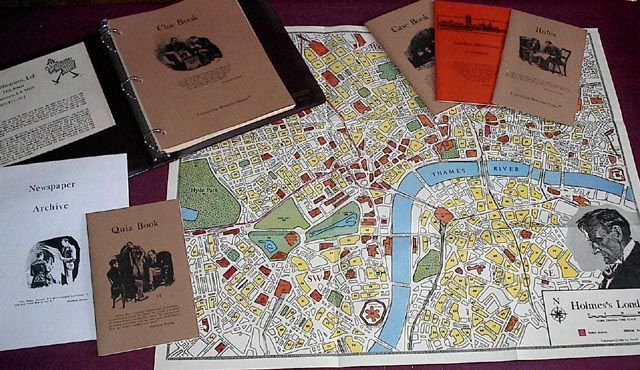
After poring over them, you get a book of disconnected paragraphs, rather like the Fighting Fantasy choose-your-own-adventure books of the early eighties and you go forth and try to solve the crime, typically a murder, in the shortest possible number of steps. Once you think you all think you have solved the crime, you finish reading and someone reads out the solution. Sherlock then explains how he solved the murder, typically in a quarter of your time and you marvel at his brilliance and your own stupidity.

What marks these games out is the attention to thematic detail. The writing, clues and graphic design are all very evocative. The language is very close to Conan Doyle's. It is as close a hybrid between gaming and literature as you will ever find. These are the perfect games to play with people who love literature, but are less keen on games themselves. The strength of the theme and the free-form mechanics make it feel like a role-playing game with the work taken out. You still have to think hard and take notes to solve the problems, but at least you do not spend your whole time looking up rules or role-playing.

The original game had two modes of play, either competitive, reading the paragraphs in silence and racing to the solution, or collaborative, reading the paragraphs together and discussing the solution. I much prefer collaboration, as it moves more quickly and it is an excellent way for people to get together. In later expansions, the competitive mode was dropped. Because of this, the game suits less competitive gamers but also might alienate the opposite. It is definitely the best team game I have played as a real story comes out of it. I would much rather play this with a few friends than organise a Murder Mystery dinner.

This is also the best solitaire game I have ever played. If you ever enjoyed Fighting Fantasy gamebooks, you will love this.

Replayability is a problem. After playing a case, it is finished for you. On the other hand, several of these games were published and I am nowhere near exhausting the gameplay in them:

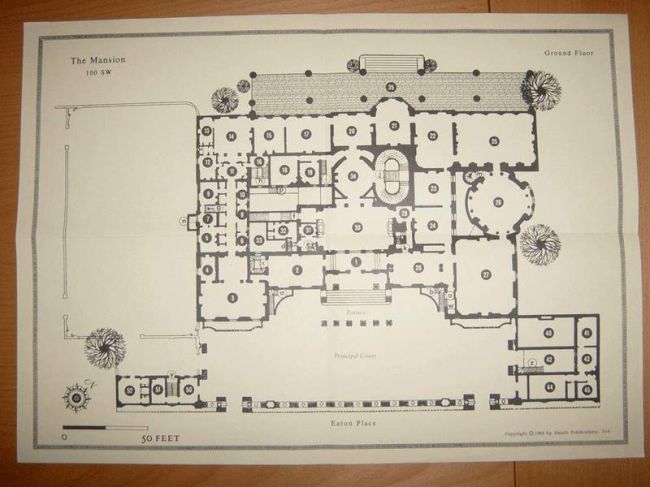
  • Queen's Park Affair - a stand-alone supplement. This is actually one huge case and my wife and brother ran out of stamina pretty quickly. I recommend you play this solo or only with a dedicated group. I really wanted to like this as I grew up about a mile off the map you see below, and you can almost see my workplace at the western end of the map. I will have to finish this solo sometime.
  • West End Adventures - a stand-along supplement. It includes a set of cases like the
    original game. I thought some of the details were less authentic, like a few stray Americanisms that jarred a little. Otherwise, it is just as good and it has my favourite box cover.
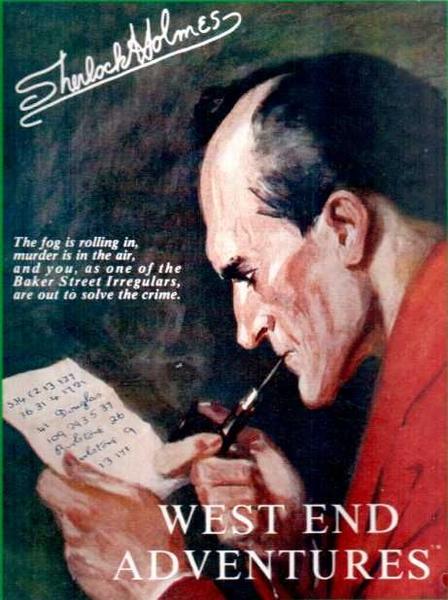
At least one of the 5 cases in this game requires that you've not only played the original, but that you remember details from some of its cases clearly. This was very disappointing to my group, as it not only made it impossible for us to solve that case, but it also spoiled a case from the original game before we got to it. I recommend that you only play this game if you've already played and finished Consulting Detective.
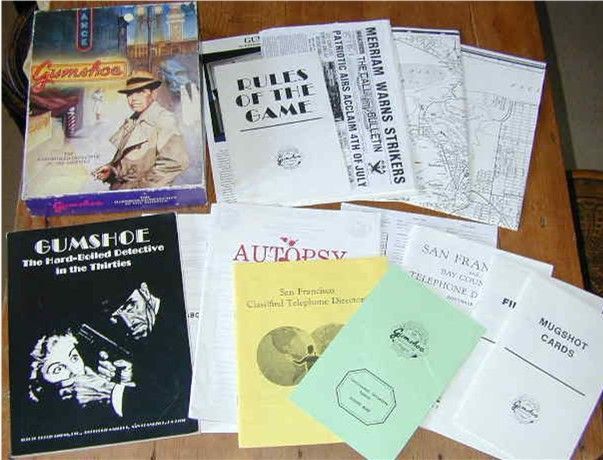
  • Gumshoe - The same system ported to the 1940's Los Angeles of Raymond Chandler. I have not played it, but the components are amazing, even more detailed than the previous games. There are mug shots, autopsy reports, fingerprints, a lavish map and the regular telephone directory etc.
Other companies made paragraph based boardgames, but these are the only ones I have.

I asked my wife for her comments. She said the number of false leads the players were given irritated her, but she says she will still play it with me. I agree there are false leads, but that is what makes the game challenging and makes it feel authentic. It is certainly the hardest game I have been able to persuade her to play with me more than once. She was put off by our Queen's Park Affair debacle. I hope I can persuade her to try a shorter case again, so she can remember what she enjoyed in it the first times.

She also pointed out that the amount of data you are presented with is overwhelming. That is realistic as you are trying to solve the mystery in as lifelike a way as possible, but these games do not hold your hand. This is intimidating for the first game or two, but becomes easier with experience as the cast of characters, map and telephone directories stay the same.

A couple of years ago, Chessex had them in stock, and the original is very available on eBay and at the BoardGameGeek marketplace. I highly recommend you pick up a copy if you want an original, challenging gaming experience.

As a final note, if you're really stuck about whodunnit, think of the most unlikely person it could be...

The images in this post were taken from the BoardGameGeek and are used under the terms of the Creative Commons Attribution-NoDerivs-NonCommercial 1.0 licence.

Thursday, December 15, 2005

Three Designers: Knizia, Kramer & Teuber

I like puzzles. No, not necessarily the sort that you'd fine in Games magazine, but instead puzzles where you slowly build up pieces of information, only to see a larger pattern suddenly emerge. Tactical games often satisfy this desire in me, be it Australia or Dungeon Twister, because you can imagine the chaos of possible turn, but then a sudden, perfect move abruptly emerges. I suspect Sleuth would satisfy this urge too, and I have no idea why I don't own a copy of that yet.

This like also influences my writing, and so I often have a desire to categorize, index, and sort, hoping to again find that ever-elusive pattern underlying the mundane. And that's what I'm going to do this week, in the first of what I expect will be many columns about game designers.

Here I'm going to give overviews of three of my favorites, and talk a little bit about what I feel holds their games together. The three designers I've choosen for this installment are, I think, the three biggest influences on the current Eurogaming scene: Reiner Knizia, Wolfgang Kramer, and Klaus Teuber--the Special K's, to quote another website.

#1: Reiner Knizia

Reiner Knizia is, in my mind, the father of the modern Eurogames movement. Sure, it was Teuber that broke the field wide open, but Knizia really seems to have envisioned the lightly themed, heavily mechanical style of play which is emulated by most modern German designers.


In general, I'd call Knizia the "elegant designer". He has a superb ability to create simple mechanics that allow for deep and meaningful strategy & tactics. In addition he seems to be a superb developer, producing games that are well-considered, without sharp edges, and largely picture perfect. Some Knizia games aren't to my liking, but it's rare that I see a Knizia game that has an actual flaw in it (though some do; no one's perfect).

The biggest problem with Knizia's designs is that he produces a wide variety of games, from ultra-ultra-light to medium-heavy, and they're for a wide variety of audiences. A lot of people seem to be expecting him to put out a certain type of design (usually, one of those medium-heavy games), and so they're disappointed by everything else. This year Knizia put out at least three games that I think will be enjoyed by gamers for years to come, two medium-light designs, Tower of Babel and Palazzo, and one medium design, Beowulf: The Legend, and they were mostly met with undeserved scorn and derision. Buck up, folks, not everything is going to be Tigris & Euphrates or Through the Desert.

I'd further classify Knizia's games by saying that they're almost all "auction games". By this I mean that you offer up scant resources in opposition to other players for the chance of winning some prize. You have what used to be his "auction trilogy", now including High Society, Medici, Modern Art, Ra, Traumfabrik, Amun-Re, Taj Mahal, The Merchants of Amsterdam, Palazzo, and Beowulf. You also have closely related trading games, such as Res Publica and Tower of Babel, differentiated mainly by the fact that the auctioneer isn't required to take the "best" bid. His bidding games, like Titan: The Arena and Goldrush are similar, except the items you have to "bid" are much more random. Even two of his very popular "tile-laying games", Samurai and Tigris & Euphrates, shade into the same categorization, since your have various values of certain currencies (a 3 buddha, 5 temples) which allow you win certain prizes (a city, a civilization). I'll grant that the last one is starting to stretch the definition, but the mathematical maximization is still there, and perhaps that's not a surprise given Knizia's mathematical background.

Perhaps the only top Knizia game that doesn't seem to fit into this style of play is Through the Desert, which places more importance on board position and majority control than just about anything else Knizia has done. (Well, actually, Carcassonne: The Castle and Tigris & Euphrates place a huge importance on board position, while Tower of Babel is a rare majority-control game for Knizia, but for someone with this many games, there's going to be exceptions to everything.)

My Reviews1: Through the Desert (A), Taj Mahal (A), Ra (A), Amun-Re (A), Tigris & Euphrates (A), Modern Art (A-), Carcassonne: The Castle (A-), Lost Cities (A-), Razzia (A-), Beowulf: The Legend (B+), Samurai (B+), Blue Moon (B+), Lord of the Rings (B+), Easy Come, Easy Go (B+), Titan: The Arena (B+), Tower of Babel (B), Palazzo (B), Quo Vadis? (B), High Society (B), Buy Low, Sell High (B), Relationship Tightrope (B-), Poison (C+), Tutankhamen (C+),Gold Digger (C+), Res Publica (C), Galaxy: The Dark Ages (C), Kingdoms (C), Spy (C),Loco! (D+)

Interviews: Funagain (1999), Gamefest, on Einfach Genial (2004), BGG podcast (2005)

#2: Wolfgang Kramer

If Reiner Knizia is the father of the Eurogames movement, Wolfgang Kramer is its grandfather. He's been publishing games since 1974 and some of his games are utterly foundational. Kramer usually designs his games with other people, Michael Kiesling being his most frequent, and I think most successful, goto guy, but I'm not going to try and differentiate. All of Kramer's collaborations are fair game here (and in other similar articles I plan to write).

At heart I'd call Kramer a "tough designer". Most of his games have a diamond heart. They require deep strategy or very thoughtful tactics in order to succeed. He's done some light and fluffy stuff, but they're either less-common or less-well-known than Knizia's, and Sunken City is the only game I can think of that really disappointed people solely because it was too light.
Kramer shows a lot of versatility & originality as a designer, and this makes some of his games, as already noted, foundational. El Grande kicked off a whole genre of majority-control games (though some are arguably the result of Sackson's Acquire instead). 6 Nimmt! no doubt influenced later simultaneous-play card games. Heimlich & Company could easily have been Clans' predecessor. Other top-level games that show Kramer's versatility but haven't necessarily had the same effect on the industry include El Caballero (tile-laying), Pueblo (spatial geometry), Goldland (exploration), Daytona 500 (racing), and of course Princes of Florence (auction).

However Kramer's biggest category of games are "tactical games". These are largely action-point-based systems which fit my core definition of a "puzzle game". They allow players many opportunities to try and figure out how to do clever things on a turn-by-turn basis with limited resources. Entrants include Tikal, Torres, Java, Mexica, Maharaja, and Australia. These are all inevitably collaborations with Kiesling.

For some reason I haven't actually reviewed many of Kramer's games, though he's one of my current favorites, as evidenced by his inclusion here.

My Reviews1: El Grande (A), Torres (A), Maharaja (B+), Java (B+), Mexica (B+), The Princes of Florence (B), Saga (B), Category 5 (B-), Sunken City (B-)

Interviews: Games International (1990), Game in the Box (2001), Gamewire (2004), Interviews by an Optimist (2005)

#3: Klaus Teuber

Finally we come to Klaus Teuber, Eurogaming's kindly uncle. His games are very approachable, but surprisingly are outside of the norm for German games. Where most German games are lightly themed, his aren't, and where many try and reduce randomness, Teuber happily uses dice. In many ways Teuber's games are closer to modern French designs than German ones (a topic I'll get back to next week). Nonetheless a lot of the success of Eurogames, both in Germany and in the United States, is due to the singular influence of The Settlers of Catan.

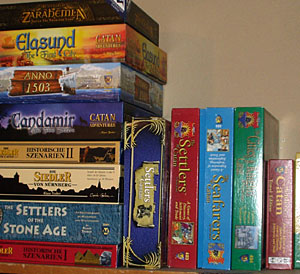
For that reason, Teuber is inevitably the "Catan designer". Catan makes up at least half of Teuber's output, and definitely most of his better known games. Besides the core game, and the Seafarers and Cities & Knights supplements we also have historical scenarios, licensed versions, and more recently full variants like The Settlers of the Stone Age and The Starfarers of Catan. Most recently Teuber has stepped away from whole-blown Catan system, but he continues to use the same basic idea: randomly produce resources, manage them, and build new stuff with them. Anno 1503, Candamir, and Elasund all fall into this later design period. A more general way to describe most of Teuber's output is "resource management games" but that's really just code for Catan.

A few of Teuber's older designs including Barbarossa and Hoity Toity have been reprinted recently. They're a bit old and creaky, and as far from the German norm as Catan, but still quite good games. Oddly enough his two other hit games were originally meant to be part of a mega-Catan game. The game that became Entdecker would have showed the settling of the island, The Settlers of Catan its development, and then Domaine the warfare that followed. Entdecker and Domaine, however, are totally distinct from Catan-like mechanics, and in fact are each quite stand-out games in their genres (exploration and warfare) and I personally think they outshine the more popular Settlers.

Reviews1: The Settlers of Nurnberg (A), Entdecker (A), Domaine (B+), Elasund: The First City (B+), Barbarossa (B+), The Settlers of Zarahemla (B+), The Kids of Catan (B+), The Settlers of Catan (B), The Settlers of Canaan (B), Anno 1503 (B), Hoity Toity (B), Starship Catan (B), The Seafarers of Catan (B-), Candamir: The First Settlers (B-), The Settlers of the Stone Age (B-), The Cities & Knights of Catan (B-), The Settlers of Catan Historical Scenarios I (B-), The Starfarers of Catan (C+), Oceania (C+), The Settlers of Catan Card Game (C+)

Interviews: Gamewire (2004), Catan Online (2005)


1. Review Links. A few caveats on these rating links: note that my letter grade incorporates both the components and the gameplay, though at an approximate 1:2 ratio. Also note that it's hard to keep this sort of rating accurate over years of reviews, so the resultant rankings may not be 100% accurate, though I've tried my best (and indeed have gone back and revised a few reviews once I saw everything together for this article). In addition, these listings don't try and be complete; they're a combination of my actual reviews, plus a few ratings I felt comfortable throwing out for stuff I've played but haven't reviewed (yet).

Wednesday, December 14, 2005

Learn History Through Games


This week we were pointed to a site with a discussion which was inspired by Matthew Baldwin’s list of the 100 best games. One comment caught my eye and made me think: “…it’s hard enough getting adults to play a board game anyway, much less one with the unappealing and sounds – boring – as – all – (expletive deleted) title of ‘Age of Steam.’ .”

I would think that a man would be curious, at least, about a game centered around the age of steam. There are many museums dedicated to steam-powered machines and they attract a lot of visitors interested in the mechanics of these wonderful machines. Why doesn’t the name of the game conjure images of massive steam locomotives, their tracks being laid by the muscle and sweat of men instead of sounding “boring”?

I suppose, to the uninitiated, the titles of some of our favorite games aren’t as appealing as Sorry, The Game of Life, Clue, Connect Four, etc., etc., but to me they suggest a visit to another place or time—of course, I’m tainted. Many of our games are inspired by actual people, places, times or events so that we occasionally get a bit of a history lesson just by opening the box.

Wallenstein is a game which centers on the Thirty Years War. It comes with an historical booklet and each character’s card has a short biography for those who are interested in the background of the theme. But of course, war games are an obvious history lesson. I love to read the historical background for each of the scenarios in Memoir ’44.

Most games don’t come with a packaged history but you may be curious enough to do some research. Google “Stephsons Rocket” and you’ll find many sites with information on this innovative steam engine design. Perhaps you wonder how closely the game of Puerto Rico reflects the history of the island. There are several sites which can sharpen your historical knowledge. A search for “Tikal” will show you some wonderful photos and maps of the archaeological site. And I’m guessing that most of us know that Carcassonne is a real place, a fortified city in southern France.

Hansa was designed around the Hanseatic League, a group of merchant associations in the cities of Northern Germany and the Baltic. At one time there was a very nice article on BGG explaining how well the game mechanics reflected the actual history of the time but, sadly, I couldn’t find it.

I think we’re lucky to be able not only to sharpen our brains but broaden our knowledge through the games that we play. It’s a shame that some people are put off by something simply because they are ignorant of the subject matter.
~~~~~~~

Last week I put in an order for Hacienda and Das Ende Des Triumvirats, both not in stock until (probably) after Christmas. That’s it! I’m not buying any more games this year!

That puts this year’s game acquisitions at 39. That’s ridiculous, isn’t it? So I’ve decided that I don’t want to hear or read about any great games that I don’t already own. No checking the new reviews on BGG, no reading of BoardGameNews, no checking the online retailers to see what’s new in stock and I refuse to listen to my internet friends discuss the pros and cons of games they like. Don’t tempt me, don’t inform me, don’t dangle that gaming-carrot in front of my face. (Side note from the daughter: “Yeah-that’ll happen!”)

While I’ll never be content to play the same 10 games over and over, I really do have enough games to satisfy even my love of variety. I have games easy enough to use when introducing someone new to gaming, I have light, fun games, I have many medium-weight games and a few heavier games. I should be set for whoever enters my door.

I’m sharing this early New Year’s resolution with all of you so you can join my daughter in saying, “Yeah, right” when you find out I’ve placed another order. Let’s see…I still haven’t broken down and bought Colovini’s Alexandros, I’d love to have the new version of Oltremare and that Hey! That’s My Fish might be a nice, quick play for Richard and me. Eep! I have to go call my psychiatrist now, Dr. Meepolous.
~~~~~~~

Until next time remember, sometimes you just have to bow to the absurd.

Mary

Tuesday, December 13, 2005

I can complain too: my top ten problems with the game world

The top ten endemic problems in the board gaming world, as I see it. You probably won't, but that's ok. That's because my two main priorities are the promulgation of
board gaming to the masses and the utility of board games and their components.

Rules

Length: Many of the best games in the world have short rules, but that is not the case with the majority of the new games. They have long complicated rules. Can the game be explained in a hundred words or less? No? Well it's not going to challenge Sorry and Monopoly for dominance in Toys R Us, Barnes and Noble, and Starbucks. Can't you make it into a basic game, with the more complicated rules included as an "advanced game"? I guess, like fine wine and art, some good games will never be for the masses.

Problems: Did you playtest this thoroughly, including all the possible rule exceptions? Did you consider what will happen if someone bids everything on his first turn, or discards his hand on every turn? Does the game flow without the theme, or does it have to be played only with "the right group of people"? Does it HAVE to include action cards where some of them are twice as good as others and you pay a lot for them and you only get to pick one?

Clarity: Spelling. Grammar. Proper use of pronouns and possessives. If the sentence sounds awkward when it is read out loud, it is too awkward to include in the rules. Try recording yourself actually teaching the game and then transcribe and edit it. Use clear examples of normal play and use pictures whenever possible. Are all the rules about a certain type of action in one place? Is it clear what changes are made for a variable number of players? Are there rules ambiguities?


Theme

I would be happy to never see another offensively themed game in the name of humor ("Slap prostitutes! Har har! What? If you don't like it, you don't have to play it.") Frankly, I would be happy to never see another game where you could root for the Nazis or any other forces from history, simulation or not. Or where you shoot cops, kill children, make fun of minorities, etc...


Boxes

Attraction: Although we would like to attract adults, face the fact that we are going to have to attract kids. Gear our marketing and graphics to interest them, and the grown ups may join in. Or, like Harry Potter books, can we have "two versions", aimed at children and adults? And how about licensing? A large number of games are bought because they have the licensing behind them. We can do the same without sacrificing game play for many games. Naturally, licensing is no substitute for an actual game in there.

Suitability: I want the market standard, please. And all components should fit back into the boxes in a neat way. And be made of recycled and recyclable materials.


Components

Standards: Easy to distinguish standard colors and patterns, non-offensive non-stereotypes, all necessary components to play (but see Modularity), and stable pieces that don't break or fall over. Fancy pieces are suitable for niche markets or
people looking for "high quality of life" items. You have to balance this against price.

Modularity: I would like pieces from one game to be usable in other games. I would like to be able to buy just the parts of the games that I need. I don't need any more 6 suited decks, pawns, checkers, or dice.


Publicity

Ninety-nine out of a hundred people I ask still don't know what Settlers of Catan is. What are we doing, here? Where's the PR? How come Daryll Hannah and Jamie Lee Curtis are still playing Candy Land?

We need big displays in Toys R Us, in malls, clever television ads, TV shows with characters playing the games, and so on.


Distribution

We need to BE in Toys R Us, malls, and so on, or noone will be able to buy the games even if they've heard of them.


Price

Price is still keeping consumers away from the best games. Can't we make two versions: the nice component version and the mass-produced version? We can combine this idea with the kids/adults versions.

Also, with better distribution channels, those of us not in America or Germany can buy these games, too.


Support

I would like game companies to be responsive and error on the side of service. How much will you lose by giving away just a tad too much to a handful of people while making all of the rest of your customers sing your praises?


Accessibility

Whenever possible, games should be suitable for all ages and produced in a such a way that low-sight and color-blind players can participate.


That's not so difficult, is it? Just compare this to my top ten problems facing the real world; doesn't this list make the game problem list look easier?

1. Universal access to clean water, food, fuel, medicine, and shelter.
2. Cessation to the destruction, and restoration, of our air, water, and land.
3. Universal access to personal security: to be free from bodily harm
due to acts of violence, disease, or natural disasters.
4. Universal access to personal liberty: to be free from kidnapping, slavery, or unreasonable government control.
5. Freedom from racism, sexism, caste systems, and other organized or personal forms of unjustified restrictions and intolerance.
6. A cessation of terrorism and war as means of solving disputes and political gain.
7. The separation of all non-civil based authorities (e.g. religion) and governmental laws.
8. An active promotion of consideration, ethics, and manners.
9. An end to unreasonable patents, copyrights, and trademarks, and a liberal policy promoting sharing and fair use.
10. A better system of material exchange other than unrestricted capitalism, which causes noise pollution, work pollution (seeping into our non-work lives), excessive garbage, radio and EMF pollution, food pollution, and identity pollution (the eradication of the individual).

Yehuda

Sunday, December 11, 2005

Shades of 'Grey' matters to come!

We're in the process here at the 'blog' of obtaining a replacement, for someone that is moving on, and we ALL wish `em the BEST in this as well. That's the nice 'element' about this, in that WE can adapt to the situation as it evolves, while we do appreciate everyone's efforts for what they've managed to accomplish for while they were around. For whomever is 'selected' then we offer our comraderie in their endeavours here, or elsewhere, as the case may become furthered. I won't divulge just WHOM we're approaching upon this 'concern'-just yet. Some of the others here haven't had the chance to reflect upon the 'contenders' being touted, so there's that consideration to take into accounts about the matter. It is hoped that sometime later on in the week's 'blog' contents, then a decision will be announced, and the newcomers can be 'Welcomed' in a befittingly appropriate manner. Then perhaps, we won't have this ''Sat-ur-day 'blog' gap'' is alright for NON-writing'', that has been occurring too often. I understand that this may have been due to other's committments as well, so that could very well have been a factor for this too.

For those of YOU who may be keeping up with some 'things' of mine, then I have some additional '411' to impart. I just discovered an unusual 'source' of potential ''gaming'' materials that someone could actually take to the NEXT 'level' for them! This is a 'series' of small figurines that I've been obtaining at my local $Dollar Tree Store, and of which I've seen at least '5' complete SETS of these 'guys'. These go by the 'name' of ''Micro Icons'' and they comprise the following' types': a "Kung Fu" SET: a ''Commandos'' SET; a ''Bikers'' SET; a ''Punk Rock`rs'' SET; & a ''Mexican Wrestlers'' SET! Each of them has around '3' packs of figures with '4' in those, while an additional '2' more 'packs' have a *Special* setting for their particular 'group' for a total of '5' per 'Group'. These also have a small magnet imbedded within their foot for 'display' purposes, while an enterprising 'person(s)' could be devising some game methods in which to apply them for. You can even 'mix & match' them for whatever you'd have in mind upon this, so keep an eye open for those IF you're so inclined. These are already ''pre-painted'' and have a dozen or more appearances and stances for them ALL . So that'll make a LOT of 'lazy & no-talent'-(I KEEEED!) folks happiest and of course there'll be others who just HAVE to make theirs more 'distinctive' as well, to 'show off' their talents in this regard. Just apply yourselves to where you're most able to then, while others shall too.

For the ''grognards'' amongst YOU, then fairly soon there is to be the ''Forward Observer'' 'group of GEEKs' to keep you informed upon materials of import for yourselves. This is going to be 'musings upon' from us all in that, to foster our 'interests' for those who happen to LIKE these as well. It may NOT have them ALL taking part in any particular 'subject' or 'topic' that could crop up, since not everyone is completely 'up to date' in many matters, of which I fully admit to that myself. That is WHY we'll leave those to them that can bring about a well derived synopsis for whatever is currently the ''soup du jeur'' in WARgaming circles. I know that I may be letting the 'cat outta the bag' in some respects here, while I just want to keep up hopes for anyone who would gladly be accepting of our collective 'knowledges' for this. I heartily expect to be able to further create additional 'expansions' for many of my OWN games within this, as well with assisting others who have the same aspirations for THEIR 'designs' in mind. It'll be something to look 'forward' to 'observing' as this transpires during its course of events, and you might even recognize MANY a fellow 'Geek' inspired by one another to greater heights in their 'projects' as those are completed, and brought forth for others to gaze upon with eager anticipation & expectations. Now, I've already commenced on initiating this 'process' by introducing a BASIC set of 'Rules' for gaming applications at the BGG site. To which I intend to 'expand' upon them with FULLY complete 'Scenarios' of which then any can commence to PLAY using those, as long as they possess the 'bits' or can readily obtain those. For a basis on which to begin this with, while ''Exclusive Rules'' pertaining to the situation for EACH individual 'topic' will then be more easily understood with as these unfold. I am even looking upon many games of what I already currently have, of which I can then 'apply' THIS upon, and for those who would like to as well. Hey! who 'says' that these can NOT be 'done' in this manner? Just YOU, I guess! So, go ahead or stay behind, just get outta the 'way' of the enjoyment of any others that WILL partake of these 'notions' for one & ALL!

Friday, December 09, 2005

In Search of Lost Time, Part 1

I often wonder to myself what it was that led me down the road to gamerism. Is it a genetic predisposition? Social conditioning? A pathological anomaly? Sometimes I worry that the hobby is a prolonged state of morbid nostalgia, or the mollycoddling of a Freudian desire to return to an oceanic moment, and maybe it's so: one of my earliest memories of playing a board game is at heart a memory of family harmony; it was a dark Christmas night in the mid- to late seventies, the lights were low, a fire crackled in the fireplace, and my parents, brother and I sat together at a card table in the middle of the living room; something about the moment in time had me under a spell, and the orthogonal boundaries of the game table seemed to encompass all that was significant in the known world, like a flat earth drifting in space. The game of the night was Dungeon Dice, and my two main recollections of the experience are that I was disappointed at losing and that there was an argument over who had to be the old man with the spoon. Nonetheless, this memory remains while others fade, and the fire is still warm in that room somewhere in the back of my mind. Why is that, I wonder?

Strangely, though, I don't remember board games as being a particular favorite among our various childhood toys; certainly they weren't in the same league as Smash-Up Derby cars, Legos or Star Wars figures. Of course, it didn't help that many of the games were flat-out terrible. Among our collection were the dreary, TV-spawned Emergency! and The Starsky and Hutch Detective Game, the cool-looking but insanely frustrating Haunted Mansion Game which our parents refused to play a second time, and the paranormally pedestrian Bermuda Triangle Game with its magnetized doom cloud that picked up your game pieces at random and gave them back when it damn well felt like it. The bottom of the barrel was an ugly, boring, sadistic game about identifying and collecting license plates; the idea of memorizing the color schemes of the license plates of the fifty states seemed as idiotic a pastime back then as it does to me today, and I feel a certain sense of satisfaction in knowing that this vile bit of nonsense is absent from the Boardgamegeek DB.

Not all the games were bad, though. Careers was certainly tolerable, even if I never won. The goofy humor of the wacky (if overlong) Mad Magazine Game was right up my alley for sure. We also enjoyed a few plays of 10-Four, Good Buddy, a game produced to cash in on the CB radio craze, of which my father was an enthusiastic participant (though not a trucker). We kids could also relate to the theme because we had seen the movie Convoy. However, our favorite board game of the time was, no doubt, The Sinking of the Titanic, a game in which the ship part of the board pivoted on a wheel so that it could actually submerge itself beneath the waves. It's true that the aimless second half really does convey the feeling of being adrift at sea, but this was made up for by the exciting first half in which players raced against the rising water levels to hit the lifeboats or collect useful castaway-type items like water and rations and magazines. For some crazy reason, getting this game was a real event for us; perhaps it was the first deluxe board game that my brother or I ever received as a present, and so there was a certain mystique about it.

However, what truly pointed me down the path of The Gamer Way was a good old deck of playing cards. Aces and spades were definitely in our blood; my parents' bridge groups (ladies' and couples') have plodded along without blinking for nearly my entire lifetime. I have no explanation for their unswerving devotion for the game, as they would never call themselves gamers, but my childhood memories of the rooms full of serious, contemplative, silent faces color the endeavor as being some kind of religious ritual: solemn, unquestioning, inescapable. However, at one point my mother did turn heretic and try to organize a mah-jongg club, though this faltered, perhaps because she was more enamored of the little bakelite blocks than she was of the game itself.

As a family we played Rummy 500, and lots of it, and there was always an argument between my mother and father over the rules of the game; my father insisted that in order to take a card off the draw pile, the player had to be able to immediately meld that card using cards in the player's hand—in other words, if there were three sevens in the draw pile, you could not simply pick them all up and put them down in front of you. My mother was of the opposite opinion, and Dad typically characterized her version of the rules as being a degeneration typical of her morally questionable hometown of Brooklyn (my Dad having grown up over the border in Queens). Now, as an adult with his own copy of Hoyle's, I finally can pronounce my mother correct in this ancient family feud. Sorry Pop.

We played the game many, many times, much more than it perhaps deserved, and I think it is this reiteration of the game, the transformation of a simple set of rules into a code through which reality is refined into patterns of logic and luck, that unlocked that weird little door of rampant gamerism. When a game is played often enough that it ceases to be a hiatus from reality and becomes instead another form of reality, and that, I think, is the essence of gaming. The game is no longer a postcard, but becomes a place in the world that you can visit.

Next week: Nerdiness in the 1980s

On Spiel des Geek

The Boardgamegeek administrators are kicking around the idea of presenting boardgame awards. I've read the comments. I've given it some thought. Here are my two cents, which are soon to be the most widely ignored two cents ever offered.

----------------

Quick Run Down of Some of the Major Boardgame Awards.

The Spiel des Jahres names the best game to be released in the previous year. It is an industry award with the goal of promoting and selling games.

The International Gamers Awards names the best game to be released in the previous year. The goal is to name the best game from a gamer's perspective.

The Deutscher Spiel Preis names the best game to be released in German speaking countries in the previous year. The goal is to name the best game from that year from a gamer's perspective. The DSP is sponsored by a game magazine.

Games Magazine names the best game released (usually) in the previous year. It purports to serve as a buyer's guide for current games.

Mensa... ah... who cares.

What all these major boardgame awards have in common is that they limit themselves to games from the previous year, other than Games Magazine which mostly names games from the previous year. (Games has the added burden of naming 100 games to their list, so there is often a need to overlap from various years in order to meet that goal.)

The boardgame world does not need another award for games released in the previous year. There are already numerous such awards.

What the boardgame world needs is a game award that reflects the enjoyment gamers got from a game over the previous year. That would be a meaningful award, especially when polling a population that isn't watered down with a lot of people who are only familiar with games available at the "box stores". Such an award would be more meaningful than an award to the best game to be released in a particular time frame.

Here's how it would work. Every game in the BGG database could be voted on. No limits based upon pre-selected nominees. No limits based upon the release date. The only criteria being the game you enjoyed most, or thought was the best game you encountered that year.

Who cares if Puerto Rico wins the Spiel des Geek (SdG) 3 years in a row? It is a very good game, and has staying power. The BGG award would simply recognize that the majority of voters (who would comprise the largest group of voting boardgamers in the world, BTW) think that Puerto Rico is the best game available for 3 years running. (I am not claiming Puerto Rico would win, nor that there has been nothing better for the last 3 years, I'm simply using it as an example of a game that could be the most-loved game for several years running.)

By opening up the voting to every game in the Boardgamegeek database, small print-run games that get all the buzz in Essen will be effectively out of the running for a SdG. So what? They tend to win or be nominated for other awards already. Only a few elite and otherwise lucky gamers will ever get a chance to play small print-run games unless a large company picks up the title for a subsequent release.

BGG does not need to focus on games released in a certain time period any more than a pollster needs to have an agenda when taking a poll. The very nature of BGG would ensure a fairly recent game would come out on top, except in the most extraordinary of circumstances. If some small "indie" game that was the toast of Essen fails to win, so what? It simply means that it garnered lots of press, but was impractical for most gamers to play.

Voting for the Boardgamegeek award should simply be based on the following criteria: What boardgame gave you the most enjoyment in the last year? Or something close to that. That criteria coupled with a broad audience would eliminate the "elite" nature of awards such as the IGA, eliminate the "lowest-common-denominator factor" of the SdJ and bring an accessible, yet enjoyable, game to the forefront.

The hype associated with newly released games would be mitigated, unlike other game awards. Game hype is usually generated by a small number of gamers who have either not played the game or only played a couple times. It is not unusual for hyped games to win awards and then fade into obscurity due to the elite nature and artificial time constraints of most game awards. By specifying that your SdG vote be for a game you have played, the hype would be drowned out by the general gaming public. If the hype pans out, the game might win the award in the next year once the game is widely released and gamers have had a chance to play a few times.

If the powers that be deem that there is a need for a nominating process, that process should be as I just described, with a subsequent round of voting. I.e. Let all BGGers vote on any game they choose, take the top 10 as the nominees, and have a second round of voting limited to the nominees.

Just let me make one more comparison and you can sleep on my idea before totally discarding it. Consider music awards. Every year there are numerous music awards presented, all of them recognize music and musicians that were prominent in the previous year. How often are music awards handed out to mediocre talents? Quite a few, to say the least. You can win a music award simply by being controversial and getting some press. The key to winning most major music awards is to stay in the public eye for the 6 months prior to the award ceremony.

How many mediocre talents get into a music hall-of-fame? A few, no doubt. But by and large, when voters aren't limited to the previous 12 months and have a chance to look back on the impact a musician had on the industry the cream will tend to rise.

The Spiel des Geek would not be a hall-of-fame type award. There would be no requirement that a game be released at least 10 year previous before it could be voted on, but without the constraints of an artificial time limit, superior games would tend to receive the award.

And just to nip it in the bud, the Games Magazine Hall-of-Fame is not a hall-of-fame. It is simply a list of games that have been in print for a long time.

Good Gaming,
Brian "Coldfoot" Waters

Note: I will be out of town for the next few weeks. Look for guest bloggers to be covering for me on "Gone Gaming" until January. Until I get back, I wish you and yours a Merry Christmas, Happy Hanukkah and Happy New Year

Thursday, December 08, 2005

Shannon's List of Do's and Don't's for Game Component Design

I've long been convinced that the reason for The Settlers of Catan's huge success wasn't its simple, yet strategic, gameplay, nor the fact that a lighter, more random game is more likely to appeal to families. Instead, I think it was largely due to its superb usability. Settlers' clean, intuitive & well-done player aid is the heart of the game's ease of use, and thus I think the heart not only of its success, but also the overall success of the Euro-games movement.

Thus whenever I've reviewed a game, I've looked very carefully at the design of the components, and in particular at their usability. Below I've listed about 50 of these lessons learned. They're not necessarily the 50 most important; I'm sure I missed the third biggest thing that any component designer should know. Instead they're just the first 50 or so items that came to my mind first and/or the ones recently mentioned by other gamers, by my wife, or by myself in my last 9 months or so of reviews.

Feel free to add on your own in the comments section, and maybe next year I'll update this article with a new and improved version!

Box Design

Do use cardboard for your boxes, not cardstock, unless you're making a relatively small card game.

Do consider the very shallow boxes now being used for games like Hansa and China. You get plenty of space for a board, and then a more appropriate amount of space for everything else.

Don't use a vastly oversized box and especially don't try and disguise the vast oversizedness by putting in a plastic tray that takes up 90% of the box.

Don't put out every one of your games with a different sized box and different branding.

Also see The Problem with Game Boxes and The Collector Bug for more of this rant.

Cover Artwork

Do have beautiful & evocative artwork that gives a feel for the theming you're trying to convey.

Don't print artwork that might be offensive to any large constinuency that you want to sell too. Cover nudity doesn't go over well in American, nor do slaves in chains, and especially not a combination of both; swastikas go over particularly poorly in Germany where the postwar criminal code actually makes it illegal to publicly show them, except for scholarly purposes.

Tray Design

Do include finger holes for any set of tiles, hexes, or cards that you provide a slot for, so that players don't have to dump your box to get the pieces out.

Do figure out what happens to the pieces in your tray if your box gets set on its side, particularly if your game is bookshelf sized.

Don't inset tray dividers notably below the level where the map or rulebook will set, else you're just asking for pieces to go all over.

Game Boards

Do fill the unused parts of your board with rules that players might not easily remember, like anything you'd put on a player aid sheet (see below), especially including victory point tables, action point tables, and combat tables.

Do try and minimize the number of folds in your board. Four panels is expected, two is really nice, and six is excessive unless you're producing a really big board.

Do use your board to pump up your theming. Named spaces and unnamed spaces have no functional difference, but the former can make a huge difference in how people vizualise & enjoy your game.

Don't go so artsy with your board that it becomes hard to use.

Don't make grossly large boards that are mostly or largely unnecessary. Most players will prefer a smaller board (and thus a smaller game) over a large one and will prefer no board at all, to allow for a card-sized game, if that board really wasn't needed.

Scoring Tracks

Do include a scoring track for your game, even if players just need to add up a couple of different things at the end.

Do try your best to make sure your scoring track will accomodate the highest score you expect players to earn in 90-95% of games.

Don't create a scoring track that players will have to wrap around 3 or 4 times.

Don't have your scoring track wrap at anything but a power of 10.

Don't even think about creating a scoring track where players mark their 10s digit with one marker and their 1s digit with another. It's unclear, easy to mess up, and doesn't do a good job of intuitively showing the rankings in a game.

Wooden Bits

Do make sure that your wooden bits are the right size for the spaces they go into. Don't make them too big, even by a little bit!

Do try and use the most appropriately themed wooden bits you can, especially if your game has multiple wooden bits that get put in the same places. The more inappropriate wooden bits your game has, the most opportunity there is to mix them up.

Don't use those darned wooden cylinders which hit the table, roll, then bounce straight onto the floor, where they're eaten by the family dog.

Plastic Bits

Do make sure that your plastic bits are the right size for the spaces they go into. Don't make them too big, even by a little bit!

Do cut your plastic pieces off the sprues before they get to your customers. No one likes to spend 2-4 hours doing so on their own.

Don't make plastic molds which such ridiculously small bases that the resultant pieces just fall over.

Cards

Do consider the readability of your cards not just in the hand, but also from across a table if your cards will ever permanently be played to the table or drafted from the table. Icons can help a lot here.

Do make sure that your most vital card information is visible when your cards are fanned. This means that you shouldn't put the info that players will use to select the card in the middle of the card or most of the way down an edge.

Do duplicate that vital information on two or four corners.

Do carefully consider the layout of your cards if they have any complexity. Similar layouts for different types of cards can highlight similar or identical information by putting them in the same places. Different layouts for different types of cards without any similarity of information can make that differentiation that much clearer.

Do think about ways that your cards can be stacked on the table to preserve information yet save space if there are going to be a lot of cards on the table.

Do be very careful about your card backs. Don't use the same card back for different types of cards unless there's a good reason for doing so (usually so that players can hide which types of cards they have in their hand) and really don't change your card back in a supplement or expansion, even to a slightly different hue.

Don't use a thinner than normal cardstock, and especially don't use a partially see-through cardstock.

Don't think that icons do the whole job. Text and icons are good as backups of each other. Unless your icon designer is a genius anything else will impact the usability of your game, and that's not worth the internationalization benefit.

Don't, for Knizia's sake, even think of printing a card with no explanation of what it does, assuming that players will memorize the list of card abilities from the rulebook.

Tiles

Do invest in good die-cutting, especially if you're producing a tile-based game where it's important that tiles sits flush up against each other.

Player Aids

Do include player aids in your game, particularly if different units have different powers, if players have action points they can spend on different things, or generally if you have more than one of two things that players have to remember. Look at The Settlers of Catan for the best way to do this sort of thing or Memoir '44 as a good example of player aids for different terrains or Java, Tikal, Mexica, or Torres as good examples of how to summarize action point usage. You can also be clever and sometimes include this stuff on the map, as noted above.

Do figure out how to quickly summarize your player aid information using icons and pictures.

Don't produce player aids that solely have huge blocks of text summarizing what to do, because they generally won't get read.

Color Usage

Do seriously consider using the most common four colors--red, green, yellow, and blue--as four of your core colors for a game, because players will have an easier time remembering what color they are if they often play the same color.

Do include some permanent reminder of what color each player is, be it a player aid, a special token, or just the expectation that each player will always have some pieces of his color in front of him.

Don't use multiple colors in the red-pink-orange spectrum.

Don't use multiple colors in the blue-purple spectrum.

Don't use the same colors as a player color and for some other purpose (e.g., a goods color, a track color, etc.) in your game, or you'll confuse players.

Also see The Problem with Colors.

Rulebooks

Do include pictures and examples, as both make rules easier to understand.

Do include summaries and do pull out important rules into sidebars.

Do consider an index, if it might be at all appropriate.

Do include a glossary for any cards, tiles, or other items in your game which might have special powers. This is a great place to address any weird questions about those individual items and about interactions between them.

Do look at how Alea does their rulebooks and mimic that, as they make the best in the business.

Don't include new rules in examples.

Don't have a bolded, named section, then include some of the rules related to that name elsewhere--unless you have a reference in the text.

Wednesday, December 07, 2005

Today's Theme is Theme


The theme of a game is the basic concept which unites the mechanics and pieces of the game into a single representative whole. Many games do not require a theme to provide a logical reason for the moves such as Go, Checkers, Chess, Blokus and the GIPF series of games. Their rules are simple and their objective is clear but their options for play are so varied that it can take years to master (such as Go).

Why, then, do so many people demand that a game have a deep theme that immerses them in another place or time? There are many strategy/Euro-games that have simple rules with well-defined objectives which are basically abstract games but have had a theme added which adds flavor and fun to the game.

I have often heard that Through the Desert is “dry” and the theme is “pasted on”. Would the game then be better as a purely abstract game with no basis in reality? Could we place a wooden marker on most of the starred spaces on the board and declare that you win points for placing one of your pieces adjacent to it, then place randomly chosen chits of varying values on spots on the board stating that you can pick these up when you place one of your pieces on it? I don’t think it would be as popular as the oasis trees and the watering hole chits but the game play would be the same. If the theme is pasted on, it was done with a creative and colorful brush.

Let’s look at Torres, another game which has a pasted on theme. There are no beautifully crafted miniatures representing the King and Knights so the game takes on the appearance of being totally abstract. Do we need a logical reason why a group of blocks are to be built no higher than they are wide any more than we need to know why the Bishop in Chess can only move diagonally? No, but it does add something to the game play so why ignore a brilliant game simply because you cannot immerse yourself in the trials of your Knights?

Some games do require a theme, however thin, which will not just add to the atmosphere of the game but help to make sense of the rules themselves. Games like Reef Encounter, Vinci and Capitol need the theme to hold the rules together but does that theme immerse you in the time and place? I doubt it but I also doubt that the game would sell without it.

I hate to hear “it’s a good game but the theme is pasted on” as if that’s a bad thing and detracts from the game play itself. For myself, I don’t care if I’m playing the part of a King, a merchant, a pirate or a disgruntled postal worker; it’s how the game plays that counts. The next time you think that a game’s theme isn’t rich enough or doesn’t make you want to speak with a funny accent, think what it would be like with no theme at all.
~~~~~~~
Games

A couple weeks ago I saw someone on BGG asking if there are any gamers in the Rapid City area so I contacted Jeremy Likens and planned a game night with him and Mike on a day when both Richard and Cori would be home, Dec. 4th. Late in the morning of that day I received a phone call from Mike who told me he and Teresa wouldn’t be able to come because he’d just become a father that morning. How’s that for a good reason to miss a game night? Congratulations to Mike and Teresa, and welcome to the gaming world, Brin.

Jeremy had requested several games that he’d like to try so the four of us sat down to Stephenson’s Rocket. I’d only played it a couple of times and that was a while ago so we were on pretty even footing as to strategy. Jeremy started with the Blue line and collecting city tokens, Cori quickly moved the Green to merge with Orange, Richard concentrated on Purple’s southward movement taking over any lines in the way, and I took the Yellow in the southeast and the Grey in the north. Being the first game for Jeremy and Cori, we really didn’t concentrate on the veto very much, which I’m sure is not a good idea in a cutthroat game, so we all pretty much did as we wanted most of the time, feeling out how all the pieces of the puzzle fit together. As the game progressed, Purple ate up everything in it’s path and earning Richard and I money for 1st and 2nd place stations, respectively. Blue also did well, meandering to cities so Jeremy could earn money for his goods tokens, and picking off the Yellow and Grey lines in the process. When the final merger saw Blue gobble up Purple, the majority of the shares fell to me. Jeremy’s majority in most of the goods was not enough to give him the win and my majority of shares fell short of what I needed to beat Richard who had made considerable money from his stations during the game.

As we were finishing up SR, Cori’s friend, Melissa, showed up so when the game was over, we sent Richard for pizza while the 4 of us played Through the Desert, another game Jeremy had wanted to try. The only Euro-game Melissa has played is Settlers but TtD is an easy game to teach and play so there were very few questions or misunderstandings. Everyone played well and there was plenty of nastiness, which I don’t often see with the new players I’ve taught. The game end was close but I just can’t remember if Cori won or I did.

We were just setting up Taj Mahal when my son, Chris, arrived after a fun day of snow-boarding and with a bump on his head. Ah, the joys of winter sports. So we dealt in another hand and I proceeded with the rules explanation, which I thought I did pretty well. Keep in mind that the only game of TM I’ve played is an online one where the interface makes sure the rules are followed so you take it for granted. We spent a lot of time going over nuances of the rules and re-explaining how the different items work but in the end we all agreed that this was a game we’d like to play again. The scores were very close, especially since 4 of the players had never played before. I squeaked in the win with 35, Jeremy close on my heels with 33, Cori right behind him with 31, followed closely by Melissa with 29 and Chris with 27.
~~~~~~~
Until next time remember: only the mediocre are always at their best.

Mary

Tuesday, December 06, 2005

Don't sue me, Richard

The scene: 1992, Wizards of the RPG boardroom. Three Wizards sit around a table.

Wizard 1: What are we going to do? This company is losing money. Our RPG line is sinking. We're being threatened with a lawsuit. We need something new, cheap, and easy to sell!

Wizard 2: Yes, sir.

Wizard 1: What do you mean, "Yes, sir"? I need ideas, not "yes, sirs"s from a horde of Zork shopkeepers!

Wizard 2: Yes, sir.

Wizard 1: Oh, shut up! Go gain a stat. Well, what about you? Got any ideas?

Wizard 3: Ummm, not really, sir. Oh, wait. There's this guy Richard waiting to see you, sir. Something about a monkey game.

Wizard 1: A monkey game? I said cheap! Oh well, send him in. What have we got to lose?

Enter Richard.

Richard: Good morning, Mr Wizard 2.

Wizard 2: Yes, sir.

Richard: Good morning, Mr Wizard 3.

Wizard 3: Good m...

Wizard 1: Yeah, yeah! Cut the crap. What have you got for us?

Richard: Oh, sir, this is a different sort of game. Each player controls a live monkey that has to navigate a maze. Players tell their monkey how to navigate the maze at the beginning of each round, and then they let their monkeys go simultaneously. Only, the thing is, they have to tell the monkeys what to do before each round. They can't talk to the monkeys while they're in the maze. As the monkeys move, they crash into each other, get turned around, slip on banana peels, and so on. Hah ha ha! And they all throw bananas at each other! If a monkey gets hit by a banana, he gets confused. It's great! Har har ho ...!

Richard dissolves into laughter.

Wizard 1: That's your game?

Richard: Wait, there's more! The monkeys are all different. One is stronger. One punches harder. One can throw things further. And so on. And you pick the monkey at random before the game starts! Hee hee! Ho ho! Hahahaaaa...

Wizard 1: This guy's one cleric short of a party. Different starting abilities? Forget it. Sounds like Cosmic Encounter. Crap game. Throwing bananas? Live monkeys? Cripes! What about a normal board game with toy robots?

Richard looks up, stunned.

Richard: Hey! Great idea!

Wizard 1: Wizard 3, go work with him on it. But this isn't helping! I need something I can put out now! Haven't you got anything else?

Wizard 3: Yes, sir.

Richard: OK, I've got this collectible .... ah Richard begins to sneeze. ... collectible ... aaahh ... collectible car .. CHOO! .. game. Excuse me.

Wizard 1: Car game? Did you say collectible car game? Hey, great idea!

Richard: No wait! I meant collecti ...

Wizard 1: Yeah, ok! Got it, go get me some paper! Wizard 2!

Wizard 2: Yes, sir.

Richard: But, Mr Wizard 1! I ...

Wizard 1: What, are you still here? Did you forget to put on trunks on your way to the gene pool? Go get me some paper! Hut hut! Unless you don't want a published game with licensing fees!

Richard gulps.

Richard: Uh, yes, sir. Ok!

Exit Richard.

Wizard 1: OK, here's how I see it. Each player has to collect cars, and each car is different. Some are rare, and some are common. Players can't play with more than 4 of any type of car during each game, and they have to use .. Wizard 2!

Wizard 2: Yes, sir.

Wizard 1: How much money do we need to make this year? $1,000,000?

Wizard 2: Yes, sir.

Wizard 1: OK, no less than 60 cars in their car bag. Each time it is their turn to play, they pick a car at random out of their bag. Then they either roll it across the floor at their opponent, or place it in such a way as to block their opponent from rolling it at them. If you hit your opponent's car, it's out of the game. Otherwise, if you hit your opponent, you win if you break their nose ... no, wait, if you hit them three times.

Wizard 2: Yes, sir.

Wizard 1: Oh, shut up! It's a wonder you ever found the fallopian tubes. Wizard 3?

Wizard 3: Sounds good, sir. What about special types of cars?

Wizard 1: Special cars? What special cars? This isn't Cosmic Encounter! Crap game!

Wizard 3: Yes, sir. I mean, cars you can play when it's not your turn. Different color cars that are better than others in certain ways, like green cars, blue cars, and so on.

Wizard 1: Excellent! Great thinking Wizard 3. Go double your salary. Where's that paper guy?!

Richard retuns.

Richard: Here you go, sir. Sir, if I may add ...

Wizard 1: Thank you, man. Just what I needed. Go double your salary.

Richard: Sir, how about a collectible card game, not CAR game, but CARD game?

Wizard 1: What? Cards? Who in their right mind would pay money to buy collectible pieces of cardboard?

Richard: Well, sir, they buy baseball cards ...

Wizard 1: Oh yes. Well, we'll give each car a coaster to sit on. Comes with the car. Very good. Go double your salary.

Richard: I meant the card is the main feature.

Wizard 1: Fine, fine. Buy a coaster, get a car. I don't care. Richard grimaces. I've got it all worked out. Gentleman, we're going to be rich. Well, all except for you, Wizard 2.

Wizard 2: Yes, sir.

Wizard 1: What should we call this game? Anyone? Wizard 2? Or are you still leaving the Intillect Devourers hungry?

Wizard 2: Yes, sir.

Wizard 3: Hmmm... perhaps, something pretentious, with an appeal to the rich kids, you know. How about: "Cars and Coasters"?

Wizard 1: Sounds like another damn RPG. How about: "Car Wars"?

Wizard 3: Already used, sir.

Richard: (sarcastically) How about "Traffic: the Splattering"?

Wizard 1: Yes. Just about right, anyway. We'll work on it. Double your salary. Anything else, wizards?

Wizard 3: I think we'll need a new name under which to publish this game, to protect it from the impending lawsuit, sir.

Wizard 1: Yes. Good idea. Any suggestions?

Richard: (sarcastically) How about "Wizards of the Coaster"?

Wizard 1: Done! Double your salary, man.

Richard: I don't have a salary, sir.

Wizard 1: Then triple it. Ah ha ha! Collectible cars! This thing is going to be huge!

And the rest, as they say, is history.

Monday, December 05, 2005

For the time being

I'm going to fill in here for ole "D W" for now and make
"YOUR HEAD A SPLODE!" ready? then WE go!

Sunday, December 04, 2005

WHY I should ''give any 'chits'!''

Yep, I'm proclaiming the 'title' for my ''saying mark'' while in a more elaborate and expansive 'setting', since I really DO! The FULL 'one' for 'moi' would be as follows:
''YES! HE really does 'give a 'chit'!''
I'm only making this 'distinction' so YOU all can 'know' where and whom that's 'O'riginally from! It's in keeping with my methods for the 'madness' that I claim for my 'fame'! I'll be following this UP with whatever I can in the meantime for whichever takes my 'fancy'.

Now I have presented the following somewhere along the line of some 'blog' and I display this HERE now. It is an actual LINE of "minis" that were mated WITH an actual couple of "Wargames" to combine these aspects for a more visually appealing GAME! For anyone wishing to VIEW these up closer, then CLICK upon the photo to enlarge it. To duplicate this 'offer' today would be truly expensive since at the time they were much cheaper than what they COST now.
This can still be accomplished using whatever it is that YOU have available, as those more recent "RISK" games have just such for their 'Armies'. Then there might be a NEED for like a "Leader" type Unit, so attach a home-made 'pennant' or FLAG for that. Maybe have an 'initial' for them on this too, with distinctive markings as well for those who are more 'talented' for it all. I woudn't permanently affix them to any GAME counters, but with some of that removable 'sticky gob' stuff, then these can be utilized for a quick "Fog of War" gaming effect. *NOTE* that this works BEST for those GAMEs that have just 'one' counter side and where a 'stacking' limit of 'one' single counter of those per HEX/'square' is USED in a 'game'. For those NOT so obvious, then adapt these to the likes of the SPI/S&T/TSR/DecisionGames series, and even "Blue & Gray", as you can 'flip' counters that are beneath the figurines IF you don't GLUE them or make them stay in place on purpose. Just be careful for movement of them at the very least anyway, since you don't want to fiddle with THEM. It tends to lend a elegante and distinguished 'aire' about this any-hoo. I can hardly await the entire "Napoleon's LAST Battles" QUAD with THAT! w00t 4 'moi'!

As a last note, then in our region a call is being made to replace our aged 'Ferry Fleet' AND why not have a "hovercraft" version of this, and 100s of 1,000s of them INTEAD? Just think of the many 10,000s that could have avoid ANY catastrophe by hoisting upon that to FLY across water, swamps, etc. that others can't presently? What's with folks who 'believe' such? Don't 'want' THAT? How's this then, obtain an "escape balloon" or series of them to 'escape'? Take or make your pick! I might combine them BOTH myself heh hehHEH!

Friday, December 02, 2005

Winter in Alaska. Perfect Gaming Weather. I Mean... If You Can Keep Your Water Pipes From Freezing.

I wasn't too concerned on Monday morning when I got the call from Dame Coldfoot, "We have no water." Frozen water pipes are a simple fact of life in Fairbanks, Alaska. Fortunately, by simply turning the thermostat up to 90 it is a problem that is easily resolved in an hour or two. My only clue that this wasn't a normal water-pipe freeze-up was the fact that it was only -30. The pipes usually don't freeze until it gets down to -50.

Long story short, all my free time has been spent thawing frozen water pipes this week. I didn't get a chance to do much else, hence this short post.

It was a very bad week for writing, and for gaming, and for sleeping, and for bathing. I do have a couple memorable quotes from my 5-year-old, though. They revolve around poop and the inability to easily flush the toilet. I won't share them here, just know that I will still be giggling about them fifty years from now if I am lucky enough to live that long.

For now I will count myself as lucky that it was the water pipes that froze and not the sewer line. Entirely too many Alaskans have stories about exploding toilets secondary to sewer line freeze-ups. Odds are everyone will eventually have an exploding toilet story if they live in Alaska for long enough. I take some solace from the knowledge that there will probably be some good blogging quotes related to such an event.

------------------------

Earlier in the week I had promised to post some pictures over on my blog. Since I didn't get the chance I thought I would switch things up and post some Alaskana on Gone Gaming this week.

-------------------------------------


High noon in Fairbanks, November 23 or 24. The shadows are quite long this time of year, even at noon. We are south of the Arctic Circle, so the sun does rise and set every day of the year, although it isn't up for long this time of year.

----------------------------------------------------


Snapped this picture about two weeks ago at 9 a.m. Note the depth of the snow on the rail. That snow took about two weeks to accumulate. Wind is rarely an issue in the Fairbanks area. Even though it gets colder here than it did where I grew up in eastern Montana, the general lack of wind makes winter weather much more tolerable than winters in the Dakotas, Wyoming or eastern Montana, in my opinion.

For you non-Americans, you can barely make it out on the face of the thermometer, but -40 is about the same temperature in both Celsius and Fahrenheit.

-----------------------------------------------


I've mentioned it in other forums before, but summer in the interior of Alaska is probably the worst boardgaming environment in the world. Summer is so short, and the days so long, that everyone has better things to do than to play games. Many people are working 80 hour weeks trying to get a year's worth of work done before winter sets in. Many spend their free time fishing, others have seasonal jobs in the tourist industry, still others need to fit 8 months of softball into 3 months.

Winter is the boardgame season in the Alaskan interior. Winter here is roughly October through April. The average daily temperature in Fairbanks is below 0 degrees Fahrenheit (-18 Celsius) for the months of December, January and February. The average temperature is below freezing (32 F.) for the months of October, November, March and April.

For those of you who wonder how the rest of the seasons break down, it's like this: Summer is June, July and August. Autumn begins and ends in September. There is no Spring in Alaska, mid-April until mid-May is called "Break-up". Break-up is that time of year when river ice starts to break up and melt, and seven months of snow accumulation slowly turns into millions of acres of arm-pit-deep mud and mosquitoes. Unlike most of the world, when the trees finally turn green in mid-May it is a sure sign that summer, not spring, has arrived.

------------------------

And now for something completely different:

What's this? Hasbro has signed Jamie Lee Curtis to advertise their wares for this Christmas season?

Hasbro? Jamie Lee Curtis? The actress with the most famous cleavage in Hollywood?

If anyone wants to take the bet, I've got five bucks that says they completely blow this opportunity. After all, we are talking about the company that owns the Avalon Hill catalog and just sits on it. Hasbro could influence the game buying habits of pimply-faced geeks for the next two decades if they played their cards right.

With Jamie Lee Curtis as the spokesperson, Topless Taboo could be bigger than Naked Twister. Naked Twister didn't even have a celebrity spokesman, and it's been around for years. (Never heard of Naked Twister? Take Twister, and add the Naked expansion.)

Look for them to put her in a turtle neck and push the PlaySkool line.

-------------------

I'll be back next week with real boardgame content, hopefully.

Thanks for your indulgence,
Coldfoot