These may not be good games, but they are the games that I have played the most in 2006, and even if I play a lot of games tomorrow I am fairly certain that all of them bar number 10 are quite safe.
1 Connect Four - 131 plays.
The scary thing is that this probably only covers the first quarter of the year until Daughter the Younger broke the bottom bar that keeps the counters in so we stopped playing it. Every single one was with Daughter the Elder. At the start of the year I could match her about 50/50. In our last session it was about 70/30 her favour. The kid is good at abstracts!
The weird thing is I am not even the person with the highest number of plays.
2 6 Nimmt! - 85 plays.
This was the lunch time game of choice early in the year, until a) the deck started to wear out, b) we found Tichu and Mü und Mehr. We played it from three to eight players generally and it was very popular.
3 Mü und Mehr - 84 plays.
Another day or two and work this year and this would have slipped into third place. Of the five games that come with the deck we played Mü for a while, but one of our group really hated it, so we switched to The Last Panther which is really just a variation on Spades or Hearts or whatever it is called in your part of the world. If there are not four players available at lunch time this is what has been brought out since the 6 Nimmt! deck was retired.
4 Tichu - 66 plays.
The four player game of choice at lunch time, also quite common at Gamers@Dockers sessions. We experimented with 6 players and a weirdo 5 player variant but now we just play it four player. Some times I go really well, sometime I do not.
5 Blink - 54 plays.
We only got this game in September, but both Daughter the Elder and Daughter the Younger love it. They play at different speeds, so I found that it is better to adjust the deck if all three of us are playing or just play against them individually. A very fast game.
6 Pick Picknic - 35 plays.
Another one of Daughter the Elder’s favourites, she invented terminology like “Foxy Loxies” and “Peck Offs” for playing the game. A very good family game, that can be played by adults and children alike and plays two or more.
7 Loopin’ Louie - 29 plays.
People who dismiss the game usually haven’t played it. It’s not a serious game by a long shot, but it is fun. Lots of fun.
8 Drakon – 3rd edtion - 27 plays.
This was brought along as a lunch time game sometime in late October or early November and has a got a lot of plays since. We usually play three to five players and can knock off two to three games in an hour. This has gone on my wishlist.
9 New Mastermind - 27 plays.
Much the same as the old Mastermind but with a funkier board which includes built in sliders instead of scoring pegs. I think the colour choices in this edition are quite poor with pink, orange and red all being quite similar. Daughter the Elder enjoys it and it helps her exercise her deductive powers. Nobody else on BGG is logging plays for this game.
10 Diamant - 18 plays.
Some friends brought back a copy of this from Germany for my birthday back in August. Unlike the BSW implementation you can play the physical game with three players. A good fun push your luck game and another advantage of the physical game is after you leave the cave you can peek to see what the next card would have been.
With the exception of Diamant pretty much all the games on the list are ones that I play either with my daughters or the lunchtime games crowd at work. That’s obviously where my volume gaming is.
If I counted on-line games Tigris & Euphrate would definitely make it on the list with more than 50 games this year.
Happy New Year all.
Gone Gaming Awards
Don’t forget that the nominations for the The Gone Gaming 2006 Board Game Internet Awards close real soon now. Click on the link for more details.
Saturday, December 30, 2006


Friday, December 29, 2006
Confessions of a Rules Slob
The big new game I got for Christmas was Perikles. We played it for the first time Wednesday night.
On Thursday, the e-mails began.
Dave, our rules lawyer, pointed out two or three rules that I got wrong when teaching the game. None of these rules mistakes or omissions prevented us from playing the game, but they may have hindered us from getting the complete Perikles experience that Martin Wallace intended.
You see, if Dave is our rules lawyer, then I am his opposite. I am a rules slob.
Heaven knows I try. I read the Perikles rules twice. And we referred to the rules while playing to double-check a few things. But I always seem to forget a detail or two. Sometimes an important detail or two.
I think age is a factor. I wasn’t always a rules slob. Back in my teenage SPI-playing days, I could suck up the driest wargame prose and study the details with the attention-span of a Talmudic scholar.
Those were the days when I knew the details of every Columbo episode: who the killer was, what the murder method was, and what his fatal mistake was. Mind you, I never tried to memorize that information. It just stuck to my fly-paper mind. Now all I can remember is that a lot of episodes starred Jack Cassidy and Robert Culp. I can’t even remember a book I read to my daughter recently. Last night, I asked my wife what book she read our daughter to put her to sleep.
My wife said: “The book about the penguin.”
“Penguin?” Did we own such a book?
My wife went on to describe the plot in detail. Finally, it began to sound vaguely familiar, and I realized that I had read that very book to my daughter at some point.
Probably, last week. I can’t remember.
But back to being a rules slob. Often this is a harmless malady. Often it just means keeping a copy of the rule book handy.
But there have been times when forgetting a rule can derail a whole game. The Appalachian Gamers tried playing Conquest of the Empire (with the Martin Wallace rules) for the first time. It was my game—so I explained the rules. I got most of them correct. But I mistakenly thought that players collected taxes every turn instead of only once per campaign. Everyone was soon awash in gold. I realized that I had done something wrong when players had every single one of their military units on the board. We stopped the game, and haven’t yet tried to play it again. (It may be first game ever called on account of excessive bounty). I’m afraid I may have tainted the CotE experience for some people with my rules goofs.
I suppose I’m lucky to have a rules lawyer in our group who can steer me back toward the path of righteousness. At least I will learn that I did something wrong, and won’t embarrass myself by someday arriving at a game convention, and sitting down to play Perikles with an incomplete set of rules in my head.
I could recite other examples of my rules failings. In fact, I could probably write an article titled Kris’s Accidental Poor-Memory Variants. But what’s the point?
You understand the rules slob syndrome. You may have a rules slob in your gaming group. You may even be one yourself.
If you know a rules slob, I counsel patience. We’re trying our best.
If you are a rules slob, then encourage others to read the rules of your games, too. If the rules are long, then maybe assign different players to read certain sections. Just to keep you honest. Just to give you a helping hand.
I try to do that with every complicated game.
If I remember.
On Thursday, the e-mails began.
Dave, our rules lawyer, pointed out two or three rules that I got wrong when teaching the game. None of these rules mistakes or omissions prevented us from playing the game, but they may have hindered us from getting the complete Perikles experience that Martin Wallace intended.
You see, if Dave is our rules lawyer, then I am his opposite. I am a rules slob.
Heaven knows I try. I read the Perikles rules twice. And we referred to the rules while playing to double-check a few things. But I always seem to forget a detail or two. Sometimes an important detail or two.
I think age is a factor. I wasn’t always a rules slob. Back in my teenage SPI-playing days, I could suck up the driest wargame prose and study the details with the attention-span of a Talmudic scholar.
Those were the days when I knew the details of every Columbo episode: who the killer was, what the murder method was, and what his fatal mistake was. Mind you, I never tried to memorize that information. It just stuck to my fly-paper mind. Now all I can remember is that a lot of episodes starred Jack Cassidy and Robert Culp. I can’t even remember a book I read to my daughter recently. Last night, I asked my wife what book she read our daughter to put her to sleep.
My wife said: “The book about the penguin.”
“Penguin?” Did we own such a book?
My wife went on to describe the plot in detail. Finally, it began to sound vaguely familiar, and I realized that I had read that very book to my daughter at some point.
Probably, last week. I can’t remember.
But back to being a rules slob. Often this is a harmless malady. Often it just means keeping a copy of the rule book handy.
But there have been times when forgetting a rule can derail a whole game. The Appalachian Gamers tried playing Conquest of the Empire (with the Martin Wallace rules) for the first time. It was my game—so I explained the rules. I got most of them correct. But I mistakenly thought that players collected taxes every turn instead of only once per campaign. Everyone was soon awash in gold. I realized that I had done something wrong when players had every single one of their military units on the board. We stopped the game, and haven’t yet tried to play it again. (It may be first game ever called on account of excessive bounty). I’m afraid I may have tainted the CotE experience for some people with my rules goofs.
I suppose I’m lucky to have a rules lawyer in our group who can steer me back toward the path of righteousness. At least I will learn that I did something wrong, and won’t embarrass myself by someday arriving at a game convention, and sitting down to play Perikles with an incomplete set of rules in my head.
I could recite other examples of my rules failings. In fact, I could probably write an article titled Kris’s Accidental Poor-Memory Variants. But what’s the point?
You understand the rules slob syndrome. You may have a rules slob in your gaming group. You may even be one yourself.
If you know a rules slob, I counsel patience. We’re trying our best.
If you are a rules slob, then encourage others to read the rules of your games, too. If the rules are long, then maybe assign different players to read certain sections. Just to keep you honest. Just to give you a helping hand.
I try to do that with every complicated game.
If I remember.
Thursday, December 28, 2006
The News in Briefs / Old Puzzler Answers / New Fortnightly Puzzler
Game Player Can't Stop Saying Hey! That's My Fish!
Parents Considering Hospitalization
Austin, TX – Since Christmas day, game lover Harvey Johnson, Jr. has not stopped saying "Hey! That's My Fish!"
Johnson, a sophomore at Austin High, requested a copy of the popular Mayfair game for Christmas after having read a couple of reviews.
"I suppose it all started innocently enough," said father Harvey Johnson, Sr. "Harvey would see an article on Hey! That's My Fish! and would exclaim, 'Hey! That's My Fish!' We all got a big kick out of it the first couple of times. But things pretty much went downhill after that."
On Christmas, after unwrapping Hey! That's My Fish!, Harvey Jr. insisted on playing it immediately. The family, struck by his intensity, complied.
"We shoulda held our ground," said mother Linda Jo Johnson. "I shoulda said, 'Now Harvey. First, we're gonna eat our Christmas lunch that the sweet Lord Almighty laid out in front of us. Then, we can play that game of yours.' But no. My strength failed me."
Harvey Jr. has continued to communicate with his family, albeit in the simple sentence framework of the game's title.
"He talks to us," said his brother Larry who was the first to break the cryptic speech. "He'll say things like 'Hey! That's my food!' when he's hungry or 'Hey! That's my pee!' when he needs to use the restroom. It's not too bad once you get used to it, but it definitely gets old fast. I just want to knock some sense into him."
Harvey Jr. responded to a few questions about his condition with answers like "Hey! That's my mike!" and "Hey! That's my line!" He was especially sensitive to other people's use of the game's title, and ultimately, not much progress could be made.
Harvey Jr.'s parents are considering hospitalization for their son's unusual behavior. "There's not much more we can do for him," Harvey Sr. said. "We've tried patience. We've tried love. I'm afraid it's just time for Harvey to say 'Hey! That's my straightjacket!'"
*********************************************************************
*********************************************************************
The News in Briefs in fictitious. While some real names and people are used,
any resemblance to real events is purely coincidental.
*********************************************************************
*********************************************************************
Old Puzzler
Find a word which contains the letters R, S, V, and P in that order. Any number of letters can come before, in between or after these letters.
I got two answers to this puzzle:
1) "paraskevidekatriaphobia" meaning "fear of Friday the 13th" - submitted by Chris Okasaki
2) "transversospinal" which is "a type of muscle group" - submitted by Dan Miller
Both solvers used on-line resources like www.onelook.com and www.quinapalus.com/matcher.html. Congratulations to both of you.
**********************************************************************
New Fortnightly Puzzler
There is a game in two words. If you drop the first, second, and last letter of the second word, the title of the game becomes a classic comic character. What's the game and who's the character?
Wednesday, December 27, 2006
It's The Most Wonderful Time of the Year
I hope you’re all having as nice a holiday season as I am. Whether it’s the fact that all of our favorite tv shows are reruns or my family is just feeling sorry for me, I don’t know but I’ve gotten to play more games in the last 2 weeks than I have in a long time.
My daughter and husband and I played Carcassonne one night, an oldie but a goodie, and I got my little Meeple butt handed to me in a dust pan. I didn’t even get around the track and my husband was 1 point away from lapping me. I must be the worst Carc player in the whole Carc-playing world! I’m not kidding. A blind, 3-legged Chihuahua with diabetes and arthritis could show me a thing or two.
My husband and I played one adventure of BattleLore, the second one, which has no Lore extras in it, just so we could get used to the small changes that it has from Memoir ’44 and C & C: Ancients. The basic rules fall somewhere between the other two games and my initial impression of the non-lore game, it that I’d rather be playing Ancients. I miss the extra types of units, the commander capabilities and the ability to evade. Hopefully the Lore portion of the game will make up for the loss of the other ingredients.
My BGG Secret Santa was a right jolly old elf, sending me Yspahan, Gheos, Hey! That’s My Fish and No Thanks, the first three of which I was able to play in the last 2 weeks. Richard and I played Yspahan 3 times before the official 2-player variant was posted and so worked to find our own way to make the game tighter. What we came up with is close to the official variant but without the building rule which makes building one of your dice actions rather than an additional action. This makes it harder to build and keeps the buildings from being too strong. In our variation, we also found a way that could make it harder to build but using a different trick. The active player chooses their set of dice, then removes a set from play before the second player chooses. This simulates a 3rd person and keeps your opponent from taking the most obvious remaining action. I really liked the game but it’s too soon to say if it has staying power.
I also played Hey! That’s My Fish with 2 players and with 4. It’s a quick, fun, filler type game that I think will get played often. It requires enough thought to keep it from being a silly kid’s game and yet is easy enough for children to enjoy, or so I’ve read, since I don’t have any children to play with. Maybe I could rent one.
Gheos has had only one play—a 2-player game with Richard. I think I’m really going to like this one once the War and Migration mechanics become more familiar to me. Right now my brain has to take it step-by-step through the consequences of replacing a tile.
My daughter’s boyfriend came over on Christmas Eve and brought one of his games with him. Munchkin. Cori told me I’d played it before when one of her past boyfriends had brought it over but I didn’t remember it, my mind having wiped it from my memory in a protective act of self-preservation. Once I saw the cards and read a bit of the rules, it came back to me but we played it anyway. See what a kind and thoughtful person I am? We did manage to have fun with it, laughing and picking on each other, but I kept hoping someone would hurry up and win already. I finally won but anyone who’s played it knows that it was purely luck, no thinking required. I’d play it again but only if Cori’s NEXT boyfriend brings it over.
Christmas day, after opening gifts, eating, and playing Guitar Hero for a while, I managed to work “game” into the conversation as in, “Can we play a game now?” The enthusiasm was underwhelming. I asked my son, Chris, if there was something he’d played before that he’d like to try again and when he had no suggestions, he girlfriend, Lindsey, mentioned the game where you set sail. Ahhh, Corsari. No problem. We played twice, my husband winning the first game in 3 quick hands with no opposition, the poop.
I then took my courage in hand and suggested I teach them Ra. It went over very well; Lindsey had a great time and was smiling enthusiastically when I asked her if she liked it, and Chris seemed to like it (though he’s one of those hard-to-read people). Chris grumbles after every game because he wants to totally understand it right from the start and that’s not what many of the great games are about. I just tell him he should come over more often and play!
There are still a few more days left in the year and I hope we all get in a few more games before it ends. Remember, drinking and serious gaming do not go together so have a safe New Year’s Eve.
And a reminder to all you lovely, devoted readers to make your nominations for the BGIA awards. Just click the link above the award icon on the left.
Mary
Tuesday, December 26, 2006
Analysis of The Menorah Game
It's Boxing Day, or post-Christmas day, or Botswanian Lake Moss Harvest day, or whatever. Nobody is reading, so I'll write some analysis about my game, The Menorah Game.
Don't Forget! This is the last few days to nominate sites and posts for the Board Game Internet Awards!
THE MENORAH GAME
2 to 4 players
OBJECT of the BASIC GAME
Be the first to collect all eight colors of candles.
OBJECT of the ADVANCED GAME
Have the highest score, where your score is the numerical value of your candles, plus your remaining coins (up to half your board value), plus 5 points if you collected all eight colors of candles.
(Technically, the advanced game suggests you to play N games, where N is equal to the number of players, each player getting an opportunity to start, and totaling scores at the end.)
COMPONENTS
44 tiles:
20 "cheap" candles in four colors, numbered 2 through 6
16 "expensive" candles in four colors, numbered 5 through 8
4 "gold" (wild) candles, 2 each numbered 9 and 10
4 Greek soldiers, 2 each numbered 4 and 6
4 menorahs (player mats on which to put candles)
4 player screens
Enough "coins" to play (around 80)
GAME PLAY
Each player starts with 12 coins. Mats and coins are kept behind the player screens.
On your turn, flip a tile from the deck. If it is a candle, you may buy the candle from the bank for its value, OR discard the candle to your personal discard pile for half its value (rounded down), OR auction the tile.
For the auction, you name a price, and each other player has a single opportunity to outbid you. You do not get a second bid! If you win the auction, pay the bank and take the tile. If an opponent wins, they pay you and take the tile.
Instead of flipping a tile, you may buy a tile out of someone's discard pile, either by paying the bank the value of the tile, or by discarding a tile of the same value or higher. This tile goes to the center of the table, as if you had flipped it. You then perform any of the above three options (so it costs effectively double to acquire a tile doing this).
If you flipped a soldier, you must pay the bank the value of the soldier or discard any tile of the same value or higher. You collect the soldier, and go again. The soldier's only use is for discarding, either on other soldiers, or to fetch tiles from discard piles. Discarded soldiers are removed from the game.
If the deck is exhausted, each player keeps the top tile of his or her discard pile, and the rest are mixed to form a new deck. That's about it, aside from a few exceptional rules (if you don't have enough to pay for a soldier, and so on).
BASIC GAME ANALYSIS
In the basic game, the object is to fill your menorah first.
Flipping low tiles allows you to buy candles cheaply. Flipping high tiles allows you to discard and collect coins without giving candles to your opponents (too easily). The middle tiles are usually where you try to auction.
When you auction, if you buy the tile, great. If someone else buys it, they get a candle and you get the cash. The number you collect should be more than half the value of the candle, or you could just as easily have thrown it out. While the theory of auctions don't require you to net as much as your opponent (only at least 1/(n-delta) as much, where n is the number of players), you can usually gain 2 or more additional coins more than discarding this way.
The gold tiles are almost never bought at face value until the end of the game. Either they are tossed, or they are auctioned for a hefty price. However, towards the end of the game, it becomes too risky to auction them; someone is probably saving up for it and needs it to finish their menorah.
Similarly, tossing cheap tiles you don't need at the end of the game is also risky. It might be better to just buy it, rather than to leave it as an easy snatch from your discard pile.
It's at the end of the game where you realize how valuable the gold candles are, since instead of hoping for that one color of candle you need to finish your menorah (or a gold candle), you will be able to complete it with either of two colors. More gold candles means more options.
The deck is typically reshuffled a few times in a four player game, once or not at all in a three player game, and almost never in a two player game.
In general, I don't track the cash of the other players too closely, nor their candle purchases too closely. But others might be more savvy and know that you don't have cash to outbid them when the put something up for auction. Or they may know that you already have that candle color, and so aren't going to bid highly for a duplicate you don't need.
Duplicate candles won't help you win the game, but a high enough duplicate can be used to toss out on an unexpected soldier or to snatch a candle from someone else's discard pile rather than flipping.
Not considering auctions, you will be spending at least 2 x 4 + 5 x 4 = 28 coins to acquire the candles you need. Your only sources of cash are discarding or auctioning tiles. Since you start with 12 coins, you will need to make at least 16 more, and typically a lot more than that (an average board is 4 x 4 + 6.5 x 4 = 42 [cool]).
The auctions change everything. You will typically not be buying any tiles at high prices unless it is near the end of the game and you have been saving up coins waiting for the tile you need. Instead, you will toss the higher ones, or auction for them, since for another player to buy it they not only have to outbid you, but give you the cash, too. Once you know that your opponent has a particular candle, you know that he or she is not going to outbid you for that candle except to spite you.
About the soldiers: Until all the soldiers are revealed, it is wise to keep some reserve cash or duplicate tiles to deal with them. You don't want to have to throw out your expensive or gold card, just because you don't have enough coins to pay off the soldier.
As the deck dwindles through the first time, if there are still unrevealed soldiers you may consider buying cards out of someone's discard pile just to avoid the possibility of getting hit by flipping. Since discarded soldiers are not returned to play, you can relax once all four soldiers have been revealed.
ADVANCED GAME ANALYSIS
The advanced game is superior to the basic game in a number of ways. First of all, getting the low candles is now of mixed benefit. They help you to finishing your menorah, but they don't give you many points.
Secondly, how much you spend on the candles is critical, because the money you're left with is victory points; unless you have so few candles that it doesn't matter how much money you have.
Spending 8 coins on an 8 cost candle is a wash as far as points are concerned. Whenever possible, you want to auction. If you win the candle, you will have netted a few points, not mention being one step closer to the 5 point bonus for finishing your menorah. If you are outbid, they gain the tile but lose their coins while you gain them, which is a full advantage to you.
Gold tiles are even more powerful here. I've won the game with only six tiles filled to my opponent's full board, simply because I had a few golds and some expensive cards.
TWO-PLAYER
In a two-player game, it is easy to get what you need, you simply have to find a way to get it before your opponent does. Gold cards are useful in this regard, as is keeping a careful count of your opponent's cash.
If you know your opponent is out of cash, or just about, you may be able to squeak in a few steals with low cost auctions when your opponent simply can't bid.
THREE-PLAYER
Perhaps the optimum number of players for the game, you can now not afford to squeak out low auctions, because one of your opponents will be able to afford the tile even when the other can't. You can put some pressure on your LHO anyway with a low auction, forcing him to bid something or risk his own LHO taking the auction for too low a price.
The deck is likely to be exhausted once, so something you pass up on will hopefully come around again. Also, there will be one or two unwanted tiles in each color, so you don't have to worry as much about passing up an early opportunity.
FOUR-PLAYER
In a four player game, golds are especially useful, because you have less opportunities for each candle, unless you have been hoarding coins. The deck will be shuffled one or more times.
In a typical game, players who have not bought a gold candle early on in the game will be waiting for the gold ones to come up at the end, and hoping to accumulate enough cash to buy it out of someone's discard pile when it is casually tossed out for cash (auctioning a gold at the end game is typically suicide). Those with an earlier gold card purchase are more hopeful in getting one of the colors they are missing.
Four player auctions are the best, of course, and with the scarcity of candles in each color, there will typically be fierce competition in the bidding. There may even be some informal auctioning happening where players simply trade cash back and forth over candles, the involved players gaining over the other two for no cost.
In the end, it comes down to some luck, some skill, and a lot of nerve. Most games end very closely, as the mechanisms for gaining cash and candles tends to even out for all players.
You can still acquire copies of the game from me (in limited prototype format) at shadejon on gmail. You can also make your own mockup and play, in which case a small donation would be appreciated but is not required. If you would like to see this game published, send me an email and I'll send it on to the publishers considering producing it.
Yehuda
Don't Forget! This is the last few days to nominate sites and posts for the Board Game Internet Awards!
THE MENORAH GAME
2 to 4 players
OBJECT of the BASIC GAME
Be the first to collect all eight colors of candles.
OBJECT of the ADVANCED GAME
Have the highest score, where your score is the numerical value of your candles, plus your remaining coins (up to half your board value), plus 5 points if you collected all eight colors of candles.
(Technically, the advanced game suggests you to play N games, where N is equal to the number of players, each player getting an opportunity to start, and totaling scores at the end.)
COMPONENTS
44 tiles:
20 "cheap" candles in four colors, numbered 2 through 6
16 "expensive" candles in four colors, numbered 5 through 8
4 "gold" (wild) candles, 2 each numbered 9 and 10
4 Greek soldiers, 2 each numbered 4 and 6
4 menorahs (player mats on which to put candles)
4 player screens
Enough "coins" to play (around 80)
GAME PLAY
Each player starts with 12 coins. Mats and coins are kept behind the player screens.
On your turn, flip a tile from the deck. If it is a candle, you may buy the candle from the bank for its value, OR discard the candle to your personal discard pile for half its value (rounded down), OR auction the tile.
For the auction, you name a price, and each other player has a single opportunity to outbid you. You do not get a second bid! If you win the auction, pay the bank and take the tile. If an opponent wins, they pay you and take the tile.
Instead of flipping a tile, you may buy a tile out of someone's discard pile, either by paying the bank the value of the tile, or by discarding a tile of the same value or higher. This tile goes to the center of the table, as if you had flipped it. You then perform any of the above three options (so it costs effectively double to acquire a tile doing this).
If you flipped a soldier, you must pay the bank the value of the soldier or discard any tile of the same value or higher. You collect the soldier, and go again. The soldier's only use is for discarding, either on other soldiers, or to fetch tiles from discard piles. Discarded soldiers are removed from the game.
If the deck is exhausted, each player keeps the top tile of his or her discard pile, and the rest are mixed to form a new deck. That's about it, aside from a few exceptional rules (if you don't have enough to pay for a soldier, and so on).
BASIC GAME ANALYSIS
In the basic game, the object is to fill your menorah first.
Flipping low tiles allows you to buy candles cheaply. Flipping high tiles allows you to discard and collect coins without giving candles to your opponents (too easily). The middle tiles are usually where you try to auction.
When you auction, if you buy the tile, great. If someone else buys it, they get a candle and you get the cash. The number you collect should be more than half the value of the candle, or you could just as easily have thrown it out. While the theory of auctions don't require you to net as much as your opponent (only at least 1/(n-delta) as much, where n is the number of players), you can usually gain 2 or more additional coins more than discarding this way.
The gold tiles are almost never bought at face value until the end of the game. Either they are tossed, or they are auctioned for a hefty price. However, towards the end of the game, it becomes too risky to auction them; someone is probably saving up for it and needs it to finish their menorah.
Similarly, tossing cheap tiles you don't need at the end of the game is also risky. It might be better to just buy it, rather than to leave it as an easy snatch from your discard pile.
It's at the end of the game where you realize how valuable the gold candles are, since instead of hoping for that one color of candle you need to finish your menorah (or a gold candle), you will be able to complete it with either of two colors. More gold candles means more options.
The deck is typically reshuffled a few times in a four player game, once or not at all in a three player game, and almost never in a two player game.
In general, I don't track the cash of the other players too closely, nor their candle purchases too closely. But others might be more savvy and know that you don't have cash to outbid them when the put something up for auction. Or they may know that you already have that candle color, and so aren't going to bid highly for a duplicate you don't need.
Duplicate candles won't help you win the game, but a high enough duplicate can be used to toss out on an unexpected soldier or to snatch a candle from someone else's discard pile rather than flipping.
Not considering auctions, you will be spending at least 2 x 4 + 5 x 4 = 28 coins to acquire the candles you need. Your only sources of cash are discarding or auctioning tiles. Since you start with 12 coins, you will need to make at least 16 more, and typically a lot more than that (an average board is 4 x 4 + 6.5 x 4 = 42 [cool]).
The auctions change everything. You will typically not be buying any tiles at high prices unless it is near the end of the game and you have been saving up coins waiting for the tile you need. Instead, you will toss the higher ones, or auction for them, since for another player to buy it they not only have to outbid you, but give you the cash, too. Once you know that your opponent has a particular candle, you know that he or she is not going to outbid you for that candle except to spite you.
About the soldiers: Until all the soldiers are revealed, it is wise to keep some reserve cash or duplicate tiles to deal with them. You don't want to have to throw out your expensive or gold card, just because you don't have enough coins to pay off the soldier.
As the deck dwindles through the first time, if there are still unrevealed soldiers you may consider buying cards out of someone's discard pile just to avoid the possibility of getting hit by flipping. Since discarded soldiers are not returned to play, you can relax once all four soldiers have been revealed.
ADVANCED GAME ANALYSIS
The advanced game is superior to the basic game in a number of ways. First of all, getting the low candles is now of mixed benefit. They help you to finishing your menorah, but they don't give you many points.
Secondly, how much you spend on the candles is critical, because the money you're left with is victory points; unless you have so few candles that it doesn't matter how much money you have.
Spending 8 coins on an 8 cost candle is a wash as far as points are concerned. Whenever possible, you want to auction. If you win the candle, you will have netted a few points, not mention being one step closer to the 5 point bonus for finishing your menorah. If you are outbid, they gain the tile but lose their coins while you gain them, which is a full advantage to you.
Gold tiles are even more powerful here. I've won the game with only six tiles filled to my opponent's full board, simply because I had a few golds and some expensive cards.
TWO-PLAYER
In a two-player game, it is easy to get what you need, you simply have to find a way to get it before your opponent does. Gold cards are useful in this regard, as is keeping a careful count of your opponent's cash.
If you know your opponent is out of cash, or just about, you may be able to squeak in a few steals with low cost auctions when your opponent simply can't bid.
THREE-PLAYER
Perhaps the optimum number of players for the game, you can now not afford to squeak out low auctions, because one of your opponents will be able to afford the tile even when the other can't. You can put some pressure on your LHO anyway with a low auction, forcing him to bid something or risk his own LHO taking the auction for too low a price.
The deck is likely to be exhausted once, so something you pass up on will hopefully come around again. Also, there will be one or two unwanted tiles in each color, so you don't have to worry as much about passing up an early opportunity.
FOUR-PLAYER
In a four player game, golds are especially useful, because you have less opportunities for each candle, unless you have been hoarding coins. The deck will be shuffled one or more times.
In a typical game, players who have not bought a gold candle early on in the game will be waiting for the gold ones to come up at the end, and hoping to accumulate enough cash to buy it out of someone's discard pile when it is casually tossed out for cash (auctioning a gold at the end game is typically suicide). Those with an earlier gold card purchase are more hopeful in getting one of the colors they are missing.
Four player auctions are the best, of course, and with the scarcity of candles in each color, there will typically be fierce competition in the bidding. There may even be some informal auctioning happening where players simply trade cash back and forth over candles, the involved players gaining over the other two for no cost.
In the end, it comes down to some luck, some skill, and a lot of nerve. Most games end very closely, as the mechanisms for gaining cash and candles tends to even out for all players.
You can still acquire copies of the game from me (in limited prototype format) at shadejon on gmail. You can also make your own mockup and play, in which case a small donation would be appreciated but is not required. If you would like to see this game published, send me an email and I'll send it on to the publishers considering producing it.
Yehuda
Saturday, December 23, 2006
Season's Greetings
Something a bit different – or just more seasonal – this weekend. And a gift for loyal readers at the end of the post.
Several of my Geekbuddies have asked me how we celebrate Christmas in Australia. That's a little like asking how long is a piece of string, but I will do my best to give a snapshot.
First, of course, you need to remember that the Australian Summer officially begins on December 1st. Christmas is usually relatively hot – high twenties would be, I think, an average for Melbourne (and hotter the further north you go) – of course, that's Celsius, or around 80+ Fahrenheit – although the really hot weather doesn’t start until January most of the time.
Despite that, our Christmas images still mostly come from the northern hemisphere – so Father Christmas always wears a red, fur-trimmed suit; snowmen abound in shopping centre displays and on cards and wrapping paper; the north pole is occupied by polar bears, reindeer and penguins; and we decorate fir trees not branches of eucalypts.
As a child, I remember overdosing on Christmas carols – at kindergarten (pre-school) and in school, as well as in Saturday morning German classes. These days, though, Christmas is much less celebrated in schools and childcare centres, and I am regularly shocked at how few carols my children actually know – Jingle Bells seems to be the exception to the rule. As of yesterday, though, I have over 6 hours of Christmas music on my ipod, and they are loving listening to all the new songs (although I did censor "Santa never made it into Darwin" – a song about Cyclone Tracy, the devastating storm that hit Darwin on Christmas Day 1974). (This is one of very few australian christmas songs; the only one that I would consider really mainstream is the carol "The North Wind")
As Fraser’s family live in and around Sydney, we don’t often get to spend Christmas with them. We do, however, spend time on Christmas day with my parents (who are both in their seventies now), my brother and his wife and – this year, for the first time – my baby niece. This year, they're coming to our place for lunch – a "traditional" lunch of ham, roast turkey, roast veggies and salad, with cranberry sauce to accompany it and probably some plum pudding (even though neither Fraser nor I like it) with brandy butter for dessert.
We also have our traditional Christmas foods that mum and I try to bake every year – honey gingerbread, brandy balls (never rum balls), "stained glass window" biscuits (sugar cookies with a hole in the centre, filled with a fruit drop that melts when you bake the cookies) and of course fruit mince pies. Oddly, we never make any of those except the gingerbread when it’s not Christmas, even though we enjoy them all very much.
Christmas Day itself starts very lazily – up around 8 (the girls won't let us sleep any later – we would if we could!) to see what Santa has brought in the girls' Christmas stockings. He's a kindly old fellow, and usually leaves them lots of lovely little things including at least one or two that will keep them busy for the morning. It's always exciting to see whether the reindeer ate the carrots we left out for them, and whether Santa drank the little glass of port and ate the brandy ball (I just hope no-one checks his blood alcohol count, and that the reindeer know the way home safely). This year, we're hoping that the Christmas fairies might stop by the girls' new-for-christmas cubby house and leave a touch of Christmas magic there too.

We try to have a rule of no presents before everyone is dressed and has had breakfast – it doesn’t always work, and we do have some tolerance (1 gift often sneaks through), but eventually we do get to exchange gifts. The girls usually choose who opens what first – we've already received some interesting-looking wrapped gifts from the northerly grandparents and auntie, as well as a couple of others by mail. Fraser is quite strict with himself about never opening gifts before Christmas Day; I am far less strict usually, but have been very good this year so I have quite a few to open.
This year, the girls' gifts from us will be much smaller as we have blown every budget ever set on their cubby, but it would not be giving anything away to suggest that pretty clothes, a handful of books and probably a toy each are on the horizon. We find, though, that the overload of gifts at Christmas and on birthdays seems to make them value individual items less, so I try to spread them out over a few days rather than encouraging them to open every single item in a hurry.
Lunch ("Christmas Dinner") is at about two o'clock – at our place this year, although mum and dad will be our only guests. I'm hoping to delay gift-giving till after we have eaten, but that will probably depend on when mum and dad arrive. We'll open a bottle of something sparkling to go with lunch, and will keep a good stock of beer, wine and cider in the fridge. I'm hoping that they will take a taxi to our place rather than try to drive, although the traffic tends to be very light on Christmas Day.
My brother and his family will be by later in the afternoon – I expect around fiveish – by then, we will have eaten, chatted, even done most of the dishes (that's Fraser's job, and he still hasn't forgiven me for the year when it took two days to get all the dishes washed). Dad will be snoozing in one of the chairs, the girls will be nearly exhausted and quite possibly getting a little ratty, mum will be worrying about helping Fraser and I will be wishing I could follow dad's example and just block out the world. I'd love to say we'll break out a game at that point but it's unlikely – although there might just be a couple of family presents in the pile that will need road-testing.
The weather will be weird this year. Due to the drought, we are subject to increasingly severe water restrictions – as of January 1st, we will only be allowed to water our garden between 8 and 10 pm on Tuesdays and Saturdays, and we are already banned from watering lawns. There's no washing cars unless you're at a specialist car wash with recycled water, and showers are supposed to be no more than 4 minutes long. Severe bushfires have already burned well over 750,000 hectares of bushland within the state, and Melbourne has been covered in thick smoke for several days in the past few weeks. We need rain and we need it soon. Fortunately, Melbourne is famous for its mercurial weather. Last Thursday, the temperature reached 36 (Celsius) with an overnight LOW temperature of 26; on Monday, we're expecting a top temperature of 16, with snow expected in alpine regions. So parts of Victoria will potentially be experiencing a white Christmas, which will hopefully help to quell the fires.
December 26th is Boxing Day, but for me it is also Sales Day. Last year, when we were in Sydney where the shops were closed, was the first year in at least 13 that I have missed the traditional Boxing Day sales – and while I am not quite keen enough to be there at 6.30 when the shops open, I am usually past my first purchase by 7.30. I am usually super organised, with a list of what I want to get (with notional price points) and a path mapped out through the various stores and departments. I even buy the morning papers on the way in to make sure I have all the catalogues handy. I'll be home by ten thirty, with an overheated credit card and – hopefully – everything I set out to buy and nothing extra. (Hear that noise? That's Fraser laughing at that idea).
As well as a time for family celebration, Christmas is also the start of our long summer holidays. Biggie finished school on Thursday 21st December and will start Year 3 on January 31st. Fortunately, Fraser and I are both able to take most of that time as leave (in my case, unpaid, as I do most of my work as a subcontractor) and we will get some good family time, including our now traditional two weeks at the beach.
There's one Christmas tradition that is unique to Melbourne, and that is the Myer Christmas Windows. Myer is a chain of department stores; its flagship store in the centre of Melbourne is the largest department store in the southern hemisphere, occupying six floors of two city buildings connected by a bridge across the street. Every Christmas since 1956 (when the Olympic Games were held in Melbourne), the Myer staff have prepared a series of six Christmas windows telling a story or sharing a theme. Past themes have included various fairytales, the twelve days of Christmas, carols and a variety of children's books. I remember going to see them as a young child, and try to make the time to take my kids to see them each year, despite the crowds and the queues. This year, the theme is the delightful children's book "Wombat Divine" by Mem Fox.
Now the funny part of this is that before I knew what the theme of the Christmas windows, I knew who my BoardGameGeek Secret Santa victim was. And I knew that he had two children, and that I wanted to send him a couple of picture books to read with them as well as his games. If I was only sending one book, there would be no choice: Possum Magic is the classic australian children's book for international gifts. With two to send, the choice is a little harder, but my pick was Wombat Divine. Biggie was excited about the Secret Santa exchange, and keen to be involved in it, so she took both the books and read them for me to burn to CD for my victim to enjoy. I'm sure he won't mind if I share a little Christmas magic with the rest of you – so here, courtesy of the lovely Biggie, is a delightful little Christmas story to hear: Wombat Divine, by Mem Fox.
(For those who are interested, my third pick – albeit for older children – would be Drac and the Gremlin which delighted even Biggie when we read it a week or so ago).
I wish you all the merriest of Christmases, happiest of Hanukahs, most wintery (or summery) of Solstices, and the best of whatever you may be celebrating at this time of year. And to all, a good night.
Melissa.
Several of my Geekbuddies have asked me how we celebrate Christmas in Australia. That's a little like asking how long is a piece of string, but I will do my best to give a snapshot.
First, of course, you need to remember that the Australian Summer officially begins on December 1st. Christmas is usually relatively hot – high twenties would be, I think, an average for Melbourne (and hotter the further north you go) – of course, that's Celsius, or around 80+ Fahrenheit – although the really hot weather doesn’t start until January most of the time.
Despite that, our Christmas images still mostly come from the northern hemisphere – so Father Christmas always wears a red, fur-trimmed suit; snowmen abound in shopping centre displays and on cards and wrapping paper; the north pole is occupied by polar bears, reindeer and penguins; and we decorate fir trees not branches of eucalypts.
As a child, I remember overdosing on Christmas carols – at kindergarten (pre-school) and in school, as well as in Saturday morning German classes. These days, though, Christmas is much less celebrated in schools and childcare centres, and I am regularly shocked at how few carols my children actually know – Jingle Bells seems to be the exception to the rule. As of yesterday, though, I have over 6 hours of Christmas music on my ipod, and they are loving listening to all the new songs (although I did censor "Santa never made it into Darwin" – a song about Cyclone Tracy, the devastating storm that hit Darwin on Christmas Day 1974). (This is one of very few australian christmas songs; the only one that I would consider really mainstream is the carol "The North Wind")
As Fraser’s family live in and around Sydney, we don’t often get to spend Christmas with them. We do, however, spend time on Christmas day with my parents (who are both in their seventies now), my brother and his wife and – this year, for the first time – my baby niece. This year, they're coming to our place for lunch – a "traditional" lunch of ham, roast turkey, roast veggies and salad, with cranberry sauce to accompany it and probably some plum pudding (even though neither Fraser nor I like it) with brandy butter for dessert.
We also have our traditional Christmas foods that mum and I try to bake every year – honey gingerbread, brandy balls (never rum balls), "stained glass window" biscuits (sugar cookies with a hole in the centre, filled with a fruit drop that melts when you bake the cookies) and of course fruit mince pies. Oddly, we never make any of those except the gingerbread when it’s not Christmas, even though we enjoy them all very much.
Christmas Day itself starts very lazily – up around 8 (the girls won't let us sleep any later – we would if we could!) to see what Santa has brought in the girls' Christmas stockings. He's a kindly old fellow, and usually leaves them lots of lovely little things including at least one or two that will keep them busy for the morning. It's always exciting to see whether the reindeer ate the carrots we left out for them, and whether Santa drank the little glass of port and ate the brandy ball (I just hope no-one checks his blood alcohol count, and that the reindeer know the way home safely). This year, we're hoping that the Christmas fairies might stop by the girls' new-for-christmas cubby house and leave a touch of Christmas magic there too.
We try to have a rule of no presents before everyone is dressed and has had breakfast – it doesn’t always work, and we do have some tolerance (1 gift often sneaks through), but eventually we do get to exchange gifts. The girls usually choose who opens what first – we've already received some interesting-looking wrapped gifts from the northerly grandparents and auntie, as well as a couple of others by mail. Fraser is quite strict with himself about never opening gifts before Christmas Day; I am far less strict usually, but have been very good this year so I have quite a few to open.
This year, the girls' gifts from us will be much smaller as we have blown every budget ever set on their cubby, but it would not be giving anything away to suggest that pretty clothes, a handful of books and probably a toy each are on the horizon. We find, though, that the overload of gifts at Christmas and on birthdays seems to make them value individual items less, so I try to spread them out over a few days rather than encouraging them to open every single item in a hurry.
Lunch ("Christmas Dinner") is at about two o'clock – at our place this year, although mum and dad will be our only guests. I'm hoping to delay gift-giving till after we have eaten, but that will probably depend on when mum and dad arrive. We'll open a bottle of something sparkling to go with lunch, and will keep a good stock of beer, wine and cider in the fridge. I'm hoping that they will take a taxi to our place rather than try to drive, although the traffic tends to be very light on Christmas Day.
My brother and his family will be by later in the afternoon – I expect around fiveish – by then, we will have eaten, chatted, even done most of the dishes (that's Fraser's job, and he still hasn't forgiven me for the year when it took two days to get all the dishes washed). Dad will be snoozing in one of the chairs, the girls will be nearly exhausted and quite possibly getting a little ratty, mum will be worrying about helping Fraser and I will be wishing I could follow dad's example and just block out the world. I'd love to say we'll break out a game at that point but it's unlikely – although there might just be a couple of family presents in the pile that will need road-testing.
The weather will be weird this year. Due to the drought, we are subject to increasingly severe water restrictions – as of January 1st, we will only be allowed to water our garden between 8 and 10 pm on Tuesdays and Saturdays, and we are already banned from watering lawns. There's no washing cars unless you're at a specialist car wash with recycled water, and showers are supposed to be no more than 4 minutes long. Severe bushfires have already burned well over 750,000 hectares of bushland within the state, and Melbourne has been covered in thick smoke for several days in the past few weeks. We need rain and we need it soon. Fortunately, Melbourne is famous for its mercurial weather. Last Thursday, the temperature reached 36 (Celsius) with an overnight LOW temperature of 26; on Monday, we're expecting a top temperature of 16, with snow expected in alpine regions. So parts of Victoria will potentially be experiencing a white Christmas, which will hopefully help to quell the fires.
December 26th is Boxing Day, but for me it is also Sales Day. Last year, when we were in Sydney where the shops were closed, was the first year in at least 13 that I have missed the traditional Boxing Day sales – and while I am not quite keen enough to be there at 6.30 when the shops open, I am usually past my first purchase by 7.30. I am usually super organised, with a list of what I want to get (with notional price points) and a path mapped out through the various stores and departments. I even buy the morning papers on the way in to make sure I have all the catalogues handy. I'll be home by ten thirty, with an overheated credit card and – hopefully – everything I set out to buy and nothing extra. (Hear that noise? That's Fraser laughing at that idea).
As well as a time for family celebration, Christmas is also the start of our long summer holidays. Biggie finished school on Thursday 21st December and will start Year 3 on January 31st. Fortunately, Fraser and I are both able to take most of that time as leave (in my case, unpaid, as I do most of my work as a subcontractor) and we will get some good family time, including our now traditional two weeks at the beach.
There's one Christmas tradition that is unique to Melbourne, and that is the Myer Christmas Windows. Myer is a chain of department stores; its flagship store in the centre of Melbourne is the largest department store in the southern hemisphere, occupying six floors of two city buildings connected by a bridge across the street. Every Christmas since 1956 (when the Olympic Games were held in Melbourne), the Myer staff have prepared a series of six Christmas windows telling a story or sharing a theme. Past themes have included various fairytales, the twelve days of Christmas, carols and a variety of children's books. I remember going to see them as a young child, and try to make the time to take my kids to see them each year, despite the crowds and the queues. This year, the theme is the delightful children's book "Wombat Divine" by Mem Fox.
Now the funny part of this is that before I knew what the theme of the Christmas windows, I knew who my BoardGameGeek Secret Santa victim was. And I knew that he had two children, and that I wanted to send him a couple of picture books to read with them as well as his games. If I was only sending one book, there would be no choice: Possum Magic is the classic australian children's book for international gifts. With two to send, the choice is a little harder, but my pick was Wombat Divine. Biggie was excited about the Secret Santa exchange, and keen to be involved in it, so she took both the books and read them for me to burn to CD for my victim to enjoy. I'm sure he won't mind if I share a little Christmas magic with the rest of you – so here, courtesy of the lovely Biggie, is a delightful little Christmas story to hear: Wombat Divine, by Mem Fox.
(For those who are interested, my third pick – albeit for older children – would be Drac and the Gremlin which delighted even Biggie when we read it a week or so ago).
I wish you all the merriest of Christmases, happiest of Hanukahs, most wintery (or summery) of Solstices, and the best of whatever you may be celebrating at this time of year. And to all, a good night.
Melissa.
Friday, December 22, 2006
Another Gaming Controversy
On September 8th of this year I wrote an essay on games dealing with controversial subject matter. In trying to define what games might be considered objectionable I wrote:
…it would be in bad taste for an American game company to make a game about any war in which our soldiers are currently fighting and dying. If I was the parent of a soldier fighting in Iraq, I wouldn’t like to see anyone playing a game called Insurgency in which one player gains points by blowing up American units with suicide meeples.
Imagine my surprise when I looked at the latest Strategy and Tactics magazine (number 240) and read their list of proposed games. Among the list of proposed modern era games was this item:
Insurgency. Covers the first two years in Iraq following the ground campaign as the American-led Coalition attempts to rebuild infrastructure in the face of armed Iraqi resistance.
There is also a proposal for a game called Iraq that deals with more than just the first two years of the Iraq war.
In my previous essay, I tried to strike a balance in my approach to the subject of political correctness in games. But on the subject of Iraq games, I don’t think that approach is necessary. I believe it is a bad idea for Decision Games, the parent company of Strategy & Tactics, to be proposing games about a war in which our soldiers are still engaged.
This is not about censorship. Decision Games has the legal right to publish games about any subject they please. I am not suggesting that anyone diminish that right in any way.
This is not about a permanent ban on Iraq and terrorism as the subject matter for games. I think both Insurgency and Iraq sound like interesting game proposals, and I might very well buy a copy of the games when they are published. As long as they are published after the war is over.
This is not about support for the war or criticism of it. It doesn’t matter if you think the war is a necessary one that we must win, or if you think the war was pure folly from its conception: you still probably believe that our soldiers deserve our utmost respect.
My objection to the game proposals is based on this respect for our men and women in uniform. American soldiers make heroic sacrifices in any war, but this war has been especially hard on our all-volunteer army. Because the Bush administration has not been willing to ask the American people as a whole to make sacrifices, and because few politicians in either party are willing to discuss a draft—let alone vote for one, many of our soldiers have not been able to leave the military when their normal terms of enlistments are up. Many soldiers have been required to do multiple tours of duty in Iraq and Afghanistan. And some have paid the ultimate price.
I know that many games have long development cycles, and that by the time these Iraq games are ready for publication American soldiers may no longer be in Iraq. But I see no indication in the magazine that the good folks at Decision Games intend to delay publication if American soldiers are still fighting in Iraq when the games are finished.
Maybe I am making a mountain out of a molehill. Maybe there are American soldiers in Iraq who would enjoy seeing their experience become a game. But the idea of rolling for cardboard American casualties while real Americans are suffering real wounds and worse just seems callous to me.
I urge gamers who agree with me to contact Joseph Miranda at Decision Games and respectfully suggest to him that consideration of these games should be delayed until after American troops have left Iraq.
Those of us who have not been required to sacrifice for our country should not be playing games about the lives and deaths of those who are still in the thick of battle.
…it would be in bad taste for an American game company to make a game about any war in which our soldiers are currently fighting and dying. If I was the parent of a soldier fighting in Iraq, I wouldn’t like to see anyone playing a game called Insurgency in which one player gains points by blowing up American units with suicide meeples.
Imagine my surprise when I looked at the latest Strategy and Tactics magazine (number 240) and read their list of proposed games. Among the list of proposed modern era games was this item:
Insurgency. Covers the first two years in Iraq following the ground campaign as the American-led Coalition attempts to rebuild infrastructure in the face of armed Iraqi resistance.
There is also a proposal for a game called Iraq that deals with more than just the first two years of the Iraq war.
In my previous essay, I tried to strike a balance in my approach to the subject of political correctness in games. But on the subject of Iraq games, I don’t think that approach is necessary. I believe it is a bad idea for Decision Games, the parent company of Strategy & Tactics, to be proposing games about a war in which our soldiers are still engaged.
This is not about censorship. Decision Games has the legal right to publish games about any subject they please. I am not suggesting that anyone diminish that right in any way.
This is not about a permanent ban on Iraq and terrorism as the subject matter for games. I think both Insurgency and Iraq sound like interesting game proposals, and I might very well buy a copy of the games when they are published. As long as they are published after the war is over.
This is not about support for the war or criticism of it. It doesn’t matter if you think the war is a necessary one that we must win, or if you think the war was pure folly from its conception: you still probably believe that our soldiers deserve our utmost respect.
My objection to the game proposals is based on this respect for our men and women in uniform. American soldiers make heroic sacrifices in any war, but this war has been especially hard on our all-volunteer army. Because the Bush administration has not been willing to ask the American people as a whole to make sacrifices, and because few politicians in either party are willing to discuss a draft—let alone vote for one, many of our soldiers have not been able to leave the military when their normal terms of enlistments are up. Many soldiers have been required to do multiple tours of duty in Iraq and Afghanistan. And some have paid the ultimate price.
I know that many games have long development cycles, and that by the time these Iraq games are ready for publication American soldiers may no longer be in Iraq. But I see no indication in the magazine that the good folks at Decision Games intend to delay publication if American soldiers are still fighting in Iraq when the games are finished.
Maybe I am making a mountain out of a molehill. Maybe there are American soldiers in Iraq who would enjoy seeing their experience become a game. But the idea of rolling for cardboard American casualties while real Americans are suffering real wounds and worse just seems callous to me.
I urge gamers who agree with me to contact Joseph Miranda at Decision Games and respectfully suggest to him that consideration of these games should be delayed until after American troops have left Iraq.
Those of us who have not been required to sacrifice for our country should not be playing games about the lives and deaths of those who are still in the thick of battle.
Thursday, December 21, 2006
The Year in Review: 2006
 Another year has slipped through our fingers, and as 2006 comes to a close I've decided to write up another year in review, much as I did for 2005.
I wrote in 2005 that I thought the biggest change of that year was the growing bifurcation of the gaming industry, with older manufacturers starting to back off of the gamer's market while newer manufacturers were going for the more complex side of things.
I'm happy to say that, if 2006 is any judge, that was a short-term trend. Hans im Gluck, Alea, Kosmos, and others all put out more serious games this year, suggesting that either 2005 was an anomoly or else a misstep, and though German mainstream publishers will probably never again publish games like those seen at the height of 2000 or so, they've definitely returned to a level that will make many of us happy if Blue Moon City, Augsburg 1520, On the Underground, and others are any predictor of the future.
And for 2006, if I noted any general trend, it would be the growing importance of the American side of the gaming industry. Days of Wonder and Fantasy Flight Games together embody that strength and seem to both have done quite well, as I'll discuss more later. However we also saw smaller publishers like Atlas Games put out some very German games, and even Mattel gave it a shot. Only the bankruptcy of Eagle Games suggested any downward trend in the American rise of designer games, and I suspect that was an anomoly itself, the result of Eagle's investments in Poker, not board games.
Beyond those two elements, the gaming world continued pretty much as it had before in 2006, with more games from the same big designers and the same big companies.
The Companies in Review
Asmodee appeared on the American market in 2005, then in 2006 they proved that they were here to stay, with more Dungeon Twister, Mission: Red Planet, Iliad, and Ave Caesar. They continue to publish very French games, with more emphasis on theme and less emphasis on mechanics than is typical than the German games. These has resulted in a lot of fun offerings that I hope do really well on the American market. And, their games also continue to be entirely beautiful, which seems to be a unique trait of French production that they share with Days of Wonder (and a few French RPGs I've seen).Atlas Games doesn't really put out enough games to regularly make this list, but I was impressed by their 2006 releases. Grand Tribunal and Recess weren't great games, but they were both interesting releases in the German style that I expect to play again while Pieces of 8 was an interesting coin game. Seismic was their best release of the year, as a somewhat derivative yet fun Carcassonne variant. More important than the individual games is their push in this new direction. I hope they sell well for them because more American-German games will just offer up new types of game design generally.
Days of Wonder spent part of the year retreading old glories with more Ticket to Ride and Memoir '44. Their one new release of the early year, Cleopatra and the Society of Architects, was a fine game that didn't light any fires. However I think the big story of 2006 for Days of Wonder is going to be Battlelore. Just as Ticket to Ride blew away the board game industry, I think Battlelore has every possibility to blow away the miniatures industry--which Games Workshop has proven is very, very big. If so, it'll be a very different direction for Days of Wonder. We'll see how things are going in a year.
Eagle Games went suddenly bankrupt in 2006 and their stock got picked up by Funagain. We'll see if they return in 2007.
Fantasy Flight Games continued to go to their core businesses in 2006. They produced a few German games, with Blue Moon City being the biggest, started distributing for Martin Wallace and Warfrog with Perikles, continued their partnership with Italian company Nexus through Marvel Heroes and of course continued to publish and expand their own big box games with new Arkham Horror and Runebound expansions filling the shelves. There was nothing particularly new in their business model, but they seem to have proven it quite well. (The big Fantasy Flight news from the year had nothing to do with board games; they announced they were making a movie based on Midnight, one of their RPG properties.)
Funagain has been lurking on the edges of the game field for a couple of years with their exclusive products arranged with companies like Sunriver and Rio Grande. It's always been a somewhat uncomfortable position because it makes them publishers who are at odds with brick & mortar stores, I think to the detriment of their publishees. In 2006 they continued pushing for their "exclusives", with the purchase of the entire Eagle Games stock being their biggest expansion, but then they introduced a new program which allows game stores to order from them direct. Suddenly Funagain is no longer cutting out the storefronts, but instead the industry distributors ... and more power to them if they can make that work. They also put out a new game or two of their own, but their overall publishing line is very uneven now, and doesn't really define itself.
Mayfair, for some reason, dropped almost entirely off my RADAR this year. I don't think I've played one of their new games since very early in the year. They seem to be continuing on with their partnerships with Catan GMBH and Phalanx, plus the new Amigo games that they arranged for last year, but other than the Catan games none of it seems to be making a big impact, at least in my gaming circles.
Rio Grande Games continued with their normal co-productions and produced another fine set of games this year. However watching them as a company I'm always most interested in the scant few productions they do on their own. There were two notable ones this year, the El Grande anniversary edition and Gloria Mundi. Sadly, I don't think either came out that well. El Grande had some notable production errors that RGG couldn't correct while Gloria Mundi wasn't developed as well as it could have been and had terrible, terrible iconography. As a jobber Rio Grande continues to do great, but as a publisher their record remains poor.
Uberplay is a company that I don't understand. After heavily retrenching in 2005, in 2006 they put out the much anticipated reprint of Ra, then disappeared off the face for most of the year, then reappeared late in the year with the much anticipated new edition of Traumfabrik, plus a handful of other games all released at the same time. I love their Knizia line and I like their Michael Schacht line which was expanded to include California this year. I hope the appearance of all those new games in the last month suggests that they've got Simply Fun off the ground and are working on new Uberplay games now, with adjustments made for the new world economy.
Z-Man Games surprised me by moving into the Euro-games scene in 2005, and they've continued that trend in 2006, both with their own releases and more co-productions. I think The Scepter of Zavandar and The End of the Triumvirate were their best co-productions, both complex games that I expect to see hitting the tables for years. Among their own games, Silk Road was OK, but I'm more exciting about some new stuff I haven't played yet like Gheos and Midgard.
The Games in Review
Seven games from 2006 made the top 100 on BoardGameGeek: Battlelore (#10), Commands & Colors: Ancients (#12), Ticket to Ride: Marklin (#34), Thurn and Taxis (#69), Lord of the Rings: Confrontation (Deluxe) (#78), Leonardo da Vinci (#84), and Fury of Dracula (#98). Blue Moon City (#104) just missed the cut.It's worth comparing that to the 2005 games that are still hanging on a year later: Caylus (#3), Twilight Struggle (#11), Railroad Tycoon (#19), Twilight Imperium III (#27), Ticket to Ride Europe (#29), Louis XIV (#56), Antike (#58), Bonaparte at Merengo (#65), Shadows Over Camelot (#76), and Descent (#87)--for a total of 10.
It's tempting to suggest that 2006 was a down year from games from 2005, with 30% fewer top ten games and only two fully original releases (Thurn & Taxis and Leonardo) in that count, as opposed to seven in the previous year. I suspect that assessment is ultimately going to be correct, given that I struggled to figure out what great games came out this year. But, it must be said that we gamers like our sequels, and if that's what we buy, that's what's going to get published, and five sequels among the seven top games in 2006 will just push things in that direction.
I don't feel like there were any truly great gamer's games released in 2006, definitely nothing like Caylus and I don't think that Augsburg even managed to raise up to Louis' standards. There's only one game in 2006 that I expect to truly have legs.
Battlelore is another game that has the ability to truly create its own industry. It'll all have to do with how Days of Wonder expands it, and whether they can actually get to the demographic of people who are interested in this sort of game. (Initial interest over at my own RPGnet suggests yes.) Within a year we'll know if it's a phenomenon, or just another cool game.
And that's 2006 from my point of view: no truly amazing changes, but on the other hand, more of the same that we all like.
And that's it for me in 2006. I'll see you next year! I've got articles on Command & Colors, Carcassonne, and blind bidding all planned!
Wednesday, December 20, 2006
Just when you though the frontiers of ignorance were being pushed back...
(When I awoke at the crack of noon I discovered today's post might have been a little premature. The folks at a consumer website were listing some top games, until yesterday their list only included Monopoly and Life. As of today they listed one of our games, Modern Art. Perhaps I should have held this post for a week and re-titled it How A Little Knowledge Can Make You Dangerous. If I were a betting man I'd venture a guess that Acquire and Settlers of Catan top the list. Perhaps the frontiers of ignorance are being pushed back.)
...you read something like this.
For the Christmas season TheSimpleDollar.com is listing the 5 greatest financial boardgames of all time. Their stated purpose is to help readers with gift suggestions. The good news is that Life is on the bottom of the list. The bad news is that Life is on the list.
Monopoly is #4.
The top three games are yet to be announced, but I'll take a stab that Acquire will be #1.
Taking TheSimpleDollar's lead, and in the spirit of the season I created this buying guide for everyday objects that I have only a layman's knowledge and did absolutely no research on.
Top 3 gifts for your teen:
Snoop Dog CD. (I understand those Woodstock birds sing harmonies. Cute.)
Dukes of Hazard-Season 3 compilation.
Atari 2600 game system (Comes with Pac Man!!!).
Top 3 toys for young children:
Slinky.
David Hasslehoff action figure.
"The Fonz" talking doll.
Top 3 gifts for grandparents:
New fangled gadget called the "Clapper" that you have to see to believe.
Viagra.
Electric can opener.
Top 3 gifts for your spouse:
Ironing board.
Betamax recorder.
Vietnamese miniature pig.
Any sixth grade student with a computer and internet link could have stumbled across the 18xx series when writing these articles. Now there's a financial game. But Life? On BGG there are 5 pages of games with 50 games per page based upon commodity speculation alone.
Using their loose definition of "Financial Game" I would have been hard pressed to whittle the list down to five games.
Or
Maybe they will read this, and Chinatown, Princes of Florence, Powergrid, or Age of Steam will get the nod for the top financial game. We'll have to wait and see. I won't be holding my breath.
...you read something like this.
For the Christmas season TheSimpleDollar.com is listing the 5 greatest financial boardgames of all time. Their stated purpose is to help readers with gift suggestions. The good news is that Life is on the bottom of the list. The bad news is that Life is on the list.
Monopoly is #4.
The top three games are yet to be announced, but I'll take a stab that Acquire will be #1.
Taking TheSimpleDollar's lead, and in the spirit of the season I created this buying guide for everyday objects that I have only a layman's knowledge and did absolutely no research on.
Top 3 gifts for your teen:
Snoop Dog CD. (I understand those Woodstock birds sing harmonies. Cute.)
Dukes of Hazard-Season 3 compilation.
Atari 2600 game system (Comes with Pac Man!!!).
Top 3 toys for young children:
Slinky.
David Hasslehoff action figure.
"The Fonz" talking doll.
Top 3 gifts for grandparents:
New fangled gadget called the "Clapper" that you have to see to believe.
Viagra.
Electric can opener.
Top 3 gifts for your spouse:
Ironing board.
Betamax recorder.
Vietnamese miniature pig.
Any sixth grade student with a computer and internet link could have stumbled across the 18xx series when writing these articles. Now there's a financial game. But Life? On BGG there are 5 pages of games with 50 games per page based upon commodity speculation alone.
Using their loose definition of "Financial Game" I would have been hard pressed to whittle the list down to five games.
Or
Maybe they will read this, and Chinatown, Princes of Florence, Powergrid, or Age of Steam will get the nod for the top financial game. We'll have to wait and see. I won't be holding my breath.
Tuesday, December 19, 2006
A Quick Post of Thanks
OK Bridge for introducing me to gaming internationally.
Bridge clubs in Israel for allowing me to game live when I didn't play any other games.
Wizards of the Coast for Magic and TSR for D&D, even though I won't play the latter anymore.
rec.games.trading-cards.magic.strategy, MTG-l, and MTG-STRATEGY-l for introducing me to discussing games with strangers.
rec.games.board and Aaron's Top 100 Board Games list for introducing me to Euro games.
Mayfair Games and Rio Grande games for bringing over and publishing the games I love.
Board Game Geek for giving gamers a community and game information.
Early bloggers, like Nimrods, for inspiring me to do the same.
Google for providing Blogger (not that it's the best, but it was there when I needed it, and free). Freewebs for providing free web space.
BSW for giving me gaming early on when I had the time.
Amazon, eBay, FunAgain, Game Surplus, and Time Well Spent for making games available to Israel, where nothing else does (did).
Coldfoot for asking me to join Gone Gaming. All the co-bloggers for doing sch a good job.
Alfred (and then the others of BoBG) for noticing me, occasionally.
Chris B for actually visiting me in Israel, twice.
Tom and Joe, Aldie and Derk, Mark, and the rest for entertaining me in my car.
Greg S. for being so enthusiastic and helpful.
Rick T. for the same.
Rick Heli (and others) for interviewing me.
Derk and Aldie again for a great Con.
Everyone who bought my game prototypes, to my astonishment.
Everyone reading my blog and my posts everywhere else, especially the frequent commenters: Gnome, Maxim, GG, Seth, and so many others.
My family, friends, and game group participants for giving me gaming.
Bless you all.
Yehuda
NOMINATE NOW for the Gone Gaming: Board Game Internet Awards!
Bridge clubs in Israel for allowing me to game live when I didn't play any other games.
Wizards of the Coast for Magic and TSR for D&D, even though I won't play the latter anymore.
rec.games.trading-cards.magic.strategy, MTG-l, and MTG-STRATEGY-l for introducing me to discussing games with strangers.
rec.games.board and Aaron's Top 100 Board Games list for introducing me to Euro games.
Mayfair Games and Rio Grande games for bringing over and publishing the games I love.
Board Game Geek for giving gamers a community and game information.
Early bloggers, like Nimrods, for inspiring me to do the same.
Google for providing Blogger (not that it's the best, but it was there when I needed it, and free). Freewebs for providing free web space.
BSW for giving me gaming early on when I had the time.
Amazon, eBay, FunAgain, Game Surplus, and Time Well Spent for making games available to Israel, where nothing else does (did).
Coldfoot for asking me to join Gone Gaming. All the co-bloggers for doing sch a good job.
Alfred (and then the others of BoBG) for noticing me, occasionally.
Chris B for actually visiting me in Israel, twice.
Tom and Joe, Aldie and Derk, Mark, and the rest for entertaining me in my car.
Greg S. for being so enthusiastic and helpful.
Rick T. for the same.
Rick Heli (and others) for interviewing me.
Derk and Aldie again for a great Con.
Everyone who bought my game prototypes, to my astonishment.
Everyone reading my blog and my posts everywhere else, especially the frequent commenters: Gnome, Maxim, GG, Seth, and so many others.
My family, friends, and game group participants for giving me gaming.
Bless you all.
Yehuda
NOMINATE NOW for the Gone Gaming: Board Game Internet Awards!
Saturday, December 16, 2006
Of falling trees and unplayed games
Now most of us have heard that old “if a tree falls in a forest but there is nobody there to see it fall, did it really fall” question. Now, in terms of games on your shelf, do you classify the game as one of your “unplayed games” if you have actually played somebody else’s copy but not your own? Or should I just be playing a game instead of proposing a stupid question?
I was looking through the shelves and we have quite a few that fall into this potentially nebulous category. In the order that I noticed them on the shelf, they are:
Age of Steam - I have played this, or one of the expansions a few times now, but never my set.
Santiago - We played it and liked it, yet our copy is still sitting in shrink. Why?
Princes of Florence - In Melissa’s top one or two games, yet our copy is unpunched.
A Game of Thrones - Now I like this game, and now that Melissa has finished the books perhaps she will too. Quite long though and I am not sure about how our home game group would take to it. If I want to play it at Dockers there are other people with copies, which would be the ones I have actually played.
HeroQuest - Played somebody else’s copy lots many years ago, I picked it up cheap and it has been sitting on the shelves ever since. I think I assembled the furniture but that is all. Perhaps I should introduce Daughter the Elder to this?
Civilization - Well this one is understandable. I only picked it up via eBay a year or so ago. When Daughter the Younger is a bit older we might be able to arrange a proper game of this. The important thing is I have it.
Wallenstein - Again no real excuses, the game is not difficult, Melissa could handle any translation issues and most of our home group would probably like it.
Risk - I picked up a copy for a few dollars at a games convention some years back. Melissa has so far refused to play it with me. Daughter the Elder prides herself on her dice rolling skills in Pirate’s Cove perhaps I should try this with her?
History of the World - Played somebody’s copy some years ago and liked it. Saw it (the Avalon Hill edition) cheap at a games convention and bought it. Still unpunched.
Vinci - If I remember correctly Melissa has expressed an interest in this, I’ve played it a few times and it was dirt cheap at a MilSims sale.
Techno Witches - Actually I am pretty sure Melissa has played our copy, but I haven’t.
Saboteur - I’ve played it or watched it a few times, but our copy is still in shrink.
Atlanteon - I have played this at work, but our copy has never seen the light of day. Given that Daughter the Elder seems to have a knack for abstracts she might enjoy this.
Bang! and Bang! - Dodge City - Much like Saboteur and some other card games, one or both of us had played them, like them and couldn’t resist picking them up at a 20% off sale at Mind Games.
Die Macher - Our teacher brought around his own copy and it just hasn’t come out at home. One day it will, promise.
Seafarers of Catan - Have I told you the story of how Melissa’s brother used to work at a games store and we made a reasonably large purchase through him just before he left? This was one of the games bought that day. Actually it is probably one of at least three games on this list.
Shadows Over Camelot - That 20% off day. Melissa really wanted a copy. We got it.
Maharaja: Palace Building in India - Dirt cheap at a MilSims sale. I have played MrSkeletor’s copy a few times at Gamers@Dockers, but ours in unpunched.
Mü und Mehr - I have played this a lot at work, particularly The Last Panther, but our copy at home is still in shrink.
6 Billion - Again played, but not a home. Perhaps we should invite the designer over to christen our copy?
The Garden Gnomes Society - We played a friends copy up in Albury and almost got ours out but then realised that we didn’t have English rules or player aids and only one German speaker on hand, so played something else that night.
Block games
Following up on my previous blog entry the Columbia Games order arrived, and I have put the stickers on the blocks for Hammer of the Scots and Rommel in the Desertm but so far Melissa has expressed no interest at all. In fact the only family member to express any interest was Daughter the Younger, but that was because she wanted to play with the blocks :-)
Gone Gaming Awards
Don’t forget that the nominations for the The Gone Gaming 2006 Board Game Internet Awards are now open. Click on the link for more details.
Have a great Christmas or whatever you do or celebrate around this time of the year. We will be kicking back and enjoying the sun.
Mmmm meeples taste like...
I was looking through the shelves and we have quite a few that fall into this potentially nebulous category. In the order that I noticed them on the shelf, they are:
Age of Steam - I have played this, or one of the expansions a few times now, but never my set.
Santiago - We played it and liked it, yet our copy is still sitting in shrink. Why?
Princes of Florence - In Melissa’s top one or two games, yet our copy is unpunched.
A Game of Thrones - Now I like this game, and now that Melissa has finished the books perhaps she will too. Quite long though and I am not sure about how our home game group would take to it. If I want to play it at Dockers there are other people with copies, which would be the ones I have actually played.
HeroQuest - Played somebody else’s copy lots many years ago, I picked it up cheap and it has been sitting on the shelves ever since. I think I assembled the furniture but that is all. Perhaps I should introduce Daughter the Elder to this?
Civilization - Well this one is understandable. I only picked it up via eBay a year or so ago. When Daughter the Younger is a bit older we might be able to arrange a proper game of this. The important thing is I have it.
Wallenstein - Again no real excuses, the game is not difficult, Melissa could handle any translation issues and most of our home group would probably like it.
Risk - I picked up a copy for a few dollars at a games convention some years back. Melissa has so far refused to play it with me. Daughter the Elder prides herself on her dice rolling skills in Pirate’s Cove perhaps I should try this with her?
History of the World - Played somebody’s copy some years ago and liked it. Saw it (the Avalon Hill edition) cheap at a games convention and bought it. Still unpunched.
Vinci - If I remember correctly Melissa has expressed an interest in this, I’ve played it a few times and it was dirt cheap at a MilSims sale.
Techno Witches - Actually I am pretty sure Melissa has played our copy, but I haven’t.
Saboteur - I’ve played it or watched it a few times, but our copy is still in shrink.
Atlanteon - I have played this at work, but our copy has never seen the light of day. Given that Daughter the Elder seems to have a knack for abstracts she might enjoy this.
Bang! and Bang! - Dodge City - Much like Saboteur and some other card games, one or both of us had played them, like them and couldn’t resist picking them up at a 20% off sale at Mind Games.
Die Macher - Our teacher brought around his own copy and it just hasn’t come out at home. One day it will, promise.
Seafarers of Catan - Have I told you the story of how Melissa’s brother used to work at a games store and we made a reasonably large purchase through him just before he left? This was one of the games bought that day. Actually it is probably one of at least three games on this list.
Shadows Over Camelot - That 20% off day. Melissa really wanted a copy. We got it.
Maharaja: Palace Building in India - Dirt cheap at a MilSims sale. I have played MrSkeletor’s copy a few times at Gamers@Dockers, but ours in unpunched.
Mü und Mehr - I have played this a lot at work, particularly The Last Panther, but our copy at home is still in shrink.
6 Billion - Again played, but not a home. Perhaps we should invite the designer over to christen our copy?
The Garden Gnomes Society - We played a friends copy up in Albury and almost got ours out but then realised that we didn’t have English rules or player aids and only one German speaker on hand, so played something else that night.
Block games
Following up on my previous blog entry the Columbia Games order arrived, and I have put the stickers on the blocks for Hammer of the Scots and Rommel in the Desertm but so far Melissa has expressed no interest at all. In fact the only family member to express any interest was Daughter the Younger, but that was because she wanted to play with the blocks :-)
Gone Gaming Awards
Don’t forget that the nominations for the The Gone Gaming 2006 Board Game Internet Awards are now open. Click on the link for more details.
Have a great Christmas or whatever you do or celebrate around this time of the year. We will be kicking back and enjoying the sun.
Mmmm meeples taste like...
Friday, December 15, 2006
Cleopatra and her Psychological Traps
The latest new game I’ve played is Cleopatra and the Society of Architects. In my first game, I ended up with the fewest victory points.
You’re shocked, I know. You think that anyone who can write such witty, perceptive, and knowledgeable commentary on this hobby of ours must be a gaming god. Alas, I must disillusion you. I’ve had my share of defeats, especially when the game I’m playing has a psychological trap into which I am prone to fall.
What is the psychological trap in Cleopatra? The corruption mechanism, of course. If you haven’t played the game, all you need to know is that it is a card-collecting game in which all of the most powerful cards come tainted with corruption. To use the powerful cards, you must take one or two of the dreaded corruption markers. At the end of the game, the player with the most corruption gets fed to Cleopatra’s crocodiles (in our game, we tried feeding the loser to the fat Corgi that lurked beneath the table, but the waddling canine deity was in a benevolent mood).
I was determined not to become a croc snack. And I ended up with only one corruption marker. But my caution was so exaggerated that I failed to use many powerful cards, and so I also failed to build many of the structures that create victory points. The winner of the game had a goodly number of corruption points, but he kept them under control through the mosaic mechanism.
My poor showing started me thinking about how certain games have psychological traps that can entice players into pursuing failing strategies. Now that I know that fear leads to poor performance in Cleopatra (hmmm, that phrase has more meanings than I expected) I can try to modify my strategies. But the dread of instant defeat will always lurk at the back of my mind, pressuring me toward a timidity that could cost me the game.
Other games have their own psychological pitfalls as well.
In my blog about shopping within games, I mentioned that the special ability tiles in Struggle of Empires are so tempting that I spend an excessive amount of time collecting them, and can easily neglect ordinary empire building--and so lose the game. This trap is the Seduction of Infinite Empire Improvability. It’s the large number and wide variety of tiles that proves my undoing. They are like potato chips; I always promise myself I will stop—right after I get just one more.
I’ve lost the last two games of Union Pacific I’ve played because of the Lure of the Concrete Payoff. In both games, I was the player with the most Union Pacific stock. The certainty that having the most Union Pacific stock will create a $20 million payoff at the end of the game is a dangerous temptation that caused me to waste too much time acquiring UP stock.
In both games, the player who won employed a version of the Second Place Strategy. A player employing this strategy tries to acquire a wide variety of stock in the hope that he will be the second-place stockholder in a large number of railroads. The advantage of this strategy is that all the first-place stockholders will be making their railroads grow, and the second-place stockholder gets the benefits of their labor for free. I realize now that this can be a winning strategy. But I also know that if I play Union Pacific again, the Lure of Concrete Payoff could again tempt me to become a Union Pacific stock junky.
In my last game of Railroad Tycoon, I fell victim to the Temptation of the Northeast Corridor Killing Fields. In a three or four player game, the profitable cities of the Northeast can be a great place to build a railroad because there is at least a chance that the other players will choose to develop their railroads in their own areas of the country. But in a five or six player game, there is virtually no chance that a player building in the Northeast will not encounter competition. And so it was in my game. While all the non-Northeast players developed their railroads in peace, I was locked into a mortal struggle with an opponent for every cube in New England. I hope that in the future I will be smart enough to avoid the Northeast--at least in games with large numbers of players. But I know that the cube congestion in the New York area always has the potential to be an unshaded lightbulb and that I could become the moth in a spiraling death orbit around it.
Fear and temptation are the common denominators in all these traps. I’m smart enough to recognize pitfalls in these games, but recognizing them and avoiding them are two different things. If logic trumped emotion in our lives, we’d all be thin and healthy non-smokers who never talk on cell phones in cars while observing the speed limit.
You’re shocked, I know. You think that anyone who can write such witty, perceptive, and knowledgeable commentary on this hobby of ours must be a gaming god. Alas, I must disillusion you. I’ve had my share of defeats, especially when the game I’m playing has a psychological trap into which I am prone to fall.
What is the psychological trap in Cleopatra? The corruption mechanism, of course. If you haven’t played the game, all you need to know is that it is a card-collecting game in which all of the most powerful cards come tainted with corruption. To use the powerful cards, you must take one or two of the dreaded corruption markers. At the end of the game, the player with the most corruption gets fed to Cleopatra’s crocodiles (in our game, we tried feeding the loser to the fat Corgi that lurked beneath the table, but the waddling canine deity was in a benevolent mood).
I was determined not to become a croc snack. And I ended up with only one corruption marker. But my caution was so exaggerated that I failed to use many powerful cards, and so I also failed to build many of the structures that create victory points. The winner of the game had a goodly number of corruption points, but he kept them under control through the mosaic mechanism.
My poor showing started me thinking about how certain games have psychological traps that can entice players into pursuing failing strategies. Now that I know that fear leads to poor performance in Cleopatra (hmmm, that phrase has more meanings than I expected) I can try to modify my strategies. But the dread of instant defeat will always lurk at the back of my mind, pressuring me toward a timidity that could cost me the game.
Other games have their own psychological pitfalls as well.
In my blog about shopping within games, I mentioned that the special ability tiles in Struggle of Empires are so tempting that I spend an excessive amount of time collecting them, and can easily neglect ordinary empire building--and so lose the game. This trap is the Seduction of Infinite Empire Improvability. It’s the large number and wide variety of tiles that proves my undoing. They are like potato chips; I always promise myself I will stop—right after I get just one more.
I’ve lost the last two games of Union Pacific I’ve played because of the Lure of the Concrete Payoff. In both games, I was the player with the most Union Pacific stock. The certainty that having the most Union Pacific stock will create a $20 million payoff at the end of the game is a dangerous temptation that caused me to waste too much time acquiring UP stock.
In both games, the player who won employed a version of the Second Place Strategy. A player employing this strategy tries to acquire a wide variety of stock in the hope that he will be the second-place stockholder in a large number of railroads. The advantage of this strategy is that all the first-place stockholders will be making their railroads grow, and the second-place stockholder gets the benefits of their labor for free. I realize now that this can be a winning strategy. But I also know that if I play Union Pacific again, the Lure of Concrete Payoff could again tempt me to become a Union Pacific stock junky.
In my last game of Railroad Tycoon, I fell victim to the Temptation of the Northeast Corridor Killing Fields. In a three or four player game, the profitable cities of the Northeast can be a great place to build a railroad because there is at least a chance that the other players will choose to develop their railroads in their own areas of the country. But in a five or six player game, there is virtually no chance that a player building in the Northeast will not encounter competition. And so it was in my game. While all the non-Northeast players developed their railroads in peace, I was locked into a mortal struggle with an opponent for every cube in New England. I hope that in the future I will be smart enough to avoid the Northeast--at least in games with large numbers of players. But I know that the cube congestion in the New York area always has the potential to be an unshaded lightbulb and that I could become the moth in a spiraling death orbit around it.
Fear and temptation are the common denominators in all these traps. I’m smart enough to recognize pitfalls in these games, but recognizing them and avoiding them are two different things. If logic trumped emotion in our lives, we’d all be thin and healthy non-smokers who never talk on cell phones in cars while observing the speed limit.
Thursday, December 14, 2006
The News in Briefs* / Last Puzzler Answer / New Fortnightly Puzzler
Mike Selinker Confesses to Hating Kill Doctor Lucky
Board Game Geek Ranking 1 Discovered
According to Ernest, the evening was meant to be a casual brainstorming session until he discovered something on the popular internet gaming site Board Game Geek. “I was just fiddling around on the computer to get some ideas,” said Ernest, “and I googled Mike’s name for kicks. What I found was unbelievable.”
Ernest discovered a user review by “M. Selinker” rating Kill Doctor Lucky a 1, the lowest possible rating, usually reserved for the most pronounced hatred of a game. “At that point, I didn’t know exactly what to do, but I figured there could be any number of M. Selinker’s who hated my game, certainly more than one. But my curiosity got me, so I asked.”
Selinker responded, “Well, what did he or she write?” Ernest replied by quoting the M. Selinker review: “You are stupid, stupid, stupid for playing this game.”
“Yep, that was me,” said Selinker.
According to Selinker, the feud began long ago over the billing of their names on games ranging from Fightball to Gloria Mundi. “I’ve gotten second billing from the beginning, and I’m sick and tired of it,” said Selinker. “What’s worse is that I’m considered a cheapass by association, and I’m not even part of that company.”
The fight lasted about a minute, but the damage was done. Ernest is quoted as saying that Selinker’s user review is “unforgivable,” and Selinker has been unwilling to back down from his top billing demands.
Unable to resolve the issues, the two have severed all ties. Ernest has promised to start a new company called Poop on Selinker Games. “I want to remember Mike for all the good he brought to gaming,” said Ernest.
Selinker however doesn’t seem unhappy with the way things have worked out. “Overall, I’m relieved,” he said. “I’ve hated Kill Doctor Lucky for so long, and it was just never the right time to tell James. Now I can write all the negative user reviews I want, get the solo billing for my games, and finally move on with my life.”
****************************************************************************************************************************************
********************************************************************
* 'The News in Briefs' is fictitious (notice the slight change by the way). While
real people are mentioned, any resemblance to real events, statements, or
happenings is purely coincidental.
********************************************************************
********************************************************************
********************************************************************
Old Puzzler and Answer
I am thinking of a color in 8 letters. Go three letters into the word and stop between the third and fourth letters. From this point to the front of the word, you get a name. From this point to the end of the word, you get a name. Both names are main characters in a famous Science Fiction series. What's the color and what's the series?
Answer: LAVENDER; VAL & ENDER from the Ender series of books by Orson Scott Card
*********************************************************************
New Fortnightly Puzzler
This is more of a challenge this week because I'll readily admit that I do not have an answer. When crafting a puzzle, I almost always start with an answer. On occasion, I'll start with the question or seemingly impossible premise in the search for something interesting. This is one such case.
Maybe a year ago, I started trying to find words that matched up with common abbreviated letters. There are some easy ones like HEPATITIS for the Environmental Protection Agency, or if I wanted the letters in any order, then PALE would do.
Well, it's pretty easy to find words with certain letters, so I added the constraint that the letters of the abbreviation had to appear in the word in the same order (though not necessarily in adjacent positions). HEPATITIS still works with this constraint as well as several others such as EMPATHY. Several other abbreviations worked; one did not. Today, I pass onto you this last one.
Find a word which contains the letters R, S, V, and P in that order. You can email answers to smattathias@gmail.com. I'll give you credit and post your name in the next column. Good luck.
Wednesday, December 13, 2006
Our Games, Modified for 7-8 Players

One key to happiness – GAMES
Our family group (ages 8-63) enjoys many different light-to-medium weight card and board games. We also enjoy keeping records of our games, noting winners and assigning points based on how each person finishes in the games. We have kept these records for the past six years, and we enjoy the competition created by those records. We only count games that at least all of the adults (6 of us) play together. We also count games that either or both our grandson and granddaughter play with all the adults.
We have several preferences for our games, including:
We enjoy game mechanics such as tile-laying, connection-making, negotiating and trading, trick-taking, special set-collecting, limited action-point, or limited or no chaos and randomness, and games that provide more than one way to score or win, as well as the traditional one-way-to-score/win games. We prefer games with easy-to-learn rules and games that allow for conversation during the game (game-related or otherwise). We do not enjoy deep games that require a lot of analyses and constant concentration. Our games can include a limited amount of “gotchas,” but we prefer games that allow both offensive (helping yourself) and defensive (thwarting others) play, without direct vicious attacks on individual players. We do not play games that eliminate any players before the end of the game, except those in which players may finish and leave the game, with others finishing soon after (Around the World in 80 Days). There are other restrictions, but these are the primary ones.
Obviously, these preferences severely restrict the number of quality games we can purchase and enjoy. Fortunately, many games meet all or most of the criteria, except for the number of players for which they are designed. A large number of quality games designed for up to 5 or 6 players are available. Some of those games would be impossible or very difficult to modify to allow for 7-8 players, but some of them can be extended easily or with moderate effort, and a few require no modification at all.
With few exceptions, we use a single die roll by each player to determine the first player in our games, with tied players rolling to break the tie. We do not adjust our seating to match the die roll results. I add a die to each game box that does not already include one, just for this purpose.
Our granddaughter (the eighth player) enjoys only a few games, preferring to occupy her time in other ways, while the rest of us play games. However, we try to include her in at least one game each time we play. Therefore, only the games she likes need to accommodate 8 players, while the others need to allow for 7 players.
This article is a description of the games we have modified to allow 7 or 8 players to enjoy simultaneously. A few are listed that require no changes or that only need an additional player token. Others require some minor rule adjustments or a modified set-up, such as the amount of starting money or number of cards dealt. Finally, some games require some effort or minor expense to create additional player token sets or to copy, print, and cut additional game materials. They are presented in order of their current rating on BGG. The game modifications that have been tested by our group are noted as such.
-----------------------
Settlers of Catan (designed for 3-6 players, with the 5-6 player expansion, extended for 7 players) – Tested - BGG: 7.68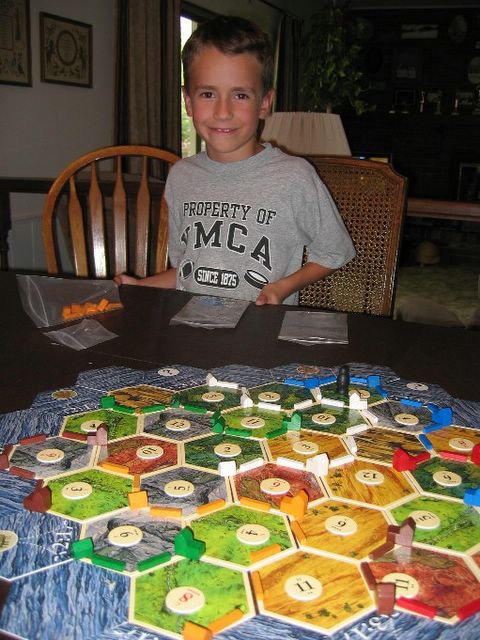
Our grandson Joel at the end of a game of Settlers of Catan >>>>
This was one of the more complicated game modifications we have done. We considered purchasing a second copy of the 5-6 player expansion, selecting several tiles to add to the mapboard, but decided that the board would be too large to be manageable on our tables.
-- Rules Changes
We like the starting mechanic of placing the first settlements in order of players, and the second in the reverse order. The major difficulty was the fact that the mapboard fills up quickly, even with 6 players. In some 6-player games, we have reached a point where only a couple of players had places available for building more settlements, and most settlements had been upgraded to cities, so that everyone was buying Development Cards to acquire another Victory Point. Adding a seventh player would fill the board even more quickly and make it much more difficult for anyone to win. We decided to make some modifications to the rules, to accommodate the seventh player.
We lowered the winning score to 7 points. On the first round of placement, each player places a city and a road, rather than a settlement and a road. The reverse placement action does not involve placing additional settlements or cities. The seventh player (in the player order) has the option of placing a second road, drawing two Resource Cards of his choice, or drawing one Development Card. The sixth player may place a second road or draw any two Resource Cards. The fifth and fourth players draw two Resource Cards. The third and second players place a second road, and the starting player draws one Resource Card. Then, the starting player rolls the dice to begin his turn. This reverse set-up round emulates the pattern of advantages allowed the players in a regular game for 6 players.
-- Components Changes
I purchased wooden dome-shaped furniture screw-hole plugs the approximate size of the settlements and larger wooden cubes the approximate size of the cities, to create a seventh set. I found at a craft store small wooden sticks, two feet long, with the exact diameter of the wooden road tokens in the box. I cut 15 pieces the same length of the tokens in the box, and there was plenty of wood left to cut more, if needed. I left all the new tokens in their natural wood finish, to distinguish them from the other sets.
-----------------------
Carcassonne (designed for 2-5 players, expanded for 6 players with the Inns and Cathedrals expansion, extended for 7 players) – BGG: 7.50
This is a family favorite, so we certainly need it to be playable by 7 players. We always play with the River, Inns & Cathedrals, and Traders & Builders expansions. We also play with the additional tiles from the King & Scout expansion, but not with the King and Robber Baron scoring rules. Fortunately, the extension was fairly simple.
-- Rules Changes
No rule changes are necessary for the additional player. However, we plan to try playing with each player starting with two tiles in his hand, replacing one at the end of his turn.
-- Components Changes
An additional set of player tokens is required. I added eight small natural-finish wooden cubes for the regular meeples (approximately the same height as the original tokens), one larger wooden cube for the larger meeple, and two dome-shaped wooden furniture screw-hole plugs for the pig and the builder tokens (marking one with a “P” and one with a “B” with a permanent marker).
My wife had already made a blue cloth draw-string bag for the tiles, larger than the original bag. This was handy, after adding the additional tiles from the expansions.
-----------------------
Hunters and Gatherers (designed for 2-5 players, extended for 6-7 players) – BGG: 7.32
We enjoy Hunters & Gatherers about as much as Carcassonne. Although the games are, of course, very similar, there are enough scoring differences to make it a good variation. We always use some of the optional rules posted on BGG for the Aurochs. We had already extended the game for 6 players, using the gray meeples from Carcassonne, before we added a seventh player.
-- Rules Changes
No rule changes are necessary.
-- Components Changes
Our extension for 6 players uses six of the gray meeples from the Carcassonne Inns & Cathedrals expansion, and the pig and builder tokens for the two river huts. For the seventh player, we add six of the natural-finish wood tokens with which we expanded Carcassonne, and the two wood plugs for the pig and builder as the river huts. We may in the future add two complete additional player token sets to Hunters & Gatherers, so we don’t have to borrow them from Carcassonne, and so they would always be in the box. One of the additional sets would need to be painted a unique color.
Since my wife made a new tile-drawing bag for Carcassonne, we use the original Carcassonne bag for the smaller number of tiles in Hunters & Gatherers.
-----------------------
For Sale (designed for 3-6 players, extended for 7-8 players) – BGG: 7.31
This is a very quickly-played game and is a great filler for our family group. The rulebook has modifications for 3 and 4 players, removing six cards from each deck for 3 players and two cards from each deck for 4 players. That makes it easy to modify the game for 7 and 8 players, using the same changes for 7 as for 4 and the same for 8 as for 3. The two decks have 30 cards in each. With 3 players, the decks have 24 cards in each, resulting in 8 rounds; with 4 players, 28 cards give 7 rounds; with 5 players, 30 cards give 6 rounds; with 6 players, 30 cards give 5 rounds; with 7 players, 28 cards give 4 rounds; and with 8 players, 24 cards give 3 rounds.
-- Rules Changes
The starting amount of money for each player has to be adjusted. For 7 players, give each eight $1,000 chips and one $2,000 chip; for 8 players, give each seven $1,000 chips and one $2,000 chip. This does not materially affect play, since there are fewer bidding rounds with more players. The bigger impact is the fact that bidding levels rise quickly, and players have to be more careful regarding their bids.
-- Components Changes
For 7 players, remove two Property Cards and two Check Cards. For 8 players, remove six Property Cards and six Check Cards. I have read some discussions about how to decide which cards to remove. Our method is to do it strictly by random selection – shuffle each deck and deal face-down the number to be removed. Place those cards face-down in the box. Not knowing which cards are missing from the deck inserts more chaos into the game. If you prefer a more calculable game, remove specific cards, such as the Void Check Cards.
-----------------------
Bohnanza (designed for 2-7 players, extended for 8 players) – Tested – BGG: 7.21
Although this game was originally designed for up to 7 players, we have found that it plays just as well with 8 players. However, we do not agree that the special rules in the rulebook for 6-7 players are appropriate for 6 or more.
We have found that generally it is not practical to purchase a third bean field in games with 7 or 8 players, using our modified rules, because there is seldom sufficient time for the third field to replace its cost.
Each additional player adds significantly to the trading aspect of the game, because a larger variety of beans is available at all times (in more players’ hands), if the players are willing to trade them.
-- Rules Changes
We have found that Bohnanza plays well for 6, 7, or 8 players by using all the cards, dealing the same number of cards (five) initially to all players, having players draw three cards at their turn end, and still charging three gold for a third bean field. However, we have begun discussing the possibility of reducing the cost of a third field to two gold, as recommended in the rulebook. This might make the purchase of a third bean field practical with a larger number of players.
With the larger number of players, it is best to exhaust the draw deck only two times, rather than three. By the time the deck is emptied the second time, there is a limited number of cards left, because many have been removed for gold scoring.
-- Components Changes
No component changes are necessary for additional players.
-----------------------
Alhambra (designed for 2-6 players, extended for 7 players) – BGG: 7.14
This is a very good game that we enjoy occasionally, so we wanted to be able to play it with 7 players.
-- Rules Changes
No rule changes are necessary.
-- Components Changes
I copied and printed a Lion’s Gate fountain tile and a player’s Reserve Board on matte photo-quality paper. I cut them to the correct size and used double-stick tape to fasten them to pieces of cardboard the same thickness as the pieces in the box. I purchased two wooden cubes the same size as the round Counters, leaving them a natural wood color to distinguish from the others.
-----------------------
Coloretto (designed for 3-5 players, extended for 7 players) – BGG: 7.09
Fortunately, the additional cards needed for more players of Coloretto are not cards that have to be shuffled and drawn from the deck. Therefore, they do not have to be perfect matches to the original cards.
-- Rules Changes
We had made a rule change in Coloretto even before adding additional players. We did not feel it was fair to the first player to not have an option of taking a row or drawing a card on his initial turn. Therefore, we always turn up the first card from the draw deck and place it by a row card to begin each round. This gives the first player the same option as all other players on his first turn.
The only rule change for additional players is the number of cards placed below the Last Round marker card in the deck. There must be cards in the amount of three times the number of players available for play in the last round. For 6 players, 18 cards are below the marker; for 7 players, 21 cards are below the marker. There are 76 cards in the deck, so the game is much shorter (in rounds) with more players, which requires players to adjust their thinking when deciding whether to draw a card or pick up a row.
-- Components Changes
I copied, printed on heavy photo paper, and cut two additional Row Cards and two additional Scoring Summary Cards.
-----------------------
Royal Turf (designed for 2-6 players, extended for 7-8 players) – Tested with 7 - BGG: 7.04
We like to play this game with hidden bets, so players cannot be absolutely certain who is betting the most (or not really placing a bet) on which horse.
-- Rules Changes
No rule changes were necessary.
-- Components Changes
I cut two sets of player tokens and betting chits from white and brown thin cardboard, the same thickness as those in the box. I numbered the betting chits appropriately with a marker, to match the other sets.
-----------------------
Elfenland (designed for 2-6 players, extended for 7 players) – BGG: 6.82
This is a neat game that we have played only a few times. The modification for 7 players required several additional components.
-- Rules Changes
No rule changes are necessary.
-- Components Changes
One additional natural-finish set of player pieces is required: a token approximately the same size as the boot tokens in the box, and twenty one-half-inch dome-shaped wooden furniture screw-hole plugs.
An additional Obstacle tile and an additional Transportation Chart are needed. I copied, printed on photo quality paper, and cut them for the additional player. The Obstacle tile was fastened with double-stick tape to a square of thin cardboard the same size and thickness as the originals, to facilitate picking it up from the board.
-----------------------
Hare & Tortoise (designed for 2-6 players; extended for 7 players) – BGG: 6.68
As with most race games, the board gets more crowded with more players, which sometimes decreases the length of the game.
-- Rules Changes
Each player begins the game with two Lettuce cards, rather than three.
-- Components Changes
I added one natural-finish wood disc, 1 inch in diameter, and the approximate thickness of the discs in the box.
-----------------------
Take It Easy (designed for 1-8 players) – BGG: 6.54
We enjoy this game occasionally, and it requires no modification, since it is one of those rare games designed for up to 8 players that meets our game criteria.
-----------------------
Around the World in 80 Days (designed for 3-6 players, extended for 7 players) – Tested – BGG: 6.53
This is one of my current favorite games, so I naturally wanted to extend it for 7 players.
-- Rules Changes
The game rulebook specifies starting each round with one more face-up Travel Card than there are players (except to use six cards for either 5 or 6 players), and the board is marked to accommodate up to six cards. Each of the cards is assigned a different benefit for the person choosing it, depending on where it is located by the board. When each player reaches the finish (London), the number of starting cards for the next round is reduced by one, so that there is always one more card than the number of active players (again, except with 6 players, six cards continue to be displayed for the remaining 5 players after the first one finishes). It appeared logical to add a seventh card to the lineup, for a 7-player game, reducing it to a six-card lineup only after two people reach London. The difficulty was in creating a logical benefit for the seventh card, without un-balancing the game play. We decided to turn face-up two cards (rather than one) in the seventh position, requiring the player who selects those cards to immediately discard one card from his hand (which may or may not be one of the two cards he just picked up). This modification worked well, and the game plays with the same “fun factor” with 7 players as with 6 players.
-- Components Changes
There are three different tokens for each player, in colors red, yellow, green, blue, and gray. I created a set in white. I purchased a round wooden game token at a craft store, which is approximately the same size as the original tokens, and I painted it white with craft water-color paint. I purchased a small wooden dome-shaped furniture screw-hole plug and painted it white, for the Time Marker. Finally, I cut a piece of white light-weight cardboard the same size as the other Betting Slips.
-----------------------
Pick Picknic (designed for 2-6 players, extended for 7-8 players) – BGG: 6.53
This is a very quick filler game we play occasionally. The game easily accommodates more players, without any changes.
-- Rules Changes
No rule changes are necessary.
-- Components Changes
No component changes are necessary.
-----------------------
Circus Flohcati (designed for 3-5 players, extended for 7-8 players) – Tested – BGG: 6.52
Circus Flohcati plays well for 3-5 players. Only one change is needed to make it play well for 6-8 players. Game play time is about the same for any number of players. Although there is more time required between any one player’s turns, the cards disappear more rapidly from the draw deck with more players involved, ending the game. With fewer players, a Gala is easier to achieve, which can end the game quicker, but that doesn’t always occur.
-- Rules Changes
Only one rule change is needed. When playing with 6, 7, or 8 players, a Gala (one card of each color in the player’s hand) is worth 15 points. The normal Gala score is 10 points, but it is much more difficult to acquire a Gala with additional players, before the draw deck runs out, ending the game (completing a Gala also ends the game). The 15-point gala is a better offset score for the three-card sets that other players probably will score (10 points for each set). Since the value of the cards-in-hand represents the player’s score, plus sets played before the end of the game, 15 points for a Gala make it worth attempting, sometimes. It is most difficult with eight players, but since each player receives fewer cards, normally, than when playing with fewer players, the 15-point value of the Gala is reasonably consistent with 6, 7, or 8 players.
We tested playing with a 20-point Gala, but that caused the player to exceed other scores significantly, when successful. We felt it un-balanced the scoring. At the same time, 10 points for a Gala did not sufficiently reward the difficulty of obtaining it in a 6, 7, or 8-player game. Hardly anyone attempted to build a Gala for only 10 points in those games.
One 7-player game ended with the creation of a Gala, with only one card remaining in the draw deck.
-- Components Changes
No component changes are necessary.
-----------------------
Dragon’s Gold (designed for 3 to 6 players, extended for 7 players) – BGG: 6.35
This game is a lot of fun, but some of the original components bother us. The tiny treasure disks tend to roll around a lot and would be very easy to lose. We plan to create our own treasure pieces from small wooden cubes, painted the same colors as those in the box. The colors on the scoring summary cards are confusing to some extent – “gold” and “yellow” look almost exactly alike; blue and green are hardly distinguishable; and even the red and purple are very similar. The printer did not choose ink hues wisely. I have created new scoring summaries that are easier to understand. I know that this will not be important after a few games, but it is needed to teach the game to new players. I also downloaded from BGG the excellent score sheet created by Mikko Saari. I modified it for seven players and added our names in the columns.
-- Rules Changes
No rule changes are necessary.
-- Components Changes
I copied, printed and cut the Treasure Screens and printed them on light cardstock. I copied, printed, and cut one additional set of Adventurer Cards, printing them in black-and-white, to make them distinct from the original sets.
-----------------------
Canyon (designed for 3-6 players, extended for 7 players) – BGG: 6.01
We had modified the rules for this game when playing with 6 players, as we didn’t care much for the rules included in the box. Also, we always use the optional box rule of skipping from turn 5 to turn 10, avoiding the deals of less than 4 cards per person (except for the 10th turn, which does have 3 cards).
-- Rules Changes
> Order of Canoe Movement
> Movement Before Rapids Area
> Movement in Rapids Area
-- Components Changes
I added a dome-shaped wooden furniture screw-hole plug about the same diameter as the canoe tokens, leaving it the natural wood finish.
I copied, printed on photo quality paper, and cut an additional set of Tempo (bidding) cards, printing them in black-and-white for the seventh player.
----------------------
Station Master (designed for 2-6 players, extended for 7 players) – BGG: 5.86
This is a neat game that plays quickly, regardless of the number of players.
-- Rules Changes
No rule changes are necessary. Simply follow the original instruction of always having the same number of engines in play as there are players, until near the end of the game, when not enough are available.
-- Components Changes
I created one additional set of Passenger Tokens, using wooden disks approximately the same diameter as the plastic ones in the box, marking the bottom of each with the same numbers as on the other sets. In fact, we like the new tokens better than the originals, because they can be more easily picked up, due to the fact that they are much thicker. In the future, I may replace all the original tokens with painted wooden ones.
-----------------------
Trumpet (designed for 2-6 players, extended for 7-8 players) – Tested – BGG: 5.84
This game is simple to modify for additional players. We have played it very successfully with 8 players, and I believe it would be possible to play with as many as 10 players, with one additional modification. Before we had 6, 7, or 8 players in our group who liked to play Trumpet, we made two modifications to make it a better game for any number. Those changes are explained below, but were not made specifically for 7-8 players.
The game time is about the same, regardless of the number of players. Although more players take more time for each hand, the increased number of tokens on the board involves more jumping, thus moving tokens quicker to the winning space.
-- Rules Changes
After all six trumps have been placed on the board, in the designated spaces numbered 1 through 6, the next player who lands on a Choose Trump space switches any two trumps. This is the key to winning the game, generally. However, the first six times players land on Choose Trump, they have fewer and fewer choices of top trump. The first one selects from the six trumps and places that color in the number 1 trump spot. The second one must select from the remaining five unplaced trumps, even if he prefers to keep the sixth color as the top trump. Each succeeding placement offers the person changing trump one less choice, and the sixth one has no choice, but must place the last remaining color as the top trump. This is not a good rule.
We allow every Choose Trump placement to be able to select the top trump color. The first player to choose a trump color may select from any of the six colors and place it in the number 1 trump spot. The next player to change trump may place one of the five remaining colors in the (higher) number 2 spot, or he may move up the color from the number 1 spot to the number 2 spot (keeping it as the high trump) and place another color on the vacated number 1 spot. The next player to change trump may select one of the four remaining colors as the high trump, or may move the color from either the number 1 or number 2 spot to the number 3 spot, placing one of the four unused colors in the vacated trump spot. This continues until all six colors have been placed, adding a new one each time, but allowing the player to always select the top trump color, which is the most important part of the action.
I believe even more players could be added, but it probably would be good to deal only six cards to each player, rather than seven, in those cases, since there are only 72 cards in the deck, and you always want to have some un-dealt cards for each hand.
-- Components Changes
The simple component change necessary when adding players is to add a unique (color or shape) player token for each additional person.
The component change we made to the board, following our first couple of games, is to mark out the last (sixth) Choose Trump space. We found it to be most unfair to allow a player to select trumps when his token was only two spaces from the finish line. Eliminating this trump change option allows trailing players a better opportunity to catch up with the leader. We simply drew an “X” across the space with a permanent marker. The space still is in play, but a player cannot change trumps when landing there. This change, combined with the rule change for placing the first six trumps, makes this game much more balanced, and it works as well for 7-8 players as for 2-6.
-----------------------
** The following games are the exceptions to this list of game modifications – they have been extended for only 6 players. **
-----------------------
Through the Desert (designed for 2-5 players, extended for 6 players) – Tested – BGG: 7.50
Through the Desert plays well for 2-5 players. One change allows a challenging game for 6 players, but several changes probably would be necessary to make it work for 7-8 players. We have not attempted to play with more than 6 players. The game plays at least as quickly with 6 players as with 5 players, because the game still ends when the last camel of any one color has been placed. It is more difficult to enclose high-value territory and to connect to as many oases, because of the additional two camels placed between your turns. In fact, players have to “think smaller” in a 6-player game. With five colors of camels, at least one player will not be able to have the largest caravan in any color, although two players might tie in a color and share the 10 points. This creates a more intense competition for largest caravans.
-- Rules Changes
No rules changes are necessary. Use the same rules for 6 players as for 5 players, including each player playing with four caravan leaders and the first two players being allowed to place only one camel on their first turn (after placing the caravan leaders). Also, as in the 5-player game, the first five caravan leaders placed must be with different colors of camels; the sixth player may play any of his camel colors on his first leader-placement turn.
-- Components Changes
The only change in components needed for a 6-player game is to have a sixth color of caravan leaders. The game box contains one extra caravan leader for each player, to be placed on the gray camels, to indicate which color each player is playing. We found it not to be necessary to use the gray camels, since each person in our group always played with the same color leaders. We used the extra caravan leaders to create a sixth group. A black permanent marker converted that set into a black set, clearly distinguishable from the other colors. If it is necessary to have a designator for which player is using which set of caravan leaders, I suggest adding some type of color marker (stone, painted block, card with the color name, etc.) to the box, one for each color of caravan leader.
-----------------------
Marco Polo Expedition (designed for 2-5 players, extended for 6 players) – BGG: 5.97
Having more players in the game complicates your timing of when to leap over other caravans and when to hold up and accumulate cards.
-- Rules Changes
No rule changes are necessary
-- Components Changes
I added one medium-sized wooden game token, about the same size as the camels in the box.
-----------------------
Future Considerations
-----------------------
We do have some other fun games in our collection, none of which are designed for 7 players, but which we enjoy playing with the number for which they were designed. Some might be extendable, but not all of them, I believe.
I suspect that Princes of Florence is designed so ideally for five players that it would not be a good idea to try to extend it, even for six players. – BGG: 8.02
I have plans to add a sixth player to Ticket to Ride. An additional set of “trains” could be created from square wood sticks cut to the proper length and left a natural-finish color. I believe some rule changes would be necessary regarding how the game ends (how many trains are left, or beginning with fewer than the normal number of trains, which would probably change the game strategy). – BGG: 7.60
I believe Hacienda would not work well with more players, and it would be extremely difficult to extend it. – BGG: 7.13
Oasis is a game we enjoy from time to time, but the board already gets very crowded before the game ends. I do not think it would work well to expand the number of players for this game. – BGG: 6.80
Cartagena hardly plays well with more than four players. However, I think a second set of boards could be added, and it might be good with six players, using fewer tokens, each. – BGG: 6.75
Hoity Toity could be extended by creating an additional set of player cards, which would not be difficult. We have not yet played the game enough to decide whether we like it well enough to modify it, though. – BGG: 6.65
Australia could be extended with some additional tokens, but I’m not sure it would play well with more than five players. – BGG: 6.54
Mississippi Queen works fine for five players. I understand the Black Rose expansion adds an additional player, but we have not purchased it. We may do so sometime in the future, if I can find a copy of it. – BGG: 6.42
Finally, Tongiaki is chaotic enough with six players; I cannot imagine adding more players. – BGG: 6.20
----------------------
It is challenging to modify many games for 7 or 8 players, and I expect to continue facing that challenge in the future, as we acquire new games for the family group. The difficult part is making an educated guess about whether a game can be extended, before purchasing it.
---- Gerald; near Denver, Colorado
aka: gamesgrandpa -- a grandpa who is a mile high on gaming
Our family group (ages 8-63) enjoys many different light-to-medium weight card and board games. We also enjoy keeping records of our games, noting winners and assigning points based on how each person finishes in the games. We have kept these records for the past six years, and we enjoy the competition created by those records. We only count games that at least all of the adults (6 of us) play together. We also count games that either or both our grandson and granddaughter play with all the adults.
We have several preferences for our games, including:
** individual, equal competition – no teams; no unbalanced arrangements, such as one person vs. the remainder of the group (Betrayal on the Hill); no cooperative games (Lord of the Rings)
** games that can be played in 90 minutes or less, normally (although some 120-minute games are acceptable)
** games that allow all of us (7 or 8 players) to play simultaneously; no dividing into smaller groups
** no wargames; no games involving violence as a theme; no realistic sports-themed games
** no party games or games that involve performances or voting on individuals
** no dexterity games
** no trivia, word, or general-knowledge games
We enjoy game mechanics such as tile-laying, connection-making, negotiating and trading, trick-taking, special set-collecting, limited action-point, or limited or no chaos and randomness, and games that provide more than one way to score or win, as well as the traditional one-way-to-score/win games. We prefer games with easy-to-learn rules and games that allow for conversation during the game (game-related or otherwise). We do not enjoy deep games that require a lot of analyses and constant concentration. Our games can include a limited amount of “gotchas,” but we prefer games that allow both offensive (helping yourself) and defensive (thwarting others) play, without direct vicious attacks on individual players. We do not play games that eliminate any players before the end of the game, except those in which players may finish and leave the game, with others finishing soon after (Around the World in 80 Days). There are other restrictions, but these are the primary ones.
Obviously, these preferences severely restrict the number of quality games we can purchase and enjoy. Fortunately, many games meet all or most of the criteria, except for the number of players for which they are designed. A large number of quality games designed for up to 5 or 6 players are available. Some of those games would be impossible or very difficult to modify to allow for 7-8 players, but some of them can be extended easily or with moderate effort, and a few require no modification at all.
With few exceptions, we use a single die roll by each player to determine the first player in our games, with tied players rolling to break the tie. We do not adjust our seating to match the die roll results. I add a die to each game box that does not already include one, just for this purpose.
Our granddaughter (the eighth player) enjoys only a few games, preferring to occupy her time in other ways, while the rest of us play games. However, we try to include her in at least one game each time we play. Therefore, only the games she likes need to accommodate 8 players, while the others need to allow for 7 players.
This article is a description of the games we have modified to allow 7 or 8 players to enjoy simultaneously. A few are listed that require no changes or that only need an additional player token. Others require some minor rule adjustments or a modified set-up, such as the amount of starting money or number of cards dealt. Finally, some games require some effort or minor expense to create additional player token sets or to copy, print, and cut additional game materials. They are presented in order of their current rating on BGG. The game modifications that have been tested by our group are noted as such.
-----------------------
Settlers of Catan (designed for 3-6 players, with the 5-6 player expansion, extended for 7 players) – Tested - BGG: 7.68
Our grandson Joel at the end of a game of Settlers of Catan >>>>
This was one of the more complicated game modifications we have done. We considered purchasing a second copy of the 5-6 player expansion, selecting several tiles to add to the mapboard, but decided that the board would be too large to be manageable on our tables.
-- Rules Changes
We like the starting mechanic of placing the first settlements in order of players, and the second in the reverse order. The major difficulty was the fact that the mapboard fills up quickly, even with 6 players. In some 6-player games, we have reached a point where only a couple of players had places available for building more settlements, and most settlements had been upgraded to cities, so that everyone was buying Development Cards to acquire another Victory Point. Adding a seventh player would fill the board even more quickly and make it much more difficult for anyone to win. We decided to make some modifications to the rules, to accommodate the seventh player.
We lowered the winning score to 7 points. On the first round of placement, each player places a city and a road, rather than a settlement and a road. The reverse placement action does not involve placing additional settlements or cities. The seventh player (in the player order) has the option of placing a second road, drawing two Resource Cards of his choice, or drawing one Development Card. The sixth player may place a second road or draw any two Resource Cards. The fifth and fourth players draw two Resource Cards. The third and second players place a second road, and the starting player draws one Resource Card. Then, the starting player rolls the dice to begin his turn. This reverse set-up round emulates the pattern of advantages allowed the players in a regular game for 6 players.
-- Components Changes
I purchased wooden dome-shaped furniture screw-hole plugs the approximate size of the settlements and larger wooden cubes the approximate size of the cities, to create a seventh set. I found at a craft store small wooden sticks, two feet long, with the exact diameter of the wooden road tokens in the box. I cut 15 pieces the same length of the tokens in the box, and there was plenty of wood left to cut more, if needed. I left all the new tokens in their natural wood finish, to distinguish them from the other sets.
-----------------------
Carcassonne (designed for 2-5 players, expanded for 6 players with the Inns and Cathedrals expansion, extended for 7 players) – BGG: 7.50
This is a family favorite, so we certainly need it to be playable by 7 players. We always play with the River, Inns & Cathedrals, and Traders & Builders expansions. We also play with the additional tiles from the King & Scout expansion, but not with the King and Robber Baron scoring rules. Fortunately, the extension was fairly simple.
-- Rules Changes
No rule changes are necessary for the additional player. However, we plan to try playing with each player starting with two tiles in his hand, replacing one at the end of his turn.
-- Components Changes
An additional set of player tokens is required. I added eight small natural-finish wooden cubes for the regular meeples (approximately the same height as the original tokens), one larger wooden cube for the larger meeple, and two dome-shaped wooden furniture screw-hole plugs for the pig and the builder tokens (marking one with a “P” and one with a “B” with a permanent marker).
My wife had already made a blue cloth draw-string bag for the tiles, larger than the original bag. This was handy, after adding the additional tiles from the expansions.
-----------------------
Hunters and Gatherers (designed for 2-5 players, extended for 6-7 players) – BGG: 7.32
We enjoy Hunters & Gatherers about as much as Carcassonne. Although the games are, of course, very similar, there are enough scoring differences to make it a good variation. We always use some of the optional rules posted on BGG for the Aurochs. We had already extended the game for 6 players, using the gray meeples from Carcassonne, before we added a seventh player.
-- Rules Changes
No rule changes are necessary.
-- Components Changes
Our extension for 6 players uses six of the gray meeples from the Carcassonne Inns & Cathedrals expansion, and the pig and builder tokens for the two river huts. For the seventh player, we add six of the natural-finish wood tokens with which we expanded Carcassonne, and the two wood plugs for the pig and builder as the river huts. We may in the future add two complete additional player token sets to Hunters & Gatherers, so we don’t have to borrow them from Carcassonne, and so they would always be in the box. One of the additional sets would need to be painted a unique color.
Since my wife made a new tile-drawing bag for Carcassonne, we use the original Carcassonne bag for the smaller number of tiles in Hunters & Gatherers.
-----------------------
For Sale (designed for 3-6 players, extended for 7-8 players) – BGG: 7.31
This is a very quickly-played game and is a great filler for our family group. The rulebook has modifications for 3 and 4 players, removing six cards from each deck for 3 players and two cards from each deck for 4 players. That makes it easy to modify the game for 7 and 8 players, using the same changes for 7 as for 4 and the same for 8 as for 3. The two decks have 30 cards in each. With 3 players, the decks have 24 cards in each, resulting in 8 rounds; with 4 players, 28 cards give 7 rounds; with 5 players, 30 cards give 6 rounds; with 6 players, 30 cards give 5 rounds; with 7 players, 28 cards give 4 rounds; and with 8 players, 24 cards give 3 rounds.
-- Rules Changes
The starting amount of money for each player has to be adjusted. For 7 players, give each eight $1,000 chips and one $2,000 chip; for 8 players, give each seven $1,000 chips and one $2,000 chip. This does not materially affect play, since there are fewer bidding rounds with more players. The bigger impact is the fact that bidding levels rise quickly, and players have to be more careful regarding their bids.
-- Components Changes
For 7 players, remove two Property Cards and two Check Cards. For 8 players, remove six Property Cards and six Check Cards. I have read some discussions about how to decide which cards to remove. Our method is to do it strictly by random selection – shuffle each deck and deal face-down the number to be removed. Place those cards face-down in the box. Not knowing which cards are missing from the deck inserts more chaos into the game. If you prefer a more calculable game, remove specific cards, such as the Void Check Cards.
-----------------------
Bohnanza (designed for 2-7 players, extended for 8 players) – Tested – BGG: 7.21
Although this game was originally designed for up to 7 players, we have found that it plays just as well with 8 players. However, we do not agree that the special rules in the rulebook for 6-7 players are appropriate for 6 or more.
We have found that generally it is not practical to purchase a third bean field in games with 7 or 8 players, using our modified rules, because there is seldom sufficient time for the third field to replace its cost.
Each additional player adds significantly to the trading aspect of the game, because a larger variety of beans is available at all times (in more players’ hands), if the players are willing to trade them.
-- Rules Changes
We have found that Bohnanza plays well for 6, 7, or 8 players by using all the cards, dealing the same number of cards (five) initially to all players, having players draw three cards at their turn end, and still charging three gold for a third bean field. However, we have begun discussing the possibility of reducing the cost of a third field to two gold, as recommended in the rulebook. This might make the purchase of a third bean field practical with a larger number of players.
With the larger number of players, it is best to exhaust the draw deck only two times, rather than three. By the time the deck is emptied the second time, there is a limited number of cards left, because many have been removed for gold scoring.
-- Components Changes
No component changes are necessary for additional players.
-----------------------
Alhambra (designed for 2-6 players, extended for 7 players) – BGG: 7.14
This is a very good game that we enjoy occasionally, so we wanted to be able to play it with 7 players.
-- Rules Changes
No rule changes are necessary.
-- Components Changes
I copied and printed a Lion’s Gate fountain tile and a player’s Reserve Board on matte photo-quality paper. I cut them to the correct size and used double-stick tape to fasten them to pieces of cardboard the same thickness as the pieces in the box. I purchased two wooden cubes the same size as the round Counters, leaving them a natural wood color to distinguish from the others.
-----------------------
Coloretto (designed for 3-5 players, extended for 7 players) – BGG: 7.09
Fortunately, the additional cards needed for more players of Coloretto are not cards that have to be shuffled and drawn from the deck. Therefore, they do not have to be perfect matches to the original cards.
-- Rules Changes
We had made a rule change in Coloretto even before adding additional players. We did not feel it was fair to the first player to not have an option of taking a row or drawing a card on his initial turn. Therefore, we always turn up the first card from the draw deck and place it by a row card to begin each round. This gives the first player the same option as all other players on his first turn.
The only rule change for additional players is the number of cards placed below the Last Round marker card in the deck. There must be cards in the amount of three times the number of players available for play in the last round. For 6 players, 18 cards are below the marker; for 7 players, 21 cards are below the marker. There are 76 cards in the deck, so the game is much shorter (in rounds) with more players, which requires players to adjust their thinking when deciding whether to draw a card or pick up a row.
-- Components Changes
I copied, printed on heavy photo paper, and cut two additional Row Cards and two additional Scoring Summary Cards.
-----------------------
Royal Turf (designed for 2-6 players, extended for 7-8 players) – Tested with 7 - BGG: 7.04
We like to play this game with hidden bets, so players cannot be absolutely certain who is betting the most (or not really placing a bet) on which horse.
-- Rules Changes
No rule changes were necessary.
-- Components Changes
I cut two sets of player tokens and betting chits from white and brown thin cardboard, the same thickness as those in the box. I numbered the betting chits appropriately with a marker, to match the other sets.
-----------------------
Elfenland (designed for 2-6 players, extended for 7 players) – BGG: 6.82
This is a neat game that we have played only a few times. The modification for 7 players required several additional components.
-- Rules Changes
No rule changes are necessary.
-- Components Changes
One additional natural-finish set of player pieces is required: a token approximately the same size as the boot tokens in the box, and twenty one-half-inch dome-shaped wooden furniture screw-hole plugs.
An additional Obstacle tile and an additional Transportation Chart are needed. I copied, printed on photo quality paper, and cut them for the additional player. The Obstacle tile was fastened with double-stick tape to a square of thin cardboard the same size and thickness as the originals, to facilitate picking it up from the board.
-----------------------
Hare & Tortoise (designed for 2-6 players; extended for 7 players) – BGG: 6.68
As with most race games, the board gets more crowded with more players, which sometimes decreases the length of the game.
-- Rules Changes
Each player begins the game with two Lettuce cards, rather than three.
-- Components Changes
I added one natural-finish wood disc, 1 inch in diameter, and the approximate thickness of the discs in the box.
-----------------------
Take It Easy (designed for 1-8 players) – BGG: 6.54
We enjoy this game occasionally, and it requires no modification, since it is one of those rare games designed for up to 8 players that meets our game criteria.
-----------------------
Around the World in 80 Days (designed for 3-6 players, extended for 7 players) – Tested – BGG: 6.53
This is one of my current favorite games, so I naturally wanted to extend it for 7 players.
-- Rules Changes
The game rulebook specifies starting each round with one more face-up Travel Card than there are players (except to use six cards for either 5 or 6 players), and the board is marked to accommodate up to six cards. Each of the cards is assigned a different benefit for the person choosing it, depending on where it is located by the board. When each player reaches the finish (London), the number of starting cards for the next round is reduced by one, so that there is always one more card than the number of active players (again, except with 6 players, six cards continue to be displayed for the remaining 5 players after the first one finishes). It appeared logical to add a seventh card to the lineup, for a 7-player game, reducing it to a six-card lineup only after two people reach London. The difficulty was in creating a logical benefit for the seventh card, without un-balancing the game play. We decided to turn face-up two cards (rather than one) in the seventh position, requiring the player who selects those cards to immediately discard one card from his hand (which may or may not be one of the two cards he just picked up). This modification worked well, and the game plays with the same “fun factor” with 7 players as with 6 players.
-- Components Changes
There are three different tokens for each player, in colors red, yellow, green, blue, and gray. I created a set in white. I purchased a round wooden game token at a craft store, which is approximately the same size as the original tokens, and I painted it white with craft water-color paint. I purchased a small wooden dome-shaped furniture screw-hole plug and painted it white, for the Time Marker. Finally, I cut a piece of white light-weight cardboard the same size as the other Betting Slips.
-----------------------
Pick Picknic (designed for 2-6 players, extended for 7-8 players) – BGG: 6.53
This is a very quick filler game we play occasionally. The game easily accommodates more players, without any changes.
-- Rules Changes
No rule changes are necessary.
-- Components Changes
No component changes are necessary.
-----------------------
Circus Flohcati (designed for 3-5 players, extended for 7-8 players) – Tested – BGG: 6.52
Circus Flohcati plays well for 3-5 players. Only one change is needed to make it play well for 6-8 players. Game play time is about the same for any number of players. Although there is more time required between any one player’s turns, the cards disappear more rapidly from the draw deck with more players involved, ending the game. With fewer players, a Gala is easier to achieve, which can end the game quicker, but that doesn’t always occur.
-- Rules Changes
Only one rule change is needed. When playing with 6, 7, or 8 players, a Gala (one card of each color in the player’s hand) is worth 15 points. The normal Gala score is 10 points, but it is much more difficult to acquire a Gala with additional players, before the draw deck runs out, ending the game (completing a Gala also ends the game). The 15-point gala is a better offset score for the three-card sets that other players probably will score (10 points for each set). Since the value of the cards-in-hand represents the player’s score, plus sets played before the end of the game, 15 points for a Gala make it worth attempting, sometimes. It is most difficult with eight players, but since each player receives fewer cards, normally, than when playing with fewer players, the 15-point value of the Gala is reasonably consistent with 6, 7, or 8 players.
We tested playing with a 20-point Gala, but that caused the player to exceed other scores significantly, when successful. We felt it un-balanced the scoring. At the same time, 10 points for a Gala did not sufficiently reward the difficulty of obtaining it in a 6, 7, or 8-player game. Hardly anyone attempted to build a Gala for only 10 points in those games.
One 7-player game ended with the creation of a Gala, with only one card remaining in the draw deck.
-- Components Changes
No component changes are necessary.
-----------------------
Dragon’s Gold (designed for 3 to 6 players, extended for 7 players) – BGG: 6.35
This game is a lot of fun, but some of the original components bother us. The tiny treasure disks tend to roll around a lot and would be very easy to lose. We plan to create our own treasure pieces from small wooden cubes, painted the same colors as those in the box. The colors on the scoring summary cards are confusing to some extent – “gold” and “yellow” look almost exactly alike; blue and green are hardly distinguishable; and even the red and purple are very similar. The printer did not choose ink hues wisely. I have created new scoring summaries that are easier to understand. I know that this will not be important after a few games, but it is needed to teach the game to new players. I also downloaded from BGG the excellent score sheet created by Mikko Saari. I modified it for seven players and added our names in the columns.
-- Rules Changes
No rule changes are necessary.
-- Components Changes
I copied, printed and cut the Treasure Screens and printed them on light cardstock. I copied, printed, and cut one additional set of Adventurer Cards, printing them in black-and-white, to make them distinct from the original sets.
-----------------------
Canyon (designed for 3-6 players, extended for 7 players) – BGG: 6.01
We had modified the rules for this game when playing with 6 players, as we didn’t care much for the rules included in the box. Also, we always use the optional box rule of skipping from turn 5 to turn 10, avoiding the deals of less than 4 cards per person (except for the 10th turn, which does have 3 cards).
-- Rules Changes
> Order of Canoe Movement
--- On first turn, canoes move in order of player turn (established randomly at start of game).
--- After first turn, canoe farthest down river moves first, followed by next in line, etc.
--- Canoes in tied position: canoe on farthest left side of river facing downstream moves first.
> Movement Before Rapids Area
--- Correct Bid: 4 spaces
--- Missed Bid by One: 2 spaces
--- Missed Bid by More Than One: 1 space (drifting with the current)
> Movement in Rapids Area
--- Correct Bid: 2 spaces
--- Missed Bid: Drift one space according to arrows
-- Components Changes
I added a dome-shaped wooden furniture screw-hole plug about the same diameter as the canoe tokens, leaving it the natural wood finish.
I copied, printed on photo quality paper, and cut an additional set of Tempo (bidding) cards, printing them in black-and-white for the seventh player.
----------------------
Station Master (designed for 2-6 players, extended for 7 players) – BGG: 5.86
This is a neat game that plays quickly, regardless of the number of players.
-- Rules Changes
No rule changes are necessary. Simply follow the original instruction of always having the same number of engines in play as there are players, until near the end of the game, when not enough are available.
-- Components Changes
I created one additional set of Passenger Tokens, using wooden disks approximately the same diameter as the plastic ones in the box, marking the bottom of each with the same numbers as on the other sets. In fact, we like the new tokens better than the originals, because they can be more easily picked up, due to the fact that they are much thicker. In the future, I may replace all the original tokens with painted wooden ones.
-----------------------
Trumpet (designed for 2-6 players, extended for 7-8 players) – Tested – BGG: 5.84
This game is simple to modify for additional players. We have played it very successfully with 8 players, and I believe it would be possible to play with as many as 10 players, with one additional modification. Before we had 6, 7, or 8 players in our group who liked to play Trumpet, we made two modifications to make it a better game for any number. Those changes are explained below, but were not made specifically for 7-8 players.
The game time is about the same, regardless of the number of players. Although more players take more time for each hand, the increased number of tokens on the board involves more jumping, thus moving tokens quicker to the winning space.
-- Rules Changes
After all six trumps have been placed on the board, in the designated spaces numbered 1 through 6, the next player who lands on a Choose Trump space switches any two trumps. This is the key to winning the game, generally. However, the first six times players land on Choose Trump, they have fewer and fewer choices of top trump. The first one selects from the six trumps and places that color in the number 1 trump spot. The second one must select from the remaining five unplaced trumps, even if he prefers to keep the sixth color as the top trump. Each succeeding placement offers the person changing trump one less choice, and the sixth one has no choice, but must place the last remaining color as the top trump. This is not a good rule.
We allow every Choose Trump placement to be able to select the top trump color. The first player to choose a trump color may select from any of the six colors and place it in the number 1 trump spot. The next player to change trump may place one of the five remaining colors in the (higher) number 2 spot, or he may move up the color from the number 1 spot to the number 2 spot (keeping it as the high trump) and place another color on the vacated number 1 spot. The next player to change trump may select one of the four remaining colors as the high trump, or may move the color from either the number 1 or number 2 spot to the number 3 spot, placing one of the four unused colors in the vacated trump spot. This continues until all six colors have been placed, adding a new one each time, but allowing the player to always select the top trump color, which is the most important part of the action.
I believe even more players could be added, but it probably would be good to deal only six cards to each player, rather than seven, in those cases, since there are only 72 cards in the deck, and you always want to have some un-dealt cards for each hand.
-- Components Changes
The simple component change necessary when adding players is to add a unique (color or shape) player token for each additional person.
The component change we made to the board, following our first couple of games, is to mark out the last (sixth) Choose Trump space. We found it to be most unfair to allow a player to select trumps when his token was only two spaces from the finish line. Eliminating this trump change option allows trailing players a better opportunity to catch up with the leader. We simply drew an “X” across the space with a permanent marker. The space still is in play, but a player cannot change trumps when landing there. This change, combined with the rule change for placing the first six trumps, makes this game much more balanced, and it works as well for 7-8 players as for 2-6.
-----------------------
** The following games are the exceptions to this list of game modifications – they have been extended for only 6 players. **
-----------------------
Through the Desert (designed for 2-5 players, extended for 6 players) – Tested – BGG: 7.50
Through the Desert plays well for 2-5 players. One change allows a challenging game for 6 players, but several changes probably would be necessary to make it work for 7-8 players. We have not attempted to play with more than 6 players. The game plays at least as quickly with 6 players as with 5 players, because the game still ends when the last camel of any one color has been placed. It is more difficult to enclose high-value territory and to connect to as many oases, because of the additional two camels placed between your turns. In fact, players have to “think smaller” in a 6-player game. With five colors of camels, at least one player will not be able to have the largest caravan in any color, although two players might tie in a color and share the 10 points. This creates a more intense competition for largest caravans.
-- Rules Changes
No rules changes are necessary. Use the same rules for 6 players as for 5 players, including each player playing with four caravan leaders and the first two players being allowed to place only one camel on their first turn (after placing the caravan leaders). Also, as in the 5-player game, the first five caravan leaders placed must be with different colors of camels; the sixth player may play any of his camel colors on his first leader-placement turn.
-- Components Changes
The only change in components needed for a 6-player game is to have a sixth color of caravan leaders. The game box contains one extra caravan leader for each player, to be placed on the gray camels, to indicate which color each player is playing. We found it not to be necessary to use the gray camels, since each person in our group always played with the same color leaders. We used the extra caravan leaders to create a sixth group. A black permanent marker converted that set into a black set, clearly distinguishable from the other colors. If it is necessary to have a designator for which player is using which set of caravan leaders, I suggest adding some type of color marker (stone, painted block, card with the color name, etc.) to the box, one for each color of caravan leader.
-----------------------
Marco Polo Expedition (designed for 2-5 players, extended for 6 players) – BGG: 5.97
Having more players in the game complicates your timing of when to leap over other caravans and when to hold up and accumulate cards.
-- Rules Changes
No rule changes are necessary
-- Components Changes
I added one medium-sized wooden game token, about the same size as the camels in the box.
-----------------------
Future Considerations
-----------------------
We do have some other fun games in our collection, none of which are designed for 7 players, but which we enjoy playing with the number for which they were designed. Some might be extendable, but not all of them, I believe.
I suspect that Princes of Florence is designed so ideally for five players that it would not be a good idea to try to extend it, even for six players. – BGG: 8.02
I have plans to add a sixth player to Ticket to Ride. An additional set of “trains” could be created from square wood sticks cut to the proper length and left a natural-finish color. I believe some rule changes would be necessary regarding how the game ends (how many trains are left, or beginning with fewer than the normal number of trains, which would probably change the game strategy). – BGG: 7.60
I believe Hacienda would not work well with more players, and it would be extremely difficult to extend it. – BGG: 7.13
Oasis is a game we enjoy from time to time, but the board already gets very crowded before the game ends. I do not think it would work well to expand the number of players for this game. – BGG: 6.80
Cartagena hardly plays well with more than four players. However, I think a second set of boards could be added, and it might be good with six players, using fewer tokens, each. – BGG: 6.75
Hoity Toity could be extended by creating an additional set of player cards, which would not be difficult. We have not yet played the game enough to decide whether we like it well enough to modify it, though. – BGG: 6.65
Australia could be extended with some additional tokens, but I’m not sure it would play well with more than five players. – BGG: 6.54
Mississippi Queen works fine for five players. I understand the Black Rose expansion adds an additional player, but we have not purchased it. We may do so sometime in the future, if I can find a copy of it. – BGG: 6.42
Finally, Tongiaki is chaotic enough with six players; I cannot imagine adding more players. – BGG: 6.20
----------------------
It is challenging to modify many games for 7 or 8 players, and I expect to continue facing that challenge in the future, as we acquire new games for the family group. The difficult part is making an educated guess about whether a game can be extended, before purchasing it.
---- Gerald; near Denver, Colorado
aka: gamesgrandpa -- a grandpa who is a mile high on gaming
Subscribe to:
Posts (Atom)