So, do you think that you're "skating along" just 'fine' there? Why, of course you do, and only WHEN you encounter strange "happenstances" taking place, will a modicum of 'doubt' enter into your mind upon those. These may just BE "coincidental" sorts, and let's just hope that they are. While should they manifest into ever the MORE with a regular frequency, then it is realized by yourself that something 'sinister' is afoot. Now many folks like to "kow-tow" for the majority of people, so that they will become readily "accepted" by such as them, and others-myself included-tend to 'blaze' their own "path" as they go through "Life". Nobody could ever "walk a mile" in another's 'shoes', and then fully understand the entire situation of that person. Not even "twins" and the like are able to fully experience what every individual undergoes in their day to day existance. Since we're ALL ever "evolving" as we learn about something NEW & 'different', with what we ascribe from a 'norm' that WE had established, then there's plenty of deviation going on for those that are more inclined for it. For the "ULTRA Conservative" person, then they're happy with the likes of the over 100 'editions' of "Monopoly" around-and increasing versions of this constantly, while the just plain "Conservative" kinds will break out the "Acquire" on occasion. The colloquial descriptive 'term' of the "Conservative", means standing FOR a "non-changing situation" to remain, and when applied in the WHOLE for anything, then that indicates that someone is "satisfied" to KEEP 'thangs' in this manner that THEY developed a "rule of thumb" upon. There was a notable person who declared towards the end of the 19th Century that there should be NO more 'applications' taken for "inventions", as EVERYTHING that was "needed" had already been 'created'. That'd BE something that an "ULTRA Conservative" would espouse, as 'they' would become "accomodated" in this manner, without regard for anyone else besides themselves. Since not all of US are in the same precise "situation", or as "better off" that many another already are, then WE have to continue along our 'course' until such "time" that a determination has been achieved, and eventually "arrived" as well for ourselves.
Carving out a "niche" for oneself isn't too difficult, it is just a matter of "exposure" to any others who THINK likewise as yourself, for whatever you desire to undertake. While NOT everbody is going to agree upon something no matter WHAT it is, unless it were some 'item' such as revoking "Taxation" in its entirety. And those who RELY upon "taxes" will certainly give an odd 'look' upon just the very "notion" for this, since they FEEL that they're "deserving" of taking those 'funds' and DOING with them what they will, with some sort of lame "attribution" about it, such as "for the CHILDREN" or "for your OWN 'good'!". The general outlook for those folks is that THEY "know" what is 'best' upon anyone else's "concerns", and YOU should just "take their word" for this, and GIVE them your monies, so that they can then "get busy" with that. Take a quick look around yourself, and then mentally 'note' upon the many "differences" that YOU and any other person, happen to involve yourselves with. These may have many similiarities to some of your very own, but you can be certain that there are quite a few "subtleties" when you take a closer look. For myself, then many would consider ME as some sort of a "Radical", should anyone recall just what THAT entails. The "Liberal" appellation really doesn't apply upon "yours truly" in any manner, since I am tolerable of many "circumstances", while SOME tend to go too far or are too extreme for even MY 'likings'. Of course, I LIKE to "shake things UP" in whatever demeaner I can, as is readily evident to many, and I shall continue to DO thusly, despite whatever obstacles are placed in my way.
"the Good Lord forgives!"~while I am of the 'mindset' that MYSELF then:
"I shall get EVEN!"~plus 'added' VALUE! as determined on a case by case basis.
Sunday, April 09, 2006


Saturday, April 08, 2006
Busy few weeks
We have a busy few weeks coming up, starting with another interstate trip over the Easter weekend (this one west to Adelaide, for a cousin's engagement party).
Two weeks after that is the first of our Big Gaming Events for the year; we're hosting a Family Game Night at Biggie's school.
I'd heard people on the 'Geek talking about their experiences running Family Game Nights, so I'd hedged around the topic with a couple of classroom teachers but got nowhere. Eventually, I bit the proverbial bullet late last year and wrote to the school principal, suggesting that the school consider offering a Family Game Night and offering Fraser's and my time to co-ordinate it. Her reaction was very positive, and we agreed to discuss it again early in the school year.
Last Friday, I met with the principal and vice-principal to finalise the details. They're both extremely keen – they commented that they saw this as a regular event in the school calendar. I started to say something about "yes, we could do one every year" before I realised they meant that we could hold them as often as every term. (This is the school that has made chess classes a part of the maths curriculum for all children in years 3-4; it shouldn't really surprise me)
So what arrangements have we made?
We've booked the hall for the first Friday in May, and set a limit on the number of people who can attend. School Council has agreed to supply tea and coffee (and something for the children to drink) at no charge; this is a community-building event, not a fundraiser.
I drafted a flyer, which went home with every child in the school last Friday (there are around 450 children enrolled). We've invited them to "bring your own games, or try something new" and asked that families NOT bring electronic games or gameboys. I'll put reminders in the school newsletter in a fortnight and then the week after that, encouraging families to come along and, hopefully, enthusing them about the evening. I know that all the parents I've spoken to about it have been keen to attend.
The other thing that I'm in the process of organising is to have some games available for sale on the night, and possibly also offer families the chance to order games for delivery directly to school. We're negotiating with a FLGS for a discount for parents as well as a cut to the school, ideally that could be used to buy some games for the school. I keep NEARLY offering to start a game club and then remembering all my other commitments and pulling back … I'm sure I will succumb at some stage though.
Other promotional activities will include speaking at the whole-school assembly in a couple of weeks, and possibly (if there is interest from the staff) taking a display of games in to school to show to (or play with) the teachers as well. We've put in quite a bit of thought as to which games we should take – we're looking at games for children aged from 5-12, and trying to make sure that we have a range of mechanics and ability levels covered. The big task before we take any to school will be to inventory the contents of each game and make sure that each game has a list of what should be in the box!
I'm confident that this will be a really fun evening, and optimistic that we will get close to our maximum 100-120 people from within the school community. What I need to work out is how we can juggle co-ordinating the evening and teaching games, as well as probably selling games on behalf of our FLGS.
If I had more time, I would be thinking about how to decorate the room with game-related artwork.
Our aims for the night are:
1. To enhance the community spirit within the school;
2. To encourage families to play games together; and
3. To (maybe) suck some new people into the hobby – or at least to show them that there are new and interesting types of games out there, that they might enjoy.
Look for a report next month on how the night went.
I'd encourage anyone who has children at school to consider offering to organise something like this. I was amazed by the enthusiasm that the principal & vice principal showed for the idea - especially as I was willing not just to suggest the event but to co-ordinate it as well.
Meanwhile, we've had some gaming fun this week.
Last Saturday, we went to Melbourne Eurogamesfest. We started with a 3p game of Caylus, and followed it with Elasund and Diabolo (the Michael Schacht cardgame). I liked Elasund a lot, and would probably have bought it on Sunday if it had been available. (Ditto Caylus – we're still waiting for general stock of Caylus to make it to Australia). Diabolo was a light filler – fun, I wouldn't complain if someone gave it to me, but we probably have enough games like that already.
Our FLGS had a double discount day last Sunday, and we got a little carried away. We've stocked the pressie cupboard with a range of games for Biggie's friends, and worked a good way through our respective wishlists. Of course, that meant we had to play some of our new games…
On Sunday, we played San Juan – a game which I find not nearly as good as its famous sibling, but which is quicker and very much easier to set up than PR. We played it again with Biggie (7) a few days later; her verdict was "I like it, but I think I would prefer Puerto Rico." Someone has been listening to what her dad says!!
We also sampled Ravensburger's Make'n'Break, a nice dexterity game where players place building blocks to match a design on a card – definitely one to take to school – and Boomtown, which we also enjoyed very much. Fairy Tale is now officially burning a hole in my bookshelf.
The other gaming I've been doing this week has involved learning some new games through PbW (play by web) sites. I'm playing mostly with a group of people who I know through the 'Geek, and who I know are happy to play friendly, chatty games and help newer players. Ron Stuckel is reminding me how to play Amun-Re, David Perrey is teaching Reef Encounter and Jon Wandke is teaching Tikal. In return, I'm teaching a couple of people to play Hansa.
With most of the rules available online, I find learning a new PbW is as much about learning the interface as it is about learning the game. As others have noted, some are definitely better than others.
May your vision targets all be wolves,
Melissa
Two weeks after that is the first of our Big Gaming Events for the year; we're hosting a Family Game Night at Biggie's school.
I'd heard people on the 'Geek talking about their experiences running Family Game Nights, so I'd hedged around the topic with a couple of classroom teachers but got nowhere. Eventually, I bit the proverbial bullet late last year and wrote to the school principal, suggesting that the school consider offering a Family Game Night and offering Fraser's and my time to co-ordinate it. Her reaction was very positive, and we agreed to discuss it again early in the school year.
Last Friday, I met with the principal and vice-principal to finalise the details. They're both extremely keen – they commented that they saw this as a regular event in the school calendar. I started to say something about "yes, we could do one every year" before I realised they meant that we could hold them as often as every term. (This is the school that has made chess classes a part of the maths curriculum for all children in years 3-4; it shouldn't really surprise me)
So what arrangements have we made?
We've booked the hall for the first Friday in May, and set a limit on the number of people who can attend. School Council has agreed to supply tea and coffee (and something for the children to drink) at no charge; this is a community-building event, not a fundraiser.
I drafted a flyer, which went home with every child in the school last Friday (there are around 450 children enrolled). We've invited them to "bring your own games, or try something new" and asked that families NOT bring electronic games or gameboys. I'll put reminders in the school newsletter in a fortnight and then the week after that, encouraging families to come along and, hopefully, enthusing them about the evening. I know that all the parents I've spoken to about it have been keen to attend.
The other thing that I'm in the process of organising is to have some games available for sale on the night, and possibly also offer families the chance to order games for delivery directly to school. We're negotiating with a FLGS for a discount for parents as well as a cut to the school, ideally that could be used to buy some games for the school. I keep NEARLY offering to start a game club and then remembering all my other commitments and pulling back … I'm sure I will succumb at some stage though.
Other promotional activities will include speaking at the whole-school assembly in a couple of weeks, and possibly (if there is interest from the staff) taking a display of games in to school to show to (or play with) the teachers as well. We've put in quite a bit of thought as to which games we should take – we're looking at games for children aged from 5-12, and trying to make sure that we have a range of mechanics and ability levels covered. The big task before we take any to school will be to inventory the contents of each game and make sure that each game has a list of what should be in the box!
I'm confident that this will be a really fun evening, and optimistic that we will get close to our maximum 100-120 people from within the school community. What I need to work out is how we can juggle co-ordinating the evening and teaching games, as well as probably selling games on behalf of our FLGS.
If I had more time, I would be thinking about how to decorate the room with game-related artwork.
Our aims for the night are:
1. To enhance the community spirit within the school;
2. To encourage families to play games together; and
3. To (maybe) suck some new people into the hobby – or at least to show them that there are new and interesting types of games out there, that they might enjoy.
Look for a report next month on how the night went.
I'd encourage anyone who has children at school to consider offering to organise something like this. I was amazed by the enthusiasm that the principal & vice principal showed for the idea - especially as I was willing not just to suggest the event but to co-ordinate it as well.
Meanwhile, we've had some gaming fun this week.
Last Saturday, we went to Melbourne Eurogamesfest. We started with a 3p game of Caylus, and followed it with Elasund and Diabolo (the Michael Schacht cardgame). I liked Elasund a lot, and would probably have bought it on Sunday if it had been available. (Ditto Caylus – we're still waiting for general stock of Caylus to make it to Australia). Diabolo was a light filler – fun, I wouldn't complain if someone gave it to me, but we probably have enough games like that already.
Our FLGS had a double discount day last Sunday, and we got a little carried away. We've stocked the pressie cupboard with a range of games for Biggie's friends, and worked a good way through our respective wishlists. Of course, that meant we had to play some of our new games…
On Sunday, we played San Juan – a game which I find not nearly as good as its famous sibling, but which is quicker and very much easier to set up than PR. We played it again with Biggie (7) a few days later; her verdict was "I like it, but I think I would prefer Puerto Rico." Someone has been listening to what her dad says!!
We also sampled Ravensburger's Make'n'Break, a nice dexterity game where players place building blocks to match a design on a card – definitely one to take to school – and Boomtown, which we also enjoyed very much. Fairy Tale is now officially burning a hole in my bookshelf.
The other gaming I've been doing this week has involved learning some new games through PbW (play by web) sites. I'm playing mostly with a group of people who I know through the 'Geek, and who I know are happy to play friendly, chatty games and help newer players. Ron Stuckel is reminding me how to play Amun-Re, David Perrey is teaching Reef Encounter and Jon Wandke is teaching Tikal. In return, I'm teaching a couple of people to play Hansa.
With most of the rules available online, I find learning a new PbW is as much about learning the interface as it is about learning the game. As others have noted, some are definitely better than others.
May your vision targets all be wolves,
Melissa
Friday, April 07, 2006
From the Book of I Teuber Chapters 12 & 13:
Chapter 12
1. In the Year of Torres The Lord appeared unto Derkes and Aaldie in the land of Dallas in the form of a barrel of Coffee. Upon seeing their fear He said unto them, "Be ye not afraid for I have chosen you," and Derkes and Aaldie were calmed.
2. And the Lord spaketh, "Go ye therefore into the lands of Geekdom and speaketh unto the Children of Hasbro saying, These are the games ye shall not play among all the games on the Earth,
3. Whatsoever game is based upon a movie, or cartoon shall ye not play, not ever, for these games are unclean pap.
4. Nevertheless a game may come along from time to time that has a movie or cartoon theme. If such a game could have some other theme such as farming in ancient Egypt, or Medieval warfare, it may be played, but not without much whining and trepidation.
5. Whatsoever game requires players to roll and move shall ye not play, for they are an abomination in My sight.
6. Whatsoever games that are collectible shall ye not play. As surely as a drunkard promises he will touch neither wine nor strong drink day after day, yet stops by Moe’s every morning for an “eye opener”, so too are collectors drawn to collectible games.
7. Whatsoever game is published by Parker Bros. shall ye not play.
8. Whatsoever game is published by Avalon Hill shall ye be skeptical of, whether that game be old or new. Lo, even though the game looks good and My Servant Vasel has naught but Praise, ye shall be skeptical. For Vasel lives in the Orient and he often eats too much kimshi causing his judgment to become clouded.
9. Whatsoever game is based upon a previous successful game shall ye also be skeptical of, unless that game is based upon Monopoly or Parcheesi. If a game shall be found to be based upon Monopoly or Parcheesi ye shall destroy it. Burn such games to ashes, drive the demons out, and flush them. Such games pollute and are unholy and I sayeth unto My Children that they should separate the clean from the unclean and destroy that which is unholy.
10. And when playing games ye shalt find an appropriate place to play. Neither on a bus nor on an elevator shalt ye play games, for only simpletons would do such.
11. Neither shalt ye play games in a pasture with the cattle, nor near the river with the alligators, nor in the trees with the squirrels.
12. Neither shall the television be on in the same room when playing games, for the television is an unholy distraction and unclean in My sight. Those who watch television whilst playing will oft ask, “Whose turn is it? Is it my turn? What did you do? Was a seven rolled?”
13. Tell My children that I will smite and strike down such players. Great shall be My Wrath, and they will feel the hand of God upon them and know that it is I, so sayeth the Lord your God.
14. Find a well lit, clean space to play boardgames, and if you love the Lord Your God turn off your cell phone.
15. Go Forth and give My message unto the Children of Hasbro that they might not walk in darkness again."
16. Derkes and Aaldie saw that their Lord was wise and gave His message unto the Children of Hasbro. And the Children of Hasbro threw off their chains and lived many prosperous years in the Land of the Geek.
Chapter 13
1. Many days passed and the Lord again spaketh unto Derkes and Aaldie, “Go ye unto the corners of the Earth and spread My Word and the Games of the Lord thy God. Spread My Word among the Children of Nintendo, and the Children of Trivia, and the Children of D&D, and lo, even unto the Children of Scrabble.
2. Bringeth with thee classic games from Mayfair and Rio Grande. Bringeth also with thee games from Fantasy Flight, Z-Man, and Days of Wonder. Bringeth with thee Tichu and Mu for those who have only known Cribbage and Poker.
3. Bringeth with thee children’s games. Bringeth HeroScape, Villa Palleti, and Gulo Gulo, for those who are numbered as children are captivated by the bright colors and simple play.
4. Bringeth with thee several Spiel des Jahres winners. Lo, after ye leave the lands of the Game Gentile they will need to be able to decide for themselves which games to play. Instruct them in the pros and cons of numerous game awards, and warn them about the abomination that is the Mensa Game Award. So sayeth your Lord.
5. Teach My games, but be ye not pushy. People who have never heard the names Kramer nor Tresham will deem you foolish. Do not let those who are ignorant of My Games deem thou to be both foolish and pushy, for My Will is not served if thou are shunned and looked down upon as a dweeb.
6. When teaching a new game to strangers Heed the words of My Prophet Reiner who said, “How does it feel doing these shows so unprepared?”
7. Reiner is wise. Heed Reiner. He whom heedeth Reiner not heedeth Me not. Reiner does not live in the Orient and only occasionally indulges in kimchi. His judgment is sound.
8. Be ye therefore familiar with the rules of the games ye are teaching.
9. Be ye familiar with the rulebook prior to teaching games, for questions will arise that thou canst not answer and thou shouldst be able to quickly and efficiently findeth the answers.
10. Teach the people to shun games sold in box stores, for the games in the box store are unholy and that which is Holy cannot abide with that which is unholy.
11. Teach the people to provide snacks when hosting a game and not unclean snacks such as bacon and greasy salted nuts nor healthy snacks such as celery and bran crackers.
12. Teach all the people of the Earth that he who brings Cheetos to a game event will be forever cast out of My sight for Cheetos are the fruit of the wicked and an abomination unto Me. Just as the fool who farts in an elevator and laughs is doomed, so too shall the Cheetos-bringer be doomed to play tic-tac-toe on a 2x2 grid for an eternity with Bobby Fischer.
13. Take My instructions and go forth unto all the People of the Earth teaching them that which is good and not teaching neither Crocodile Pool Party nor Dungeon Twister.
14. To show that you are the Messenger of the One True God, greet those you meet with “Hellooooo Ev’rabuddy” for this will show that you are obedient to My Word and are the true messenger sent by Me."
15. And Derkes and Aaldie again did as Their Lord had commanded. Their work was Blessed and the fruit of their labours continues to be seen unto this very day.
1. In the Year of Torres The Lord appeared unto Derkes and Aaldie in the land of Dallas in the form of a barrel of Coffee. Upon seeing their fear He said unto them, "Be ye not afraid for I have chosen you," and Derkes and Aaldie were calmed.
2. And the Lord spaketh, "Go ye therefore into the lands of Geekdom and speaketh unto the Children of Hasbro saying, These are the games ye shall not play among all the games on the Earth,
3. Whatsoever game is based upon a movie, or cartoon shall ye not play, not ever, for these games are unclean pap.
4. Nevertheless a game may come along from time to time that has a movie or cartoon theme. If such a game could have some other theme such as farming in ancient Egypt, or Medieval warfare, it may be played, but not without much whining and trepidation.
5. Whatsoever game requires players to roll and move shall ye not play, for they are an abomination in My sight.
6. Whatsoever games that are collectible shall ye not play. As surely as a drunkard promises he will touch neither wine nor strong drink day after day, yet stops by Moe’s every morning for an “eye opener”, so too are collectors drawn to collectible games.
7. Whatsoever game is published by Parker Bros. shall ye not play.
8. Whatsoever game is published by Avalon Hill shall ye be skeptical of, whether that game be old or new. Lo, even though the game looks good and My Servant Vasel has naught but Praise, ye shall be skeptical. For Vasel lives in the Orient and he often eats too much kimshi causing his judgment to become clouded.
9. Whatsoever game is based upon a previous successful game shall ye also be skeptical of, unless that game is based upon Monopoly or Parcheesi. If a game shall be found to be based upon Monopoly or Parcheesi ye shall destroy it. Burn such games to ashes, drive the demons out, and flush them. Such games pollute and are unholy and I sayeth unto My Children that they should separate the clean from the unclean and destroy that which is unholy.
10. And when playing games ye shalt find an appropriate place to play. Neither on a bus nor on an elevator shalt ye play games, for only simpletons would do such.
11. Neither shalt ye play games in a pasture with the cattle, nor near the river with the alligators, nor in the trees with the squirrels.
12. Neither shall the television be on in the same room when playing games, for the television is an unholy distraction and unclean in My sight. Those who watch television whilst playing will oft ask, “Whose turn is it? Is it my turn? What did you do? Was a seven rolled?”
13. Tell My children that I will smite and strike down such players. Great shall be My Wrath, and they will feel the hand of God upon them and know that it is I, so sayeth the Lord your God.
14. Find a well lit, clean space to play boardgames, and if you love the Lord Your God turn off your cell phone.
15. Go Forth and give My message unto the Children of Hasbro that they might not walk in darkness again."
16. Derkes and Aaldie saw that their Lord was wise and gave His message unto the Children of Hasbro. And the Children of Hasbro threw off their chains and lived many prosperous years in the Land of the Geek.
Chapter 13
1. Many days passed and the Lord again spaketh unto Derkes and Aaldie, “Go ye unto the corners of the Earth and spread My Word and the Games of the Lord thy God. Spread My Word among the Children of Nintendo, and the Children of Trivia, and the Children of D&D, and lo, even unto the Children of Scrabble.
2. Bringeth with thee classic games from Mayfair and Rio Grande. Bringeth also with thee games from Fantasy Flight, Z-Man, and Days of Wonder. Bringeth with thee Tichu and Mu for those who have only known Cribbage and Poker.
3. Bringeth with thee children’s games. Bringeth HeroScape, Villa Palleti, and Gulo Gulo, for those who are numbered as children are captivated by the bright colors and simple play.
4. Bringeth with thee several Spiel des Jahres winners. Lo, after ye leave the lands of the Game Gentile they will need to be able to decide for themselves which games to play. Instruct them in the pros and cons of numerous game awards, and warn them about the abomination that is the Mensa Game Award. So sayeth your Lord.
5. Teach My games, but be ye not pushy. People who have never heard the names Kramer nor Tresham will deem you foolish. Do not let those who are ignorant of My Games deem thou to be both foolish and pushy, for My Will is not served if thou are shunned and looked down upon as a dweeb.
6. When teaching a new game to strangers Heed the words of My Prophet Reiner who said, “How does it feel doing these shows so unprepared?”
7. Reiner is wise. Heed Reiner. He whom heedeth Reiner not heedeth Me not. Reiner does not live in the Orient and only occasionally indulges in kimchi. His judgment is sound.
8. Be ye therefore familiar with the rules of the games ye are teaching.
9. Be ye familiar with the rulebook prior to teaching games, for questions will arise that thou canst not answer and thou shouldst be able to quickly and efficiently findeth the answers.
10. Teach the people to shun games sold in box stores, for the games in the box store are unholy and that which is Holy cannot abide with that which is unholy.
11. Teach the people to provide snacks when hosting a game and not unclean snacks such as bacon and greasy salted nuts nor healthy snacks such as celery and bran crackers.
12. Teach all the people of the Earth that he who brings Cheetos to a game event will be forever cast out of My sight for Cheetos are the fruit of the wicked and an abomination unto Me. Just as the fool who farts in an elevator and laughs is doomed, so too shall the Cheetos-bringer be doomed to play tic-tac-toe on a 2x2 grid for an eternity with Bobby Fischer.
13. Take My instructions and go forth unto all the People of the Earth teaching them that which is good and not teaching neither Crocodile Pool Party nor Dungeon Twister.
14. To show that you are the Messenger of the One True God, greet those you meet with “Hellooooo Ev’rabuddy” for this will show that you are obedient to My Word and are the true messenger sent by Me."
15. And Derkes and Aaldie again did as Their Lord had commanded. Their work was Blessed and the fruit of their labours continues to be seen unto this very day.
Thursday, April 06, 2006
The Problem with Blind Bidding
 "1 ..."
I had two, perhaps three seconds left to make a decision, and it would decide the entire game.
"2 ..."
We'd tied at rock last time, and the average person shifts upward, which meant Eric was most likely to go to paper. But Eric was bright, and he probably knew that, which meant he'd stay at rock to crush my scissors when I displayed that to cut his paper if he did shift up as expected, but if ...
"Shoot!"
My gyrating hand came to stuttering stop, stuck on rock because I was frozen in indecision.
And Eric had counted on my indecisiveness, as was evidenced by by his wide spread hand.
"Paper smothers rock!"
To be honest, I've never understood why paper beats rock in the first place.
Stupid game.
If there's a single game mechanic that's more maligned than randomness (for which see my articles The Problem with Luck and The Problem with Luck II), it's blind bidding: simultaneously making selections at the same time as other players.
As usual, I think that the nay-sayers don't understand the mechanic.
However, I think that some designers don't understand the mechanic either, because I've played games with good blind bidding mechanics, and I've played games where the blinding bidding mechanic is bad. To my frustration, bad blind bidding designers don't seem to understand the problems with their game, and thus I can to some extent empathize with those players who have been burned.
A Definition of Terms
I've been using the term "blind bidding" thus far, because it's the term most frequently used when people explain how blind bidding games fall somewhere between Monopoly and Candyland in their strategic basis. However, I don't think it's really the correct term to describe what's actually a broad class of very similar, but subtly differentiated mechanics.
To better define that class of games I'd use the phrase simultaneous selection (though that term is sometimes used exclusively for the second subcategory I note below). Broadly, there are three major subcategories of simultaneous selection.
First is what I actually consider to be blind bidding. This is the the simultaneous selection of differently valued markers. It's an auction mechanic, what's commonly called a closed-fist or sealed-envelope auction. You can find it in Fist of Dragonstones and Modern Art.
Second is simultaneous action. This is simultaneous selection of different actions; often these actions become less valued when more people take them. This mechanic is found most obviously in Basari and Goldbrau. I think it's the best classification for Rock, Scissors, Paper too.
Third is simultaneous ordering. This is the simultaneous selection of what order a set number of items are evaluated in. This has been used as the combat system for both Age of Mythology and Dungeonville (though not successfully in either case).
As usual, I've got lots of reviews of these games if you'd like some more insight:
Blind Bidding Games: Caribbean (B+), Fist of Dragonstones (B-), For Sale (A), Modern Art (A-), Money! (B), O Zoo Le Mio! (B-)
Simultaneous Action Games: Basari (B), Goldbrau (C+), Hoity Toity (B), Rock, Scissors, Paper (D-)
Simultaneous Ordering Games: Age of Mythology (C+), Dungeonville (C), Fairy Tale (A)
Some of these games do seem to cross the boundaries.
With Caribbean it looks and feels like bidding, but on the other hand you get your money back each turn, and you have to bid in very discrete amounts; it would have been easy to classify it as "simultaneous ordering" instead.
Meanwhile Fairy Tale is just barely simultaneous ordering, but the order can matter infrequently (with "hunt" and "flip" cards). If it weren't for that, I could probably have classified it as simultaneous action, since each turn you select 3 actions from a set of 5.
But no definition's perfect ...
The Problem with Design
One of the reasons that blind bidding had gotten a bad rap is because some people don't understand how to design it well. Roshambo (or Rock, Scissors, Paper) offers an example of gameplay that just barely works, and sadly there's worse than that in actual published games.
In order for any type of simultaneous selection to be meaningful, the different choices have to have different values. In Roshambo this is marginally true because of the selection method. Players have no way to make a truly random selection among the three options while playing in person, and so human psychology tends to influence the result. Players will start off with rock more often than the other two options, and as I noted above, people will often move upward, choosing the option that would have won the last round.
If Roshambo were played with a method where people could randomize their choices, say if each player had a rock card, a scissors card, and a paper card, and they could either select one or truly randomize one, then any strategy in the "game" would disappear.
The wikipedia page on Rock, Scissors, Paper has a fine explanation on this strategy devolution:
Mathematically optimal play (according to game theory) is a simple matter of selecting randomly, and so the game may be considered trivial in that sense when played in a way that eliminates psychology, as with a computer. But "optimal" in this sense means only "incapable of being defeated more than expected by chance", while it does not imply that the random strategy is best at taking advantage of a suboptimal opponent. In fact, if the opponent is human or a non-random program, it is almost certain that he plays suboptimally and that a modified strategy can exploit that weakness.Now the problem with some simultaneous selection game design is that: (1) like Roshambo there's no true difference between the value of the selections; and (2) you often have cards which you can randomize to make a selection. If you're the player that's playing suboptimally, you should immediately switch to randomizing your selections, thus giving a superoptimal player who could read your moves only a few marginal wins before play returns to the random chance at the heart of this gameplay.
Dungeonville and Age of Mythology are two published games which fall into this exact trap. In each game you're setting up one-on-one battles between yourself and an opponent, and you're doing so by ordering your troops so that your first troop will fight your opponent's first, your second will fight his second, ... etc. In Dungeonville in each battle the better (lower numbered) troop wins. In Age of Mythology each troops tends to have a advantage against one other type of troop and a disadvantage against another, and that will often decide the result.
To be clear: This. Mechanic. Doesn't. Work.
It amounts to an entirely random selection unless one player is stupid, and pretending anything else just tends to waste time, wherein players carefully try to select an order that really doesn't matter.
And it gives a bad name to blind bidding, simultaneous selection, simultaneous ordering, or whatever else you want to call it.
The Problem with Play
Now a well designed simultaneous selection does something very different: it ensures that different options have different values. As a result, a random selection is no longer superior to a non-random selection, because you might be getting high-value results less often than you would have if you'd actually selected.
Pure blind bidding does this sort of by default, because if you bid more for something, that's clearly more cost to you (thus making the item you're bidding for lower value), and if you bid a little, that's lower cost. It's simultaneous action and simultaneous ordering games that have to think about this design more carefully.
If you examine the design of Basari, it's a fine example of game that does place different values on the different options. First of all, any of the options (points, gems, movement) may have a higher value to you personally. You might currently have a high-point value or a high-gem value depending on what space you're on. Second of all, each of the options has an overall desirability which might increase or decrease its personal worth to you depending on how many people you expect to take it. If everyone is on a high-point value space, you might feel the value of gems is higher to you, because of the lower likelyhood that anyone else will take it.
The heart of a good simultaneous selection design is, thus, the ability to make guesses about which optimal actions other people will take ... and then start second-guessing whether they'll actually take those optimal actions or not.
Which brings us to the heart of what a simultaneous action system should mean to a player, and it's a term that I've talked about before: risk vs. reward.
In Basari and any other good simultaenous selection game, there's usually a clear best choice to you, but taking that clear best choice is often risky, because there's opportunity for other people to spoil it. Thus, you decide whether you want the best reward, and if you do, you understand you're taking a risk to try and attain that reward.
And, just like in those situations with controllable luck that I've been talking about lately, if you risked too much and you lost ... it's your fault. Period. End of story. Quit complain'.
Conclusion
Simultaneous selection games--including blind bidding, simultaneous action, and simultaneous ordering--should have at their heart the same basis as any luck-based game: the ability to assess risk versus reward.
If a game doesn't, because all options are equally valued and thus the various simultaenously selected rewards are the same, then the simultaneous selection mechanic has probably been badly designed. You were right. The blind bidding sucks.
But, most simultaneous selection games do have the ability to make that assessment. If you want to win them--and you can, and you can do so with some reliability--then you need to undestand that you're taking your risk if you're going for the big reward.
And live with it.
By happestance last night I played three of the games listed herein: two games of Fairy Tale, one game of Beowulf, and one game of Money!. I did well in the Beowulf--despite having really bad luck with wounds--but winning at Fairy Tale and Money! remains beyond me. In this three games I picked up two fifth-place results and one third.
That I could do so reliably poorly in the two pure simultaneous selection games (Fairy Tale and Money!) just points out the strategy implicit in this sort of game--and apparently, my inability to grasp it.
Wednesday, April 05, 2006
Conversations in Gaming
-What do ya wanta play?
-I don’t care. Whatever you wanna play.
-Wanta race?
-Nah.
-How about a card game?
-Not really. I want something a little heavier.
-Blokus?
-No, I’m not in the mood for an abstract.
-Carcassonne: The City then?
-Perfect. You know me so well.
_____
-What do you get if you cross Carcassonne with Daytona 500?
-I don’t know.
-Meeples that can only make left turns.
-I’m guessing you just made that up.
-No, it’s been handed down in my family for generations! Of course, I just made that up. How about this: What do you get if you cross Monkeys on the Moon with Command & Colors: Ancients?
-Ummm…ancient monkeys who ride elephants?
-Nope. Romans who like to monkey around.
_____
-The weather forecast for tomorrow says “almost balmy”. What do you think that means?
-Haven’t a clue but obviously there’s some technical data that determines a cut-off for balmy.
-Well, whatever it is, it sounds better than “nearly frigid.”
-We’re still talking about the weather, right?
-Depends on who wins this game.
_____
-Did you know you’re looking awfully cute today?
-Am I?
-Uh-huh.
-I think you’re trying to distract me from the game.
-Would I do that? I know you have a mind like a steel trap. Of course, a few of the teeth are missing.
-Good thing for you or I’d totally annihilate you instead of just kicking your butt. How’s that for a play?
-Oh, that wasn’t very nice.
-I know. Am I still cute?
-The cute is getting a little fuzzy around the edges, dear.
____
-What’s on TV tonight?
-Well, you have a choice: stupid crap, boring crap, asinine crap, reality crap or plain ole crappy crap.
-So then…another game?
-Oh, yeah.
~~~~~~~~~
Until next time, may your “Q” always triple score.
Mary
Tuesday, April 04, 2006
A Gamer's Haggadah
For the uninitiated: Passover and Haggadah.
Preparation: you must remove all traces of roll-and-move and trivia games from your house. Spiritually, you must try to remove them from your heart, as well.
-All-
These are the games of affliction that the monolithic board game manufacturers have foisted upon us, our fathers, and our forefathers. Yesterday, we were slaves to Monopoly, today we are free to play games from all countries. Yesterday we were slaves to Trivial Pursuit, today we are free men and women.
-Youngest child-
Why is this game night different from all other game nights?
On all other game nights we play all type of games; tonight we play only Eurogames.
On all other game nights we invite the Nudelman's who play only Charades, and badly at that; tonight we have lots of interesting people with good manners who look intelligent, don't smell funny, and don't pinch my cheeks.
On all other game nights we invite that ugly woman that you said is loudmouthed and a busybody and wouldn't know how to close her mouth if she were handed a six-page, fully illustrated ... ! Hey! I don't have to go to the bathroom! Hey!
-Leader-
Ahem. Kids. Heh.
We were slaves to Hasbro in America. Then Mayfair brought over Settlers of Catan and marketed it. Now the roots of freedom have taken hold and other game companies are flourishing. Niche game companies heard our cry and brought us games that are worth playing. If it were not for these game companies, we, and our children, and our children's children, would still be trying to pry colored plastic wedges jammed the wrong way into fat plastic pizzas.
-All-
There are four sons:
The Wise son
The Wicked son
The Simple son
The son who does not know what to do when it is his turn
-Leader-
The Wise son asks, loudly: Can you teach me the rules to that expensive Eurogame that you bought with the money that you promised Mom you were going to spend on repairing the sprinklers ... mmmph!
Whereupon you must bribe the Wise son with $20 to keep him quiet and let him borrow the car.
The Wicked son asks: You call this a game? I'm had more fun watching paint dry! Can't we play Sorry? This is stupid! Who likes to sit around playing board games, anyway? Get a life!
Whereupon you must knock the teeth of the Wicked son and tell him that he was adopted and his real parents are buried alive in that mud-puddle and if he looks close, he can see the bubbles coming up. Ha ha. I'm just kidding. Your parents are really dead.
The Simple son asks: What are you playing?
Whereupon you begin to explain the rules to him until he asks again "What are you playing?" Whereupon you tell him to be patient and again begin to explain the rules to him, until he asks "What are you playing?" and shoves the meeples in his mouth. Whereupon you tell him to shut up and go bother his mother.
As for the son who does not know what to do when it is his turn, you suggest to him that Aunt Katy is really winning and he should trade with you, instead. That will teach him to think on his own turn and stop asking dumb questions.
-All-
In all generations we were taught to play bad games, and if it were not for Eurogames, we would still be taping together the money that Billy ripped up after he landed on Park Place for the second time and threw yet another temper tantrum.
-Leader-
A story is told about five sages who stayed up all night playing games until their wives came to them and told them to cut it out already.
All who do not say these three things have not fulfilled their obligation, and these are the three things that you must say: Knizia, Kramer, Klaus Teuber.
-All-
Gesundheit!
-Leader-
Let us thank the game companies for all the great games we now enjoy:
-All-
If you had only given us Acquire, but not given us a great bunch of books, it would have been enough!
If you had only given us Settlers of Catan, but not given us Cities and Knights, Seafarers, Starfarers, Starships, Crossfarers, Knightsettlers, Stoneeaters, Lightsabers, Crossdressers, Turtlewhippers, Crackerjackers, and Whippersnappers, it would have been enough!
If you have only given us Carcassonne, but not given us Inns and Outs, Arks and Barks, Hunters, Bunters, and Punters, Castles and Knishes, Pickles and Tickles, and Towers, Powers, and Flowers, it would have been enough!
If you had only given us Tigris and Euphrates, but not give us Ra, Amun-Re, Age of Mythology, Ark of the Covenant, Antike, Attika, Attila, Aktilla, Antiquity, Antiquitee, Antikwitty, Anti-kitty, Aboker, Abarker, Aboukir, or Acucumber, it would have been enough!
If you had only give us Princes of Florence, but not given us a list of games about mediaeval Europe, the absurd number of which can be compared to the list in the previous verse, it would have been enough!
If you had only given us BGG.con, and not given us Bubercon, Napacon, Silicon, Proseandcon, Emoticon, Thewrathofcon, and Yourenotinvitedcon, it would have been enough!
-Leader-
Now we play the games.
Games are played. After four cups of wine, you sing the songs.
-Songs-
Who knows one?
1 is the robber in Settlers of Catan
2 are the colors of the disks in Dvonn
3 is the best number to play San Marco
4 are the players for Blokus, righto
5 are for Amun-Re, a goodly number
6 hours for a Civ game, when I start to slumber
7 cities in each area for Power Grid connecting
8 meeples each player starts Carcassonne by selecting
9 areas in the provinces on the map of Wallenstein
10 can play that Apple game, if you've got enough wine
11 blue pieces each if you're up for playing Hive
12 pages in the ASL:SK rulebook, that's no jive
13 El Grande power cards, ain't it good to be alive
Fall asleep in your chicken soup, here.
Preparation: you must remove all traces of roll-and-move and trivia games from your house. Spiritually, you must try to remove them from your heart, as well.
-All-
These are the games of affliction that the monolithic board game manufacturers have foisted upon us, our fathers, and our forefathers. Yesterday, we were slaves to Monopoly, today we are free to play games from all countries. Yesterday we were slaves to Trivial Pursuit, today we are free men and women.
-Youngest child-
Why is this game night different from all other game nights?
On all other game nights we play all type of games; tonight we play only Eurogames.
On all other game nights we invite the Nudelman's who play only Charades, and badly at that; tonight we have lots of interesting people with good manners who look intelligent, don't smell funny, and don't pinch my cheeks.
On all other game nights we invite that ugly woman that you said is loudmouthed and a busybody and wouldn't know how to close her mouth if she were handed a six-page, fully illustrated ... ! Hey! I don't have to go to the bathroom! Hey!
-Leader-
Ahem. Kids. Heh.
We were slaves to Hasbro in America. Then Mayfair brought over Settlers of Catan and marketed it. Now the roots of freedom have taken hold and other game companies are flourishing. Niche game companies heard our cry and brought us games that are worth playing. If it were not for these game companies, we, and our children, and our children's children, would still be trying to pry colored plastic wedges jammed the wrong way into fat plastic pizzas.
-All-
There are four sons:
The Wise son
The Wicked son
The Simple son
The son who does not know what to do when it is his turn
-Leader-
The Wise son asks, loudly: Can you teach me the rules to that expensive Eurogame that you bought with the money that you promised Mom you were going to spend on repairing the sprinklers ... mmmph!
Whereupon you must bribe the Wise son with $20 to keep him quiet and let him borrow the car.
The Wicked son asks: You call this a game? I'm had more fun watching paint dry! Can't we play Sorry? This is stupid! Who likes to sit around playing board games, anyway? Get a life!
Whereupon you must knock the teeth of the Wicked son and tell him that he was adopted and his real parents are buried alive in that mud-puddle and if he looks close, he can see the bubbles coming up. Ha ha. I'm just kidding. Your parents are really dead.
The Simple son asks: What are you playing?
Whereupon you begin to explain the rules to him until he asks again "What are you playing?" Whereupon you tell him to be patient and again begin to explain the rules to him, until he asks "What are you playing?" and shoves the meeples in his mouth. Whereupon you tell him to shut up and go bother his mother.
As for the son who does not know what to do when it is his turn, you suggest to him that Aunt Katy is really winning and he should trade with you, instead. That will teach him to think on his own turn and stop asking dumb questions.
-All-
In all generations we were taught to play bad games, and if it were not for Eurogames, we would still be taping together the money that Billy ripped up after he landed on Park Place for the second time and threw yet another temper tantrum.
-Leader-
A story is told about five sages who stayed up all night playing games until their wives came to them and told them to cut it out already.
All who do not say these three things have not fulfilled their obligation, and these are the three things that you must say: Knizia, Kramer, Klaus Teuber.
-All-
Gesundheit!
-Leader-
Let us thank the game companies for all the great games we now enjoy:
-All-
If you had only given us Acquire, but not given us a great bunch of books, it would have been enough!
If you had only given us Settlers of Catan, but not given us Cities and Knights, Seafarers, Starfarers, Starships, Crossfarers, Knightsettlers, Stoneeaters, Lightsabers, Crossdressers, Turtlewhippers, Crackerjackers, and Whippersnappers, it would have been enough!
If you have only given us Carcassonne, but not given us Inns and Outs, Arks and Barks, Hunters, Bunters, and Punters, Castles and Knishes, Pickles and Tickles, and Towers, Powers, and Flowers, it would have been enough!
If you had only given us Tigris and Euphrates, but not give us Ra, Amun-Re, Age of Mythology, Ark of the Covenant, Antike, Attika, Attila, Aktilla, Antiquity, Antiquitee, Antikwitty, Anti-kitty, Aboker, Abarker, Aboukir, or Acucumber, it would have been enough!
If you had only give us Princes of Florence, but not given us a list of games about mediaeval Europe, the absurd number of which can be compared to the list in the previous verse, it would have been enough!
If you had only given us BGG.con, and not given us Bubercon, Napacon, Silicon, Proseandcon, Emoticon, Thewrathofcon, and Yourenotinvitedcon, it would have been enough!
-Leader-
Now we play the games.
Games are played. After four cups of wine, you sing the songs.
-Songs-
Who knows one?
1 is the robber in Settlers of Catan
2 are the colors of the disks in Dvonn
3 is the best number to play San Marco
4 are the players for Blokus, righto
5 are for Amun-Re, a goodly number
6 hours for a Civ game, when I start to slumber
7 cities in each area for Power Grid connecting
8 meeples each player starts Carcassonne by selecting
9 areas in the provinces on the map of Wallenstein
10 can play that Apple game, if you've got enough wine
11 blue pieces each if you're up for playing Hive
12 pages in the ASL:SK rulebook, that's no jive
13 El Grande power cards, ain't it good to be alive
Fall asleep in your chicken soup, here.
Saturday, April 01, 2006
Two evenings and an afternoon of gaming.
Work has been busy, to put in mildly, this week, so I managed to miss most of the lunchtime sessions. However, my gaming life was saved by Gamers@Dockers on Thursday, friends visiting on Friday night and Eurogamesfest (Melbourne) on Saturday afternoon.
It must have been a bad week for other people at work too, because at Thursday lunchtime we only had three people. We played three handed 6 Nimmt!. Since our regular group gets up to 8 people now, 6 Nimmt! has become the gaming standard. So much so, that I may need to order extra copies from Germany since this game does not seem to exist in Australia in any edition. We always deal from the full deck of 104 cards regardless of the number of players, so sometimes adding a card three or four higher that the top of the stack can become a bit of an interesting gamble. It is a nice simple game and has been a hit with all the lunchtime players (at least when they are winning) and we usually manage to finish two complete games in the allotted hour.
At the evening session of Gamers@Dockers I sat in on a hand of Dr. Jekyll & Mr. Hyde. The concept of getting other people to play your card for you is an interesting one and I will need a few more games to get my head around what is going on.
Next up was four player Domaine. If I remember correctly about what I have read and heard around the traps this is the "nice" or more friendly version of
Löwenherz. It was smaller and quicker that I had thought it would be. I don't actually know why I thought it would be a big and long game, I just did. In some respects it reminds me of Through the Desert because you usually want to do three or four things each turn, but can only do one. I need to play it again, if only to come up with some sort of concrete idea when the end of the game is going to occur. I was way off in this game, I had plans for things that would have covered the next two turns, but alas the game ended. With some games, like Power Grid for example, I have a very good idea of when the game is going to end and work towards it or even trigger it deliberately to take advantage of it, but with Domaine I was happily sailing along and suddenly it was over. First game inexperience probably accounts for a lot of that, but I would still like to play it again. Since it is currently AUS$99, I am not entirely sure that I will be rushing out to get my own copy though.
After Domaine we played Formula Dé . I have been waiting a long time to play this. I have been interested in playing it, but didn't want to buy it without playing it. Now that I have played it I am happy to buy it, or would be if there were any copies available in Australia - very annoying especially since the local FLGS is having a 20% off sale for Gamers@Dockers members tomorrow and I won't be able to get it :-(
It is certainly not a heavy game by any means, but we played an eight player, single lap game and it was enjoyable. We had good banter throughout the race, with the crowd calling for collisions and daring the drivers to take corners in 5th or 6th. I am pretty sure Daughter the Elder would like it too, so I will keep a look out for it.
The last game for the evening was five player Die Dolmengötter. It plays very quickly and there is quite a lot going on. I am told it works well from two players and up. If I saw this around I would snap it up. Had you told me that you could make a decent abstract type game about Druids and Druid Circles I probably wouldn't have believed you, but you would have been correct.
Thanks to another joyous day at work I didn't get home until around 8:15 pm on Friday and I don't think we started gaming until close to nine. With seven players and not enough time for Civilization or Diplomacy we settled on Finstere Flure (Fearsome Floors). With seven players it is a bit of a traffic jam at times, and then the monster comes careering though the middle of it all and scatters the players, quite often because somebody had lured the monster into the pack!
After Finstere Flure had finished we still had four players left so played four player 6 Nimmt! because it did not seem right to end the night after just one game.
Moving forward to Saturday afternoon, Daughter the Elder and Daughter the Younger went to visit their grandparents and Melissa and I went to Eurogamesfest.
First of was a three player game of Caylus with Stefanie. I have tried this a few times online at BSW recently, but I prefer it face to face. I really like Caylus but I still find that I am playing it by the seat of my pants. I have no grand plan or strategy and just seem to jump around. I don't do badly, but I have yet to win. If this ever becomes available locally we will certainly get it, or we may well just buckle under and do another big order from Germany and include it and the myriad of other things not available in Australia.
Next we added Jonathan to the group and played Elasund. Stefanie had played about a third of a game at Essen last year, but that was it. We had a quick run through the rules and started up. A little way in we realised that we had been placing the building permits anywhere on the board without paying the influence cards so decided it would be best to restart. It certainly has more combative player interaction than normal Settlers, from the placement of building permits to the overbuilding of other player's buldings. We found that the end game had a definite bash the leader feature to it, but that certainly didn't deter us. This ran two hours, but it was our first game and not being quite used to the mechanics or flow. I think the second game would come in at 90 minutes or less and the third should be close to an hour.
To finish off the afternoon before collecting the girls we played Diabolo, that the Schacht, not the Knizia. I can sense that there is some of sort of strategy possible in this game, but after four or five hands I can confidently say I haven't found it yet, luck can work against you though much more so than with its sibling Coloretto. In late breaking news we have found that we got some of the rules wrong, so should definitely give it another go.
That brings us to the end of three partial days of gaming. A BGG friend is returning to Melbourne from America for a short time in the near future so we should be able to squeeze in some game time with them, but otherwise it will be a slightly quiter spell for a while.
Mmm meeple taste like...
It must have been a bad week for other people at work too, because at Thursday lunchtime we only had three people. We played three handed 6 Nimmt!. Since our regular group gets up to 8 people now, 6 Nimmt! has become the gaming standard. So much so, that I may need to order extra copies from Germany since this game does not seem to exist in Australia in any edition. We always deal from the full deck of 104 cards regardless of the number of players, so sometimes adding a card three or four higher that the top of the stack can become a bit of an interesting gamble. It is a nice simple game and has been a hit with all the lunchtime players (at least when they are winning) and we usually manage to finish two complete games in the allotted hour.
At the evening session of Gamers@Dockers I sat in on a hand of Dr. Jekyll & Mr. Hyde. The concept of getting other people to play your card for you is an interesting one and I will need a few more games to get my head around what is going on.
Next up was four player Domaine. If I remember correctly about what I have read and heard around the traps this is the "nice" or more friendly version of
Löwenherz. It was smaller and quicker that I had thought it would be. I don't actually know why I thought it would be a big and long game, I just did. In some respects it reminds me of Through the Desert because you usually want to do three or four things each turn, but can only do one. I need to play it again, if only to come up with some sort of concrete idea when the end of the game is going to occur. I was way off in this game, I had plans for things that would have covered the next two turns, but alas the game ended. With some games, like Power Grid for example, I have a very good idea of when the game is going to end and work towards it or even trigger it deliberately to take advantage of it, but with Domaine I was happily sailing along and suddenly it was over. First game inexperience probably accounts for a lot of that, but I would still like to play it again. Since it is currently AUS$99, I am not entirely sure that I will be rushing out to get my own copy though.
After Domaine we played Formula Dé . I have been waiting a long time to play this. I have been interested in playing it, but didn't want to buy it without playing it. Now that I have played it I am happy to buy it, or would be if there were any copies available in Australia - very annoying especially since the local FLGS is having a 20% off sale for Gamers@Dockers members tomorrow and I won't be able to get it :-(
It is certainly not a heavy game by any means, but we played an eight player, single lap game and it was enjoyable. We had good banter throughout the race, with the crowd calling for collisions and daring the drivers to take corners in 5th or 6th. I am pretty sure Daughter the Elder would like it too, so I will keep a look out for it.
The last game for the evening was five player Die Dolmengötter. It plays very quickly and there is quite a lot going on. I am told it works well from two players and up. If I saw this around I would snap it up. Had you told me that you could make a decent abstract type game about Druids and Druid Circles I probably wouldn't have believed you, but you would have been correct.
Thanks to another joyous day at work I didn't get home until around 8:15 pm on Friday and I don't think we started gaming until close to nine. With seven players and not enough time for Civilization or Diplomacy we settled on Finstere Flure (Fearsome Floors). With seven players it is a bit of a traffic jam at times, and then the monster comes careering though the middle of it all and scatters the players, quite often because somebody had lured the monster into the pack!
After Finstere Flure had finished we still had four players left so played four player 6 Nimmt! because it did not seem right to end the night after just one game.
Moving forward to Saturday afternoon, Daughter the Elder and Daughter the Younger went to visit their grandparents and Melissa and I went to Eurogamesfest.
First of was a three player game of Caylus with Stefanie. I have tried this a few times online at BSW recently, but I prefer it face to face. I really like Caylus but I still find that I am playing it by the seat of my pants. I have no grand plan or strategy and just seem to jump around. I don't do badly, but I have yet to win. If this ever becomes available locally we will certainly get it, or we may well just buckle under and do another big order from Germany and include it and the myriad of other things not available in Australia.
Next we added Jonathan to the group and played Elasund. Stefanie had played about a third of a game at Essen last year, but that was it. We had a quick run through the rules and started up. A little way in we realised that we had been placing the building permits anywhere on the board without paying the influence cards so decided it would be best to restart. It certainly has more combative player interaction than normal Settlers, from the placement of building permits to the overbuilding of other player's buldings. We found that the end game had a definite bash the leader feature to it, but that certainly didn't deter us. This ran two hours, but it was our first game and not being quite used to the mechanics or flow. I think the second game would come in at 90 minutes or less and the third should be close to an hour.
To finish off the afternoon before collecting the girls we played Diabolo, that the Schacht, not the Knizia. I can sense that there is some of sort of strategy possible in this game, but after four or five hands I can confidently say I haven't found it yet, luck can work against you though much more so than with its sibling Coloretto. In late breaking news we have found that we got some of the rules wrong, so should definitely give it another go.
That brings us to the end of three partial days of gaming. A BGG friend is returning to Melbourne from America for a short time in the near future so we should be able to squeeze in some game time with them, but otherwise it will be a slightly quiter spell for a while.
Mmm meeple taste like...
Friday, March 31, 2006
Game Notes
Played the new Phalanx version of A House Divided a few days ago. We played the advanced version and I liked it. I do want to play again, and soon.
Although there was much rolling of the dice, there weren't that many DRMs (die roll modifiers) to keep track of. I've recently come to the conclusion that I don't mind lots of dice rolling, it's keeping track of all the DRMs that is a major turn off for me. I much prefer wargames with only a few logical DRMs. Try as I might I get confused with more than 2 or 3 DRMs. As soon as I think I understand all the DRMs my leader dies, my troops mutiny, or my nation revolts and I have a new set of DRMs to contend with. A House Divided was pretty intuitive. I probably won't get to play again soon. It's tough to fit two player wargames into my schedule. Game nights are usually multi-player affairs.
Played one game of Twilight Struggle. Wasn't too impressed. Seemed like a basic area control game with too much chrome. Edit the rule book down to 8 pages and you could have the definitive Cold War game. Martin Wallace could take this basic design and create a killer game.
Played the Revised Axis and Allies the other day. Played with my regular game group. Had fun. No one was more surprised than I. Two of the players had never actually played A&A before. I expected the game to go a couple rounds, the down time would get to us and everyone would agree to throw in the towel. We could then play a good game before the night was wasted.
Didn't happen.
We did quit a little early, but it was clear that Germany and Japan would pull out a win by the next round and the Allies were powerless to stop them. I think the designers really added some good improvements to the new version. It is a much better game than the original Axis and Allies. Victory conditions were changed to require the capture of a certain number of cities. The Sahara, Himalayas, and neutral countries are impassable. Destroyers and artillery were added. Most importantly Germany and Russia have more points of contact, I think that did more to revitalize the game than any of the other tweaks. I'll be able to go several years without playing Axis and Allies again, but it is fun to pull out occasionally, especially now that it was revised for the better.
Speaking of waiting years between games, I played a five player game of Advanced Civilization at a game convention over the weekend. The game started at 11 a.m. Everyone understood that three of us would have to leave by 6:30 p.m. Yes, seven hours makes for a pretty short game of Civ, but the time just flew by. We made it right up to the Early Iron Age/Late Iron Age. I eked out a win.
Although there was much rolling of the dice, there weren't that many DRMs (die roll modifiers) to keep track of. I've recently come to the conclusion that I don't mind lots of dice rolling, it's keeping track of all the DRMs that is a major turn off for me. I much prefer wargames with only a few logical DRMs. Try as I might I get confused with more than 2 or 3 DRMs. As soon as I think I understand all the DRMs my leader dies, my troops mutiny, or my nation revolts and I have a new set of DRMs to contend with. A House Divided was pretty intuitive. I probably won't get to play again soon. It's tough to fit two player wargames into my schedule. Game nights are usually multi-player affairs.
Played one game of Twilight Struggle. Wasn't too impressed. Seemed like a basic area control game with too much chrome. Edit the rule book down to 8 pages and you could have the definitive Cold War game. Martin Wallace could take this basic design and create a killer game.
Played the Revised Axis and Allies the other day. Played with my regular game group. Had fun. No one was more surprised than I. Two of the players had never actually played A&A before. I expected the game to go a couple rounds, the down time would get to us and everyone would agree to throw in the towel. We could then play a good game before the night was wasted.
Didn't happen.
We did quit a little early, but it was clear that Germany and Japan would pull out a win by the next round and the Allies were powerless to stop them. I think the designers really added some good improvements to the new version. It is a much better game than the original Axis and Allies. Victory conditions were changed to require the capture of a certain number of cities. The Sahara, Himalayas, and neutral countries are impassable. Destroyers and artillery were added. Most importantly Germany and Russia have more points of contact, I think that did more to revitalize the game than any of the other tweaks. I'll be able to go several years without playing Axis and Allies again, but it is fun to pull out occasionally, especially now that it was revised for the better.
Speaking of waiting years between games, I played a five player game of Advanced Civilization at a game convention over the weekend. The game started at 11 a.m. Everyone understood that three of us would have to leave by 6:30 p.m. Yes, seven hours makes for a pretty short game of Civ, but the time just flew by. We made it right up to the Early Iron Age/Late Iron Age. I eked out a win.
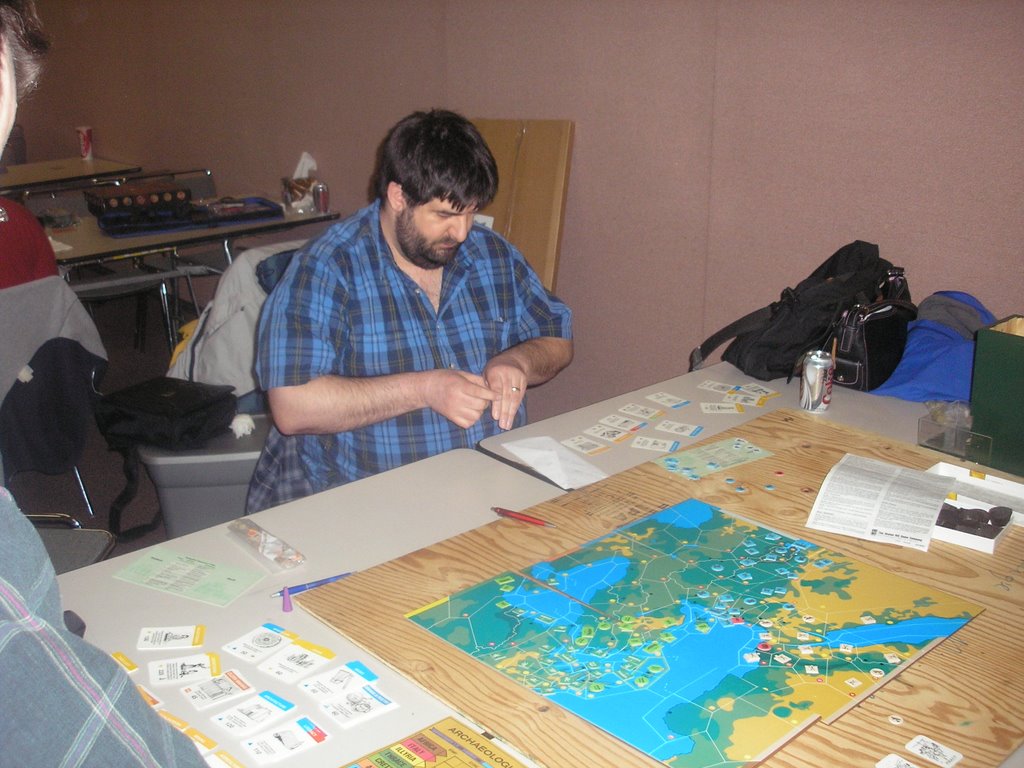
The original and Advanced versions of Civilization continue to keep their rightful place at the top of the heap among long empire building games. If you have never played Civ nor Advanced Civ you need to find someone with a copy, set an entire day aside and learn the game. You will be hooked.
It's not a new game, but the more I play Napoleonic Wars the more I like it. DRMs be darned. Of course I still struggle with strategy that is second nature to experienced wargamers. The frequent rulebook checks still irritate me. I know. That's just part of wargaming. Then there is the standard wargame response, "I just checked ConSim and that rule was changed last week." Arrrrrrrgh.
Living rules, my butt. It's a game. Wargamers just accept this nonsense? Try telling the guy from the IRS that the deduction in question was allowed last year, if he responds with, "the rules were changed to keep things more balanced," you would want to kick his smarmy teeth in. Have you ever had to deal with the Environmental Protection Agency? Same thing. The EPA specializes in "living rules". Living rules are a form of legal harassment. Why do we want to introduce this concept into our hobby?
Rules are rules. Rules that change when someone whines are not rules. Make a rule and stick with it. Don't change the rule to reflect popular group-think.
When did wargamers buy into this notion that if it is posted on the web it is official? If a rule is important enough to change I want a phone call. At least an e-mail. Don't post it and expect everyone to go find it. If you don't care enough about the change to give me a call, don't make the change.
Living rules as applied to wargames represent nothing more than a bunch of repressed wanna-be bureaucrats who've appointed themselves as arbiters of fairness, because nothing in life should ever be unfair.
If there is a mistake fix it. If there is simply unbalance, tweak the rules in the next edition. [/rant]
I've played a few games of Elasund, and I have come to the conclusion that it is not a very good game. There is more hosage than your typical Settlers variation, which makes the game worth trying, but play a friend's copy. Do not buy Elasund hoping your wife will like it because she likes Settlers. There is no trading. There is no player interaction.
The four phases to each turn are not intuitive. After several games I still find I need to constantly refer to the step by step chart to make it through my turn. If I don't follow the chart I forget to do something major, like place a building permit, or take my two gold. I always forget if I need two or three influence cards to perform different actions, and if the cards need to be the same color or different colors.
Elasund is a very simple game, yet it feels like Advanced Squad Leader after a couple rounds. Instead of asking "What phase is next?", "Do you get to shoot at me in that phase, or the next one?", "When do I get to rally my guys again?", like I do in ASL, I'm asking "Do I take two gold before I move a building permit?", "Did I already place a building permit?", "How many influence cards do I need to do that, again?". Shortly after it starts I find my mind wandering and wishing for the game to end, but it just won't end.
I'm holding off on pronouncing Reef Encounter good or bad. (So far it is bad.) I am intrigued enough that I want to play a few more times. (That would be an indication that it is good.) And by the way, alga? Alga? A Google search indicates that alga is the Australian Local Government Association. Is alga common usage across the pond?
Theoretically I should like Reef Encounter. Maybe if the parrot fish looked more like a parrot fish instead of a box, and there was some algae in the game...
Thursday, March 30, 2006
Anatomy of a Game: Carcassonne, Part One: The Original Game
 Carcassonne was originally released by Hans im Gluck in 2000. It won the SdJ that year, and since has become a phenomenon. There are now 4 large Carcassonne supplements, 4 small Carassonne supplements, and 5 variant games. Within our Eurogame community, only The Settlers of Catan has been more successful in sheer bulk of releases.
This week I'm beginning a series that will analyze that phenomenon--talking about how Carcassonne works and also examining how the game system has evolved over the last six years. This first installment will examine the mechanics of the original game, while in future articles I'll be talking about how the game has evolved through a series of expansions and new games.
Before we get started, if you're now familiar with the game and its supplements, you may want to look at my reviews of the same. I've fallen down on the more recent Carcassonne supplements, because I don't feel like they fit the vision of the original game (which I'll talk about in the next few articles), and I haven't bought Leo Colovini's Discovery because I don't agree with its manner of distribution, but everything else is there.
Original Carcassonne Reviews: Carcassonne w/River (B+), Inns & Cathedrals (B), Traders & Builders (A-), King & Scout (B+), The River II (C)
Carcassonne Variant Reviews: Carcassonne: Hunters and Gatherers (A), The Ark of the Covenant (A), Carcassonne: The Castle (A-), Carcassonne: The City (A)
Not Reviewed: The Count of Carcassonne, The Cathars, The Princess & The Dragon, The Tower, Carcassonne: The Discovery
Analyzing the Gameplay
Last week I provided a broad overview of terminology for analyzing gameplay. Though I'm sure I'll use it again in the future, the immediate purpose was to provide a lexicon for this article. Broadly, Carcassonne's gameplay is very simple, but I'm going to break it down part-by-part.
Components. Each player has a small set of static personal tokens which he'll use to mark ownership of terrains in the game, but which don't move once they hit the board.
The board, meanwhile, is a classic example of an evolving environment that's constructed turn-by-turn. Each of the tiles used to create this board is accessed via an arbitrary draw, which we'll get back to when we cover Luck.
Activity. The overall activity of Carcassonne is split, linearly, among three parts: play a tile; play a token (meeple); and score completed terrains. As with most games, these activities are ultimately defined by component interaction.
The first activity is best defined as environment placement: you're creating the board through your tile draws.
The placement of the meeples, meanwhile is token placement. You're moving a token on-board, and will never be able to scoot it around the environment.
Finally the scoring portion of the activity centers on token conflict. Or, to use a more common term, it's majority control. It took me a long time to see it, but Carcassonne actually falls into the same category of games as El Grande or (perhaps more clearly) Entdecker. It's about getting the most personal tokens into an environmental area to control and thus score it. Carcassonne looks a bit different because you're building out the environment as you go, and because getting multiple tokens into a terrain is actually a trick rather than a standard mechanic, but nonetheless it follows a lot of the same conventions as the broadly understood majority-control category of gameplay.
Decisions. Last week I spoke of decision constraints and the need to keep options small; Carcassonne sort of tries to follow the "rule of 7" that I suggest, which means it tries to constrain any individual decision to just 7 options, to prevent a player from becoming totally paralyzed. But, it doesn't do so perfectly, especially not for inexperienced players.
Technically when a player draws and places a tile this is largely unconstrained. The tile could go in any legal space in the board, which is usually a couple of places at the start of the game, but could be a hundred (or more) different places by mid-game. I find this a serious problem for first-time players, who don't know how to quickly analyze the best board positions, and thus take agonizingly long amounts of time to decide where their tile goes.
A more experienced player usually quickly constrains a choice to 7 or less options. First, he looks at his current on-board positions (which, as it happens, maxes at 7 tokens), and sees if the newly drawn tile may be useful to: (1) close out a position; (2) expand a position; or (3) block others from getting into his position. Alternatively the player sees if he can use the tile to create any new on-board positions, and again this is usually constrained by a couple of "best choices" at any time. Finally if and only if he can't expand, he can't close, and he can't create, then the player may use a tile solely to block other players. Each of these main categories of options is pretty individual, and a good player will usually assess which is best based on the tile, on his current positions, and on his current token supply--but a new player can't.
Technically where a player positions his token on a tile is almost always constrained to seven or less options (excepting, perhaps, some road crossroads which could give the options of four road placements and four field placements, for a grand total of 8). However in actuality there isn't good separation between the placement of a tile and a placement of a token. The one so directly affects the other that they might as well be one decision. Thus a good player figures out his token placement as part of his 7 or less options that he quickly assesses when he looks at a tile, while an inexperienced player just sees it as a multiplier to his tile-placement decision, thus meaning that all told he probably sees several hundred choices. For me this has proven a very real failing of the game when playing with a certain type of relatively serious gamer who has some problems with Analysis Paralysis and hasn't played much Carcassonne. I literally can't play with them because games take hours.
Luck. The main luck in Carcassonne is arbitrariness, which comes about through the draw of the tiles. Some people see a ton of luck in the game, but I think it's phenomenally well controlled, and that's because of the multiple tokens. You can easily set yourself up in a situation so that most draws will benefit you: one type of tile drawn might expand your city, one might build out your road, and one might keep people out of your field. The original version of the game was a bit more "lucky" than later versions, solely because roads were always less valuable than cities, and thus you could do poorly if you only drew them. This has been corrected in most later versions, and through the expansions; I'll talk about this balancing act in the next article in this series.
The remaining luckiness tends to revolve around getting a very specific tile that you need. However, I think this "luckiness" actually results from poor gameplaying. If you're waiting for one specific tile, and there aren't many of it, then you shouldn't have let yourself get into that situation (or else you should congratulate your opponent who put you there).
There is also chaos in Carcassonne, and this centers around the landscape of the game changing between your turns. As you'd expect, the chaos factor gets bigger the more players you have. In a 5-player game you can have set yourself up with a perfect, well-defended city, then have one opponent place a tile which makes you vulnerable, and have another take advantage of that, all before it can back around to you. The arbitrariness of the tile draw can also multiply the chaos, since it can sometimes be several turns before you can respond to something.
Because of the chaos factor, I think the ideal player number for Carcassonne is 3. Two really doesn't work, for reasons I'll discuss when I talk about the Carcassonne variants (in part five of this series) while with 4-6 the chaos keeps cranking up.
Victory. Finally, looking at victory conditions, we realize that the token conflict activity translates into environment control victory. The exact formulas for those environmental control valuations are a bit varied, but the basic idea is obvious: the more environment you controlled during the game, the better you'll do.
The following chart shows these various elements of Carcassonne's game design in a more graphical format. Note that the different elements are color-coordinated. Arrows represent interrelations between the parts of the game and dashed lines represent decisions.
You can click on the diagram to see a larger version.
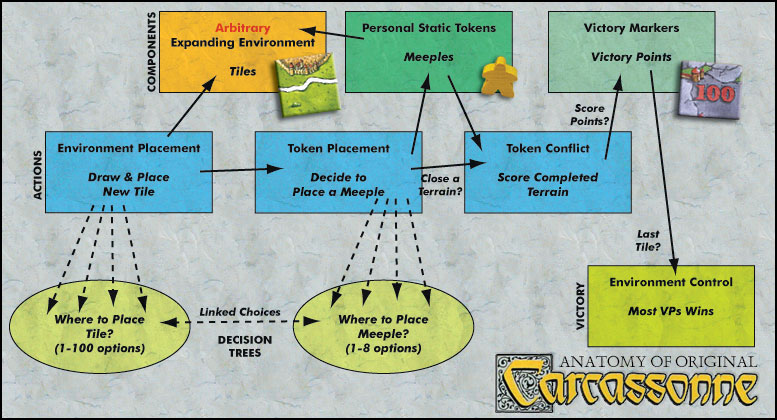
What I found particularly notable about the chart as I put it together is how simple Carcassonne really is. There's just a couple of components and just a few decision points, but the result is a very rich, replayable game.
Carcassonne Strategy
I don't really intend this to be a full strategy article, but I think it's worth looking at a few points of Carcassonne strategy to show how they illuminate the gameplay.
I already mentioned one of the most crucial bits of Carcassonne strategy, which is that you need to play a multivaried game. You have multiple tokens and you should use them to insure that every tile draw is a good one. If you've got good fields, good cities, and good roads, then tile draws will always help you out.
Much strategy comes from how precisely the tiles are laid. You have to make sure that you place tiles so that it's easy to complete your terrains, and hard to get boxed in. In addition you have to try and place your tiles so that it's hard for opponents to get into your terrains. You could probably write an entire article just on these intricacies.
A lot of the strategy of Carcassonne comes through a balance between cooperation and competition, which are elements that I'm going to talk about more two articles from now.
Cooperation means that you should try and share terrains with some of your opponents, particularly those opponents who are behind you in scoring. You'll both get points and you'll jointly earn more points than you could have individually. Inexperienced players can think that sharing a terrain with an opponent is bad, but this just isn't the case in a 3+ player game--unless the player getting into your terrain is ahead of you in scoring.
Competition means that you should try and harm your opponents, particularly those who are ahead of you in score, and particularly when you can do so without costing yourself actions. Placing a tile in such a way that it makes it harder for an opponent to close a terrain is almost always better than placing that tile somewhere out of the way, provided that your own token placement opportunities are similar in both opportunities. An experienced player will know a couple of the rarer tile types (for example "road, field, city, field", or if you prefer "a road running into a city" of which there is only one tile in what I call "classic Carcassonne") and may purposefully block a player by creating the need for that very rare tile. I'll get quite specific about tile distribution in the next article in this series.
Conclusion
Carcassonne is a very simple game system that nonetheless provides a lot of depth. However, that simplicity has also begun to change through many supplements. In my next three articles in this series I'm going to talk about Carcassonne's expansions; as we'll see, the gameplay has changed and evolved over the last five years, and if you're playing a game with all the expansions, you are playing a very different game from the original gameplay experience.
However, I don't want my portion of Gone Gaming to become the all-Carcassonne-all-the-time channel, so I'll be taking a break next week to discuss a different topic. But I'll see you in 14 to discuss game balance and tile distribution, with an emphasis on the "good" Carcassonne expansions.
Wednesday, March 29, 2006
A Game I'm Looking Forward To
Here are simple overviews of several games that I enjoy playing. How many can you name?
-Area control game where you move all the pieces in one area to an adjacent area. Scoring is done when an area is totally cut off from all other areas.
-A race game where you play a card to move ahead and move backwards to collect more cards.
-An area control game where you not only fight for control of the ever-merging areas, but also for control of the majority color in an area.
-An area control game where the areas are decided by a pawn which moves along triangular spaces.
-An area control game where you place pieces in vertical sections of the board but the areas to control pass horizontally through 3 to 5 vertical sections.
If you recognized and enjoy these games, you join me in looking forward to the English release of Leo Colovini's Mauerbauer (Masons for those who are German-language handicapped). A Colovini game always has a unique twist to it, something new to it that challenges my thought processes. I get the feeling that if games are basically mathematical, then Colovini’s games are more geometric than algebraic; more about the special awareness than the numbers. I like that since I always hated algebra. I also like that his games usually have simple rules, and I don’t mind that the themes are thinner than one-ply toilet paper.
Sunday I got to play Europa 1945-2030 for the second time when Mike brought it to game day at my request. This one is a bit more involved than most of Colovini’s games and dealing with the overlays for each country is a pain in the butt but it’s still an interesting game with area influence and a little negotiation which can result in either happy cooperation or nasty back-stabbing. I was playing a bit nasty towards the end and it jumped up a bit me hard as a result. That means instead of being the winner, I came in 3rd out of four. Still, it left me wishing to play again.
An English translation of the rules for Mauerbauer from the Hans im Gluck site can be found on the Geek. This is probably not one of his most original designs since the ability to merge 2 cities before you score reminds me of Titicaca, another game that I thoroughly enjoy. That’s alright because it sounds like there’s plenty newness here for area-control freaks like myself to love. One twist, I think, is the fact that you do not own a particular color but are trying to place pieces in order to fulfill the requirements on the cards in your hand. Also the areas will develop differently each time you play so will be a totally new challenge, a feature I've liked in other games like Trias and Fjords.
This is one of the few new games that I’m really looking forward to. That’s actually a good thing since we just bought a new truck and will have payments to make for the first time in 4 years. You know what that means: either go on a starvation diet or slow down the game-buying mania. Well…I COULD stand to lose a little weight!
Oh, in case you were stumped by my Reader’s Digest condensed version of the games above, the answers are Clans, Cartagena, Carolus Magnus, Alexandros and Meridian.
~~~~~~~~
Until next time, don’t trust King Arthur just because he’s king.
Mary
Tuesday, March 28, 2006
If - A Europoem
If you can keep your king when all about you
Are removing theirs and blaming it on you,
If you can draw red tiles when you need them
But make allowance for having no reds, too,
If you can fake frustration with your drawing,
Thereby inviting an external conflict,
Or being the attacker, choose your victim,
Carefully, to maximize what you inflict:
If you can plan-- but not make plans your master,
If you can think-- but not only on your turn;
If you can smartly strike with each disaster
And from a lost position still return;
If you can bear to watch a mighty kingdom
Broken into parts by all your foes,
Or watch the monument you sacrificed for
Taken by your enemies, with repose:
If you can make four heaps of all your vee-pees
And see them grow in equal colored counts,
And not expend a useless tile playing
For a color you don't need in your accounts;
If you deceptively can place a leader
Into a kingdom soon under attack
And lose it, thus removing several tiles
And keeping your opponent's kingdom back
From encroaching on your other leaders,
And still not think that any certain kingdom
Is every really owned by anyone;
If all the other players think you're losing,
When you know that you've already won,
And can control the end-game at your choosing,
Yours is the Tigris and Euphrates rivers,
And--which is more--you'll win the game, my son!
--Reinard Knipling
Are removing theirs and blaming it on you,
If you can draw red tiles when you need them
But make allowance for having no reds, too,
If you can fake frustration with your drawing,
Thereby inviting an external conflict,
Or being the attacker, choose your victim,
Carefully, to maximize what you inflict:
If you can plan-- but not make plans your master,
If you can think-- but not only on your turn;
If you can smartly strike with each disaster
And from a lost position still return;
If you can bear to watch a mighty kingdom
Broken into parts by all your foes,
Or watch the monument you sacrificed for
Taken by your enemies, with repose:
If you can make four heaps of all your vee-pees
And see them grow in equal colored counts,
And not expend a useless tile playing
For a color you don't need in your accounts;
If you deceptively can place a leader
Into a kingdom soon under attack
And lose it, thus removing several tiles
And keeping your opponent's kingdom back
From encroaching on your other leaders,
And still not think that any certain kingdom
Is every really owned by anyone;
If all the other players think you're losing,
When you know that you've already won,
And can control the end-game at your choosing,
Yours is the Tigris and Euphrates rivers,
And--which is more--you'll win the game, my son!
--Reinard Knipling
Sunday, March 26, 2006
OLD "habits" are 'hard' to break
 While a tiresome 'relic' from the "past" has been "resurrected" upon the "Geek" recently, and I'm talking upon that "Jack Chick" crap fest of purported "religious enlightenment" 'propaganda'. Which brings to 'mind' about IF "Patriotism" is the "last resort" of a 'scoundrel', then just WHAT is "religious fervor", or "Zealotry", considered AS in this 'manner'? I do so HOPE that there is a *Special* HELL 'reserved' for these 'folk' and their "ilk", as it would certainly seem a befitting 'place' for their 'likes'. NOW if only these "deities" would "call HOME" their 'emissaries', then the WORLD could become a much more "better place" for the remaining populace! "IMAGINE" there's NO 'religion'? I wonder IF y0u can? NO "God" to die for, a "brotherhood" of MAN! Yes, for those "people" without ANY 'qualms' about inflicting pain or misery upon others, then WHY wait for some "Supreme Being" 'justice'? I say MAKE an "example" of 'them', for any would-be OTHERS with sinister 'intentions' to mull over and consider. HAVE the 'punishment' FIT according TO the 'crime'! Then, make this ever the MORE "abhorrent" as a 'determent', and publicly displayed to boot, in order for SOME to 'learn' from the "mistakes" of another. The more "heinous", the BETTER, since just WHY should 'someone' who concocted and performed some "torture & torment" upon their 'victims' BE "treated" any better? YOU don't have the 'stomach' for such? Then allow the 'victim's' relatives to mete out "justice" instead. Many HAVE wanted to, and I don't 'blame' ANY in the least, of those who managed to for their "circumstances". Now, go and 'play' some "D&D" why doncha? oh yeah, and "Eat 'fecal matter' and DIE" there "Jack Chick", if that's your 'real name'!
ONTO "gaming" matters then, and 'props' TO my current ongoing "gaming partner" over in Belgium, Mrs "Gwen Dons", with HER as the "Invaders", of which I place here our most recent "Turn" in this then:
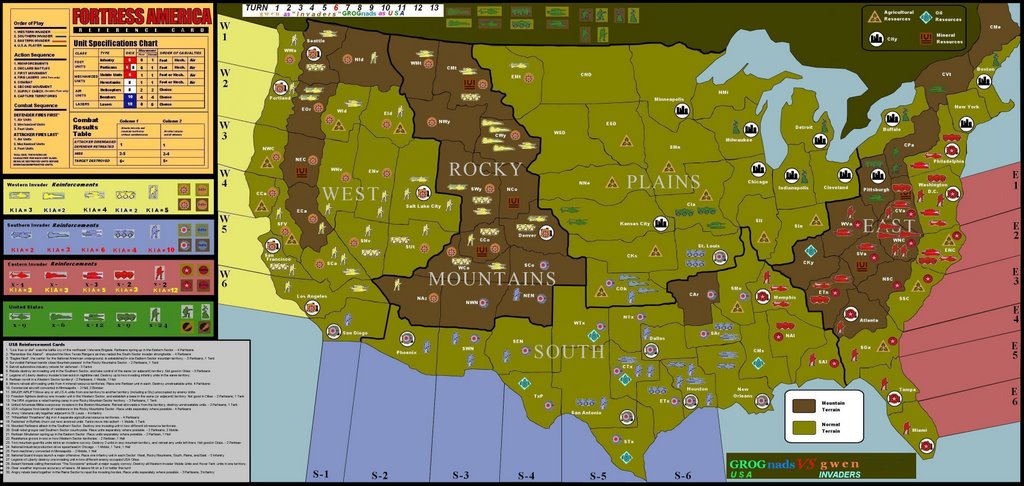 It may "look" a tad 'bleak' for the "good guys" in this here, but IT ain't 'over' until it's OVER! There is yet the "USA" Turn to conduct and for anyone wishing to follow along, then just check out my "Glog"-('Gaming Log') here:
GROG's "Glog"
while I'm going to provide the most recent "update" within that here shortly. We have been resolving the "dice rolls" WITH actual "die rollings" conducted within varying "Chat" programs for it all. Since we're NOT doing this for anything but the "fun" of it, then we completly 'trust' one another, for those who are wondering. There can become another means in which to actually "game" with one another, such as "web-cams" and the like, or those 'PbEm' methods, I have to resort to this "manner" due to my computer NOT allowing myself to 'do' otherwise. "Good Gaming" then everyone!
Saturday, March 25, 2006
“Sleep Well, darling. Don’t let the Meeples bite.”
Something a bit different this week. I hope you enjoy.
Inspired by the story of a family who read the rules of a game ("Return of the Heroes") to their kids as a bedtime story, I present three bedtime stories for gaming (or gamers') children.
How the Meeples invented Time Travel
Once upon a time there were some little Meeples. They lived in a big box on Mummy and Daddy's shelves and, when the stars were right and the children were tucked up safely in bed, they came out to play.
The little Meeples had a friend who they called Bubba. They liked to play with Bubba, but because he was the biggest and the best at counting they often sent him to the Great Scoring Track on the Other Side of the Table. Bubba liked to count, but best of all he liked to play in the Meadows with his little friends, even though he was so big that it took two of them to beat him at leapfrog.
Sometimes they built cities on the edges of the Meadows where the Meeples played. Some of the Meeples moved to the cities, and others liked to play on the roads that linked the cities together. It's never safe to play on roads, though, and those Meeples were never seen again. (You should remember that when you are out walking.) Others moved to Monasteries and surrounded themselves with wilderness (and sometimes with the wilderness of a city).
These Monastic Meeples liked to study the history of Meepledom. Especially, they liked to learn about the Olden Days, when ancient animals roamed the world. They told stories to the other Meeples of a race of prehistoric Meeples with one hand permanently raised in salute.
These prehistoric Meeples were a pre-agrarian society, and liked to hunt and fish for their food. They would forage in the jungles, and had special rituals to scare away the sabre-toothed tigers that lurked in the wide-open plains.
One day, one of the prehistoric Meeples escaped from his box and found his way into the other little Meeples' box.
The Meeples were so excited to meet him, and the Monastic Meeples wrote down all his stories. He told them fantastic stories of a King and a Count, a dragon, a princess and a fairy, and of a great Castle in a far-off land, inhabited only by Meeples of colours never seen before in the Land of the Meeples. He told them of a tower so big that it could hold all the land in the world. They told him of the Great Blue Bag from which all the land came, and of the Giants who laid it.
The little Prehistoric Meeple was so excited, he ran back to his box to tell his friends. Sadly, he went one box too far and was eaten by two dinosaurs named Jill and Fred, who we will read about in our next story.
The End.
A prehistoric love story
Once Upon a Time, there were two little dinosaurs. Their names were Bill and Fred, and they lived near the South Pole, even though they didn’t know it was the South Pole.
Bill and Fred liked to move about and explore their world. As they moved around, they made friends with some of the other dinosaurs that lived nearby. Their special friends were Susan and Jill. They liked Susan and Jill so much that they got married and decided to have some little baby dinosaurs together.
As they all got older, the world around them started to change. This was caused by continental drift, although the dinosaurs wouldn't learn about that until it was too late. Sometimes they would go to sleep on dry land and wake up in the water, swimming for their lives.
There were other groups of dinosaurs that lived nearby, but Bill and Fred and Susan and Jill (who were great-grandparents by now) were shy and didn't know how to speak to other dinosaurs, so they tried to stay with their own family. Sometimes they would graze on the same trees as other dinosaurs, but they preferred to stick together and find lovely big islands where they could roam free.
One day, Jill and Fred were drowned in a freak flood. Their children survived, though, and continued to grow and explore the wonderful world that they lived in, until one day the Earth was hit by a giant meteor and all the dinosaurs died.
Their bones lay buried for many, many years, until one day people found them and started to learn all about dinosaurs again. They found them so interesting that they wrote books about them and made models of them, and even made movies and games about them.
And so, Jill and Fred and Sue and Bill will never truly be forgotten.
The End.
My Mother was a Pirate
Once Upon a Time, Mummy was a Pirate. She liked to sail the seas in herboat ship, collecting lots of treasure by entirely legal means, because of course it would be Wrong to Steal. Daddy was a Pirate, too, and he liked to collect lots of treasure, especially if he could take it before Mummy got to it. This is called Healthy Competition and it is very good for married couples, as long as neither takes it Too Seriously.
Mummy and Daddy were both very scared of the Dread Pirates. Sometimes the Dread Pirates weren't very scary, but often they would hurt Mummy and Daddy'sboats ships and make Mummy and Daddy have to limp home to Pirates' Cove to perform essential repairs.
There were lots of islands in the seas, and Mummy and Daddy liked to visit them all. Daddy's favourite island was Tavern Island, because Daddy likes to play with cards. Mummy liked Treasure Island best of all, because she got to dig holes and hide her treasure, and mark it with special little flags.
Mummy and Daddy were very good pirates, with very powerfulboats ships. They both had very big sails, and Daddy’s had a very big hold, which is the place where you keep your treasure. Mummy had lots of crew, who are the people who work on boats ships. She kept her crew busy firing the ship's cannons at Daddy's boat ship so that Daddy would have to go to Pirate's Cove a lot. Then she would go to Treasure Island and make her crew dig holes and hide her treasure, while she drew clever maps to help her find it again.
After they had been pirates for one year, Mummy and Daddy decided to get married, so they went to Treasure Island together and dug up all their treasure and thenMummy stole it and left Daddy behind on the island they got married and lived happily ever after with their lovely daughters.
The End.
Inspired by the story of a family who read the rules of a game ("Return of the Heroes") to their kids as a bedtime story, I present three bedtime stories for gaming (or gamers') children.
How the Meeples invented Time Travel
Once upon a time there were some little Meeples. They lived in a big box on Mummy and Daddy's shelves and, when the stars were right and the children were tucked up safely in bed, they came out to play.
The little Meeples had a friend who they called Bubba. They liked to play with Bubba, but because he was the biggest and the best at counting they often sent him to the Great Scoring Track on the Other Side of the Table. Bubba liked to count, but best of all he liked to play in the Meadows with his little friends, even though he was so big that it took two of them to beat him at leapfrog.
Sometimes they built cities on the edges of the Meadows where the Meeples played. Some of the Meeples moved to the cities, and others liked to play on the roads that linked the cities together. It's never safe to play on roads, though, and those Meeples were never seen again. (You should remember that when you are out walking.) Others moved to Monasteries and surrounded themselves with wilderness (and sometimes with the wilderness of a city).
These Monastic Meeples liked to study the history of Meepledom. Especially, they liked to learn about the Olden Days, when ancient animals roamed the world. They told stories to the other Meeples of a race of prehistoric Meeples with one hand permanently raised in salute.
These prehistoric Meeples were a pre-agrarian society, and liked to hunt and fish for their food. They would forage in the jungles, and had special rituals to scare away the sabre-toothed tigers that lurked in the wide-open plains.
One day, one of the prehistoric Meeples escaped from his box and found his way into the other little Meeples' box.
The Meeples were so excited to meet him, and the Monastic Meeples wrote down all his stories. He told them fantastic stories of a King and a Count, a dragon, a princess and a fairy, and of a great Castle in a far-off land, inhabited only by Meeples of colours never seen before in the Land of the Meeples. He told them of a tower so big that it could hold all the land in the world. They told him of the Great Blue Bag from which all the land came, and of the Giants who laid it.
The little Prehistoric Meeple was so excited, he ran back to his box to tell his friends. Sadly, he went one box too far and was eaten by two dinosaurs named Jill and Fred, who we will read about in our next story.
The End.
A prehistoric love story
Once Upon a Time, there were two little dinosaurs. Their names were Bill and Fred, and they lived near the South Pole, even though they didn’t know it was the South Pole.
Bill and Fred liked to move about and explore their world. As they moved around, they made friends with some of the other dinosaurs that lived nearby. Their special friends were Susan and Jill. They liked Susan and Jill so much that they got married and decided to have some little baby dinosaurs together.
As they all got older, the world around them started to change. This was caused by continental drift, although the dinosaurs wouldn't learn about that until it was too late. Sometimes they would go to sleep on dry land and wake up in the water, swimming for their lives.
There were other groups of dinosaurs that lived nearby, but Bill and Fred and Susan and Jill (who were great-grandparents by now) were shy and didn't know how to speak to other dinosaurs, so they tried to stay with their own family. Sometimes they would graze on the same trees as other dinosaurs, but they preferred to stick together and find lovely big islands where they could roam free.
One day, Jill and Fred were drowned in a freak flood. Their children survived, though, and continued to grow and explore the wonderful world that they lived in, until one day the Earth was hit by a giant meteor and all the dinosaurs died.
Their bones lay buried for many, many years, until one day people found them and started to learn all about dinosaurs again. They found them so interesting that they wrote books about them and made models of them, and even made movies and games about them.
And so, Jill and Fred and Sue and Bill will never truly be forgotten.
The End.
My Mother was a Pirate
Once Upon a Time, Mummy was a Pirate. She liked to sail the seas in her
Mummy and Daddy were both very scared of the Dread Pirates. Sometimes the Dread Pirates weren't very scary, but often they would hurt Mummy and Daddy's
There were lots of islands in the seas, and Mummy and Daddy liked to visit them all. Daddy's favourite island was Tavern Island, because Daddy likes to play with cards. Mummy liked Treasure Island best of all, because she got to dig holes and hide her treasure, and mark it with special little flags.
Mummy and Daddy were very good pirates, with very powerful
After they had been pirates for one year, Mummy and Daddy decided to get married, so they went to Treasure Island together and dug up all their treasure and then
The End.
Friday, March 24, 2006
Be careful what you ask for. You just might get it.
Late last year I extended an invitation to Sexy Amy from Boardgamegeek to write a piece for Gone Gaming. Due to various circumstances we had to wait until March to finally coordinate, which turned out to work quite well for me. I have been rather busy this week. I was working extra shifts and preparing to attend the only game convention in Alaska, BRIMFROST, which will be held this weekend in Anchorage.
I must admit that I was duly warned. Amy told me several times that if she wrote something it might not be your typical boardgame blog. She worried that I might need to edit it for Gone Gaming, to which I replied, don't write anything you don't want me to post, 'cause I ain't gonna edit it.
Well, it isn't nearly as trashy as I had hoped, but I'm going to resist temptation, stick to my guns and not edit in any gratuitous sex and violence.
For further reading, here's Amy & Friends' boardgame site
Amy's Artifacts. It's not a blog. It's a website.
Brian
Chess and the City
Part III: The Fianchetto
I have this girlfriend. For the sake of this story, let’s call her Carrie. We grew up on the same block of one of those tree-lined streets in the Magnolia District of Burbank. One summer when we were twelve and just beginning to discover boys, our parents sent us away to chess camp. That kind of thing happens when your fathers are, respectively, an academic and a rocket scientist—even in LA.
I remember how, right in the middle of one of our chess games, Carrie leaned over the board and said, “You are really cute. And that pisses me off!” But Carrie was smarter. A few months later when our school tested our IQs, she scored a full ten points higher than me. “That pisses me off,” I told her. “Good !” she said. “Now we are even.”
OK, now skip ahead ... wait, I’m counting ... yeah, skip ahead eleven years.
Carrie is now some kind of programmer for some kind of Silicon Valley startup. When the company went public, she made a killing in the IPO and bought a million-plus house in Palo Alto—in California real-estate terms, an 1100-square-foot cottage on a busy street. Still the address is prestigious and carries just enough cachet to peg her as an up-and-comer in the coding world.
Carrie and I are now in the process of reconnecting. We meet for coffee on campus or at the local Borders. Occasionally we even play chess.
One day she calls and asks me if I can meet her that evening for drinks in Sunnyvale. I recognize the name of the place—a bar famous for its geekiness—where the next great thing—the next iPod, maybe—gets invented on the back of a paper napkin.
I get caught in traffic and arrive thirty, maybe forty, minutes late. I find Carrie playing chess at a corner table—with a guy.
“Hi,” he says. “I’m Kev.” And, oh god, this guy is gorgeous. I see that right away, even in the light from the fifteen-watt bulb that hangs above the table. He’s wearing a polo shirt that he totally fills out, and he has these dazzlingly attractive arms that he’s built up to the point that they threaten to burst out of their shirtsleeves. Apparently this Kev saw Carrie alone with a chessboard and invited himself over for a game.
As it turns out, Kev is a pretty bad chess player. When I arrive he is already down a knight and a bishop. But then, all of a sudden, Carrie starts to blunder badly. She is playing quickly, so maybe that’s an excuse, but I can’t help wondering if it has something to do with me. By the time they reach the endgame, their positions seem about equal.
Out of nowhere, Carrie announces, “I need to go to the ladies’ room. Amy, you want to come with me?”
“Look,” she says when we are down the hallway and out of sight. “He’s already given me his number. Would you mind leaving now?”
So I do.
Two days later, I’m going through my purse. I find a slip of paper with a phone number. “Call me,” it says. “Kev.”
Now any reasonable person would tear it up, right? But I don’t. “I’ll tear it up later,” I say to myself. “I’m not going to call anyway. So what’s the rush?” My god, I’m pathetic.
Later, my cell rings. It’s Carrie. “Sorry about the other night,” she says. “But Kev and I hit it off right away. I know you understand.”
Yeah, I do understand—all too well.
Women don’t play chess as well as men. Statistically. Many explanations for this have been asserted. The most common one is this: Women lack the killer instinct. Well, I can think of about half-a-dozen explanations. Lack of killer instinct isn’t one of them. Look, there are a lot of ways to kill. I prefer not to use a gun. Most women don’t. It’s way too messy.
In chess I’ve always preferred the fianchetto defenses. You, sir, open with the aggressive d4? I reply with the shy Nf6. You stake out even more territory with c4? I meekly try g6. Most of the time it doesn’t work. I get lazy or can’t figure out what to do with my bishop or end up with doubled pawns. But it’s a style that fits my personality.
When Carrie and I meet for coffee now, she usually talks about Kev. At first their relationship seems hot and heavy. For a few months, while his house is being remodeled, he even stays with her in Palo Alto. But honestly— and I see this right away—there is no spark. It takes longer for Carrie to see it.
Kev is a weak chess player, despite his biceps. And that bothers her. She laughs about it, but it is the first chink in the armor. Those little things add up.
In the meantime, I stall for time. I push a pawn here, retreat a rook there. Inevitably my cellphone rings. “Kev and I broke up,” Carrie says. She is in bad shape—crying, almost hysterical. Of course, I commiserate. We have been friends for a long time. All the way back to Burbank, all the way back, even, to chess camp.
When she hangs up, I’m surprised at how calm I feel. I cross my bedroom and open the nightstand. I pull out my copy of Modern Chess Openings. I remove the bookmark and look at it. “Call me,” it says.
I must admit that I was duly warned. Amy told me several times that if she wrote something it might not be your typical boardgame blog. She worried that I might need to edit it for Gone Gaming, to which I replied, don't write anything you don't want me to post, 'cause I ain't gonna edit it.
Well, it isn't nearly as trashy as I had hoped, but I'm going to resist temptation, stick to my guns and not edit in any gratuitous sex and violence.
For further reading, here's Amy & Friends' boardgame site
Amy's Artifacts. It's not a blog. It's a website.
Brian
Chess and the City
Part III: The Fianchetto
I have this girlfriend. For the sake of this story, let’s call her Carrie. We grew up on the same block of one of those tree-lined streets in the Magnolia District of Burbank. One summer when we were twelve and just beginning to discover boys, our parents sent us away to chess camp. That kind of thing happens when your fathers are, respectively, an academic and a rocket scientist—even in LA.
I remember how, right in the middle of one of our chess games, Carrie leaned over the board and said, “You are really cute. And that pisses me off!” But Carrie was smarter. A few months later when our school tested our IQs, she scored a full ten points higher than me. “That pisses me off,” I told her. “Good !” she said. “Now we are even.”
OK, now skip ahead ... wait, I’m counting ... yeah, skip ahead eleven years.
Carrie is now some kind of programmer for some kind of Silicon Valley startup. When the company went public, she made a killing in the IPO and bought a million-plus house in Palo Alto—in California real-estate terms, an 1100-square-foot cottage on a busy street. Still the address is prestigious and carries just enough cachet to peg her as an up-and-comer in the coding world.
Carrie and I are now in the process of reconnecting. We meet for coffee on campus or at the local Borders. Occasionally we even play chess.
One day she calls and asks me if I can meet her that evening for drinks in Sunnyvale. I recognize the name of the place—a bar famous for its geekiness—where the next great thing—the next iPod, maybe—gets invented on the back of a paper napkin.
I get caught in traffic and arrive thirty, maybe forty, minutes late. I find Carrie playing chess at a corner table—with a guy.
“Hi,” he says. “I’m Kev.” And, oh god, this guy is gorgeous. I see that right away, even in the light from the fifteen-watt bulb that hangs above the table. He’s wearing a polo shirt that he totally fills out, and he has these dazzlingly attractive arms that he’s built up to the point that they threaten to burst out of their shirtsleeves. Apparently this Kev saw Carrie alone with a chessboard and invited himself over for a game.
As it turns out, Kev is a pretty bad chess player. When I arrive he is already down a knight and a bishop. But then, all of a sudden, Carrie starts to blunder badly. She is playing quickly, so maybe that’s an excuse, but I can’t help wondering if it has something to do with me. By the time they reach the endgame, their positions seem about equal.
Out of nowhere, Carrie announces, “I need to go to the ladies’ room. Amy, you want to come with me?”
“Look,” she says when we are down the hallway and out of sight. “He’s already given me his number. Would you mind leaving now?”
So I do.
Two days later, I’m going through my purse. I find a slip of paper with a phone number. “Call me,” it says. “Kev.”
Now any reasonable person would tear it up, right? But I don’t. “I’ll tear it up later,” I say to myself. “I’m not going to call anyway. So what’s the rush?” My god, I’m pathetic.
Later, my cell rings. It’s Carrie. “Sorry about the other night,” she says. “But Kev and I hit it off right away. I know you understand.”
Yeah, I do understand—all too well.
Women don’t play chess as well as men. Statistically. Many explanations for this have been asserted. The most common one is this: Women lack the killer instinct. Well, I can think of about half-a-dozen explanations. Lack of killer instinct isn’t one of them. Look, there are a lot of ways to kill. I prefer not to use a gun. Most women don’t. It’s way too messy.
In chess I’ve always preferred the fianchetto defenses. You, sir, open with the aggressive d4? I reply with the shy Nf6. You stake out even more territory with c4? I meekly try g6. Most of the time it doesn’t work. I get lazy or can’t figure out what to do with my bishop or end up with doubled pawns. But it’s a style that fits my personality.
When Carrie and I meet for coffee now, she usually talks about Kev. At first their relationship seems hot and heavy. For a few months, while his house is being remodeled, he even stays with her in Palo Alto. But honestly— and I see this right away—there is no spark. It takes longer for Carrie to see it.
Kev is a weak chess player, despite his biceps. And that bothers her. She laughs about it, but it is the first chink in the armor. Those little things add up.
In the meantime, I stall for time. I push a pawn here, retreat a rook there. Inevitably my cellphone rings. “Kev and I broke up,” Carrie says. She is in bad shape—crying, almost hysterical. Of course, I commiserate. We have been friends for a long time. All the way back to Burbank, all the way back, even, to chess camp.
When she hangs up, I’m surprised at how calm I feel. I cross my bedroom and open the nightstand. I pull out my copy of Modern Chess Openings. I remove the bookmark and look at it. “Call me,” it says.
Subscribe to:
Posts (Atom)